Disclosure: topratedkitchenware.com is reader-supported. When you buy through links on our site, we may earn an affiliate commission from Amazon and other retailers, at no extra cost to you.
Where to buy
One pick in this guide to best professional charcoal vertical smokers is a true vertical cabinet with a verified listing link: the Dyna-Glo Wide Body Vertical Offset, listed first below. The other five are capable horizontal offset cookers reviewed in full as prose-only alternatives, without sales links or listing photos, because a horizontal barrel is not a vertical smoker and this guide will not pretend otherwise. Read the full guide ↓ for the detailed reviews, the format comparison and the buying guide before you decide which shape actually fits your cooking.
- Dyna-Glo DGO1890BDC-D Wide Body Vertical Offset Charcoal Smoker — Best True Vertical (Linked)
- Oklahoma Joe’s Highland Offset Charcoal Smoker Grill — Best Horizontal Alternative (Prose-Only)
- Oklahoma Joe’s Longhorn Offset Charcoal Smoker and Grill — Best for Crowds (Prose-Only)
- Royal Gourmet CC1830S BBQ Charcoal Grill and Offset Smoker — Best Workstation (Prose-Only)
- Oklahoma Joe’s Highland Offset Reverse Flow Smoker and Grill — Best for Even Heat (Prose-Only)
- Realcook Charcoal Grill with Offset Smoker — Best Versatile Combo (Prose-Only)
That split is the most important fact in this article, so it belongs at the top. A vertical smoker stacks its cooking grates inside a tall cabinet and feeds them from an offset firebox at the base, so heat and smoke rise through the food. A horizontal offset moves heat sideways through a barrel. Both cook with charcoal and wood smoke, both demand fire tending, and both can produce outstanding barbecue — but they load differently, they occupy patio space differently, and they reward different habits. If your heart is set on the vertical format, the Dyna-Glo is the pick to study. If you arrived here mainly wanting serious charcoal offset cooking and the format is negotiable, the five horizontal alternatives each earn their place below on their own terms.
Key Takeaways
- Only one pick here is a genuine vertical: the Dyna-Glo Wide Body Vertical Offset, and it is the linked recommendation for anyone committed to the format.
- Vertical cabinets trade a small ground footprint for stacked capacity — food loads upward in layers instead of spreading along a barrel.
- Professional, in this class, means repeatable heat, honest capacity and fire control you can run for hours, not a badge on the lid.
- The five horizontal offsets are reviewed prose-only: strong cookers, wrong shape for this keyword, and labelled as such throughout.
- Choose the format first and the model second; most disappointment in this category comes from buying the right smoker in the wrong shape.
In this guide
Quick Picks
Six picks, one vertical and five horizontal alternatives, each with a badge that is repeated in its detailed review. The linked pick carries an Amazon link here; the prose-only picks are named in plain text so the distinction stays visible at every stage of the guide.
| Pick | Badge | Format | Cooking area (per title) |
|---|---|---|---|
| Dyna-Glo DGO1890BDC-D Wide Body Vertical Offset Charcoal Smoker | Best True Vertical | Vertical offset cabinet | Not stated in title |
| Oklahoma Joe’s Highland Offset Charcoal Smoker Grill | Best Horizontal Alternative | Horizontal offset barrel | 900 sq. in. |
| Oklahoma Joe’s Longhorn Offset Charcoal Smoker and Grill | Best for Crowds | Horizontal offset barrel | 1,060 sq. in. |
| Royal Gourmet CC1830S BBQ Charcoal Grill and Offset Smoker | Best Workstation | Barrel grill with offset smoker | 783 sq. in. |
| Oklahoma Joe’s Highland Offset Reverse Flow Smoker and Grill | Best for Even Heat | Horizontal reverse flow offset | 1,093 sq. in. |
| Realcook Charcoal Grill with Offset Smoker | Best Versatile Combo | Barrel grill with offset smoker | 800 sq. in. |
How These Picks Were Chosen
The starting point was the verified pick pool for offset smokers, checked pick by pick against the one attribute this keyword cannot compromise on: a vertical cooking chamber. Titles were read literally. A pick only earned a link and a listing photo if its own verified title describes a vertical design, and exactly one pick in the pool does — the Dyna-Glo Wide Body Vertical Offset. Every other pick is a horizontal barrel or barrel combo, however good its smoking credentials, so each is reviewed prose-only with its real strengths stated plainly and its format mismatch stated just as plainly.
Beyond format, the comparison weighed stated cooking area where the title gives one, fire-control features named in the listings, work surfaces, and the kind of cooking each design genuinely suits: stacked batch cooking, long-chamber brisket work, grill-and-smoke versatility, or even-heat reverse flow. This is research-led guidance built from verified listing data and category knowledge. No hands-on testing is claimed, no prices are asserted, and each detailed review names an honest limitation, because a guide that hides the trade-offs is advertising, not advice. Readers comparing this format against the wider field should also look at Best Professional Offset Smokers to see how the professional standard is judged when shape is not the deciding factor.
The 6 Best Professional Charcoal Vertical Smokers and Their Alternatives
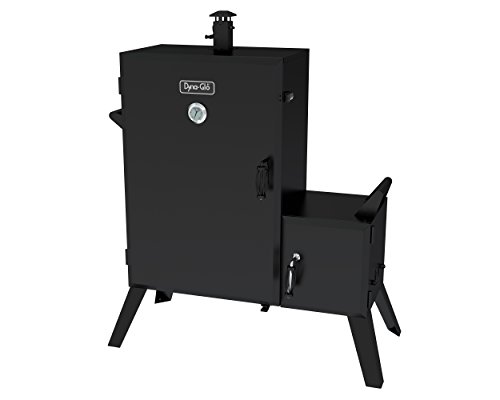
Dyna-Glo DGO1890BDC-D Wide Body Vertical Offset Charcoal Smoker
Badge: Best True Vertical
Strengths
- The only true vertical cabinet in this group: stacked grates fed by an offset firebox, exactly the format this keyword asks for.
- Wide body design gives the cabinet useful width, so larger cuts sit more naturally than in narrow tower smokers.
- Vertical loading multiplies capacity per square foot of patio, which matters on small decks and tight yards.
Trade-offs
- Heat rises, so the top and bottom grates rarely run at identical temperatures; rotation is part of the method.
- Reaching the lowest grate means working around the ones above it — loading order takes planning.
- Its listing title states no cooking area, so compare its grate dimensions rather than a headline figure.
| Specification (from listing title) | Detail |
|---|---|
| Model | DGO1890BDC-D (per listing title) |
| Format | Wide body vertical offset cabinet |
| Fuel | Charcoal |
| Finish | Black |
This is the pick the keyword is actually about. The Dyna-Glo Wide Body arranges its cooking space the way professional vertical smokers have always done it: a tall cabinet, grates stacked at intervals, and an offset firebox low at the side so the fire never sits directly under the food. Smoke and heat travel up through the cabinet, bathing each layer as they pass, which is why vertical cabinets are prized for batch cooking — ribs on one level, chicken on another, a pan of beans catching drippings below a brisket. The wide body matters more than it sounds. Slim tower smokers force awkward trimming of full briskets and long rib racks; a wider cabinet swallows them with far less surgery, and that single difference decides whether the format feels generous or cramped in weekly use.
Running it well is a learnable routine. Because heat stratifies in a cabinet, experienced vertical cooks load deliberately: items that want more heat sit lower, delicate items ride higher, and a mid-cook rotation evens out the differences instead of fighting them. The offset firebox keeps ash and flare-ups away from the food and lets you tend the fire without opening the cooking cabinet and dumping your heat — the same discipline that separates professional results from lucky ones on any offset. Its honest limitation is access: a stacked cabinet will never match a barrel for simply sliding a tray in and out, and cooks who mostly smoke one large cut at a time may find the vertical advantage wasted on them. For batch cooks, small caterers working from home and anyone whose patio footprint is the binding constraint, it is the standout design in this guide by a wide margin.
Best for: batch cooks who want stacked capacity on a small footprint / Not suited for: cooks who smoke a single large cut and rarely load more than one level
Oklahoma Joe’s Highland Offset Charcoal Smoker Grill
Badge: Best Horizontal Alternative (Prose-Only)
Strengths
- The classic horizontal offset layout in a balanced size, with 900 sq. in. of cooking area per its title.
- A long-established design language: firebox at one end, chamber alongside, chimney at the far end.
- Works as both smoker and charcoal grill, covering the two jobs most backyards actually ask for.
Trade-offs
- It is a horizontal barrel, not a vertical cabinet — the core mismatch with this keyword.
- Side-by-side layout takes considerably more patio length than a vertical footprint.
- Heat runs hotter near the firebox, so placement and rotation matter on full loads.
| Specification (from listing title) | Detail |
|---|---|
| Format | Horizontal offset charcoal smoker grill |
| Cooking area | 900 sq. in. (per listing title) |
| Fuel | Charcoal |
| Finish | Black |
Reviewed on its own terms, the Highland is the benchmark backyard offset: a horizontal barrel with the fire in a side box, 900 sq. in. of cooking area, and proportions that have made this layout the default picture most people form when they hear the words offset smoker. It grills directly over charcoal in the main chamber and smokes indirectly from the firebox, and that dual role is its real appeal. None of that makes it vertical. Its chamber spreads food along a horizontal grate at one working height, which is genuinely convenient for access — everything is visible, reachable and easy to baste — but it cannot stack a cook the way the Dyna-Glo cabinet can, and it claims a long strip of patio to do its work.
Why include it at all? Because many readers searching for professional vertical smokers are really searching for professional charcoal smoking, and the format question deserves an honest comparison rather than a forced fit. If your typical cook is one brisket, two racks of ribs and a tray of wings laid out where you can see them all, the Highland pattern serves you better than a cabinet. If your typical cook is layered — different foods at different heights in one session — it does not. This pick is therefore presented prose-only, without a link or listing photo, as the clearest statement of the horizontal alternative. Readers whose priority is even heat across a horizontal chamber should compare it with Best Reverse Flow Backyard Smokers, where the reverse flow variation on this same idea gets its own full treatment.
Best for: cooks who value single-level access and a classic offset layout / Not suited for: anyone who specifically needs stacked vertical capacity
Oklahoma Joe’s Longhorn Offset Charcoal Smoker and Grill
Badge: Best for Crowds (Prose-Only)
Strengths
- The largest horizontal chamber among the barrel alternatives here, at 1,060 sq. in. per its title.
- A long cooking chamber creates natural heat zones, from brisk near the firebox to gentle at the far end.
- Doubles as a full-size charcoal grill for direct cooking when smoking is not on the menu.
Trade-offs
- Horizontal, not vertical — it spreads capacity along a barrel instead of stacking it.
- The longest footprint in this guide; measure your patio run before falling for the capacity.
- Zoned heat is a feature only if you use it; beginners may find the gradient one more thing to learn.
| Specification (from listing title) | Detail |
|---|---|
| Format | Horizontal offset charcoal smoker and grill |
| Cooking area | 1,060 sq. in. (per listing title) |
| Fuel | Charcoal |
| Finish | Black |
The Longhorn takes the Highland formula and stretches it: 1,060 sq. in. of cooking area in a longer chamber that behaves like two climates in one cooker. Food near the firebox gets assertive heat for searing and crisping; food at the chimney end coasts in gentler smoke. Experienced offset cooks exploit that gradient deliberately, moving cuts as they cook rather than treating the whole grate as one temperature. For crowd cooking — a brisket holding at the cool end while ribs finish hot — it is a genuinely capable pattern, and as a straight charcoal grill for a big gathering it has the grate space to feed everyone without batch juggling.
Set against this keyword, though, the same honesty applies: the Longhorn is the opposite strategy to a vertical smoker. Where the Dyna-Glo climbs, the Longhorn sprawls, and the patio maths are reversed — maximum ground footprint in exchange for single-level convenience. It also asks more of the cook. A long chamber rewards attention to placement, and cooks who load it edge to edge without thinking about the gradient get uneven results they then blame on the smoker. Presented prose-only, it stands here as the crowd-capacity alternative for readers who conclude, on reflection, that horizontal room matters more to them than vertical stacking. Cooks in that camp often pair a big offset with accurate temperature monitoring, a topic covered in Best Temperature Guage For Offset Smokers.
Best for: hosts cooking for crowds who will use a long chamber’s heat zones / Not suited for: small patios or anyone set on the vertical format
Royal Gourmet CC1830S BBQ Charcoal Grill and Offset Smoker
Badge: Best Workstation (Prose-Only)
Strengths
- Front and side tables turn the cooker into a real workstation, with room for trays, tools and resting meat.
- An adjustable charcoal pan and a side door in the firebox area make fire tending more controlled.
- A lid thermometer gives a quick at-a-glance check without lifting the lid.
Trade-offs
- A horizontal barrel grill with an offset box — not a vertical cabinet by any definition.
- At 783 sq. in. it is mid-size; the largest batch cooks will outgrow it.
- Lid thermometers read lid air, not grate temperature, so a probe is still essential kit.
| Specification (from listing title) | Detail |
|---|---|
| Model | CC1830S (per listing title) |
| Cooking area | 783 sq. in. (per listing title) |
| Format | Barrel charcoal grill and offset smoker |
| Features from title | Front and side table, adjustable charcoal pan, side door, lid thermometer |
The CC1830S is built around workflow. Where many barrels leave you balancing a tray on your forearm, this Royal Gourmet surrounds the cook with surfaces: a front table, a side table, and the small civilities that decide whether a long smoke feels organised or chaotic. The adjustable charcoal pan raises and lowers the direct fire for grilling control, and the side door lets you work the fire without hoisting lids and losing the chamber’s heat — a genuinely professional habit built into a mid-size cooker. As a smoker it follows the family pattern: the offset box drives the barrel indirectly, the dampers answer quickly, and results track how attentively the fire is fed.
None of that changes its geometry. The CC1830S lays its 783 sq. in. out horizontally, at one main working level, which is comfortable and visible and entirely unlike a stacked cabinet. Cooks whose sessions are grill-heavy with regular smoking will find its balance well judged; cooks who need to load food in vertical layers for a big batch will hit its ceiling immediately. It is included prose-only as the workstation alternative — the pick for readers who discover that what they wanted from the word professional was really a cooker that helps them work like one. That same workflow lens shapes the Texas tradition discussed in Best Texas Charcoal Smokers, where fire discipline and setup matter as much as the cooker itself.
Best for: organised cooks who grill often and smoke regularly / Not suited for: batch cooks who need stacked vertical levels
Oklahoma Joe’s Highland Offset Reverse Flow Smoker and Grill
Badge: Best for Even Heat (Prose-Only)
Strengths
- Reverse flow routing sends heat under a baffle first, evening out temperatures across the chamber.
- At 1,093 sq. in. per its title, it offers the largest stated area in this guide.
- Keeps the Highland’s dual role — offset smoker plus full charcoal grill — in a calmer, more uniform package.
Trade-offs
- Horizontal reverse flow is still horizontal; there is no vertical stacking here.
- The baffle plate collects drippings and needs regular scraping to stay clean.
- Even heat removes the hot zone some cooks deliberately use for finishing and crisping.
| Specification (from listing title) | Detail |
|---|---|
| Format | Horizontal reverse flow offset charcoal smoker and grill |
| Cooking area | 1,093 sq. in. (per listing title) |
| Fuel | Charcoal |
| Finish | Black |
Reverse flow is the engineering answer to the offset smoker’s oldest complaint: one end cooks hotter than the other. On this Highland variant, smoke and heat from the firebox travel the length of the chamber beneath a baffle before rising at the far end and flowing back across the food toward the chimney. The payoff is a noticeably more even grate, which matters most on exactly the cooks a professional brief implies — full loads where every rack of ribs should finish together, not in sequence. At 1,093 sq. in. it is also the largest cooker in this lineup by stated area, with room for serious party quantities without stacking anything.
Its place in a vertical roundup is as the strongest possible counter-argument. If evenness across a single level is what you actually crave — if your frustration with offsets is the gradient, not the shape — then this design solves your real problem more directly than a cabinet does, because a cabinet trades the left-to-right gradient for a top-to-bottom one. If, on the other hand, your problem is footprint or layered batch cooking, reverse flow does nothing for you at all. Presented prose-only, it earns its badge honestly: the even-heat alternative, in the wrong shape for this keyword, and all the more useful for being labelled clearly. The full reverse flow case is made in the dedicated guide linked earlier, and the Texas offset tradition behind designs like this is explored in Best Texas Offset Smokers.
Best for: full, uniform loads that must finish together / Not suited for: anyone who needs vertical stacking or a small footprint
Realcook Charcoal Grill with Offset Smoker
Badge: Best Versatile Combo (Prose-Only)
Strengths
- A spacious barrel combo pitched squarely at gatherings: 800 sq. in. of cooking space per its title.
- Grills directly in the main chamber and smokes indirectly from the offset box, covering both weekly jobs.
- A straightforward, familiar barrel design keeps assembly and the learning curve approachable.
Trade-offs
- A horizontal barrel combo, not a vertical cabinet — the format mismatch applies in full.
- The offset box follows the mid-size pattern: fuel in chunks and short pieces, fed regularly.
- Accessory and ecosystem support is thinner than the longest-established brands offer.
| Specification (from listing title) | Detail |
|---|---|
| Format | Barrel charcoal grill with offset smoker |
| Cooking area | 800 sq. in. (per listing title) |
| Use case from title | Backyard parties and weekend barbecues |
| Fuel | Charcoal |
Realcook’s barrel combo aims squarely at the gathering brief: 800 sq. in. of cooking space, a main chamber that grills burgers and chicken directly over charcoal, and an offset firebox for when the plan turns to ribs or a shoulder. The design is deliberately uncomplicated, which keeps the learning curve short and the cooker easy to live with. In offset mode it behaves like other mid-size barrels — the firebox wants modest fuel pieces, the dampers respond quickly, and the cook who checks in regularly is rewarded with steady, clean smoke. Where it asks for compromise is around the edges: a smaller accessory ecosystem, and thermal behaviour that rewards attention on cold or windy days rather than forgiving neglect.
As the closing pick in a vertical roundup, the Realcook underlines the pattern of the whole pool: this set is rich in capable horizontal offsets and contains exactly one cabinet. Judged as a barrel, it is a rational, honestly positioned cooker for households that grill often and smoke a few times a month. Judged against the keyword, it fails the geometry test like the other four alternatives, and it is presented prose-only for exactly that reason. Readers who decide the barrel route is right for them will find its combination of size, simplicity and dual role easy to justify; readers who need the cabinet should stay with the Dyna-Glo and the checklist that follows.
Best for: hosts who grill and smoke for gatherings in one straightforward barrel / Not suited for: anyone shopping specifically for a vertical cabinet
Comparison Table
One view of all six: format first, because format is the decision this keyword turns on, then stated area and the badge each pick earned. Only the linked pick carries a listing link; the prose-only rows say so plainly.
| Pick | Format | Cooking area (per title) | Badge | Listing |
|---|---|---|---|---|
| Dyna-Glo DGO1890BDC-D Wide Body Vertical Offset Charcoal Smoker | Vertical offset cabinet | Not stated in title | Best True Vertical | Check on Amazon |
| Oklahoma Joe’s Highland Offset Charcoal Smoker Grill | Horizontal offset barrel | 900 sq. in. | Best Horizontal Alternative | Prose-only review |
| Oklahoma Joe’s Longhorn Offset Charcoal Smoker and Grill | Horizontal offset barrel | 1,060 sq. in. | Best for Crowds | Prose-only review |
| Royal Gourmet CC1830S BBQ Charcoal Grill and Offset Smoker | Barrel grill with offset smoker | 783 sq. in. | Best Workstation | Prose-only review |
| Oklahoma Joe’s Highland Offset Reverse Flow Smoker and Grill | Horizontal reverse flow offset | 1,093 sq. in. | Best for Even Heat | Prose-only review |
| Realcook Charcoal Grill with Offset Smoker | Barrel grill with offset smoker | 800 sq. in. | Best Versatile Combo | Prose-only review |
How to Choose Between the Best Professional Charcoal Vertical Smokers and a Horizontal Offset
Start with the fire, because every decision in this category flows from it. An offset smoker cooks with indirect heat: the fire lives in a separate firebox, and hot air and smoke are drawn across the food by the chimney’s draft. That separation is the whole point — no flare-ups, no direct scorching, and smoke that bathes food for hours. It also means the cook manages two things at once, the fire and the food, and the designs in this guide differ mainly in how the food side of that bargain is arranged: stacked in a cabinet, or spread along a barrel.
Footprint is the vertical format’s first argument, and it is a strong one. A cabinet claims roughly the ground space of its base and grows upward, so a cooker that feeds a crowd can stand on a small deck, a narrow side yard or a balcony with safe clearances where a long barrel simply cannot fit. Measure your space honestly, including the room you need to stand, open doors and tend the firebox, then compare shapes. If the only cookers that fit your space are vertical, the format question answers itself.
Capacity works differently in the two shapes, and headline areas mislead if you compare them naively. A barrel’s area is one main level: everything visible, everything reachable, but nothing stacked. A cabinet’s capacity is the sum of its levels, and it only counts if the spacing between grates fits the food you cook — a tall brisket or a beer-can chicken needs headroom that closely spaced grates cannot give. Count your real cooks in cuts, not in square inches: how many rib racks, shoulders or chickens, at once, in a typical big session? Then check that the levels or the barrel can hold that load with airflow gaps around each piece.
Heat behaviour is the second argument, and here neither shape wins outright. Cabinets stratify: lower levels run hotter, upper levels gentler, and the technique is rotation — moving food between levels on a schedule. Barrels gradient: hotter near the firebox, gentler near the chimney, and the technique is placement and zoning. Reverse flow barrels flatten their gradient with a baffle, at the cost of a plate to maintain. Choose the behaviour you would rather manage, because you will manage it on every single cook.
The word professional should be tested, not trusted. In practice it means a duty cycle: doors that seat cleanly and leak little, grates that carry heavy loads without flexing, an ash path you can clear quickly between back-to-back cooks, and a firebox sized so the fire needs feeding on a schedule you can keep for hours. Apply that test to any candidate, including the linked Dyna-Glo, and to the wider field covered in Best Replacement Thermometer For Offset Smokers, where accurate grate-level measurement is treated as part of the same professional standard — because a cooker you cannot measure is a cooker you cannot run repeatably.
Finally, budget for the system around the cooker. A dual-probe thermometer, a charcoal basket, a fitted cover, seasoned hardwood and consistent charcoal are not decorative extras; they are the difference between the cooker as listed and the cooker as it performs in your weather, on your patio, with your fuel. The most common regret in this category is not choosing the wrong model — it is choosing the right model and none of the kit that makes it perform.
How to Run a Vertical Offset Smoker, Cook by Cook
The vertical routine begins before any food appears. Clear the firebox of old ash, lay a charcoal bed in a basket if you use one, and light it in a chimney starter so no chemical taint reaches the cabinet. While the cabinet preheats with its vents open, decide your loading plan: which items ride low where the heat is strongest, which ride high, and which will swap places midway. That plan, made once with a cool head, is worth more than any adjustment made later with a hot one.
Load with the door open for as short a time as you can manage. A cabinet dumps its heat quickly when opened wide, so work in a deliberate order — pans and trays staged beside you, probes ready, water pan filled if you use one. Set grate-level probes at the levels you are actually cooking on, not just at the lid, because in a stratified cabinet the lid reading can describe a level no food occupies. Then close the door and let the fire, not your curiosity, do the work for the first stretch.
Through the cook, manage the fire in small moves. Add fuel before the temperature curve bends, not after; adjust the intake in small steps and wait for the response; and rotate food between levels on the schedule your loading plan set. When you do open the cabinet, combine jobs — rotate, spritz, check, close — rather than opening three times for three tasks. Near the end, rest meat properly before slicing: a brisket or shoulder rested in a warm, still place finishes more tender than one rushed to the board, and the rest also frees the cabinet for a final side dish if the meal needs one.
After the cook, the routine closes the loop. Let the fire burn down safely, remove ash once it is fully cold, brush the grates while the cabinet still holds some warmth, and wipe rather than scour the interior so its seasoned finish keeps building. That finish — a thin, dark layer laid down by smoke and heat — protects the steel better than any paint, and it is earned one cook at a time.
Troubleshooting
Problem: The top level lags far behind the bottom → what to do: This is stratification, not failure. Rotate the loads between levels, check that upper grates are not packed so tightly that rising heat cannot pass, and give the lagging items the lower position for the remainder of the cook.
Problem: Temperature keeps climbing past target → what to do: Close the firebox intake a small step, confirm wind is not forcing extra draft through the firebox, and let the charcoal bed burn down rather than adding fuel. Never choke the exhaust fully, because stale smoke will punish the food.
Problem: Smoke runs thick, white and bitter-smelling → what to do: The fire is smouldering. Open the intake, add a smaller, hotter fuel piece rather than a large cold one, and wait for the exhaust to run thin and pale before trusting the cook again.
What Professional Really Means on a Charcoal Smoker
Professional is the most abused word in this category, so it deserves a plain definition before it is allowed to sell anyone anything. On a charcoal smoker it cannot mean electronics, because the best offsets have none. It cannot mean size alone, because an oversized thin cooker is worse than a compact sound one. What it can honestly mean is repeatability under load: the same fire producing the same grate temperatures, cook after cook, for hours at a time, with a workload the cook can actually sustain.
That repeatability rests on unglamorous details. Doors and lids that seat cleanly leak less heat and smoke, so the fire’s behaviour stays predictable. A firebox that can be fed and cleared without dismantling the cook keeps the schedule humane. Grates that carry a full load of shoulders without flexing keep airflow as designed. None of these details photograph well, and all of them matter more than any headline feature — which is why this guide’s reviews keep returning to them.
There is also a professional workflow, and it transfers between formats. Mise en place beside the cooker. Probes placed before the door closes. Fuel staged, dry and sized. A written or memorised rotation plan for a cabinet, a zoning plan for a barrel. The cooks who produce consistently excellent barbecue from modest equipment almost always share that workflow, and the cooks who struggle with excellent equipment almost always lack it. Buy the cooker that fits your format decision, then invest your real effort in the workflow.
Vertical Cabinets and Texas Tradition: Two Answers to the Same Fire
It surprises some readers that the vertical cabinet and the Texas horizontal offset are cousins rather than rivals. Both were answers to the same problem — how to cook tough cuts slowly in wood smoke without burning them — worked out by cooks with different spaces, different materials and different habits. The cabinet tradition grew where space was tight and batches were stacked; the Texas tradition, explored in the guides linked earlier, grew around long chambers, post oak fires and brisket as the defining cut.
Understanding that kinship makes the format choice calmer. You are not choosing between a right and a wrong technology; you are choosing which set of techniques you want to practise. Cabinet cooks become rotation experts. Barrel cooks become zoning experts. Both become fire experts first, because in either shape the fire is the engine and everything else is steering. A reader who grasps that will read any smoker guide — including this one — with better questions: not which cooker is best, but which cooker’s demands match the cook they intend to become.
Practically, the traditions also share a fuel lesson. Consistent charcoal for the bed, seasoned hardwood for the smoke, pieces sized to the firebox, and patience with the preheat. Master those four things and either format in this guide will feed a crowd memorably. Neglect them and neither will save the cook.
Seasoning and Caring for a Vertical Cabinet
A new cabinet deserves one careful afternoon before its first real cook. Wipe the interior down, coat the inner surfaces and grates with a thin film of high-heat cooking oil, and run a moderate charcoal fire for a couple of hours with the vents open. The oil polymerises in the heat into a hard, dark seasoning — the same protective finish that makes cast iron cookware resilient — and that layer is the cabinet’s first defence against rust and its first step toward the even, smoke-friendly interior that seasoned cookers develop. Cook something forgiving for the first session, fatty and undemanding, and let the cabinet learn its own behaviour while you learn its dampers.
After that, care is rhythm rather than project. Ash leaves the firebox once it is cold, every cook, because ash holds moisture against the steel exactly where the heat has stressed it most. Grates get a hot brush-down while the cabinet still holds warmth, and the interior gets wiped, not scoured, so the seasoned finish keeps building instead of being stripped back to bare metal. Grease that collects low in the cabinet should be cleared before it can pool and flare; a cabinet’s vertical path means drippings travel downward toward the fire, and managing that path is part of the format’s craft.
Shelter completes the routine. A fitted cover, ground that drains, and protection for the top vent in wet weather keep water out of a chamber that is, by design, a chimney. Check door fit and fasteners when the seasons change, keep charcoal and wood dry indoors, and the cabinet will light the same way in its fourth year as in its first month. None of this is expensive, and all of it together is worth more to the cooker’s working life than any single feature difference between the models in this guide.
Common Buying Mistakes
- Trusting a headline that calls a barrel vertical — check the geometry, not the adjectives, before anything else.
- Reading professional as a look rather than a duty cycle of construction, fit and ash handling.
- Comparing a cabinet’s stacked capacity directly with a barrel’s single-level area as if they were the same kind of space.
- Buying a horizontal alternative to solve a footprint problem it cannot solve, or a cabinet for single-cut cooks that never use its levels.
- Ignoring grate spacing in a cabinet: levels that cannot fit your food turn headline capacity into fiction.
- Skipping the support kit — probes, basket, cover and dry fuel — and then blaming the cooker for the results.
Final Recommendation
For the reader this keyword describes — someone who wants a professional charcoal vertical smoker — the recommendation is the Dyna-Glo DGO1890BDC-D Wide Body Vertical Offset Charcoal Smoker: the one true cabinet in this guide, with the wide body that makes the format practical and the offset firebox that makes it a genuine offset rather than a tower with a fire in its base. Check on Amazon for its current listing details, load it with a rotation plan, and it will do the stacked, small-footprint batch cooking that no barrel here can imitate.
Choose differently only for a stated reason. If evenness across one level is your real priority, the reverse flow Highland reviewed above is the stronger tool and the vertical word was never your true requirement. If crowd capacity on one level is the priority, the Longhorn pattern answers it. If workflow furniture matters most, the Royal Gourmet workstation earns its look. What you should not do is buy any of those alternatives while still calling the purchase a vertical smoker — decide which problem you are solving, then let the format follow.
Frequently Asked Questions
Which pick in this guide is actually a vertical smoker?
Only the Dyna-Glo DGO1890BDC-D Wide Body Vertical Offset. Its title states the vertical offset format, and it is the only pick linked here. The other five are horizontal barrels or barrel combos, reviewed in full as prose-only alternatives with the mismatch stated openly.
Why are the other five picks not linked?
Because their verified titles describe horizontal designs, and the core attribute of this keyword is a vertical chamber. Under this site’s rules, a pick that misses the keyword’s core attribute is never linked or pictured; it is reviewed prose-only so readers can still judge it as an alternative.
What makes a smoker vertical?
Cabinet geometry: stacked grates at multiple heights inside an upright chamber, with heat and smoke entering low — ideally from an offset firebox — and rising through the levels. A horizontal barrel with one main grate level is not vertical, regardless of marketing language.
Is a vertical smoker harder to run than a barrel offset?
Different rather than harder. Cabinets stratify heat, so rotation between levels is the core skill; barrels gradient heat from the firebox end, so placement and zoning are the core skills. Both run on the same fire craft: a consistent charcoal bed, seasoned wood for smoke, and probes at the level the food actually occupies.
How much patio space does a vertical smoker save?
Substantially, because capacity grows upward from a compact base instead of along a long chamber. You still need safe clearance around the cabinet, room to open its doors, and space to stand and tend the firebox — measure all of that, not just the base, before buying.
What should I check first when comparing vertical cabinets?
Grate levels and the spacing between them, since your tallest regular food must fit per level; then door fit, firebox separation, and how quickly ash can be cleared. A cabinet whose levels cannot fit your cooks has less real capacity than its footprint suggests.
Can a horizontal offset do the same job as a vertical?
It can cook the same foods with the same fuel and often similar total capacity, but with different technique — zoning along a grate instead of rotating between levels — and a larger footprint for the same load. Whether that trade suits you depends on your patio, your menu and which skill you would rather practise.


