Disclosure: topratedkitchenware.com is reader-supported. When you buy through links on our site, we may earn an affiliate commission from Amazon and other retailers, at no extra cost to you.
Where to buy
All six models below are verified portable toilets suited to tent camping, and all six carry Amazon links. The pool contains one flush cassette toilet with a detachable tank, three folding or retractable designs, a simple bucket portable, and a rigid steel commode for users who need published strength.
- Camco Portable RV Toilet with Detachable Tank, 5.3 Gallon — Check on Amazon for the current configuration and availability
- Sckee Camping Toilet, Portable Travel Folding Toilet
- Ann Katy Upgrade XL Portable Toilet for Adults
- imodomio Retractable Portable Toilet
- Zinyeme Portable Toilet for Camping
- Drive Medical Folding Bedside Commode
Read the full guide ↓ for the ranking logic, the honest limitations of every pick, and the tent-specific siting rules that keep a portable toilet comfortable, stable and odour-free under canvas.
The best tent camping portable toilets are chosen for a room that is not a room. A tent porch or privacy tent gives a portable toilet its walls, but the floor is grass or a groundsheet, the light after dark is a lantern, the users arrive in socks and sleeping clothes, and the whole arrangement must pack into the same car as the tent it serves. A portable toilet that thrives in a garage or a boat cabin can still fail under canvas if it rocks on soft ground, traps odour in still air, or asks for a rinsing routine the site cannot support.
This guide therefore ranks six verified designs by tent criteria first: stability on real ground, sealing and lid discipline for odour control in an enclosed porch, packed shape against the tent’s own bulk, and an emptying routine a campsite can actually absorb. The pool divides into a flush cassette for settled tent camps, folding and retractable seats for travelling tent campers, a bucket for sheer readiness, and a rigid commode for the camper whose strength requirement outranks every other consideration. Campers whose tent is pitched beside a trailer rather than a car will find the storage side of the same questions continued under Best Toilets For Travel Trailers, and those comparing against the wider camping category can cross-check under Best Toilets For Camping.
Every pick was checked against the verified pool for this category on 2026-11-20, and every pick carries an Amazon link so you can check the latest price on Amazon. Spec boxes use only details from the verified listing titles — tank capacities, load figures and included features appear only where a title states them. No prices, star ratings or review counts appear anywhere in this guide.
Key Takeaways
- The Camco cassette leads for tent camps that stay put: a 5.3-gallon detachable tank, a sealing slide valve and a bellows-type flush give the most fixture-like routine in the pool.
- The Sckee folding toilet is the tent traveller’s pattern — a lidded folder with a paper holder, titled for car, camp, truck, RV and beach duty.
- The Ann Katy XL and the imodomio retractable cover the family and pack-size cases: an extra-large lidded seat, and an adjustable-height body that retracts for the car.
- The Zinyeme bucket is the always-ready second toilet for the porch, the children and the emergency.
- The Drive Medical commode is the strength pick — the pool’s only published load figure, up to 350 pounds, on a rigid folding frame — for the camper whose safety requirement decides the purchase.
In this guide
Quick Picks
| Pick | Badge | Type | Link |
|---|---|---|---|
| Camco Portable RV Toilet, 5.3 Gallon | Best Overall | Cassette, detachable tank, bellows flush | Check on Amazon |
| Sckee Camping Toilet | Best Folding Tent Pick | Folding, with lid and paper holder | Check on Amazon |
| Ann Katy Upgrade XL Portable Toilet | Best XL Family Pick | Extra-large, lightweight and compact | Check on Amazon |
| imodomio Retractable Portable Toilet | Best Pack-Down Design | Retractable, adjustable height | Check on Amazon |
| Zinyeme Portable Toilet for Camping | Best Simple All-Rounder | Bucket-style portable commode | Check on Amazon |
| Drive Medical Folding Bedside Commode | Best Weight Capacity | Folding commode, bucket included | Check on Amazon |
Choose by where the toilet will stand and how long the camp will last; the ranking inside each pattern then takes care of itself. A settled family camp and a moving two-person tour can read this same table and correctly choose different rows — the table’s job is to make the rows’ differences legible, not to crown a single winner for every tent in the country, and the reviews that follow are written to keep that legibility honest.
How These Picks Were Chosen
This guide is research-led and claims no hands-on testing. Each candidate was assessed from its verified listing title — waste system, stated capacity, sealing features, included components and stated applications — and screened against tent camping’s specific demands. The toilet must stand stably on outdoor ground, contain waste in a sealed or sealable form suitable for an enclosed porch, pack alongside a tent and its poles without drama, and empty through a routine a campsite offers. All six picks met the standard on their titles’ evidence and are linked. Ranking then followed the tent hierarchy: sealing and flush behaviour for camps that stay, packed discipline for camps that move, seat honesty for the users named, and published strength where strength is the requirement. Where a title publishes no figure, the review says so plainly and recommends the pick for what its design — not an invented specification — supports.
The 6 Best Tent Camping Portable Toilets, Reviewed Honestly

Camco Portable RV Toilet with Detachable Tank, 5.3 Gallon
Badge: Best Overall
Strengths
- A complete flush cassette in a portable body: 5.3-gallon detachable tank, a sealing slide valve that closes the waste away between uses, and a bellows-type flush.
- Compact and lightweight design as titled, with a built-in carry handle — the cassette pattern made car-friendly.
- The sealing slide valve is the tent feature that matters most: it is the barrier between the tank and the porch air.
Trade-offs
- A full 5.3-gallon tank is a substantial carry to the disposal point; empty on the sensible side of full.
- Bellows flushing is a manual pump rhythm to learn, less instant than a plumbed flush and dependent on the user’s technique.
- It packs as a rigid unit, so the folding designs beat it when boot space is the binding constraint.
Mini spec box
- Brand: Camco
- Model reference in title: 41541
- Waste tank: 5.3 gallon, detachable
- Valve: sealing slide valve
- Flush: bellows-type flush
- Carrying: built-in carry handle
- Design: compact and lightweight as titled
- Colour: gray
Tent camping rewards the Camco’s particular combination more than any other setting in this category. The sealing slide valve closes the tank off completely between uses, which in the still air of a tent porch is the difference between a toilet that is simply present and one that is noticeable. The bellows flush rinses the bowl without any water connection — a few pumps of the hand bellows, a habit learned in a day — and the detachable tank carries to the disposal point by its built-in handle with the valve sealed. For a family tent camped a week on a serviced pitch, this is the closest the portable world comes to a bathroom routine, and it earns Best Overall on exactly that ground.
The honest costs travel with the pattern. The tank’s capacity is bought back in carrying weight at the end of each interval, so the wise routine empties early and often enough that the carry stays comfortable over site ground. The bellows technique rewards a full, confident pump and punishes a timid one with a second rinse. And the rigid body must be planned into the car’s packing rather than folded into a gap. None of these is a surprise, and all of them are stated here so the buyer meets them in print before meeting them on a pitch. For settled tent camps, no pick in this pool is more complete.
Best for: family tent camps on serviced pitches, and any tent camper who wants a flushing, sealing toilet / Not suited for: ultralight or fast-moving camps, or sites with no disposal point for cassette emptying

Sckee Camping Toilet, Portable Travel Folding Toilet
Badge: Best Folding Tent Pick
Strengths
- Folding travel format with a lid and a paper holder — the small completeness that makes a porch toilet feel equipped rather than improvised.
- Titled across car, camp, hiking, truck, RV and beach use: a traveller’s tool, not a single-setting one.
- Compact potty format that folds for the car and opens into a real seat at the pitch.
Trade-offs
- A bag-or-liner pattern: no sealed tank, so disposal follows bag rules and the sealing routine is the user’s discipline.
- No published load or capacity figures in the title; the review judges the design pattern.
- The paper holder is a porch convenience, not a weatherproof store — paper still travels in the dry kit.
Mini spec box
- Brand: Sckee
- Design: portable travel folding toilet with lid and paper holder
- Format: compact potty
- Stated application: car, camping, hiking, truck, RV, beach
The Sckee understands the tent traveller’s priorities in the right order. It folds, because the car is full. It has a lid, because a porch toilet lives in the camp’s airspace. And it carries a paper holder, a detail so small it is easy to mock and so practical that every owner who has balanced a roll on a groundsheet in the dark will recognise it as the mark of a designer who has actually camped. Titled for the whole travelling itinerary — car, truck, RV, beach and hike as well as camp — it is the pick for campers whose tent moves every few days and whose toilet must move as casually as the rest of the kit.
Its waste handling is the folder family’s: bags or liners, sealed by the user’s routine, disposed of where the rules allow. That makes it lighter and simpler than the Camco and dependent on the same discipline — seal promptly, keep the lid down, carry out properly. It will not serve a fortnight’s static camp as calmly as the cassette, and it publishes no strength figures for the user who needs them. Within its travelling pattern, though, it is the most tent-minded folder in the pool, and the one this guide would pack for a touring tent holiday without further debate.
Best for: touring tent campers who move pitches and want a lidded, equipped folding toilet / Not suited for: long static camps wanting a tank, or users needing published load figures

Ann Katy Upgrade XL Portable Toilet for Adults
Badge: Best XL Family Pick
Strengths
- Extra-large seat in a body titled lightweight and compact — family-sized comfort that still travels.
- Lidded pattern, for porch hygiene and tidier carrying between car and pitch.
- Titled for adults and kids across camping, hiking, beach, boat, emergency and RV settings.
Trade-offs
- Bag-or-liner waste handling, with no sealed tank and no published load capacity.
- XL seat generosity means a larger folded footprint than the retractable design below.
- A generalist across many settings; the cassette beats it for static camps, the retractable for packing.
Mini spec box
- Brand: Ann Katy
- Design: upgrade XL portable toilet, extra-large camping toilet
- Weight character: lightweight and compact as titled
- Seat: with lid as titled
- Users: adults and kids as titled
- Stated application: camping, hiking, beach, boat, emergency, RV
In a family tent, the toilet’s seat is a shared resource under peak demand, and the Ann Katy’s XL format is aimed squarely at that reality. A seat that fits the largest adult properly and still serves a child without acrobatics ends the quiet rationing that small portables impose — the adults deferring, the children perching — and replaces it with an ordinary facility. That it achieves the format in a body its title calls lightweight and compact is the design’s whole argument, and for car-based tent families the argument is persuasive.
The folder family’s standard cautions apply without dilution: bags or liners carry the waste, no figures are published for the buyer who needs them, and a static fortnight will expose the absence of a tank. The review also notes the honest comparison inside this pool: against the Sckee, the Ann Katy trades the paper holder and touring trim for seat size; against the imodomio, it trades packed cleverness for the same size. Families choose among those trades by their own shape, and any of the three serves a tent weekend well. The Ann Katy is the one chosen when the seat itself is the complaint being solved.
Best for: tent families for whom seat size is the deciding comfort / Not suited for: static long camps, or buyers needing a sealed tank or published strength figures

imodomio Retractable Portable Toilet
Badge: Best Pack-Down Design
Strengths
- Retractable body: collapses toward luggage dimensions, freeing the boot for the tent itself.
- Adjustable height, serving a child at one setting and an adult at another from the same unit.
- Titled for tent use explicitly, alongside camping, car, travel, boat, beach and emergency duty.
Trade-offs
- The retractable mechanism’s joints and locks need a pre-trip check and a careful, level first set-up.
- No published load capacity; the strength-first buyer has one evidence-based option in this pool, reviewed last.
- Bag-or-liner waste handling, as with all the folding designs here.
Mini spec box
- Brand: imodomio
- Design: retractable portable toilet, camping toilet
- Height: adjustable height
- Stated application: camping, car, travel, boat, beach, tent, emergency use
Tent campers feel packed size more keenly than any other portable-toilet buyers, because the tent itself is the bulkiest item in the car and everything else negotiates for the remainder. The imodomio’s retractable body is the pool’s most serious answer to that negotiation: a toilet that travels at a fraction of its working height and then, at the pitch, adjusts its height to the user — low and stable for a child, raised for an adult. Its title names the tent among its settings, and for once the naming matches the design logic exactly.
The mechanism is the consideration, and it is a small one honestly stated: retracting joints want to be opened fully, locked positively and checked before each trip, ideally once at home in daylight. Owners who keep that two-minute discipline own the pool’s best packing toilet; owners who will not keep it should buy a folder or the bucket and spend the saved attention elsewhere. Seat-height shoppers comparing across the wider market will find the low-fixture end of the subject treated fully under Best Short Height Toilets, where adjustable and low designs are the entire topic.
Best for: tent campers whose car space is the binding constraint, and families wanting one height-adjustable toilet / Not suited for: users needing published strength figures, or campers who skip pre-trip checks
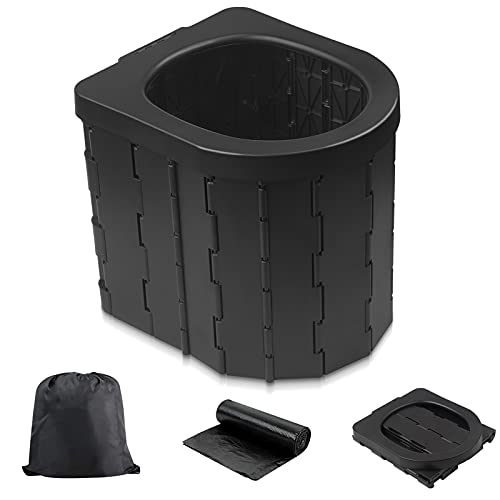
Zinyeme Portable Toilet for Camping
Badge: Best Simple All-Rounder
Strengths
- The bucket pattern at its simplest: nothing to assemble, pump or configure — the porch’s instant second toilet.
- Titled for tent use among an unusually wide range — boat, beach, car, hiking, backpack trips, traffic jam and home.
- Lines with bags for sealed carry-out, suiting both serviced sites and carry-out land.
Trade-offs
- No capacity, load or dimension figures in the title; the pattern, not a specification, is the product.
- The plainest seat in the pool — a night and emergency facility more than a fortnight’s main toilet.
- No lid or holder is claimed in the title; the user’s kit supplies the refinements.
Mini spec box
- Brand: Zinyeme
- Design: portable commode bucket toilet
- Users: adults as titled
- Stated application: camping, tent, boat, beach, car, hiking, trips, home
Every family tent camp discovers the second-toilet problem: the main facility is occupied, or across a dark porch, exactly when a child needs it now. The Zinyeme is this pool’s answer to that problem — a bucket portable so simple it can live in the sleeping tent’s porch corner as the night and emergency unit, lined, lidded by routine if not by a claimed fitting, and emptied with the morning’s main routine. Its title’s breadth, which includes the tent explicitly, reflects a tool that genuinely goes anywhere a person might need it.
As a camp’s only toilet on a long stay it is outclassed, and the review does not pretend otherwise: the Camco’s sealed tank and the folders’ real seats are better main facilities by design. The Zinyeme’s excellence is positional. It is the toilet that is there — in the car all year, in the porch all night, in the garage between trips — and in camping, as in most of outdoor life, the equipment that is there beats the equipment that is better and elsewhere.
Best for: second-toilet and night duty in a family tent, and year-round car-boot readiness / Not suited for: sole-toilet duty on long stays, or comfort-first main-facility buyers

Drive Medical Folding Bedside Commode
Badge: Best Weight Capacity
Strengths
- The pool’s only published load figure: supports up to 350 pounds, on a durable powder-coated frame that does not flex.
- Adjustable height and a folding frame, with the 7.5-quart bucket included — a complete system.
- Frame rigidity is a tent virtue too: on soft or uneven ground, a rigid commode feels planted where light folders can feel vague.
Trade-offs
- A bedside commode by design heritage, with medical styling that no tent porch will disguise.
- The bucket is small, so it serves a primary user or night duty rather than a whole family’s main facility.
- Folds like furniture, not luggage; its car space must be planned, not found.
Mini spec box
- Brand: Drive Medical
- Load: supports up to 350 lb as titled
- Frame: powder-coated, folding, adjustable height
- Bucket: 7.5 qt bucket included
- Pattern: 3-in-1 toilet solution as titled
This pick closes the guide because its case is specific, and specific cases deserve precise framing. The Drive Medical commode was designed for a bedside; it is recommended here for the tent camper whose requirement is not packed size or a flush but a seat that can be trusted completely — a larger camper, a camper with mobility limitations, anyone for whom a folding stool’s flex is a safety question rather than a comfort one. For that camper, the published 350-pound capacity and the rigid powder-coated frame are not specifications among others; they are the purchase, and no camp-styled alternative in this pool publishes anything to answer them.
The tent compromises are the familiar ones, stated once more without softening: a small bucket that wants frequent emptying, furniture-like folded dimensions, and looks that belong to a clinic. Set against a member of the party camping at all — safely, nightly, without anxiety — those compromises are trivial, and families who have made this choice for a parent or partner will recognise the arithmetic immediately. Equipment that includes people is the best equipment on the pitch, whatever shelf it was first sold from.
Best for: larger campers and anyone with mobility needs who requires a published capacity and a rigid frame / Not suited for: family main-toilet duty, or campers counting packed inches
Comparison Table
| Pick | Waste system | Packing pattern | Published figure | Tent role | Link |
|---|---|---|---|---|---|
| Camco Portable Toilet | Detachable tank, sealing slide valve | Rigid compact unit | 5.3-gallon tank | Main toilet, settled camps | Check on Amazon |
| Sckee Camping Toilet | Bag or liner with frame | Folding, with lid | Paper holder included | Touring main toilet | Check on Amazon |
| Ann Katy XL | Bag or liner with frame | Lightweight compact folder | XL seat format | Family main toilet | Check on Amazon |
| imodomio Retractable | Bag or liner with frame | Retractable | Adjustable height | Space-pressed camps | Check on Amazon |
| Zinyeme Portable Toilet | Bucket, bag-lined | Simple bucket format | None in title | Night and second toilet | Check on Amazon |
| Drive Medical Commode | Bucket, 7.5 qt included | Folding steel frame | Supports up to 350 lb | Strength and mobility needs | Check on Amazon |
Every row is a tent role before it is a product. Match the role your camp actually contains and the product follows.
How to Choose a Portable Toilet for Tent Camping
Decide where it will stand: porch, privacy tent or open pitch
The standing place decides the sealing standard you need. Inside a tent porch, still air makes sealing and lids non-negotiable — the Camco’s slide valve and the folders’ lids earn their keep there. In a separate privacy tent, the same features still help but ventilation forgives more. On an open pitch, discretion and distance do the work that walls do elsewhere. Choose the toilet for the most enclosed place it will actually be used, because odour discipline that suffices outdoors can fail under canvas.
Groundsheet protection and stability
A toilet standing on a groundsheet must not punish it. Frames should stand on their feet without point loads that threaten the sheet, and the wise camper puts a mat or a square of old carpet under any portable toilet in the porch — it protects the sheet, steadies the stance on grass, and catches the drips that every system eventually produces. Stability is also a ground question: level the stance with the mat and the pitch choice, and test with a deliberate sit before the first night. A toilet that rocks at noon will rock worse at 3 a.m.
Camp length and the emptying route
Settled camps with a disposal point can run the cassette’s calm rhythm; moving camps and bag-accepting sites suit the folders; carry-out land suits sealed bags in any frame or bucket. Walk the emptying route mentally before choosing — its distance, its surface, its lighting at the hour you will actually walk it — because that route, repeated daily, is the ownership experience of any portable toilet. The paper that travels with the system matters to the same routine: quick-dissolving paper keeps tanks emptying cleanly and bags compact, and the dedicated guidance under Best Toilet Paper For Portable Toilets is written for exactly these systems.
Users: children, guests and the camper who needs certainty
Children need height they can manage and a night route they cannot get wrong — adjustable designs and a porch bucket answer both. Guests need obvious operation; a lid, a clear routine and a light left burning spare everyone the briefing. And the camper with a strength or mobility requirement needs the one published figure in this pool and the rigid frame behind it. List the users before the features, as in every guide in this series, and the shortlist writes itself.
How to Site, Use and Clean a Tent Camping Toilet
Siting comes first and takes five deliberate minutes. Choose level ground inside the porch or privacy tent, on a protective mat, downwind of the sleeping and cooking areas, at the distance from water and neighbours that the site’s rules prescribe. Set the toilet, confirm its stance with a full sit, place the lantern or low light, and lay out the night kit — paper in its dry place, bags or liners ready, hand cleaning at hand. That small ceremony, done once on arrival, is the difference between a facility and an improvisation for the whole stay.
Use is a discipline of sealing and surfaces: bags sealed promptly, the cassette’s slide valve closed after every use, lids down always, and the mat and seat wiped as part of the evening routine rather than the morning’s emergency. Ventilate the porch when the camp is awake; still, warm air is odour’s accomplice. Cleaning at the trip’s end follows the pattern of every portable in this series — tanks rinsed at a proper disposal point and dried with seals clean, buckets washed and fully dried, frames wiped and joints checked — and storage is dry, complete and with the consumables kit restocked, so the next pitch begins with a facility rather than a project.
Troubleshooting, in the pattern that matters under canvas:
- Problem: the porch smells by the second day → audit the sealing routine before the product: valve closed every time, bags sealed promptly, lid down, and the porch ventilated whenever the camp is up and about.
- Problem: the toilet feels unstable at night → the stance, not the hour, is the issue; re-level on the mat in daylight and re-test with a deliberate sit.
- Problem: condensation and damp around the toilet area → improve porch ventilation and keep the mat between the unit and the groundsheet; warm bodies and sealed canvas make moisture that only airflow moves.
Tent Toilets and the Small Bathroom Connection
It surprises campers that the tent toilet’s lessons transfer indoors, but the constraints are cousins: a small enclosed space, users arriving in the dark, no plumbing to forgive mistakes. The households researching compact fixtures under Best Small Toilets For Small Bathroom are solving the same geometry with porcelain — fit the room, respect the users, keep the routine simple. The tent version simply adds weather and a groundsheet. Campers who master the portable discipline — sealing, siting, honest capacity — tend to become the homeowners who measure before they buy, which is perhaps the category’s most portable benefit of all.
Rain, Wind and Cold: Tent Toilets in Real Weather
A tent toilet’s brochure life is a dry evening in June; its working life includes the other weathers, and each weather tests a different part of the system. Rain tests the siting: a toilet under a porch or privacy tent stays usable, while one in the open turns every visit into a negotiation with a waterproof jacket, and the walk to it into a mud study. Wind tests the shelter and the lid discipline — a lid left open in a gusting porch scatters the light contents of the night kit and reminds everyone why the closed-lid routine exists. Cold tests the users more than the equipment: no portable toilet in this pool can freeze-damage the way a plumbed fixture can, which is one of the category’s quiet advantages, but a cold seat at dawn is a genuine deterrent to the youngest campers, and a simple fabric seat cover or the camp’s spare fleece, kept at the toilet for the purpose, removes the deterrent for almost nothing.
Weather also rewrites the emptying plan. A disposal walk that is a pleasure in sunshine becomes a chore in a storm, which argues for emptying ahead of forecast weather rather than after it — the cassette’s indicator and the bag system’s small sealed units both support a pre-emptive routine, and the campers who thrive in bad weather are invariably the ones who did the unglamorous jobs in the fair interval before it. None of this requires special equipment. It requires the guide’s recurring virtues — sealing, siting, routine — applied with the forecast in mind, and it is why experienced tent campers speak of their toilet arrangements with a satisfaction that puzzles the uninitiated: a camp whose sanitation survives the weather is a camp that survives the weather whole.
Children in the Tent Camp
Children change a tent camp’s sanitation from a convenience into a piece of safety equipment. A child who will not walk a dark site to a distant block will either hold on miserably or improvise dangerously, and neither outcome belongs in a family holiday. A portable toilet in the porch, at a height the child can manage, with a light left burning and a routine rehearsed in daylight, converts the night from an expedition into a non-event — which is the entire goal. The designs in this pool serve that goal in their different ways: adjustable heights that can be set low and stable, lidded folders a child can operate without instruction, and the humble porch bucket whose simplicity a tired six-year-old cannot defeat.
The parents’ side of the routine deserves equal honesty. A child’s toilet needs its waste handled with the same sealing discipline as the adults’, its seat wiped as part of the evening round, and its consumables — bags, liners, paper, hand cleaning — stocked at the toilet rather than in a parent’s rucksack across the tent. Children should be taught the routine as campers, not managed as problems: the seal, the lid, the hand cleaning, in that order, every time. Families who establish that in the first trip find it runs itself by the third, and the tent toilet becomes what it should be — the piece of camp infrastructure nobody thinks about, standing quietly between the children and the dark. That invisibility, purchased with five minutes of siting and a rehearsed routine, is the true product every pick in this guide is selling.
The Disposal Point: Technique and Etiquette
Every portable toilet’s story ends at a disposal point, and the manner of that ending reflects on every camper who follows. The technique is simple and worth doing deliberately. Carry the tank or the sealed bags by their handles, closed and upright. At the point, empty steadily rather than in a rush — a cassette emptied calmly rinses clean in one pass, while a hurried emptying splashes, lingers and has to be done twice. Rinse the tank or bucket with the point’s hose where one is provided, clean the seal, and leave the area cleaner than the average you found: the next camper’s first impression of the site is made standing exactly where you are standing. Bag-system waste goes only where the site directs bagged waste, never into a cassette point and never into general litter bins unless the site explicitly says so.
The etiquette extends beyond the point itself. Choose the hour with a little consideration — not the breakfast peak if it can be helped — and keep the carry discreet without being furtive; a sealed tank carried openly and unhurriedly is the most ordinary sight on a serviced site, and treating it as ordinary is what keeps it ordinary. Children old enough to help can be given the clean parts of the job — carrying the rinse kit, holding the light — because campers are made by participation in the whole of camp life, including its least glamorous chore. And when the site provides no disposal point at all, the rule is the carry-out rule from the wild-camping sections of this series: sealed, contained and taken to a proper facility, without exception or improvisation. The toilet you chose made that promise physically possible; keeping it is the camper’s half of the design.
Common Buying Mistakes
- Buying for the garden, using it under canvas. Sealing that suffices outdoors can fail in a still porch. Judge the toilet by its most enclosed workplace.
- Standing a frame straight on the groundsheet. Point loads and drips punish groundsheets. A mat underneath is part of the product, bought once and used forever.
- Skipping the daylight rehearsal. Locks, valves and bellows technique should all be learned at home, not discovered by lantern light.
- Treating the second-toilet question as indulgence. For a family tent, a simple porch bucket changes the night more than any upgrade to the main toilet.
- Ignoring the strength requirement in favour of camp styling. Where a user needs a published capacity, the commode’s figure outranks every aesthetic in this pool.
Final Recommendation
For most tent camps the Camco Portable RV Toilet is the recommendation: a sealing slide valve for porch air, a bellows flush that needs no connection, a 5.3-gallon detachable tank and a carry handle — the complete settled-camp facility in one unit, so Check on Amazon once your site’s disposal point is confirmed. Touring tent campers should take the Sckee folder, families the Ann Katy XL, pack-counters the imodomio retractable, and every family tent should consider the Zinyeme as its night bucket. Where strength decides, the Drive Medical stands alone and should be chosen without apology. The best tent camping portable toilets disappear into the camp’s routine — sealed, stable, sited with five minutes’ thought — and each of these six can disappear in exactly that way, in the role its design was honestly built for. That is the standard this category should be held to: not features counted in a listing, but nights survived without a thought — the wet night, the child’s night, the last night of a long stay — each one as unremarkable, comfortable and entirely forgettable as the quiet night at home.
Frequently Asked Questions
Can a portable toilet really be used inside a tent?
Inside the sleeping compartment, no — ventilation and spill sense both say otherwise. Inside a tent porch or a dedicated privacy tent, yes, and it is the standard arrangement this guide is written around. Site it on a protective mat, keep the sealing routine tight, ventilate the porch when the camp is awake, and the arrangement is comfortable and hygienic for the whole stay.
How do I stop a tent toilet from smelling?
Sealing is the whole answer, applied as routine: the cassette’s slide valve closed after every use, bags sealed promptly, lids down, tanks emptied before they are brim-full, and the porch ventilated daily. Odour under canvas is almost always a routine gap rather than a product failure — which is good news, because routines are free and immediate.
Will a portable toilet damage my tent groundsheet?
Not if it is sited on a mat, as this guide recommends for every design. The mat spreads frame loads, catches drips and keeps the stance steady on grass. Standing any frame directly on a groundsheet concentrates weight on its feet and invites both punctures and rocking; the mat abolishes both risks for the price of one square of old carpet carried with the kit.
Which pick suits a camper who needs a very stable seat?
The Drive Medical commode. Its rigid powder-coated frame and published capacity — up to 350 pounds as titled — make it the trustworthy seat in this pool, and its adjustable height lets the stance be set for the user’s feet to plant firmly. Its bucket is small and its styling medical, but for the camper whose requirement is certainty, those are the right trades.
Is a flush cassette worth it for a weekend tent trip?
For a single weekend, the folders usually serve as well with less to rinse; the cassette’s virtues compound across longer stays. The exception is the camper who simply wants the most bathroom-like routine available and has a disposal point on site — for that buyer the Camco’s premium in effort is small and its comfort is real. Judge by stay length first and preference second.
What light should I leave at a tent toilet?
A low, warm lantern on its dimmest setting, placed to light the path and the seat without shining into sleeping eyes. The goal is a route that can be walked half-asleep without a torch in hand — which also keeps hands free for doors, zips and the toilet’s own lid. It is the cheapest safety feature in the camp and the one most often forgotten until the first night argues for it.
How many portable toilets does a family tent camp need?
For most families, one main toilet chosen well is enough, and the case for a second is about the night rather than the day. A single cassette or XL folder in the privacy tent covers the camp’s waking hours completely. The second unit — in this pool, the simple Zinyeme bucket — earns its place only where young children, older relatives or a long dark walk to the main toilet make a porch night facility genuinely valuable. Buy the main toilet first, camp with it once, and let the actual nights of that trip vote on the second. Families who buy both on speculation often find the bucket living in the garage; families who buy it after one honest trip find it living in the porch, used nightly, and wondered at for not having been bought sooner. The sequence costs nothing and converts a guess into a measurement.


