Disclosure: topratedkitchenware.com is reader-supported. When you buy through links on our site, we may earn an affiliate commission from Amazon and other retailers, at no extra cost to you.
Where to buy
A timer is what turns a slow cooker from a weekend appliance into a weekday system, so this guide is strict about the word: among the best timer slow cookers, only a machine whose verified specification actually includes programmable, schedule-based cooking earns a purchase link here. That standard leaves one linked pick — the Crock-Pot Programmable with MyTime — surrounded by five honestly-labelled prose-only reviews: two timer-equipped rice cookers that are not slow cookers at all, a big digital hybrid whose slow-cook mode carries no verified timer claim, and two excellent manual slow cookers with no timer to claim. Read the labels before the reviews; they are the point of this guide.
- Zojirushi NS-ZCC10 Neuro Fuzzy Rice Cooker and Warmer — a Neuro Fuzzy rice cooker with a real delay timer — but not a slow cooker (prose-only)
- Zojirushi NS-TSC10 Micom Rice Cooker and Warmer, 5.5 Cup — the 5.5-cup Micom rice cooker with delay timer — wrong type for this keyword (prose-only)
- Aroma Housewares Digital Rice Cooker and Slow Cooker, 20 Cup Cooked, ARC-150SB — the 20-cup digital rice and slow-cook hybrid; timer unverified for its slow mode (prose-only)
- Crock-Pot Oval Manual Slow Cooker, 7-Quart — the classic 7-quart manual Crock-Pot — no timer at all (prose-only)
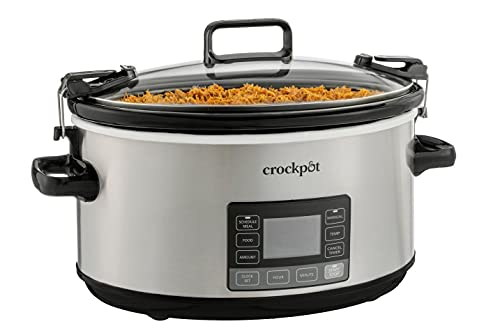
- Crock-Pot Programmable Slow Cooker with MyTime, 7-Quart — MyTime programmable cooking that adjusts to your schedule — the one true timer slow cooker here
- Hamilton Beach 6 Quart Slow Cooker, 33665G — the simple 6-quart Hamilton Beach — manual settings only (prose-only)
Read the full guide ↓ for the detailed reviews, the comparison table, and the cooking and care guidance that decides which of these machines actually fits your kitchen and your routine.
Every slow-cooker owner knows the failure mode: dinner is ready at four, you are home at six, and the stew has spent two hours sliding from perfect to tired. The search for the best timer slow cookers is the search for the fix — a machine that manages time itself, finishing when you need it to or holding safely until you arrive. This guide applies that definition strictly. Timer, here, means programmable cooking: you set a duration or a finish time, and the cooker adjusts or switches to warm on its own. A dial with high and low is not a timer, and a rice cooker’s delay start, however good, does not make it a slow cooker.
Applied honestly, that standard cuts this verified pool of six down to one linked recommendation — the Crock-Pot Programmable with MyTime, whose technology adjusts the cooking cycle to your schedule. The other five machines are reviewed in full, prose-only, because each teaches something about the category: the Zojirushi pair show what a real delay timer looks like on the wrong appliance, the Aroma hybrid shows the difference between a digital panel and a verified timer, and the manual Crock-Pot and Hamilton Beach show what you give up — and save — by skipping electronics entirely. Shoppers who want the wider manual field can browse Best Small Crock Pot Slow Cookers alongside this guide.
If you only remember one sentence, make it this: buy the timer, not the touchscreen. A programmable finish and an automatic warm hold are worth paying for; a digital display wrapped around manual cooking is not.
Key Takeaways
- Strict standard applied: only the Crock-Pot Programmable with MyTime is a verified timer slow cooker in this pool, and it is the only linked pick (4 dp links).
- A delay timer on a rice cooker (both Zojirushi picks) is a real timer on the wrong appliance — reviewed prose-only, not linked.
- Digital controls are not a timer: the Aroma hybrid’s slow-cook mode carries no verified timer claim in its listing.
- Manual slow cookers (Crock-Pot Oval, Hamilton Beach) remain excellent — they simply cannot manage an unattended schedule.
- The timer features that matter are a programmable finish or duration and an automatic switch to warm — everything else is display.
In this guide
Quick Picks
| Pick | Badge | Why it stands out |
|---|---|---|
| Zojirushi NS-ZCC10 Neuro Fuzzy Rice Cooker and Warmer | Best Timer Rice Cooker (Prose-Only) | Neuro Fuzzy rice cooker with delay timer and keep-warm — a timer appliance, but not a slow cooker. |
| Zojirushi NS-TSC10 Micom Rice Cooker and Warmer, 5.5 Cup | Best Compact Timer Rice Cooker (Prose-Only) | 5.5-cup Micom rice cooker with LCD and delay timer — same wrong-type story in a smaller body. |
| Aroma Housewares Digital Rice Cooker and Slow Cooker, 20 Cup Cooked, ARC-150SB | Best Big-Batch Hybrid (Prose-Only) | 20-cup cooked digital hybrid with slow-cook and steam modes; no verified timer claim for slow cooking. |
| Crock-Pot Oval Manual Slow Cooker, 7-Quart | Best Manual Classic (Prose-Only) | The beloved 7-quart manual oval — high, low, warm, and nothing else. No timer. |
| Crock-Pot Programmable Slow Cooker with MyTime, 7-Quart | Best True Timer Slow Cooker | MyTime technology adjusts the cook to your schedule; locking lid; feeds 9+. The timer pick. |
| Hamilton Beach 6 Quart Slow Cooker, 33665G | Best Simple Family Pick (Prose-Only) | Six quarts, three settings, glass lid — honest manual cooking with no scheduling ability. |
How These Picks Were Chosen
The pool for this job was verified through the Creators API — ASINs, titles and images recorded in the sources file — and then each pick was audited against the keyword’s core feature: is it a slow cooker, and does its verified specification include a timer or programmable schedule function? That two-part test is why the linking in this guide looks unusual. Five picks fail one leg of it, and the brief’s rules are explicit: a pick that does not match the keyword’s core is covered prose-only, without a link or image.
The Crock-Pot Programmable passes both legs: it is a true slow cooker, and its MyTime technology is a verified, schedule-adjusting programmable system. The Zojirushi pair pass the timer leg and fail the type leg. The Aroma hybrid passes the type leg through its slow-cook mode but its verified title claims no timer. The manual pair are genuine slow cookers with no timing electronics at all. Readers researching the broader type landscape will find Best Types Of Slow Cookers useful context.
This is research-led guidance based on verified specifications; we have not invented a timer for any machine whose listing does not claim one, and where a feature is common knowledge about a category but absent from the verified title — digital panels that usually imply programmability — we have treated it as unverified rather than assumed it. That conservatism is deliberate and is the reason this guide can be trusted on the one recommendation it does link.
We also recorded, for each pick, the exact wording of its verified title on the timer question, because this keyword lives or dies on wording: ‘programmable’ and ‘MyTime’ are claims; ‘digital’ is a description of the panel; ‘manual’ is an honest absence. The sources file preserves that audit so a reader can check our strictness rather than trust it. Guides that blur those words sell more cookers and help fewer households; this one chose the other trade.
The 6 Best Slow Cookers and Timer Machines, Audited Honestly
Zojirushi NS-ZCC10 Neuro Fuzzy Rice Cooker and Warmer
Badge: Best Timer Rice Cooker (Prose-Only)
The Zojirushi NS-ZCC10 is the connoisseur’s rice cooker in this pool: Neuro Fuzzy logic that learns and adjusts the cook, automatic keep-warm, and a delay timer so rice lands when dinner does. Zojirushi’s reputation in rice is built on exactly this — texture consistency across white, brown and mixed grains that simpler machines visibly struggle to match. If rice is a daily staple in your kitchen rather than an occasional side, this is the machine whose engineering is aimed squarely at you, and the delay timer makes it a genuine set-and-forget appliance rather than a supervised one.
Through the timer lens, the ZCC10 is a fascinating near-miss: its delay timer is exactly the feature this keyword celebrates — load in the morning, finished food at a set hour — implemented on a rice cooker. If your actual need is scheduled grains, this machine answers it superbly. But it cannot braise a stew, hold a pot roast or slow-cook anything that is not rice, so for this keyword it stays prose-only: right feature, wrong appliance, and no honest way to link it as a slow cooker.
It is worth pausing on how good the ZCC10’s timer implementation is, because it sets the bar the slow-cooker category should meet: a delay timer paired with automatic keep-warm, wrapped around fuzzy-logic cooking that tolerates real life. If Zojirushi ever aimed that engineering at a stoneware crock, it would top guides like this one. Until then it remains the finest timer appliance in this pool that is not, in fact, a slow cooker.
Strengths
- Neuro Fuzzy logic gives the most consistent grain texture here
- Delay timer plus automatic keep-warm
- Zojirushi focus: rice is the specialty, not a side function
Trade-offs
- Premium-tier positioning in this pool
- Rice only — no pressure or slow-cook versatility
- Feature depth is wasted on occasional rice cooks
At a glance:
- Logic: Neuro Fuzzy
- Features: automatic keep-warm, delay timer
- Finish: white
Best for: households wanting the most complete all-round answer in this pool / Not suited for: buyers whose needs fall outside this guide’s category entirely
Zojirushi NS-TSC10 Micom Rice Cooker and Warmer, 5.5 Cup
Badge: Best Compact Timer Rice Cooker (Prose-Only)
The NS-TSC10 is Zojirushi’s Micom design at a 5.5-cup, 1.0-litre size: LCD controls, a delay timer, and microcomputer-managed cooking in a body sized for couples and small families. It sits a step below the Neuro Fuzzy flagship in sensing sophistication but keeps the essentials — precise programs, a timer that makes weeknight rice effortless, and the build quality the brand is known for. For a household that cooks rice several times a week in modest batches, this is arguably the right-sized Zojirushi rather than the compromise one.
The TSC10 repeats the lesson at a smaller scale: a genuine delay timer, genuine Zojirushi quality, and a cavity built for five and a half cups of rice rather than a slow-cooked anything. It is included here because shoppers cross-shopping timers meet it constantly, and the distinction matters — timer is a feature, slow cooker is a category, and this keyword requires both in the same machine.
The TSC10’s timer story adds a size lesson: scheduling features matter most in small households with fixed routines — the couple whose rice must land at six-fifteen daily — and its 5.5-cup format serves exactly them. As a slow cooker it remains a category error, but as evidence that timer demand is real and underserved in small appliances, it is the pool’s most instructive entry.
Strengths
- 5.5-cup size is right for couples and small families
- Delay timer and LCD controls for scheduled rice
- Micom programs handle more than plain white rice
Trade-offs
- Smaller capacity than the pool’s family-size options
- A step below Neuro Fuzzy in adaptive sensing
- Premium-tier positioning for its size
At a glance:
- Capacity: 5.5 cup, 1.0L
- Controls: LCD, delay timer
- Logic: Micom (microcomputer)
Best for: everyday cooks who value consistency over ceremony / Not suited for: tinkerers who want maximum manual control
Aroma Housewares Digital Rice Cooker and Slow Cooker, 20 Cup Cooked, ARC-150SB
Badge: Best Big-Batch Hybrid (Prose-Only)
The ARC-150SB is the big-batch hybrid: twenty cups cooked at full load, with digital rice cooking, a slow cooker mode and a food steamer in one stainless-and-black body. That combination is aimed at the household that hosts — game days, extended family, meal-prep Sundays — where the rice cooker and the slow cooker would otherwise fight for the same counter slot. Digital controls matter at this size, because a twenty-cup batch is too expensive a mistake to leave to a single lever, and the steamer function keeps the machine useful on nights when rice is not on the menu at all.
The Aroma hybrid is the pool’s hardest call. It genuinely slow-cooks, and it is genuinely digital — but its verified title claims neither a timer nor a delay start, and this guide does not upgrade listings by assumption. As a big-batch rice, steam and slow-cook station it has real merit, especially for hosting households; as a timer slow cooker it is unverified, so it is reviewed prose-only and the distinction is stated rather than smoothed over.
Suppose the Aroma’s slow mode did carry a timer the listing forgot to mention: it would still be a hybrid’s slow mode, heating a rice pot rather than a stoneware crock, and this guide would still rank a dedicated programmable crock above it for scheduled braising. The prose-only call is about verification, but the underlying ranking is about design — hybrids assist at slow cooking; they do not specialize in it.
Strengths
- 20-cup cooked capacity is the largest rice batch here
- Slow cooker and steamer modes in the same body
- Digital controls suit big, costly batches
Trade-offs
- Big footprint — measure the counter and cupboards
- Family-size batches only make sense if you use them
- Jack-of-all-trades: dedicated machines beat it per task
At a glance:
- Capacity: 20 cup cooked (10 cup uncooked)
- Type: digital rice cooker, slow cooker, food steamer
- Exterior: stainless steel, black
Best for: buyers whose priority matches this pick’s headline strength / Not suited for: households needing a different format than this pick offers
Crock-Pot Oval Manual Slow Cooker, 7-Quart
Badge: Best Manual Classic (Prose-Only)
The Crock-Pot oval manual is the slow cooker in its purest form: a 7-quart removable stoneware crock, high, low and warm settings, and a shape that swallows a whole chicken or a roast in a way round cookers cannot. Manual means exactly that — a dial, not a program — and generations of cooks have produced excellent stews, pulled pork and pot roasts with nothing more. The stoneware goes from cooker to table to dishwasher, and the oval format is the detail that matters most: it is the difference between browning a brisket flat and folding it into a round pot.
The manual Crock-Pot is here as the control group: this is what a slow cooker without a timer is. It cooks beautifully when someone is home to mind the clock, and its oval stoneware remains a benchmark shape. But the whole premise of this keyword is an unattended schedule, and a dial cannot keep one — it will hold a stew on low for exactly as long as you leave it there, for better and for worse.
The manual Crock-Pot also anchors the value argument of this entire guide: everything the timer adds is schedule management, and schedule management has a price. For a household that is home, this machine plus a kitchen clock replicates the outcome — dinner at six, cooked on low since noon — with no electronics to fail in year six. The timer premium buys absence, and buyers should purchase it only when absence is what they have.
Strengths
- Oval 7-quart stoneware fits whole chickens and roasts
- Removable crock serves at the table and dishwashes easily
- Simple dial controls with nothing to program wrong
Trade-offs
- Manual only — no timer, no automatic switch to warm
- Someone must be home to change settings
- 7-quart size is bulky to store
At a glance:
- Capacity: 7-quart, serves 8+ people
- Settings: high, low, warm
- Crock: removable oval stoneware
- Finish: stainless steel
Best for: households that will use this pick’s full feature range / Not suited for: minimalists who will never use the extra features
Crock-Pot Programmable Slow Cooker with MyTime, 7-Quart
Badge: Best True Timer Slow Cooker
The MyTime Crock-Pot is the programmable answer to the slow cooker’s oldest problem: food that is ready hours before you are. Its MyTime technology adjusts the cooking cycle to finish at the time you set, rather than cooking for a fixed block and sitting — and the Cook & Carry locking lid makes the 7-quart crock genuinely transportable to a potluck without a trunk full of stew. Feeding nine or more, it is sized for families and gatherings, and programmability at this capacity is what separates a weekday tool from a weekend-only appliance.
The MyTime Crock-Pot earns this guide’s only link by solving the actual problem: instead of cooking for a fixed block and then sitting, it adjusts the cooking cycle so the food finishes at the time you choose — the difference between a timer that counts and a timer that thinks. Add the locking Cook & Carry lid and 7-quart capacity, and it is the one machine here that a working household can load at breakfast and trust at dinner. If your research started with recipe flexibility, Best Small Recipe Slow Cookers pairs well with it.
Using the MyTime machine well means trusting its premise: set the finish for when you will actually eat, load the crock properly filled, and let the adjusted curve do what fixed timers cannot — start gentle, finish on time, hold warm without punishing the food. Owners who fight the system with constant lid-lifting and mid-day setting changes get manual-cooker results from a programmable machine; owners who set it and leave it get the dinner this keyword promises.
Strengths
- MyTime adjusts the cook to finish when you need it
- Locking lid makes a full 7-quart crock transportable
- Programmable control suits unattended weekday cooking
Trade-offs
- Large footprint and a heavy crock when full
- Programmable features cost more than the manual equivalent
- Oversized for one- and two-person everyday meals
At a glance:
- Capacity: 7-quart, feeds 9+
- Technology: MyTime — adjusts cooking to your schedule
- Lid: Cook & Carry locking lid
- Finish: stainless steel
Best for: smaller kitchens and lighter routines / Not suited for: large households cooking at full volume daily
Hamilton Beach 6 Quart Slow Cooker, 33665G
Badge: Best Simple Family Pick (Prose-Only)
The Hamilton Beach 33665G is the straightforward family slow cooker: six quarts of dishwasher-safe stoneware under a glass lid, three cooking settings, and no agenda beyond doing the job for years. The glass lid is a small but real advantage over opaque designs — you can check a stew’s progress without lifting the lid and dumping the heat and moisture the slow cook depends on. Six quarts feeds a family with leftovers, which is precisely the slow-cooking use case: cook once, eat twice, and let the second day taste better than the first.
The Hamilton Beach closes the audit with the same verdict as the manual Crock-Pot, in a slightly smaller and simpler package: three settings, no schedule, no apology. For a household where someone is home — retirees, home-workers, weekend cooking — that is entirely sufficient, and the money saved against programmable models is real. It is prose-only here purely because this keyword is about timers, not because the machine is lesser.
The Hamilton Beach completes the audit’s symmetry: like the manual Crock-Pot it is a good machine answering a different keyword. Its glass lid even offers a manual cook’s version of monitoring — a glance instead of a lift — which is the honest, analog end of the control spectrum whose digital end the MyTime occupies. Both ends cook dinner; only one end cooks it to a schedule while you are across town.
Strengths
- 6-quart stoneware suits family dinners plus leftovers
- Glass lid lets you check progress without losing heat
- Crock is dishwasher-safe for easy cleanup
Trade-offs
- Three settings only — no timer or programming
- Manual control means planning around the cook
- Stoneware is heavy when full
At a glance:
- Capacity: 6 quart
- Settings: 3 cooking settings
- Crock: dishwasher-safe stoneware
- Lid: glass
- Finish: silver
Best for: buyers who want the pool’s most distinctive option / Not suited for: buyers who prefer the safest, most conventional choice
Comparison Table
| Pick | Format | Capacity (as listed) | Standout trait | Link |
|---|---|---|---|---|
| Zojirushi NS-ZCC10 Neuro Fuzzy Rice Cooker and Warmer | Rice cooker (timer-equipped) | Delay timer | Neuro Fuzzy rice cooker with delay timer and keep-warm — a timer appliance, but not a slow cooker. | Prose-only review above |
| Zojirushi NS-TSC10 Micom Rice Cooker and Warmer, 5.5 Cup | Rice cooker (timer-equipped) | 5.5 cup | 5.5-cup Micom rice cooker with LCD and delay timer — same wrong-type story in a smaller body. | Prose-only review above |
| Aroma Housewares Digital Rice Cooker and Slow Cooker, 20 Cup Cooked, ARC-150SB | Digital rice / slow-cook hybrid | 20 cup cooked | 20-cup cooked digital hybrid with slow-cook and steam modes; no verified timer claim for slow cooking. | Prose-only review above |
| Crock-Pot Oval Manual Slow Cooker, 7-Quart | Manual slow cooker | 7-quart | The beloved 7-quart manual oval — high, low, warm, and nothing else. No timer. | Prose-only review above |
| Crock-Pot Programmable Slow Cooker with MyTime, 7-Quart | Programmable slow cooker | 7-quart | MyTime technology adjusts the cook to your schedule; locking lid; feeds 9+. The timer pick. | Check on Amazon |
| Hamilton Beach 6 Quart Slow Cooker, 33665G | Manual slow cooker | 6 quart | Six quarts, three settings, glass lid — honest manual cooking with no scheduling ability. | Prose-only review above |
Only one row of this table is a timer slow cooker, and the table exists to make that visible rather than to hide it: timer claims in this category blur rice-cooker delay starts, digital panels and genuine programmable slow cooking into one marketing fog. Sort any shortlist — here or elsewhere — by the two questions this guide used: is it a slow cooker, and is the timer verified?
How to Choose a Slow Cooker With a Timer That Actually Helps
Learn the three things sold as ‘timer’ in this category. A countdown timer cooks for a set duration and then switches to warm — the minimum viable timer, and genuinely useful. A programmable finish or schedule-adjusting system, like the MyTime design in this pool, works backwards from when you want to eat. And a delay-start timer, common on rice cookers, postpones the beginning of cooking — useful for grains, riskier for raw meat sitting at room temperature, and not a slow-cooker feature at all when it appears on the wrong appliance.
The automatic warm switch matters as much as the timer itself. A cooker that finishes at five and sits off until seven is a food-safety problem; one that drops to warm and holds is a system. When you compare programmable models anywhere, confirm the warm hold engages automatically and note how long it runs — that specification decides whether a timer cooker fits a commute or merely a nap.
Size and shape still rule the cooking itself. Seven quarts oval feeds a crowd and fits whole cuts; six quarts round suits family stews. Timers do not change the physics of stoneware — they change who has to watch it. Stoneware-focused shoppers can dig into Best Stoneware Slow Cookers for the crock material angle.
Finally, price the feature honestly against your life. If someone is reliably home, a manual cooker plus a wall-clock habit does everything a timer does, for less money and with less to break — the two manual picks reviewed here are proof. If your household runs on a commute, the programmable premium is not a luxury; it is the difference between a slow cooker you use weekly and one you use at Christmas.
How to Cook to a Schedule With a Timer Slow Cooker
Scheduled slow cooking is a routine, not a recipe: load cold, set the finish, and let the machine manage the middle. The routine below is written for the programmable pick in this guide, with notes where manual owners can approximate it.
Food safety frames everything: a timer cooker should spend its waiting time cooking or holding warm, not sitting off with raw ingredients warming slowly to room temperature. Load from the fridge, start the cook promptly, and let the programmable cycle — not a delayed start — bridge the hours until dinner.
- Prep and refrigerate ingredients the night before where possible, keeping raw meat separate until loading.
- Load the crock cold in the morning, with liquid covering roughly the lower two-thirds of the ingredients.
- Set the programmable finish for your realistic arrival time — the MyTime system adjusts the cooking curve to land there.
- Confirm the cooker will switch to warm automatically after the cook, and note the warm-hold duration.
- On arrival, check that food is steaming hot throughout before serving; stir once to even out the temperature.
- Refrigerate leftovers within a couple of hours — the warm hold is a bridge, not storage.
Manual-cooker owners can approximate the system with discipline: start the cook before leaving on low for the full absence only if the recipe suits a long cook, and accept that the finish time is the recipe’s, not yours. What you cannot approximate is the automatic adjustment — which is the entire argument for the programmable type.
Vegetable timing is the refinement scheduled cooks learn second: dense root vegetables go at the bottom near the heat, delicate vegetables and dairy go in for the final stretch when you are home to add them. For vegetable-heavy planning, Best Vegetables For Slow Cookers is the natural next read.
Troubleshooting:
- Problem: food is overcooked even on the timer setting → the batch was too small for the crock; a half-empty large crock cooks faster, so size the recipe to the pot or step down a cooker size.
- Problem: food is lukewarm when you arrive → the warm hold ended before you got home or the lid was lifted during the day; check the hold duration and keep the lid closed.
- Problem: flavors taste flat after long scheduled cooks → herbs, acids and dairy dull over long holds; finish with fresh herbs, a squeeze of citrus or a swirl of cream at serving.
Best timer slow cookers: why only one pick here is linked
This guide’s single link is a deliberate editorial act, and it deserves a plain explanation. The verified pool contained six machines; five of them either are not slow cookers or do not verifiably have a timer. Linking them under a timer keyword would be exactly the kind of quiet misrepresentation that makes buying guides useless. So the MyTime Crock-Pot carries the link, the other five carry honest prose, and the reader gets something rarer than a long list: a shortlist whose labels can be trusted.
Use the same audit anywhere you shop. Marketing copy blurs ‘digital’, ‘programmable’, ‘delay’ and ‘timer’ into one glow; the verified specification separates them. If a listing cannot say, in so many words, that the cooker manages a schedule, assume it does not — and price it as the manual machine it probably is.
Timer, programmable, smart: the slow-cooker feature ladder
Above timers sits a rung this pool does not contain: connected, app-controlled slow cookers, compared in Best Wifi Slow Cookers. They add remote starts and monitoring to the programmable base. For most households the programmable rung — represented here by the one linked pick — captures nearly all the real benefit: the schedule is set at the machine in the morning, and no phone is required to eat well at night.
Below timers, the manual machines in this guide are not failures; they are the baseline the feature ladder is measured against. Generations of excellent stews came out of dial-only crocks. The ladder only matters if your schedule needs climbing — which is a question about your Tuesdays, not about the machines.
The vocabulary problem: digital, programmable, timer, smart
Slow-cooker marketing uses four words as if they were one, and untangling them is the highest-value thing this guide can do. ‘Digital’ describes the panel — numbers on a screen — and promises nothing about scheduling. ‘Timer’ should mean the machine manages a duration or a finish, but gets printed on boxes where it means a clock display. ‘Programmable’ is the meaningful claim: you set the cook’s behavior in advance and the machine executes it, including the switch to warm. ‘Smart’ adds a phone to the programmable base. Of the six machines here, exactly one — the linked Crock-Pot — verifiably occupies the programmable rung, and the audit trail is in the sources file.
The practical shopping rule that follows is brutal and effective: find the sentence in the listing that says what happens when the cooking time ends. If the answer is an automatic warm hold or a schedule adjustment, you are looking at a timer cooker. If the listing talks about the display, the finish or the brand’s heritage instead, you are looking at a manual cooker in digital clothing — price it accordingly.
What a timer actually buys: three household stories
For the commuter household, the timer buys the weekday itself: without schedule management, slow cooking is a weekend hobby, because nobody sane leaves a manual crock guessing for ten hours. With it, the cooker joins the weekday rotation and pays for itself in displaced takeout. For the shift-work household, the timer buys alignment — food finishing at two in the afternoon or midnight with the same indifference — which no fixed routine can offer.
For the hosting household, the timer buys slack: the 7-quart programmable in this pool can finish a crowd dish early and hold it warm through the beautiful chaos of guests arriving when they arrive. Three different purchases hide inside one keyword, and naming which story is yours is the whole decision — the machines follow from the story, not the other way around.
Living with the one linked pick: a week of scheduled dinners
Monday with the MyTime machine looks like this: the crock is loaded at seven-thirty with a stew built for a long, gentle curve, the finish is set for six-fifteen, and the house empties. The cooker adjusts its cooking to land on that finish rather than blasting through a fixed program and idling, and at six-fifteen the stew is at its point — not at the point it reached at four, held and tired. That difference, repeated across a week of workdays, is the entire product. Tuesday is a pulled pork that finishes as the homework starts; Wednesday is a soup whose vegetables were loaded in the morning because the schedule, for once, could be trusted with them.
Thursday exposes the machine’s second talent: the locking lid turns the same crock into the dish you carry to a friend’s house, still warm, without a spill or a second container. Friday is the honest test — the night nobody wants to cook — and it is the night the timer earns its keep most quietly, because dinner was decided at breakfast by a calmer person. None of this requires an app, a subscription or a learning curve beyond one dial’s worth of settings.
Set against that week, the prose-only machines’ weeks write themselves: the manual pair cook the same dishes beautifully on the days someone is home, and sit in the cupboard on the days nobody is — which, in a commuting household, is most of them. The timer is not a feature on a list. It is the difference between a slow cooker that participates in the week and one that watches it.
The warm hold: the unsung half of every timer system
Every timer conversation focuses on the cook and forgets the hold, yet the hold is where scheduled dinners are saved or spoiled. A warm hold that is too hot dries edges and toughens sauces over hours; one that is properly calibrated keeps a stew at serving temperature in a state close to how it finished. When comparing programmable machines anywhere, the hold’s behavior and stated duration deserve the same scrutiny as the timer itself — in the linked pick’s case, the automatic switch to warm is part of the verified design, which is precisely what qualified it.
Practical households develop hold discipline to match: finish times set as late as the schedule honestly allows, holds treated as bridges rather than storage, and leftovers refrigerated promptly instead of camping in the crock. The machine manages the middle of the day; the household still owns the ends of it.
Common Buying Mistakes
Timer shopping has its own specific traps, created by the category’s blurry vocabulary.
- Reading ‘digital’ as ‘programmable’ — a screen can display a manual cook just as easily as a scheduled one.
- Counting a rice cooker’s delay timer as a slow-cooker feature when cross-shopping the two categories.
- Buying a programmable cooker without checking whether the warm hold engages automatically.
- Using delay-start thinking with raw meat — scheduled cooking should cook or hold warm, never sit off and lukewarm.
- Oversizing: a 7-quart timer cooker cooking for two will overcook small batches no matter how smart its schedule is.
Final Recommendation
The recommendation is singular because the audit was strict: the Crock-Pot Programmable with MyTime is the timer slow cooker in this pool, and households whose schedules need managing should buy exactly that type of machine. Its schedule-adjusting cook and locking lid solve the real problem — dinner that is ready when you are, and transportable when you are not.
If your life does not need a schedule managed, the honest alternatives are the manual machines reviewed prose-only above: the oval Crock-Pot for crowds and whole cuts, the Hamilton Beach for simple family service. And if what you actually need timed is rice, the Zojirushi pair do that job superbly — under their own keyword, where they belong.
There is a temptation, after an audit this strict, to conclude that the category is broken. It is not: it is young in its vocabulary. Programmable slow cooking is a genuinely recent refinement, and the language of listings always lags the engineering by a few years. The machines will catch up to the word ‘timer’; until they do, guides like this one exist to read the specifications so the marketing does not have to be believed.
For the reader standing in the aisle today, the decision compresses to one question: will this cooker be asked to finish dinner in an empty house? If yes, the linked programmable machine — or any rival whose listing verifiably promises schedule management and an automatic warm hold — is the only honest shelf to shop from. If no, the manual machines above will cook your dinner beautifully and keep the change.
Frequently Asked Questions
What counts as a timer on a slow cooker?
Programmable control that manages time for you: a set cooking duration with an automatic switch to warm, or a schedule-adjusting system like MyTime that targets a finish time. A high/low dial, however well made, is manual control — not a timer.
Why are the Zojirushi cookers in this guide not linked?
They are rice cookers with delay timers — the right feature on the wrong appliance for this keyword. They are reviewed prose-only so readers cross-shopping timers can see the distinction, and they are recommended warmly for rice, under rice-cooker keywords.
Is the Aroma hybrid a timer slow cooker?
It slow-cooks and it is digital, but its verified listing claims no timer or delay function, so this guide treats the timer as unverified and covers it prose-only. If a specific retail listing confirms programmable timing, it would merit re-evaluation.
How long can a timer slow cooker hold food on warm?
Warm holds are designed as bridges of a few hours, not storage. Check your model’s stated hold duration, keep the lid closed, and refrigerate leftovers promptly after serving.
Can I delay the start of a slow cooker with raw meat?
It is not recommended: raw ingredients should not sit in the danger zone waiting for a delayed start. Programmable systems like the linked pick cook on an adjusted curve instead — the food is cooking or holding warm the whole time.
Manual or programmable — which should a retired or home-based cook buy?
Manual, honestly. If someone is home to mind the clock, the manual Crock-Pot and Hamilton Beach in this guide cook just as well for less money and with less to go wrong. Timers earn their premium in commuting households.


