Disclosure: topratedkitchenware.com is reader-supported. When you buy through links on our site, we may earn an affiliate commission from Amazon and other retailers, at no extra cost to you.
Where to buy
A quick note on the name: ‘trice cookers’ is a misspelling of rice cookers, and this guide is the rice cooker shortlist the search intends. Among the best trice cookers — rice cookers — in the verified pool, the six picks below split into clear camps: a balanced digital family cooker, a fuzzy-logic flagship, two simple small cookers and two Zojirushi machines for households where rice quality is a daily concern. Start with this list, then read the reviews for the capacity and logic differences that decide the right one for your kitchen.
- AROMA Digital Rice Cooker, 4-Cup Uncooked / 8-Cup Cooked, ARC-914SBD — the balanced 8-cup cooked digital family cooker
- Cosori Rice Cooker 10 Cup, Fuzzy Logic, 18-in-1 — fuzzy logic, 18 functions, delay timer and 24H keep warm
- BLACK+DECKER Rice Cooker, 6-Cup Cooked — the one-button 6-cup cooker with steaming basket
- AROMA Rice Cooker, 3-Cup Uncooked / 6-Cup Cooked, ARC-363NG — the compact 1.5 Qt AROMA for small households
- Zojirushi NS-ZCC10 Neuro Fuzzy Rice Cooker and Warmer — Neuro Fuzzy logic — the texture specialist
- Zojirushi NS-TSC10 Micom Rice Cooker and Warmer, 5.5 Cup — the 5.5-cup Micom Zojirushi with LCD and delay timer
Read the full guide ↓ for the detailed reviews, the comparison table, and the cooking and care guidance that decides which of these machines actually fits your kitchen and your routine.
Search engines are forgiving about spelling, and so is this guide: the best trice cookers are rice cookers, and the six verified machines below are the shortlist. Rice cookers look simple from the outside — a pot, a lid, a button — but inside they divide into distinct philosophies: fixed heat cycles that cook until the water is gone, digital programs tuned per grain, and fuzzy-logic systems that sense and adjust as they go. This guide ranks the pool across those philosophies so you can match a machine to how your household actually eats. If brown rice is your main grain, start with Best Small Brown Rice Cookers after this overview.
Capacity is the second divide, and the pool spans it fully: six cups cooked at the compact end, eight in the family middle, ten cups in the Cosori, and two Zojirushi sized for couples and for devotees respectively. A rice cooker is one of the few appliances where buying the wrong size punishes you twice — uneven small batches in a big pot, impossible hosting with a small one — so the reviews below lead with honest batch guidance for each machine.
Everything here was verified through the Creators API before it earned a link, and the guide is research-led: verified specifications and design, compared plainly, with no invented performance claims. What we can tell you with confidence is which machine’s logic, size and pot suit which kitchen — which is the decision that actually determines your next several years of rice.
Key Takeaways
- ‘Trice’ is a typo for ‘rice’ — this is a rice-cooker guide, and all six verified picks are rice cookers.
- Logic is the quality ladder: simple heat cycle, digital programs, then fuzzy logic (Cosori) and Neuro Fuzzy (Zojirushi) at the top.
- Capacity runs 6 to 10+ cups cooked across the pool — buy for your ordinary batch, not your biggest party.
- Timers appear where they matter: the Cosori and both Zojirushi offer delay timing for scheduled rice.
- Simple cookers (BLACK+DECKER, small AROMA) remain the right answer for small households and first kitchens.
In this guide
Quick Picks
| Pick | Badge | Why it stands out |
|---|---|---|
| AROMA Digital Rice Cooker, 4-Cup Uncooked / 8-Cup Cooked, ARC-914SBD | Best All-Rounder | The balanced family standard: 8 cups cooked, digital grain and steam programs, stainless exterior. |
| Cosori Rice Cooker 10 Cup, Fuzzy Logic, 18-in-1 | Best Featured Pick | Fuzzy logic with 18 functions, ceramic-coated pot, delay timer and a stainless steamer basket. |
| BLACK+DECKER Rice Cooker, 6-Cup Cooked | Best Simple Pick | One-button simplicity with a steaming basket included — the teach-anyone cooker. |
| AROMA Rice Cooker, 3-Cup Uncooked / 6-Cup Cooked, ARC-363NG | Best for Small Households | The 1.5 Qt compact for singles, couples and dorms; also cooks oatmeal and soup. |
| Zojirushi NS-ZCC10 Neuro Fuzzy Rice Cooker and Warmer | Best Premium Pick | Neuro Fuzzy logic and a delay timer — the texture-first premium pick. |
| Zojirushi NS-TSC10 Micom Rice Cooker and Warmer, 5.5 Cup | Best Right-Sized Zojirushi | Micom control at 5.5 cups with LCD and delay timer — the right-sized Zojirushi. |
How These Picks Were Chosen
Every pick comes from the job’s verified pool, cross-checked through the Creators API with ASIN, title and image recorded in the accompanying sources file. The pool happened to cover the category’s full logic ladder — simple, digital, fuzzy and Neuro Fuzzy — which let us structure the guide as a genuine comparison of philosophies rather than a row of near-identical machines.
We weighed cooked capacity against household size, program depth against grain variety, timer and keep-warm behavior, pot material and cleanup, and the unglamorous question of whether a machine earns permanent counter space. Japanese-machine specialists can go further with Best Small Japanese Rice Cookers; pressure-rice hybrids are compared in Best Small Pressure Cookers For Rice.
This is research-led guidance, not a lab report: comparisons rest on verified specifications and documented design. Where a machine’s advantage is a philosophy — Zojirushi’s texture obsession, BLACK+DECKER’s simplicity — we describe it as a philosophy, and let your kitchen’s habits arbitrate.
We gave extra weight to the first month of ownership, because rice cookers are abandoned early or kept for a decade: is the water-line system legible, does the pot wash without ceremony, does the machine’s size invite daily use or exile it to a cupboard? Those questions — not launch features — predict which of these six a household will still be using in five years, and the reviews return to them deliberately.
The 6 Best Rice Cookers Worth Your Counter

AROMA Digital Rice Cooker, 4-Cup Uncooked / 8-Cup Cooked, ARC-914SBD
Badge: Best All-Rounder
The AROMA ARC-914SBD is the classic mid-size digital rice cooker: four cups uncooked, eight cooked, in a 2-quart body with a stainless steel exterior, plus steamer, grain and multicooker functions. That capacity is the American household sweet spot — enough rice for a family dinner with leftovers, not so much that a Tuesday two-person batch rattles around in an oversized pot. Digital controls beat the one-lever designs when you switch between white rice, brown rice and steaming vegetables, because each program adjusts the cook rather than simply running the same heat until the water is gone.
In a rice-cooker guide, the ARC-914SBD is the median machine in the best sense: digital enough to handle brown rice and steaming properly, simple enough that nobody in the house needs the manual. Its eight cups cooked is the batch most family dinners actually are. If this guide had to send one cooker to a random household, this is the one whose size, programs and exterior would fit the widest range of kitchens without argument.
The AROMA digital’s second act is as a steamer: the tray above the rice turns the same cycle into a two-part meal, and households that discover this use the machine noticeably more than households that treat it as rice-only. That versatility-within-simplicity is the digital tier’s real proposition — not more buttons, but more dinners from the same footprint — and it is why this tier, rather than the flagship tier, is the category’s center of gravity.
Strengths
- 8-cup cooked capacity fits most family dinners exactly
- Digital programs for grains and steaming, not just white rice
- Stainless exterior wipes clean and suits most kitchens
Trade-offs
- 2 Qt body is too small for big-batch meal prep
- Digital panel is more to learn than a one-lever cooker
- No fuzzy-logic sensing at this tier
At a glance:
- Capacity: 4-cup uncooked / 8-cup cooked, 2 Qt
- Exterior: stainless steel
- Type: digital rice cooker, steamer, grain cooker, multicooker
Best for: households wanting the most complete all-round answer in this pool / Not suited for: buyers whose needs fall outside this guide’s category entirely

Cosori Rice Cooker 10 Cup, Fuzzy Logic, 18-in-1
Badge: Best Featured Pick
The Cosori is the most fully featured dedicated rice cooker in this pool: a 10-cup fuzzy-logic machine with a ceramic-coated inner pot, eighteen functions, a stainless steel steamer basket, and both a 24-hour keep-warm and a delay timer. Fuzzy logic is the real dividing line in rice cookers — the machine senses and adjusts during the cook instead of following a fixed timer — and it shows up most in forgiving results when your water measurement is a little off. The saute and slow-cook functions stretch it toward multi-cooker territory without giving up the dedicated rice programs that are its reason to exist.
The Cosori is the modern flagship of the pool: fuzzy logic doing the quiet work, a ceramic-coated pot answering the coating question, and a function list that stretches toward multi-cooker territory without surrendering its rice identity. It is the pick for households that cook several grains — the 18-in-1 list is not decoration when quinoa, brown rice and steamed vegetables rotate through the week — and its delay timer makes it a scheduling appliance as well as a cooking one.
Cosori ownership has a learning week: eighteen functions look like a menu to master, but real households settle into four or five programs used constantly, with the rest as occasional reach. That settling is healthy, and the machine supports it — the programs you live in are the ones with the fuzzy logic working hardest, on grains where sensing matters. Buy the depth for your rotation’s hardest grain, not for the count on the box.
Strengths
- Fuzzy logic adjusts mid-cook for more forgiving rice
- Delay timer plus 24H keep warm fits real schedules
- Ceramic-coated pot and stainless steamer basket are quality touches
Trade-offs
- 10-cup size is overkill for one or two people
- Eighteen functions mean a menu to learn
- Premium-tier positioning within this pool
At a glance:
- Capacity: 10 cup (20 cup cooked as listed)
- Logic: fuzzy logic
- Pot: ceramic coating inner pot
- Functions: 18-in-1, saute, slow cook
- Keep warm: 24H keep warm and delay timer
- Extras: stainless steel steamer basket
Best for: everyday cooks who value consistency over ceremony / Not suited for: tinkerers who want maximum manual control

BLACK+DECKER Rice Cooker, 6-Cup Cooked
Badge: Best Simple Pick
The BLACK+DECKER 6-cup is the simplest honest rice cooker in this pool: a removable non-stick bowl, a steaming basket in the box, and one job done without menus or modes. Six cups cooked is a deliberate size — a side dish for a small family, a base for two generous rice bowls, a pot of oatmeal-adjacent grains — and the steaming basket lets vegetables or dumplings ride along above the rice. Machines like this survive for years in real kitchens because there is almost nothing to break, nothing to program wrong, and a bowl that goes straight to the sink when dinner is done.
Every category needs its honest basic, and the BLACK+DECKER is this one’s: a bowl, a basket and a switch. Rice-cooker sophistication is wasted on households that cook plain white rice twice a week as a side, and for them this machine’s virtues — nothing to program, nothing to break, a bowl that rinses in seconds — are not compromises. They are the product.
There is a social virtue to the BLACK+DECKER worth naming: it is the cooker a household can hand to anyone — a guest helping with dinner, a grandparent, a new roommate — with a one-sentence explanation. Appliances that only their buyer can operate create bottlenecks in real kitchens; this one’s radical legibility is a feature the spec sheet cannot list and the reviews should not omit.
Strengths
- Dead-simple operation — no menus to mis-set
- Steaming basket included for vegetables and dumplings
- Removable non-stick bowl cleans in seconds
Trade-offs
- 6-cup cooked ceiling rules out larger households
- No timer, no fuzzy logic, no grain programs
- Basic controls give basic consistency
At a glance:
- Capacity: 6-cup cooked
- Bowl: removable, non-stick
- Extras: steaming basket included
- Finish: white
Best for: buyers whose priority matches this pick’s headline strength / Not suited for: households needing a different format than this pick offers

AROMA Rice Cooker, 3-Cup Uncooked / 6-Cup Cooked, ARC-363NG
Badge: Best for Small Households
The AROMA ARC-363NG is the small-apartment staple: three cups uncooked, six cooked, in a 1.5-quart body that also handles oatmeal and soup and drops into auto keep-warm when the cook finishes. It is the cooker students, first-apartment cooks and small households buy because it asks for almost no counter and almost no thought. The honest trade is sophistication — there is no fuzzy logic here — but at this size the batches are small enough that a simple cook-and-hold cycle delivers perfectly serviceable rice night after night.
The small AROMA is the pool’s proof that rice quality is not only a premium game: at 1.5 quarts it cooks small batches evenly precisely because the pot is sized to them, something a big cooker run near-empty cannot claim. Dorms, offices, first apartments and couples who cook rice as a side rather than a centerpiece will use this machine constantly — and constant use is the real test of a small appliance.
The small AROMA teaches a sizing lesson the whole category should print on its boxes: a cooker matched to small batches makes small batches well, and a cooker bought for imagined dinner parties makes small batches badly. Most single and couple households eat rice in two-cup cooked quantities; this machine’s entire design honors that fact instead of apologizing for it.
Strengths
- 1.5 Qt footprint suits dorms, offices and tiny kitchens
- Also cooks oatmeal and soup, not just rice
- Auto keep warm handles late dinners without input
Trade-offs
- Small batches only — not a family or party cooker
- No delay timer or grain-specific programs
- Simple heating cycle is less forgiving of water errors
At a glance:
- Capacity: 3-cup uncooked / 6-cup cooked, 1.5 Qt
- Functions: rice, oatmeal, soup
- Feature: auto keep warm
- Finish: white
Best for: households that will use this pick’s full feature range / Not suited for: minimalists who will never use the extra features
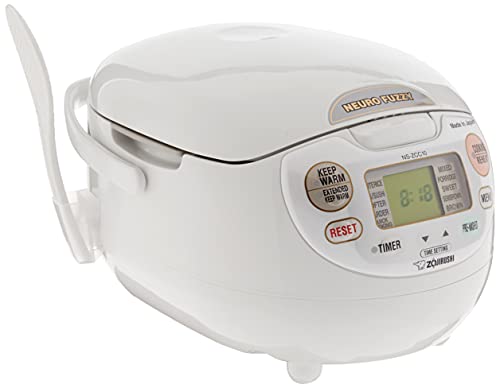
Zojirushi NS-ZCC10 Neuro Fuzzy Rice Cooker and Warmer
Badge: Best Premium Pick
The Zojirushi NS-ZCC10 is the connoisseur’s rice cooker in this pool: Neuro Fuzzy logic that learns and adjusts the cook, automatic keep-warm, and a delay timer so rice lands when dinner does. Zojirushi’s reputation in rice is built on exactly this — texture consistency across white, brown and mixed grains that simpler machines visibly struggle to match. If rice is a daily staple in your kitchen rather than an occasional side, this is the machine whose engineering is aimed squarely at you, and the delay timer makes it a genuine set-and-forget appliance rather than a supervised one.
The NS-ZCC10 is what happens when a company treats rice as a craft: Neuro Fuzzy logic adjusting the cook in ways a fixed cycle cannot, wrapped around Zojirushi’s warmer and timer discipline. Daily rice households — the ones who notice texture differences between Tuesday’s batch and Wednesday’s — are its audience, and for them the premium positioning is not a tax but a fair price for the pool’s most consistent grains.
Zojirushi’s Neuro Fuzzy premium buys consistency insurance: the hundredth pot matches the tenth, across grains and across the small measuring errors of tired evenings. Households deciding whether that insurance is worth it should count their rice nights per month honestly — at twenty, the math is easy; at two, the simple tier’s honesty wins and the premium is better spent on the rice itself.
Strengths
- Neuro Fuzzy logic gives the most consistent grain texture here
- Delay timer plus automatic keep-warm
- Zojirushi focus: rice is the specialty, not a side function
Trade-offs
- Premium-tier positioning in this pool
- Rice only — no pressure or slow-cook versatility
- Feature depth is wasted on occasional rice cooks
At a glance:
- Logic: Neuro Fuzzy
- Features: automatic keep-warm, delay timer
- Finish: white
Best for: smaller kitchens and lighter routines / Not suited for: large households cooking at full volume daily

Zojirushi NS-TSC10 Micom Rice Cooker and Warmer, 5.5 Cup
Badge: Best Right-Sized Zojirushi
The NS-TSC10 is Zojirushi’s Micom design at a 5.5-cup, 1.0-litre size: LCD controls, a delay timer, and microcomputer-managed cooking in a body sized for couples and small families. It sits a step below the Neuro Fuzzy flagship in sensing sophistication but keeps the essentials — precise programs, a timer that makes weeknight rice effortless, and the build quality the brand is known for. For a household that cooks rice several times a week in modest batches, this is arguably the right-sized Zojirushi rather than the compromise one.
The TSC10 is the considered Zojirushi: Micom programs, LCD clarity and a delay timer at a 5.5-cup size that matches couples and small families honestly. Next to its Neuro Fuzzy sibling it is the value play within the premium brand — you give up the flagship’s adaptive sensing and keep the build, the programs and the timer that make Zojirushi ownership satisfying.
The TSC10’s LCD-and-timer combination makes it the set-and-forget Zojirushi: load in the morning, and the machine’s Micom programs handle a 5.5-cup batch with a precision the simple tier cannot approach. For couples who eat rice most nights, it is arguably the pool’s best-matched machine — flagship thinking at a two-person scale — and its only real rival in this guide is its own bigger sibling.
Strengths
- 5.5-cup size is right for couples and small families
- Delay timer and LCD controls for scheduled rice
- Micom programs handle more than plain white rice
Trade-offs
- Smaller capacity than the pool’s family-size options
- A step below Neuro Fuzzy in adaptive sensing
- Premium-tier positioning for its size
At a glance:
- Capacity: 5.5 cup, 1.0L
- Controls: LCD, delay timer
- Logic: Micom (microcomputer)
Best for: buyers who want the pool’s most distinctive option / Not suited for: buyers who prefer the safest, most conventional choice
Comparison Table
| Pick | Format | Capacity (as listed) | Standout trait | Link |
|---|---|---|---|---|
| AROMA Digital Rice Cooker, 4-Cup Uncooked / 8-Cup Cooked, ARC-914SBD | Digital rice cooker | 8-cup cooked | The balanced family standard: 8 cups cooked, digital grain and steam programs, stainless exterior. | Check on Amazon |
| Cosori Rice Cooker 10 Cup, Fuzzy Logic, 18-in-1 | Fuzzy-logic rice cooker | 10 cup | Fuzzy logic with 18 functions, ceramic-coated pot, delay timer and a stainless steamer basket. | Check on Amazon |
| BLACK+DECKER Rice Cooker, 6-Cup Cooked | Simple rice cooker | 6-cup cooked | One-button simplicity with a steaming basket included — the teach-anyone cooker. | Check on Amazon |
| AROMA Rice Cooker, 3-Cup Uncooked / 6-Cup Cooked, ARC-363NG | Compact rice cooker | 6-cup cooked / 1.5 Qt | The 1.5 Qt compact for singles, couples and dorms; also cooks oatmeal and soup. | Check on Amazon |
| Zojirushi NS-ZCC10 Neuro Fuzzy Rice Cooker and Warmer | Neuro Fuzzy rice cooker | Delay timer model | Neuro Fuzzy logic and a delay timer — the texture-first premium pick. | Check on Amazon |
| Zojirushi NS-TSC10 Micom Rice Cooker and Warmer, 5.5 Cup | Micom rice cooker | 5.5 cup / 1.0L | Micom control at 5.5 cups with LCD and delay timer — the right-sized Zojirushi. | Check on Amazon |
Sort the table by logic tier and the category’s story tells itself: two simple cookers for small and simple jobs, one digital all-rounder, and three sensing machines — Cosori and the Zojirushi pair — for households that cook rice often enough to taste the difference.
How to Choose the Right Rice Cooker
Match capacity to your ordinary batch using cooked cups: one to one-and-a-half cups cooked per person is a working serving. A couple that eats rice as a side lives happily at six cups cooked; a family of five that builds meals on rice needs the eight-to-ten-cup tier. Remember that manufacturers quote both uncooked and cooked figures for the same pot — the AROMA digital’s 4-cup uncooked and 8-cup cooked are one machine, not two sizes.
Choose logic by grain variety and frequency. White rice twice a week forgives a simple cycle; brown rice, mixed grains and daily cooking reward programs and, above them, fuzzy sensing. The honest question is how often imperfect rice would actually bother you — that answer, not the spec sheet, sets your tier. Brown-rice households should also read Best Small Pressure Cookers For Rice.
Timers and keep-warm are lifestyle features: delay timing suits households that leave in the morning and eat at a fixed hour, and long keep-warm suits staggered dinners. Both appear on the Cosori and the Zojirushi pair. If someone is always home and dinner is an event rather than a schedule, those features matter less than pot quality and size.
Pot material closes the decision. Ceramic-coated pots (Cosori) split the difference between nonstick release and coating caution; classic nonstick bowls (AROMA, BLACK+DECKER) clean fastest; and every machine here uses a removable inner pot, which is the design detail that decides whether the cooker gets washed happily or dreaded. Multi-cooker fans can compare formats in Best Small Multi Cookers.
How to Cook Rice Properly in a Countertop Cooker
The method below flatters every machine in this guide, and most of it is about the minutes before and after the cook rather than the cook itself — the machine handles the middle.
Two habits do most of the work: rinsing away surface starch, and resting the finished rice before fluffing. Skipping either is responsible for most disappointing batches blamed on innocent cookers.
- Measure with the cup supplied with the cooker, then rinse the rice in several changes of water until it runs mostly clear.
- Add water to the pot’s marked line for your amount and grain — the pot’s own lines are calibrated to its cup.
- Pre-soak brown rice for 20-30 minutes, or select the brown/grain program on digital and fuzzy models.
- Cook with the lid closed and resist lifting it; the cycle is timed around the steam staying inside.
- Rest the finished rice for 10 minutes on warm, then fluff with a paddle from the bottom up.
- Serve, and move leftovers to the fridge once cooled rather than holding them on warm for hours.
Water discipline is the variable home cooks control most and respect least: the same rice, in the same cooker, swings from fluffy to porridge on a quarter-cup of water. Use the pot lines for a week before freestyling, and adjust in small steps — rice remembers nothing, but your notes should.
Cleaning is a two-minute ritual: pot and lid washed, vent wiped, heating plate kept dry and free of stray grains. A stray grain on the plate is the classic cause of a scorched patch on the next batch, and the easiest fault in this whole guide to prevent.
Troubleshooting:
- Problem: rice sticks in a solid layer → too little water or too long on warm; measure to the pot lines and serve or refrigerate within a reasonable hold.
- Problem: the top layer is wet while the bottom is dry → the rest was skipped; keep the lid on for a full 10 minutes after the cook so moisture equalizes.
- Problem: brown rice stays hard → it needs time, not just heat; pre-soak, use the grain program, and add a small amount of extra water.
Best trice cookers: a typo that leads to the right shortlist
Misspelled keywords are a quiet reality of how people shop — ‘trice’ for rice joins this wave’s ‘toasrer’ and ‘elecreic’ in the typo hall of fame — and the correct editorial response is to answer the intended question fully rather than to punish the spelling. The intended question here is the classic one: which rice cooker, at which size, with which logic? Everything in this guide is organized around that question.
It is also worth saying what this guide did not do: it did not invent a product category called a ‘trice cooker’, and it did not pad the pool. Six verified rice cookers, honestly compared, are the complete answer the search was looking for.
Simple, digital, fuzzy: the three philosophies of rice cooking
The simple philosophy says rice needs heat, water and time, and that a thermostat watching the pot’s weight of water is enough — the BLACK+DECKER and small AROMA embody it, and for plain rice in small batches they are right. The digital philosophy adds programs: different grains genuinely cook differently, and the AROMA digital’s modes encode that knowledge so the cook does not have to.
The fuzzy philosophy — Cosori’s fuzzy logic and Zojirushi’s Neuro Fuzzy and Micom systems — adds judgment: sensors watch the cook and correct it. That is why sensing machines forgive imperfect measuring and mixed grains. None of the three philosophies is a scam or a miracle; they are three answers to how much thinking you want the machine to do, priced accordingly.
Reading a rice cooker spec sheet without being fooled
Three numbers on a rice-cooker listing do most of the misleading. The cup figure may be uncooked or cooked — the same pot wears both — so convert everything to cooked cups before comparing. The function count mixes genuine programs with variations of warm and steam, so ask which grains get their own program rather than how many programs exist. And ‘fuzzy’ describes sensing and adjustment during the cook, a real capability with real grain benefits, not a synonym for ‘digital’ — a distinction this pool demonstrates by containing both kinds of machine.
The honest spec sheet, by contrast, tells you capacity both ways, names its grain programs, states its timer and keep-warm behavior in hours, and describes its pot material plainly. Every pick in this guide was read that way from its verified listing, and the specification boxes in the reviews reproduce exactly that discipline — what the listing claims, and nothing it does not.
White, brown and everything between: matching grains to machines
White rice is the category’s easy exam: every machine here passes it, and the differences are texture preferences at the margins. Brown rice is the discriminating one — its bran layer needs time and water management that simple cycles rush — and it is where the digital programs, the Cosori’s fuzzy logic and the Zojirushi systems separate themselves. Households whose staple is brown should buy from the sensing half of this pool and use the pre-soak habit the how-to section teaches.
Mixed grains, quinoa, oats and steamed accompaniments stretch the definition of a rice cooker entirely, and the pool stretches with it — oatmeal and soup in the little AROMA, steaming in the digital models, an 18-function range in the Cosori. The modern rice cooker is really a grain station, and buying it as one — sized to your grains, not just your rice — is how the purchase stays right for years.
The rest, the rinse and the ratio: small habits, large differences
New owners often blame a cooker for results that belong to three habits. Unrinsed rice carries surface starch that glues grains and foams at the vent. Unrested rice serves wet on top and dry below, because the equalizing ten minutes were skipped. And freestyled water — a splash more, a splash less — swings texture further than any logic tier can correct. The machines in this pool differ in how much they forgive, but none repeals the habits.
The encouraging news is that the habits are free and fast: ninety seconds of rinsing, the pot’s own lines for water, ten patient minutes at the end. Master them on a simple cooker and you will cook well on any machine in this guide; skip them on a flagship and you will conclude, wrongly, that the flagship is ordinary.
From first batch to hundredth: how a rice cooker earns its place
The first batch in any new cooker is a calibration, not a verdict: the pot’s lines, your rice brand and your water all meet for the first time, and a thoughtful cook adjusts one variable before judging. By the tenth batch, the machine’s personality is known — how it likes its water, how its keep-warm treats the edges, which grains flatter it. By the hundredth, the cooker is either furniture or family, and the difference was almost never the spec sheet; it was whether the size and the logic matched the household’s real rhythm.
That arc explains this pool’s spread better than any ranking. The simple machines reach ‘family’ fastest because there is nothing to learn; the sensing machines take longer and then disappear just as completely, having absorbed the learning into themselves. The digital middle splits the difference. A buyer who understands which arc they are purchasing — quick familiarity, or deeper delegation — will be satisfied with any tier in this guide.
It also explains why rice cookers are so rarely returned and so often re-bought in kind: households do not shop for a new philosophy every few years, they shop for the same philosophy with a fresh pot. Buy the philosophy right the first time — simple, digital or fuzzy — and the hundredth batch takes care of itself.
Counter space economics: the footprint nobody lists
Every cooker in this guide competes for the same scarce resource, and it is not money — it is the thirty-odd inches of counter a kitchen can spare. A machine that fits its household’s counter stays out, gets used daily and justifies itself; a machine that must be fetched cooks rice monthly and resents itself. Measure the resting place, including the height under cabinets where lids must open, before falling for any capacity figure.
That economics explains the pool’s shape one last time: the minis exist because small counters are real, the family tier exists because most counters can host exactly one mid-size machine, and the flagships exist for kitchens where rice has already won the argument for prime space. Choose the machine your counter votes for, and the cooking takes care of itself.
Common Buying Mistakes
Rice-cooker buying mistakes repeat so reliably that they read like a checklist — which is what we have made them.
- Buying by uncooked cup figures and discovering the cooker is half the size you pictured.
- Paying for fuzzy logic to cook plain white rice twice a month.
- Skipping the timer on a commuter schedule, then cooking rice in a saucepan out of impatience anyway.
- Judging a cooker on its first batch, before learning its water lines and rest time.
- Using metal utensils in coated pots and blaming the coating when it fails.
Final Recommendation
Most households should buy the AROMA ARC-914SBD: the balanced size, honest digital programs and easy exterior make it the pool’s safest recommendation. Grain enthusiasts and daily rice cooks should climb to the Cosori for fuzzy logic and scheduling, or to the Zojirushi pair — the ZCC10 for flagship texture, the TSC10 for the right-sized version. Small and simple kitchens are genuinely best served by the little AROMA or the BLACK+DECKER.
Rice is a staple, and staples deserve a machine matched to your real routine. Choose by your ordinary Tuesday batch and your usual grain, and any of these six will repay the thought.
One last piece of insurance whichever tier you choose: cook your staple grain three times in the first week, adjusting only the water, and write the winning measure on a card kept with the cooker. That small ritual converts a new machine into your machine faster than any feature can, and it is the difference between households that love their rice cooker and households still negotiating with it a year later.
A closing thought on the pool’s balance: it would have been easy for a six-machine shortlist to cluster at one tier, but this one spans the category’s whole argument — simplicity, programs and sensing — which is what makes the comparison useful rather than ceremonial. Whichever tier you land in, you are not buying a compromise position in someone else’s ranking; you are buying the philosophy that matches your kitchen, defended on its own terms in the reviews above.
Consider, too, the gift and hand-me-down life of these machines, because rice cookers circulate: the simple tier is what gets bought for a student, a first flat, a parent downsizing — contexts where a manual would be opened before the box is. The sensing tier is what gets bought for oneself, deliberately, after years of knowing exactly what one wants from a grain. A shortlist that contains both, honestly labelled, serves both moments, and a reader who knows which moment they are in already knows their tier.
And if the household is genuinely torn between tiers, the tiebreaker is the calendar, not the grain: count the rice nights in a honest month. Under six, buy simple and spend the difference on better rice. Over fifteen, buy sensing and let the machine carry the repetition. Between the two, the digital middle of this pool — the AROMA with its programs and steamer — exists precisely for the torn, and it resolves more of these arguments than any other single pick here.
Rice, in the end, is a forgiving food cooked by unforgiving routines — the same grain, the same hour, the same expectations, night after night. That is why the machine matters less as an object than as a routine made solid, and why this guide has spent its length on sizes, logic and habits rather than on crowns and scores. Pick the routine you want to live inside; the cooker that embodies it is already reviewed above, with its badge, its trade-offs and its honest limits attached.
And one small promise to close: every claim in the reviews above can be traced to a verified listing in the sources file — the capacities, the programs, the timers, the pot materials. Where this guide recommends, it recommends from that record and from the reasoning laid out in the open. That is the standard a staple purchase deserves.
Good rice, repeated calmly for years, is the entire ambition — and it is well within reach of every machine on this page.
Start here: AROMA Digital Rice Cooker, 4-Cup Uncooked / 8-Cup Cooked, ARC-914SBD (Best All-Rounder); Cosori Rice Cooker 10 Cup, Fuzzy Logic, 18-in-1 (Best Featured Pick); BLACK+DECKER Rice Cooker, 6-Cup Cooked (Best Simple Pick).
Frequently Asked Questions
What is a trice cooker?
‘Trice’ is a misspelling of ‘rice’ — a trice cooker is a rice cooker. This guide answers the intended search with six verified rice cookers across simple, digital and fuzzy-logic designs.
Which size rice cooker suits a family of four?
About eight cups cooked — the AROMA ARC-914SBD’s capacity — covers a family of four with leftovers. Couples and side-dish households do better with the 6-cup cooked compact models.
Is fuzzy logic noticeably better than a simple cooker?
For brown rice, mixed grains and imperfect water measuring, yes — sensing machines adjust mid-cook in ways fixed cycles cannot. For plain white rice in small batches, a simple cooker is honestly sufficient.
Can these cookers handle grains besides rice?
Yes, to different degrees: the small AROMA lists oatmeal and soup, the Cosori’s 18-in-1 list covers a wide grain and steam range, and the digital AROMA includes grain and steamer functions. Check each review’s specification box for the verified list.
Do I need a delay timer on a rice cooker?
Only if your schedule is predictable but your presence is not — commuters who load in the morning and eat at a set hour benefit most. The Cosori and both Zojirushi models in this guide offer delay timing.
Why does my rice cooker boil over occasionally?
Usually overfilling or very starchy, unrinsed rice. Rinse until the water runs clearer, respect the maximum lines, and keep the steam vent clean so pressure escapes as designed.


