Disclosure: topratedkitchenware.com is reader-supported. When you buy through links on our site, we may earn an affiliate commission from Amazon and other retailers, at no extra cost to you.
Where to buy
A guide to the best toasters ratings culture produces has to start by breaking the culture’s favourite habit: this page prints no scores, no percentages and no verdicts borrowed from other people’s stars. Instead, the six verified toasters below are ranked on stated specifications and design evidence, and the second half of the guide teaches you to read owner ratings themselves — what they reveal, what they conceal, and which complaints buried in them actually predict regret. Check the latest price on Amazon through the links, and bring your new reading skills with you.
- Hommater 2-Slice Wide Slot Smart Toaster with LCD Countdown
- Amazon Basics 2 Slice Toaster with Extra Wide Slots
- Elite Gourmet ECT1027B 2-Slice Cool-Touch Toaster
- Hamilton Beach 22634 Extra-Wide Slot 2 Slice Toaster
- bella Fits-Anywhere Slim Toaster, 4 Slice
- BLACK+DECKER 2-Slice Toaster with Extra-Wide Slots
Read the full guide ↓
Search for the best toasters ratings pages and you will be buried in numbers within a minute — averages, percentages, bestseller badges — almost none of which answer the only question that matters: will this machine toast your bread, your way, every morning for years? Ratings are not useless. Read properly, an owner-rating history is the largest field test any toaster will ever get, full of consistency reports, failure modes and small daily frictions that no specification sheet admits. Read lazily, the same numbers are weather: real, measurable, and nearly useless for deciding what to wear.
This guide takes the harder, more honest route. It ranks six verified designs — the Hommater’s countdown and fine control, the Amazon Basics’ fully stated specification, the Elite Gourmet’s cool-touch sides, the Hamilton Beach’s safety set, bella’s four-slice long slot and the BLACK+DECKER’s wide-slot classic pattern — on evidence you can inspect: stated features, measured details, design logic. It deliberately prints no rating figures for any of them, for the same reason it prints no prices: numbers like those move, age and quietly become wrong, and a guide that teaches you to distrust stale numbers cannot traffic in them. Shoppers who cross-check several sources, including Best Toasters Online listings, will see how quickly the figures drift.
What follows the reviews is the real payload: a field guide to reading ratings like an analyst. You will learn why the distribution of scores matters more than their average, why the date pattern of reviews predicts more than their total, which complaint categories are signal and which are noise, and how the toaster-specific failures — one-sided browning, hot second cycles, dying elements — show up in owner language long before they show up in yours. Bring those skills to any listing, including the ones linked here, and the numbers start working for you instead of on you.
Key Takeaways
- This guide prints no rating figures on purpose: they drift, age and would be stale before the toast cools.
- The distribution of owner scores predicts satisfaction better than any average — look for the shape, not the headline.
- Complaint patterns are the gold in ratings: consistency and one-sided browning complaints outrank every praise category.
- The Hommater leads on verifiable features; the Amazon Basics is the pick whose stated spec needs the least faith.
- Judge a toaster’s ratings by its recent reviews, because designs, factories and quality control all change over a model’s life.
In this guide
Quick Picks
Six verified toasters ranked on inspectable evidence — stated features and design — while the sections after the reviews teach the ratings-reading method itself.
| Pick | Badge | Why it stands out |
|---|---|---|
| Hommater 2-Slice Smart Toaster | Best Overall | A countdown and nine shades: the most feature-verifiable pick in the pool |
| Amazon Basics 2 Slice Toaster | Best Value Pick | A fully stated specification that asks for no faith at all |
| Elite Gourmet ECT1027B Cool-Touch Toaster | Best Cool-Touch Pick | Cool-touch sides with a stated slot measurement — evidence, not adjectives |
| Hamilton Beach 22634 Toaster | Best Safety-Minded Pick | Auto shutoff and Toast Boost in a complete, named control set |
| bella Fits-Anywhere Slim Toaster | Best for Families | Four slices and a long slot: capacity claims you can verify from the title |
| BLACK+DECKER 2-Slice Toaster | Best Wide-Slot Classic | The long-selling wide-slot pattern with every working feature named |
How These Picks Were Chosen
This guide is research-led, and it is worth being plain about what that means. We did not run a test kitchen, toast a hundred loaves, or handle pre-release samples. Instead, every pick in this list was verified through Amazon’s Creators API, which returned each product’s confirmed title, brand and listing details; the specifications quoted in the spec boxes are taken from those verified titles and from nothing else. Where a listing title does not state a feature — a shade count, a wattage, a named button — we say so rather than filling the gap from memory or from a different model in the same range.
The shortlist was built by comparing the verified toaster pool on the attributes that decide daily satisfaction: slot width and format, because bread that does not fit cannot toast; the number and spread of shade settings, because repeatability is what separates a good morning from a guessing game; the presence of bagel and defrost functions, because frozen and thick bread behave differently from fresh sandwich slices; crumb management, because a tray you can slide out beats crumbs you cannot reach; and safety and retrieval details such as cool-touch sides, auto shutoff and high-lift levers, which sound minor until a small slice is sitting out of reach above hot elements.
For the ratings edition, the selection method inverted the usual one: instead of gathering scores, we gathered verifiables. Each pick was assessed on what a buyer can confirm without trusting anyone’s average — stated shade counts, named functions, measured slot details, cleaning arrangements, safety features — and on how completely its listing supports independent checking. The result is a ranking designed to survive contact with any ratings page: whichever scores you find elsewhere, the design evidence here remains yours to inspect.
Two honesty rules governed the writing. First, no prices and no ratings appear anywhere in this guide: prices move, ratings drift, and a number printed here would quietly become wrong, so every pick simply invites you to check the latest price on Amazon. Second, where the pool and the keyword pull in different directions, we say so in the open — in a note inside the relevant section and in the sources file published with this article — instead of dressing a mismatch up as a match. A shorter, honest guide beats a longer, padded one.
The 6 Best Toasters, Reviewed in Detail
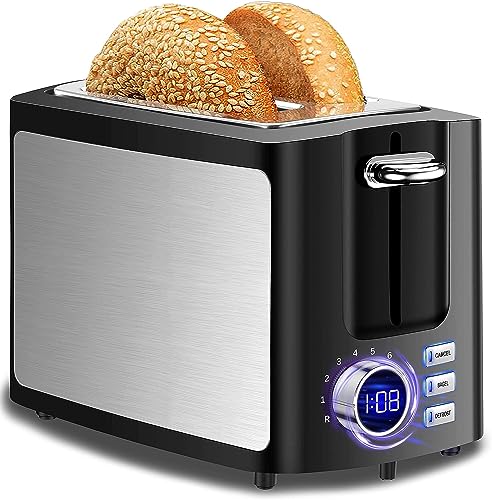
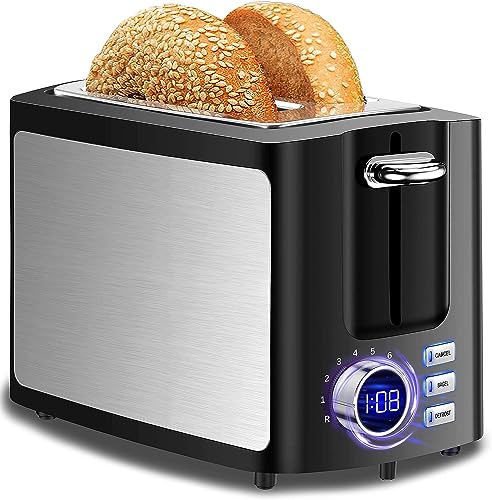
Hommater 2-Slice Wide Slot Smart Toaster with LCD Countdown
Badge: Best Overall
Strengths
- The LCD countdown removes the guesswork — you can see exactly how long a cycle has left
- Nine shade settings are the finest gradation in this pool, useful for picky preferences
- A dedicated reheat function warms finished toast without pushing it further brown
Trade-offs
- A newer, lesser-known brand, so long-term parts and support are less proven than the big names
- Nine shades is more granularity than most households will ever distinguish in practice
- Two-slice capacity still limits it to smaller households and slower breakfast runs
Key specs (from the verified listing)
- Format: 2-slice pop-up toaster
- Slots: wide slot design
- Shade settings: 9
- LCD digital countdown timer
- Functions: bagel, defrost, cancel, reheat
The Hommater is the pool’s technology-led option: a two-slice wide-slot toaster built around an LCD digital countdown timer and nine shade settings, with bagel, defrost, cancel and reheat functions. The countdown sounds like a gimmick until you live with a toaster that gives no feedback at all — knowing whether a cycle has ten seconds or a minute left changes whether you start the eggs now or wait. For households where two people like visibly different shades, the nine-step dial also makes preferences repeatable: note your number once and you can return to it exactly.
The function set is complete for frozen and fresh bread alike. Defrost adds the thaw time frozen slices need before browning, and reheat rescues toast that popped while you were distracted, warming it through instead of browning it a second time. The honest limitation is provenance: Hommater is a newer name than the established brands in this guide, so while the verified listing confirms the features above, long-term durability and after-sales support are less documented. Buy it for the display and the fine control, and keep the packaging and order details in case you need that support.
When you research this one, read its owner reviews for a specific pattern: comments about repeatability. A nine-step dial and a countdown make promises that only consistency can keep, so reviews describing the same result at the same setting, week after week, are the signal that matters here.
Best for: anyone who values a countdown display and precise, repeatable shade settings / Not suited for: buyers who prioritise a long-established brand’s service network over features

Amazon Basics 2 Slice Toaster with Extra Wide Slots
Badge: Best Value Pick
Strengths
- The most completely stated specification in the pool, including its 900W power figure
- Extra-wide slots and a bagel button handle thick items without a separate appliance
- Cord wrap and a removable crumb tray keep a small counter tidy between uses
Trade-offs
- Six browning settings offer slightly coarser control than the seven- and nine-step rivals
- A plain black-and-silver finish will not suit kitchens chasing a particular colour scheme
- Two slices per cycle, like most of this pool, caps its breakfast throughput
Key specs (from the verified listing)
- Format: 2-slice pop-up toaster
- Slots: extra wide, sized for bagels
- Browning settings: 6
- Power: 900W (as stated in the listing title)
- Buttons: defrost, cancel, bagel
- Removable crumb tray and cord wrap
- Finish: black and silver
The Amazon Basics toaster is the pool’s no-nonsense value design, and unusually for this class its listing states the full working specification: extra-wide slots for bagels, six browning settings, defrost, cancel and bagel buttons, a removable crumb tray, cord wrap and a stated 900W. That completeness makes it the easiest pick here to buy with your eyes open — what is in the title is what arrives, and the feature set covers the complete everyday brief: fresh bread, frozen bread, bagels, and a cancel button for the morning you change your mind mid-cycle.
In daily use its virtues are tidiness and predictability. The cord wrap keeps the lead off the worktop in small kitchens and rental flats where the toaster lives in a cupboard between uses, and the slide-out tray means crumbs go in the bin rather than building up inside the slots. Six settings is one step coarser than some rivals, and in practice the middle of the dial will handle most bread, with the ends reserved for very light warming or very dark, sturdy slices. Its honest limitation is ambition: it will not countdown your toast or toast four slices, but as a simple, fully specified two-slice machine it is hard to fault.
The value pick is the ratings-sceptic’s friend: because its specification is stated in full, its owner reviews can be read purely for behaviour — consistency, second-cycle darkening, tray habits — rather than for discovering what the machine was supposed to do.
Best for: budget-conscious buyers, renters and small kitchens that want a complete, stated specification / Not suited for: anyone who needs four-slice capacity or a digital countdown display

Elite Gourmet ECT1027B 2-Slice Cool-Touch Toaster
Badge: Best Cool-Touch Pick
Strengths
- Cool-touch sides are a genuine safety plus in homes with children or tight counters
- The stated 1.25-inch slot width is one of the few exact slot measurements in this pool
- Six shades plus a cancel control cover the everyday fresh and thick-bread brief
Trade-offs
- No dedicated bagel or defrost button is stated, so frozen bread needs manual shade tweaks
- Black is the stated finish here, which limits colour matching in pale kitchens
- A compact two-slice format shares the pool’s usual throughput ceiling
Key specs (from the verified listing)
- Format: 2-slice pop-up toaster
- Slots: 1.25-inch extra-wide, for bagels and thick bread
- Shade settings: 6
- Cool-touch exterior (as stated in the listing title)
- Cancel function
- Model: ECT1027B, black
The Elite Gourmet ECT1027B earns its place on one clearly stated idea: a cool-touch exterior on a two-slice toaster with 1.25-inch extra-wide slots and six shade settings. Toasters get hot — the elements have to — and in a crowded kitchen the casing is what brushes against a child’s hand, a tea towel or the side of the fridge. A design that keeps its outer walls cooler is a practical safety choice rather than a luxury, and it also makes the toaster easier to slide aside straight after use in a small space.
The slot width being stated as a measurement is quietly useful: 1.25 inches accommodates bagels and thick-cut bread, which the listing names directly, so you can compare your usual loaf against a number instead of a marketing adjective. What the stated feature set does not include is a named bagel or defrost button — the listing promises a cancel function and shades, so frozen slices will need a step up the dial and a watchful eye the first few times. That is the honest trade: you gain the cool-touch casing and a measured slot, and you give up some one-button convenience found elsewhere in this pool.
For a cool-touch design, the telling reviews are the household ones: parents and small-kitchen owners reporting on the casing in daily traffic. Weight those accounts heavily and discount generic praise; the feature is either working in real kitchens or it is not.
Best for: households with children, and anyone whose toaster sits within touching distance of daily traffic / Not suited for: frozen-bread households that rely on a dedicated defrost cycle every morning
Hamilton Beach 22634 Extra-Wide Slot 2 Slice Toaster
Badge: Best Safety-Minded Pick
Strengths
- Toast Boost lifts small items higher, solving the stuck-crumpet problem directly
- Auto shutoff adds a layer of safety if a cycle is ever interrupted or forgotten
- Seven shades plus named bagel and defrost buttons make the control set complete
Trade-offs
- The blue finish is a statement — it will either anchor your kitchen’s colour or clash with it
- Two-slice capacity, again, is the ceiling for larger breakfast rounds
- No countdown display, so timing feedback is limited to the pop itself
Key specs (from the verified listing)
- Format: 2-slice pop-up toaster
- Slots: extra-wide
- Shade settings: 7
- Buttons: bagel and defrost
- Auto shutoff
- Toast Boost for higher lift
- Slide-out crumb tray
- Finish: Kitchen Makeover Blue; model 22634
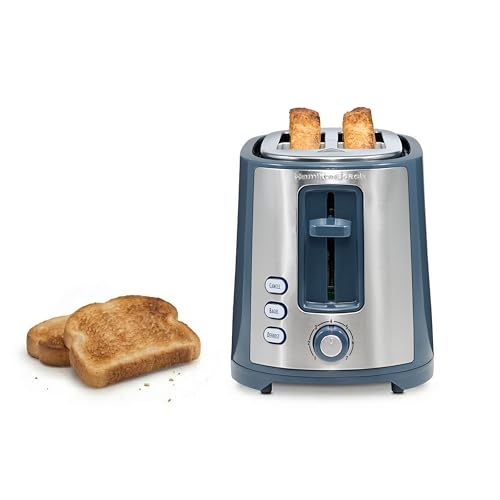
The Hamilton Beach 22634 combines the pool’s most safety-conscious control set with its boldest finish. Start with the working features: extra-wide slots, seven shade settings, dedicated bagel and defrost buttons, auto shutoff, Toast Boost and a slide-out crumb tray. Toast Boost deserves its name in the listing — it raises finished items higher than a standard carriage, which is exactly what small slices, English muffins and crumpets need, and auto shutoff means a cycle cannot linger indefinitely if something goes wrong or the kitchen empties mid-breakfast.
Then there is the colour. The listing calls the finish Kitchen Makeover Blue, and it is genuinely that: a toaster you choose partly as a kitchen accent, from a long-established American small-appliance brand. If your kitchen runs to pale blues, white cabinetry or a deliberate pop of colour, it will look intentional; in a strictly stainless scheme it will look like a guest. Performance-wise its honest limits are the familiar ones for this class — two slices at a time and no countdown display — but as a complete, safe and characterful two-slice package, it is one of the strongest all-round designs in this pool.
Safety features generate a distinctive review signature — few mentions when they work, vivid ones when a rival lacked them. Read this model’s feedback for Toast Boost retrieval stories; small-slice owners are its natural jury.
Best for: safety-conscious households and anyone who wants a reliable brand name with a colourful finish / Not suited for: four-slice households, or kitchens committed to an all-stainless look

bella Fits-Anywhere Slim Toaster, 4 Slice
Badge: Best for Families
Strengths
- Four slices per cycle doubles the throughput of every other pick in this pool
- The extra long slot swallows artisan and sourdough slices that defeat standard slots
- A slim profile returns counter depth that a conventional four-slice body would consume
Trade-offs
- The listing title states fewer control details — no shade count or named bagel/defrost buttons
- A single long slot gives less independent control than two separately controlled slot pairs
- The oatmilk finish is distinctive; it will not disappear into a stainless appliance run
Key specs (from the verified listing)
- Format: slim-profile toaster
- Capacity: 4 slices via an extra long slot layout
- Slot: extra long and wide, suited to artisan loaves
- Finish: Oatmilk
- Design line: Fits-Anywhere
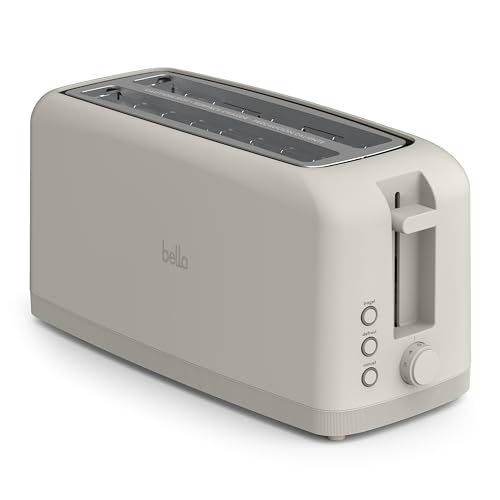
The bella Fits-Anywhere is the pool’s structural outlier, and for many kitchens the most interesting design here: a slim-profile toaster that handles four slices through an extra long and wide slot, finished in a soft colour the listing calls Oatmilk. Where a conventional four-slice toaster is a deep, boxy appliance, a slim long-slot body slides along the back of the counter, and the long slot solves the artisan-bread problem — wide sourdough and bakery slices that must be trimmed, forced or toasted in two passes in a standard slot fit here in one piece.
Throughput is the other headline. Four slices per cycle halves breakfast queuing for families compared with every two-slice pick in this guide, and the wide slot still takes bagels and thick cuts. The honest trade-offs sit in the stated specification: the listing title does not name a shade count, a bagel setting or a defrost button, so if those one-button routines matter to you, check the listing’s full specification before ordering, and expect a single shared control rhythm rather than two independently timed slot pairs. Buy it for shape and capacity; it is the only pick here designed around the counter itself.
Capacity claims attract capacity reviews, so this design’s feedback skews toward family throughput and artisan loaves. That is the right jury for it — but note the control-detail check in its spec box before letting any score, good or bad, close the question.
Best for: families, artisan-bread households and anyone short on counter depth / Not suited for: buyers who want a stated shade count and named bagel/defrost buttons confirmed in the title
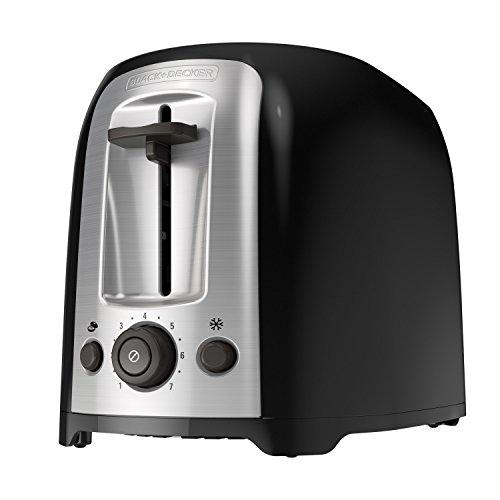
BLACK+DECKER 2-Slice Toaster with Extra-Wide Slots
Badge: Best Wide-Slot Classic
Strengths
- Extra-wide slots take bagel halves and thick-cut bread without trimming or forcing
- Seven shade settings give a usable spread from gentle warming to deep, crisp browning
- The extra lift lever raises small slices and crumpets high enough to grab safely
Trade-offs
- Two slices at a time is slow when a household wants four pieces on the table together
- The stated feature set is deliberately basic, with no countdown display or digital timer
- Wide slots centre thin sandwich bread less precisely than they centre thick slices
Key specs (from the verified listing)
- Format: 2-slice pop-up toaster
- Slots: extra-wide, suited to bagels and thick bread
- Shade settings: 7
- Bagel mode: yes
- Extra lift lever for small slices
- Removable crumb tray
The BLACK+DECKER is the straightforward, wide-slot workhorse of this pool: a two-slice pop-up toaster whose extra-wide slots, bagel mode and seven shade settings cover the jobs most kitchens actually ask of a toaster. The design makes no attempt to be clever. You choose a shade, press the lever, and the bagel mode adjusts the cycle for a thick, one-sided item whose cut face you want toasted while the crust side stays softer. That honesty is its appeal — every control maps to one obvious job, so a guest or a teenager can use it without a manual.
Two details lift it above the most basic machines. The extra lift lever matters more than it sounds: short slices, crumpets and the end pieces of a loaf sit deep in wide slots, and being able to raise them clear of the elements beats fishing with a fork near live elements. The removable crumb tray keeps the counter and the toaster’s interior cleaner with a weekly slide-out rather than a shake over the sink. Its honest limitation is throughput and feedback — two slices per cycle, and no display telling you how long is left, so busy households queue. Treat it as a dependable everyday toaster for one or two people, not a family production line.
A long-selling design accumulates the deepest review history in the pool, which is an advantage with a trap: early and recent production may differ. Read its newest reviews first and treat the archive as background, a method the Best Toasters Reddit community applies instinctively.
Best for: one or two people who toast bagels and thick bread daily and want simple, proven controls / Not suited for: families who need four slices at once, or anyone who wants a countdown display
Comparison Table
Evidence you can inspect yourself, side by side — the attributes that ratings pages assume you already know, and that actually decide whether the scores you find elsewhere will apply to your kitchen.
| Pick | Format | Shades | Standout feature | Link |
|---|---|---|---|---|
| Hommater 2-Slice Smart Toaster | 2-slice pop-up | 9 | LCD countdown timer | Check on Amazon |
| Amazon Basics 2 Slice Toaster | 2-slice pop-up | 6 | Stated 900W, cord wrap | Check on Amazon |
| Elite Gourmet ECT1027B Cool-Touch Toaster | 2-slice pop-up | 6 | Cool-touch exterior, 1.25-inch slots | Check on Amazon |
| Hamilton Beach 22634 Toaster | 2-slice pop-up | 7 | Toast Boost and auto shutoff | Check on Amazon |
| bella Fits-Anywhere Slim Toaster | Slim 4-slice long slot | Not stated in title | Four slices, artisan-length slot | Check on Amazon |
| BLACK+DECKER 2-Slice Toaster | 2-slice pop-up | 7 | Extra lift lever and bagel mode | Check on Amazon |
How to Choose When Reading Best Toasters Ratings
Start with the bread, not the toaster. The single most common reason a toaster disappoints is a slot that does not match the loaf: standard slots handle sandwich bread, but bagel halves, thick-cut farmhouse slices, crumpets and wide artisan sourdough each stress a design differently. Extra-wide slots — the pattern across most of this pool — cover bagels and thick cuts. An extra long slot, like the bella’s, is the answer for wide artisan slices. Measure your usual slice before you shop; it takes ten seconds and eliminates half the wrong purchases in this category.
Next, decide your capacity honestly. A two-slice toaster suits one or two people whose breakfasts are staggered. The moment three or four people want toast in the same ten minutes, a two-slice machine becomes a queue, and the second round eats while the first round cools. That is the one situation where a four-slice design is not a luxury but the correct tool. If your household is between the two, think about staggering: a two-slice machine with a reheat function can hold a pattern together, because the first slices can be warmed through without browning further when the second pair pops.
Shade settings are about repeatability, not range. Nobody needs the darkest setting a toaster offers; what you need is to find your setting once and return to it. Six settings is workable, seven is comfortable, and nine — the Hommater’s count — lets two fussy people each keep a number. What matters more than the count is consistency: a good toaster gives the same result on the same setting across a morning, including the second cycle, when the elements are already hot and many cheap designs overshoot. When you read owner feedback anywhere, consistency complaints are the ones to weight.
Then work through the functions your bread actually needs. Bagel mode exists because a bagel’s cut face and crust want different treatment; if you toast bagels weekly, treat it as essential, and if you never do, ignore it entirely. Defrost matters in households that freeze bread — which is most households that buy sliced loaves — because frozen slices browned on a fresh setting emerge dark outside and cold in the middle. A cancel button is the humble essential: it is the difference between rescuing a cycle and unplugging an appliance. Reheat is the quiet luxury that fixes toast popped too early.
Finally, judge the ownership details. A removable or slide-out crumb tray decides whether cleaning is a ten-second habit or a monthly excavation. High lift — named as an extra lift lever or Toast Boost in this pool — decides whether small items are retrievable without tools. Cool-touch sides and auto shutoff decide how forgiving the machine is in a busy or child-populated kitchen. And measure the counter: depth, not width, is what most toasters steal, which is why a slim long-slot design exists at all. Choose on those five axes — bread fit, capacity, repeatability, functions, ownership — and the right pick in this guide usually names itself.
How to Use, Clean, and Look After Your Toaster
Good toast is mostly technique, and the technique is learnable in a week. Follow these steps when a new toaster arrives, and most early disappointment — the pale first slice, the mysteriously dark second — explains itself.
- Run two empty or sacrificial cycles first. New elements carry manufacturing residues that smoke and smell on first heat. Two cycles on a middle setting, in a ventilated kitchen, burn that off; use the cheapest slices you have if you prefer something in the slots.
- Calibrate with your real bread. Toast one slice at the middle setting and judge it. Move one step at a time from there, and write your number down — on the fridge, in a phone note, anywhere. Every bread type gets its own number: fresh white, wholemeal, frozen, and bagels will all differ.
- Respect the hot second cycle. A toaster already at temperature browns faster. When you run back-to-back cycles for a household, drop the setting half a step to a full step for the second round, or accept a darker result knowingly.
- Use the right function, not a workaround. Frozen bread goes on defrost, bagels go cut-side as the manual directs on bagel mode, and yesterday’s toast goes on reheat — each exists because the timing genuinely differs.
- Retrieve with the lever, not with tools. Use the high-lift feature for small items. Never insert a metal utensil into a plugged-in toaster, for the obvious reason.
Cleaning is a rhythm, not an event. Empty the crumb tray weekly if you toast daily — slide it out, tip it into the bin, wipe it, and slide it back. Once a month, unplug the toaster, let it cool fully, turn it over a bin and shake gently to dislodge what the tray missed. Wipe the exterior with a barely damp cloth; never immerse the appliance, never spray cleaner into the slots, and never use abrasive pads on coloured or coated finishes. If your kitchen fills with crumbs around the toaster, the tray routine is the fix, not a bigger clean.
Troubleshooting: three common problems
Problem: one side of the slice browns more than the other → centre the slice in the slot, check that a previous cycle has not left one element bank hotter, and rotate the slice halfway through only if your design allows pausing; persistent one-sided results on every bread type suggest an element fault, not user error.
Problem: toast is dark outside but cold or soft in the middle → the bread almost certainly started frozen without the defrost function, or the slice is thicker than the slot comfortably holds; use defrost, or drop the shade and run a second short cycle.
Problem: small items sit too low to reach → use the high-lift lever or Toast Boost if your model has it; if it does not, switch the power off at the wall and lift the carriage lever manually, using a wooden utensil — never metal — only once the appliance is unplugged and cool.
How to Read Toaster Ratings Without Being Fooled
Start with the shape of the scores, never the average. Two toasters can share an identical average while telling opposite stories: one clusters tightly around satisfied, the other splits between delighted owners and a furious minority reporting the same mechanical failure. The second pattern is the dangerous one, and only the distribution shows it. When a listing displays its score breakdown, study the unhappy tail and read what those owners actually say. A tail full of delivery complaints and changed minds is noise; a tail repeating one failure — an element bank, a carriage, a lever — is a forecast.
Then read by date, newest first. A toaster model can live for years while its factory, components and quality control quietly change, so a wall of praise from its launch era may describe a machine you can no longer buy. Recent reviews describe the current production, the current packaging and the current seller behaviour. This is also why this guide refuses to print figures: the honest number for any pick here is the one on its listing today, weighted by the method in this section — not a number frozen into an article. The test-led approach described in Best Toasters Sweethome exists for the same reason: fresh evidence, re-gathered, beats inherited verdicts.
Finally, translate praise into your own kitchen before crediting it. Owners praise what their households use: a bagel household’s glowing verdict says little to a sourdough household, and a single person’s delight in a two-slice machine is a warning, not an endorsement, to a family of five. Match the reviewer’s stated use to yours — bread type, household size, frozen or fresh — and discount every verdict, glowing or furious, from a kitchen unlike your own. Ratings are a census of other people’s breakfasts; your job is to find your own street in it.
The Complaints That Actually Matter
After thousands of owner reports across this category, the complaints that predict regret form a short, learnable list. First and most serious: inconsistent browning — the same setting producing different results across a morning, or one side of the slice darkening ahead of the other. This is the core job of the appliance failing, and reviews that describe it in operational detail, across several bread types, should end your interest in a model regardless of its average. Second: premature element or carriage failure, especially when reports cluster at a similar age. A pattern of deaths at the same lifespan is manufacturing information no marketing page will give you.
The middle tier of complaints is real but manageable. Hot second cycles darken the next batch — physics, shared by every toaster, and solved by dropping the setting; treat reviews furious about it as reviewers who have not calibrated yet, unless the effect described is extreme. Crumb mess and awkward trays are design facts you can verify from the stated specification before buying, which is why this guide’s spec boxes name the tray arrangement for every pick. Small slices sitting low is likewise checkable in advance: it is precisely what high-lift levers and Toast Boost exist to prevent.
The bottom tier is noise wearing a uniform: complaints about a colour differing from a photograph, about a toaster being the size a toaster is, about delivery by a seller you are not using. Note them, forgive them, and move on. The discipline in one sentence: weight detailed, recent, use-matched complaints about the core job; shrug at everything else. Apply that filter to the six listings in this guide — including glancing at how Best Toasters Nz market versions gather their own distinct feedback — and you will read ratings the way manufacturers fear and good buyers deserve.
Common Buying Mistakes
Buying the slot before measuring the bread. The most expensive toaster mistake costs nothing to avoid: a tape measure against your usual slice. Wide artisan loaves in standard slots and bagel halves forced into narrow ones account for more returns in this category than any mechanical failure. If your bread is wide, the long-slot design exists precisely for you; if it is thick, the stated slot widths in the spec boxes are the numbers to compare.
Paying for capacity you will queue for anyway — or skipping capacity you need. Both directions happen. Singles buy four-slice machines that dominate a small counter and run half-empty for years; families buy elegant two-slice machines and spend every morning running a toast rota. Count the people who eat toast at the same time on a school or work morning, and buy for that number, not for the household’s total size.
Judging shade dials by their maximum. A dial that goes very dark proves nothing; every toaster can burn bread. What you are buying is the middle of the dial — fine, repeatable steps around the shades real people use. A nine-step dial is genuinely useful for a household with strong and differing preferences, and genuinely pointless for a household that will park on one number forever. Match the granularity to the people.
Ignoring the crumb tray until it matters. Crumbs accumulate invisibly, scorch, smoke, and eventually flavour everything the toaster makes. A removable or slide-out tray turns the fix into a weekly ten seconds; a fixed base turns it into an upside-down shake over the sink. Check which design you are buying before the first month teaches you the difference.
Treating the first week as the verdict. Every toaster in this guide needs calibration: a sacrificial first cycle, a setting found for each bread you use, and an adjustment for hot second cycles. Buyers who judge on the first two slices — usually pale, because the elements were cold and the setting was a guess — return machines that would have served them well for years. Give any pick here one honest week of calibration before you judge it.
Final Recommendation
Ranked on evidence rather than applause, the Hommater takes this edition: its countdown and nine-step control make the strongest verifiable case, and its reviews can be read against unusually specific promises. The Amazon Basics follows as the faith-free value pick, the Elite Gourmet and Hamilton Beach serve the safety-led households, the bella owns the family and artisan brief, and the BLACK+DECKER remains the deep-history classic whose recent reviews deserve your first attention. Whichever you choose, choose it the way this guide did — specification in one hand, complaint patterns in the other, and no inherited number doing your thinking for you.
Start with the first three picks if you want the shortest route to a decision: Hommater 2-Slice Smart Toaster, Amazon Basics 2 Slice Toaster and Elite Gourmet ECT1027B Cool-Touch Toaster cover the widest spread of households in this guide between them.
Frequently Asked Questions
Why does this guide not print rating scores for its picks?
Because a printed score begins going stale immediately. Ratings accumulate daily, models change production, and the figure that matters is the current one on the listing, read with the distribution-and-recency method this guide teaches. Freezing a number into an article would teach exactly the lazy habit the article exists to correct — so every pick here is ranked on inspectable design evidence instead.
What matters more, a toaster’s average score or its number of reviews?
Neither, on its own. A deep review history helps because patterns become visible, but the average conceals the distribution, and the count conceals the dates. The useful reading order is: recent reviews first, the unhappy tail’s complaint patterns second, the match between reviewers’ households and yours third — and the headline average last, if at all.
Which owner complaints should stop me buying a toaster?
Detailed, repeated, recent reports of inconsistent or one-sided browning, and clustered reports of element or carriage failure at a similar age. Those describe the core job failing in a pattern. By contrast, second-cycle darkening, colour-versus-photograph grumbles and seller complaints are either physics, perception or somebody else’s transaction — none should veto a sound design.
How long should a toaster last?
A toaster is a simple appliance — elements, a carriage, a timer mechanism — and a well-kept one should give years of daily service. Longevity is decided less by the brand badge than by crumb discipline and by not forcing the lever. Empty the tray weekly, let the carriage work unforced, and keep the slots free of foil and packaging. When an element bank fails or browning becomes permanently one-sided, replacement is usually more sensible than repair at this product tier.
Is a bagel setting actually different from turning the dial up?
Yes, in intent. A bagel is thick and one-sided: the cut face wants full toasting while the rounded crust wants warming, and a bagel mode adjusts the cycle to that pattern rather than simply browning everything harder for longer. Turning the dial up on a normal cycle over-browns the crust before the cut face is right. If bagels are a weekly food in your house, a named bagel function — stated on most picks in this guide — is worth having; if they are a monthly food, the dial workaround is survivable.
Why does the second round of toast come out darker?
Because the toaster is already hot. The elements and the slot walls hold heat from the first cycle, so the second batch starts browning from a higher base and reaches a given shade faster. It is physics, not a fault. The fix is to drop the setting slightly for back-to-back rounds, or to accept the darker second round as the household’s standing arrangement — many families simply assign the second round to whoever likes their toast darkest.