Disclosure: topratedkitchenware.com is reader-supported. When you buy through links on our site, we may earn an affiliate commission from Amazon and other retailers, at no extra cost to you.
Where to buy
This shortlist gathers six toilets that earn the ‘water wise’ label in two different ways: two conventional 1.28 GPF ceramic toilets for ordinary bathrooms, and four macerating upflush systems whose controlled, dual-flush cycles serve bathrooms that gravity cannot reach. Every pick is linked so you can check the latest price on Amazon and confirm the configuration against your own plumbing before ordering.
- Garvee Two-Piece Elongated Toilet with Side Push Flush — check the latest price on Amazon
- IDEALHOUSE ADA Compliant 17-Inch Elongated Toilet — check the latest price on Amazon
- VEVOR Macerating Toilet System with 700W Macerator Pump — check the latest price on Amazon
- Simple Project 750W PRO Macerating Toilet System — check the latest price on Amazon
- SUPERFLO Macerating Toilet System with 600W Macerator Pump — check the latest price on Amazon
- Simple Project 600W Macerating Toilet System (Silent & Powerful) — check the latest price on Amazon
Read the full guide ↓
‘Water wise’ is a broader promise than ‘low flow’. The best water wise toilets do not just post a small gallons-per-flush figure — they clear the bowl decisively at that figure, they do not leak their savings away through tired seals, and they fit the bathroom they are actually installed in, because a water saving toilet that gets replaced in three years, or double-flushed every morning, has saved nothing. This guide judges six current models against that fuller definition.
Two of the six are the familiar pattern: Garvee and IDEALHOUSE build two-piece ceramic toilets rated at 1.28 GPF, one with a side push flush and stated cUPC certification, the other a full 17-inch ADA-height bowl with a siphonic jet. The other four — from VEVOR, Simple Project (twice, in two different system sizes), and SUPERFLO — are macerating upflush systems built for basements and added bathrooms. Their water wisdom is of a second kind: a macerator meters each flush through a pump cycle, several of these systems offer dual flush so liquid waste uses less, and all of them let a household add a bathroom without the water waste of a badly planned conventional rough-in that never quite works.
If you are still mapping the territory, the conservation-first shortlists behind Best Water Conserving Toilets cover the wider category; this guide narrows it to the six verified models below and spends its length on the details that decide real-world consumption — flush mechanism, tank water level, seal quality, and the discipline of the people using the flush buttons. A toilet’s rating is printed on a box. Its wisdom shows up on a water bill, over years.
A note on evidence: every specification quoted here — flush volumes, pump wattages, inlet counts, bowl heights — comes from the manufacturer’s verified listing data. Where a listing does not state a figure (a macerator’s exact flush volume, for instance), the review says so plainly rather than estimating one. Water wise buying starts with refusing to be sold numbers nobody measured.
Key Takeaways
- Garvee and IDEALHOUSE deliver the classic water wise recipe: 1.28 GPF, gravity siphonic flushing, standard 12-inch rough-in, seats included.
- The four macerating picks (VEVOR, two Simple Project systems, SUPERFLO) meter water through pump cycles and suit basements or additions; two state dual flush explicitly.
- Real-world savings depend on single-flush clearance and healthy seals as much as on the rated GPF — a leaking flapper can waste more than the flush volume you saved.
- Bowl height is part of wisdom: IDEALHOUSE’s stated 17-inch ADA bowl prevents the costly mistake of replacing a new toilet that the household finds hard to use.
- Dual flush only saves water when people use the small flush — in undisciplined households a good single 1.28 GPF flush is the wiser buy.
- Every figure in this guide comes from verified listing data; unstated specifications are flagged as unstated, never filled in.
In this guide
Quick Picks
| Pick | Badge | Standout trait | Check |
|---|---|---|---|
| Garvee Two-Piece Elongated Toilet with Side Push Flush | Best Overall | 1.28 GPF water-saving side push flush, cUPC certified, locking soft-close seat | Check on Amazon |
| IDEALHOUSE ADA Compliant 17-Inch Elongated Toilet | Best for Accessibility | 17-inch ADA-height bowl, 1.28 GPF siphonic jet, easy-clean porcelain | Check on Amazon |
| VEVOR Macerating Toilet System with 700W Macerator Pump | Best Basement Pick | 700W macerator, rear discharge upflush, dual flush, 3-inlet kit | Check on Amazon |
| Simple Project 750W PRO Macerating Toilet System | Best for a Full Added Bathroom | 750W PRO macerator, 4-inlet, dual flush, quiet-operation design | Check on Amazon |
| SUPERFLO Macerating Toilet System with 600W Macerator Pump | Best One-Piece Upflush Design | 600W macerator, one-piece upflush format, rear outlet, 3 inlets for sink/shower/laundry | Check on Amazon |
| Simple Project 600W Macerating Toilet System (Silent & Powerful) | Quietest Macerating Pick | 600W macerator, silent-and-powerful positioning, AC vent, 4 water inlets, 2-piece kit | Check on Amazon |
Choose your camp first. If your bathroom has a standard floor drain, your shortlist is Garvee versus IDEALHOUSE — certification and documentation against accessibility height. If it has no drain, the four macerating systems are your field, and the contest is pump power and inlet count against the size of your project: a single basement toilet needs less machine than a full basement suite with a shower on the same pump.
Readers comparing philosophies rather than models may find the counterpoint in Best Toilets That Don T Conserve Water useful: it clarifies exactly what high-volume flushing buys (and what it costs), which sharpens the case for every pick below.
How These Picks Were Chosen
The verified pool for this guide was confirmed through the Creators API before a word was written: brand, listing title, and product image for all six models. A pick qualified as water wise only if its own listing data supported the claim — a stated 1.28 GPF flush for the gravity toilets, and for the macerators a controlled pump-cycle design with, where stated, dual flush. Models whose listings offered no efficiency evidence at all were not promoted into the six on reputation.
Ranking within the pool weighed five things: the credibility of the water saving mechanism, single-flush clearing ability as implied by the flush design (siphonic jet systems build clearing momentum earlier than plain washdown designs), the completeness of the stated specifications, the maintenance burden the design creates, and the fit between the toilet and the bathroom it is marketed for. That last criterion is why the macerators are not ranked as failed gravity toilets: judged against their actual job — a working, economical bathroom below grade — they are the wisest option in their setting.
This guide is research-led. It does not claim bench testing, and it repeats no rating or review figures. Where the verified data ends — exact macerator flush volumes, for example — the analysis works with the mechanism and says the number is unstated. That is a deliberate editorial choice: a guide about using resources wisely should model the same honesty with facts.
The 6 Best Water Wise Toilets
The two gravity toilets come first, because they serve the most bathrooms; the macerating systems follow, ordered from the full-suite build down to the single utility bathroom. Each review covers the water saving mechanism, the ownership reality, and one honest limitation.

Garvee Two-Piece Elongated Toilet with Side Push Flush
Badge: Best Overall
Strengths
- A stated 1.28 GPF flush — the current water wise benchmark — delivered by simple, serviceable side-push mechanics.
- cUPC certification stated in the listing, the verifiable compliance signal most value listings omit.
- Locking soft-close seat prevents the gradual loosening that makes owners replace seats (and waste money) early.
Trade-offs
- Single flush volume: no reduced liquid flush, so savings rely on the 1.28 rating alone.
- Polypropylene seat is practical and hygienic but lighter in feel than premium seat materials.
- Comfort height in the 15-inch class suits most adults but is not the full 17-inch accessibility height.
At a glance: Flush: 1.28 GPF, side push; Configuration: two-piece, elongated; Seat: locking PP soft-close, included; Certification stated: cUPC; Rough-in: 12 inch; Material: ceramic, white.
The Garvee is what water wise looks like when it is stripped of marketing: a two-piece ceramic toilet that flushes at 1.28 gallons, states its certification, includes its seat, and fits the standard rough-in found in most American bathrooms. The side push flush is the oldest actuation pattern in the modern toilet, and that is a compliment — the mechanism is simple, its parts are generic, and a homeowner can service it with a screwdriver and ten minutes. Every flush spends about twenty percent less than the 1.6 GPF generation, and the elongated comfort-height bowl means nobody in the household is lobbying to replace it early, which is its own form of conservation.
What elevates it to Best Overall is documentation. The listing states cUPC certification — the plumbing code compliance mark — where many rivals in this price territory say nothing verifiable at all. For a purchase that is expected to sit in your floor for fifteen years, that stated compliance, plus plainly stated dimensions, is the difference between buying a specification and buying a hope. The locking seat mount is a smaller version of the same virtue: it addresses the wobble that develops in ordinary hinge mounts, keeping the seat planted and the toilet feeling solid for longer.
The honest limitation is the single flush. Households that would genuinely use a reduced liquid flush — a dual-flush button pressed correctly most of the time — can save more with a dual-flush design. Garvee also uses a polypropylene seat: easy to clean and resistant to chemical yellowing, but it will never feel like the heavy seat on a premium model. Neither point dents the core case. For a standard bathroom, this is the wisest default in the pool.
Best for: standard bathrooms wanting certified, documented 1.28 GPF savings with the simplest possible mechanics / Not suited for: households determined to use a dual-flush liquid mode, or buyers wanting a full 17-inch ADA bowl

IDEALHOUSE ADA Compliant 17-Inch Elongated Toilet
Badge: Best for Accessibility
Strengths
- Full 17-inch bowl height with ADA compliance stated — sit-to-stand ease for tall users and anyone with limited mobility.
- Siphonic jet flush builds clearing momentum early, defending the 1.28 GPF rating against double-flushing.
- Easy-clean porcelain and soft-close seat reduce the physical effort of routine bathroom upkeep.
Trade-offs
- The tall bowl can leave shorter users’ feet unsupported; young children will need a step stool.
- Single flush volume only — no reduced liquid flush.
- Newer specialist brand, so confirm seat and valve part availability when you buy.
At a glance: Flush: 1.28 GPF siphonic jet; Configuration: two-piece, elongated; Bowl height: 17 inch, ADA compliant (stated); Seat: soft-close, included; Rough-in: 12 inch; Material: white porcelain, easy-clean.
IDEALHOUSE makes the case that a toilet nobody can use comfortably is not water wise at all, however little it flushes — because it will be replaced, and replacement is the most wasteful outcome in the category. Its 17-inch bowl is the tallest here, with ADA compliance stated in the listing rather than implied, and for tall adults, older users, or anyone recovering from a hip or knee procedure, that height is the difference between independent use and a daily struggle. The elongated bowl and soft-close seat complete a package designed around the user’s body first.
The flush engineering supports the rating honestly. A siphonic jet design drives a directed stream into the trapway entrance, starting the siphon quickly so that 1.28 gallons clears an elongated bowl in one event. That matters more than it sounds: the quiet failure mode of cheap low-flow toilets is the routine second flush, which turns a nominal 1.28 GPF toilet into a 2.56-gallon-per-visit toilet. A jet-assisted siphon is the established defence, and pairing it with easy-clean porcelain reduces the other hidden water cost — the extra scrubbing flushes a stained bowl provokes.
The limitation is the mirror of the strength: 17 inches is tall. In a household of shorter adults, feet may not rest flat, and for small children the bowl is a climb. IDEALHOUSE is also a focused newer brand, so do the parts check at purchase. But for the bathroom whose brief begins with accessibility — a growing share of remodels — this is the water wise pick that respects both the water bill and the person.
Best for: accessibility-led bathrooms, tall users, and ageing-in-place remodels that still want 1.28 GPF efficiency / Not suited for: households of shorter adults or bathrooms used mainly by young children

VEVOR Macerating Toilet System with 700W Macerator Pump
Badge: Best Basement Pick
Strengths
- Dual flush on a macerating system — liquid visits do not spend a full flush, rare discipline in this category.
- 700W-class pump with rear discharge handles the below-grade geometry that rules gravity toilets out entirely.
- Three inlets let a basin share the pump, so a basement toilet room becomes a real half-bath in one project.
Trade-offs
- The pump is a machine with blades and seals: it needs power, makes some noise, and will eventually need service.
- Exact per-flush volumes are not stated in the listing, so its efficiency is structural rather than precisely documented.
- Wipes and sanitary products must never enter a macerator — a household rule some homes find hard to enforce with guests.
At a glance: System: macerating upflush, rear discharge; Pump: 700W macerator (stated); Flush: dual flush; Inlets: 3; Intended use: basement bathrooms; Design: space-saving kit.
Below grade, the water wise question changes. There is no gravity option to be wise with — the choice is between a macerating system, a sewage ejector project involving a cut slab and a pit, or no bathroom at all. Against that field, the VEVOR system’s virtues are clear: a 700W macerator that grinds and pumps waste through a small rear-discharge line to a drain above or behind, a dual flush that keeps liquid visits cheap, and three inlets so the hand basin joins the same pump. It turns a basement corner into a functioning half-bath while metering its water in controlled cycles instead of tank dumps.
VEVOR builds like an equipment maker, and the listing reflects it — pump wattage, discharge direction, inlet count, the facts an installer plans around. The space-saving kit format suits the utility-room placements these systems actually get, tucked beside a water heater or under a stair. For a guest suite, a basement office, or an ageing parent moving into a lower-level room, this is the pick that makes the project ordinary instead of architectural.
The honest costs are the category’s costs. A macerator adds a motor and blades to your home’s maintenance list, it cycles audibly, and the bathroom depends on power. The listing also leaves exact flush volumes unstated, so if precise per-flush accounting is your deciding metric, the gravity picks document theirs better. Treat the VEVOR as an appliance, install it with service access, keep wipes out of it absolutely, and it will be the wisest water decision available for that room.
Best for: basement half-baths and below-grade additions needing a toilet and basin on one pump / Not suited for: any bathroom with a working floor drain, where a gravity toilet is wiser in every way
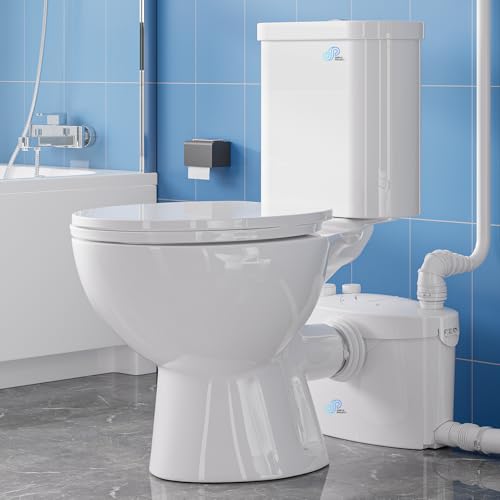
Simple Project 750W PRO Macerating Toilet System
Badge: Best for a Full Added Bathroom
Strengths
- The strongest pump in this guide (750W class) for long or high discharge runs.
- Four inlets — toilet, basin, and shower can share one unit in a complete basement suite.
- Dual flush plus a stated quiet-operation focus tackles the category’s two classic weaknesses together.
Trade-offs
- The biggest installation in the guide: four inlets mean four sets of joints to plan and keep accessible.
- Total dependence on the pump — an outage or pump failure closes the bathroom.
- Specialist brand: verify the replacement-pump pathway before building a whole suite around it.
At a glance: System: macerating upflush; Pump: 750W PRO macerator (stated); Flush: dual flush; Inlets: 4; Intended use: basements and attics; Design: space-saving, quiet-operation focus.
The 750W PRO is the system for the largest version of the upflush idea: not a lone basement toilet, but a complete added bathroom — toilet, basin, and shower — in a basement or attic conversion where the main drain is nowhere near. Four inlets on the pool’s most powerful pump mean one machine serves the whole suite, and dual flush keeps the suite’s most-used fixture from becoming the house’s water hog. In water wise terms, this is systems thinking: one well-chosen pump instead of a slab cut, a pit, and a conventional rough-in that a conversion often cannot accommodate at all.
Simple Project specialises in exactly this niche, and the listing’s emphases — power, inlet count, quiet operation — are the three questions experienced installers ask first. The quiet-operation claim deserves its comparative reading: a macerator will be heard in the room, but a maker engineering against noise is preferable to one ignoring it, especially in a guest suite where the pump sits behind a bedroom wall. The space-saving format likewise suits attic eaves and basement utility corners.
Scale is the limitation. This is a plumbing project with an appliance at its heart, not a toilet swap: more inlets, more joints, more planning, and a single point of failure for the whole bathroom. The brand is a specialist, so confirm — before the suite is framed around it — how a replacement pump is obtained and what the swap involves. For the full conversion brief, nothing else in this pool is as capable; for anything smaller, buy less machine.
Best for: complete basement or attic bathroom suites with several fixtures on one powerful pump / Not suited for: single-toilet additions or anyone unwilling to plan around a pump appliance

SUPERFLO Macerating Toilet System with 600W Macerator Pump
Badge: Best One-Piece Upflush Design
Strengths
- One-piece upflush format with a rear outlet keeps the installation visually tidy in a finished basement bathroom.
- Three inlets explicitly cover sink, shower, and laundry — a utility-room combination few rivals state as clearly.
- 600W-class pump is a sensible middle power for shorter discharge runs, without oversizing the machine.
Trade-offs
- Flush volumes are not stated in the listing; its water case is the controlled pump cycle, not a documented GPF figure.
- Shares the full macerator burden: power dependence, audible cycling, blade and seal maintenance.
- Niche brand — confirm discharge capability against your layout and parts supply before purchase.
At a glance: System: macerating upflush, one-piece; Pump: 600W macerator (stated); Outlet: rear; Inlets: 3 (sink, shower, laundry stated); Intended use: basement bathrooms.
SUPERFLO’s 600W system is the considered middle of the macerating field. Its one-piece upflush format with a rear outlet hides the machinery better than most — in a finished basement bathroom, the installation reads as a toilet, not as equipment — and its three inlets are specified by fixture: sink, shower, and laundry. That laundry inlet is a quietly wise detail for utility-level rooms, where a wash basin or a washer standpipe often needs the same drainage rescue as the toilet, and planning all of it through one pump is cleaner than improvising later.
On water, the honest description is structural. The listing does not state flush volumes, so this guide will not assign it a GPF figure. What a macerating system does by design is meter water through short, controlled pump cycles rather than filling and dumping a large tank, and in an occasional-use basement bathroom the absolute consumption is modest whatever the cycle volume. If your project is a primary bathroom chasing documented efficiency, the gravity picks above state their numbers; if your project is a below-grade room, this system’s tidiness and inlet planning are the relevant virtues.
The caveats are the category’s own: a powered pump with a finite service life, noise you will hear, and a fixture that stops when power does. SUPERFLO is a niche name, so verify the pump’s discharge height and distance against your actual run to the drain, and confirm how replacements are sourced. Within its brief — a neat, complete basement bathroom on one mid-power pump — it is a well-judged package.
Best for: finished basement bathrooms wanting a tidy one-piece look and inlets for sink, shower, or laundry / Not suited for: primary bathrooms, or buyers who need documented per-flush volumes

Simple Project 600W Macerating Toilet System (Silent & Powerful)
Badge: Quietest Macerating Pick
Strengths
- Noise is the headline design target — the right priority for a pump that may sit behind a guest-room wall.
- Four water inlets on a mid-power pump give suite-level flexibility without the flagship’s scale.
- An included AC vent and a 2-piece easy-assembly kit format lower the installation friction for DIYers.
Trade-offs
- Flush volumes unstated in the listing; efficiency rests on the metered pump cycle and user habits.
- ‘Silent’ is a relative claim for any macerator — expect audible cycling, just less of it.
- Same pump-dependence and parts-verification homework as every macerating pick here.
At a glance: System: macerating upflush; Pump: 600W macerator (stated); Inlets: 4 water inlets; Vent: AC vent included; Format: 2-piece kit, easy assembly; Intended use: basement bathrooms.
The second Simple Project system in this guide exists because the first question about any macerator, after ‘will it pump?’, is ‘how loud is it?’. This 600W model is positioned explicitly as the quiet answer — silent and powerful is the maker’s own framing — and for the placements that dominate this category, a pump cycling behind the wall of a basement guest room or beside a home office, that priority is well chosen. Treat the claim comparatively: no macerator is silent, but a system engineered and marketed around reduced noise is the rational bet when noise is your deciding factor.
The rest of the specification is generously complete for a mid-power unit: four water inlets, matching the flagship’s flexibility for a multi-fixture bathroom; an AC vent included in the kit, saving a separate sourcing errand; and a 2-piece format with easy assembly stated, which matters to the DIY installer these systems are usually bought by. In water wise terms, its case parallels the SUPERFLO’s: metered pump cycles in a secondary bathroom, with total consumption governed more by how often the room is used than by any single cycle.
Its limitations are shared and specific. Shared: power dependence, maintenance, and the absolute rule against wipes. Specific: the listing does not state flush volumes, and the easy-assembly promise still describes a project involving discharge plumbing and electrics — confident DIY territory, not a first plumbing job. If your basement bathroom’s success will be judged by a sleeping guest on the other side of the wall, this is the macerating pick to start from.
Best for: basement guest bathrooms and home offices where pump noise is the deciding concern / Not suited for: first-time DIY plumbers, or primary bathrooms with conventional drainage
Comparison Table
| Pick | Type | Flush | Key figure | Standout | Check |
|---|---|---|---|---|---|
| Garvee Two-Piece Elongated Toilet with Side Push Flush | Two-piece gravity | 1.28 GPF side push | Comfort height | cUPC stated | Check on Amazon |
| IDEALHOUSE ADA Compliant 17-Inch Elongated Toilet | Two-piece gravity | 1.28 GPF siphonic jet | 17-inch ADA height | Easy-clean porcelain | Check on Amazon |
| VEVOR Macerating Toilet System with 700W Macerator Pump | Macerating upflush | Dual flush | 700W pump, 3 inlets | Rear discharge | Check on Amazon |
| Simple Project 750W PRO Macerating Toilet System | Macerating upflush | Dual flush | 750W pump, 4 inlets | Full-suite capable | Check on Amazon |
| SUPERFLO Macerating Toilet System with 600W Macerator Pump | Macerating upflush | Volume unstated | 600W pump, 3 inlets | One-piece, rear outlet | Check on Amazon |
| Simple Project 600W Macerating Toilet System (Silent & Powerful) | Macerating upflush | Volume unstated | 600W pump, 4 inlets | Quiet-focused, AC vent | Check on Amazon |
How to Choose a Water Wise Toilet
Begin with the only question that cannot be compromised: where does the waste go? A floor drain at a standard rough-in means a gravity toilet — Garvee or IDEALHOUSE here — and every other consideration is refinement. No floor drain, or a drain above floor level, means a macerating system, and the refinement becomes pump power versus discharge distance, and inlet count versus how many fixtures the new bathroom includes. Buyers who blur this line end up with the classic water wise failure: an efficient toilet installed in a situation it was never designed for, performing badly and being replaced early.
Then read the efficiency claim properly. For gravity toilets, the claim is a number: 1.28 GPF is the current benchmark, and a mechanism should be named beside it — siphonic or siphonic jet designs clear reliably at that volume, which is what prevents the double-flush habit that silently doubles consumption. Do the household maths honestly: the saving per flush against a 1.6 GPF toilet is about a third of a gallon; against a pre-1994 toilet it is over two gallons. Multiply by your household’s daily flushes before deciding how much the upgrade is worth to you — and if you want the broader conservation picture, the strategies in Best Toilets To Save Water extend the same thinking beyond the toilet itself.
For macerating systems, the efficiency claim is structural: metered pump cycles, dual flush where stated, and a bathroom that exists without major construction. Compare pump wattage to your discharge run — longer and higher runs want the 750W class; short runs are honestly served by 600W — and count inlets against fixtures, including the laundry inlet that basement projects so often forget until the utility sink is already bought. Check, too, what the maker states and what it does not: an unstated flush volume is not a scandal, but it should lower the weight you put on efficiency claims relative to documented rivals.
Finally, price in the wisdom of maintenance. A gravity toilet’s water wisdom can be undone by one tired flapper leaking silently for a year, so favour designs with standard, obtainable seals — and plan to check them. A macerator’s wisdom depends on respecting its rules: nothing but waste and toilet paper, service access preserved, power supply reliable. If your household cannot keep those rules — a rental with rotating guests is the hard case — the wisest choice may be the simplest gravity toilet you can install, a trade-off the discussion in Best Toilets Water Sense also circles: certified efficiency only counts when the installation and the users sustain it.
How to Install a Water Wise Toilet and Keep It Wise
A water wise toilet is made or lost at installation and in the first month of ownership. For a gravity model (Garvee, IDEALHOUSE), work through the standard sequence with two efficiency-critical steps emphasised:
- Shut off the supply, remove the old toilet, clean and inspect the flange, and dry-fit the new bowl to confirm the 12-inch rough-in.
- Set a fresh sealing ring, lower the bowl straight onto the bolts, and tighten the nuts alternately — snug, never strained enough to crack porcelain.
- Assemble the tank, connect the supply, and fill the tank. Then set the water level exactly to the mark inside the tank: this adjustment alone decides whether the toilet flushes at its rated 1.28 gallons or quietly uses more on every flush for its whole life.
- Flush repeatedly, confirm one-flush clearance, and check the base, tank joint, and supply connection for weeps.
- Fit the seat, engage any locking mounts fully, and file the manual where you will find it in five years.
- In the first month, drop a food-colouring tablet in the tank overnight once: colour in the bowl by morning means the seal is passing water — the single most common way a water wise toilet stops being one.
For a macerating system (VEVOR, Simple Project, SUPERFLO), set the bowl, connect the pump to the rear outlet, run the discharge line at the maker’s specified diameter, plumb and seal each inlet you use, vent as instructed, and provide the pump’s power outlet. Commission with repeated cycles while watching every joint, and confirm connected fixtures drain without backing up into each other. Then post the house rule where guests will see it if the bathroom serves visitors: toilet paper only. A macerator’s water wisdom survives exactly as long as its blades do.
Troubleshooting
Problem: the toilet clears poorly and invites a second flush → check the tank water level against the maker’s mark before anything else; a level set low at installation is the usual cause, followed by a flapper closing early. Restore the level and retest.
Problem: the water bill creeps up though nobody flushes more → suspect a passing flapper or flush seal. The overnight dye test isolates it; replace the seal with the correct standard part and the silent waste stops.
Problem: a macerator runs long or struggles → stop using the fixture, check the discharge line for kinks and the inlet for obstruction, and never answer a struggling pump with repeated flushing. If a forbidden item went in, the pump needs opening by someone equipped for it — which is why the toilet-paper-only rule exists.
The Hidden Half of Water Wisdom: Leaks, Habits, and the Second Flush
Rated flush volume is the visible half of a toilet’s water story. The hidden half is everything else: the flapper that begins passing a trickle in year three, the fill valve that overfills slightly on every cycle, the household member who holds the handle down ‘to be sure’, and the guest who flushes twice because the first flush looked weak. A genuinely water wise purchase anticipates all four. It chooses a flush design that clears decisively so nobody is tempted to re-flush; it uses standard seals that can be replaced in minutes when they tire; and it is installed with the tank level set to the mark, not to wherever the float happened to stop.
This is also why this guide ranks documented, conventional designs above exotic ones for primary bathrooms. The Garvee and IDEALHOUSE pattern — named mechanism, stated volume, standard rough-in — leaves the fewest hidden variables. Shoppers working through the wider conservation literature, including the efficiency-first angle behind Best Water Efficiency Toilets, will notice the same theme in every credible source: measured savings come from boring reliability compounded over thousands of flushes, not from any single clever feature.
Water Wise Below Grade: Why Macerators Belong in This Guide
It surprises some readers to find pump systems in a water wise guide at all. The reasoning is practical. The alternative to a macerating toilet in a basement is usually one of three things: no bathroom (and occupants traipsing upstairs — no water saved or spent, but a worse house), a sewage ejector pit (a larger, more disruptive construction project with its own pump), or a conventional rough-in cut into the slab at significant cost. The macerator is the least-resource route to a working bathroom, and once installed, its metered cycles and — on the VEVOR and the Simple Project PRO — dual flush keep its ongoing consumption disciplined.
The category’s real water risk is not the flush; it is misuse shortening the pump’s life and sending a whole system to landfill early. That is why the reviews above repeat the toilet-paper-only rule without embarrassment, and why service access matters at installation: a pump that can be reached can be repaired, and a repairable appliance is a water wise appliance. Judge the macerating picks against the rooms they serve, and they earn their place in this guide honestly.
Common Buying Mistakes
Mistake one: worshipping the GPF figure and ignoring clearance. A toilet that needs two flushes uses more water than a slightly higher-rated toilet that clears in one — mechanism and bowl design matter as much as the number.
Mistake two: never setting the tank water level. Installers leave it wherever it lands; owners never check. That one float adjustment is the difference between the rated flush and a lifetime of quiet overuse.
Mistake three: putting a macerator where gravity would work, or a gravity toilet where only a pump can. The drainage question comes first; getting it wrong wastes either machinery or a whole installation.
Mistake four: flushing wipes — including ‘flushable’ ones — through a macerating system. They are the leading cause of premature pump failure, and a failed pump wastes every resource the system was installed to save.
Mistake five: forgetting the seals. A five-minute dye test once a year and a standard replacement flapper when it tires will save more water over a toilet’s life than the difference between most rival models on this page. Relatedly, know your shut-off: the guidance behind Best Type Of Water Shut Off For Toilets is worth reading before you need it at midnight.
Final Recommendation
For a conventional bathroom, buy the Garvee: certified, documented, mechanically simple, and flushing at an honest 1.28 GPF — the water wise brief with the fewest asterisks. Choose the IDEALHOUSE instead when the bathroom serves tall users or anyone with limited mobility, where its stated 17-inch ADA bowl is worth more than any other single feature in this guide.
Below grade, match the machine to the project: the Simple Project 750W PRO for a full added suite, the VEVOR for a basement toilet-and-basin with dual flush, the SUPERFLO 600W for a tidy one-piece finish with a laundry inlet, and the Simple Project 600W when pump noise is the concern that will make or break the room. Whichever of the six you choose, set the water level, keep the seals honest, and enforce the macerator rules — wisdom, in this category, is a maintenance habit as much as a purchase. If your project also involves the supply side of the room, the background in Best Type Of Toilets Filler Water covers the fill-valve choices that pair with these picks.
Start here: Garvee two-piece elongated toilet, IDEALHOUSE 17-inch elongated toilet, VEVOR macerating toilet system.
Frequently Asked Questions
What makes a toilet ‘water wise’ rather than just low flow?
Low flow is a single number; water wise is the whole ownership picture. A water wise toilet posts a low flush volume (1.28 GPF is the current benchmark), clears decisively at that volume so it is not double-flushed, uses seals and parts that can be maintained before they leak, and fits its users and its drainage situation so it is not replaced early. Every pick in this guide was judged against that fuller definition, which is why documented reliability ranks so highly in the reviews.
How much water does a 1.28 GPF toilet actually save?
Against the older 1.6 GPF standard, about a third of a gallon per flush — modest per event, substantial across a household’s daily use over a year. Against a pre-1994 toilet using 3.5 gallons or more, the saving is over two gallons on every single flush, which is why replacing very old toilets is the highest-value water move most homes can make. Exact household totals depend on flush counts, which is why this guide avoids inventing a precise annual figure for your home.
Are macerating toilets water wise?
In their setting, yes. A macerator meters water through controlled pump cycles, several systems here offer dual flush, and the alternative for a below-grade bathroom is usually a far more disruptive construction project. Their water wisdom is conditional on care: toilet paper only, service access preserved, and a pump maintained rather than abused. In a bathroom with a working floor drain, a gravity toilet is always the wiser choice.
Does dual flush always save more than a single 1.28 GPF flush?
Only when it is used as designed. Most flushes are liquid-only, so a household that reliably chooses the reduced flush saves meaningfully more. A household that presses the full flush every time saves nothing extra — in which case a good single-flush 1.28 GPF toilet like the Garvee delivers its full rated saving with no behaviour required. Choose based on your household’s real habits, not its intentions.
How do I stop a water wise toilet from wasting water as it ages?
Watch the seals. Run an overnight dye test — food colouring in the tank, check the bowl in the morning — once or twice a year; colour in the bowl means the flapper or flush seal is passing water and should be cleaned or replaced with the correct standard part. Also re-check the tank water level against the maker’s mark after any fill-valve work. These two habits protect more savings than any other maintenance you can do.
Which pick should I choose for a basement guest bathroom?
Start with the Simple Project 600W if the pump will sit near a sleeping space — it is the noise-focused pick — or the VEVOR if you want dual flush and a toilet-plus-basin arrangement on three inlets. If the project grows into a full suite with a shower, step up to the Simple Project 750W PRO’s four inlets and stronger pump, or the SUPERFLO if a laundry inlet and a one-piece look matter more.


