Disclosure: topratedkitchenware.com is reader-supported. When you buy through links on our site, we may earn an affiliate commission from Amazon and other retailers, at no extra cost to you.
Where to buy
This guide reviews six verified listings for shoppers comparing best commercial farm use 12 volt battery sa tex. Picks that pass every gate for this job are linked; picks that miss on voltage, format or duty are reviewed in full as prose-only entries, with the reason stated in their sections, because a guide that hides its near-misses is not guiding anyone. Start with the linked shortlist, then read the detailed reviews for the fit notes that decide between them.
- yeagulch 12.8V 100Ah LiFePO4 Battery, Group 31 — Check on Amazon
- SUPER EMPOWER 12V 100Ah LiFePO4 Battery, Group 24 — Check on Amazon
- VEMDIA 12V 100Ah LiFePO4 Battery, Group 31 — Check on Amazon
- VEMDIA 12V 100Ah LiFePO4 Battery with Smart BMS, Group 31
- SUPER EMPOWER 12V 100Ah LiFePO4 Battery, Group 24 (2 Pack)
- VATRER POWER 12V 300Ah LiFePO4 Battery with Self-Heating
Read the full guide ↓ for the detailed reviews, the sizing maths and the checks that separate a battery that fits your job from one that merely fits your search.
Farm work asks a battery to do everything: start early in the cold, sit through August heat in a metal shed, power a fence charger for weeks, then run a sprayer pump all afternoon. The best commercial farm use 12 volt battery sa tex buyers (South Texas operations, in the shorthand of the original search) need a 12-volt battery that treats that variety as normal. This guide works through a pool of 12V deep-cycle batteries and judges them the way a farm would: on stamina, heat tolerance, charging forgiveness and how little attention they demand.
Every pick in this pool is a 12V deep-cycle unit, and that shapes the honest scope of the guide. These are the batteries for the farm’s deep-cycle work (solar fence chargers, gate openers, water pumps on solar or stored power, barn lighting, sprayer and utility power, RV and bunkhouse systems), and they are reviewed for exactly that. Pure engine-cranking for tractors and trucks is a different battery class with published cranking figures, and where a job is cranking-first we say so rather than pretend a deep-cycle unit is something it is not.
South Texas conditions run through every judgement below: sustained heat that ages batteries in storage, dust that finds terminals, long distances between the shed and the far fence line, and equipment that may sit for weeks between uses. A battery that thrives in that pattern is worth more than a headline capacity, a point the equipment notes in Best Lawn And Garden 12 Volt Battery U1 make for smaller machines as well.
Key Takeaways
- All six picks are 12V deep-cycle batteries suited to farm auxiliary and off-grid duty; all six are linked.
- The VATRER 300Ah is the long-interval champion for remote solar and fence systems.
- Group 31 100Ah units are the workhorse size for pumps, sprayers and barn systems.
- Low-temperature protection matters less in South Texas than heat discipline: shade, ventilation and clean terminals decide service life.
- For pure tractor cranking, buy a battery with published cranking figures; this pool is the deep-cycle half of the farm’s battery fleet.
In this guide
Quick Picks
| Pick | Badge | Why it is here | Amazon |
|---|---|---|---|
| yeagulch 12.8V 100Ah LiFePO4 Battery, Group 31 | Best All-Round Farm Battery | If a farm could keep only one spare 12V battery on the shelf, this Group 31 unit is the shape it should take: 1280Wh for a real day’s auxiliary work, a 100A BMS for pump-class loads, low-temperature protection for the rare cold snap, and a long cycle-life figure for equipment that cycles daily. | Check on Amazon |
| SUPER EMPOWER 12V 100Ah LiFePO4 Battery, Group 24 | Best for Equipment Rotation | The Group 24 case is the farm’s most portable standard size, and this unit makes the most of it: light enough to move between the sprayer, the fence tester setup and the utility trailer without a hoist, with the same 1280Wh and 100A BMS specification as its bigger-cased rivals. | Check on Amazon |
| VEMDIA 12V 100Ah LiFePO4 Battery, Group 31 | Best Simple Workhorse | There is a kind of farm equipment nobody writes songs about and everybody depends on, and this battery belongs to it. | Check on Amazon |
| VEMDIA 12V 100Ah LiFePO4 Battery with Smart BMS, Group 31 | Best Monitored Mid-Size | The smart BMS variant of the farm’s workhorse size adds low-temperature protection to the same 1280Wh Group 31 formula, and its listing names trolling, RV, solar and home duty, which on a farm reads as: it expects to be worked outdoors and recharged from whatever is available. | Check on Amazon |
| SUPER EMPOWER 12V 100Ah LiFePO4 Battery, Group 24 (2 Pack) | Best Matched Pair for a Barn Bank | Farms build banks: the barn solar array, the well-house backup, the bunkhouse system. | Check on Amazon |
| VATRER POWER 12V 300Ah LiFePO4 Battery with Self-Heating | Best for Remote, Long-Interval Systems | The far fence line is where farm batteries go to be forgotten, and this 300Ah unit is built for exactly that posting. | Check on Amazon |
How These Picks Were Chosen
We verified the pool’s published data (voltage, capacity, watt-hours, BMS rating, case size and named uses) and judged each battery against commercial farm duty: sustained and intermittent loads, solar charging compatibility, storage behaviour between uses, and tolerance of heat and neglect. All six are 12-volt deep-cycle units whose listings name RV, marine, solar, camping or off-grid work, which maps directly onto the farm’s auxiliary power jobs, so all six are linked and ranked by farm role rather than by a single spec. This is research-led guidance from published data; we claim no hands-on farm testing, and we flag the one boundary that matters, engine cranking, wherever it appears.
One further discipline applied throughout: nothing in this guide invents a specification, a price or a performance figure. Where a number appears, it comes from the verified listing data for that product, and where a judgement is ours, it is presented as a judgement, with the reasoning beside it, so you can disagree productively rather than shop blind.
The 6 Best Commercial farm use 12 volt battery sa tex
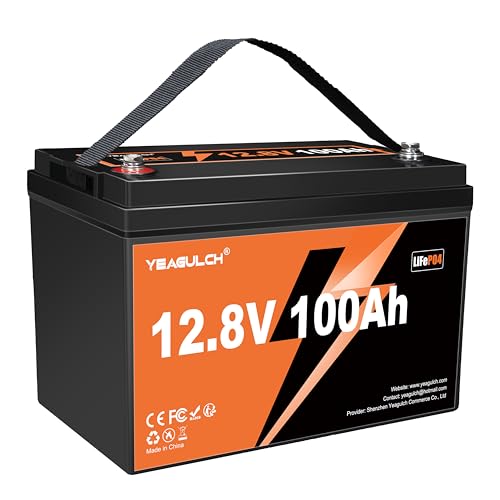
yeagulch 12.8V 100Ah LiFePO4 Battery, Group 31
Badge: Best All-Round Farm Battery
Strengths
- Group 31 case with a full 1280Wh of stored energy
- Low-temperature protection matters for equipment that lives outdoors year-round
- 15000+ cycle maker figure points to long service between replacements
Trade-offs
- Value-brand support runs through the marketplace seller, not a dealer network
- Group 31 case is too large for compact equipment trays
- No self-heating function for sub-freezing charging
| Voltage / capacity | 12.8V, 100Ah |
|---|---|
| Case size | Group 31 |
| Stored energy | 1280Wh |
| Chemistry | LiFePO4 |
| Protection | 100A BMS with low-temperature protection |
| Cycle life (maker figure) | 15000+ deep cycles |
| Named uses in listing | RV, marine, camping, off-grid, home energy storage |
If a farm could keep only one spare 12V battery on the shelf, this Group 31 unit is the shape it should take: 1280Wh for a real day’s auxiliary work, a 100A BMS for pump-class loads, low-temperature protection for the rare cold snap, and a long cycle-life figure for equipment that cycles daily. It will run a sprayer pump, carry a barn lighting circuit, back up a gate opener and take solar charge without complaint, and its standard case size means trays, boxes and hold-downs from any farm supplier fit it. It is not glamorous, and on a farm that is a compliment: it is the battery that gets borrowed for everything and returned without a story.
In specification terms, the headline facts are these: 12.8V, 100Ah; Group 31. Those two lines decide most of what ownership feels like, because they set the energy available each day and the protection standing guard over it. The rest of the published data fills in the supporting cast, and in this pool the listings are unusually willing to state figures that can be checked rather than slogans that cannot.
Best for: Mixed farms needing one dependable deep-cycle battery for many auxiliary jobs / Not suited for: Pure engine-cranking duty, which needs a starter battery with published cranking figures

SUPER EMPOWER 12V 100Ah LiFePO4 Battery, Group 24
Badge: Best for Equipment Rotation
Strengths
- Group 24 case is the most common mid-size battery footprint, so trays and boxes are easy to match
- 100A BMS with low-temperature cutoff covers the main outdoor risks
- Documented 4P4S expansion path, up to 20.48kWh
Trade-offs
- 100Ah is a mid-size bank: heavy daily loads will want a second unit in parallel
- No self-heating function, so sub-freezing charging relies on the cutoff alone
- Value-brand warranty handling is seller-based rather than dealer-based
| Voltage / capacity | 12V, 100Ah |
|---|---|
| Case size | Group 24 |
| Stored energy | 1280Wh |
| Chemistry | LiFePO4 |
| Protection | Built-in 100A BMS with low-temperature cutoff |
| Expansion | Supports 4P4S configuration, up to 20.48kWh |
| Named uses in listing | RVs, trolling motors, marine, solar |
The Group 24 case is the farm’s most portable standard size, and this unit makes the most of it: light enough to move between the sprayer, the fence tester setup and the utility trailer without a hoist, with the same 1280Wh and 100A BMS specification as its bigger-cased rivals. The documented 4P4S expansion means a unit bought singly for odd jobs can later join a matched bank for the barn solar system. On operations where batteries rotate between machines across the week, that combination of standard size, honest capacity and growth path is exactly the working answer.
Put the published numbers together and a character emerges: 12V, 100Ah, with 1280Wh. That combination is what the detailed judgements in this section rest on. Where the maker publishes a figure, we report it as a maker’s figure; where the listing is silent, we leave the gap visible rather than filling it with a guess, because a visible gap is information a buyer can act on.
Best for: Farms that move one battery between several machines and jobs / Not suited for: Fixed high-capacity banks, where a larger single unit is tidier

VEMDIA 12V 100Ah LiFePO4 Battery, Group 31
Badge: Best Simple Workhorse
Strengths
- Group 31 case suits the larger standard battery boxes and trays
- 15000-cycle maker figure signals a long-service design intent
- Straightforward 100A BMS specification with no app or account required
Trade-offs
- The listing does not name low-temperature charge protection, so cold-weather charging needs owner discipline
- Group 31 size will not fit Group 24 trays
- No app monitoring or self-heating extras
| Voltage / capacity | 12V, 100Ah |
|---|---|
| Case size | Group 31 |
| Chemistry | LiFePO4 (lithium iron phosphate cells) |
| Protection | Built-in 100A BMS |
| Cycle life (maker figure) | 15000 deep cycles |
| Named uses in listing | Solar systems, home energy, RVs, marine |
There is a kind of farm equipment nobody writes songs about and everybody depends on, and this battery belongs to it. A plain Group 31 LiFePO4 block with a 100A BMS, a long cycle-life figure and no app, account or self-heating extras to configure or fail. For a pump house, a lighting circuit or a solar gate system that gets checked when someone passes, that simplicity is the feature: connect it correctly, charge it on a lithium profile, and let it work. Its listing does not name low-temperature charge protection, a minor gap in South Texas, where the bigger enemy is summer heat in a closed shed.
The practical reading of its data sheet runs as follows: Group 31; Built-in 100A BMS. Neither line is glamorous, and both matter more in the second year of ownership than the first, when protection behaviour and honest capacity have had time to separate the well-specified batteries from the merely well-described ones. This pick’s paperwork, taken as a whole, supports the role this guide assigns it.
Best for: Set-and-forget auxiliary systems checked on a passing-by basis / Not suited for: Owners who want monitoring apps or cold-climate charging features

VEMDIA 12V 100Ah LiFePO4 Battery with Smart BMS, Group 31
Badge: Best Monitored Mid-Size
Strengths
- Smart BMS with low-temperature protection in a standard Group 31 case
- 1280Wh capacity is the workhorse size for a single-battery system
- Listing names trolling motor, RV, solar and home duty explicitly
Trade-offs
- Smart features still stop short of app monitoring or self-heating
- Group 31 footprint excludes compact trays and boxes
- Two near-identical VEMDIA variants in the market make careful model checking essential
| Voltage / capacity | 12V, 100Ah |
|---|---|
| Case size | Group 31 |
| Stored energy | 1280Wh |
| Chemistry | LiFePO4 (lithium iron phosphate) |
| Protection | Built-in 100A smart BMS with low-temperature protection |
| Cycle life (maker figure) | 15000+ deep cycles |
| Named uses in listing | RV, marine trolling motor, solar, home, off-grid |
The smart BMS variant of the farm’s workhorse size adds low-temperature protection to the same 1280Wh Group 31 formula, and its listing names trolling, RV, solar and home duty, which on a farm reads as: it expects to be worked outdoors and recharged from whatever is available. Choose it over its plainer sibling when the battery will live somewhere genuinely cold-exposed in winter or when the extra protection layer is worth having on a system nobody watches closely. The two VEMDIA variants are close enough that buyers should check the model on the order twice; the battery itself will not care, but your records should.
In specification terms, the headline facts are these: 12V, 100Ah; Group 31. Those two lines decide most of what ownership feels like, because they set the energy available each day and the protection standing guard over it. The rest of the published data fills in the supporting cast, and in this pool the listings are unusually willing to state figures that can be checked rather than slogans that cannot.
Best for: Unattended outdoor systems that want the extra protection layer / Not suited for: Buyers who prefer the plainest possible specification and will never use the extras

SUPER EMPOWER 12V 100Ah LiFePO4 Battery, Group 24 (2 Pack)
Badge: Best Matched Pair for a Barn Bank
Strengths
- Sold as a matched 2 pack, so a series pair starts life balanced instead of mixing an old and a new battery
- 100A BMS per unit with low-temperature cutoff protects the pair on cold mornings
- Documented 4P4S expansion path lets the same units grow into a larger bank later
Trade-offs
- Each unit is still a 12V battery: the 24V result depends on correct series wiring by the owner
- Two units mean two sets of terminals and cables to inspect and keep tight
- LiFePO4 needs a lithium-compatible charger profile to fill completely
| Voltage / capacity | 12V, 100Ah per unit, sold as a 2 pack |
|---|---|
| Stored energy | 1280Wh per unit |
| Chemistry | LiFePO4 (lithium iron phosphate) |
| Protection | Built-in 100A BMS with low-temperature cutoff |
| Expansion | Supports 4P4S configuration, up to 20.48kWh |
| Named uses in listing | RV, trolling motor, marine, solar |
Farms build banks: the barn solar array, the well-house backup, the bunkhouse system. Buying capacity as a factory-matched 2-pack is the clean way to start one, because parallel or series partners that share a birth date and a model number age together instead of arguing. Each unit brings 1280Wh and a 100A BMS with low-temperature cutoff, and the documented expansion path runs to a genuinely large bank if the operation grows into it. Bought as a pair and installed as a pair, this is the pool’s tidiest foundation for a fixed farm power system.
Put the published numbers together and a character emerges: 12V, 100Ah per unit, sold as a 2 pack, with LiFePO4 (lithium iron phosphate). That combination is what the detailed judgements in this section rest on. Where the maker publishes a figure, we report it as a maker’s figure; where the listing is silent, we leave the gap visible rather than filling it with a guess, because a visible gap is information a buyer can act on.
Best for: Barn, well-house and bunkhouse banks built from matched units / Not suited for: Single odd-job use, where the second unit becomes expensive shelf stock

VATRER POWER 12V 300Ah LiFePO4 Battery with Self-Heating
Badge: Best for Remote, Long-Interval Systems
Strengths
- 300Ah in a single unit removes the wiring and balancing work of a parallel pair
- Self-heating function addresses the cold-charge weakness of lithium chemistries
- App monitoring plus a 200A BMS with high and low temperature cutoffs
Trade-offs
- 300Ah is far more battery than small or occasional loads can justify
- A single large unit concentrates cost and failure risk in one case
- Self-heating consumes some stored energy to warm the cells
| Voltage / capacity | 12V, 300Ah |
|---|---|
| Chemistry | LiFePO4 deep cycle |
| Protection | Built-in 200A BMS with low/high temperature cutoff |
| Extra features | Self-heating function and app monitoring |
| Named uses in listing | RV, camping, off-grid applications |
The far fence line is where farm batteries go to be forgotten, and this 300Ah unit is built for exactly that posting. Its capacity stretches the interval between visits to remote solar and fence systems, its 200A BMS handles pump-class surges when a stock-water system kicks on, app monitoring lets a manager check the bank without a drive, and self-heating covers the occasional freeze that catches South Texas unprepared. It is the premium-tier option in this pool and it earns the position on systems where a service visit costs more than the battery upgrade did. For a gate opener by the house, it is far more battery than the job needs.
The practical reading of its data sheet runs as follows: LiFePO4 deep cycle; Self-heating function and app monitoring. Neither line is glamorous, and both matter more in the second year of ownership than the first, when protection behaviour and honest capacity have had time to separate the well-specified batteries from the merely well-described ones. This pick’s paperwork, taken as a whole, supports the role this guide assigns it.
Best for: Remote solar, fence and stock-water systems visited infrequently / Not suited for: Small single loads near the house, where its capacity is wasted
Comparison Table
| Pick | Voltage / Capacity | Case or Format | Protection / Discharge | Best for | Amazon |
|---|---|---|---|---|---|
| yeagulch 12.8V 100Ah LiFePO4 Battery, Group 31 | 12.8V, 100Ah | Group 31 | 100A BMS with low-temperature protection | Mixed farms needing one dependable deep-cycle battery for many auxiliary jobs | Check on Amazon |
| SUPER EMPOWER 12V 100Ah LiFePO4 Battery, Group 24 | 12V, 100Ah | Group 24 | Built-in 100A BMS with low-temperature cutoff | Farms that move one battery between several machines and jobs | Check on Amazon |
| VEMDIA 12V 100Ah LiFePO4 Battery, Group 31 | 12V, 100Ah | Group 31 | Built-in 100A BMS | Set-and-forget auxiliary systems checked on a passing-by basis | Check on Amazon |
| VEMDIA 12V 100Ah LiFePO4 Battery with Smart BMS, Group 31 | 12V, 100Ah | Group 31 | Built-in 100A smart BMS with low-temperature protection | Unattended outdoor systems that want the extra protection layer | Check on Amazon |
| SUPER EMPOWER 12V 100Ah LiFePO4 Battery, Group 24 (2 Pack) | 12V, 100Ah per unit, sold as a 2 pack | See spec box in its review | Built-in 100A BMS with low-temperature cutoff | Barn, well-house and bunkhouse banks built from matched units | Check on Amazon |
| VATRER POWER 12V 300Ah LiFePO4 Battery with Self-Heating | 12V, 300Ah | See spec box in its review | Built-in 200A BMS with low/high temperature cutoff | Remote solar, fence and stock-water systems visited infrequently | Check on Amazon |
How to Choose: best commercial farm use 12 volt battery sa tex, Decided Properly
Separate the farm’s battery jobs into two fleets
Cranking and deep-cycle work age batteries differently and reward different designs. Keep starter batteries, chosen on published cranking figures, for tractors and trucks; keep deep-cycle units, chosen on usable capacity and protection, for everything that runs for hours. The picks in this guide are the second fleet, and a farm that stops asking one battery to do both jobs will replace batteries less often across the whole operation.
Heat is the service-life specification in South Texas
Calendar ageing accelerates with temperature, so where a battery lives matters as much as what it is. A shaded, ventilated mounting in the barn beats a sealed box in the sun every time, and a battery stored charged-or-maintained through the summer survives to work in the autumn. When comparing picks, treat low-temperature features as minor here and put your money into capacity, protection and a mounting spot with moving air.
Size for the interval between visits
A system checked daily can be sized close to its daily draw. A system visited monthly must carry the month, including the cloudy week and the pump that ran long. Work out the honest load, multiply by the days between visits, add a margin for the worst week, and buy that number. The 300Ah pick exists because on remote systems the maths, done honestly, often lands there.
Charging infrastructure is part of the purchase
Lithium batteries want a lithium-profile charger or a solar controller set for lithium; the farm’s legacy lead-acid charger may undercharge them forever without ever showing a fault. Budget the charger check with the battery purchase, label each charger with the chemistry it serves, and keep one known-good charger at the home place for recoveries.
Temperature cuts both ways. Heat accelerates the ageing of every chemistry, shortening the calendar life of a battery stored in a hot shed, a sun-baked compartment or an engine bay. Cold does the opposite damage in the moment: capacity shrinks, voltage sags earlier under load, and lithium cells can be harmed by charging below freezing, which is exactly why low-temperature charge cut-offs and self-heating functions appear in the better listings in this pool. Where a battery lives is therefore a specification in its own right, and a shaded, ventilated, dry mounting spot is free performance.
Storage habits decide whether a battery wakes up healthy in spring. Lithium iron phosphate prefers to rest at a partial charge in a cool, dry place, checked and topped occasionally; lead acid prefers the opposite discipline, resting fully charged with a maintainer attached so self-discharge never drags it into the damage zone. Either way, disconnect parasitic loads, clean and dry the terminals, note the date and the resting voltage in a notebook or phone note, and schedule a mid-storage check. Ten minutes of routine beats a replacement purchase at the start of the season.
Measuring your real load beats guessing it. A plug-in meter on a charger, a clamp meter on a cable, or a simple log of run-times and recharge behaviour across a week will tell you more than any forum estimate. Once you know the honest daily draw, the sizing maths in this guide becomes simple arithmetic instead of optimism, and the battery you choose will be the one the equipment actually needed. Owners who measure once rarely buy the wrong capacity twice, and they can spot a fading battery months before it strands them.
Terminal hardware is a small cost that protects a large one. The right lug size for the cable, stainless hardware where corrosion is a risk, anti-corrosion treatment on lead posts, and a torque check with a real wrench rather than a guess all belong in the installation budget. Heat at a terminal under load is the tell-tale of a bad joint, and it can be found with the back of a hand after a working session. Fix hot joints immediately: they waste energy, confuse voltage readings and, left alone, damage cables and battery posts.
Solar pairing changes the buying maths for outdoor and off-grid systems. A battery that recharges from panels must accept charge efficiently across a variable day, tolerate partial-charge living, and protect itself when a cold bright morning follows a hard night. Lithium iron phosphate suits that rhythm well, which is why so many listings in this pool name solar duty, but the charge controller’s profile matters as much as the battery: set it for the chemistry you actually bought, confirm the temperature compensation behaviour, and size the array for the worst month, not the best.
Warranty and support are part of the product, especially from value brands selling through marketplaces. Read what the warranty actually covers, how a claim is started, whether return shipping of a heavy battery is addressed, and whether the seller answers technical questions with specifics or slogans. Keep the order record, photograph the installed bank, and save the manual’s charging table. A slightly less glamorous specification from a seller who documents everything is often the better long-term buy than a headline number with no paperwork behind it.
Reading a listing critically is a skill this category rewards. Look for the figures that can be checked: capacity in amp-hours and watt-hours that agree with each other, a named BMS current, a case group size you can measure against your tray, and certifications printed in full. Be wary of listings that shout a single huge number with no supporting detail, that borrow the vocabulary of a different chemistry, or that promise compatibility with everything. The picks in this guide were chosen partly because their titles state verifiable facts that a buyer can hold the seller to.
Cable and connection quality decides how much of a battery’s capability ever reaches the equipment. Undersized cable, corroded terminals and loose lugs all add resistance, and resistance shows up as voltage sag under load, nuisance low-voltage cut-outs and heat at the connection point. Use cable sized for the highest continuous draw, keep runs as short as the layout allows, crimp and seal lugs properly, and re-check terminal tightness after the first few weeks of vibration in service. Many ‘weak battery’ complaints brought to dealers trace back to a connection, not a cell.
Parallel banks share current unevenly when they are built carelessly. Differences in cable length, terminal condition and internal resistance mean one unit works harder, ages faster and eventually drags the bank down to its level. Build parallel connections symmetrically, take the main feeds from diagonally opposite corners of the bank, keep interconnects equal, and check individual unit voltages at the first few services. A bank is a team, and the maintenance habit that keeps it one is verifying that every member is still doing its share.
Charging is where mismatched equipment does its slow damage. A charger built for flooded lead acid may never push a lithium battery to a full charge, and an aggressive equalisation stage can trip a lithium battery’s protection or stress an AGM unit. Before any battery in this guide earns its place, match it to a charger with the correct profile for its chemistry, confirm the charger’s voltage settings in the manual, and treat the first full charge as a supervised event: watch for heat, swelling, error lights or a protection cut-off, and only then settle into a routine.
Reserve thinking separates a system that copes from one that strands you. Size for the ordinary day, then ask what the bad day looks like: the overcast stretch that starves a solar input, the headwind that doubles motor consumption, the cold snap that shrinks capacity, the guest load nobody planned for. A bank with honest headroom cycles shallower, sags less and lasts longer, and the cheapest time to buy that headroom is at the first purchase, because adding a mismatched unit to an aged bank a year later rarely performs as well as a matched bank bought together.
Disposal is the last specification. Lead acid batteries are among the most completely recycled products in commerce, and core-charge systems exist to pull them back; lithium packs go through battery recycling channels rather than household waste. Plan the exit when you buy the entrance: keep the packaging until the install is proven, note the retailer’s take-back route, and never let a retired battery sit leaking in a corner of the shed. Responsible disposal is also practical, because core value returned on an old unit offsets part of the next purchase.
Safety with any high-capacity battery is mostly about respecting stored energy. Fuse the main positive cable close to the battery, insulate terminals against dropped tools, keep metal jewellery and loose hardware away during installation, and never bypass a protection device that keeps tripping: a BMS that disconnects is reporting a condition, not malfunctioning. Ventilation still matters for lead acid under charge, eye protection is cheap insurance around any battery work, and a battery that is swollen, cracked, leaking or hot at rest leaves service immediately, whatever its age.
Depth of discharge is the quiet number that decides how long any battery in this guide actually lives. Lead acid designs give their longest service when daily use takes only a modest share of the nameplate capacity, while lithium iron phosphate tolerates much deeper daily cycling because its chemistry and its battery management system guard the cells at both ends of the charge range. When you compare two batteries with the same amp-hour figure, ask how much of that capacity you are honestly allowed to use every day, because the usable figure, not the printed one, is what runs your equipment between charges.
Voltage sag under load is the symptom owners describe most and understand least. Every battery’s terminal voltage dips while it delivers current; the question is how far and how fast. A healthy bank of the right size dips modestly and recovers at rest, while an undersized, aged or cold bank dips hard, trips low-voltage alarms and makes equipment behave as if it were faulty. When a system misbehaves, measure voltage at the battery under the real load before blaming the equipment: the number separates a battery problem from a wiring problem from a genuinely failing device.
Weight is a specification with daily consequences. Lithium iron phosphate stores the same energy at roughly half the weight of lead acid, which changes who can lift the battery, where it can be mounted, and how the vehicle or equipment balances and rides. In weight-sensitive installs that difference can be the whole decision; in fixed installs it matters less, and lead acid’s lower purchase tier and tolerant charging behaviour can be the smarter trade. Decide with your back, your mounting structure and your payload limit in the room, not just the capacity chart.
Cycle-life figures deserve a sceptical but fair reading. Makers quote cycles under stated conditions, usually a defined depth of discharge at a moderate rate and temperature, so a headline number is a comparison tool rather than a promise about your installation. Shallow daily cycling, moderate temperatures and correct charging stretch real life toward the maker’s figure; deep daily cycling in heat pulls it down. Compare like with like across the picks, treat the figure as evidence of design intent, and put more weight on the protection features that guard the battery in your actual conditions.
How to Install and Maintain Farm 12V Batteries
- Mount the battery shaded and ventilated, secured against vibration and the occasional knock from equipment, with terminals protected from tools, chain and weather. Farm dust is conductive enough, given time and moisture, to matter; a cover or a clean mounting shelf is cheap insurance.
- Fuse the main positive run near the battery, size cables for the largest sustained load (pumps surge at start), and use sealed, crimped lugs. A connection that is merely tight today works loose under a season of vibration, so re-torque at the first service.
- For solar systems, set the charge controller to its lithium profile, confirm temperature behaviour, and size the panel for the worst month the system must survive, not the best.
- Build a passing-by checklist: glance at the indicator or app, feel for a warm terminal after work, look for dust blankets, corrosion or rodent damage to cables. Farms run on passing-by maintenance; design for it.
- Rotate and record: label each battery with its purchase date and home system, and keep a notebook page per system. When a unit weakens, the record tells you whether it is age, abuse or a charging fault before you spend money.
- Troubleshooting. Problem: the fence charger fades after a few weeks → the bank is undersized for the interval or the panel is shaded or dusty; clean the panel and recheck the maths before replacing the battery. Problem: a pump trips the battery’s protection at start → start-up surge exceeds the BMS rating; a higher-BMS pick or a soft-start arrangement is the fix. Problem: a stored battery is dead by spring → parasitic draw or self-discharge through a hot storage season; disconnect, maintain, and store shaded.
Solar Fence Chargers and Stock Water: The Signature Farm Loads
A solar fence system is a small daily load with a non-negotiable schedule, which makes it a capacity-and-reliability purchase rather than a power purchase. The battery must accept a variable solar day, shrug off partial-charge living, and still be standing after the cloudy week. Every linked pick suits that rhythm, and the choice between them is interval and surge: small chargers near the house take a 100Ah unit; remote lines and stock-water pumps that surge at start want the 200A BMS of the 300Ah pick. The sizing habits in Best Lawn And Garden 12 Volt Battery translate directly to the smaller machines that share the same batteries.
Stock water deserves its own sentence because failure is not an inconvenience, it is a welfare problem. Systems that water animals get the margin: bigger bank, monitored if possible, and a manual fallback plan. That is the one farm load where buying the premium pick is not indulgence but insurance.
The Shed Shelf: Spares, Rotation and Honest Retirement
A working farm keeps a spare battery the way it keeps a spare belt: because the day it is needed, the store is far and the job is now. The picks here make good shelf spares because their standard case sizes fit many trays, but a spare only counts if it is maintained: stored shaded, checked on a calendar, and rotated into service so it ages in harness rather than on the shelf. The vehicle side of the fleet follows different rules, covered in Best Cranking Amp 12 Volt Battery and Best Lithium 12 Volt Car Battery, where cranking figures rule the decision.
Retirement should be equally unsentimental. A deep-cycle battery that no longer holds a working charge moves to the lightest duty or to recycling, not into a bank where it becomes the weak member that limits good units. Label, date and decide: the farms that spend least on batteries are the ones that manage them as a fleet with records, not as a pile of black boxes.
Common Buying Mistakes
- Asking a deep-cycle battery to crank a tractor, or a starter battery to run a fence line, and blaming the battery for the mismatch.
- Storing batteries in a sealed, sun-heated box and wondering why service life halved.
- Charging lithium batteries for years on an unexamined lead-acid charger profile.
- Sizing a remote system for the average week instead of the worst week between visits.
- Mixing ages and models in a bank and letting the weakest unit set the performance.
- Never labelling batteries, so no one knows what is new, what is tired and what is lying.
Final Recommendation
Readers working through the neighbouring question of Best Lithium 12 Volt Motorcycle Battery will find the same evidence standards applied there. The adjacent guide to Best Batteries To Use For 24 Volt Trolling Motor covers the closest variation of this job.
Keep it simple: the yeagulch Group 31 is the farm’s all-round deep-cycle battery, the SUPER EMPOWER Group 24 rotates between machines, and the SUPER EMPOWER 2-pack founds a barn bank properly. For remote fence and stock-water systems visited rarely, step up to the VATRER 300Ah and let its capacity and monitoring stretch the interval. And keep the fleets separate: starter batteries for cranking, these deep-cycle picks for everything that runs for hours.
Frequently Asked Questions
Can these batteries start a tractor or truck?
They are deep-cycle batteries without published cranking figures, and their BMS limits sit below starter-motor demand on the lithium units. Use a starter battery chosen on cranking figures for engines, and these picks for the farm’s sustained loads.
Which pick suits a solar fence charger best?
Any of the 100Ah units for lines near the home place, sized by the interval between visits. For remote lines, the 300Ah VATRER stretches visits and its monitoring saves drives out to check.
How do I protect batteries from South Texas heat?
Mount shaded and ventilated, keep terminals clean under a cover, avoid sealed sun-baked boxes, and store spares in the coolest dry spot available. Heat discipline is worth more than any single feature in this climate.
Can I charge these from the farm’s existing solar controller?
Yes, if the controller offers a lithium profile; set it before connecting. Controllers without a lithium setting may undercharge the battery indefinitely, which looks like a battery fault and is not.
Is a matched 2-pack worth it for a barn bank?
Yes. Units that start life identical age together, share work evenly and save the troubleshooting that mixed banks generate. The small premium buys a quieter system for years.
How long between visits can a remote system run?
Divide the bank’s usable watt-hours by the load’s honest daily watt-hours, then discount for cloudy stretches. The method, not a headline number, is what keeps stock water running.
What retires a farm battery?
When it no longer holds a working charge for its assigned duty after a correct full charge, move it to lighter duty or recycle it. Do not leave it in a bank, where it limits the healthy units.