Disclosure: topratedkitchenware.com is reader-supported. When you buy through links on our site, we may earn an affiliate commission from Amazon and other retailers, at no extra cost to you.
Where to buy
This guide reviews six verified listings for shoppers comparing best lawn and garden 12 volt battery. Picks that pass every gate for this job are linked; picks that miss on voltage, format or duty are reviewed in full as prose-only entries, with the reason stated in their sections, because a guide that hides its near-misses is not guiding anyone. Start with the linked shortlist, then read the detailed reviews for the fit notes that decide between them.
- yeagulch 12.8V 100Ah LiFePO4 Battery, Group 31 — Check on Amazon
- SUPER EMPOWER 12V 100Ah LiFePO4 Battery, Group 24 — Check on Amazon
- VEMDIA 12V 100Ah LiFePO4 Battery, Group 31 — Check on Amazon
- VEMDIA 12V 100Ah LiFePO4 Battery with Smart BMS, Group 31
- SUPER EMPOWER 12V 100Ah LiFePO4 Battery, Group 24 (2 Pack)
- VATRER POWER 12V 300Ah LiFePO4 Battery with Self-Heating
Read the full guide ↓ for the detailed reviews, the sizing maths and the checks that separate a battery that fits your job from one that merely fits your search.
The best lawn and garden 12 volt battery has to survive a peculiar life: hard work in mowing season, long naps in the shed, dust, vibration, and owners who think about it twice a year. This guide works through a pool of full-size 12V deep-cycle batteries and judges them for the lawn and garden jobs they genuinely fit: large garden tractors and estate equipment with full-size battery boxes, utility vehicles, sprayers, solar garden systems and the backup power a property runs on.
One boundary is stated up front, because honesty here saves returns: most compact riding mowers take a small U1-class battery, and none of these full-size Group 24 and Group 31 blocks fits a U1 tray. If your mower’s battery lives in a compact tray under the seat, the dedicated discussion at Best Lawn And Garden 12 Volt Battery U1 is your guide. If your equipment has a full-size box, or your garden power needs are bigger than a mower, read on: this pool is strong, long-lived and well suited to property-scale work.
All six picks are linked, because all six serve the full-size end of lawn and garden duty well. They are ranked by role (the all-rounder, the bank-builder, the remote-system champion) rather than by a single number, and every judgement uses only the verified listing data: capacity, watt-hours, BMS rating, case size and named uses.
Key Takeaways
- All six picks are full-size 12V deep-cycle batteries for estate-scale lawn and garden equipment and property power systems; all six are linked.
- Compact U1 mower trays are out of scope for this pool; measure your tray before ordering anything.
- The yeagulch Group 31 is the all-round pick; the VATRER 300Ah anchors remote solar and water systems.
- LiFePO4’s light weight matters on equipment you lift batteries in and out of each season.
- Off-season storage discipline decides whether any of these is still strong in year three.
In this guide
Quick Picks
| Pick | Badge | Why it is here | Amazon |
|---|---|---|---|
| yeagulch 12.8V 100Ah LiFePO4 Battery, Group 31 | Best Overall for Property Work | The all-rounder earns its place by having no awkward questions: a standard Group 31 case that fits the larger equipment boxes, 1280Wh for a full day of spraying, hauling or powering the shed, a 100A BMS for pump-class loads, low-temperature protection for the shoulder seasons, and a long cycle-life figure for equipment that works weekly. | Check on Amazon |
| SUPER EMPOWER 12V 100Ah LiFePO4 Battery, Group 24 | Best for Seasonal Swapping | The Group 24 case is the friendliest size in this pool for equipment that gives its battery back every winter: smaller, lighter, easier to carry to the bench for storage, and still carrying the same 1280Wh and 100A BMS specification as its Group 31 rivals. | Check on Amazon |
| VEMDIA 12V 100Ah LiFePO4 Battery, Group 31 | Best Simple Shed Battery | For the shed system (lights, a radio, tool charging, the occasional pump) this plain Group 31 block is the pool’s least demanding citizen: no app, no self-heating, no configuration, just a 100A BMS and a long cycle-life figure behind a standard case. | Check on Amazon |
| VEMDIA 12V 100Ah LiFePO4 Battery with Smart BMS, Group 31 | Best Protected Mid-Size | The smart-BMS sibling adds low-temperature protection to the same 1280Wh Group 31 formula, and for equipment that lives outdoors through the shoulder seasons (a sprayer that starts early, a gate system that never sleeps) that protection is the difference between a battery that guards itself and one that relies on the owner’s memory. | Check on Amazon |
| SUPER EMPOWER 12V 100Ah LiFePO4 Battery, Group 24 (2 Pack) | Best for Building a Property Bank | Properties grow power systems the way they grow everything else: a panel for the gate becomes a bank for the shed becomes backup for the well house. | Check on Amazon |
| VATRER POWER 12V 300Ah LiFePO4 Battery with Self-Heating | Best for Remote Garden Systems | The far end of a property (the irrigation pump, the stock tank, the gate at the road) is where batteries earn their keep unobserved, and this 300Ah unit is built for the posting: capacity that stretches service intervals, a 200A BMS for pump surges, app monitoring that saves a walk or a drive, and self-heating for the freeze that arrives unannounced. | Check on Amazon |
How These Picks Were Chosen
We checked each pool battery’s verified data against the lawn and garden jobs that take full-size batteries: estate and garden tractors with Group 24 or Group 31 boxes, utility and side-by-side vehicles used around a property, tow sprayers, solar lighting and gate systems, and small off-grid setups for sheds and outbuildings. All six picks are 12V deep-cycle units whose listings name RV, marine, solar, camping or off-grid service, which is the same duty pattern as property work, so all six are linked. The U1 boundary is flagged wherever a reader might meet it, because a battery that cannot physically fit is not a recommendation at all. This guide is research-led, built on published specifications; we claim no hands-on testing.
One further discipline applied throughout: nothing in this guide invents a specification, a price or a performance figure. Where a number appears, it comes from the verified listing data for that product, and where a judgement is ours, it is presented as a judgement, with the reasoning beside it, so you can disagree productively rather than shop blind.
The 6 Best Lawn and garden 12 volt battery
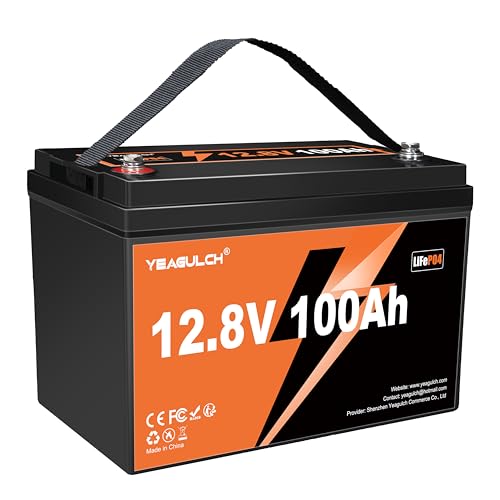
yeagulch 12.8V 100Ah LiFePO4 Battery, Group 31
Badge: Best Overall for Property Work
Strengths
- Group 31 case with a full 1280Wh of stored energy
- Low-temperature protection matters for equipment that lives outdoors year-round
- 15000+ cycle maker figure points to long service between replacements
Trade-offs
- Value-brand support runs through the marketplace seller, not a dealer network
- Group 31 case is too large for compact equipment trays
- No self-heating function for sub-freezing charging
| Voltage / capacity | 12.8V, 100Ah |
|---|---|
| Case size | Group 31 |
| Stored energy | 1280Wh |
| Chemistry | LiFePO4 |
| Protection | 100A BMS with low-temperature protection |
| Cycle life (maker figure) | 15000+ deep cycles |
| Named uses in listing | RV, marine, camping, off-grid, home energy storage |
The all-rounder earns its place by having no awkward questions: a standard Group 31 case that fits the larger equipment boxes, 1280Wh for a full day of spraying, hauling or powering the shed, a 100A BMS for pump-class loads, low-temperature protection for the shoulder seasons, and a long cycle-life figure for equipment that works weekly. On a property, the battery that gets chosen for everything should be the one that is merely good at everything, and this is it. Its weight is the usual lithium advantage over lead acid, which your back will notice at the seasonal swap.
Put the published numbers together and a character emerges: 12.8V, 100Ah, with 1280Wh. That combination is what the detailed judgements in this section rest on. Where the maker publishes a figure, we report it as a maker’s figure; where the listing is silent, we leave the gap visible rather than filling it with a guess, because a visible gap is information a buyer can act on.
Best for: Estate tractors, utility vehicles and general property power / Not suited for: Compact U1 mower trays, which it physically cannot fit

SUPER EMPOWER 12V 100Ah LiFePO4 Battery, Group 24
Badge: Best for Seasonal Swapping
Strengths
- Group 24 case is the most common mid-size battery footprint, so trays and boxes are easy to match
- 100A BMS with low-temperature cutoff covers the main outdoor risks
- Documented 4P4S expansion path, up to 20.48kWh
Trade-offs
- 100Ah is a mid-size bank: heavy daily loads will want a second unit in parallel
- No self-heating function, so sub-freezing charging relies on the cutoff alone
- Value-brand warranty handling is seller-based rather than dealer-based
| Voltage / capacity | 12V, 100Ah |
|---|---|
| Case size | Group 24 |
| Stored energy | 1280Wh |
| Chemistry | LiFePO4 |
| Protection | Built-in 100A BMS with low-temperature cutoff |
| Expansion | Supports 4P4S configuration, up to 20.48kWh |
| Named uses in listing | RVs, trolling motors, marine, solar |
The Group 24 case is the friendliest size in this pool for equipment that gives its battery back every winter: smaller, lighter, easier to carry to the bench for storage, and still carrying the same 1280Wh and 100A BMS specification as its Group 31 rivals. For a garden tractor that works hard from April to October and rests all winter, that combination is the sweet spot, and the documented expansion path means the same unit can join a shed solar bank later in its life instead of being retired. Seasonal equipment rewards owners who store batteries properly, and this is the easiest pick here to store properly.
The practical reading of its data sheet runs as follows: Group 24; LiFePO4. Neither line is glamorous, and both matter more in the second year of ownership than the first, when protection behaviour and honest capacity have had time to separate the well-specified batteries from the merely well-described ones. This pick’s paperwork, taken as a whole, supports the role this guide assigns it.
Best for: Garden tractors and seasonal machines with Group 24 boxes / Not suited for: Fixed high-capacity banks, where one larger unit is tidier

VEMDIA 12V 100Ah LiFePO4 Battery, Group 31
Badge: Best Simple Shed Battery
Strengths
- Group 31 case suits the larger standard battery boxes and trays
- 15000-cycle maker figure signals a long-service design intent
- Straightforward 100A BMS specification with no app or account required
Trade-offs
- The listing does not name low-temperature charge protection, so cold-weather charging needs owner discipline
- Group 31 size will not fit Group 24 trays
- No app monitoring or self-heating extras
| Voltage / capacity | 12V, 100Ah |
|---|---|
| Case size | Group 31 |
| Chemistry | LiFePO4 (lithium iron phosphate cells) |
| Protection | Built-in 100A BMS |
| Cycle life (maker figure) | 15000 deep cycles |
| Named uses in listing | Solar systems, home energy, RVs, marine |
For the shed system (lights, a radio, tool charging, the occasional pump) this plain Group 31 block is the pool’s least demanding citizen: no app, no self-heating, no configuration, just a 100A BMS and a long cycle-life figure behind a standard case. Equipment that is checked when someone happens to be in the shed wants exactly this personality. Its listing does not name low-temperature charge protection, so in cold climates give it the courtesy of charging in the warmer part of the day in midwinter; in most garden service that is the only asterisk on a straightforward recommendation.
In specification terms, the headline facts are these: 12V, 100Ah; Group 31. Those two lines decide most of what ownership feels like, because they set the energy available each day and the protection standing guard over it. The rest of the published data fills in the supporting cast, and in this pool the listings are unusually willing to state figures that can be checked rather than slogans that cannot.
Best for: Shed, barn and outbuilding power systems on a passing-by maintenance rhythm / Not suited for: Owners who want app monitoring or cold-climate charging features

VEMDIA 12V 100Ah LiFePO4 Battery with Smart BMS, Group 31
Badge: Best Protected Mid-Size
Strengths
- Smart BMS with low-temperature protection in a standard Group 31 case
- 1280Wh capacity is the workhorse size for a single-battery system
- Listing names trolling motor, RV, solar and home duty explicitly
Trade-offs
- Smart features still stop short of app monitoring or self-heating
- Group 31 footprint excludes compact trays and boxes
- Two near-identical VEMDIA variants in the market make careful model checking essential
| Voltage / capacity | 12V, 100Ah |
|---|---|
| Case size | Group 31 |
| Stored energy | 1280Wh |
| Chemistry | LiFePO4 (lithium iron phosphate) |
| Protection | Built-in 100A smart BMS with low-temperature protection |
| Cycle life (maker figure) | 15000+ deep cycles |
| Named uses in listing | RV, marine trolling motor, solar, home, off-grid |
The smart-BMS sibling adds low-temperature protection to the same 1280Wh Group 31 formula, and for equipment that lives outdoors through the shoulder seasons (a sprayer that starts early, a gate system that never sleeps) that protection is the difference between a battery that guards itself and one that relies on the owner’s memory. Its listing names trolling, RV, solar and home duty, which maps cleanly onto property work. Between this and its plainer sibling, choose on whether the battery will ever be charged in near-freezing conditions by someone in a hurry; if yes, the protection earns its keep.
Put the published numbers together and a character emerges: 12V, 100Ah, with 1280Wh. That combination is what the detailed judgements in this section rest on. Where the maker publishes a figure, we report it as a maker’s figure; where the listing is silent, we leave the gap visible rather than filling it with a guess, because a visible gap is information a buyer can act on.
Best for: Outdoor systems charged year-round in variable weather / Not suited for: Indoor shed systems on a gentle rhythm, where the plainer pick suffices

SUPER EMPOWER 12V 100Ah LiFePO4 Battery, Group 24 (2 Pack)
Badge: Best for Building a Property Bank
Strengths
- Sold as a matched 2 pack, so a series pair starts life balanced instead of mixing an old and a new battery
- 100A BMS per unit with low-temperature cutoff protects the pair on cold mornings
- Documented 4P4S expansion path lets the same units grow into a larger bank later
Trade-offs
- Each unit is still a 12V battery: the 24V result depends on correct series wiring by the owner
- Two units mean two sets of terminals and cables to inspect and keep tight
- LiFePO4 needs a lithium-compatible charger profile to fill completely
| Voltage / capacity | 12V, 100Ah per unit, sold as a 2 pack |
|---|---|
| Stored energy | 1280Wh per unit |
| Chemistry | LiFePO4 (lithium iron phosphate) |
| Protection | Built-in 100A BMS with low-temperature cutoff |
| Expansion | Supports 4P4S configuration, up to 20.48kWh |
| Named uses in listing | RV, trolling motor, marine, solar |
Properties grow power systems the way they grow everything else: a panel for the gate becomes a bank for the shed becomes backup for the well house. Starting that growth with a factory-matched pair is the disciplined way to do it, because bank members that share a model and a birth date share work evenly and age together. Each unit here brings 1280Wh, a 100A BMS with low-temperature cutoff and a documented expansion path to a large bank. Bought as a pair and installed as a pair, this is the pool’s foundation stone for a property that intends to keep expanding its off-grid corner.
The practical reading of its data sheet runs as follows: 1280Wh per unit; Built-in 100A BMS with low-temperature cutoff. Neither line is glamorous, and both matter more in the second year of ownership than the first, when protection behaviour and honest capacity have had time to separate the well-specified batteries from the merely well-described ones. This pick’s paperwork, taken as a whole, supports the role this guide assigns it.
Best for: Growing solar and backup banks for sheds, gates and outbuildings / Not suited for: A single small machine, where the second unit is expensive shelf stock

VATRER POWER 12V 300Ah LiFePO4 Battery with Self-Heating
Badge: Best for Remote Garden Systems
Strengths
- 300Ah in a single unit removes the wiring and balancing work of a parallel pair
- Self-heating function addresses the cold-charge weakness of lithium chemistries
- App monitoring plus a 200A BMS with high and low temperature cutoffs
Trade-offs
- 300Ah is far more battery than small or occasional loads can justify
- A single large unit concentrates cost and failure risk in one case
- Self-heating consumes some stored energy to warm the cells
| Voltage / capacity | 12V, 300Ah |
|---|---|
| Chemistry | LiFePO4 deep cycle |
| Protection | Built-in 200A BMS with low/high temperature cutoff |
| Extra features | Self-heating function and app monitoring |
| Named uses in listing | RV, camping, off-grid applications |
The far end of a property (the irrigation pump, the stock tank, the gate at the road) is where batteries earn their keep unobserved, and this 300Ah unit is built for the posting: capacity that stretches service intervals, a 200A BMS for pump surges, app monitoring that saves a walk or a drive, and self-heating for the freeze that arrives unannounced. It sits at the premium tier of this pool and justifies it wherever a service visit costs real time. For the mower by the house it is far more battery than the season needs; for the system nobody visits, it is the honest answer.
In specification terms, the headline facts are these: 12V, 300Ah; LiFePO4 deep cycle. Those two lines decide most of what ownership feels like, because they set the energy available each day and the protection standing guard over it. The rest of the published data fills in the supporting cast, and in this pool the listings are unusually willing to state figures that can be checked rather than slogans that cannot.
Best for: Remote irrigation, water and gate systems visited infrequently / Not suited for: Single seasonal machines near the house
Comparison Table
| Pick | Voltage / Capacity | Case or Format | Protection / Discharge | Best for | Amazon |
|---|---|---|---|---|---|
| yeagulch 12.8V 100Ah LiFePO4 Battery, Group 31 | 12.8V, 100Ah | Group 31 | 100A BMS with low-temperature protection | Estate tractors, utility vehicles and general property power | Check on Amazon |
| SUPER EMPOWER 12V 100Ah LiFePO4 Battery, Group 24 | 12V, 100Ah | Group 24 | Built-in 100A BMS with low-temperature cutoff | Garden tractors and seasonal machines with Group 24 boxes | Check on Amazon |
| VEMDIA 12V 100Ah LiFePO4 Battery, Group 31 | 12V, 100Ah | Group 31 | Built-in 100A BMS | Shed, barn and outbuilding power systems on a passing-by maintenance rhythm | Check on Amazon |
| VEMDIA 12V 100Ah LiFePO4 Battery with Smart BMS, Group 31 | 12V, 100Ah | Group 31 | Built-in 100A smart BMS with low-temperature protection | Outdoor systems charged year-round in variable weather | Check on Amazon |
| SUPER EMPOWER 12V 100Ah LiFePO4 Battery, Group 24 (2 Pack) | 12V, 100Ah per unit, sold as a 2 pack | See spec box in its review | Built-in 100A BMS with low-temperature cutoff | Growing solar and backup banks for sheds, gates and outbuildings | Check on Amazon |
| VATRER POWER 12V 300Ah LiFePO4 Battery with Self-Heating | 12V, 300Ah | See spec box in its review | Built-in 200A BMS with low/high temperature cutoff | Remote irrigation, water and gate systems visited infrequently | Check on Amazon |
How to Choose: best lawn and garden 12 volt battery, Decided Properly
Measure the tray before you fall in love
Battery group sizes are physical promises. A Group 31 battery needs a Group 31 space, with room for cables and a hold-down, and no enthusiasm will fit it into a U1 tray. Measure length, width and height, note the terminal positions, and only then shop. This single check prevents the most common lawn and garden battery mistake, which is not electrical at all.
Match the battery to the machine’s season
Seasonal machines want light weight for the winter lift, tolerance of partial-charge storage and protection against the odd cold charge. Year-round systems want capacity, monitoring and surge headroom. The pool splits along exactly that line: Group 24 and plain Group 31 units for the seasonal fleet, the big monitored unit for the systems that never sleep.
Usable capacity is the figure that mows
Lithium lets you use most of its nameplate capacity daily; that is the honest comparison against the lead acid battery you are replacing, whose comfortable daily share is much smaller. A 100Ah lithium unit therefore replaces a noticeably larger lead acid bank in daily service, which is why these picks feel stronger than their paper figures suggest.
Charging and storage are one decision
Buy the battery and its winter plan together: a lithium-profile charger or maintainer, a cool dry shelf, and a calendar note for a mid-storage check. The owners who get long life from garden batteries are not lucky; they are the ones whose storage routine takes ten minutes twice a year.
Weight is a specification with daily consequences. Lithium iron phosphate stores the same energy at roughly half the weight of lead acid, which changes who can lift the battery, where it can be mounted, and how the vehicle or equipment balances and rides. In weight-sensitive installs that difference can be the whole decision; in fixed installs it matters less, and lead acid’s lower purchase tier and tolerant charging behaviour can be the smarter trade. Decide with your back, your mounting structure and your payload limit in the room, not just the capacity chart.
Cycle-life figures deserve a sceptical but fair reading. Makers quote cycles under stated conditions, usually a defined depth of discharge at a moderate rate and temperature, so a headline number is a comparison tool rather than a promise about your installation. Shallow daily cycling, moderate temperatures and correct charging stretch real life toward the maker’s figure; deep daily cycling in heat pulls it down. Compare like with like across the picks, treat the figure as evidence of design intent, and put more weight on the protection features that guard the battery in your actual conditions.
Voltage sag under load is the symptom owners describe most and understand least. Every battery’s terminal voltage dips while it delivers current; the question is how far and how fast. A healthy bank of the right size dips modestly and recovers at rest, while an undersized, aged or cold bank dips hard, trips low-voltage alarms and makes equipment behave as if it were faulty. When a system misbehaves, measure voltage at the battery under the real load before blaming the equipment: the number separates a battery problem from a wiring problem from a genuinely failing device.
Temperature cuts both ways. Heat accelerates the ageing of every chemistry, shortening the calendar life of a battery stored in a hot shed, a sun-baked compartment or an engine bay. Cold does the opposite damage in the moment: capacity shrinks, voltage sags earlier under load, and lithium cells can be harmed by charging below freezing, which is exactly why low-temperature charge cut-offs and self-heating functions appear in the better listings in this pool. Where a battery lives is therefore a specification in its own right, and a shaded, ventilated, dry mounting spot is free performance.
Storage habits decide whether a battery wakes up healthy in spring. Lithium iron phosphate prefers to rest at a partial charge in a cool, dry place, checked and topped occasionally; lead acid prefers the opposite discipline, resting fully charged with a maintainer attached so self-discharge never drags it into the damage zone. Either way, disconnect parasitic loads, clean and dry the terminals, note the date and the resting voltage in a notebook or phone note, and schedule a mid-storage check. Ten minutes of routine beats a replacement purchase at the start of the season.
Parallel banks share current unevenly when they are built carelessly. Differences in cable length, terminal condition and internal resistance mean one unit works harder, ages faster and eventually drags the bank down to its level. Build parallel connections symmetrically, take the main feeds from diagonally opposite corners of the bank, keep interconnects equal, and check individual unit voltages at the first few services. A bank is a team, and the maintenance habit that keeps it one is verifying that every member is still doing its share.
Cable and connection quality decides how much of a battery’s capability ever reaches the equipment. Undersized cable, corroded terminals and loose lugs all add resistance, and resistance shows up as voltage sag under load, nuisance low-voltage cut-outs and heat at the connection point. Use cable sized for the highest continuous draw, keep runs as short as the layout allows, crimp and seal lugs properly, and re-check terminal tightness after the first few weeks of vibration in service. Many ‘weak battery’ complaints brought to dealers trace back to a connection, not a cell.
Disposal is the last specification. Lead acid batteries are among the most completely recycled products in commerce, and core-charge systems exist to pull them back; lithium packs go through battery recycling channels rather than household waste. Plan the exit when you buy the entrance: keep the packaging until the install is proven, note the retailer’s take-back route, and never let a retired battery sit leaking in a corner of the shed. Responsible disposal is also practical, because core value returned on an old unit offsets part of the next purchase.
Warranty and support are part of the product, especially from value brands selling through marketplaces. Read what the warranty actually covers, how a claim is started, whether return shipping of a heavy battery is addressed, and whether the seller answers technical questions with specifics or slogans. Keep the order record, photograph the installed bank, and save the manual’s charging table. A slightly less glamorous specification from a seller who documents everything is often the better long-term buy than a headline number with no paperwork behind it.
Measuring your real load beats guessing it. A plug-in meter on a charger, a clamp meter on a cable, or a simple log of run-times and recharge behaviour across a week will tell you more than any forum estimate. Once you know the honest daily draw, the sizing maths in this guide becomes simple arithmetic instead of optimism, and the battery you choose will be the one the equipment actually needed. Owners who measure once rarely buy the wrong capacity twice, and they can spot a fading battery months before it strands them.
Reserve thinking separates a system that copes from one that strands you. Size for the ordinary day, then ask what the bad day looks like: the overcast stretch that starves a solar input, the headwind that doubles motor consumption, the cold snap that shrinks capacity, the guest load nobody planned for. A bank with honest headroom cycles shallower, sags less and lasts longer, and the cheapest time to buy that headroom is at the first purchase, because adding a mismatched unit to an aged bank a year later rarely performs as well as a matched bank bought together.
A battery management system is the referee inside every lithium pick in this guide. It watches cell voltages, limits charge and discharge current, and disconnects the battery when conditions leave the safe window, including the low-temperature charging block that protects lithium cells in winter. The headline figure to compare is the BMS continuous current rating, because it caps what the battery can deliver no matter how large its capacity is. A 100Ah battery with a 100A BMS and a 100Ah battery with a 200A BMS are different tools, and the right one depends on your largest sustained load.
Terminal hardware is a small cost that protects a large one. The right lug size for the cable, stainless hardware where corrosion is a risk, anti-corrosion treatment on lead posts, and a torque check with a real wrench rather than a guess all belong in the installation budget. Heat at a terminal under load is the tell-tale of a bad joint, and it can be found with the back of a hand after a working session. Fix hot joints immediately: they waste energy, confuse voltage readings and, left alone, damage cables and battery posts.
Depth of discharge is the quiet number that decides how long any battery in this guide actually lives. Lead acid designs give their longest service when daily use takes only a modest share of the nameplate capacity, while lithium iron phosphate tolerates much deeper daily cycling because its chemistry and its battery management system guard the cells at both ends of the charge range. When you compare two batteries with the same amp-hour figure, ask how much of that capacity you are honestly allowed to use every day, because the usable figure, not the printed one, is what runs your equipment between charges.
Series and parallel wiring are the two levers that turn single units into systems. Wiring identical batteries in series adds their voltages while capacity in amp-hours stays the same; wiring them in parallel adds capacity while voltage stays the same. Both demand discipline: units should be the same model, the same age and at the same state of charge before they are joined, interconnecting cables should be equal in length, and the system’s main cables should draw from opposite ends of the bank so every unit shares the work evenly instead of the nearest battery doing most of it.
The second-hand and take-out market tempts many buyers in this category, and it deserves a caution. A used deep-cycle battery’s remaining life is invisible from the case, resting voltage flatters tired units, and mismatched used units make poor banks. If you buy used, buy for light duty, test under load before paying, and never mix a used unit into a new bank where its weakness becomes the bank’s weakness. For the primary system your season depends on, the new picks in this guide, with known history and a warranty trail, are the defensible money.
Solar pairing changes the buying maths for outdoor and off-grid systems. A battery that recharges from panels must accept charge efficiently across a variable day, tolerate partial-charge living, and protect itself when a cold bright morning follows a hard night. Lithium iron phosphate suits that rhythm well, which is why so many listings in this pool name solar duty, but the charge controller’s profile matters as much as the battery: set it for the chemistry you actually bought, confirm the temperature compensation behaviour, and size the array for the worst month, not the best.
How to Fit, Use and Store a Garden Battery Across the Seasons
- Fit with the machine off and the old battery out: clean the tray, check the hold-down hardware, set the new battery in and confirm cable reach and terminal orientation before tightening anything. A battery that strains its cables will loosen its terminals in service.
- Connect positive last in your tightening sequence per the machine maker’s guidance, protect the terminals from tools and weather, and confirm the charging system or charger is set to a lithium profile before the first full charge.
- In season, build the passing-by check: terminals tight and clean, no dust blanket cooking on the case, no cable chafe where the machine vibrates. Garden equipment vibrates honestly, and connections loosen honestly too.
- At season’s end, charge the battery to a partial storage charge per lithium practice, disconnect it from parasitic loads, and store it cool and dry, off concrete if the shed floor sweats, with its purchase date labelled on the case.
- Calendar a mid-winter check: resting state, a top-up if needed, and a glance for rodent damage to stored cables. Ten minutes in January is the cheapest battery insurance on the property.
- Troubleshooting. Problem: the machine’s electrics die under load but recover at rest → check terminal tightness and cable condition first, then whether the load’s surge exceeds the BMS rating. Problem: a stored battery is flat in spring → a parasitic draw or a hot storage spot; disconnect and store shaded next year. Problem: the charger never completes → confirm it is on a lithium profile and that the battery is not simply cold-soaked below its charge window.
Sprayers, Pumps and Gates: The Garden’s Real Battery Jobs
A tow sprayer’s pump is a sustained, honest load, and it exposes undersized batteries by lunchtime. The 100Ah class in this pool carries that work comfortably, with BMS headroom for the pump’s start-up surge; the 300Ah unit exists for the sprayer that also runs the irrigation zone at the far fence. Gate openers are the opposite profile: tiny daily draws, absolute reliability demands, and a battery that must accept solar charge through the worst month. Every pick here serves one of those profiles, and the buying guide’s interval maths tells you which. The smaller-machine version of these questions is covered in Best Commercial Farm Use 12 Volt Battery Sa Tex, where the same pool works farm duty.
Water is the load that forgives nothing, because the cost of failure is measured in crops and animals rather than convenience. Give water systems the margin, the monitoring and the manual fallback, in that order.
The Winter Shelf: Where Garden Batteries Are Won and Lost
More lawn and garden batteries die in storage than in service. Heat cooks them slowly in summer sheds; parasitic draws drain them silently; a lithium battery left on the wrong charger profile wakes up diminished. The routine in the how-to section is deliberately short, because a routine that takes ten minutes gets done and a routine that takes an hour gets postponed. The fleet thinking in Best Heavy Duty 12 Volt Truck Batteries applies here too: label, date, record, and retire honestly, because a tired battery moved into a bank becomes the bank’s ceiling.
Spring is the audit: resting voltage, a full correct charge, a load test under the real machine. Batteries that pass go to work; batteries that fail get replaced before the season’s first emergency, not during it.
Common Buying Mistakes
- Ordering a full-size battery for a compact U1 tray without measuring.
- Storing the battery all winter on the machine, connected, in a hot or freezing shed.
- Charging lithium on the old lead-acid profile because the charger was already there.
- Letting dust and chaff blanket the case and terminals through the season.
- Moving a tired battery into a bank, where it limits the healthy units.
- Skipping the mid-storage check and meeting the failure on the season’s busiest day.
Final Recommendation
Readers working through the neighbouring question of Best Lithium 12 Volt Car Battery will find the same evidence standards applied there. The adjacent guide to Best Lithium 12 Volt Motorcycle Battery covers the closest variation of this job. The adjacent guide to Best Quality 12 Volt 10ah Sla Agm Battery covers the closest variation of this job.
Start with the yeagulch Group 31 for general property work, the SUPER EMPOWER Group 24 for seasonal machines you lift in and out, and the SUPER EMPOWER pair when a property bank is the plan. Give remote water, gate and irrigation systems the VATRER 300Ah and its monitoring. And if your mower takes a U1 battery, take this guide’s blessing and its boundary with you to the U1 shelf: fit is the first specification.
Frequently Asked Questions
Will these batteries fit my riding mower?
Only if your mower has a full-size Group 24 or Group 31 battery box, as some estate and garden tractors do. Most compact riders take a U1 battery, which none of these is; measure the tray before ordering.
Why choose lithium for garden equipment?
Weight and usable capacity: a lithium unit is far lighter to lift at the seasonal swap and lets you use most of its capacity daily, so a 100Ah lithium battery does the daily work of a larger lead acid one.
How should I store the battery over winter?
At a partial charge, disconnected, in a cool dry place, with a mid-winter check and top-up if needed. Avoid hot sheds and never leave it connected to a machine with parasitic draws.
Can one of these run my sprayer pump all day?
The 100Ah class handles typical sprayer duty well; divide the pump’s watts into the battery’s usable watt-hours for your honest figure, and size up to the 300Ah unit for combined spraying and irrigation work.
Do I need a new charger?
You need a charger or maintainer with a lithium profile. Many modern units offer one; older lead-acid-only chargers may never fill a lithium battery properly, which masquerades as a battery fault.
What size solar panel keeps a gate battery charged?
Size for the worst month, not the best: the panel must replace the gate’s daily draw plus the system’s losses through the shortest, cloudiest stretch the gate must survive.
When should a garden battery be retired?
When a correct full charge no longer delivers a working day for its assigned job. Move it to lighter duty or recycle it; do not install it in a bank with healthy units.
