Disclosure: topratedkitchenware.com is reader-supported. When you buy through links on our site, we may earn an affiliate commission from Amazon and other retailers, at no extra cost to you.
Where to buy
These are the verified picks for this guide to best natural gas grills on th emarket. Each linked name goes to its Amazon listing, where you can check the latest price on Amazon and confirm the current fuel configuration before you decide — in the natural gas category, that confirmation step matters more than any other on this page. Picks shown without a link are reviewed in full below and appear prose-only for the reason stated in their review.
- Nexgrill 4-Burner Propane Gas Grill with Side Burner
- IdeaMaxx 3-Burner Propane Gas Grill with Cast Iron Grates
- Weber Spirit E-425 Gas Grill
- Nexgrill 4-Burner Propane Gas Grill with Stainless Steel Lid
- AMERLIFE 6-Burner Propane Gas Grill with Side Burner
- Realcook Charcoal Grill with Offset Smoker (reviewed prose-only below — no purchase link, for the reason its review explains)
Start with our top linked pick: Check on Amazon. Read the full guide ↓ for the detailed reviews, the sizing and fuel guidance, and the how-to layer.
The keyword best natural gas grills on th emarket — typo and all — asks the broadest question in this category: of everything on the market, what should a natural gas shopper actually buy? The honest answer starts with a market truth. The full-size gas grill market is built overwhelmingly around propane carts; natural gas is a configuration layered onto that market, offered as factory NG versions of popular formats and as manufacturer-approved conversion paths. Anyone who understands that structure can shop the whole market confidently, and anyone who misses it risks buying a beautiful grill that cannot connect to their gas line.
This guide maps that market through six verified formats that span it: a cabinet four-burner, two big Nexgrill four-burners, a compact folding three-burner, a premium Weber with a dedicated sear zone, a six-burner crowd machine — and, reviewed prose-only, a charcoal offset smoker that marks the boundary of the category. Every gas pick’s verified fuel configuration is stated in its spec box; as listed, they are propane configurations, and the guide’s market sections explain how the natural gas version of each format is obtained and verified.
Read it as a market briefing first and a pick list second. By the end you will know what the tiers are, what separates them, which format fits which household, and the exact verification steps that turn a propane-dominated market into a successful natural gas purchase.
Shoppers who started here frequently cross-check against Best Natural Gas Barbecue Grills when the shortlist narrows to two formats.
Key Takeaways
- The grill market is propane-first; natural gas is a configuration of popular formats, bought deliberately.
- Six formats map the market: compact 3-burner, balanced 4-burner, premium sear-focused, and 6-burner crowd class.
- Verified fuel is stated per pick — as listed these are propane configurations; NG versions or approved kits must be confirmed per model.
- Tiers separate on grate material, burner zoning and build, not on headline BTU alone.
- A charcoal offset smoker is included prose-only as the category boundary — it cannot use gas at all.
- The winning purchase sequence: choose format, verify NG configuration by model number, then book the line install.
In this guide
Quick Picks
| Pick | Badge | Headline facts (from verified listing) |
|---|---|---|
| Nexgrill 4-Burner Propane Gas Grill with Side Burner | Best Large Four-Burner | Burners: 4 main burners plus a side burner; Total output stated: 60,000 BTU |
| IdeaMaxx 3-Burner Propane Gas Grill with Cast Iron Grates | Best for Small Spaces | Burners: 3; Output stated: 38,200 BTU |
| Weber Spirit E-425 Gas Grill | Best Premium Pick | Burners: 4; Sear Zone with Boost Burners (from listing title) |
| Nexgrill 4-Burner Propane Gas Grill with Stainless Steel Lid | Best Balanced Family Pick | Burners: 4 plus a side burner; Total output stated: 52,000 BTU |
| AMERLIFE 6-Burner Propane Gas Grill with Side Burner | Best for Crowds | Burners: 6 plus a side burner; Total output stated: 60,000 BTU |
| Realcook Charcoal Grill with Offset Smoker | Best for Smoke Flavour (Prose-Only) | Fuel: charcoal only; Format: barrel grill with offset smoker |
The table is the short version; the reviews below are the honest one. Note in particular the fuel column of each spec box that follows — in a guide to best natural gas grills on th emarket, the configuration a listing actually sells is part of the product, and it is printed for every pick rather than left for you to discover at checkout.
How These Picks Were Chosen
These picks were chosen by research, not by bench testing, and this guide makes no claim otherwise. The raw material was the verified listing for each product: the burners, output, cooking area, grate material and fuel configuration its title and data actually state. Anything a listing did not state was left out of the spec boxes rather than filled in from assumption — if a number is missing below, it is missing because the verified data does not provide it.
Selection weighted the things that decide satisfaction in year three rather than week one. Burner zoning came first, because temperature control is the daily experience of grilling. Grate material came second, because it sets both searing performance and the maintenance rhythm. Fuel configuration was checked third and printed explicitly for every pick — in this category, that transparency is not a courtesy but the core of the buying decision, since most of the wider market is configured for propane and natural gas versions must be chosen deliberately.
Imperfect fits were kept visible on purpose. A pool that spans compact portables and six-burner crowd machines lets you see the whole format landscape, and each review’s trade-offs name exactly where its pick diverges from this keyword’s ideal, so the mismatch itself becomes useful information.
A useful companion read at this stage is Best Natural Gas Bbq Grills, which approaches the same pool from a different priority.
The 6 Best Picks Reviewed in Full: Best natural gas grills on th emarket

Nexgrill 4-Burner Propane Gas Grill with Side Burner
Badge: Best Large Four-Burner
Strengths
- The largest stated cooking space in this pool alongside the six-burner — 626 sq in swallows party loads
- 60,000 BTU across four burners gives genuine two-zone flexibility
- Double-door cabinet and stainless body suit a fixed, plumbed-in patio position
Trade-offs
- Listed and configured for propane — it is not a natural gas grill as sold here
- Stainless panels need regular wiping to keep water spots and fingerprints in check
- At this size it is a two-person assembly and a committed footprint
At a glance: Burners: 4 main burners plus a side burner; Total output stated: 60,000 BTU; Cooking space stated: 626 sq in; Body: stainless steel with double-door cabinet; Ignition: electronic; built-in thermometer. Fuel note: Propane as listed — not a natural gas model as configured; treat it as a format reference and verify any NG version or approved conversion before planning a gas-line install.
This Nexgrill is the big stainless four-burner that anchors a lot of American patios: 626 square inches of stated cooking space, 60,000 BTU of total output, a side burner, and a double-door cabinet underneath. Numbers like those describe a grill that can cook burgers for a crowd on the left while vegetables finish gently on the right, and still leave the side burner free for a skillet of peppers and onions.
For a natural gas shopper, the honest framing is that this exact listing is a propane configuration. Its value in this guide is as a size-and-layout benchmark: if your patio plan calls for a plumbed line, use this grill’s footprint, burner layout and cabinet format as the template, then confirm — on the listing and with the manufacturer — whether a factory natural gas version or an approved conversion kit exists for it. Never assume a propane grill can be re-jetted safely without the manufacturer’s own kit and instructions.
In whole-market terms, the Nexgrill 4-Burner Propane Gas Grill with Side Burner represents its format’s tier honestly — judge it against the tier map above, then complete the market’s standard final step: verify the factory natural gas configuration or manufacturer-approved conversion for this exact model before purchase. That two-step — format, then fuel — is how the entire category is successfully bought.
Best for: hosts who cook for crowds and want the four-burner layout, cabinet storage and output headroom this class offers / Not suited for: anyone who needs a natural gas grill out of the box with no conversion questions to resolve

IdeaMaxx 3-Burner Propane Gas Grill with Cast Iron Grates
Badge: Best for Small Spaces
Strengths
- Cast iron grates hold heat and lay down strong sear marks for a three-burner
- Foldable side shelves shrink the footprint when the grill is parked
- Three burners still allow a hot zone and a cooler zone for most family meals
Trade-offs
- Propane configuration only as listed — no natural gas variant is stated
- Smaller burner count means less true multi-zone cooking than the four- and six-burner picks
- Foldable shelves trade some prep stability for the compact parked size
At a glance: Burners: 3; Output stated: 38,200 BTU; Grates: cast iron; Side shelves: foldable; Intended use in title: portable outdoor, patio and camping. Fuel note: Propane as listed — not a natural gas model as configured.
The IdeaMaxx is the compact counterpoint in this lineup: three burners, 38,200 BTU, cast iron grates and side shelves that fold down when the cooking is done. For a small patio or a balcony-adjacent setup, that folding detail is the whole ballgame — the grill works like a full-size cooker on Saturday and parks like a much smaller one on Sunday.
Cast iron grates are the other reason to look twice. They store heat, so the surface recovers faster after a cold steak lands on it, and they produce the deep, dark sear marks that thin wire grates struggle to match. The trade is maintenance: cast iron wants a light oil wipe after cooking and a little respect in wet weather. As listed, this is a propane grill, so natural gas households should read it as the compact-format option and verify fuel options before committing.
In whole-market terms, the IdeaMaxx 3-Burner Propane Gas Grill with Cast Iron Grates represents its format’s tier honestly — judge it against the tier map above, then complete the market’s standard final step: verify the factory natural gas configuration or manufacturer-approved conversion for this exact model before purchase. That two-step — format, then fuel — is how the entire category is successfully bought.
Best for: small patios and campers who want cast iron searing in a three-burner footprint that folds away / Not suited for: large-crowd hosts, or natural gas buyers unwilling to verify a conversion path first

Weber Spirit E-425 Gas Grill
Badge: Best Premium Pick
Strengths
- A dedicated Sear Zone with Boost Burners is built for steakhouse crusts
- Porcelain-enameled cast iron grates combine cast iron’s heat with easier care
- Weber’s dealer and parts network is the deepest in this pool, which matters for a grill you plan to keep for years
Trade-offs
- Listed here in propane configuration — confirm the natural gas version before planning a line install
- Premium-tier positioning within this pool
- Accessory rails invite extra purchases that are easy to over-buy
At a glance: Burners: 4; Sear Zone with Boost Burners (from listing title); Grates: porcelain-enameled cast iron; Accessory system: Weber Works rails; Fuel as listed: propane. Fuel note: Propane as listed — the Spirit family is the one to check first for a factory natural gas sibling model.
The Weber Spirit E-425 is the refinement pick. Four burners, a Sear Zone with Boost Burners for concentrated steak heat, porcelain-enameled cast-iron grates, and the Weber Works rail system for snap-on prep accessories. Where several grills in this pool compete on raw size, the E-425 competes on control: the sear zone gets properly fierce while the remaining burners hold gentler temperatures for chicken, vegetables and finishing.
Weber is also the brand in this pool where the natural gas question is most worth asking directly, because the Spirit line is a mainstream family with broad retail distribution — check the listing and Weber’s own channels for the natural gas configuration of this format rather than assuming the propane listing converts. Long-term ownership is the quiet argument here: burners, igniters, grates and flavorizer bars for popular Weber families stay available for years, and a plumbed grill is exactly the kind of appliance you want to repair rather than replace.
In whole-market terms, the Weber Spirit E-425 Gas Grill represents its format’s tier honestly — judge it against the tier map above, then complete the market’s standard final step: verify the factory natural gas configuration or manufacturer-approved conversion for this exact model before purchase. That two-step — format, then fuel — is how the entire category is successfully bought.
Best for: quality-first buyers who sear often and plan to keep one grill for a long time / Not suited for: shoppers chasing the largest cooking area per purchase, or anyone who will not verify the fuel version
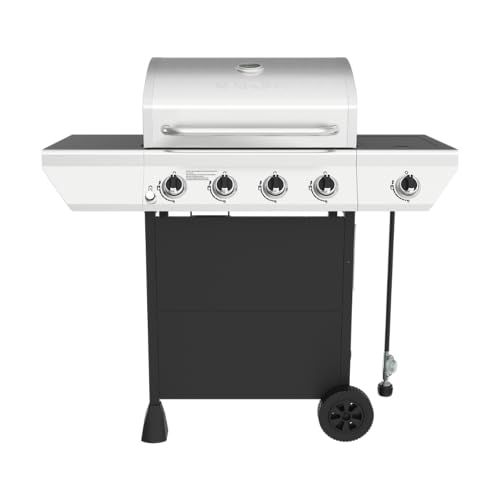
Nexgrill 4-Burner Propane Gas Grill with Stainless Steel Lid
Badge: Best Balanced Family Pick
Strengths
- 526 sq in and four burners hit the family-size sweet spot without the six-burner footprint
- Matte cast iron grates sear well and hide seasoning wear gracefully
- Side burner and built-in thermometer cover the everyday extras without add-ons
Trade-offs
- Propane as listed, so natural gas use needs a verified factory version or approved kit
- Mid-pack output — very large, thick cuts benefit from a longer preheat
- Stainless lid still needs a cover in harsh weather to stay looking new
At a glance: Burners: 4 plus a side burner; Total output stated: 52,000 BTU; Cooking space stated: 526 sq in; Grates: matte-finish cast iron; Ignition: electronic; built-in thermometer; stainless steel lid. Fuel note: Propane as listed — not a natural gas model as configured.
This second Nexgrill trades a little of its sibling’s stainless theatre for a practical matte-black-and-steel look: four burners, 52,000 BTU, 526 square inches of cooking space and matte-finish cast iron grates. That is family arithmetic done right — enough room for a dozen burgers with a vegetable zone to spare, without demanding the patio depth of the biggest carts in this guide.
The matte cast iron grates deserve a word. Cast iron’s heat retention is what makes recovery searing possible after the lid has been open, and the matte finish is forgiving about the mottled seasoning look that glossy grates advertise. As with the other propane listings here, the natural gas shopper’s job is verification: this format — mid-size four-burner with side burner — is precisely what most households should plumb for, but the fuel hardware itself must come from a factory NG model or a manufacturer-approved conversion.
In whole-market terms, the Nexgrill 4-Burner Propane Gas Grill with Stainless Steel Lid represents its format’s tier honestly — judge it against the tier map above, then complete the market’s standard final step: verify the factory natural gas configuration or manufacturer-approved conversion for this exact model before purchase. That two-step — format, then fuel — is how the entire category is successfully bought.
Best for: families who want the balanced four-burner format with cast iron grates and a side burner / Not suited for: buyers who need stated natural gas configuration from the listing itself

AMERLIFE 6-Burner Propane Gas Grill with Side Burner
Badge: Best for Crowds
Strengths
- The largest stated cooking area in this pool at 650 sq in, plus a warming rack
- Six burners allow three distinct temperature zones at once
- Cast iron grates across a very wide box suit batch cooking and big gatherings
Trade-offs
- Propane configuration as listed — the natural gas question must be resolved before purchase
- The widest footprint here; small patios will feel it
- More burners mean more parts to clean, inspect and eventually service
At a glance: Burners: 6 plus a side burner; Total output stated: 60,000 BTU; Cooking area stated: 650 sq in; Grates: cast iron; warming rack fitted; Built-in thermometer and regulating valve (from listing title). Fuel note: Propane as listed — not a natural gas model as configured.
The AMERLIFE is the maximalist entry: six burners, 60,000 BTU, a stated 650 square inches of cooking area, cast iron grates and a warming rack, plus a side burner for the pan work. Six burners change what is possible — a fierce sear zone, a medium zone for chicken and sausages, and a low zone for holding and toasting, all running at once without lid-opening negotiations.
That capacity is aimed at a specific household: the one that hosts. Graduation weekends, double-family cookouts, a whole pack of ribs next to a tray of corn — this is the grill that does not make you cook in shifts. The honest costs are footprint and upkeep. Six burners mean six burners to brush around, inspect and keep clear, and as listed this is a propane grill, so a natural gas installation starts with verifying a factory NG option or an approved conversion — never with improvisation.
In whole-market terms, the AMERLIFE 6-Burner Propane Gas Grill with Side Burner represents its format’s tier honestly — judge it against the tier map above, then complete the market’s standard final step: verify the factory natural gas configuration or manufacturer-approved conversion for this exact model before purchase. That two-step — format, then fuel — is how the entire category is successfully bought.
Best for: frequent hosts who regularly cook for a crowd and want three heat zones at once / Not suited for: small patios, minimalist cooks, or buyers who need a stated natural gas model
Realcook Charcoal Grill with Offset Smoker
Badge: Best for Smoke Flavour (Prose-Only)
Strengths
- Offset smoker box delivers genuine wood-smoke flavour no gas grill fully imitates
- 800 sq in of stated space is the largest cooking area in this pool
- Charcoal heat gives a different, deeper crust character for those who love the ritual
Trade-offs
- It is not a gas grill — no burners, no gas line, no instant start
- Fire management is a skill and a time commitment every single cook
- Ash, charcoal storage and longer cleanup are part of the deal
At a glance: Fuel: charcoal only; Format: barrel grill with offset smoker; Cooking space stated: 800 sq in; Intended use in title: backyard parties and gatherings. Fuel note: Charcoal — not a gas grill of any kind; included prose-only as the smoke-flavour reference point.
The Realcook is here for one honest reason: it is the flavour benchmark. A barrel charcoal grill with an offset smoker and a stated 800 square inches of space, it represents everything gas gives up in exchange for convenience — live fire, real smoke, and the deep bark on ribs and brisket that comes from hours in a smoke bath. For gatherings it is a genuine event grill.
It is reviewed prose-only, with no purchase link in this guide, because it does not belong to the product class this keyword is about: it burns charcoal, full stop. If reading about it makes you realise smoke flavour matters more to you than push-button gas convenience, that is a legitimate conclusion — many households end up owning both, a gas grill for Tuesday and a charcoal smoker for Saturday. Just do not buy it expecting anything a gas line can connect to.
In whole-market terms, the Realcook Charcoal Grill with Offset Smoker represents its format’s tier honestly — judge it against the tier map above, then complete the market’s standard final step: verify the factory natural gas configuration or manufacturer-approved conversion for this exact model before purchase. That two-step — format, then fuel — is how the entire category is successfully bought.
Best for: smoke-flavour devotees who want an offset-smoker event grill alongside (not instead of) gas / Not suited for: natural gas shoppers — this grill cannot use gas at all
Comparison Table
| Pick | Badge | Format | Fuel as listed | Listing |
|---|---|---|---|---|
| Nexgrill 4-Burner Propane Gas Grill with Side Burner | Best Large Four-Burner | Burners: 4 main burners plus a side burner | Propane as listed | Check on Amazon |
| IdeaMaxx 3-Burner Propane Gas Grill with Cast Iron Grates | Best for Small Spaces | Burners: 3 | Propane as listed | Check on Amazon |
| Weber Spirit E-425 Gas Grill | Best Premium Pick | Burners: 4 | Propane as listed | Check on Amazon |
| Nexgrill 4-Burner Propane Gas Grill with Stainless Steel Lid | Best Balanced Family Pick | Burners: 4 plus a side burner | Propane as listed | Check on Amazon |
| AMERLIFE 6-Burner Propane Gas Grill with Side Burner | Best for Crowds | Burners: 6 plus a side burner | Propane as listed | Check on Amazon |
| Realcook Charcoal Grill with Offset Smoker | Best for Smoke Flavour (Prose-Only) | Fuel: charcoal only | Charcoal | Prose-only in this guide |
Read the fuel column as the table’s most important data. It is the column most grill comparisons omit, and in the natural gas category it is the difference between a smooth installation and an expensive surprise. Readers comparing this format with the wider cluster often continue to Best Natural Gas Cast Iron Grills for the neighbouring angle on the same decision.
How to Choose the Right Grill for natural gas grills on th emarket
Fuel configuration is the first specification, not the last. Natural gas grills are plumbed appliances: a licensed fitter runs the line, fits a shutoff and quick-disconnect, and the grill connects by hose. For that to work, the grill must be a factory natural gas model or carry its manufacturer’s approved conversion — the orifices that meter gas differ between propane and natural gas, and only the maker’s kit or factory build gets them right. This guide states each pick’s verified fuel in its spec box precisely so this decision is never made on a guess.
Count zones, not just burners. The practical unit of grilling is the temperature zone. Three burners give you hot and holding; four give you sear, cook and hold simultaneously; six let you run three true zones for crowd logistics. Match the zone count to how you actually cook — a two-person household gains little from six burners, while a host cooking ribs, chicken and corn together will feel every missing zone. Stated cooking areas here span 360 to 650 square inches; pair the area with the burner count before comparing any two grills.
Read grate material as a maintenance contract. Cast iron offers the deepest sear and asks for oil and dryness in return. Porcelain-enameled cast iron is the balanced contract — heavy, hot and forgiving. Porcelain-coated grates in the compact class ask least and give up the most thermal recovery. Pick the contract you will honour in February, not the one you admire in June.
Think in total project cost. Grill, fuel configuration, line installation, cover and the first season’s consumables are one purchase wearing five hats. A format that leaves the installation properly funded will make you happier than a flagship grill still waiting for its gas line — a theme this guide returns to because it is where natural gas projects most often stall.
If your shortlist is still forming, the companion guide at Best Natural Gas Gas Grills covers the adjacent version of this search.
How to Set Up, Use and Maintain a Natural Gas Grill
First connection, done properly. With the line installed and pressure-tested by your fitter, push the hose coupling onto the quick-disconnect until it locks, open the shutoff valve, and brush soapy water over each joint — growing bubbles mean a leak, and a leak means closing the valve and calling the professional back. Ignite with the lid open, one burner at a time, and watch for steady blue flames with small yellow tips. Season new cast iron grates with a light coat of high-heat oil during the first long preheat.
Everyday technique. Think of the grill as three appliances sharing a lid: a searing station (hottest zone), a roasting oven (medium zone, lid down) and a warming drawer (coolest edge). Arrange the burners that way by default and most recipes organise themselves. Keep the lid down while cooking — every peek dumps the heat a plumbed grill’s steady supply then has to rebuild — and use a probe thermometer for thick cuts rather than cutting them open to check.
Care that prevents funerals. Hot-brush the grates after cooking, not before the next session. Manage the grease tray on a schedule, because a permanent grill accumulates what a portable one gets emptied by travel. Keep the quick-disconnect capped or clean — grit in the coupling is the natural gas equivalent of a dirty tank valve. Each spring, inspect burners, diffusers and the igniter, and replace tired parts while the season is young.
Troubleshooting.
Problem: the grill will not reach full temperature → confirm the shutoff is fully open, the hose is not kinked, and the quick-disconnect is fully engaged; check for blocked burner ports before suspecting the supply.
Problem: flare-ups beyond the usual sizzle → the grease tray or diffuser bars are loaded; let the grill cool, clean both, trim fattier cuts, and cook the fattiest foods over the gentler zone until they render.
Problem: uneven cooking left to right → swap food positions mid-cook as a workaround, then inspect for a partially blocked or corroded burner on the cool side and clean or replace it.
The First Year With a Plumbed Grill: What Owners Learn
What changes is not the cooking — it is the friction. Ask owners a year into a plumbed grill what is different and few mention flavour or heat. They mention the vanished errands: no tank exchanges, no spare-cylinder anxiety, no cookout arithmetic about whether the gas outlasts the ribs. The grill joins the house’s infrastructure, and like all good infrastructure it disappears from thought. That disappearance is the product you actually bought, and it is why format comfort — the right size, the right zones, grates you enjoy maintaining — matters more than any headline specification.
The coupling becomes the grill’s front door. Owners learn to treat the quick-disconnect with the respect a front door gets: kept clean, capped when the grill is uncoupled for service, checked with soapy water after any disturbance, and never forced. The hose lives with a gentle curve, never a kink, never stretched to reach a spot the grill was not sited for. These are thirty-second habits, and they are the entire safety culture of the appliance — simple, repeatable, and non-negotiable.
Year two is when build quality files its report. The first year flatters every grill. The second reveals whose burner ports clog, whose diffusers rust through, whose igniter was a fair-weather friend. This is the practical root of this guide’s bias toward established formats and deep parts channels: the second-year report is written in replacement parts, and the brands that stock them turn a bad report into a weekend fix. When you read the reviews above, the longevity notes are not decoration — they are predictions about your year two.
Hosting changes shape. A plumbed grill invites a particular confidence: the cookout can expand without a fuel calculation. Owners find the side burner promoted from novelty to necessity, the warming edge permanently occupied, and the grill’s permanent spot becoming the patio’s social centre of gravity. Choose the spot and the format for that gravity. It is easier to plumb once, generously, than to wish the outlet were three feet to the left for a decade.
The Market in Tiers: What Separates the Shelves
The entry tier is the compact three-burner: honest weeknight cooking, porcelain-coated or cast iron grates, folding or fixed shelves, and a footprint that respects small patios. It is where most households should start their thinking, because it covers the majority of real meals. The mid tier — where this pool is densest — is the full-size four-burner: 500-plus square inches, side burners, cabinets, cast iron grates and enough zoning for genuine technique. Most natural gas installations in the real world are plumbed to exactly this class, because it is the largest grill that still behaves like a weeknight appliance.
The premium tier buys control and longevity rather than size: dedicated sear zones with boost burners, porcelain-enameled cast iron, deeper parts networks and accessory ecosystems. The maximal tier buys capacity — six burners and 650 square inches — and is justified only by genuine crowd frequency. Notice what does not separate the tiers: raw BTU totals, which mostly scale with burner count and say little about how evenly or controllably a grill cooks.
Natural gas cuts across all four tiers as a configuration, not a tier of its own. That is the market insight that simplifies everything: pick your tier by cooking life, then execute the fuel verification for that format.
Why Propane Dominates — and What It Means for NG Buyers
Propane dominates for logistical reasons: a tank makes a grill self-contained, shippable and demo-ready on any retail floor, with no dependence on the customer’s home infrastructure. Natural gas grills, by contrast, presume a line installation, so manufacturers offer them as configurations of proven formats rather than as separate inventions. The result is the market structure this guide keeps repeating — propane listings everywhere, NG versions one verification step away.
For buyers this has two consequences. First, abundance: nearly every format worth owning exists in, or converts to, a natural gas configuration through official channels, so you never have to settle for a format you dislike for fuel reasons. Second, responsibility: the verification burden sits with the buyer. Model numbers, configuration labels and manufacturer conversion kits are the tools; assumptions are the hazard.
It also explains the charcoal smoker in this lineup. The market’s flavour frontier still belongs to live fire, and a share of gas shoppers are really smoke shoppers. Naming that boundary honestly — as this guide does by reviewing the smoker prose-only — is part of mapping the market truthfully.
A final market observation is worth carrying into any showroom or listing page: the formats in this pool recur across the whole market because they are the shapes that sell, season after season, under many badges. That recurrence is useful intelligence. It means accessories, covers and replacement parts concentrate around these shapes; it means your neighbours’ ownership experience is genuinely transferable to your decision; and it means a format that looks unfashionable in a catalogue may simply be a proven one between facelifts. The market rewards buyers who read recurrence as evidence rather than as boredom — the exotic grill is a gamble, while the familiar format, correctly fuelled and properly installed, is the closest thing this category offers to a sure outcome.
The same format questions are examined from another direction in Best Natural Gas Grills 42 Inch, which many readers pair with this guide.
Common Buying Mistakes
Assuming the shelf model is the NG model. Retail floors and listings default to propane. The natural gas version is a configuration with its own model number — verify it explicitly, every time, no matter how familiar the grill looks.
Forgetting the installation in the budget. A natural gas project is grill plus line. Buyers who fund only the grill end up tank-powered by default and disappointed by arithmetic they controlled.
Heaping modifications on a stock grill. Rock beds, blocked vents and unapproved accessories layered onto a design that never contemplated them are how warranties die and fireboxes warp. The manual is the boundary of modification.
Ignoring grate care until the rust arrives. Cast iron forgives cooks and punishes owners — in that order. The two-minute oil-and-brush habit is the whole secret; skipping it for a season is the whole failure.
Placing the outlet before choosing the spot. The grill’s working position — level, sheltered, lid clearance, room to stand — should be chosen by cooking in it mentally for a year. The fitter then places the outlet to serve that spot, not the other way round.
Chasing the biggest number on the box. Cooking area, BTU and burner count are all easy to inflate and none cooks dinner. Zoning, grate mass and parts support are the specifications that survive contact with real life.
For the related cut of this category, see Best Natural Gas Grills At Home Depot before you finalise a model number.
Final Recommendation
Start with the Nexgrill 4-Burner Propane Gas Grill with Side Burner. It earns the first look in this pool for the balance its review lays out — the format fits the widest range of households shopping for best natural gas grills on th emarket, and its strengths survive the trade-offs that follow them. Confirm its natural gas configuration path exactly as its spec box directs, and you have the safest pair of hands in this guide.
Choose the IdeaMaxx 3-Burner Propane Gas Grill with Cast Iron Grates instead if its badge matches your life more closely — the badges in this guide were written to be shopped, not admired. Hosts with genuine crowd volume should read the AMERLIFE 6-Burner Propane Gas Grill with Side Burner review twice before deciding; its capacity argument is real, and so is its footprint. And whichever format wins, close the purchase the way this guide has insisted from the first section: model number verified, fuel configuration confirmed, licensed fitter booked. A natural gas grill bought that way is not a purchase — it is patio infrastructure, and it will cook like it for a decade.
Frequently Asked Questions
Is a natural gas grill weaker than a propane grill?
A correctly configured natural gas grill cooks with the same authority as its propane counterpart. The fuels differ in energy per cubic foot, which is why natural gas models use larger orifices — the hardware compensates, and the cooking evens out. Weak performance almost always traces to a configuration mismatch or blocked burners, not to the fuel itself.
What does it cost to run a natural gas line to a patio?
Costs vary too much by region, distance and local labour to quote responsibly in a guide, and any figure printed here would mislead as many readers as it helped. The reliable method is two quotes from licensed local gas fitters once you know where the grill will stand — and to budget that figure into the purchase from the start, as this guide’s buying sections advise.
Can a natural gas grill be moved after installation?
Within the radius of its hose, yes — the quick-disconnect exists precisely so the grill can be uncoupled for cleaning, servicing or patio work. Beyond that radius it is a fixed appliance, which is the honest trade for unlimited fuel. Choose the spot as if it were permanent, because functionally it is.
Do I need a special cover or accessories for a natural gas grill?
The grill itself uses standard accessories — cover, brush, tools — sized to its format. The natural-gas-specific items are the hose and quick-disconnect hardware supplied for the installation, plus keeping that coupling clean and capped. A fitted, vented cover matters more than usual because a plumbed grill lives outdoors in one spot all year.
How long should a plumbed gas grill last?
With the maintenance rhythm in this guide — hot brushing, grease discipline, spring inspections and timely burner or igniter replacement — a well-built format from a brand with a deep parts channel is a decade-plus appliance. Longevity is mostly a parts-availability question, which is why brand ecosystems are weighted so heavily in the reviews above.
Are natural gas grills a separate product category?
Mostly no — they are configurations of the same formats sold as propane carts. That is good news: the format choice (size, burners, grates) and the fuel choice can each be made on their merits, as long as the natural gas configuration of your chosen model is verified by model number before you buy.
What is the single most common market-wide buying mistake?
Assuming the grill on the floor or in the listing is the fuel configuration you need. Propane and natural gas versions of one format can look identical. Match the model number and configuration label every time — it takes two minutes and prevents the category’s most expensive error.


