Disclosure: topratedkitchenware.com is reader-supported. When you buy through links on our site, we may earn an affiliate commission from Amazon and other retailers, at no extra cost to you.
Where to buy
Every pick below was shortlisted for buyers comparing the best mixers hand mixers for cake, and each linked pick’s specifications were verified against its listing data before this guide was written. Prose-only picks are reviewed in full but carry no purchase link, for the reason stated in their review.
- WEPSEN 5-Speed Hand Mixer Set — check the latest price on Amazon
- LILPARTNER 7-Speed Hand Mixer — check the latest price on Amazon
- Cuisinart Power Advantage Plus 9-Speed Hand Mixer (HM-90S) — check the latest price on Amazon
- Hamilton Beach 6-Speed Hand Mixer with QuickBurst — check the latest price on Amazon
- KitchenAid 5 Ultra Power Speed Hand Mixer (KHM512, Empire Red) — check the latest price on Amazon
- KitchenAid 5 Ultra Power Speed Hand Mixer (KHM512, Contour Silver) — check the latest price on Amazon
Read the full guide ↓ for the detailed reviews, the comparison table and the buying advice behind this shortlist.
The best mixers hand mixers for cake work are judged by cake bakers on a short list of real tests: can it cream butter and sugar to genuine paleness, fold flour in without knocking the air out of a sponge, whip cream to peaks that hold, and do all three without covering the kitchen in flour at switch-on. The six verified hand mixers in this guide were chosen against exactly those tests — speed control at the low end, beater design, stated power where published, and the accessories that cake work actually uses.
The line-up pairs two value picks (the WEPSEN set with its included bowls and the seven-speed, accessory-rich LILPARTNER) with the Hamilton Beach workhorse and its QuickBurst button, the nine-speed Cuisinart Power Advantage Plus, and the KitchenAid KHM512 benchmark in Empire Red and Contour Silver. They are all hand mixers — this guide does not smuggle in stand mixers — because the keyword asks for the handheld tool’s particular virtues: control you can feel, a drawer’s worth of storage, and a price that leaves budget for tins and ingredients. The wedding-scale version of this shortlist lives in Best Mixers For Wedding Cake Making.
Key Takeaways
- Cake work lives at low speeds: the first setting’s gentleness decides sponges, and the Cuisinart’s nine-speed range with SmoothStart is the control benchmark.
- Beater design matters as much as motor size — KitchenAid’s Turbo Beaters are shaped to move batter without clogging.
- The LILPARTNER is the whipping pick: seven speeds and five stainless accessories aimed at creams, meringues and frostings.
- The WEPSEN set is the kit pick — four large bowls included, which cake production quietly depends on.
- Hamilton Beach’s QuickBurst is the practical feature nobody expects to love: a short surge for the moment thick batter fights back.
In this guide
Quick Picks
The cake shortlist at a glance. Badges are used consistently through the detailed reviews below.
| Pick | Badge | Headline specification | Link |
|---|---|---|---|
| WEPSEN 5-Speed Hand Mixer Set | Best Overall | 5 speeds | Check on Amazon |
| LILPARTNER 7-Speed Hand Mixer | Best for Whipping | 7 speeds | Check on Amazon |
| Cuisinart Power Advantage Plus 9-Speed Hand Mixer (HM-90S) | Best for Fine Control | 9 speeds | Check on Amazon |
| Hamilton Beach 6-Speed Hand Mixer with QuickBurst | Best Workhorse | 6 speeds | Check on Amazon |
| KitchenAid 5 Ultra Power Speed Hand Mixer (KHM512, Empire Red) | Best Brand Pick | 5 speeds | Check on Amazon |
| KitchenAid 5 Ultra Power Speed Hand Mixer (KHM512, Contour Silver) | Best Neutral Finish | 5 speeds | Check on Amazon |
How These Picks Were Chosen
Picks were selected by comparing verified specifications against the cake brief: speed count and low-end control, beater and whisk provision, stated motor wattage where the maker publishes it, included bowls or storage, and finish options. Every product was cross-checked against its listing data through the Creators API on the recorded check date; spec boxes contain only confirmed data, and where a maker does not publish a figure, this guide does not invent one.
The method is research-led comparison — designs and specifications, honestly labelled — not a fabricated bake-off. Ranking weighs the three cake tasks in the order bakers meet them: batter first, frosting second, whipping third. Readers whose cake ambitions run to tiered and wedding work should treat this as the foundation guide and the wedding guide as the specialisation; readers shopping purely on price will find the market surveyed in Best Prices On Electric Hand Mixers.
A final methodological honesty: hand mixers are simple machines, and their listings are padded accordingly — speed counts inflated with settings nobody uses, wattages quoted at peak rather than in work, accessories counted by the piece. This guide compared the specifications that survive deflation: the gentleness of the lowest speed, the shape and material of the beaters, whether a whisk exists, what the maker states plainly enough to be checked. Where a figure could not be verified from the listing data, it does not appear in the spec boxes, and the reviews lean on design instead. That is a transferable shopping skill for the whole category: deflate first, compare second, and let the features that address real failures — the cloud, the clog, the stall — carry the decision.
One last practical note on buying two finishes of the same model, since this guide lists the KHM512 twice: households do sometimes buy both — one for the everyday kitchen, one kept for the good baking, or one each for two homes — and there is no redundancy penalty beyond storage, because beaters and behaviour are identical and interchangeable in habit. More commonly, the second listing simply resolves the gift and registry problem: the giver chooses the model, the receiver’s kitchen chooses the finish. Either way, the cake-relevant fact stands — the choice costs nothing in performance, which is exactly what a finish decision should cost.
The 6 Best Mixers Hand Mixers for Cake

WEPSEN 5-Speed Hand Mixer Set
Badge: Best Overall
Strengths
- The included bowl set makes it a starter kit, not just a mixer
- Stainless steel attachments clean up easily
- Five speeds cover folding through whipping for cake work
Trade-offs
- A bundled set targets beginners more than committed bakers
- Hand mixing a full wedding cake still means long sessions at the bowl
- Fewer speeds than the premium picks for fine control
Key specifications (verified): 5 speeds; Includes 4 large mixing bowls; Whisk and beater attachments; Stainless steel attachments.
The WEPSEN set takes a different approach to value: a five-speed electric hand mixer sold with four large mixing bowls plus whisk and beater attachments in stainless steel. For wedding cake work that bundling is not a gimmick — tiered cakes are a multi-bowl production by nature, with batter, filling and frosting in progress at once, and a baker setting up for a first big cake often owns fewer bowls than the project demands. The mixer itself covers the standard hand-mixer range, from slow folding to whipping cream and egg whites.
Judged as a working tool it is a starter’s kit with honest limits: five speeds give less fine-grained control than the nine-speed premium picks when you are creeping up on soft peaks, and a hand mixer — any hand mixer — asks your arm to hold it through every batch. For occasional celebration cakes and bakers building their kit from near zero, the everything-included logic is sound.
For cake production the bowls are quietly decisive: sponge cooling, frosting waiting, cream ready to whip — parallel components need parallel vessels, and this set ships them.
The WEPSEN set’s cake argument is parallel production. Even an ordinary weekend layer cake runs components concurrently — batter resting, frosting waiting, cream about to whip — and four large bowls mean the mixer moves between components instead of waiting for the washing-up. That changes the mixer’s effective power more than a wattage figure would: a five-speed mixer with bowls ready is a faster cake tool than a nine-speed mixer behind a sink queue. Its stainless attachments rinse clean between components, which is the other half of parallel work. For a baker building a cake kit from a standing start — new kitchen, new hobby, first commissions — this set is the most complete first purchase in the guide.
Best for: the default choice for most buyers in this category / Not suited for: a narrower, more specialised brief than this pick serves

LILPARTNER 7-Speed Hand Mixer
Badge: Best for Whipping
Strengths
- Seven speeds give finer control over delicate batters and foams
- Five stainless accessories cover beaters, whisks and dough work
- A whipping focus suits frostings, meringues and cream
Trade-offs
- Accessory breadth matters only if you use more than beaters
- Handheld format still limits very stiff dough work
- Value-brand support is thinner than the legacy names
Key specifications (verified): 7 speeds; 5 stainless steel accessories; Electric hand mixer format; Built for whipping tasks.
The LILPARTNER hand mixer leans into versatility: seven speeds and five stainless steel accessories in an electric hand mixer built for whipping. The extra speeds are not decoration for cake bakers — the difference between a speed that folds flour into a delicate sponge without knocking out the air and the next speed up is exactly where cakes are won and lost, and seven steps give you a setting closer to the one the batter wants. The accessory set extends the tool from beaters into whisking and lighter dough work.
For wedding cakes specifically, the whipping brief matters: Swiss meringue buttercream, whipped ganache and stabilised cream all live at the whisk, and a mixer that treats whipping as its home territory earns its place. The honest limits are the class limits — stiff, large-batch dough still belongs to a stand mixer, and a value brand’s accessory ecosystem is what you see in the box rather than a catalogue. Within the hand-mixer brief, though, the spec is well aimed.
Its cake case is the whisk: meringue toppings, whipped ganache and chantilly are where seven speeds and a proper accessory set stop being specifications and start being results.
Cake bakers who whip weekly will feel the LILPARTNER’s design priorities immediately. Seven speeds let you approach a peak the way recipes actually describe — gradually, watching — instead of toggling between too slow and too fast, and the whisk among its five stainless accessories is the right geometry for cream and meringue rather than a beater’s compromise. It also reframes value for cake work: the accessory set covers the secondary jobs (a light dough for a coffee cake, a whisked sponge) that otherwise send a baker to a second tool. The class limits apply — stiff, large doughs are not its brief — but within cake’s actual repertoire, whipping-led versatility is the versatility that gets used.
Best for: buyers who want the balanced middle of this shortlist / Not suited for: buyers who need the largest format in the guide

Cuisinart Power Advantage Plus 9-Speed Hand Mixer (HM-90S)
Badge: Best for Fine Control
Strengths
- Nine speeds is the finest control in this group
- SmoothStart prevents the flour-cloud first second of mixing
- The snap-on case keeps mixer and attachments together between projects
Trade-offs
- Premium-tier positioning among hand mixers
- Nine speeds are wasted on bakers who use two settings
- The case adds storage bulk in a small kitchen
Key specifications (verified): 9 speeds; Snap-on storage case; SmoothStart anti-splat feature; Power Advantage Plus motor design.
The Cuisinart Power Advantage Plus HM-90S is the control freak’s hand mixer: nine speeds, a SmoothStart feature that eases the beaters up to speed instead of blasting flour across the kitchen, and a snap-on storage case that keeps the mixer and its attachments in one place. Nine speeds sounds like excess until you bake cakes regularly — genoise, chiffon and angel food all punish the wrong speed, and the low end of this mixer’s range is genuinely low, which is where folding and starting a mix live.
SmoothStart deserves its headline status for cake work specifically, because the classic hand-mixer failure is the first second: beaters at full tilt in a bowl of flour and cocoa. Starting slow and ramping up removes it. The trade-offs are proportion — this is a premium hand mixer, and bakers who mix boxed batter twice a year will never use its range — but for repeated celebration and wedding cakes, control is the feature that pays.
SmoothStart plus nine speeds is the full cake-control package — the flour stage, the sugar stage and the peak-approach all get the exact gentleness they ask for.
The HM-90S is the mixer for the baker who has started reading recipes critically — who knows why the genoise failed and wants equipment that stops causing it. Nine speeds make the low end a place you can work, not just start: folding becomes a powered, controlled act instead of a risk. SmoothStart removes the flour-cloud tax on every batter, which across a year of cakes is a genuine quality-of-life feature and, on cocoa-heavy batters, a clothing-preservation one. The snap-on case suits the project baker’s rhythm — everything together, out for the weekend’s cake, away on Monday. It is the premium pick, and its premium buys control, which is the currency cake baking actually trades in.
Best for: buyers whose setup is growing and needs headroom / Not suited for: buyers with a fixed, minimal format

Hamilton Beach 6-Speed Hand Mixer with QuickBurst
Badge: Best Workhorse
Strengths
- QuickBurst gives a short power surge for thick batter moments
- Bowl Rest lets the mixer sit on the bowl edge instead of the counter
- A stated 250 watt motor is honest power for the class
Trade-offs
- Traditional beaters only — no whisk-led versatility story
- Six speeds is mid-pack for delicate work
- Utilitarian design prioritises function over feel
Key specifications (verified): 6 speeds; QuickBurst extra-power button; Bowl Rest feature; 250 watt motor; Traditional beaters included.
The Hamilton Beach six-speed hand mixer is the workhorse entry: a 250 watt motor, traditional beaters, a QuickBurst button for a short surge of extra power, and a Bowl Rest feature that lets the mixer perch on the edge of the bowl instead of dripping across the counter. Those two named features are more practical than they sound. QuickBurst is for the moment a thick cake batter or a stiff frosting fights back — a brief surge rather than a permanent higher speed — and Bowl Rest solves the where-do-I-put-it problem that occurs a dozen times in a wedding cake session.
The design philosophy is utility: no storage theatre, no accessory catalogue, just a motor with enough stated power and controls that make sense mid-recipe with floury hands. The limits match — traditional beaters handle batters and frostings well but the whisk-led techniques get less support, and six speeds is mid-pack for the most delicate foams. For bakers who want a tool that simply works every time, it is a coherent answer.
QuickBurst is the thick-batter tool: a chilled, stiff frosting that stalls a steady speed yields to a ten-second surge, then settles back to control.
Hamilton Beach built this mixer around two moments every cake baker knows. The first is the stall: a cold, stiff buttercream or a heavy fruit-cake batter that slows the beaters and tempts you to push the mixer through by hand — QuickBurst’s short surge is the correct, motor-safe answer. The second is the pause: bowl in one hand, scraper in the other, mixer dripping — Bowl Rest parks it on the bowl’s edge. A stated 250 watt motor and traditional beaters complete a specification that reads as modest and behaves as sufficient, which is why this model is the workhorse recommendation: it spends its money on the moments that recur, not the features that photograph.
Best for: buyers who prioritise the headline feature of this pick / Not suited for: buyers shopping purely on the lowest tier
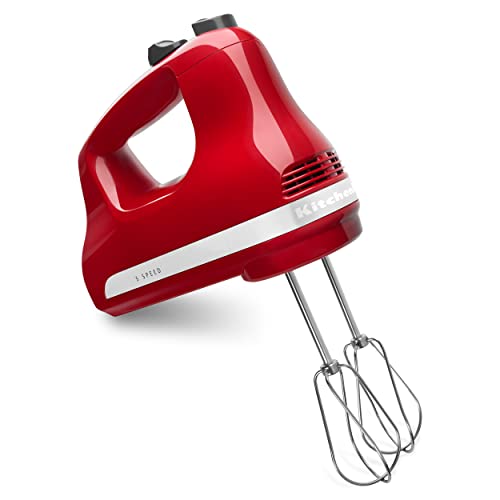
KitchenAid 5 Ultra Power Speed Hand Mixer (KHM512, Empire Red)
Badge: Best Brand Pick
Strengths
- Turbo Beaters are shaped to pull batter through without clogging
- Lockable swivel cord stays out of the bowl and out of the way
- KitchenAid’s accessory and support ecosystem is the deepest here
Trade-offs
- Five speeds is the joint-fewest in this group
- You pay a brand premium for the badge and ecosystem
- The colour is a commitment — it will not match every kitchen
Key specifications (verified): 5 speeds; Lockable swivel cord; Turbo Beaters; Empire Red finish.
The KitchenAid KHM512 in Empire Red is the brand-name benchmark of this group: five speeds, Turbo Beaters and a lockable swivel cord. The Turbo Beaters are the engineering story — their shape is designed to pull mixture through efficiently without the clogging that makes cheap beaters ride up out of a thick batter — and the swivel cord, which locks to the left or right, is one of those details nobody praises until they have mixed one-handed while scraping a bowl with the other.
Five speeds is the honest compromise in the spec: KitchenAid bets that well-chosen steps plus efficient beaters beat a long speed dial, and for standard cake batters, frostings and whipped cream that bet mostly holds. The premium is real, though — you are paying for the brand’s ecosystem, parts availability and resale-proof reputation as much as for the mixing. In Empire Red it is also unapologetically a statement object on the counter.
Empire Red is the counter-statement finish, but the cake substance is the Turbo Beaters — batter pulled through cleanly, fewer scrapes, less over-mixing.
The KHM512’s cake credentials are mechanical, not sentimental. Turbo Beaters are shaped to keep mixture circulating — batter is pulled through the beaters instead of being pushed ahead of them — so creaming is even, flour pockets are rarer, and the baker stops sooner, which protects texture. The lockable swivel cord sounds like a footnote until you have scraped a bowl one-handed while the cord drags through the batter; then it becomes the feature you describe to other bakers. Five speeds is the considered compromise: enough graduation for cake’s stages, chosen by a maker betting on beater efficiency over dial length. Empire Red simply makes the benchmark visible on the counter.
Best for: buyers with the specific use case this pick was designed around / Not suited for: buyers whose use case is the opposite end of the category

KitchenAid 5 Ultra Power Speed Hand Mixer (KHM512, Contour Silver)
Badge: Best Neutral Finish
Strengths
- Same proven KHM512 mechanics in a neutral finish
- Turbo Beaters handle batters and frostings without clogging
- A finish that suits rental, registry and minimalist kitchens
Trade-offs
- Identical performance to the red version — the choice is cosmetic
- Five speeds remains the control compromise
- Brand premium applies here too
Key specifications (verified): 5 speeds; Lockable swivel cord; Turbo Beaters; Contour Silver finish.
This is the same KitchenAid KHM512 — five speeds, Turbo Beaters, lockable swivel cord — finished in Contour Silver instead of Empire Red. That makes it the right listing for a particular kind of buyer: the one who has read the reviews, decided on the model, and wants the finish that disappears into a stainless-and-white kitchen, suits a wedding registry, or matches a rental property’s appliances. Mechanically nothing changes, and this guide treats it as its own pick because the purchase decision genuinely is separate — colour is the reason one listing outsells the other in different households.
Everything said about the model applies: efficient beaters that do not clog in thick batter, a cord that locks out of your way, five well-chosen speeds, and a brand premium paid for ecosystem and longevity. If your kitchen runs red, the Empire Red version is the same tool with more personality; if it runs neutral, this is your version. Wedding-cake performance is identical — which, for a colour variant, is exactly the point.
Contour Silver is the same cake tool in the finish that disappears into a modern kitchen — the pick for bakers who want the benchmark without the billboard.
Contour Silver exists because KitchenAid understands its own buyers: the model is the decision, the finish is the identity. Mechanically this is the KHM512 of the previous review — Turbo Beaters, five speeds, lockable swivel cord, the same creaming and folding behaviour — in the finish that suits stainless kitchens, rental properties, registries and bakers who prefer their tools quiet. This guide lists it as its own pick rather than a footnote because in practice the two finishes serve different households, and a buyer comparing listings deserves the cake-relevant facts stated plainly: identical performance, identical accessories story, different presence on the counter. Choose the colour; the cakes will not know.
Best for: buyers who want the largest or most specialised option here / Not suited for: buyers who want the simplest possible tool
Comparison Table
| Pick | Badge | Format | Standout feature | Link |
|---|---|---|---|---|
| WEPSEN 5-Speed Hand Mixer Set | Best Overall | 5 speeds | Includes 4 large mixing bowls | Check on Amazon |
| LILPARTNER 7-Speed Hand Mixer | Best for Whipping | 7 speeds | 5 stainless steel accessories | Check on Amazon |
| Cuisinart Power Advantage Plus 9-Speed Hand Mixer (HM-90S) | Best for Fine Control | 9 speeds | Snap-on storage case | Check on Amazon |
| Hamilton Beach 6-Speed Hand Mixer with QuickBurst | Best Workhorse | 6 speeds | QuickBurst extra-power button | Check on Amazon |
| KitchenAid 5 Ultra Power Speed Hand Mixer (KHM512, Empire Red) | Best Brand Pick | 5 speeds | Lockable swivel cord | Check on Amazon |
| KitchenAid 5 Ultra Power Speed Hand Mixer (KHM512, Contour Silver) | Best Neutral Finish | 5 speeds | Lockable swivel cord | Check on Amazon |
How to Choose a Hand Mixer for Cake Baking
Match the mixer to the cakes you actually bake. A weekly sponge and the occasional layer cake need gentle low speeds and beaters that fold as well as they stir; a frosting-heavy practice — buttercream on everything — needs a motor and beaters that stay composed in stiff mixtures; a baker who whips constantly (meringue, cream, ganache) should weight whisk provision and fine speed steps. Most home bakers are all three across a year, which is why the balanced picks top this guide and the specialists are flagged as specialists.
Read speed counts critically. Nine speeds are only better than five if the steps are genuinely graduated and the lowest is slow — a galloping first speed ruins more sponges than a modest top speed ever saved. Named features deserve the same scrutiny, and the ones here pass it: SmoothStart addresses the real flour-cloud failure, QuickBurst addresses the real thick-batter stall, Turbo Beaters address real clogging. Features that address real failures are worth paying for; features that address brochure comparisons are not.
Finally, the ownership details: cord behaviour (KitchenAid’s lockable swivel cord keeps it out of the bowl), storage (Cuisinart’s snap-on case; WEPSEN’s bowls stacking into the kit), and cleaning — stainless attachments that rinse clean and release easily, because a mixer that is annoying to wash gets used less, and cake baking is a habit before it is an event. Buy the mixer that fits your hand, your drawer and your repertoire, in that order.
Hand size and strength are a legitimate selection criterion that listings never mention. A hand mixer is held, tilted and manoeuvred for minutes at a time, often one-handed while the other hand turns the bowl or scrapes; a model that suits a large hand can fatigue a small one, and a heavy, powerful-feeling unit can be the wrong choice for a baker with wrist trouble. Where possible, hold before you buy, or buy from a seller whose returns are painless, and weight the first five minutes’ comfort heavily — cake sessions are long, and the mixer you enjoy holding is the one whose technique you will bother to learn.
How to Use a Hand Mixer for Better Cakes
Technique outweighs equipment in cake mixing, and the technique is mostly about stages. Creaming — butter and sugar beaten to paleness — builds a cake’s structure and should not be rushed: medium speed, several minutes, scraping the bowl’s sides and bottom with the mixer off, because beaters cannot reach what the bowl hides. Eggs go in gradually, a little at a time, so the emulsion holds. Dry ingredients go in last, in additions, at the lowest speed, and the final folds are often better finished with a spatula — the mixer’s job is to combine, and over-mixing at this stage develops toughness.
For the other cake tasks: buttercream wants butter beaten smooth first, sugar added in additions at low speed (bury the beaters before switching on — the flour-cloud rule applies to sugar too), then a medium-speed finish for silkiness, and a final slow stir to remove air bubbles before spreading. Whipping wants the opposite discipline: a clean, deep bowl, cream cold, speed built gradually, and constant checking near the end — the distance between soft peaks and over-whipped graininess is seconds, and it is judged by lifting the beaters and looking, never by a timer. After baking, wash attachments promptly in warm soapy water, dry fully before storing, and coil the cord loosely; hand mixers stored clean and dry outlast their owners’ kitchens.
Problem: cakes come out dense despite following the recipe → what to do. Audit the two usual suspects: under-creaming at the start (beat butter and sugar longer, until genuinely pale) and over-mixing after the flour goes in (lowest speed, additions, finish by hand). The mixer is rarely the fault; the stages are.
Problem: whipped cream turns grainy → what to do. It was whipped past its peak. Stop earlier — soft, billowy peaks that just hold their shape — and remember the beaters keep working for a second after switch-off. Cold cream and a cold bowl widen the window.
Problem: batter splashes out of the bowl at every start → what to do. Start with beaters buried, at the lowest speed, in a deeper bowl than feels necessary. Add dry ingredients in additions. If your mixer’s first speed is simply fast, begin with two or three hand stirs to take the powder’s looseness away.
Problem: buttercream keeps coming out too soft to pipe → what to do. Temperature, not mixing, is the usual cause: butter that started too warm, or a hot kitchen. Chill the finished buttercream briefly, then re-beat at low speed to restore smoothness — and next batch, start with cooler butter and add any liquid a teaspoon at a time.
Speeds, Beaters and Motors: What the Specifications Really Mean
Three specifications dominate hand-mixer listings, and each translates differently into cake terms. Speed count is really about the low end: what you are buying with seven or nine speeds is a first gear gentle enough for folding and a graduation fine enough to approach peaks gradually. Beater design is about movement: efficient shapes pull mixture from the bowl’s bottom and sides, reducing both unmixed pockets and the temptation to over-beat while chasing them. Motor wattage, where published — the Hamilton Beach states 250 watts — is about composure in stiff mixtures, not about speed; a composed motor in thick buttercream beats a frantic one.
The specification nobody lists is the one experienced bakers ask about: how the mixer feels at minute eight of a big session — weight in the hand, vibration, a cord that behaves. Reviews and return policies are the honest proxies for that, and this guide’s structure — balanced picks first, specialists flagged — is built to route you by repertoire rather than by spec-sheet arithmetic. Bakers who want the quality-first version of this comparison should see Best Quality Hand Mixers.
The Case for the Hand Mixer in a Stand-Mixer World
Cake baking is where the hand mixer’s case is strongest. You feel the batter’s resistance change as it comes together — information a stand mixer’s bowl hides. You move to the mixture, around the edges and across the bottom, instead of stopping to adjust a beater’s clearance. Small batches — a single sponge, a half-batch of frosting — are proportionate in a hand mixer and lost in a stand mixer’s bowl. And the tool stores in a drawer, costs a fraction, and travels to the holiday kitchen where half the year’s cakes are actually baked.
The stand mixer keeps its own honest wins — unattended creaming, big batches, dough — and bakers who live on those should buy one without guilt. But for cake specifically, the hand mixer is not the budget compromise it is marketed as; it is the control instrument, which is why professional pastry kitchens keep both and reach for the hand mixer more often than outsiders expect. The professional-leaning end of the hand market is surveyed in Best Proffessional Hand Mixers.
A Short Course in Cake Stages, by Mixer Setting
Creaming is the foundation stage and the most commonly short-changed. Butter at the right temperature — pliable, not melted — beaten with sugar at a medium speed until the mixture lightens in colour and texture. On the picks here that is a middle setting held for minutes, with one scrape-down midway. The visual cue is unmistakable once seen: the mixture goes from yellow and dense to pale and fluffy, and cakes made from properly creamed bases rise as recipes promise.
The egg stage is an emulsion negotiation: eggs at room temperature, added a spoonful at a time at medium speed, each addition absorbed before the next. Rushing it curdles the mixture — recoverable with a spoonful of the recipe’s flour, but better never tested. The flour stage is the mixer’s gentlest work: lowest speed, additions, and the discipline to stop while a few streaks remain and finish by hand, because the last folds are where tenderness is decided.
Frosting and whipping reverse the priorities: buttercream wants patience at low speed then a confident medium finish; cream wants a gradual build and a watched stop. A baker who can name the stage they are in, and the setting it wants, will make good cakes with any pick in this guide — and a baker who cannot will struggle with all of them, which is the most useful sentence in this article.
Storage, Care and the Ten-Year Hand Mixer
Hand mixers are among the longest-lived kitchen tools when stored like tools: attachments washed and fully dried, cord coiled loosely rather than wrapped tight around the body (which fatigues the cable at its entry point, the classic hand-mixer death), and the unit kept where it will not be crushed by heavier drawers’ contents. The Cuisinart’s snap-on case is the designed version of this care; a dedicated drawer corner with the attachments captive is the improvised version, and either beats the communal utensil jumble.
Care during use is equally plain: rest the motor on long sessions — a minute’s pause between batches keeps a hard-working mixer composed across a wedding-scale day — and never force stalled beaters through a mixture by hand-pressure, which is how motors and wrists both get hurt. Treated this way, the picks in this guide are decade purchases, and their cost per cake becomes trivial — one more reason the hand mixer’s economics beat its reputation as the budget option.
Before You Buy: Final Checks for a Cake Hand Mixer
Match the finalist to your repertoire in writing: the cakes you baked last year, listed honestly. Sponge-led bakers weight low-speed control; frosting-led bakers weight motor composure and beater design; whipping-led bakers weight the whisk and the speed ladder. The list takes five minutes and converts this guide’s balanced ranking into your personal one, which is the only ranking that will be standing in your kitchen.
Check the ownership details that listings bury: cord length and behaviour, where the attachments store, how the beaters release, whether the finish you want is the model you think it is — the two KitchenAid listings here exist to make that last check concrete. Small frictions recur at every bake; a mixer whose details fit your kitchen gets used weekly, and weekly use is where cake skill actually comes from.
And hold the thing, or buy where returns are painless. Weight, balance and grip decide whether minute eight of creaming is comfortable, and no specification in this guide can tell you that about your hand. The right hand mixer disappears into the stages — cream, fold, whip — and leaves the baker thinking about the cake. Choose the one that disappears for you.
Common Buying Mistakes
- Mixing everything at one speed. Each stage wants its own speed — medium to cream, low to fold, building to whip. One-speed baking produces one-texture cakes.
- Never scraping the bowl. Beaters cannot reach the bottom’s corners. Stop, scrape, continue — or accept the unmixed pocket in the finished crumb.
- Adding dry ingredients all at once. It guarantees a dust cloud and uneven mixing. Additions at low speed are the whole technique.
- Whipping by timer. Peaks are a look, not a duration. Lift the beaters and judge; seconds separate perfect from grainy.
- Storing the mixer dirty or damp. Dried batter in beater joints and a damp drawer shorten a mixer’s life more than baking does. Wash, dry, then store.
Final Recommendation
The balanced first choice for cake bakers is the Cuisinart HM-90S: the finest speed control here, a slow start that protects every batter, and storage that keeps the kit honest. Brand buyers take the KitchenAid KHM512 in their finish; whipping-led bakers take the LILPARTNER; kit-builders take the WEPSEN set; and the Hamilton Beach remains the workhorse that simply does the job, with QuickBurst as its party trick. Every one of them will make better cakes in practised hands than a flagship will in careless ones. Start with the WEPSEN 5-Speed Hand Mixer Set, consider the LILPARTNER 7-Speed Hand Mixer as the alternative, and keep the Cuisinart Power Advantage Plus 9-Speed Hand Mixer (HM-90S) on the shortlist if its badge matches your use case.
So buy for your repertoire, then practise the stages: cream patiently, fold gently, whip by eye. Cake rewards technique, and the right hand mixer is the one that gets out of technique’s way. For the portable side of the same toolkit — the mixer that travels — see Best Portable Hand Mixers For Making Mashed Potatoes, whose picks overlap more with this guide than its title suggests.
Frequently Asked Questions
What speed should I use for cake batter?
Cream butter and sugar at a medium speed; add eggs gradually at medium; combine flour at the lowest speed, in additions, and finish the last folds by hand. The lowest speed is the cake speed — it is why low-end control dominates this guide’s rankings.
Are more speeds always better in a hand mixer?
Only when the steps are genuinely graduated and the lowest is slow. Nine well-chosen speeds (Cuisinart) beat five for delicate work; five well-chosen speeds (KitchenAid) beat nine badly spaced ones. Judge the first speed, not the count.
Can a hand mixer make buttercream as well as a stand mixer?
Yes, in batches sized to the bowl and the mixer’s movement. The technique is identical — smooth butter, gradual sugar at low speed, medium finish — and the hand mixer’s feel for the mixture’s stiffness is a genuine advantage. Very large batches are the stand mixer’s remaining edge.
Do I need the whisk attachment for cakes?
For whipped cream, meringues and light frostings it helps meaningfully, and the LILPARTNER’s set is built around it. Beaters can whip — slightly slower, slightly less volume — so the whisk is a preference for whipping-led bakers, not a requirement for cake generally.
Empire Red or Contour Silver KitchenAid — which should I buy?
They are the same KHM512 mechanically; buy the finish that suits your kitchen and your eye. This guide lists both because the purchase decision is real, and the cake performance is identical either way.
How long should creaming butter and sugar take?
Minutes, not moments — until the mixture is visibly paler and fluffier, typically several minutes at medium speed depending on butter temperature. Under-creaming is the most common cause of dense cakes, and no later stage can repair it.
Can I make meringue-based frostings with a hand mixer?
Yes — Swiss and Italian meringue buttercreams are whisk work followed by beater work, and a hand mixer handles both stages in domestic quantities. The whisk-equipped LILPARTNER is the natural pick for a meringue-led repertoire; beater-only models manage with a little more time at the whisking stage.


