Disclosure: topratedkitchenware.com is reader-supported. When you buy through links on our site, we may earn an affiliate commission from Amazon and other retailers, at no extra cost to you.
Where to buy
If you are shopping for the best one hand mixers blemders, the six models below are the shortlist this guide is built around. Listings and availability change often on Amazon, so use the links to check the current listing before you buy. Picks that do not match this search’s core ask are covered in full below but deliberately carry no purchase link.
- Best Overall: KitchenAid 5 Ultra Power Speed Hand Mixer (Contour Silver) — Check on Amazon
- Best for Fine Control: Cuisinart Power Advantage Plus 9-Speed Hand Mixer (HM-90S) — Check on Amazon
- Best in Black Matte: KitchenAid 5 Ultra Power Speed Hand Mixer (Black Matte) — Check on Amazon
- Best Attachment Set: Hamilton Beach 6-Speed Hand Mixer with Easy Clean Beaters (62636J) — Check on Amazon
- Best with Storage Case: Cuisinart 9-Speed Hand Mixer with Storage Case (HM-90BCS) — Check on Amazon
- Best Lightweight Pick: Proctor Silex Easy Mix 5-Speed Hand Mixer (62511) — Check on Amazon
Read the full guide ↓
If you searched for the best one hand mixers blemders, you already know the shape of the problem: too many mixers look alike on a listing page, and the differences that matter only appear in use. This guide is built around one-handed mixing, when the other hand is holding the bowl, steadying the pan or turning the recipe page — not mixing in the abstract, but the real work of quick batters, whipped cream, mashing and small dough jobs done with a mixer that one hand can genuinely manage. Best Mixers Hand Mixers For Cake
The keyword arrives with a typo — ‘blemders’ — but the need underneath it is real and specific: a mixer you can run with one hand. That might be because the other hand is holding a bowl that will not sit still, because you are adding ingredients as you mix, or because one-handed operation is simply how your kitchen works best. Every pick here is a hand mixer, judged on exactly the things that decide one-handed success: how the controls fall under a thumb, whether the cord can be locked out of the way, whether there is a bowl rest for pauses, and whether the body stays manageable through a full job.
Every product below was checked against the verified pool for this category on 2026-11-20: the name, brand and image in each review come from that check, and only picks that genuinely match this search carry Amazon links and images. Where a pool pick does not match — a different format, or the very brand this search rules out — it is still reviewed in full, but prose-only. That honesty is the point of the guide: you should be able to see the whole pool and exactly why each pick is treated the way it is.
Key Takeaways
- For most readers, the first name to look at is the KitchenAid 5 Ultra Power Speed Hand Mixer (Contour Silver) — it leads the linked picks for one-handed mixing, when the other hand is holding the bowl, steadying the pan or turning the recipe page.
- Speed behaviour matters more than speed count: a gentle low speed protects flour, mash and batters alike.
- Attachments decide the real job list — beaters for batters, a whisk for aeration, dough hooks for soft doughs.
- Prose-only picks in this guide are a deliberate honesty signal: they are in the pool, but they do not match this search, so they carry no link and no image.
- Buy for your actual weekly pattern — quick batters, whipped cream, mashing and small dough jobs done with a mixer that one hand can genuinely manage — not for the biggest batch you can imagine.
In this guide
Quick Picks
Six picks, six badges. The badges match the detailed reviews below, so you can follow any pick from this table to its full write-up.
| Pick | Badge | Why it earns its place |
|---|---|---|
| KitchenAid 5 Ultra Power Speed Hand Mixer (Contour Silver) | Best Overall | Listed with five speeds, Turbo Beaters, a lockable swivel cord that can sit on either side of the body, an easy-release button for the beaters, and beaters that go in the dishwasher. |
| Cuisinart Power Advantage Plus 9-Speed Hand Mixer (HM-90S) | Best for Fine Control | Listed with nine speeds — the widest speed range in this shortlist — SmoothStart, which eases the beaters up to speed to limit splatter, and a snap-on storage case that keeps the body and attachments together. |
| KitchenAid 5 Ultra Power Speed Hand Mixer (Black Matte) | Best in Black Matte | Listed with five speeds, Turbo Beaters, a lockable swivel cord, an easy-release button for the beaters, and dishwasher-safe beaters, finished in Black Matte. |
| Hamilton Beach 6-Speed Hand Mixer with Easy Clean Beaters (62636J) | Best Attachment Set | Listed with six speeds, a 275 watt motor as listed, easy-clean beaters, and the broadest attachment set in this group — traditional beaters, dough hooks and a whisk — plus a snap-on storage case. |
| Cuisinart 9-Speed Hand Mixer with Storage Case (HM-90BCS) | Best with Storage Case | Listed with nine speeds, a 220 W motor as listed by the maker, SmoothStart anti-splatter technology, a snap-on storage case, and a six-piece set in a brushed chrome finish. |
| Proctor Silex Easy Mix 5-Speed Hand Mixer (62511) | Best Lightweight Pick | Listed with five speeds, 215 watts of peak power as listed, a bowl rest, and a compact, lightweight body — the simplest control layout in this group. |
How These Picks Were Chosen
This is a research-led guide, not a hands-on lab test, and it does not pretend otherwise. The shortlist comes from a verified product pool for the mixers category: each pick’s brand, model identity and image were cross-checked on 2026-11-20, and only those verified details are used for specifications in this article. Where a listing states a figure — a speed count, a motor figure, a bowl size — the spec boxes below repeat only that. Where a listing is silent, this guide is silent too, rather than filling gaps with plausible inventions. Best Portable Hand Mixers For Making Mashed Potatoes
The ranking lens is this search itself: one-handed mixing, when the other hand is holding the bowl, steadying the pan or turning the recipe page. Picks were weighed on how their verified feature sets serve quick batters, whipped cream, mashing and small dough jobs done with a mixer that one hand can genuinely manage — control at low speed, the attachments actually included, storage and pause features that change daily use, and the format honesty that separates a stand mixer from a hand mixer. Colour variants of one model are treated as one machine in several finishes, because that is what they are. Picks that failed the search’s core test were not quietly dropped; they are reviewed prose-only so the reasoning stays visible.
One more discipline note: this guide contains no prices and no fixed scores, on purpose. Prices move, and a number printed here would mislead within weeks; the links exist so you can check the live listing. What does not move is the analysis — which features serve which jobs, and where each machine’s honest limits sit.
Best one hand mixers blemders — the six picks in detail

KitchenAid 5 Ultra Power Speed Hand Mixer (Contour Silver)
Badge: Best Overall
Strengths
- Simple five-speed layout that is hard to get wrong mid-recipe
- Lockable swivel cord suits left- and right-handed cooks and awkward outlets
- Dishwasher-safe beaters keep cleanup short
Trade-offs
- Only five speeds, so fine low-speed control is limited
- No storage case is listed, so beaters live loose in a drawer
- Still a hand mixer: you hold it for the whole job, and stiff dough is hard work
At a glance: 5 speeds; Turbo Beaters; Lockable swivel cord; Easy-release beater button; Dishwasher-safe beaters; Finish: Contour Silver.
The listing leads with its hardware: five speeds, Turbo Beaters, a lockable swivel cord that can sit on either side of the body, an easy-release button for the beaters, and beaters that go in the dishwasher.
Judged against this guide’s job — one-handed mixing, when the other hand is holding the bowl, steadying the pan or turning the recipe page — the design makes sense. The everyday workload of quick batters, whipped cream, mashing and small dough jobs done with a mixer that one hand can genuinely manage asks for exactly this balance of control, included kit and easy cleanup.
The honest limitation is the format itself: your arm is the stand. On long or stiff jobs you will feel it, and the correct response is rests, smaller batches and the lowest speed that moves the mixture — not forcing on while the motor strains. In daily use the pattern that suits this model best is short, deliberate sessions: stage the ingredients, start slow, let the machine work in its comfortable speed band, and clean the attachments while they are still easy to rinse. Cooks who work that way tend to keep a mixer for years; cooks who treat every job as a maximum-load event tend to shop again sooner, whatever they bought.
Best for: cooks focused on one-handed mixing, when the other hand is holding the bowl, steadying the pan or turning the recipe page, who want a verified, link-checked pick that covers quick batters, whipped cream, mashing and small dough jobs done with a mixer that one hand can genuinely manage. / Not suited for: anyone whose real need is a different format or a much larger batch than this design serves.

Cuisinart Power Advantage Plus 9-Speed Hand Mixer (HM-90S)
Badge: Best for Fine Control
Strengths
- Nine speeds give unusually fine control from slow stirring to fast whipping
- SmoothStart limits the flour-cloud and splatter problem at startup
- Snap-on case keeps attachments from vanishing into a drawer
Trade-offs
- Nine speeds are more than casual bakers will ever use
- No dough hooks are named in the listing, unlike some rivals here
- The case adds bulk if your storage is a narrow drawer
At a glance: 9 speeds; SmoothStart anti-splatter start; Snap-on storage case; Model HM-90S; Finish: White.
Strip away the marketing and the substance is nine speeds — the widest speed range in this shortlist — SmoothStart, which eases the beaters up to speed to limit splatter, and a snap-on storage case that keeps the body and attachments together.
Where this model fits the brief of one-handed mixing, when the other hand is holding the bowl, steadying the pan or turning the recipe page is in the details. A week built around quick batters, whipped cream, mashing and small dough jobs done with a mixer that one hand can genuinely manage exposes weak controls and missing attachments quickly; this package covers the bases without drama.
The honest limitation is the format itself: your arm is the stand. On long or stiff jobs you will feel it, and the correct response is rests, smaller batches and the lowest speed that moves the mixture — not forcing on while the motor strains. In daily use the pattern that suits this model best is short, deliberate sessions: stage the ingredients, start slow, let the machine work in its comfortable speed band, and clean the attachments while they are still easy to rinse. Cooks who work that way tend to keep a mixer for years; cooks who treat every job as a maximum-load event tend to shop again sooner, whatever they bought.
Best for: cooks focused on one-handed mixing, when the other hand is holding the bowl, steadying the pan or turning the recipe page, who want a verified, link-checked pick that covers quick batters, whipped cream, mashing and small dough jobs done with a mixer that one hand can genuinely manage. / Not suited for: anyone whose real need is a different format or a much larger batch than this design serves.

KitchenAid 5 Ultra Power Speed Hand Mixer (Black Matte)
Badge: Best in Black Matte
Strengths
- Simple five-speed layout that is hard to get wrong mid-recipe
- Lockable swivel cord suits left- and right-handed cooks and awkward outlets
- Dishwasher-safe beaters keep cleanup short
Trade-offs
- Only five speeds, so fine low-speed control is limited
- No storage case is listed, so beaters live loose in a drawer
- Still a hand mixer: you hold it for the whole job, and stiff dough is hard work
At a glance: 5 speeds; Turbo Beaters; Lockable swivel cord; Easy-release beater button; Dishwasher-safe beaters; Finish: Black Matte.
Start with what the listing itself tells you, because that is the honest ground: this model offers five speeds, Turbo Beaters, a lockable swivel cord, an easy-release button for the beaters, and dishwasher-safe beaters, finished in Black Matte.
For the cook whose week involves one-handed mixing, when the other hand is holding the bowl, steadying the pan or turning the recipe page, the appeal is practical. The recurring jobs — quick batters, whipped cream, mashing and small dough jobs done with a mixer that one hand can genuinely manage — are handled with the attachments in the box and a control layout that stays calm under load.
The honest limitation is the format itself: your arm is the stand. On long or stiff jobs you will feel it, and the correct response is rests, smaller batches and the lowest speed that moves the mixture — not forcing on while the motor strains. In daily use the pattern that suits this model best is short, deliberate sessions: stage the ingredients, start slow, let the machine work in its comfortable speed band, and clean the attachments while they are still easy to rinse. Cooks who work that way tend to keep a mixer for years; cooks who treat every job as a maximum-load event tend to shop again sooner, whatever they bought.
Best for: cooks focused on one-handed mixing, when the other hand is holding the bowl, steadying the pan or turning the recipe page, who want a verified, link-checked pick that covers quick batters, whipped cream, mashing and small dough jobs done with a mixer that one hand can genuinely manage. / Not suited for: anyone whose real need is a different format or a much larger batch than this design serves.
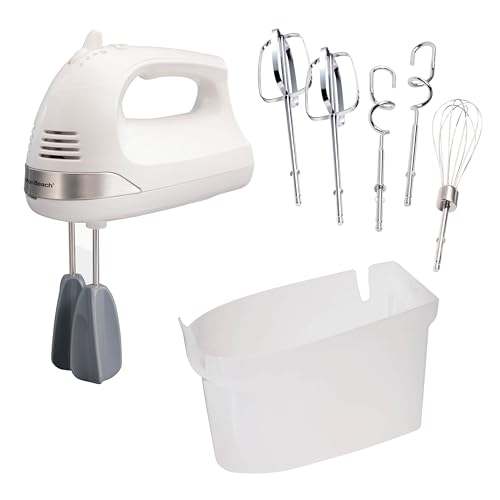
Hamilton Beach 6-Speed Hand Mixer with Easy Clean Beaters (62636J)
Badge: Best Attachment Set
Strengths
- Dough hooks and a whisk are included, not sold as extras
- Easy Clean beaters are designed to release batter instead of holding it
- Snap-on storage case keeps the full set together
Trade-offs
- Six speeds, not nine, so the top-end range is narrower than the Cuisinart pair
- White finish shows batter splashes and turmeric stains readily
- Hand format still means your arm does the holding on long jobs
At a glance: 6 speeds; 275 watt motor (as listed); Easy Clean beaters; Traditional beaters, dough hooks and whisk included; Snap-on storage case; Finish: White.
The verified listing for this model is specific about its kit: six speeds, a 275 watt motor as listed, easy-clean beaters, and the broadest attachment set in this group — traditional beaters, dough hooks and a whisk — plus a snap-on storage case.
This is a machine shaped by the jobs in this guide: one-handed mixing, when the other hand is holding the bowl, steadying the pan or turning the recipe page, with quick batters, whipped cream, mashing and small dough jobs done with a mixer that one hand can genuinely manage as the weekly reality. Its listing reads like it was written for that workload.
The honest limitation is the format itself: your arm is the stand. On long or stiff jobs you will feel it, and the correct response is rests, smaller batches and the lowest speed that moves the mixture — not forcing on while the motor strains. In daily use the pattern that suits this model best is short, deliberate sessions: stage the ingredients, start slow, let the machine work in its comfortable speed band, and clean the attachments while they are still easy to rinse. Cooks who work that way tend to keep a mixer for years; cooks who treat every job as a maximum-load event tend to shop again sooner, whatever they bought.
Best for: cooks focused on one-handed mixing, when the other hand is holding the bowl, steadying the pan or turning the recipe page, who want a verified, link-checked pick that covers quick batters, whipped cream, mashing and small dough jobs done with a mixer that one hand can genuinely manage. / Not suited for: anyone whose real need is a different format or a much larger batch than this design serves.

Cuisinart 9-Speed Hand Mixer with Storage Case (HM-90BCS)
Badge: Best with Storage Case
Strengths
- Nine speeds give unusually fine control from slow stirring to fast whipping
- SmoothStart limits the flour-cloud and splatter problem at startup
- Snap-on case keeps attachments from vanishing into a drawer
Trade-offs
- Nine speeds are more than casual bakers will ever use
- No dough hooks are named in the listing, unlike some rivals here
- The case adds bulk if your storage is a narrow drawer
At a glance: 9 speeds; 220 W motor (as listed); SmoothStart anti-splatter technology; Snap-on storage case; 6-piece set; Finish: Brushed chrome.
On paper — which here means on its verified listing — the offer is nine speeds, a 220 W motor as listed by the maker, SmoothStart anti-splatter technology, a snap-on storage case, and a six-piece set in a brushed chrome finish.
For one-handed mixing, when the other hand is holding the bowl, steadying the pan or turning the recipe page, that combination lands well. Quick batters, whipped cream, mashing and small dough jobs done with a mixer that one hand can genuinely manage is the workload this guide keeps coming back to, and the machine’s layout matches it: nothing you need is buried, and nothing you do not need gets in the way.
The honest limitation is the format itself: your arm is the stand. On long or stiff jobs you will feel it, and the correct response is rests, smaller batches and the lowest speed that moves the mixture — not forcing on while the motor strains. In daily use the pattern that suits this model best is short, deliberate sessions: stage the ingredients, start slow, let the machine work in its comfortable speed band, and clean the attachments while they are still easy to rinse. Cooks who work that way tend to keep a mixer for years; cooks who treat every job as a maximum-load event tend to shop again sooner, whatever they bought.
Best for: cooks focused on one-handed mixing, when the other hand is holding the bowl, steadying the pan or turning the recipe page, who want a verified, link-checked pick that covers quick batters, whipped cream, mashing and small dough jobs done with a mixer that one hand can genuinely manage. / Not suited for: anyone whose real need is a different format or a much larger batch than this design serves.

Proctor Silex Easy Mix 5-Speed Hand Mixer (62511)
Badge: Best Lightweight Pick
Strengths
- Compact, lightweight body is easy to hold and easy to store
- Bowl rest supports tidy pauses while you add ingredients
- Five speeds cover the everyday jobs without menu-diving
Trade-offs
- 215 watts of peak power is the most modest figure in this group
- No storage case or extra attachments are listed
- Basic feature set: no anti-splatter start is named
At a glance: 5 speeds; 215 watts of peak power (as listed); Bowl rest; Compact, lightweight body; Model 62511; Finish: Black.
What you are buying, per the maker’s own listing, is a package built around five speeds, 215 watts of peak power as listed, a bowl rest, and a compact, lightweight body — the simplest control layout in this group.
That feature set earns its keep when the job is one-handed mixing, when the other hand is holding the bowl, steadying the pan or turning the recipe page. The workload — quick batters, whipped cream, mashing and small dough jobs done with a mixer that one hand can genuinely manage — rewards control and quick pauses more than brute force, and this design leans that way.
The honest limitation is the format itself: your arm is the stand. On long or stiff jobs you will feel it, and the correct response is rests, smaller batches and the lowest speed that moves the mixture — not forcing on while the motor strains. In daily use the pattern that suits this model best is short, deliberate sessions: stage the ingredients, start slow, let the machine work in its comfortable speed band, and clean the attachments while they are still easy to rinse. Cooks who work that way tend to keep a mixer for years; cooks who treat every job as a maximum-load event tend to shop again sooner, whatever they bought.
Best for: cooks focused on one-handed mixing, when the other hand is holding the bowl, steadying the pan or turning the recipe page, who want a verified, link-checked pick that covers quick batters, whipped cream, mashing and small dough jobs done with a mixer that one hand can genuinely manage. / Not suited for: anyone whose real need is a different format or a much larger batch than this design serves.
Comparison Table
| Pick | Format | Headline verified features | Badge | Link |
|---|---|---|---|---|
| KitchenAid 5 Ultra Power Speed Hand Mixer (Contour Silver) | Hand mixer | 5 speeds; Turbo Beaters | Best Overall | Check on Amazon |
| Cuisinart Power Advantage Plus 9-Speed Hand Mixer (HM-90S) | Hand mixer | 9 speeds; SmoothStart anti-splatter start | Best for Fine Control | Check on Amazon |
| KitchenAid 5 Ultra Power Speed Hand Mixer (Black Matte) | Hand mixer | 5 speeds; Turbo Beaters | Best in Black Matte | Check on Amazon |
| Hamilton Beach 6-Speed Hand Mixer with Easy Clean Beaters (62636J) | Hand mixer | 6 speeds; 275 watt motor (as listed) | Best Attachment Set | Check on Amazon |
| Cuisinart 9-Speed Hand Mixer with Storage Case (HM-90BCS) | Hand mixer | 9 speeds; 220 W motor (as listed) | Best with Storage Case | Check on Amazon |
| Proctor Silex Easy Mix 5-Speed Hand Mixer (62511) | Hand mixer | 5 speeds; 215 watts of peak power (as listed) | Best Lightweight Pick | Check on Amazon |
Read the table by format first, features second. Format decides the class of job — a stand mixer works hands-free at the counter, a hand mixer goes to the bowl or the pan — and only then do speed counts and attachment sets separate the picks inside each format. Best Prices On Electric Hand Mixers
How to Choose the Right Mixer for One-handed mixing, when the other hand is holding the bowl, steadying the pan or turning the recipe page
Start with the job list, not the product list. Write down the five things you mixed in the last month. If the list is batters, creams and mashing, a hand mixer with a gentle low speed covers it, and your decision narrows to attachments and storage. If the list includes weekly dough or double batches, the stand format stops being a luxury. The expensive mistake is buying for an imaginary baker; the cheap success is buying for the documented one. Best Prices On Hand Mixers
Next, speeds. Count them, then discount the count: what matters is a genuinely slow start for flour and mash, a comfortable middle for creaming and batters, and enough top end for whipping. Anti-splatter starts and burst buttons are real quality-of-life features, not garnish. Then attachments: beaters are universal, a whisk transforms cream and egg whites, and dough hooks calm soft dough work. A storage case sounds boring until the third time a beater goes missing — then it sounds like wisdom.
Finally, the ownership details. Where will it live? How will the cord behave at your outlets? Can the attachments go in your dishwasher? Is the finish one you will happily wipe down? None of these questions appear in a headline, and all of them decide whether the mixer is still in weekly use next year. Answer them honestly and the right pick from this shortlist usually names itself.
How to Use, Clean and Look After Your Mixer
Set up. Stage every ingredient before the mixer comes out — with a hand mixer, one of your hands is committed. Use a deep bowl, set it on a damp cloth so it cannot skate, and fit the right attachment before plugging in: beaters for batters and mashing, whisk for aeration, hooks for soft dough.
Mix. Always start at the lowest speed and let the mixture come together before moving up. Move the mixer slowly through the bowl rather than holding it in one spot, scrape down the sides during a pause — on the bowl rest if your model has one — and work in short, deliberate bursts on anything stiff. For stand mixers, use the splash guard when adding flour, and add it in stages at low speed.
Clean and store. Eject the attachments straight into warm soapy water or the dishwasher where the listing allows it, wipe the body with a damp cloth, and never submerge a mixer body. Brush flour from the vents. Store hand mixers with their attachments — in the snap-on case where one is provided — and cover a stand mixer’s bowl so nothing falls into it between bakes. Targets4}]
Troubleshooting. Problem: flour erupts across the counter at startup → start at the lowest speed, add flour in stages, and use the splash guard or a towel over the bowl for the first seconds. Problem: dough climbs the beaters toward the body → stop, push the dough down with a spatula, switch to hooks if you have them, and finish stiff batches by hand. Problem: the motor smells warm on a heavy job → you are at the format’s limit; rest the mixer, split the batch, and let time and folds do the remaining work.
What makes a hand mixer genuinely one-hand friendly
Three things. First, controls: a speed control you can nudge with the thumb of the holding hand, without regripping or using the other hand. Second, the cord: a lockable swivel cord that parks on either side keeps it out of the bowl and out of your way, which matters twice as much when you have no spare hand to move it. Third, pauses: a bowl rest lets you set the mixer down on the bowl rim mid-job to add ingredients or scrape, instead of laying a batter-coated mixer on the counter. Judge every pick here against those three tests and the ranking mostly explains itself.
One hand on the mixer, one hand on everything else
The classic one-handed jobs are the ones where the bowl moves: mashing potatoes in a hot pan, whipping cream while the other hand rotates the bowl, folding additions into a batter that keeps trying to climb. Technique helps as much as hardware — a deep bowl, a damp cloth under it to stop it skating, ingredients staged before you start. With the stage set, any of these six mixers can run one-handed; without it, even the best mixer becomes a wrestling match.
Speed ranges matter less than speed behaviour. A mixer that starts gently will not throw flour across the counter, and a mixer whose lowest speed is genuinely slow can fold in chocolate chips or nuts without smashing them. At the other end, the top speed only matters for whipping — cream and egg whites — where a minute of patience at the right speed beats raw power applied at the wrong one.
Attachments decide what a mixer actually does all year. Beaters handle batters and mashing, a whisk handles cream and egg whites properly, and dough hooks handle soft doughs without wrapping them around the beaters. Before choosing, list the three things you mixed most often last year and match the attachment set to that list, not to the longest feature list on the page.
Noise and vibration are worth a mention because they decide whether early-morning baking feels civilised. Smaller hand mixers transmit more vibration to your hand on stiff mixtures, while a heavy stand mixer body absorbs it on the counter. Neither is silent, and if a listing promises whisper-quiet dough kneading, treat the claim kindly and sceptically in equal measure.
Finally, buy for the baker you are this year. A first mixer that gets used weekly teaches you more than a flagship that waits for special occasions. If you later outgrow it — bigger batches, weekly bread, layered celebration cakes — the upgrade path is obvious, and the humble first mixer still earns its drawer as the quick-job tool for whipped cream and small batters.
Consider the bowl you already own before blaming the mixer. A shallow, wide bowl throws mixture up the walls and out; a deep, narrower bowl keeps everything in the working zone and makes a modest mixer feel stronger. If your current bowl is a salad bowl pressed into service, upgrading the bowl is the cheapest performance upgrade in this entire guide, and it improves every mixer on this page equally.
Temperature is an invisible ingredient in mixing. Butter creams properly only in a fairly narrow band — cool enough to hold structure, warm enough to yield — and no mixer, at any speed, fixes butter that is fridge-hard or half-melted. Cream whips fastest cold, egg whites whip fullest at room temperature, and dough develops best when the liquid is lukewarm rather than hot. Ten minutes of temperature patience outperforms any feature on any listing here.
Learn your mixer’s sounds. A healthy mixer changes pitch smoothly as load changes; a mixer that suddenly strains, slows or smells warm is giving you information, not failing you. Ease off, scrape down, rest it for a moment, or split the batch. Bakers who listen to their machines keep them for years, because most small-motor damage happens in the sixty seconds after the first warning sign was ignored.
Recipes written for stand mixers translate to hand mixers with two adjustments: time and batch discipline. Expect creaming and mixing stages to take a little longer, move the mixer constantly so all of the bowl gets worked, and resist doubling. The ingredient ratios do not change — only the choreography does — and the results, for the great majority of cakes, batters and soft doughs, are indistinguishable.
If two bakers cook in your kitchen, controls matter socially as well as mechanically. A simple five-speed layout is a mixer a second person can pick up mid-recipe without a briefing; a nine- or twelve-speed range rewards the regular user who learns its bands. Neither is better in the abstract — match the control complexity to the household that will actually share the tool.
Replacement beaters and attachments are the long game of mixer ownership. Before buying, it is worth a moment’s thought about the brand’s retail footprint: established names keep spares findable for years, while a little-known import may be a single bent beater away from retirement. That consideration is built into this guide’s rankings, quietly, in the background of every badge.
A word on flour discipline, because it decides more bakes than any motor: add flour in two or three stages, start slow after each addition, and let each stage incorporate before adding the next. The cloud of flour that escapes a rushed start is not just mess — it is measurement leaving the recipe, and it slightly changes the bake you end up with.
Whipping deserves its own note. Cream and egg whites reward clean, dry, grease-free attachments and a bowl with room to grow — the mixture can triple in volume. Chill the bowl for cream if your kitchen is warm, wipe attachments with a little vinegar if they feel greasy, and stop at soft peaks first to look, because the distance from soft peaks to overwhipped is shorter than the distance you just travelled.
Think about where the finished mixture goes next. Batters that must be scraped into a narrow pan, doughs that move to a floured board, and mashes that stay in the cooking pan each favour a slightly different workflow around the same mixer. Planning the landing spot before you start mixing — pan greased, board floured, trivet ready — is the unglamorous habit that separates calm baking sessions from chaotic ones, and no product feature substitutes for it.
Altitude, humidity and flour age quietly change mixing. A batter that behaved last month may need a spoon more liquid in a dry winter kitchen, and dough hydration shifts with the flour’s mood. A mixer with a genuinely gentle low speed and several steps above it lets you adjust by feel — a little longer here, a touch slower there — which is why experienced bakers talk about speed behaviour more than speed counts.
There is a simple test for whether a mixer suits your kitchen: the Tuesday test. Not the birthday cake, not the holiday marathon — an ordinary Tuesday, when you want whipped cream, a quick batter or mashed potatoes with minimal fuss and minimal washing up. The mixer that wins Tuesdays is the mixer that earns its storage space, and it is the standard this guide quietly applies to every pick.
If you bake with children or beginners, add supervision-friendliness to your criteria. Simple controls, a mixer that stops the moment you release or switch it off, and attachments that eject without finger traps all matter. Several picks here keep their layouts deliberately simple, and that simplicity is a feature to value rather than a specification to apologise for.
Common Buying Mistakes
- Buying by speed count alone. Nine speeds used badly lose to five speeds used well; behaviour at the low end matters more.
- Ignoring what is in the box. A whisk or dough hooks bought later cost more and match worse than a set included from the start.
- Asking a hand mixer to live a stand mixer’s life. Weekly stiff dough through a hand-held motor shortens its life, whichever brand it is.
- Doubling recipes in small bowls. Two sequential batches beat one strained, uneven doubled batch every time.
- Choosing colour before format. Finishes of one model are the same machine; decide the format and features first, then enjoy the colour choice.
- Skipping the storage question. A mixer that is annoying to store becomes a mixer that is rarely used.
Final Recommendation
For most readers searching for the best one hand mixers blemders, start with the KitchenAid 5 Ultra Power Speed Hand Mixer (Contour Silver). It leads the linked picks because its verified feature set serves one-handed mixing, when the other hand is holding the bowl, steadying the pan or turning the recipe page with the fewest compromises. Check on Amazon for the KitchenAid 5 Ultra Power Speed Hand Mixer (Contour Silver). Check on Amazon for the Cuisinart Power Advantage Plus 9-Speed Hand Mixer (HM-90S).
Choose differently if your pattern differs: frequent bakers should weight speed range and storage, dough-focused cooks should weight hooks and low-speed calm, and anyone whose real format need differs from this search should follow the prose-only discussion honestly rather than forcing a mismatch. The right mixer is the one matched to your documented week — and this shortlist contains that match. Best Quality Hand Mixers
Frequently Asked Questions
What does ‘blemders’ mean in this keyword?
It is a typo in the search itself — most likely for ‘blenders’. The verified pool for this search is hand mixers, not blenders, so this guide covers the hand mixers honestly and judges them on one-handed use. If you specifically need a blender or an immersion blender, that is a different shortlist; nothing here should be bought expecting it to blend.
Which pick is easiest to run one-handed?
The KitchenAid models make the strongest case: the lockable swivel cord can be parked on either side, the easy-release button drops the beaters without a two-handed tug, and five speeds keep the control simple. In Contour Silver or Black Matte, the machine underneath is the same.
Why does a bowl rest matter so much?
Because one-handed bakers pause more, not less. A bowl rest — on the Hamilton Beach and the Proctor Silex here — lets the mixer sit on the bowl rim while your free hand scrapes or adds. Without one, every pause means finding a plate or a clean patch of counter for a dripping mixer.
Can I add ingredients while mixing one-handed?
Yes, with staging. Measure everything into small bowls before you start, keep them on your free-hand side, and add at low speed. The Cuisinart SmoothStart models help here, because the gentle start means an addition does not trigger a splatter when the beaters catch it.
Is a lightweight mixer always better one-handed?
Light helps over long jobs, and the Proctor Silex is explicitly the compact, lightweight design here. But balance matters as much as weight: a slightly heavier mixer that sits steady in the bowl can feel easier than a featherweight that skates. For short jobs — cream, batters, mashing — all six are manageable.
What jobs should not be done one-handed?
Stiff dough is the main one: it pulls the mixer and the bowl in opposite directions and deserves two hands or a stand mixer. Very full bowls of thin liquid are the other — sloshing plus a moving mixer is a mess looking for a moment. Keep one-handed work to batters, creams, mashing and soft mixtures.


