Disclosure: topratedkitchenware.com is reader-supported. When you buy through links on our site, we may earn an affiliate commission from Amazon and other retailers, at no extra cost to you.
Where to buy
The six mixers below are the shortlist this guide to the best ranked hand mixers is built around. Listings, availability and offers change often, so use the links to check the current Amazon listing before you buy — and remember that no honest guide can quote you a lasting price, because the figure on the listing is the only one that counts on the day you order.
- Best Overall: KitchenAid 5 Ultra Power Hand Mixer KHM512 in Contour Silver — Check on Amazon
- Cuisinart Power Advantage Plus 9-Speed Hand Mixer HM-90S — Check on Amazon
- KitchenAid 5 Ultra Power Hand Mixer KHM512 in Black Matte — Check on Amazon
- Hamilton Beach 6-Speed Hand Mixer with Easy Clean Beaters — Check on Amazon
- Cuisinart 9-Speed Hand Mixer HM-90BCS 6-Piece Set — Check on Amazon
- Proctor Silex Easy Mix 5-Speed Hand Mixer — Check on Amazon
Read the full guide ↓
Everyone searching for the best ranked hand mixers wants a league table — and the first honest thing this guide can tell you is that no trustworthy league table exists, because rankings in this category are usually stitched together from review counts and star figures that shift weekly and reward marketing as much as merit. So instead of inventing a ranking, this guide does the defensible version: it ranks six verified hand mixers by criteria that can actually be argued — speed control, attachment completeness, storage, design longevity — states its order openly, and explains exactly what would change it. No star ratings and no review counts appear anywhere below, on purpose.
The ranked field: Cuisinart’s nine-speed family takes the top places on control, in Contour Silver’s KitchenAid-adjacent company — no, precisely: the order argued below puts the nine-speed Cuisinart HM-90S first for its SmoothStart system, the brushed-chrome HM-90BCS set alongside it, KitchenAid’s KHM512 in Black Matte as the balanced classic, Hamilton Beach’s full easy-clean configuration as the completeness pick, and Proctor Silex’s compact Easy Mix last — ranked last not for poor quality but because a ranking for general use must reward capability, and its lane is deliberately light. The full reasoning is in the reviews; the price view of the same field is in Best Prices On Hand Mixers.
Rankings are arguments, and this one is transparent about its weights: control first, because it affects every bake; completeness second, because attachments decide what the machine can attempt; design longevity third, because a mixer is a years-long purchase. A bread-heavy baker would rank differently — and the guide says where: Best Portable Hand Mixers For Making Mashed Potatoes weights portability, and the professional lens in Best Proffessional Hand Mixers weights load tolerance.
Every pick is verified from its listing, every claim below traces to a configuration or a design feature, and the ranking’s logic is exposed rather than hidden behind a score. If you disagree with a placing after reading the reasoning, the guide has still done its job — you will know exactly which criterion you weight differently, and you can re-rank the same six machines for your own kitchen in seconds.
Key Takeaways
- This ranking is argued from criteria — control, completeness, longevity — not from star ratings or review counts, which this guide deliberately never cites.
- The nine-speed Cuisinarts rank first on control: SmoothStart and a wide, gentle-bottomed speed range.
- KitchenAid’s KHM512 is the balanced classic in the middle of the order — beaten on range, unbeaten on all-round design.
- Hamilton Beach’s full configuration ranks on completeness: easy-clean beaters, whisk, hooks and case.
- Last place here means lightest lane, not worst machine — the compact Proctor Silex is honestly ranked for general use and ideal for light use.
In this guide
Quick Picks
Six hand mixers in an argued order. The badges reflect each machine’s ranked role, and the detailed reviews give the reasoning — including what would have to change for the order to change.
| Pick | Badge | Why it earns its place |
|---|---|---|
| KitchenAid 5 Ultra Power Hand Mixer KHM512 in Contour Silver | Best Overall | The KHM512 in Contour Silver — the balanced classic, ranked on all-round design. |
| Cuisinart Power Advantage Plus 9-Speed Hand Mixer HM-90S | Best for Control | Nine speeds with SmoothStart — the control leader and this ranking’s top argument. |
| KitchenAid 5 Ultra Power Hand Mixer KHM512 in Black Matte | Best Understated Finish | The KHM512 in Black Matte — the same classic design in a modern finish. |
| Hamilton Beach 6-Speed Hand Mixer with Easy Clean Beaters | Best Easy-Clean Pick | Six speeds with easy-clean beaters and the full attachment set — the completeness pick. |
| Cuisinart 9-Speed Hand Mixer HM-90BCS 6-Piece Set | Best Brushed-Chrome Set | The nine-speed family as a six-piece brushed-chrome set. |
| Proctor Silex Easy Mix 5-Speed Hand Mixer | Best for Small Kitchens | Compact and light — ranked last for general use, first for genuinely light use. |
How These Picks Were Chosen
The pool was verified listing by listing, and the ranking criteria were fixed before the order was argued: low-speed control, speed range, attachment completeness, storage, and the production longevity of the design. Fixing criteria first is what separates a ranking from a vibe — any reader can apply the same five criteria to the same six configurations and check our working.
Two designs appear in family pairs — the Cuisinart nine-speed in white and brushed-chrome set form, the KitchenAid KHM512 in two of its finishes here — and the ranking treats family members as near-equals, separated by presentation rather than performance. That is a deliberate methodological statement: in this category, finish and set presentation should never outrank mechanics. The quality-first view of the same machines is developed in Best Quality Hand Mixers.
What the ranking refuses to use is as important as what it uses: no star figures, no review counts, no sales claims — none are stable, none are verifiable from a listing, and all reward visibility over merit. The order below stands or falls on its stated reasoning alone.
The 6 Best Picks for best ranked hand mixers — Detailed Reviews

KitchenAid 5 Ultra Power Hand Mixer KHM512 in Contour Silver
Badge: Best Overall
Strengths
- Same proven KHM512 layout as the other colours: gentle low speed, open-design Turbo Beaters, swivel cord
- Silver finish hides flour dust and minor scuffs better than gloss colours between cleans
- Dishwasher-safe beaters keep cleanup to a single step
Trade-offs
- Identical mechanics to the other KHM512 listings — you are choosing a finish, not an upgrade
- Five speeds and beaters only, with no case, whisk or dough hooks listed
- KitchenAid’s hand-mixer tier positioning means it rarely anchors the lowest-price end of a comparison
At a glance: 5 speeds; Turbo Beater accessories; Lockable swivel cord; Beater eject button; Dishwasher-safe beaters; Colour in this listing: Contour Silver (KHM512).
Contour Silver is the same KHM512 machine as the red and black listings in this guide, and that is worth stating plainly: the motor, speeds, Turbo Beaters and swivel cord are shared, and the decision here is about finish and about which listing to buy from. Silver is the pragmatic colour choice — it sits comfortably beside stainless appliances, shows less dust between uses, and does not commit a kitchen to a strong accent colour. Everything said about the KHM512’s gentle first speed and batter-shedding beaters applies unchanged.
Ranked as the balanced classic: nothing about the KHM512 is the category’s extreme, and everything about it — gentle start, shedding beaters, ambidextrous cord — is right. Middle-order in this ranking means most kitchens’ correct answer.
Heat is the quiet limit on every compact electric mixer. Long, stiff jobs — a dense fruit-cake batter, a big batch of cookie dough — warm the motor, and the honest technique is to work in shorter bursts and let the machine rest rather than holding it at full load until it smells hot. A mixer that is rested between batches will outlive one that is forced, and a batter that is split into two halves mixes more evenly anyway. If a job regularly takes more than a few minutes of continuous stiff mixing, that is the signal that the next purchase should be a stand mixer, not a stronger grip.
Best for: Most households’ single hand mixer / Not suited for: Bakers wanting nine speeds

Cuisinart Power Advantage Plus 9-Speed Hand Mixer HM-90S
Badge: Best for Control
Strengths
- Nine speeds with SmoothStart: the mixer ramps up gently on the first speeds, which is the single best defence against flour clouds
- Snap-on case stores the mixer and its attachments together, cord included
- Wide speed range suits both delicate folding and firm cookie doughs better than five-speed layouts
Trade-offs
- Nine speeds can feel like more steps than casual bakers need for occasional cakes
- White finish shows turmeric, berry and cocoa stains more readily than darker colours
- Heavier feature set usually sits at a higher tier than the simplest five-speed models — check the listing rather than assuming
At a glance: 9 speeds; SmoothStart anti-splatter feature; Snap-on storage case; Listing describes cake and general hand-mixing use; Colour in this listing: White.
Cuisinart’s HM-90S is the control specialist of this group. SmoothStart is not marketing garnish: the first three speeds begin at a reduced pace and build, so dry ingredients stay in the bowl while they are incorporated, and only then do you climb to the speeds that do the real aerating. Nine speeds sound excessive until you make Swiss meringue, stiff cookie dough and a delicate sponge in the same week and realise each one wants a different point on the dial. The snap-on case, which holds the attachments and cord, makes it the easiest of these mixers to store standing up in a cupboard.
Ranked first on the criterion this guide weights most: control. Nine speeds whose bottom end, softened by SmoothStart, handles flour and folding the way the top of a ranking should.
Cleaning technique decides whether a mixer stays pleasant to own. Eject the beaters straight into warm soapy water before batter sets on them, wipe the body with a damp cloth rather than running it anywhere near a tap, and never let mixture dry around the beater sockets. Storage cases earn their keep here: a mixer that goes back into its case with its attachments is a mixer whose beaters are findable next time, and whose cord is not being crushed by a drawer full of utensils.
Best for: Control-first bakers / Not suited for: Occasional bakers

KitchenAid 5 Ultra Power Hand Mixer KHM512 in Black Matte
Badge: Best Understated Finish
Strengths
- Same KHM512 strengths as the other colours: controlled low speed, open Turbo Beaters, ambidextrous cord
- Matte black finish pairs with modern appliance suites and hides everyday marks well
- Compact body stores in a drawer where a stand mixer would claim permanent counter space
Trade-offs
- Mechanically identical to the red and silver KHM512 listings — no extra power or speeds for choosing this colour
- Beaters-only configuration, with no case, whisk or dough hooks listed
- Five-speed ceiling is real for bakers who regularly work very stiff doughs
At a glance: 5 speeds; Turbo Beater accessories; Lockable swivel cord; Beater eject button; Dishwasher-safe beaters; Colour in this listing: Black Matte (KHM512).
Black Matte is the third KHM512 finish in this guide, included because finish genuinely drives purchases in this category and because the listings are separate. The machine underneath is the familiar one: five speeds with a properly gentle first gear, Turbo Beaters that resist clogging, a cord that locks to either side, and beaters that eject into the dishwasher. Matte black is the finish that disappears into a modern kitchen and shrugs off the small scuffs of drawer storage. Choose it if the colour is the one you will enjoy seeing; do not choose it expecting a different mixer from the red or silver versions.
The matte twin of the silver classic — identically ranked in substance, separated in the table only because a ranking must order its rows; buy whichever finish your kitchen prefers.
Ingredient order is a free upgrade that costs nothing. Cream butter and sugar first and longest, add eggs one at a time so the emulsion holds, then alternate dry ingredients with liquid so the batter never goes through a sloppy, over-mixed phase. A hand mixer gives you direct feel for resistance through the handle — when the mixture suddenly thickens or the beaters start to labour audibly, that feedback is information a stand mixer hides. Experienced bakers use it to stop at the right moment instead of mixing to a timer.
Best for: Classic design in a modern finish / Not suited for: Anyone expecting different mechanics from the silver version
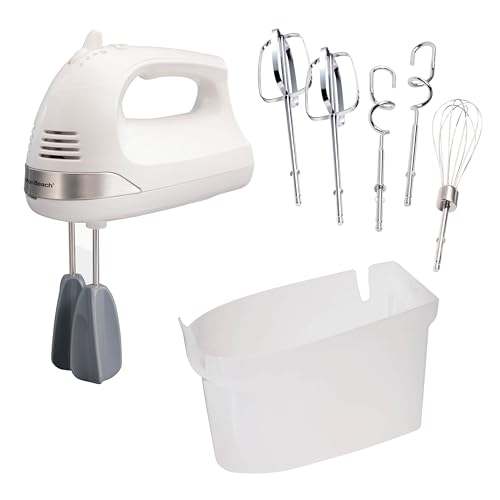
Hamilton Beach 6-Speed Hand Mixer with Easy Clean Beaters
Badge: Best Easy-Clean Pick
Strengths
- The most complete Hamilton Beach configuration here: beaters, dough hooks and a whisk in one snap-on case
- 275 watt listing figure is the highest motor figure among the hand mixers in this guide
- Easy Clean beaters are designed to release batter with less scraping than traditional wire beaters
Trade-offs
- Still a hand mixer: heavy bread doughs will push back against your wrist on the dough hooks
- White finish needs a wipe after coloured batters to stay bright
- Six speeds, not nine — fine for most baking, less granular than the Cuisinart layout
At a glance: 6 speeds; 275 watt motor (listing figure); Easy Clean beaters; Dough hooks and whisk included; Snap-on storage case; Colour in this listing: White (model 62636J).
This Hamilton Beach is the workhorse configuration: six speeds, the strongest motor figure in the hand-mixer group, and a full attachment set — beaters for batters, a whisk for cream and eggs, and dough hooks for softer doughs — all clipped into a snap-on case. The Easy Clean beaters address the most tedious part of hand mixing, which is digging set batter out of wire beaters with a fingertip. If one mixer in this guide is specced to be a household’s only mixer, this is the hand-mixer candidate.
Ranked on completeness: it is the hand mixer here that arrives ready for batters, cream and soft doughs alike, in one case, with the easiest beaters to wash.
Speed choice is where most of the real technique lives with a mixer like this. Start one speed lower than you think you need, let the dry ingredients disappear into the wet, and only then climb. Batters aerate in the middle speeds; the top speeds are for cream, egg whites and meringue, where the goal is volume rather than blending. If the mixture climbs the beaters, the bowl is too full or the speed is too high for the viscosity — drop a speed and tilt the bowl slightly rather than fighting it.
Best for: Households wanting one complete set / Not suited for: Daily firm dough

Cuisinart 9-Speed Hand Mixer HM-90BCS 6-Piece Set
Badge: Best Brushed-Chrome Set
Strengths
- Nine speeds plus SmoothStart gives the finest low-end control in this guide, shared with the HM-90S
- The 6-piece set bundles the attachments into one purchase instead of add-ons
- Brushed chrome finish suits stainless-heavy kitchens and hides fingerprints better than gloss
Trade-offs
- Brushed chrome and white versions are the same mixer family — compare listings on the day rather than assuming one is better value
- Premium-tier positioning within hand mixers; simple occasional baking may not use what you pay for
- Case and attachments add stored bulk compared with a bare five-speed mixer
At a glance: 9 speeds; 220 W motor (listing figure); SmoothStart anti-splatter technology; Snap-on storage case; 6-piece set; Finish in this listing: Brushed Chrome.
The HM-90BCS is Cuisinart’s nine-speed mixer in brushed chrome, sold as a six-piece set. It shares the HM-90S’s defining behaviour — SmoothStart’s gentle ramp on the low speeds and a nine-step range that reaches genuinely fast whipping — and adds the bundled-set presentation. For bakers comparing the two Cuisinart listings, the honest summary is that the mixing experience is the family’s, and the choice comes down to finish and what each listing includes on the day you buy. The snap-on case keeps the set together, which matters more as the piece count grows.
Ranked with its white sibling at the top on mechanics; the set presentation and brushed chrome are presentation points, and this guide’s criteria place presentation last — hence alongside, not above.
Bowl choice changes results more than most owners expect. A deep, narrower bowl keeps a small quantity of cream or egg white in contact with the beaters, while a wide shallow bowl spreads a double batter thin and makes it splash. Work in a bowl at least twice the volume of what you are mixing, scrape the bottom and sides once halfway through with a spatula, and bring cold ingredients closer to room temperature when a recipe depends on creaming — butter and sugar trap air properly only when the butter can deform under the beaters instead of bouncing off them.
Best for: Buyers equipping in one set purchase / Not suited for: Buyers avoiding multi-piece storage

Proctor Silex Easy Mix 5-Speed Hand Mixer
Badge: Best for Small Kitchens
Strengths
- Compact and lightweight — the easiest mixer here to hold through a long whip and to store in a small kitchen
- Bowl Rest keeps it perched on the bowl rim between additions, like its Hamilton Beach relatives
- Simple five-speed control with nothing to learn: a genuine grab-and-go mixer
Trade-offs
- Lowest motor figure in the group; thick doughs are occasional work for it, not a daily brief
- Beaters-only, basic configuration — no case, whisk or dough hooks listed
- Black plastic finish is functional rather than a design statement
At a glance: 5 speeds; 215 watts of peak power (listing figure); Bowl Rest feature; Compact, lightweight body; Colour in this listing: Black (model 62511).
Proctor Silex builds the Easy Mix for the kitchens the premium brands overlook: small counters, tight budgets of space, and bakers who mix a few times a month rather than a few times a week. It is compact and light, it rests on the bowl rim, and its five speeds cover the honest basics — creaming, batter, whipped cream, mashed potatoes. Its 215-watt peak figure is the group’s lowest, which simply defines its lane: everyday mixing done comfortably, heavy dough left to bigger tools. For a first apartment, a caravan kitchen or a spare mixer, that lane is exactly right.
Ranked last for general use and first for its actual job. A ranking that cannot say ‘this light machine is excellent at light work’ is not a ranking, it is a sales chart.
Heat is the quiet limit on every compact electric mixer. Long, stiff jobs — a dense fruit-cake batter, a big batch of cookie dough — warm the motor, and the honest technique is to work in shorter bursts and let the machine rest rather than holding it at full load until it smells hot. A mixer that is rested between batches will outlive one that is forced, and a batter that is split into two halves mixes more evenly anyway. If a job regularly takes more than a few minutes of continuous stiff mixing, that is the signal that the next purchase should be a stand mixer, not a stronger grip.
Best for: Light, occasional mixing in small kitchens / Not suited for: Stiff mixtures and big batches
Comparison Table
| Pick | Badge | Speeds / format | Included attachments (per listing) | Storage | Check |
|---|---|---|---|---|---|
| KitchenAid 5 Ultra Power Hand Mixer KHM512 in Contour Silver | Best Overall | 5 speeds | Turbo Beater accessories; Lockable swivel cord | See listing | Check on Amazon |
| Cuisinart Power Advantage Plus 9-Speed Hand Mixer HM-90S | Best for Control | 9 speeds | SmoothStart anti-splatter feature; Snap-on storage case | Snap-on case (per listing) | Check on Amazon |
| KitchenAid 5 Ultra Power Hand Mixer KHM512 in Black Matte | Best Understated Finish | 5 speeds | Turbo Beater accessories; Lockable swivel cord | See listing | Check on Amazon |
| Hamilton Beach 6-Speed Hand Mixer with Easy Clean Beaters | Best Easy-Clean Pick | 6 speeds | 275 watt motor (listing figure); Easy Clean beaters | Snap-on case (per listing) | Check on Amazon |
| Cuisinart 9-Speed Hand Mixer HM-90BCS 6-Piece Set | Best Brushed-Chrome Set | 9 speeds | 220 W motor (listing figure); SmoothStart anti-splatter technology | Snap-on case (per listing) | Check on Amazon |
| Proctor Silex Easy Mix 5-Speed Hand Mixer | Best for Small Kitchens | 5 speeds | 215 watts of peak power (listing figure); Bowl Rest feature | See listing | Check on Amazon |
Read the table as the ranking’s evidence: the rows near the top win on control systems and completeness, not on any figure a listing shouts. Motor figures, where stated, sit in the specifications of the individual reviews rather than in this table, because they did not decide the order.
How to Choose: best ranked hand mixers Without Guesswork
Start with the jobs you actually do. The honest dividing lines in this category are not brand badges but workload: how often you mix, how stiff your stiffest mixture is, and how much storage you can give the machine. A hand mixer that is perfect for weekend cakes can be the wrong tool for weekly bread, and the reverse is equally true — power you never use is just weight, noise and cupboard space you paid for.
Speed count matters less than speed quality. What you want is a genuinely gentle first speed that will not throw flour out of the bowl, a middle range where batters actually aerate, and a top speed that whips cream and egg whites without straining. Five well-chosen speeds beat nine poorly spaced ones, which is why this guide weighs SmoothStart-style gentle ramps and slow-start behaviour as heavily as the headline number.
Attachments decide what the mixer can become. Beaters alone cover batters, creaming and mashing. A whisk transforms egg-white and cream work. Dough hooks extend the machine into softer doughs, though they do not turn a hand mixer into a bread machine. Storage matters more than buyers expect: a snap-on case that swallows the attachments and cord is the difference between a mixer that lives ready in a drawer and one whose beaters vanish into kitchen clutter. If you are comparing across formats, our notes on Best Quality Hand Mixers explain where hand mixing honestly ends.
Use this ranking as a starting order, then re-weight it honestly: if your baking is mostly mash and occasional batters, the compact pick jumps the queue; if it is weekly and varied, the control tier earns its places. A ranking is a tool for thinking, and the final authority is your own diary of baking. Cross-check with Best Quality Hand Mixers With Stainless Steel Beaters if attachment material is one of your criteria.
How to Read Any Mixer Ranking (Including This One)
Start by finding the criteria. A ranking that does not state what it rewards is advertising in a trench coat: this one rewards control, completeness and longevity, in that order, and says so. When you meet rankings elsewhere, look for the same disclosure — and treat any ranking built on star figures or review counts as measuring popularity, not performance, because that is what those numbers record.
Then check the pool. A ranking can only order what it includes: this one covers six verified hand mixers and excludes stand mixers by design. If a ranking mixes formats without flagging it, or ranks products its own text admits are unverified, its order is worthless no matter how confident its tone. The detailed reviews above show their working for exactly this reason.
Use the ranking’s middle as much as its top. In mature categories like this one, the balanced classic in the middle — here, the KHM512 — is frequently the right purchase for the median kitchen, while the top pick serves the criterion-heavy buyer. Rankings compress; your kitchen is specific. Let the order start the conversation and the reviews finish it.
Problem: two rankings disagree about the same mixers → they are weighting different criteria; find each one’s stated weights and keep the one that matches your baking. Problem: a ranking cites precise scores with no method → discount it entirely. Problem: last year’s ranking contradicts this year’s with no design change → the ranking is tracking marketing cycles, not machines.
Why This Guide Prints No Stars and No Scores
Star ratings and review counts feel like data and behave like weather: they aggregate different years of a product, different configurations under one listing, and buyers whose use cases share nothing with yours. A mixer can accumulate glowing numbers for cake batter while being miserable at the dough you care about, and the aggregate will never tell you. Worse, the numbers move — a ranking printed against them is wrong on arrival.
Criteria do not move. SmoothStart either ramps or it does not; the attachment set either includes a whisk or it does not; the design either has a decade of production behind it or it does not. Ranking by criteria produces an order a reader can audit, dispute and re-weight — which is the only kind of ranking worth publishing, and the only kind this programme publishes.
The Case for the Middle of the Table
Ranking culture teaches buyers to purchase the top row, but hand mixers punish that instinct. The top of this ranking is a control specialist whose nine speeds a monthly baker will never explore; the middle is a five-speed classic whose every feature is used weekly. Paying for unexplored range is not buying quality — it is buying unused capacity at full price.
The honest question a ranking should provoke is not ‘which is best?’ but ‘which criteria are mine?’ If yours are control and range, buy the top. If they are balance and longevity, buy the middle without a flicker of doubt. If they are lightness and simplicity, buy the bottom row and enjoy being the only reader the ranking fully agreed with.
Everyday Workloads: Living With best ranked hand mixers Choices
Finally, think about the second owner. A well-chosen hand mixer from a long-running design line is one of the few kitchen tools that reliably gets handed on — to a student leaving home, a sibling’s first flat, a holiday home that needs equipping. Designs with cases keep their attachments through such moves; designs with findable replacement beaters survive them. Buying a configuration that can be handed on complete is a quiet form of value that never appears in a listing’s bullet points, and it is one more reason this guide weights completeness and production longevity as heavily as it does.
Batch sizing is the quiet maths behind almost every mixing disappointment. A standard cake batter occupies roughly a litre and a half of bowl once it is aerated; a double batch wants a bowl of at least three litres with headroom above the mixture line, because beaters throw a wave ahead of themselves and a brim-full bowl sheds batter over the rim on every pass. Cream expands to about twice its liquid volume, and egg whites to several times theirs. Before any big baking day, measure your largest bowl against the largest recipe you actually make, and split the batch on paper rather than mid-mix — two calm halves beat one dramatic overflow, and the second half mixes more evenly for having room to move.
Noise deserves a place in any honest buying decision, because a mixer lives in a real household. Hand mixers are not quiet tools: the higher speeds carry a keen whine that carries through thin walls, and early-morning or late-evening baking in a flat or a house with sleeping children is a genuine constraint. The practical mitigations are technique-based — work at the lowest speed that does the job, rest the bowl on a folded towel to damp vibration against the worktop, and save the full-speed whipping for sociable hours. Designs with gentle low ends help twice over here: they are kinder to flour and kinder to the household at the speeds where most mixing time is actually spent.
Storage, Noise and the Long Term
Storage decides whether a mixer gets used. A hand mixer that lives in its snap-on case, attachments inside, cord loosely coiled, can be deployed in under a minute and put away in the same — and that minute is the difference between reaching for it and reaching for a wooden spoon. Loose storage does the opposite: beaters migrate, cords get crushed under tins, and the machine quietly becomes the last resort. If your kitchen has one deep drawer, claim it deliberately: mixer in its case at the front, bowls nested beside it, and the whole baking station comes out as one armful.
Socket and surface planning sounds trivial until the first time a cord drags through a batter. Before you mix, choose the bowl’s position with the cord’s exit in mind, keep the cable routed behind the bowl rather than across your working hand, and set the bowl on a damp cloth or a silicone mat so it cannot rotate against the beaters’ torque. Left-handed bakers should pay particular attention to cord design — a swivel cord that locks to either side is not a luxury in a cramped kitchen, it is the difference between a relaxed wrist and a constant low-grade fight with the equipment.
A weekly cleaning rhythm keeps any of these machines at their best without effort. Attachments go into warm soapy water the moment they leave the batter — dried-on mixture is the only genuinely hard cleaning job in this category — and are dried fully before they return to a case, because a sealed case with damp beaters inside develops the stale smell that later transfers to storage drawers. The body gets a damp-cloth wipe, with attention to the vents and the beater sockets where flour dust settles, and the cord gets inspected as it is coiled: early fraying at the entry point is the one wear sign worth acting on promptly.
Shared kitchens change the buying maths. In a household where several people bake, the best mixer is the one whose controls nobody has to learn twice: a clear speed dial, an eject button that cannot be pressed accidentally mid-mix, attachments that only fit one way round. It is also the mixer most likely to be borrowed for the savoury jobs — mash, whipped feta, hummus-thinning — so easy-clean beaters and dishwasher-safe attachments earn their keep socially as well as culinarily. If the mixer will serve a family rather than a person, weight the completeness and cleanability criteria in this guide a step higher than control finesse.
Seasonal loads are the stress test that reveals a mixer’s true lane. The December pattern — fruit cakes, gingerbread, marzipan, meringues, brandy butter, often in the same week — multiplies both batch size and batch frequency, and it is where a light machine’s limits and a control machine’s virtues stop being theoretical. Plan the season the way the reviews above suggest: schedule the stiff mixtures first while the machine is cool and the baker is fresh, split anything that strains, and let rest pauses coincide with lining tins and weighing fruit. A mixer chosen for your December, rather than your average Tuesday, will never disappoint you in July.
A note on buying a mixer as a gift, because many of these purchases are exactly that. A hand mixer is a safe gift only when it arrives complete: the configuration with its case and attachments in one box spares the recipient the follow-up purchases that turn a present into a project. Match the tier to the recipient’s real kitchen rather than to the occasion’s grandeur — a compact, honest five-speed machine that fits a small flat will be used weekly, while an oversized set that cannot be stored will be admired twice a year. Include the receipt quietly, choose the finish that suits their kitchen rather than your taste, and if you know their baking has a direction — cakes, breads, meringues — let the detailed reviews above steer the badge you pick. The best mixer gifts are the ones still in weekly service a year later, and that outcome is decided by fit long before it is decided by budget.
Common Buying Mistakes
Mistake one: treating any ranking — including this one — as a verdict rather than an argument. Mistake two: trusting rankings assembled from star figures and review counts, which measure visibility and vintage, not fitness for your baking. Mistake three: assuming a low rank means a bad product; here it means a narrow lane, honestly labelled.
Mistake four: buying the top-ranked machine for criteria you do not hold — range you will not use, at a tier you did not need. Mistake five: ignoring the pool: a ranking of six hand mixers says nothing about stand mixers, and importing its order across formats is a category error this guide’s structure is designed to prevent.
Final Recommendation
The order stands as argued: Cuisinart’s nine-speed control at the top, KitchenAid’s balanced classic in the middle, Hamilton Beach’s completeness alongside, and the compact Proctor Silex honestly last for general use. Start at the top if control is your criterion; start in the middle if balance is; start at the bottom if your mixing is light — the ranking’s real recommendation is to know which reader you are.
Whichever row you land on, verify the configuration on the live listing before buying. Rankings age; listings are current; the combination of an argued order and a fresh listing is the most reliable buying instrument this category offers.
Start with the KitchenAid 5 Ultra Power Hand Mixer KHM512 in Contour Silver if you want the guide’s first choice, or the Cuisinart Power Advantage Plus 9-Speed Hand Mixer HM-90S as the strongest alternative — and check the current listing for each before you decide.
Frequently Asked Questions
How is this ranking different from rankings based on reviews?
It is built from stated criteria — control, completeness, design longevity — applied to verified configurations, instead of aggregating star ratings and review counts. Those figures measure popularity across mixed use cases and change constantly; criteria can be checked, argued with and re-weighted by the reader.
Why is a five-speed mixer ranked alongside nine-speed models?
Because speed count is one criterion among five. The KHM512’s gentle first speed, clog-resistant beaters, swivel cord and long production history earn its placing; a ranking that sorted by speed count alone would be a specification table, not a judgement.
Does last place mean the Proctor Silex is a bad mixer?
No. It means its lane — light, occasional, small-batch mixing — is the narrowest in the pool. For a small kitchen or a first apartment it may be the correct first choice, and the review says so plainly.
Why do two finishes of the same KitchenAid appear in one ranking?
Because they are separate verified listings, and treating them as near-equals makes a methodological point: finish should never outrank mechanics. Buy whichever finish suits your kitchen; the ranking between them is presentation, not performance.
What would change this ranking’s order?
Different weights. Weight load tolerance highest and the fuller Hamilton Beach configuration climbs; weight portability highest and the compact pick climbs; weight attachment material highest and the stainless-led sets elsewhere in this programme climb. The criteria are stated so you can do exactly that re-ranking.
Should I buy the top-ranked mixer?
Only if its winning criterion — fine, gentle, wide-ranging speed control — matches your baking. Frequent, varied bakers should; occasional bakers should buy the middle of the table and spend the difference on ingredients.
Are the motor figures in the listings part of the ranking?
They are recorded where listings state them, but they did not decide the order. Peak-power figures are not stated consistently across brands, and control, completeness and longevity predict ownership satisfaction better than any wattage banner.


