Disclosure: topratedkitchenware.com is reader-supported. When you buy through links on our site, we may earn an affiliate commission from Amazon and other retailers, at no extra cost to you.
Where to buy
The best programmable drip or brew coffee makers cast a wider net — drip or brew — and the roundup answers in kind: five programmable drip brewers by the pot, one always-ready drip brewer, and within the FlexBrew, a single-serve brewing side that covers the ‘or brew’ half of the question outright. All six picks are linked.
- BLACK+DECKER 12-Cup Thermal Programmable Coffee Maker (CM2046S) — a 12-cup thermal carafe machine with brew strength control and a VORTEX showerhead; check the latest price on Amazon
- Cuisinart PerfecTemp 12-Cup Thermal Drip Coffee Maker (DCC-3400NAS) — Cuisinart’s PerfecTemp design brews hotter, into a double-wall stainless thermal carafe; check the latest price on Amazon
- BLACK+DECKER CaféCraft 12-Cup Thermal Coffee Maker — a programmable 12-cup thermal machine that brews for both hot and iced coffee; check the latest price on Amazon
- Cuisinart 12-Cup Programmable PerfecTemp Thermal Coffee Maker (White) — Cuisinart’s PerfecTemp thermal machine in white, with a dedicated 1–4 cup setting and Brew Pause; check the latest price on Amazon
- BUNN Speed Brew Platinum Thermal Coffee Maker (CSB3T) — BUNN’s Speed Brew design keeps water hot and ready, pouring a 10-cup pot with minimal wait; check the latest price on Amazon
- Hamilton Beach FlexBrew Advanced 5-in-1 Coffee Maker — a 5-in-1 system: 12-cup programmable thermal drip on one side, single-serve pods or grounds on the other; check the latest price on Amazon
Read the full guide ↓
The best programmable drip or brew coffee makers sit at the crossing of two searches: shoppers who know they want drip, and shoppers who only know they want coffee brewed for them, on time, without fuss. This guide serves both. Its six machines are drip brewers at heart — that remains the best answer for pots — but they span the wider meaning of ‘brew’: scheduled pots, on-demand pots, single cups from pods or grounds, and iced coffee, all under programmable or always-ready control.
That breadth is deliberate, because the honest first question in this category is not which machine but which brewing architecture fits your household: a pot on a timer, a pot on demand, or a hybrid that refuses the choice. The picks below map one to each architecture, with the drip pot — in four distinct interpretations — at the center. For the pure cup-at-a-time reading of ‘brew’, Best Single Serve Pod Coffee Makers covers that field on its own terms.
What unites the six is the programmable promise in its two forms: coffee that brews itself at the appointed hour, or a machine so ready that the appointment is unnecessary. Everything else — carafes, temperatures, batch sizes — is about making sure the coffee that results deserves the convenience.
Key Takeaways
- ‘Drip or brew’ is really an architecture question: scheduled pot, on-demand pot, or a hybrid machine that does both plus single cups.
- Four of the six are programmable thermal drip machines differing in temperature (PerfecTemp), distribution (VORTEX), batch range (1–4 cup), and seasonality (hot and iced).
- The FlexBrew is the widest interpretation of ‘brew’ in the pool: drip, pods, grounds, hot, and iced in one housing.
- The BUNN is the narrowest and deepest: one method, drip, executed at commercial speed from an always-hot reservoir.
- Thermal carafes throughout — because whichever architecture you choose, brewed coffee that waits should never wait on a hot plate.
- If the household cannot agree on an architecture, the hybrid is not a compromise; it is the answer.
In this guide
Quick Picks
Six machines, three architectures. The badges identify what each does best within the drip-or-brew landscape, and the detailed reviews argue each case on its own terms.
| Pick | Badge | Why it stands out | Link |
|---|---|---|---|
| BLACK+DECKER 12-Cup Thermal Programmable Coffee Maker (CM2046S) | Best Overall | Full programmability, a thermal carafe that skips the hot plate, and even saturation from the VORTEX showerhead | Check on Amazon |
| Cuisinart PerfecTemp 12-Cup Thermal Drip Coffee Maker (DCC-3400NAS) | Best for Hotter Brewing | Hotter brewing water for fuller extraction, plus Brew Strength control and a stainless thermal carafe | Check on Amazon |
| BLACK+DECKER CaféCraft 12-Cup Thermal Coffee Maker | Best for Hot and Iced | One programmable machine covering the morning hot pot and the afternoon iced glass | Check on Amazon |
| Cuisinart 12-Cup Programmable PerfecTemp Thermal Coffee Maker (White) | Best for Small Batches | The 1–4 cup setting makes small pots taste right, and Brew Pause serves a cup mid-brew | Check on Amazon |
| BUNN Speed Brew Platinum Thermal Coffee Maker (CSB3T) | Best for Speed | The always-ready reservoir approach: the fastest route from decision to full pot in this pool | Check on Amazon |
| Hamilton Beach FlexBrew Advanced 5-in-1 Coffee Maker | Most Versatile | Full pot and single cup, pods and grounds, hot and iced — the one-machine answer for mixed households | Check on Amazon |
How These Picks Were Chosen
The pool was verified against manufacturer specifications for the two properties the keyword demands: programmable or always-ready operation, and genuine drip or equivalent brewing. Machines that merely heated water or relied on pressure systems outside the drip family were not admitted. The FlexBrew’s single-serve side was counted as in-scope because the keyword’s ‘or brew’ plainly invites formats beyond the pot, and the machine’s drip side independently qualifies it.
Comparison then proceeded within architectures before across them: the four programmable drip machines against each other on extraction and carafe merits, the BUNN as the on-demand thesis, the FlexBrew as the hybrid thesis. This is research-led guidance from verified specifications, with limitations stated in each review rather than smoothed over. Shoppers who want the evaluation-frameworks angle — how roundups and testers score these machines — will find it pursued in Best Small Coffee Makers Consumer Reports.
The 6 Best Programmable Drip or Brew Coffee Makers, Reviewed in Detail
The order below moves from the center of the category outward: the complete drip package first, then drip’s specialists, then the two machines that reinterpret the brief — the always-ready BUNN and the everything-at-once FlexBrew.
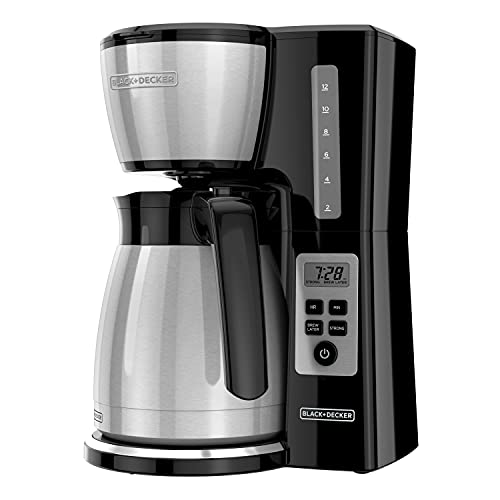
BLACK+DECKER 12-Cup Thermal Programmable Coffee Maker (CM2046S)
Badge: Best Overall
Strengths
- Programmable scheduling means coffee is brewed when you wake, not started when you stumble into the kitchen
- Thermal carafe holds heat without a warming plate, so the last cup never tastes scorched
- VORTEX showerhead is designed to saturate grounds evenly rather than channeling through the middle
Trade-offs
- A thermal carafe keeps coffee hot for hours, not all day; marathon grazers will reheat a cup eventually
- No built-in grinder, so peak freshness still depends on a separate grinder or pre-ground coffee
- The black and steel finish shows fingerprints and coffee splashes more readily than matte designs
Mini spec box
- Capacity: 12 cups
- Carafe: Thermal, Black/Steel (model CM2046S)
- Controls: Programmable, with Brew Strength control
- Showerhead: VORTEX Technology
Think of the CM2046S as the pool’s reference design for modern drip: programmable start, thermal carafe, strength control, and a showerhead built for even extraction. Each of those features addresses a specific, real failure mode of older drip machines — coffee that is not ready when you are, coffee that cooks itself bitter on a plate, one-strength-fits-nobody brewing, and water that tunnels through the grounds instead of bathing them.
In daily use the combination is greater than the list. Scheduling means the machine works while you sleep. The thermal carafe means the second and third cups hold their character. The VORTEX distribution means the pot tastes consistent from the first pour to the last, because the grounds gave up their flavor evenly. Brew Strength control is the adjustment you will actually use weekly, far more than exotic settings on fancier machines, because household tastes genuinely do change with the day and the bean.
It stops short of grinding — fresh-ground purists will pair it with a burr grinder — and its heat retention, while strong, is not an all-day thermos. Within the honest boundaries of a programmable thermal drip machine, though, this is the complete package, and it earns the Best Overall badge without needing a single exaggerated claim.
Best for: households that drink a full pot across the morning and want it brewed before they wake / Not suited for: single-cup drinkers, or anyone who wants grinding built into the same machine

Cuisinart PerfecTemp 12-Cup Thermal Drip Coffee Maker (DCC-3400NAS)
Badge: Best for Hotter Brewing
Strengths
- PerfecTemp hotter brewing targets the water temperature window where coffee extracts most completely
- Double-wall stainless thermal carafe protects flavor and shrugs off the knocks that crack glass
- Brew Strength control gives a real say in the cup without changing beans or dose
Trade-offs
- Hotter brewing is a liability with stale or very dark beans, which can tip toward harshness
- Stainless carafe hides the coffee level, so you judge the remaining pot by weight and memory
- No integrated grinder; it is a brewer only, by design
Mini spec box
- Capacity: 12 cups
- Carafe: Double-wall stainless steel thermal
- Brewing: PerfecTemp hotter brewing
- Controls: Brew Strength control
- Finish: Silver
Temperature is the invisible ingredient in drip coffee, and the PerfecTemp is the one machine here that makes it the headline. Cuisinart’s design brews hotter than standard drip machines, pushing water into the zone where extraction completes — where the sweetness and depth of the grounds actually make it into the pot instead of staying behind in the basket. For households that buy good beans and feel vaguely disappointed by their home drip, this is very often the missing variable.
The supporting cast is equally considered. The double-wall stainless thermal carafe protects the finished coffee from the slow scorching of a warming plate, so a pot brewed for an early riser still tastes honest when a late riser pours. Brew Strength control adjusts intensity for different beans and different drinkers. The silver, squared-off design reads as serious countertop equipment, which matches its intent.
The caveats: hotter water exposes stale beans without mercy, the steel carafe conceals the coffee level, and there is no grinder aboard. None of those is a flaw so much as a focus. This is a brewer built to extract well and hold heat, and it does those two things with more conviction than anything else in the pool.
Best for: drinkers who buy good beans — especially lighter roasts — and want drip that extracts them fully / Not suited for: anyone using stale or very dark beans, or who wants an all-in-one grinding machine

BLACK+DECKER CaféCraft 12-Cup Thermal Coffee Maker
Badge: Best for Hot and Iced
Strengths
- Hot and iced capability in one programmable machine covers the household’s whole day
- Thermal carafe keeps the hot pot at temperature without a flavor-cooking hot plate
- Programmable start means the hot pot can be waiting before the house wakes
Trade-offs
- Iced results depend on brewing over ice correctly; the machine cannot fix a watery technique
- Jack-of-two-temperatures design means neither mode gets the specialized depth of a dedicated machine
- Thermal carafe, as always, trades the visibility of glass for insulation
Mini spec box
- Capacity: 12 cups
- Carafe: Thermal
- Modes: Hot and iced coffee
- Controls: Programmable
Versatility is a word that gets abused in appliance marketing, so it is worth being precise about the CaféCraft: its versatility is specific and useful. It is a programmable, 12-cup, thermal-carafe drip machine — the full weekday package — that also brews for iced coffee. That second mode is not a gimmick setting; home iced coffee fails in a predictable way (dilution), and a machine that brews accounting for the ice produces a fundamentally better glass.
Around that headline, the fundamentals hold up. The programmable timer removes the morning’s first chore. The thermal carafe holds the hot pot at temperature without the slow damage of a warming plate, and it moves to the table cordlessly. Twelve cups is real household capacity — enough for guests, enough for a work-from-home day with refills, enough that nobody is brewing a second pot at ten.
Limits: no grinder, a full-size footprint, and the understanding that a dual-mode machine serves two habits well rather than one habit perfectly. Households that live in both camps — and most do, across a year — will find this the easiest pick to justify.
Best for: households that split the year between hot morning pots and iced afternoon coffee / Not suited for: single-mode purists who never drink iced coffee, or who want a dedicated specialty brewer

Cuisinart 12-Cup Programmable PerfecTemp Thermal Coffee Maker (White)
Badge: Best for Small Batches
Strengths
- The 1–4 cup setting adjusts brewing for small batches, so a half pot does not taste like an afterthought
- Brew Pause lets you pour a cup mid-cycle without the basket dripping down the carafe’s side
- PerfecTemp hotter brewing and Brew Strength control carry over from Cuisinart’s drip flagship
Trade-offs
- White finishes show coffee splashes and demand a wipe-down habit
- Thermal carafe hides the fill level, a minor daily guessing game
- Still no grinder; the small-batch setting perfects brewing, not bean freshness
Mini spec box
- Capacity: 12 cups, with 1–4 cup setting
- Carafe: Thermal
- Brewing: PerfecTemp
- Controls: Programmable, Brew Strength control, Brew Pause
- Finish: Stainless steel and white
Household math drives this Cuisinart’s design. A 12-cup capacity covers guests and gatherings, but the daily reality for many homes is two to four cups — and standard machines brew that quantity badly, rushing water through a shallow bed of grounds. The dedicated 1–4 cup setting is engineered for that reality, and it transforms the machine from a capacity purchase into a daily-quality purchase.
Around that centerpiece sits the full Cuisinart drip toolkit: PerfecTemp hotter brewing for complete extraction, Brew Strength control, programmable start for a pot that makes itself overnight, Brew Pause for the mid-cycle cup, and a thermal carafe that holds heat without a plate. The stainless-and-white finish gives bright kitchens an option that does not read as a black monolith on the counter.
Trade-offs are modest and knowable: no built-in grinding, an opaque carafe, and a white finish that asks for regular wiping. If your household brews small most days and large on weekends, this is arguably the most honestly matched machine in the roundup.
Best for: couples and small households that brew 1–4 cups daily but still host full-pot occasions / Not suited for: large households that always brew full pots, or dark kitchens where a white appliance clashes

BUNN Speed Brew Platinum Thermal Coffee Maker (CSB3T)
Badge: Best for Speed
Strengths
- Speed Brew design keeps brew water ready, so a full pot follows the decision to make one almost immediately
- BUNN’s commercial heritage shows in a simple, serviceable, no-nonsense build
- Thermal carafe protects the fast-brewed pot from hot-plate damage afterward
Trade-offs
- The always-hot reservoir uses standby energy and wants to stay plugged in and filled
- Its speed-first philosophy means no wake-up timer ritual — the machine is ready, but it does not start itself on a clock schedule
- 10 cups is the smallest capacity here; big households will brew twice
Mini spec box
- Capacity: 10 cups
- Carafe: Thermal
- Design: Speed Brew, stainless steel
- Model: 55200 CSB3T
- Finish: Black
The BUNN CSB3T answers a question the programmable machines do not ask: what if the wait itself is the problem? Its Speed Brew reservoir keeps water hot continuously, so a fresh 10-cup pot is a few minutes away at any moment of the day — no scheduling foresight required, no heat-up lag. Households with irregular hours, shift workers, and enthusiastic second-pot drinkers will recognize their lives in that design.
Build and intent are commercial. BUNN’s name is on diner counters across the country for a reason: the machines are simple, sturdy, and serviceable. The thermal carafe continues the theme, holding the pot without a plate. There are no strength algorithms or specialty modes; the levers are the timeless ones — coffee dose, grind, and fresh water — and the machine gets out of the way.
Know the trade-offs before choosing it: the hot reservoir sips power around the clock and scales faster in hard water, the capacity is the pool’s smallest at 10 cups, and if your joy is waking to a pot that brewed itself at 6:30 sharp, a programmable rival serves that ritual better. For coffee on demand, nothing else here is close.
Best for: impatient drinkers, irregular schedules, second-pot households, and small offices / Not suited for: schedule-driven drinkers who want coffee brewed before they wake, or very large households
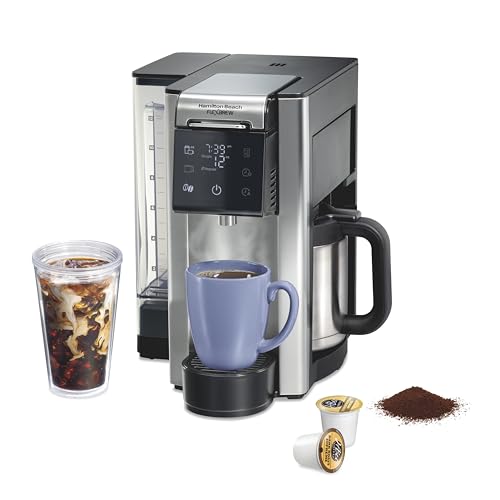
Hamilton Beach FlexBrew Advanced 5-in-1 Coffee Maker
Badge: Most Versatile
Strengths
- Drip and single-serve in one machine ends the two-appliance standoff in mixed households
- Accepts both pods and grounds on the single-serve side, so nobody is locked into one format
- The 60 oz. removable reservoir refills at the sink instead of by the jug-under-cabinet shuffle
Trade-offs
- Two brewing systems mean two sets of parts to clean and descale
- A multi-format machine rarely matches a dedicated machine’s mastery of any single format
- The larger, busier design will dominate a small counter
Mini spec box
- Capacity: 12-cup drip, plus single serve
- Carafe: Thermal, programmable drip side
- Single serve: Pods and grounds
- Reservoir: Removable, 60 oz.
- Modes: Hot and iced; 5-in-1 FlexBrew design
Versatility claims are cheap; the FlexBrew Advanced itemizes its own. Five functions — full-pot drip, single-serve pods, single-serve grounds, hot, iced — share one housing and one removable 60 oz. reservoir. The drip brewer is programmable and thermal-carafed, the specification a dedicated machine would lead with. The single-serve side accepts the two formats households actually use, which quietly resolves the pod-versus-grounds debate by refusing to pick a side.
In practice, the machine’s value compounds across a day: a programmed pot for the morning rush, a single grounds cup for the early riser who precedes it, a pod for a guest, an iced glass in the afternoon. Each use case is one another machine in this pool either cannot serve or serves by wasting a pot. The removable reservoir, filled at the sink, is the kind of unglamorous design decision that owners appreciate every single day.
The reservations are structural: two systems to clean, a large footprint, and a generalist’s ceiling in any one discipline. If your household is unanimous in its habits, a dedicated machine serves you better. If it is a coalition, this is the coalition government.
Best for: mixed households split between pot drinkers and single-cup drinkers, pods and grounds / Not suited for: single-habit households, tiny counters, or minimalists who descale reluctantly
Comparison Table
Compare first by architecture, then by detail. Capacity and carafe describe the pot; the scheduling column describes the philosophy; the final column names each machine’s claim on your counter.
| Pick | Capacity | Carafe | Scheduling approach | Standout feature | Link |
|---|---|---|---|---|---|
| BLACK+DECKER 12-Cup Thermal Programmable Coffee Maker (CM2046S) | 12 cups | Thermal carafe | Programmable + Brew Strength | VORTEX showerhead | Check on Amazon |
| Cuisinart PerfecTemp 12-Cup Thermal Drip Coffee Maker (DCC-3400NAS) | 12 cups | Stainless thermal carafe | PerfecTemp hotter brewing | Brew Strength control | Check on Amazon |
| BLACK+DECKER CaféCraft 12-Cup Thermal Coffee Maker | 12 cups | Thermal carafe | Programmable | Hot + iced modes | Check on Amazon |
| Cuisinart 12-Cup Programmable PerfecTemp Thermal Coffee Maker (White) | 12 cups (1–4 cup setting) | Thermal carafe | PerfecTemp + programmable | Brew Pause + strength control | Check on Amazon |
| BUNN Speed Brew Platinum Thermal Coffee Maker (CSB3T) | 10 cups | Thermal carafe | Speed Brew reservoir | Commercial-style build | Check on Amazon |
| Hamilton Beach FlexBrew Advanced 5-in-1 Coffee Maker | 12 cups + single serve | Thermal carafe | Pods + grounds, hot + iced | 60 oz. removable reservoir | Check on Amazon |
How to Choose the Best Programmable Drip or Brew Coffee Makers
The wider keyword deserves a wider method. Choose in three passes: architecture first, extraction second, and the daily-grind details third. Most buyers do it backwards and end up with a beautifully featured machine built on the wrong idea.
Pass one: pick your architecture
Scheduled drip is the classic: load at night, wake to a pot. It suits regular hours and households that drink together. On-demand drip — the BUNN pattern — keeps water hot so a pot is minutes away at any hour; it suits irregular schedules and spontaneous second pots, at the cost of standby energy. Hybrid brewing — the FlexBrew pattern — adds single-serve pods and grounds to a full drip machine; it suits divided households and variable days. Name your household’s pattern honestly before reading another specification.
Pass two: judge the extraction
Within drip, flavor is temperature, distribution, and control. PerfecTemp’s hotter brewing extracts more completely and flatters fresh beans. The VORTEX showerhead’s even saturation prevents channeled, uneven pots. Brew Strength controls adjust intensity across beans and drinkers. These are not luxuries; they are the difference between coffee that justifies the programmable convenience and coffee that merely arrives on time.
Pass three: the details you will live with
Carafe: thermal, everywhere in this pool, for the waiting-coffee reason. Batch range: small households need the white Cuisinart’s 1–4 cup setting or a hybrid’s single side. Reservoir: removable tanks (FlexBrew, 60 oz.) fill at the sink; fixed tanks fill by jug. Seasonality: the CaféCraft’s iced mode matters if your summers run cold-coffee. Footprint: hybrids and the BUNN claim real counter territory. And for design-led kitchens, Best Sleek Programmable Coffee Makers maps where this category meets aesthetics, while Best Single Serve Type Coffee Makers isolates the cup-at-a-time field.
Do not overlook the humble question of where the machine’s cord and lid want to live. Programmable machines are loaded daily, often in the evening dark, and a brewer whose reservoir fills from the front and whose lid clears the upper cabinets will be loved at year two for reasons no specification sheet lists. Measure the counter with the lid open before any machine in this pool — several are tall — earns a permanent address.
How to Get the Best Brew from a Programmable Machine, Whatever the Format
Programmable machines automate the start of brewing. The drinker’s remaining craft is common across formats — pot, single cup, or iced — and it is mostly about freshness, proportion, and cleanliness.
Universal rules
- Fresh beans, or the freshest grounds you can manage, in sealed storage. Every format amplifies staleness in its own way.
- Correct proportion before exotic adjustments: roughly a tablespoon of grounds per cup for drip; a level, fully seated pod for single-serve.
- Fresh water at fill time. The reservoir is not a storage tank; yesterday’s water brews yesterday’s coffee.
- A clean machine. Oils and scale are the two slow poisons of every format, and both are cured by routine, not by replacement.
Format-specific notes
For scheduled drip, load as late in the evening as your routine allows, level the grounds bed, and confirm both the program light and the carafe’s presence. For on-demand machines like the BUNN, keep the reservoir topped and descaled — its readiness depends on the tank’s health. For single-serve sides, run a plain-water cycle after grounds brewing to clear the needle and basket before the next drinker. For iced modes, fill the serving glass with ice before brewing; the mode’s concentration assumes the melt.
Maintenance rhythm
Daily: wash carafes, baskets, and any grounds cups; wipe the warming area and spray head. Weekly: run a plain-water cycle on single-serve sides and check drip-stop valves for coffee buildup. On the manufacturer’s schedule: descale, without exception — temperature is flavor in every format here, and scale is temperature’s enemy. The reservoir machines concentrate minerals fastest and go first in the descaling queue.
Troubleshooting
- Problem: coffee ready but disappointing across all formats → suspect the beans and the water before the machine; swap both for one brew and taste the difference.
- Problem: drip side overflows → folded filter, over-fine grind, or clogged drip-stop. Reseat, coarsen, rinse, in that order.
- Problem: single-serve side brews slowly or weakly → a scaled or grounds-clogged needle path. Run the maker’s cleaning cycle and a descale before assuming failure.
Whichever format you run, keep the coffee itself in a sealed container near the machine, measured with the same scoop, and replace the supply on a rhythm your household actually finishes. The most common cause of ‘my new machine disappoints’ across every architecture in this guide is month-old coffee asked to perform like fresh — a variable no timer, reservoir, or showerhead can redeem.
Why Drip Endures in a World of Pods and Pressure
Every decade announces a successor to drip coffee, and drip outlives the announcements. The reasons are structural. Drip is the only method that scales from one mug to a tableful without changing equipment or technique. Its inputs are the cheapest in coffee — beans and paper — and its waste is compost. Its skill floor is low and its ceiling, with hot water and even extraction, is higher than its reputation suggests. The machines in this guide exist because millions of households have done this math, consciously or not.
Programmability is drip’s modern chapter: it removed the last labor from a method that had already minimized cost and complexity. Read against that history, the ‘or brew’ in this keyword is the market hedging — keeping a door open to pods and hybrids — while the pot quietly remains the center of gravity. The FlexBrew’s success as a format is precisely that it refuses to make households choose between the center and the hedge. For the espresso-adjacent corner of ‘brew’, Best Single Shot Coffee Makers covers machines built around intensity rather than volume.
Reading Coffee Maker Roundups Without Being Misled
Shoppers for this keyword will meet many roundups, and a few reading skills protect against most of their failure modes. Check whether a roundup’s picks share one architecture or genuinely span the drip-or-brew question. Check whether ‘programmable’ claims are verified against specifications or copied from marketing — true programmability means a clock-set automatic start, and several machines advertise around its edges. Check whether carafe type is treated as the first-order variable it is for scheduled brewing.
And check what the roundup admits. Every machine in this guide carries stated trade-offs, because every real machine has them; a review with no limitations is an advertisement wearing a review’s clothes. The consumer-testing tradition — standardized criteria, stated methods — is the benchmark, and Best Small Coffee Makers Consumer Reports follows that thread for the small-machine end of the category. This guide’s method is stated in its How These Picks Were Chosen section, and its picks are confined to a verified pool for the same reason: conclusions should never outrun evidence.
Decaf, Half-Caf, and the Mixed-Household Problem
One household pattern decides more machine choices than any specification: the split-caffeine home. One drinker wants full strength at dawn; another has been ordered to decaf; a third splits the difference. A single pot cannot serve them all at once, and this is where the drip-or-brew breadth of this keyword stops being marketing and becomes the actual answer. The FlexBrew’s single-serve side is the structural solution — the pot brews for the caffeinated, the single side brews decaf or half-caf per cup, from pods or grounds, without a second machine.
The pot-only machines answer with scheduling instead: a decaf pot programmed for the evening (decaf drinkers are often the evening drinkers), or small batches — the white Cuisinart’s 1–4 cup setting again — brewed in sequence, regular first, decaf second, with the thermal carafe holding the first pot while the second brews. Neither answer is wrong; they are different prices for the same peace. When you enumerate your household in the buying guide’s first pass, count caffeine patterns alongside schedules and batch sizes — the household that forgets to count them buys twice.
Guests: The Stress Test Every Architecture Faces
Weekday routines flatter every machine; guests tell the truth. A table of six coffee drinkers empties a 12-cup pot in one sitting and asks about the second before the first is gone. Pot architectures pass this test natively — brew back-to-back pots, hold the first in its thermal carafe at the table — and the 12-cup machines here were sized with exactly that morning in mind. The BUNN passes it fastest of all: its reservoir turns the second pot from a project into a pause.
Single-serve architectures fail the guest test gracefully but unmistakably: cups queue, pods accumulate, and the host becomes a barista. That is not an argument against single-serve households — it is the argument for the hybrid, whose pot side absorbs the guest morning while its single side serves the ordinary days. If your home hosts more than it solos, weight the pot heavily in your architecture decision; if guests are a twice-a-year event, rent their coffee with a second pot and buy for your real life.
What the Word ‘Best’ Has to Mean in a Roundup Like This
A word of methodological honesty, because this keyword’s breadth invites its abuse. ‘Best’ in this guide does not mean a single winner imposed on every household — with three architectures in one pool, that would be a category error dressed as a verdict. It means: the strongest verified example of each legitimate interpretation of the keyword, with its trade-offs printed, so that a reader who recognizes their own pattern in the buying guide can trust the corresponding pick. The CM2046S is recommended first because the scheduled-pot pattern is the most common, not because the other patterns are lesser.
That is also why this guide prints its pool logic, its exception (the BUNN), and its hybrid reasoning in the open. A roundup that hides its method asks for faith; a roundup that shows it asks only for agreement with its premises, and lets the reader who disagrees — the household that prizes design over carafes, say — re-weight the same evidence toward a different pick. The machines will not be offended. They are, all six of them, good at what they are for.
Coffee Strength, Decoded for Pot Drinkers
Few words in coffee cause more confusion than ‘strong’. Drinkers use it to mean at least three different things: more caffeine, darker roast, or a higher ratio of coffee to water in the brew. Machines respond to the third meaning only. The Brew Strength controls across this pool adjust the brewing itself — contact and intensity — so the same beans pour a bolder or gentler pot. They cannot add caffeine the beans do not contain, and they cannot darken a roast; a household chasing either of those should change its coffee, not its settings.
The practical method: fix your dose and grind for a week, then move the strength setting alone and taste the difference across three pots. Most households find their setting and never move it again, which is the control’s real purpose — not daily adjustment but a one-time calibration of the machine to the house’s palate, after which the programmable routine repeats it forever. Strength, properly understood, is a decision you make once. The machines here all let you make it deliberately.
Common Buying Mistakes
Answering the architecture question by accident
Buying a scheduled pot machine for an irregular household — or an always-on reservoir machine for a household that only drinks at 7 a.m. — locks in a daily mismatch no feature can fix. Decide scheduled, on-demand, or hybrid first.
Treating ‘brew’ as a synonym for drip when shopping
The keyword’s breadth is real: single-serve, iced, and hybrid formats all brew. Shoppers who never consider them may miss the format their household would actually use most — the FlexBrew’s entire existence argues the point.
Overvaluing capacity
A 12-cup machine that mostly brews four cups is counter space and stale coffee. Match capacity to the median day, using small-batch settings or single-serve sides for the tails of the distribution.
Ignoring standby costs in always-ready designs
The BUNN’s readiness is bought with continuous heating. It is a fair trade for the right household and a pointless one for a household on a fixed schedule — know which you are before choosing the philosophy.
Neglecting the second system’s maintenance on hybrids
Hybrid owners descale the side they use and forget the other, then blame the machine when the neglected side falters. A hybrid is two machines for maintenance purposes; calendar both.
Forgetting that the carafe is part of the brew
Drinkers tune dose and grind, then pour into a cold, unwashed carafe and wonder at the result. The carafe receives the coffee at its peak; rinse it hot, keep it clean, and let it do its insulating work from the first minute. In a drip-or-brew household the vessel is not storage — it is the final brewing step.
Final Recommendation
For the household that simply wants the keyword answered well, the BLACK+DECKER CM2046S Check on Amazon is the center of the category: programmable drip with a thermal carafe, even extraction, and strength control, without a wasted feature. Begin there.
The Cuisinart PerfecTemp Check on Amazon deepens the drip case for good beans; its white sibling widens the batch range downward. The CaféCraft Check on Amazon extends the year into iced season. Beyond them, the BUNN and the FlexBrew are not better or worse but different theses — readiness and versatility — and households matching those theses should choose them without hesitation.
The keyword asked for drip or brew. The honest answer is that drip, programmed well, is still the pot to beat — and that the two reinterpretations in this pool earn their places by solving real household patterns rather than by novelty. Choose the pattern that matches your mornings, and the machine chooses itself.
Related guides
Frequently Asked Questions
What is the difference between a drip coffee maker and a brew coffee maker?
Drip is a specific brewing method — hot water showered over grounds, filtered by gravity into a carafe. ‘Brew’ is the general word for making coffee by any method. All six machines here drip-brew by the pot; the FlexBrew additionally brews single cups from pods or grounds, which is why this roundup spans the keyword’s ‘drip or brew’ phrasing.
Can one machine really do both pots and single cups well?
The FlexBrew in this guide is the proof of concept: a full programmable thermal drip brewer on one side and a pods-or-grounds single-serve brewer on the other. Generalists rarely match a specialist’s peak, but for households genuinely split between formats, the hybrid’s convenience outweighs the small specialist edge.
Is an always-hot machine like the BUNN wasteful?
It uses standby energy to keep its reservoir at brewing temperature — that is the price of a full pot within minutes at any hour. For households with irregular schedules the trade is worthwhile; for a household that drinks at one fixed time daily, a timer machine delivers the same readiness with no standby cost.
Which of these is best for a household of two?
The white Cuisinart, for its 1–4 cup setting that brews small batches properly, or the FlexBrew if the two of you drink differently — one pot drinker and one single-cup drinker is the hybrid’s home turf. A standard 12-cup machine without small-batch compensation is the awkward fit for couples.
Do programmable machines brew as well as manual methods?
They automate a drip brew; the quality ceiling is set by temperature, distribution, and freshness, all addressed in this guide. The PerfecTemp and VORTEX models brew to a standard that satisfies most drinkers completely. What automation removes is variance — the machine brews the same pot every day, for better and for worse, which is why dialing in your dose in week one matters.
What should I check before buying any machine in this category?
Four things: that ‘programmable’ means a true clock-set auto-start (verified for every timer machine here), that the carafe is thermal if coffee will wait, that the batch range matches your household’s real days, and that your counter and cabinets fit the machine’s footprint with the lid open.
Which architecture handles a coffee-drinking crowd best?
The programmable pot, without contest: a 12-cup thermal machine brews for a table in one cycle and its carafe holds the second round. The BUNN is the fastest at the follow-up pot. Hybrids pass the test on their pot side. Pure single-serve formats serve guests one cup at a time, which is why this guide’s hybrid pick exists.


