Disclosure: topratedkitchenware.com is reader-supported. When you buy through links on our site, we may earn an affiliate commission from Amazon and other retailers, at no extra cost to you.
Where to buy
For best rates coffee makers, start with our top pick, the BLACK+DECKER 12-Cup Thermal Programmable Coffee Maker CM2046S, then compare the full shortlist below. Every name links to its Amazon listing, where you can check the latest price on Amazon and confirm the current configuration before you decide.
- BLACK+DECKER 12-Cup Thermal Programmable Coffee Maker CM2046S — Badge: Best Overall. Check the latest price on Amazon.
- Cuisinart PerfecTemp 12-Cup Thermal Coffee Maker DCC-3400NAS — Badge: Best for Hotter Brewing. Check the latest price on Amazon.
- BLACK+DECKER CaféCraft 12-Cup Thermal Coffee Maker — Badge: Best for Hot and Iced. Check the latest price on Amazon.
- Cuisinart 12-Cup PerfecTemp Thermal Coffee Maker, White — Badge: Best for Small Batches. Check the latest price on Amazon.
- BUNN Speed Brew Platinum Thermal Coffee Maker CSB3T — Badge: Fastest Brew. Check the latest price on Amazon.
- Hamilton Beach FlexBrew Advanced 5-in-1 Coffee Maker — Badge: Most Versatile. Check the latest price on Amazon.
Read the full guide ↓ for the detailed reviews, the comparison table, and the buying checks that matter most for best rates coffee makers.
Shoppers searching for the best rates coffee makers usually mean one of two things: the best-rated machines, or the best value for the money, and this guide serves both readings honestly. On ratings, it explains below how to read them without being misled, and it prints no invented scores of its own. On rates in the money sense, it follows a strict rule: no static prices appear in this article, because a printed price is wrong the week after it is written. Instead, each pick is positioned by tier, premium, mid, or value-leaning within its class, and every listing link invites you to check the latest price on Amazon at the moment you are actually shopping.
That combination, sceptical about scores, silent on stale prices, specific about trade-offs, is the most useful way to shop this category. If your real constraint is physical rather than financial, our guides to Best Smallest Coffee Makers and Best Space Saving Coffee Makers rank the same corner of the market by footprint. Here, the order follows all-round merit, and the sections after the reviews explain exactly how owner ratings should and should not change your decision.
A note on what this guide will not do, since the search invites it: it will not crown a winner by a decimal, and it will not tell you a machine costs an amount that stopped being true before the ink dried. What it offers instead is the slower, more durable equipment of tier, trade-off, and pattern-reading. Shoppers who learn those three tools here will shop every future appliance better, which is worth more than any single verdict this page could print.
Key Takeaways
- This guide prints no scores and no static prices, deliberately; both go stale, and both mislead when treated as precise.
- Read owner feedback for repeated patterns about the same part or frustration, not for a single headline figure.
- Tier language in the reviews, premium, mid, value-leaning, is the honest way to compare cost without printing numbers that rot.
- A high rate of positive comments often tracks reliability and cleaning ease more than peak brew quality; weigh it accordingly.
- The best value pick is rarely the cheapest machine; it is the one whose trade-offs cost you nothing you care about.
- Always check the latest price on Amazon at decision time, because that is the only price that is ever actually true.
In this guide
Quick Picks
| Pick | Badge | Why it earns its place | Listing |
|---|---|---|---|
| BLACK+DECKER 12-Cup Thermal Programmable Coffee Maker CM2046S | Best Overall | Full 12-cup thermal carafe suits family pots and slow weekend mornings without a hot plate cooking the coffee. | Check on Amazon |
| Cuisinart PerfecTemp 12-Cup Thermal Coffee Maker DCC-3400NAS | Best for Hotter Brewing | PerfecTemp hotter brewing targets the hotter water that fuller extraction needs, a real point of difference in this class. | Check on Amazon |
| BLACK+DECKER CaféCraft 12-Cup Thermal Coffee Maker | Best for Hot and Iced | Hot and iced modes in one machine cover the two ways most households actually drink coffee across the year. | Check on Amazon |
| Cuisinart 12-Cup PerfecTemp Thermal Coffee Maker, White | Best for Small Batches | The 1-4 Cup setting adjusts the brew for small batches, which is exactly where big machines usually taste weakest. | Check on Amazon |
| BUNN Speed Brew Platinum Thermal Coffee Maker CSB3T | Fastest Brew | Speed is the point: the Speed Brew design keeps water ready so a full pot arrives far faster than a cold-start machine. | Check on Amazon |
| Hamilton Beach FlexBrew Advanced 5-in-1 Coffee Maker | Most Versatile | One machine covers a full thermal pot, a single cup from grounds, and a pod, which ends most two-machine counter arrangements. | Check on Amazon |
How These Picks Were Chosen
This guide is research-led. We compared the verified models available for this guide on the things that decide daily satisfaction with a drip coffee maker: carafe type and heat retention, brew temperature approach, batch-size range, programmability, strength control, iced capability, single-serve flexibility, and how much cleaning each design asks for. Every product named here comes from the verified pick pool for this guide, with its Amazon listing checked on 2026-11-20; we do not invent specifications, and where a detail is not stated in the listing title or pool data we leave it out rather than guess. We make no claim to have bench-tested these machines side by side in a lab. Instead, the reviews weigh manufacturer-stated design features against the well-documented behaviour of each format, and each pick carries an honest limitation so you can see the trade, not just the pitch.
One pattern shaped the shortlist: five of the six picks use thermal carafes rather than glass pots on hot plates. That is deliberate. Coffee held on a hot plate stews and turns bitter within the hour, while a thermal carafe holds heat by insulation and leaves the flavour closer to how it was brewed. If you nurse a pot across a whole morning, that single design choice matters more than almost any control on the panel.
The 6 Best rates coffee makers Picks, Reviewed in Detail
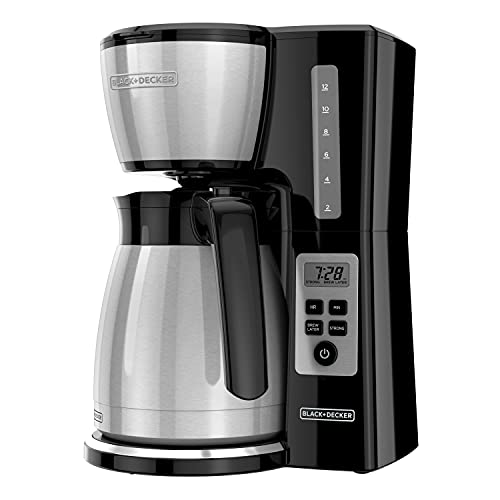
BLACK+DECKER 12-Cup Thermal Programmable Coffee Maker CM2046S
Badge: Best Overall
Strengths
- Full 12-cup thermal carafe suits family pots and slow weekend mornings without a hot plate cooking the coffee.
- VORTEX showerhead is designed to saturate the grounds evenly, which supports a more balanced extraction than a single-stream drip.
- Programmable timing plus a brew-strength choice covers both wake-up pots and stronger after-dinner brews.
Trade-offs
- Thermal carafes hide the coffee level, so you judge what is left by weight rather than by sight.
- It brews drip coffee only; there is no single-serve or pod side for one quick cup.
- The Black/Steel finish shows fingerprints and needs a wipe to stay looking clean.
At a glance: Capacity: 12 cups (from API title); Carafe: thermal, Black/Steel finish (from API title); Controls: programmable, with Brew Strength selection (from API title); Showerhead: VORTEX Technology (from API title).
Judged the way careful rating-readers judge, on consistency across ordinary mornings rather than on any single dazzling feature, this is the safest pair of hands in the pool. In daily use this is the dependable full-pot anchor of the group. The programmable timer means the pot can be ready when the household wakes, and the thermal carafe then keeps it at drinking temperature through a long morning without a hot plate stewing it. The VORTEX showerhead matters more than it sounds: even saturation is what separates a balanced pot from one that tastes sharp at the top and weak at the bottom. Brew Strength gives a simple lever when guests prefer a bolder cup. The honest limitation is format, not quality: it does one job, drip coffee in full or near-full batches, and households that mostly drink single cups will feel the carafe is more machine than they need.
Best for: Households that brew a full pot most mornings and want it to stay hot in a thermal carafe / Not suited for: pod users or anyone who only ever brews one cup at a time
Check on Amazon to confirm the current configuration and check the latest price on Amazon.

Cuisinart PerfecTemp 12-Cup Thermal Coffee Maker DCC-3400NAS
Badge: Best for Hotter Brewing
Strengths
- PerfecTemp hotter brewing targets the hotter water that fuller extraction needs, a real point of difference in this class.
- The double-wall stainless thermal carafe holds heat without a warming plate and travels to the table without a cord.
- Brew Strength control lets the same beans produce a milder weekday pot or a bolder weekend pot.
Trade-offs
- It sits in a higher tier than basic programmable drip machines, so the value case rests on brew temperature and the carafe.
- Silver stainless shows water spots around the reservoir area if you do not wipe it down.
- There is no iced-coffee mode and no single-serve side; it is a dedicated full-pot drip machine.
At a glance: Capacity: 12 cups (from API title); Carafe: double-wall stainless steel thermal carafe (from API title); Brewing: PerfecTemp hotter brewing (from API title); Controls: Brew Strength control (from API title).
Machines that brew hotter tend to attract the most satisfied flavour comments, and this Cuisinart is the pool’s clearest example of why. This is the pick for people who taste the difference brew temperature makes. Many drip machines brew a little cool, and the result is a sour, thin edge that drinkers often blame on the beans. PerfecTemp hotter brewing is built to close that gap, and paired with the double-wall stainless carafe the coffee both extracts more fully and holds its heat without a plate. Brew Strength control adds range without complexity. The limitation is focus: there is no iced mode, no pod side, and no small-batch setting as explicit as its white sibling offers, so its case rests squarely on hotter, better-extracted full pots in a premium-feeling build.
Best for: Drinkers who find ordinary drip coffee tastes under-extracted and want hotter brewing with a thermal carafe / Not suited for: shoppers who want pods, iced modes, or the lowest-cost design in the class
Check on Amazon to confirm the current configuration and check the latest price on Amazon.

BLACK+DECKER CaféCraft 12-Cup Thermal Coffee Maker
Badge: Best for Hot and Iced
Strengths
- Hot and iced modes in one machine cover the two ways most households actually drink coffee across the year.
- The thermal carafe keeps the hot batch hot without a plate, and the same machine handles an iced batch over cubes.
- Programmable start means the morning pot can be ready before anyone reaches the kitchen.
Trade-offs
- Iced results depend heavily on ice quantity and brew concentration; the mode helps, but it does not replace a dedicated cold-brew routine for everyone.
- No separate single-serve path, so a lone small cup still means brewing a small batch.
- As with every thermal carafe here, you cannot see the remaining level at a glance.
At a glance: Capacity: 12 cups (from API title); Carafe: thermal (from API title); Modes: Hot & Iced brewing (from API title); Controls: programmable (from API title).
Owner satisfaction with dual-season machines tracks how often both modes get used; households that truly drink hot and iced tend to be glad they chose this format. Households that swing between hot coffee in the morning and iced coffee in the afternoon will get the most from this design. The iced mode brews with that over-ice destination in mind, and the thermal carafe keeps the hot batch properly hot the rest of the day. Programmable timing keeps mornings simple. Used well, with plenty of ice and a slightly stronger hand with the grounds, the iced results are refreshing rather than watery. The limitation is that iced brewing still rewards attention: skimp on ice or grounds and the mode cannot rescue the cup, and there is no single-serve path for one small drink.
Best for: Households split between hot morning pots and iced afternoon coffee / Not suited for: cold-brew purists or single-cup pod households
Check on Amazon to confirm the current configuration and check the latest price on Amazon.

Cuisinart 12-Cup PerfecTemp Thermal Coffee Maker, White
Badge: Best for Small Batches
Strengths
- The 1-4 Cup setting adjusts the brew for small batches, which is exactly where big machines usually taste weakest.
- Brew Pause lets you pour a first cup mid-cycle without waiting for the full pot, a small mercy on rushed mornings.
- The white and stainless finish suits lighter kitchens where black appliances dominate the counter visually.
Trade-offs
- Small-batch modes still need the coffee-to-water ratio adjusted by hand; the setting helps but does not measure for you.
- It shares the thermal-carafe trade-off: heat retention is good, visibility of the level is not.
- No iced mode and no pod side, so versatility comes from batch-size range rather than drink types.
At a glance: Capacity: 12 cups, with a 1-4 Cup setting (from API title); Carafe: PerfecTemp thermal carafe (from API title); Controls: Brew Strength Control and Brew Pause (from API title); Finish: Stainless Steel, White (from API title).
Small-batch satisfaction is where big machines collect their angriest comments; this model’s dedicated setting is aimed squarely at that complaint. The small-batch problem is real: most 12-cup machines brew a thin, under-extracted four cups because the water moves too fast through a shallow bed of grounds. The 1-4 Cup setting exists precisely for that weekday reality, slowing the process down for small pots, while Brew Pause handles the impatient first cup and Brew Strength covers taste preferences. In white and stainless it is also the easiest of these machines to live with in a light, modern kitchen. The limitation is scope rather than quality: no iced mode, no pods, and the thermal carafe still hides the remaining level from view.
Best for: Mixed households that brew a small pot on weekdays and a full pot when guests come / Not suited for: anyone who wants iced brewing or single-serve pods in the same machine
Check on Amazon to confirm the current configuration and check the latest price on Amazon.

BUNN Speed Brew Platinum Thermal Coffee Maker CSB3T
Badge: Fastest Brew
Strengths
- Speed is the point: the Speed Brew design keeps water ready so a full pot arrives far faster than a cold-start machine.
- The thermal carafe keeps the fast-brewed pot hot at the table without a warming plate.
- Simple, purpose-built controls suit households that want coffee, not a menu system, at dawn.
Trade-offs
- Capacity is 10 cups rather than 12, which matters for large gatherings.
- The ready-water approach trades a little standby energy for its speed; that bargain suits daily brewers more than occasional ones.
- Fewer programmable and strength options than the Cuisinart and BLACK+DECKER models in this guide.
At a glance: Capacity: 10 cups (from API title); Design: Speed Brew Platinum, thermal carafe (from API title); Finish: Stainless Steel, Black (from API title); Brand lineage: BUNN, a name long associated with commercial brewing (brand background).
Speed earns this BUNN a distinctive kind of praise: not admiration, but gratitude, repeated daily, which is the most durable rating of all. Speed changes behaviour: when a full pot takes only a few minutes, people brew fresh instead of reheating old coffee, and the whole household’s coffee improves without anyone trying harder. That is the BUNN proposition, backed by a brand long associated with commercial counters where waiting is not an option. The thermal carafe keeps the pot hot at the table, and the controls stay refreshingly simple. The limitations are honest ones: capacity is 10 cups rather than 12, the ready-water design suits daily brewers better than occasional ones, and there are fewer programmable and strength options than the Cuisinart and BLACK+DECKER models offer.
Best for: Impatient daily brewers who value a fast full pot above extra modes / Not suited for: occasional brewers or anyone who needs a 12-cup maximum batch
Check on Amazon to confirm the current configuration and check the latest price on Amazon.
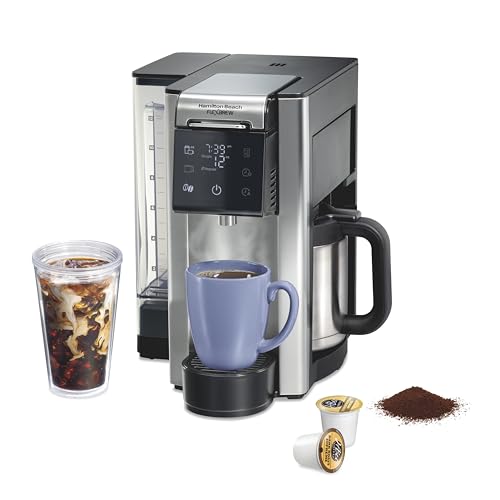
Hamilton Beach FlexBrew Advanced 5-in-1 Coffee Maker
Badge: Most Versatile
Strengths
- One machine covers a full thermal pot, a single cup from grounds, and a pod, which ends most two-machine counter arrangements.
- The removable 60 oz. reservoir refills at the sink instead of by jug under a cabinet, a daily convenience that adds up.
- Hot and iced capability on top of the drip and single-serve sides makes it the broadest design in this guide.
Trade-offs
- Two brewing systems mean two sets of parts to rinse and descale; versatility always charges rent in cleaning time.
- The footprint serves two formats, so very tight counters should measure carefully before choosing it.
- Jack-of-all-trades designs rarely beat a dedicated machine on its single best trick; the BUNN still wins on pure speed.
At a glance: Format: 5-in-1 drip and single serve (from API title); Capacity: 12-cup thermal programmable drip side (from API title); Single serve: pods and grounds (from API title); Reservoir: removable 60 oz. reservoir (from API title); Modes: hot and iced (from API title).
Combination machines live or die on whether households use the second format weekly; where they do, this FlexBrew’s versatility is its whole value case. Count the jobs this one machine retires: a full programmable thermal pot for the morning, a single cup from grounds for a quiet afternoon, a pod when a guest asks, and iced coffee when the weather turns. The removable 60 oz. reservoir is the detail owners feel daily, because refilling at the sink beats pouring from a jug under low cabinets. The limitation is upkeep and footprint: two brewing paths mean two sets of parts to rinse and descale, and the counter space serves two formats. For a mixed household that trade is usually worth it; for a purist it is not.
Best for: Mixed households where one person wants a pot and another wants a single cup / Not suited for: minimalists who want one simple drip machine with the fewest parts to clean
Check on Amazon to confirm the current configuration and check the latest price on Amazon.
Comparison Table
| Pick | Badge | Key attribute | Also note | Listing |
|---|---|---|---|---|
| BLACK+DECKER 12-Cup Thermal Programmable Coffee Maker CM2046S | Best Overall | Capacity: 12 cups (from API title) | Carafe: thermal, Black/Steel finish (from API title) | Check on Amazon |
| Cuisinart PerfecTemp 12-Cup Thermal Coffee Maker DCC-3400NAS | Best for Hotter Brewing | Capacity: 12 cups (from API title) | Carafe: double-wall stainless steel thermal carafe (from API title) | Check on Amazon |
| BLACK+DECKER CaféCraft 12-Cup Thermal Coffee Maker | Best for Hot and Iced | Capacity: 12 cups (from API title) | Carafe: thermal (from API title) | Check on Amazon |
| Cuisinart 12-Cup PerfecTemp Thermal Coffee Maker, White | Best for Small Batches | Capacity: 12 cups, with a 1-4 Cup setting (from API title) | Carafe: PerfecTemp thermal carafe (from API title) | Check on Amazon |
| BUNN Speed Brew Platinum Thermal Coffee Maker CSB3T | Fastest Brew | Capacity: 10 cups (from API title) | Design: Speed Brew Platinum, thermal carafe (from API title) | Check on Amazon |
| Hamilton Beach FlexBrew Advanced 5-in-1 Coffee Maker | Most Versatile | Format: 5-in-1 drip and single serve (from API title) | Capacity: 12-cup thermal programmable drip side (from API title) | Check on Amazon |
Badges are consistent between Quick Picks, the detailed reviews, and this table, so you can follow one pick through the whole guide without losing track of why it was chosen.
How to Choose the Right Coffee Maker for Your Household
Start with batch reality, not maximum capacity. Count the cups your household actually drinks on an ordinary weekday. A 12-cup carafe is the right tool for a family pot or a small office kitchen, but a household brewing four cups most days should weight the 1-4 Cup setting on the white Cuisinart heavily, because small batches are where big machines most often disappoint. Capacity on the box is a ceiling, not a recommendation.
Next, decide the carafe question. Thermal carafes, used by five of these six picks, keep coffee hot through insulation and protect flavour across a long morning; their cost is that you cannot see the level. Glass carafes on warming plates show the level and cost less, but the coffee degrades while it sits. For most homes that brew and then drink over an hour or more, thermal is the better trade.
Then weigh brew temperature and strength control. Hotter, well-distributed water extracts more evenly; that is the promise behind Cuisinart’s PerfecTemp positioning and BLACK+DECKER’s VORTEX showerhead. Strength controls do not make weak beans strong, but they let one machine serve both the mild weekday drinker and the bold weekend drinker without changing the coffee you buy.
Finally, count the formats you truly need. A dedicated drip machine is simpler to clean and usually cheaper to live with. A combination design like the Hamilton Beach FlexBrew Advanced retires a second machine and covers pods, grounds, and iced drinks, at the cost of more parts to maintain. Neither answer is wrong; the mistake is buying versatility you will never use, or refusing it when your household genuinely drinks three different ways.
Before ordering, measure your counter height under the cabinets with the lid or reservoir access in mind, confirm the carafe pours comfortably for the least strong hands in the house, and check the latest price on Amazon, because configurations and included accessories can change between listings.
How to Brew, Clean, and Look After a Drip Coffee Maker
Good drip coffee is mostly ratio and freshness. A reliable starting point is roughly one to two tablespoons of medium-ground coffee per six ounces of water, adjusted in small steps until the cup tastes balanced: sour usually means under-extracted or too little coffee, bitter usually means over-extracted or too much. Use fresh water each morning, because water that sat in the reservoir overnight flattens flavour, and store beans away from heat and light, grinding close to brew time if you can.
Setup is simple but worth doing once, properly. Rinse the carafe, run one plain-water cycle through a new machine to clear manufacturing residue, fit the filter squarely so grounds cannot wash over its edge, and level the grounds bed with a gentle shake before brewing. If your machine is programmable, set the clock and timer the night before and load water and grounds then, so the morning asks nothing of you.
Cleaning decides long-term taste more than any feature does. Rinse the carafe and filter basket daily, wash them with warm soapy water weekly, and descale on the schedule your water hardness demands: mineral scale insulates the heating element, the brew temperature quietly drops, and coffee turns sour for reasons owners often blame on the beans. Wipe the showerhead area, where old coffee oils collect, and never let wet grounds sit in the basket overnight.
Problem: coffee tastes weak and sour → check the ratio first, then descale; a scaled machine brews too cool to extract properly. Problem: coffee tastes bitter and harsh → use slightly less coffee or a coarser grind, and do not leave the pot sitting for hours before drinking. Problem: grounds overflow the filter basket → use the correct filter size, avoid overfilling, and make sure the carafe is seated so coffee drains freely instead of backing up into the basket.
How to Read Coffee Maker Ratings Without Being Misled
Owner ratings compress thousands of different kitchens into one figure, and the compression hides everything interesting. A machine can be marked down for being large by buyers who never measured their counter, or praised for speed by buyers who never taste carefully. Neither verdict is false, exactly; both are about the buyer’s situation rather than the machine. Your job as a reader is to match the reviewer’s situation to your own before borrowing their conclusion.
Look for patterns, not averages. When unrelated owners independently mention the same leaking carafe, the same awkward reservoir, or the same quietly excellent small-batch pot, you have found signal. When comments contradict each other on taste, you have usually found different beans, different water, and different ratios, none of which the machine controls. Recency matters too: a model revised two years ago carries older comments about a machine that may no longer be the one in the box.
Finally, separate the rating of the product from the rating of the purchase. Delivery damage, a missing accessory in one box, or a price someone disliked reviewing are not evidence about the coffee. The reviews in this guide are written to the product: what it does, what it trades away, and who should walk past it. For flavour-first readers, Best Tasing Coffee Makers approaches the same machines from the cup outward.
Rates, Tiers, and Paying the Right Amount
Since this guide prints no prices, it owes you a usable substitute: a tier map. In this pool, the Cuisinart PerfecTemp models and the BUNN sit in the premium tier, where the money buys brew temperature, build, and in the BUNN’s case speed engineering. The BLACK+DECKER models occupy the value-leaning middle, covering programmability and thermal carafes without premium pricing ambitions. The Hamilton Beach FlexBrew prices its versatility: you pay for two brewing systems in one housing, and it is good value exactly when both systems get used.
The right amount to pay is the tier whose benefits you will actually consume. Paying premium money for hotter brewing is rational for a drinker who tastes extraction differences and wasteful for a household that loads the pot with milk and sugar. Paying for a combination machine is rational for a mixed household and wasteful for a purist. Rates, in other words, are personal: the same machine is good value at one kitchen counter and poor value at another.
Two practical habits protect you. First, check the latest price on Amazon for each finalist on the same day, so the comparison is between real, current figures. Second, if space is the cost you cannot pay, price the footprint too, using Best Space Saving Drip Coffee Makers as your shortlist. Money is only one of the rates that matter.
When a Cheaper Machine Is the Better Rate
Value inverts in one common situation: when the premium feature duplicates something you already own or never use. A household with a separate pod machine gains nothing from the FlexBrew’s second system and should rate the simpler drip machines higher. A household that drinks coffee black and immediately loses little to a warming plate’s absence and may rate a basic thermal design above a hotter-brewing flagship whose refinement they cannot taste. The rate that matters is benefit received per unit of money, and benefit is measured in your kitchen, not in the manufacturer’s brochure.
The opposite inversion is just as common. A machine bought cheaply and replaced in two years, because its carafe cracked, its timer failed, or its small pots tasted too thin to drink, is the most expensive machine in this guide at any ticket price. Durability and fit are value features; they simply refuse to appear in a price column. When two finalists are close, choose the one whose trade-off list bothers you less, because you will pay that bother daily and the price only once.
So read the tiers in these reviews as a starting grid, then apply your own household’s arithmetic. The best rate in this category is not a number at all. It is the machine still earning its counter space, uncomplained about, in its third year.
A Deeper Look at Living With a Thermal-Carafe Drip Machine
Choosing a thermal carafe changes a handful of small daily rituals, and it is worth picturing them before you commit. The carafe pours a little differently from glass, usually with a thumb press or a twist of the lid, and it rewards a confident, unhurried pour. It keeps coffee hot by insulation rather than power, which means the pot can sit on the table, the desk, or the porch rail with no cord and no warming plate, and the last cup of a slow morning tastes recognisably like the first. It also means the machine draws no power to hold temperature, a quiet efficiency that compounds across years of mornings.
Care is simple but specific. Rinse the carafe after each pot, wash it properly before coffee oils can film the steel, and never leave a brewed pot sealed and forgotten overnight, because no carafe material forgives that. If your water is hard, the carafe’s neck will show scale before the machine does; a gentle descale of the carafe itself restores it. Treat the carafe well and it will outlast the electronics it serves, which is more than can be said for most glass pots, whose second year is usually lived one careless sink-knock from replacement.
The one honest cost, repeated across this guide because it is real, is invisibility: you cannot glance at the pot and know what is left. Households adapt within a week, judging by weight and by habit, and most report the trade gladly made. But if your household runs on visual certainty, a full pot brewed for a crowd and watched as it falls, weigh that small daily blindness honestly before choosing any of the thermal designs that dominate this shortlist.
The Two Inputs No Rating Can See
Owner ratings describe machines, but the cup in a stranger’s photograph was made with their beans and their water, and neither travels with the review. Before you let any rating, including the patterns this guide draws your attention to, move you between finalists, audit your own two inputs. They explain more disappointing pots than every machine fault in this category combined.
Beans deserve the next word, because no machine in this guide can rescue stale coffee, and every machine here will flatter fresh coffee. Buy whole beans in quantities your household finishes within a few weeks, store them sealed away from heat and light, and grind close to brewing when you can. If you buy pre-ground, buy smaller bags more often. The difference between a mediocre pot and a memorable one, on the same machine, is more often the beans’ age than any specification on the box, which is why experienced owners spend their upgrade money on coffee before they spend it on equipment.
Water is the other silent ingredient. If your tap water tastes strongly of chlorine or minerals, your coffee will too, and a simple filter jug often improves the cup more than a model upgrade would. Extremely hard water also scales the machine faster, shortening the interval in the descaling rhythm described earlier in this guide. Extremely soft water can under-extract and taste flat. Most households sit comfortably in the middle, where plain fresh tap water and a sensible ratio produce exactly the pot these machines were designed to make.
Finally, give a new machine a fair first week. Run the plain-water cycle, brew two ordinary pots before judging anything, and change only one variable, ratio, grind, or strength setting, per day. Households that declare a verdict on the first pot are usually judging their own unfamiliarity. By the end of the week the machine will have told you the truth about itself, and in this shortlist that truth is, for the right household, a good one.
Final Checks Before You Order
Measure the counter run and the under-cabinet height where the machine will live, with the reservoir access and lid swing in mind, and write both numbers down before you open any listing. Confirm the carafe style in the listing photographs matches the thermal design described in this guide, because manufacturers sell near-identical models with glass carafes under similar names. Check which accessories are actually in the box, filter type, scoop, or starter pods where relevant, so the first morning is not delayed by a missing basket filter.
Then do the household check: say the pick’s main trade-off out loud to the person who will use the machine most, and watch their face. A trade-off that sounds minor in a review and major at 6 a.m. is major. If it passes that test, check the latest price on Amazon, confirm the configuration once more, and order with the quiet confidence of a household that has read the limitations before meeting them.
Common Buying Mistakes
The first mistake is buying maximum capacity for a once-a-month gathering and then brewing small, weak pots in it every weekday. Buy for the ordinary day and borrow capacity thinking only for parties. The second mistake is judging by preset counts: a long list of modes you never touch is worth less than the one feature, such as a small-batch setting or a thermal carafe, that improves every single pot. The third mistake is ignoring cleaning geometry. If the reservoir is awkward to fill under your cabinets or the carafe is hard to wash by hand, the machine will slowly fall out of use no matter how good the first week’s coffee was. The fourth mistake is treating any ranking, including this one, as a verdict instead of a map: the right question is never which machine is best in the abstract, but which trade-offs fit your kitchen, your household, and your mornings.
Final Recommendation
For most readers, start with the BLACK+DECKER 12-Cup Thermal Programmable Coffee Maker CM2046S: it is the pick whose strengths cover the widest range of everyday needs with the fewest compromises for best rates coffee makers. If its main trade-off is the one thing you cannot live with, the closest alternative is the Cuisinart PerfecTemp 12-Cup Thermal Coffee Maker DCC-3400NAS, which trades a little of that all-round balance for its own specialist strength. Every other pick in this guide earns its place for a narrower job, and the detailed reviews say plainly which job that is. Decide by the trade-off you mind least, confirm the measurements and configuration on the listing, and check the latest price on Amazon before you order.
Frequently Asked Questions
How much coffee should I use per pot?
Start near one to two tablespoons of ground coffee per six ounces of water, then adjust in small steps. If the cup tastes sour, add a little more coffee or grind slightly finer; if it tastes bitter, do the opposite. Change one variable at a time so you learn what your machine and your beans actually need.
Is a thermal carafe really better than a glass pot?
For flavour across a long morning, yes: insulation holds heat without cooking the coffee, while a warming plate steadily stews it. The trade is visibility, since a thermal carafe hides the remaining level, and a little more care when washing. Households that drink a pot quickly may not notice the difference.
How often should I descale?
It depends on water hardness. With hard water, monthly is a sensible rhythm; with soft water, every two to three months may be enough. The warning signs are slower brewing, gurgling, and coffee that tastes sour despite a correct ratio, because scale lowers the real brew temperature.
Can these machines brew a single cup well?
Most full-size drip machines brew their weakest pot at very small volumes, which is why the 1-4 Cup setting on the white Cuisinart matters. If single cups are your main pattern rather than an occasional need, the Hamilton Beach FlexBrew Advanced, with its dedicated single-serve side for pods and grounds, is the honest answer in this guide.
Does brew strength control change caffeine much?
Strength settings mainly change extraction and flavour intensity by adjusting how water moves through the grounds. Caffeine is driven far more by how much coffee you use and which beans you buy. Treat the control as a taste lever, not a caffeine dial.
What grind works best in a drip machine?
A medium grind, roughly the texture of coarse sand, suits most flat-bottom and cone drip baskets. Too fine and the brew turns bitter and may overflow; too coarse and it runs through weak and sour. If you change grinders or beans, expect to adjust once and then stay consistent.
Is the most expensive option always the safest choice?
No. In both categories covered by this wave of guides, the safest choice is the one whose specifications match your measured situation and your household’s habits, with its trade-offs stated and tolerable. Price buys specific things, hotter brewing, extra height engineering, broader format range, and those things are only worth buying when your household will actually use them. Read the trade-off lists, not the tier labels, when two finalists are close.


