Disclosure: topratedkitchenware.com is reader-supported. When you buy through links on our site, we may earn an affiliate commission from Amazon and other retailers, at no extra cost to you.
Where to buy
Start here if you already know your shortlist. The linked picks below are the verified recommendations in this guide to the best 24 volt lithium ion battery; each name leads to its Amazon listing, where you can check the latest price on Amazon and confirm current details. Picks marked prose-only are context and comparison entries discussed in full below — they carry no link and no image, deliberately, and the reviews explain why in each case.
- yeagulch 24V 314Ah LiFePO4 Battery — Best Overall · Check on Amazon
- dumfume 24V 100Ah LiFePO4 Battery — Best Weather Sealing
- yeagulch 24V 100Ah LiFePO4 Battery — Best All-Round 100Ah
- Dyness 24V 100Ah LiFePO4 Battery — Best for Expansion
- VATRER POWER 12V 300Ah LiFePO4 Battery — 12V High-Capacity Contrast (Prose) (prose-only context pick, no Amazon link)
- VEMDIA 12V 100Ah LiFePO4 Battery (Group 31) — Series-Pair Component (Prose) (prose-only context pick, no Amazon link)
Read the full guide ↓ for the sizing, setup and ownership detail behind each pick.
The search for the best 24 volt lithium ion battery usually starts with a system that already exists: a trolling motor, an RV house bank, a solar setup, a floor machine or a backup rig wired for 24V. What most buyers actually receive in today’s market — and what every linked pick in this guide is — is a LiFePO4 battery, the lithium family that has taken over deep-cycle 24V work because it cycles deeply, charges efficiently and tolerates years of service that would wear out lead-acid quickly.
Four native 24V batteries are linked here: one very large 314Ah unit and three 100Ah units with different strengths — an IP65 waterproof enclosure on one, a stated multi-unit expansion path on another. Between them they cover the realistic center of the 24V market, from a single battery that runs a boat all weekend to a bank anchor for a small off-grid system.
Two 12V products are included in prose only, as a standing warning. A 12V battery is not a 24V battery, however good it is; it becomes part of a 24V system only as one of a matched series pair, with extra wiring and balancing duties. Both prose picks are legitimate products in their own voltage class, both are described fairly, and neither is linked or pictured, because linking them under a 24V heading would mislead exactly the buyers this guide exists to help.
Key Takeaways
- The linked picks are the only products in this guide with Amazon links and images; prose-only entries are labeled context, never recommendations with links.
- For general 24V power — vehicles, boats, cabins and backup, the deciding factors are fit for the job, honest capacity or output figures from the listing, and the ownership routine — not headline marketing.
- Badges are used consistently from Quick Picks through the detailed reviews, so a pick’s role never changes mid-guide.
- Specifications here come only from the verified listings; where a listing is silent, this guide is silent too, rather than inventing a number.
- No prices are printed because they change; use the links to check the latest price on Amazon at the moment you buy.
In this guide
Quick Picks
Six entries, one table. If you are comparing quickly, this is the whole argument of the guide in miniature: what each pick is, what it is for, and whether it earned a link.
| Pick | Badge | Key facts from the listing |
|---|---|---|
| yeagulch 24V 314Ah LiFePO4 Battery | Best Overall | 24V (nominal); 314Ah; 8038.4Wh; built-in 200A |
| dumfume 24V 100Ah LiFePO4 Battery · Check on Amazon | Best Weather Sealing | 24V (nominal); 100Ah; 2560Wh; built-in 100A |
| yeagulch 24V 100Ah LiFePO4 Battery · Check on Amazon | Best All-Round 100Ah | 24V (nominal); 100Ah; 2560Wh; built-in 100A |
| Dyness 24V 100Ah LiFePO4 Battery | Best for Expansion | 24V (nominal); 100Ah; 2560Wh; smart 100A |
| VATRER POWER 12V 300Ah LiFePO4 Battery (prose-only) | 12V High-Capacity Contrast (Prose) | 12V (nominal) — not a native 24V battery; 300Ah at 12V; built-in 200A; self-heating, app monitoring, low/high temperature cutoff |
| VEMDIA 12V 100Ah LiFePO4 Battery (Group 31) (prose-only) | Series-Pair Component (Prose) | 12V (nominal) — not a native 24V battery; 100Ah; 1280Wh; built-in 100A smart BMS |
How These Picks Were Chosen
This guide is research-led. Every linked pick comes from a verified product pool checked against the maker’s Amazon listing on 2026-11-22: the title, stated specifications and named features were read in full, and only products that genuinely fit the brief of best 24 volt lithium ion battery were linked. Products that appeared in the same searches but failed the brief — wrong voltage, wrong category, missing the keyword’s core attribute — were not quietly dropped; they are covered as prose-only entries with the reason stated, because readers meet those same products in search results and deserve an explanation.
Badges were assigned by role, not by price: the pick most readers should start with, the pick for the common alternative use case, and the specialist options are labeled as such in Quick Picks and again in the detailed reviews. Where two listings are close relatives — a color variant, a capacity sibling — the reviews say so plainly instead of manufacturing differences. Readers comparing neighboring topics may also find Best Batteries To Use For 24 Volt Trolling Motor useful alongside this guide.
A note on limits: this is desk research, not a laboratory test program, and the guide makes no hands-on testing claims. Cycle figures, output figures and lifetime framing are reported as the makers state them in their listings, and are flagged as maker claims where the distinction matters. What research can do well — and what this guide attempts — is to read the listings more carefully than a search-results page does, and to refuse to print prices, ratings or specifications that cannot be verified.
The 6 Picks in Detail

yeagulch 24V 314Ah LiFePO4 Battery
Badge: Best Overall
Strengths
- Largest single-unit energy in this guide at 8038.4Wh, so one battery can replace a bank of smaller units
- 200A BMS gives more continuous-current headroom than the 100A units here
- Low-temperature protection and UL 1973 / UN38.3 listings are named in the product title
Trade-offs
- A 314Ah unit is physically large and heavy compared with the 100Ah picks
- Far more capacity than a small system needs, so the extra size is wasted in compact setups
- Deep-cycle count is stated as 15000+ in the title, but real life still depends on depth of discharge and temperature
Key specifications (from the listing)
- Voltage: 24V (nominal)
- Capacity: 314Ah
- Energy: 8038.4Wh
- BMS: built-in 200A
- Chemistry: LiFePO4 (lithium iron phosphate)
- Protection: low-temperature protection
- Certifications named in listing: UL 1973, UN38.3
Consider where this pick sits in a guide to general 24V power — vehicles, boats, cabins and backup. Its listing promises 24v (nominal); 314ah; 8038.4wh; built-in 200a, and the honest reading of that promise is narrower than the headline: those are the facts the maker chose to publish, verified for this guide, and they define both what the product will do and the questions a careful buyer should still ask the seller. Largest single-unit energy in this guide at 8038.4Wh, so one battery can replace a bank of smaller units That strength is the reason it holds the “Best Overall” badge here rather than a lower slot.
The limitations deserve equal time. A 314Ah unit is physically large and heavy compared with the 100Ah picks In practice that means this pick rewards a buyer whose use case matches its design center and quietly penalizes a buyer who needed something else and hoped the headline would stretch. Matched against the other entries in this guide, its role is specific rather than universal — which is precisely what a badge system is for, and why the comparison table below keeps its facts in one row rather than scattering them through prose.
Day-to-day life with this pick is where the second strength on its list earns its place: 200a bms gives more continuous-current headroom than the 100a units here That sounds like a small thing in a listing, and it is — right up until it becomes the detail you interact with every single time you use the product, long after the headline specifications have faded into the background. Reviewers of this category consistently underweight those recurring small interactions, because they are hard to photograph and harder to put in a comparison chart, yet they are what separate a purchase that settles into your routine from one that quietly irritates you for years. Weigh this pick’s everyday details at least as heavily as its biggest number.
There is also a second trade-off worth naming before the verdict: far more capacity than a small system needs, so the extra size is wasted in compact setups None of the six entries in this guide escapes trade-offs entirely — the honest differences are in which compromises each design chose. If the compromise named here touches something you care about daily, move to the pick whose compromises live in areas you care about less; that exchange, rather than any pursuit of a flawless product, is how readers end up satisfied with purchases in this category. Satisfaction is usually a match, not a maximum.
Best for: buyers whose needs match the “Best Overall” role described above / Not suited for: buyers outside that role, who should start with a different pick in this guide.

dumfume 24V 100Ah LiFePO4 Battery
Badge: Best Weather Sealing
Strengths
- IP65 waterproof enclosure is unusual in this group and suits exposed or marine-adjacent mounting
- Low-temperature cutoff protection is built in
- 2560Wh is a practical single-unit building block that can be paralleled as a system grows
Trade-offs
- 100A BMS limits continuous draw compared with the 200A large pick
- No series/parallel expansion figure is stated in the title, so confirm wiring plans with the maker first
- 100Ah runs a large inverter load for a shorter time than the 314Ah pick
Key specifications (from the listing)
- Voltage: 24V (nominal)
- Capacity: 100Ah
- Energy: 2560Wh
- BMS: built-in 100A
- Chemistry: LiFePO4
- Protection: low-temperature cutoff
- Enclosure: IP65 waterproof rating named in listing
- Certifications named in listing: UN38.3, UL1973
Consider where this pick sits in a guide to general 24V power — vehicles, boats, cabins and backup. Its listing promises 24v (nominal); 100ah; 2560wh; built-in 100a, and the honest reading of that promise is narrower than the headline: those are the facts the maker chose to publish, verified for this guide, and they define both what the product will do and the questions a careful buyer should still ask the seller. IP65 waterproof enclosure is unusual in this group and suits exposed or marine-adjacent mounting That strength is the reason it holds the “Best Weather Sealing” badge here rather than a lower slot.
The limitations deserve equal time. 100A BMS limits continuous draw compared with the 200A large pick In practice that means this pick rewards a buyer whose use case matches its design center and quietly penalizes a buyer who needed something else and hoped the headline would stretch. Matched against the other entries in this guide, its role is specific rather than universal — which is precisely what a badge system is for. Readers whose needs sit at the edges of this category may also want to read Best Heavy Duty 12 Volt Truck Batteries before deciding.
Day-to-day life with this pick is where the second strength on its list earns its place: low-temperature cutoff protection is built in That sounds like a small thing in a listing, and it is — right up until it becomes the detail you interact with every single time you use the product, long after the headline specifications have faded into the background. Reviewers of this category consistently underweight those recurring small interactions, because they are hard to photograph and harder to put in a comparison chart, yet they are what separate a purchase that settles into your routine from one that quietly irritates you for years. Weigh this pick’s everyday details at least as heavily as its biggest number.
There is also a second trade-off worth naming before the verdict: no series/parallel expansion figure is stated in the title, so confirm wiring plans with the maker first None of the six entries in this guide escapes trade-offs entirely — the honest differences are in which compromises each design chose. If the compromise named here touches something you care about daily, move to the pick whose compromises live in areas you care about less; that exchange, rather than any pursuit of a flawless product, is how readers end up satisfied with purchases in this category. Satisfaction is usually a match, not a maximum.
Best for: buyers whose needs match the “Best Weather Sealing” role described above / Not suited for: buyers outside that role, who should start with a different pick in this guide.
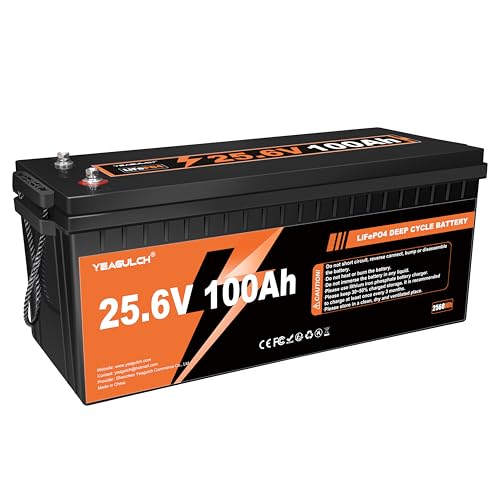
yeagulch 24V 100Ah LiFePO4 Battery
Badge: Best All-Round 100Ah
Strengths
- Title explicitly names trolling motors, off-grid solar, RV and marine use
- Low-temperature cutoff protects the cells during cold-weather charging
- Same 2560Wh class as the other 100Ah picks, so runtime comparisons are straightforward
Trade-offs
- 100A BMS is the ceiling for continuous current; high-draw inverters may need parallel units
- No waterproof rating is stated in the title, unlike the IP65 pick
- Shares its maker’s naming with the larger 314Ah unit, so check the capacity on the label before ordering
Key specifications (from the listing)
- Voltage: 24V (nominal)
- Capacity: 100Ah
- Energy: 2560Wh
- BMS: built-in 100A
- Chemistry: LiFePO4
- Protection: low-temperature cutoff
- Certifications named in listing: UN38.3, UL1973
Consider where this pick sits in a guide to general 24V power — vehicles, boats, cabins and backup. Its listing promises 24v (nominal); 100ah; 2560wh; built-in 100a, and the honest reading of that promise is narrower than the headline: those are the facts the maker chose to publish, verified for this guide, and they define both what the product will do and the questions a careful buyer should still ask the seller. Title explicitly names trolling motors, off-grid solar, RV and marine use That strength is the reason it holds the “Best All-Round 100Ah” badge here rather than a lower slot.
The limitations deserve equal time. 100A BMS is the ceiling for continuous current; high-draw inverters may need parallel units In practice that means this pick rewards a buyer whose use case matches its design center and quietly penalizes a buyer who needed something else and hoped the headline would stretch. Matched against the other entries in this guide, its role is specific rather than universal — which is precisely what a badge system is for, and why the comparison table below keeps its facts in one row rather than scattering them through prose.
Day-to-day life with this pick is where the second strength on its list earns its place: low-temperature cutoff protects the cells during cold-weather charging That sounds like a small thing in a listing, and it is — right up until it becomes the detail you interact with every single time you use the product, long after the headline specifications have faded into the background. Reviewers of this category consistently underweight those recurring small interactions, because they are hard to photograph and harder to put in a comparison chart, yet they are what separate a purchase that settles into your routine from one that quietly irritates you for years. Weigh this pick’s everyday details at least as heavily as its biggest number.
There is also a second trade-off worth naming before the verdict: no waterproof rating is stated in the title, unlike the ip65 pick None of the six entries in this guide escapes trade-offs entirely — the honest differences are in which compromises each design chose. If the compromise named here touches something you care about daily, move to the pick whose compromises live in areas you care about less; that exchange, rather than any pursuit of a flawless product, is how readers end up satisfied with purchases in this category. Satisfaction is usually a match, not a maximum.
Best for: buyers whose needs match the “Best All-Round 100Ah” role described above / Not suited for: buyers outside that role, who should start with a different pick in this guide.

Dyness 24V 100Ah LiFePO4 Battery
Badge: Best for Expansion
Strengths
- Expansion path is stated plainly: 4P2S connection up to 20.48kWh
- Smart 100A BMS and a named brand with a stated 10-year lifetime framing
- Title explicitly covers marine, RV and solar use
Trade-offs
- Stated cycle figure (4000+) is lower than the 15000+ figures on rival listings here, so compare warranty terms carefully
- 100A BMS still caps single-unit continuous output
- Reaching the full 20.48kWh expansion means buying several more units and the cabling to match
Key specifications (from the listing)
- Voltage: 24V (nominal)
- Capacity: 100Ah
- Energy: 2560Wh
- BMS: smart 100A
- Chemistry: LiFePO4
- Expansion: 4P2S connection up to 20.48kWh named in listing
- Lifetime framing in listing: 10-year lifetime, 4000+ deep cycles
Consider where this pick sits in a guide to general 24V power — vehicles, boats, cabins and backup. Its listing promises 24v (nominal); 100ah; 2560wh; smart 100a, and the honest reading of that promise is narrower than the headline: those are the facts the maker chose to publish, verified for this guide, and they define both what the product will do and the questions a careful buyer should still ask the seller. Expansion path is stated plainly: 4P2S connection up to 20.48kWh That strength is the reason it holds the “Best for Expansion” badge here rather than a lower slot.
The limitations deserve equal time. Stated cycle figure (4000+) is lower than the 15000+ figures on rival listings here, so compare warranty terms carefully In practice that means this pick rewards a buyer whose use case matches its design center and quietly penalizes a buyer who needed something else and hoped the headline would stretch. Matched against the other entries in this guide, its role is specific rather than universal — which is precisely what a badge system is for, and why the comparison table below keeps its facts in one row rather than scattering them through prose.
Day-to-day life with this pick is where the second strength on its list earns its place: smart 100a bms and a named brand with a stated 10-year lifetime framing That sounds like a small thing in a listing, and it is — right up until it becomes the detail you interact with every single time you use the product, long after the headline specifications have faded into the background. Reviewers of this category consistently underweight those recurring small interactions, because they are hard to photograph and harder to put in a comparison chart, yet they are what separate a purchase that settles into your routine from one that quietly irritates you for years. Weigh this pick’s everyday details at least as heavily as its biggest number.
There is also a second trade-off worth naming before the verdict: 100a bms still caps single-unit continuous output None of the six entries in this guide escapes trade-offs entirely — the honest differences are in which compromises each design chose. If the compromise named here touches something you care about daily, move to the pick whose compromises live in areas you care about less; that exchange, rather than any pursuit of a flawless product, is how readers end up satisfied with purchases in this category. Satisfaction is usually a match, not a maximum.
Best for: buyers whose needs match the “Best for Expansion” role described above / Not suited for: buyers outside that role, who should start with a different pick in this guide.
VATRER POWER 12V 300Ah LiFePO4 Battery
Badge: 12V High-Capacity Contrast (Prose)
Prose-only pick — no Amazon link and no image in this guide. Reason: it does not carry the keyword’s core attribute, or it duplicates a linked pick, as explained in the review below.
Strengths
- Self-heating and app monitoring are genuinely useful features in cold-climate RV and off-grid setups
- Large 300Ah capacity at 12V, with a 200A BMS
- Shows what the 12V side of the market offers when a system is designed around 12V
Trade-offs
- It is a 12V battery — a 24V system would need a matched pair in series, with the usual balancing caveats
- Its size and weight follow its large capacity
- Not a drop-in answer for a buyer who specifically needs one native 24V unit
Key specifications (from the listing)
- Voltage: 12V (nominal) — not a native 24V battery
- Capacity: 300Ah at 12V
- BMS: built-in 200A
- Features named in listing: self-heating, app monitoring, low/high temperature cutoff
- Named uses in listing: RV, camping, off-grid
Consider where this pick sits in a guide to general 24V power — vehicles, boats, cabins and backup. Its listing promises 12v (nominal) — not a native 24v battery; 300ah at 12v; built-in 200a; self-heating, app monitoring, low/high temperature cutoff, and the honest reading of that promise is narrower than the headline: those are the facts the maker chose to publish, verified for this guide, and they define both what the product will do and the questions a careful buyer should still ask the seller. Self-heating and app monitoring are genuinely useful features in cold-climate RV and off-grid setups That strength is the reason it holds the “12V High-Capacity Contrast (Prose)” badge here rather than a lower slot.
The limitations deserve equal time. It is a 12V battery — a 24V system would need a matched pair in series, with the usual balancing caveats In practice that means this pick rewards a buyer whose use case matches its design center and quietly penalizes a buyer who needed something else and hoped the headline would stretch. Matched against the other entries in this guide, its role is specific rather than universal — which is precisely what a badge system is for. Readers whose needs sit at the edges of this category may also want to read Best Priece On 12 Volt Car Battery before deciding.
Day-to-day life with this pick is where the second strength on its list earns its place: large 300ah capacity at 12v, with a 200a bms That sounds like a small thing in a listing, and it is — right up until it becomes the detail you interact with every single time you use the product, long after the headline specifications have faded into the background. Reviewers of this category consistently underweight those recurring small interactions, because they are hard to photograph and harder to put in a comparison chart, yet they are what separate a purchase that settles into your routine from one that quietly irritates you for years. Weigh this pick’s everyday details at least as heavily as its biggest number.
There is also a second trade-off worth naming before the verdict: its size and weight follow its large capacity None of the six entries in this guide escapes trade-offs entirely — the honest differences are in which compromises each design chose. If the compromise named here touches something you care about daily, move to the pick whose compromises live in areas you care about less; that exchange, rather than any pursuit of a flawless product, is how readers end up satisfied with purchases in this category. Satisfaction is usually a match, not a maximum.
Best for: buyers whose needs match the “12V High-Capacity Contrast (Prose)” role described above / Not suited for: buyers outside that role, who should start with a different pick in this guide.
VEMDIA 12V 100Ah LiFePO4 Battery (Group 31)
Badge: Series-Pair Component (Prose)
Prose-only pick — no Amazon link and no image in this guide. Reason: it does not carry the keyword’s core attribute, or it duplicates a linked pick, as explained in the review below.
Strengths
- Useful as a matched series-pair component: two identical 12V units wired in series make a 24V bank
- Group 31 footprint fits many existing battery trays and boxes
- Low-temperature protection and a smart BMS are named in the title
Trade-offs
- On its own it is a 12V battery — it does not meet a native 24V requirement by itself
- Series wiring adds balancing and cabling considerations a single 24V unit avoids
- Only half the energy per unit of the 24V 100Ah picks
Key specifications (from the listing)
- Voltage: 12V (nominal) — not a native 24V battery
- Capacity: 100Ah
- Energy: 1280Wh
- BMS: built-in 100A smart BMS
- Form factor: Group 31
- Protection: low-temperature protection
Consider where this pick sits in a guide to general 24V power — vehicles, boats, cabins and backup. Its listing promises 12v (nominal) — not a native 24v battery; 100ah; 1280wh; built-in 100a smart bms, and the honest reading of that promise is narrower than the headline: those are the facts the maker chose to publish, verified for this guide, and they define both what the product will do and the questions a careful buyer should still ask the seller. Useful as a matched series-pair component: two identical 12V units wired in series make a 24V bank That strength is the reason it holds the “Series-Pair Component (Prose)” badge here rather than a lower slot.
The limitations deserve equal time. On its own it is a 12V battery — it does not meet a native 24V requirement by itself In practice that means this pick rewards a buyer whose use case matches its design center and quietly penalizes a buyer who needed something else and hoped the headline would stretch. Matched against the other entries in this guide, its role is specific rather than universal — which is precisely what a badge system is for, and why the comparison table below keeps its facts in one row rather than scattering them through prose.
Day-to-day life with this pick is where the second strength on its list earns its place: group 31 footprint fits many existing battery trays and boxes That sounds like a small thing in a listing, and it is — right up until it becomes the detail you interact with every single time you use the product, long after the headline specifications have faded into the background. Reviewers of this category consistently underweight those recurring small interactions, because they are hard to photograph and harder to put in a comparison chart, yet they are what separate a purchase that settles into your routine from one that quietly irritates you for years. Weigh this pick’s everyday details at least as heavily as its biggest number.
There is also a second trade-off worth naming before the verdict: series wiring adds balancing and cabling considerations a single 24v unit avoids None of the six entries in this guide escapes trade-offs entirely — the honest differences are in which compromises each design chose. If the compromise named here touches something you care about daily, move to the pick whose compromises live in areas you care about less; that exchange, rather than any pursuit of a flawless product, is how readers end up satisfied with purchases in this category. Satisfaction is usually a match, not a maximum.
Best for: buyers whose needs match the “Series-Pair Component (Prose)” role described above / Not suited for: buyers outside that role, who should start with a different pick in this guide.
Comparison Table
| Pick | Badge | Key facts | Listing |
|---|---|---|---|
| yeagulch 24V 314Ah LiFePO4 Battery | Best Overall | 24V (nominal); 314Ah; 8038.4Wh; built-in 200A | Check on Amazon |
| dumfume 24V 100Ah LiFePO4 Battery | Best Weather Sealing | 24V (nominal); 100Ah; 2560Wh; built-in 100A | Check on Amazon |
| yeagulch 24V 100Ah LiFePO4 Battery | Best All-Round 100Ah | 24V (nominal); 100Ah; 2560Wh; built-in 100A | Check on Amazon |
| Dyness 24V 100Ah LiFePO4 Battery | Best for Expansion | 24V (nominal); 100Ah; 2560Wh; smart 100A | Check on Amazon |
| VATRER POWER 12V 300Ah LiFePO4 Battery | 12V High-Capacity Contrast (Prose) | 12V (nominal) — not a native 24V battery; 300Ah at 12V; built-in 200A; self-heating, app monitoring, low/high temperature cutoff | Prose-only — no link |
| VEMDIA 12V 100Ah LiFePO4 Battery (Group 31) | Series-Pair Component (Prose) | 12V (nominal) — not a native 24V battery; 100Ah; 1280Wh; built-in 100A smart BMS | Prose-only — no link |
Read the table by badge first and facts second. Most disappointment in this category comes from buying the right product for the wrong role, and the badge column exists to prevent exactly that. Shoppers whose brief is close but not identical may find Best Heavy Duty 12 Volt Truck Batteries a better starting point than forcing a fit here.
How to Choose the best 24 volt lithium ion battery
Start with the job, stated in one sentence, before you look at any product: the sentence that begins “I need this for…” and ends with the specific use. Every later decision — capacity, output, size, features — is a translation of that sentence into specifications. Buyers who skip it end up comparing products against each other instead of against their own lives, which is how capable products end up returned and unsuitable ones end up kept.
Weight deserves a mention in any 24V decision. Lithium’s energy density means a 24V lithium battery typically weighs a fraction of the lead-acid bank it replaces at the same usable capacity. On a boat that changes trim; in an RV it returns payload; in a machine it changes handling. The saving is real, but secure the lighter battery properly — the old battery’s weight was doing accidental work holding it in place.
Also decide how you feel about ecosystems. A battery with a stated expansion scheme and a maker that sells matching units is a safer long-term bet than a slightly cheaper orphan. Systems grow: a second battery next year is a common story, and it goes smoothly only if the first purchase left that door open.
Budget framing deserves a word, because this guide prints no prices. Think in tiers rather than figures: within any category there is a working tier that covers the brief competently, a step-up tier that buys durability, capacity or convenience you can name, and a prestige tier whose extra cost buys refinement more than function. Decide your tier from your usage — daily users rationally buy a tier higher than occasional users — and then let the verified picks within that tier compete on fit. Checking the latest price on Amazon for the one or two finalists, at the moment of purchase, is the only price research that stays true.
Then apply the filters in order. First, the hard constraints: the core attribute in the keyword, physical fit, and any compatibility your existing setup imposes. Second, the sizing decision, using the arithmetic in this guide rather than a headline number. Third, the ownership routine — cleaning, charging, storing, maintaining — because a product you will maintain beats a marginally better product you will not. Only after those three should badges and preferences arbitrate between the survivors, and in this guide that usually leaves exactly one pick standing.
How to Swap a 24V System Over to Lithium Safely
Converting an existing 24V system to lithium is a half-day job done carefully. Step one is an audit: photograph the existing wiring, note how the old batteries are connected, and confirm every charger and controller in the system offers a lithium profile. Step two is removal — disconnect negatives first, keep terminals from touching anything conductive, and note that your new lithium battery will likely weigh far less than the lead-acid it replaces, which changes how it should be secured against movement.
Step three is installation: mount the battery so it cannot shift, connect with clean, tight terminals and correctly sized cable, and fuse the positive run near the battery. Step four is configuration — set every charge source to its lithium profile before the first charge, and disable any equalization setting left over from lead-acid days. Step five is verification: run the system’s main load, watch for nuisance BMS cutoffs, and check that charging completes normally.
Problem: the system cuts out under a heavy load → compare the load’s draw with the BMS rating; the fix is a higher-BMS battery, a parallel unit where supported, or a smaller load, not bypassing protection. Problem: the battery will not accept charge on a cold morning → low-temperature protection is doing its job; warm the battery’s environment. Problem: runtime is far below expectations → verify the charger actually finished a lithium-profile charge, and audit for parasitic loads you forgot the system had.
What 24V Systems Actually Exist, and Why the Voltage Persists
Twenty-four volts survives because it is a sweet spot. Trolling motors in the mid-thrust range run on it, many RVs and boats wire house power around it, small solar and backup systems use it to halve cable current versus 12V, and a range of commercial machines — scrubbers, lifts, mobility equipment — standardized on it long ago. A buyer shopping this voltage is rarely starting from zero; something they own already demands 24V, and the battery must fit that demand exactly.
That is also why voltage honesty matters more here than in most battery shopping. A 12V battery cannot be ‘close enough.’ Motors, chargers and controllers are built around a nominal voltage, and feeding them the wrong one ranges from disappointing to damaging. Every linked pick in this guide is a native 24V unit; the prose-only entries exist to explain the one legitimate exception — a matched series pair — and its costs.
Reading a Lithium Battery Listing Without Being Misled
Battery listings compress a lot into their titles, and the skill is knowing which numbers do the work. Amp-hours only mean something at a stated voltage: 100Ah at 24V is 2560Wh, double the energy of 100Ah at 12V. The BMS rating — 100A or 200A among these picks — caps how much continuous current the battery will deliver before protecting itself, which decides whether a high-draw inverter or motor runs or trips. Cycle figures are maker claims under their own test conditions, useful for rough comparison within a brand’s range, weaker evidence across brands.
Certifications named in a title, such as UL 1973 and UN38.3 on several picks here, signal that a maker has put the product through recognized safety and transport evaluations — worth crediting, and worth verifying with the seller for insured installations. Features like low-temperature cutoff and an IP65 enclosure rating answer specific environmental questions. Read a listing by asking, in order: is the voltage right, is the energy enough, is the BMS strong enough, and does it survive my environment? The rest is decoration.
One more cross-check before you buy: readers who arrived here from a neighboring search often benefit from Best Lithium 12 Volt Car Battery, which covers the adjacent version of this decision with its own verified picks.
Common Buying Mistakes
- Comparing amp-hours across voltages — 100Ah at 12V is half the energy of 100Ah at 24V.
- Buying a battery whose BMS rating is below the system’s biggest sustained load, then discovering protection cutoffs under real use.
- Keeping a lead-acid-only charger with an equalization mode connected to a lithium bank.
- Assuming a 12V battery can serve a 24V system alone because the listings appeared under the same search.
- Leaving the lighter lithium battery unsecured in a space designed around the weight of lead-acid.
Notice the pattern across those mistakes: none of them is about buying a bad product. All of them are about skipping a verification step — a measurement, a profile setting, a category check, a habit honestly assessed. The picks in this guide are capable; the mistakes are what capable products cannot survive.
Final Recommendation
If you want one battery that simply is 24V and ready for almost any system in this class, the linked 100Ah picks are the practical center; the 314Ah unit is for systems whose appetite has already outgrown that center.
Whichever pick you choose, buy it as the start of a routine rather than the end of a search: set it up as the how-to section describes, note your baseline experience in the first week, and keep the manual. And if your brief turns out to be the neighboring one, Best Priece On 12 Volt Car Battery is the guide written for it.
Frequently Asked Questions
Is LiFePO4 the same as lithium ion?
LiFePO4 — lithium iron phosphate — is a lithium-ion chemistry, and it is the one used by every linked pick here because deep-cycle 24V work rewards its cycle life and stability over the higher energy density of phone-style cells.
Can I replace two 12V lead-acid batteries with one 24V lithium battery?
In many 24V systems, yes, and it simplifies wiring and removes series balancing between two separate batteries. Confirm physical fit, charger compatibility with lithium, and that the single battery’s BMS rating covers your peak loads.
Can I use a single 12V lithium battery in a 24V system?
No. A 24V system needs 24V. Two identical 12V batteries wired in series can provide it, as the prose picks discuss, but one 12V battery alone cannot, and wiring mistakes here can damage equipment.
What does the BMS rating mean for me?
The battery management system’s amp rating is the continuous current ceiling. A 100A BMS at 24V supports roughly 2400W before protection intervenes, less inverter losses; the 200A pick doubles that headroom. Match the BMS to your largest sustained load, including surge behavior.
Do I need a special charger for a 24V lithium battery?
You need a charger or charge controller with a lithium-appropriate profile for 24V LiFePO4. Many modern chargers include one; older lead-acid-only chargers with equalization modes are a poor match and can shorten battery life.
How should I store a 24V lithium battery off-season?
Partially charged rather than full or empty, in a cool dry place, disconnected from loads and parasitic draws. Check it occasionally across a long storage period and top up if it drifts low. The exact state-of-charge target in the maker’s manual wins over any general advice.
