Disclosure: topratedkitchenware.com is reader-supported. When you buy through links on our site, we may earn an affiliate commission from Amazon and other retailers, at no extra cost to you.
Where to buy
Start here if you already know your shortlist. The linked picks below are the verified recommendations in this guide to the best battery for minn kota 24 volt trolling motor; each name leads to its Amazon listing, where you can check the latest price on Amazon and confirm current details. Picks marked prose-only are context and comparison entries discussed in full below — they carry no link and no image, deliberately, and the reviews explain why in each case.
- Dyness 24V 100Ah LiFePO4 Battery — Best Overall for 24V Trolling · Check on Amazon
- yeagulch 24V 100Ah LiFePO4 Battery — Best Trolling-Motor Fit
- yeagulch 24V 314Ah LiFePO4 Battery — Best for Long Days on the Water
- dumfume 24V 100Ah LiFePO4 Battery — Best Sealed Option
- SUPER EMPOWER 12V 100Ah LiFePO4 Battery (Group 24) — Series-Pair Route (Prose) (prose-only context pick, no Amazon link)
- SUPER EMPOWER 12V 100Ah LiFePO4 Battery (Group 24, 2-Pack) — Matched Pair Route (Prose) (prose-only context pick, no Amazon link)
Read the full guide ↓ for the sizing, setup and ownership detail behind each pick.
Choosing the best battery for minn kota 24 volt trolling motor setups comes down to one experience every angler knows: the afternoon the wind rises, the motor works harder, and a tired battery turns a good day into a long paddle. Minn Kota’s 24V motors are a use context here, not a pick brand — the four linked batteries in this guide are native 24V LiFePO4 deep-cycle units whose listings name trolling-motor or marine use, chosen because a single 24V battery replaces the traditional pair of 12V batteries wired in series.
That single-battery route is the headline change lithium brings to trolling. One unit, one BMS, no series pair drifting apart in charge, and a fraction of the weight in the bow or stern. The linked picks offer three 100Ah options with different strengths and one 314Ah unit for anglers whose days are long, whose boats are heavy, or whose spot-lock sessions run from dawn to weigh-in.
The two prose-only slots cover the series-pair route honestly: 12V batteries, including a factory 2-pack, that can build a 24V bank when wired in series. They are real options with real costs — double the connections, double the balancing attention — and they are presented without links or images because they are not native 24V batteries. Readers weighing both architectures will find the comparison laid out plainly below.
Key Takeaways
- The linked picks are the only products in this guide with Amazon links and images; prose-only entries are labeled context, never recommendations with links.
- For 24V trolling-motor duty on the water, the deciding factors are fit for the job, honest capacity or output figures from the listing, and the ownership routine — not headline marketing.
- Badges are used consistently from Quick Picks through the detailed reviews, so a pick’s role never changes mid-guide.
- Specifications here come only from the verified listings; where a listing is silent, this guide is silent too, rather than inventing a number.
- No prices are printed because they change; use the links to check the latest price on Amazon at the moment you buy.
In this guide
Quick Picks
Six entries, one table. If you are comparing quickly, this is the whole argument of the guide in miniature: what each pick is, what it is for, and whether it earned a link.
| Pick | Badge | Key facts from the listing |
|---|---|---|
| Dyness 24V 100Ah LiFePO4 Battery | Best Overall for 24V Trolling | 24V (nominal); 100Ah; 2560Wh; smart 100A |
| yeagulch 24V 100Ah LiFePO4 Battery · Check on Amazon | Best Trolling-Motor Fit | 24V (nominal); 100Ah; 2560Wh; built-in 100A |
| yeagulch 24V 314Ah LiFePO4 Battery · Check on Amazon | Best for Long Days on the Water | 24V (nominal); 314Ah; 8038.4Wh; built-in 200A |
| dumfume 24V 100Ah LiFePO4 Battery | Best Sealed Option | 24V (nominal); 100Ah; 2560Wh; built-in 100A |
| SUPER EMPOWER 12V 100Ah LiFePO4 Battery (Group 24) (prose-only) | Series-Pair Route (Prose) | 12V (nominal) — series-pair component, not native 24V; 100Ah; 1280Wh; 100A |
| SUPER EMPOWER 12V 100Ah LiFePO4 Battery (Group 24, 2-Pack) (prose-only) | Matched Pair Route (Prose) | 12V per unit (nominal) — sold as a 2-pack for series/parallel builds; 100Ah per unit; 1280Wh per unit; 100A per unit |
How These Picks Were Chosen
This guide is research-led. Every linked pick comes from a verified product pool checked against the maker’s Amazon listing on 2026-11-22: the title, stated specifications and named features were read in full, and only products that genuinely fit the brief of best battery for minn kota 24 volt trolling motor were linked. Products that appeared in the same searches but failed the brief — wrong voltage, wrong category, missing the keyword’s core attribute — were not quietly dropped; they are covered as prose-only entries with the reason stated, because readers meet those same products in search results and deserve an explanation.
Badges were assigned by role, not by price: the pick most readers should start with, the pick for the common alternative use case, and the specialist options are labeled as such in Quick Picks and again in the detailed reviews. Where two listings are close relatives — a color variant, a capacity sibling — the reviews say so plainly instead of manufacturing differences. Readers comparing neighboring topics may also find Best Batteries To Use For 24 Volt Trolling Motor useful alongside this guide.
A note on limits: this is desk research, not a laboratory test program, and the guide makes no hands-on testing claims. Cycle figures, output figures and lifetime framing are reported as the makers state them in their listings, and are flagged as maker claims where the distinction matters. What research can do well — and what this guide attempts — is to read the listings more carefully than a search-results page does, and to refuse to print prices, ratings or specifications that cannot be verified.
The 6 Picks in Detail

Dyness 24V 100Ah LiFePO4 Battery
Badge: Best Overall for 24V Trolling
Strengths
- Expansion path is stated plainly: 4P2S connection up to 20.48kWh
- Smart 100A BMS and a named brand with a stated 10-year lifetime framing
- Title explicitly covers marine, RV and solar use
Trade-offs
- Stated cycle figure (4000+) is lower than the 15000+ figures on rival listings here, so compare warranty terms carefully
- 100A BMS still caps single-unit continuous output
- Reaching the full 20.48kWh expansion means buying several more units and the cabling to match
Key specifications (from the listing)
- Voltage: 24V (nominal)
- Capacity: 100Ah
- Energy: 2560Wh
- BMS: smart 100A
- Chemistry: LiFePO4
- Expansion: 4P2S connection up to 20.48kWh named in listing
- Lifetime framing in listing: 10-year lifetime, 4000+ deep cycles
Consider where this pick sits in a guide to 24V trolling-motor duty on the water. Its listing promises 24v (nominal); 100ah; 2560wh; smart 100a, and the honest reading of that promise is narrower than the headline: those are the facts the maker chose to publish, verified for this guide, and they define both what the product will do and the questions a careful buyer should still ask the seller. Expansion path is stated plainly: 4P2S connection up to 20.48kWh That strength is the reason it holds the “Best Overall for 24V Trolling” badge here rather than a lower slot.
The limitations deserve equal time. Stated cycle figure (4000+) is lower than the 15000+ figures on rival listings here, so compare warranty terms carefully In practice that means this pick rewards a buyer whose use case matches its design center and quietly penalizes a buyer who needed something else and hoped the headline would stretch. Matched against the other entries in this guide, its role is specific rather than universal — which is precisely what a badge system is for, and why the comparison table below keeps its facts in one row rather than scattering them through prose.
Day-to-day life with this pick is where the second strength on its list earns its place: smart 100a bms and a named brand with a stated 10-year lifetime framing That sounds like a small thing in a listing, and it is — right up until it becomes the detail you interact with every single time you use the product, long after the headline specifications have faded into the background. Reviewers of this category consistently underweight those recurring small interactions, because they are hard to photograph and harder to put in a comparison chart, yet they are what separate a purchase that settles into your routine from one that quietly irritates you for years. Weigh this pick’s everyday details at least as heavily as its biggest number.
There is also a second trade-off worth naming before the verdict: 100a bms still caps single-unit continuous output None of the six entries in this guide escapes trade-offs entirely — the honest differences are in which compromises each design chose. If the compromise named here touches something you care about daily, move to the pick whose compromises live in areas you care about less; that exchange, rather than any pursuit of a flawless product, is how readers end up satisfied with purchases in this category. Satisfaction is usually a match, not a maximum.
Best for: buyers whose needs match the “Best Overall for 24V Trolling” role described above / Not suited for: buyers outside that role, who should start with a different pick in this guide.
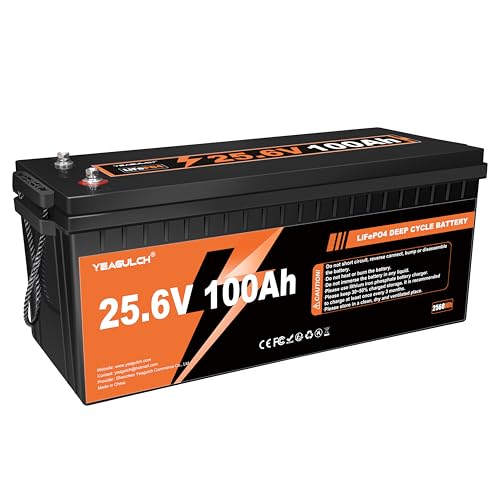
yeagulch 24V 100Ah LiFePO4 Battery
Badge: Best Trolling-Motor Fit
Strengths
- Title explicitly names trolling motors, off-grid solar, RV and marine use
- Low-temperature cutoff protects the cells during cold-weather charging
- Same 2560Wh class as the other 100Ah picks, so runtime comparisons are straightforward
Trade-offs
- 100A BMS is the ceiling for continuous current; high-draw inverters may need parallel units
- No waterproof rating is stated in the title, unlike the IP65 pick
- Shares its maker’s naming with the larger 314Ah unit, so check the capacity on the label before ordering
Key specifications (from the listing)
- Voltage: 24V (nominal)
- Capacity: 100Ah
- Energy: 2560Wh
- BMS: built-in 100A
- Chemistry: LiFePO4
- Protection: low-temperature cutoff
- Certifications named in listing: UN38.3, UL1973
Consider where this pick sits in a guide to 24V trolling-motor duty on the water. Its listing promises 24v (nominal); 100ah; 2560wh; built-in 100a, and the honest reading of that promise is narrower than the headline: those are the facts the maker chose to publish, verified for this guide, and they define both what the product will do and the questions a careful buyer should still ask the seller. Title explicitly names trolling motors, off-grid solar, RV and marine use That strength is the reason it holds the “Best Trolling-Motor Fit” badge here rather than a lower slot.
The limitations deserve equal time. 100A BMS is the ceiling for continuous current; high-draw inverters may need parallel units In practice that means this pick rewards a buyer whose use case matches its design center and quietly penalizes a buyer who needed something else and hoped the headline would stretch. Matched against the other entries in this guide, its role is specific rather than universal — which is precisely what a badge system is for. Readers whose needs sit at the edges of this category may also want to read Best Heavy Duty 12 Volt Truck Batteries before deciding.
Day-to-day life with this pick is where the second strength on its list earns its place: low-temperature cutoff protects the cells during cold-weather charging That sounds like a small thing in a listing, and it is — right up until it becomes the detail you interact with every single time you use the product, long after the headline specifications have faded into the background. Reviewers of this category consistently underweight those recurring small interactions, because they are hard to photograph and harder to put in a comparison chart, yet they are what separate a purchase that settles into your routine from one that quietly irritates you for years. Weigh this pick’s everyday details at least as heavily as its biggest number.
There is also a second trade-off worth naming before the verdict: no waterproof rating is stated in the title, unlike the ip65 pick None of the six entries in this guide escapes trade-offs entirely — the honest differences are in which compromises each design chose. If the compromise named here touches something you care about daily, move to the pick whose compromises live in areas you care about less; that exchange, rather than any pursuit of a flawless product, is how readers end up satisfied with purchases in this category. Satisfaction is usually a match, not a maximum.
Best for: buyers whose needs match the “Best Trolling-Motor Fit” role described above / Not suited for: buyers outside that role, who should start with a different pick in this guide.

yeagulch 24V 314Ah LiFePO4 Battery
Badge: Best for Long Days on the Water
Strengths
- Largest single-unit energy in this guide at 8038.4Wh, so one battery can replace a bank of smaller units
- 200A BMS gives more continuous-current headroom than the 100A units here
- Low-temperature protection and UL 1973 / UN38.3 listings are named in the product title
Trade-offs
- A 314Ah unit is physically large and heavy compared with the 100Ah picks
- Far more capacity than a small system needs, so the extra size is wasted in compact setups
- Deep-cycle count is stated as 15000+ in the title, but real life still depends on depth of discharge and temperature
Key specifications (from the listing)
- Voltage: 24V (nominal)
- Capacity: 314Ah
- Energy: 8038.4Wh
- BMS: built-in 200A
- Chemistry: LiFePO4 (lithium iron phosphate)
- Protection: low-temperature protection
- Certifications named in listing: UL 1973, UN38.3
Consider where this pick sits in a guide to 24V trolling-motor duty on the water. Its listing promises 24v (nominal); 314ah; 8038.4wh; built-in 200a, and the honest reading of that promise is narrower than the headline: those are the facts the maker chose to publish, verified for this guide, and they define both what the product will do and the questions a careful buyer should still ask the seller. Largest single-unit energy in this guide at 8038.4Wh, so one battery can replace a bank of smaller units That strength is the reason it holds the “Best for Long Days on the Water” badge here rather than a lower slot.
The limitations deserve equal time. A 314Ah unit is physically large and heavy compared with the 100Ah picks In practice that means this pick rewards a buyer whose use case matches its design center and quietly penalizes a buyer who needed something else and hoped the headline would stretch. Matched against the other entries in this guide, its role is specific rather than universal — which is precisely what a badge system is for, and why the comparison table below keeps its facts in one row rather than scattering them through prose.
Day-to-day life with this pick is where the second strength on its list earns its place: 200a bms gives more continuous-current headroom than the 100a units here That sounds like a small thing in a listing, and it is — right up until it becomes the detail you interact with every single time you use the product, long after the headline specifications have faded into the background. Reviewers of this category consistently underweight those recurring small interactions, because they are hard to photograph and harder to put in a comparison chart, yet they are what separate a purchase that settles into your routine from one that quietly irritates you for years. Weigh this pick’s everyday details at least as heavily as its biggest number.
There is also a second trade-off worth naming before the verdict: far more capacity than a small system needs, so the extra size is wasted in compact setups None of the six entries in this guide escapes trade-offs entirely — the honest differences are in which compromises each design chose. If the compromise named here touches something you care about daily, move to the pick whose compromises live in areas you care about less; that exchange, rather than any pursuit of a flawless product, is how readers end up satisfied with purchases in this category. Satisfaction is usually a match, not a maximum.
Best for: buyers whose needs match the “Best for Long Days on the Water” role described above / Not suited for: buyers outside that role, who should start with a different pick in this guide.

dumfume 24V 100Ah LiFePO4 Battery
Badge: Best Sealed Option
Strengths
- IP65 waterproof enclosure is unusual in this group and suits exposed or marine-adjacent mounting
- Low-temperature cutoff protection is built in
- 2560Wh is a practical single-unit building block that can be paralleled as a system grows
Trade-offs
- 100A BMS limits continuous draw compared with the 200A large pick
- No series/parallel expansion figure is stated in the title, so confirm wiring plans with the maker first
- 100Ah runs a large inverter load for a shorter time than the 314Ah pick
Key specifications (from the listing)
- Voltage: 24V (nominal)
- Capacity: 100Ah
- Energy: 2560Wh
- BMS: built-in 100A
- Chemistry: LiFePO4
- Protection: low-temperature cutoff
- Enclosure: IP65 waterproof rating named in listing
- Certifications named in listing: UN38.3, UL1973
Consider where this pick sits in a guide to 24V trolling-motor duty on the water. Its listing promises 24v (nominal); 100ah; 2560wh; built-in 100a, and the honest reading of that promise is narrower than the headline: those are the facts the maker chose to publish, verified for this guide, and they define both what the product will do and the questions a careful buyer should still ask the seller. IP65 waterproof enclosure is unusual in this group and suits exposed or marine-adjacent mounting That strength is the reason it holds the “Best Sealed Option” badge here rather than a lower slot.
The limitations deserve equal time. 100A BMS limits continuous draw compared with the 200A large pick In practice that means this pick rewards a buyer whose use case matches its design center and quietly penalizes a buyer who needed something else and hoped the headline would stretch. Matched against the other entries in this guide, its role is specific rather than universal — which is precisely what a badge system is for, and why the comparison table below keeps its facts in one row rather than scattering them through prose.
Day-to-day life with this pick is where the second strength on its list earns its place: low-temperature cutoff protection is built in That sounds like a small thing in a listing, and it is — right up until it becomes the detail you interact with every single time you use the product, long after the headline specifications have faded into the background. Reviewers of this category consistently underweight those recurring small interactions, because they are hard to photograph and harder to put in a comparison chart, yet they are what separate a purchase that settles into your routine from one that quietly irritates you for years. Weigh this pick’s everyday details at least as heavily as its biggest number.
There is also a second trade-off worth naming before the verdict: no series/parallel expansion figure is stated in the title, so confirm wiring plans with the maker first None of the six entries in this guide escapes trade-offs entirely — the honest differences are in which compromises each design chose. If the compromise named here touches something you care about daily, move to the pick whose compromises live in areas you care about less; that exchange, rather than any pursuit of a flawless product, is how readers end up satisfied with purchases in this category. Satisfaction is usually a match, not a maximum.
Best for: buyers whose needs match the “Best Sealed Option” role described above / Not suited for: buyers outside that role, who should start with a different pick in this guide.
SUPER EMPOWER 12V 100Ah LiFePO4 Battery (Group 24)
Badge: Series-Pair Route (Prose)
Prose-only pick — no Amazon link and no image in this guide. Reason: it does not carry the keyword’s core attribute, or it duplicates a linked pick, as explained in the review below.
Strengths
- A legitimate series-pair route: two matched units in series give a 24V bank for a trolling motor
- Group 24 size fits many standard marine battery boxes
- Low-temp cutoff and a stated expansion path
Trade-offs
- You must buy and maintain two units, matched in age and charge, instead of one native 24V battery
- Series pairs can drift out of balance over time and need periodic checks
- Takes more tray space than a single 24V unit of similar energy
Key specifications (from the listing)
- Voltage: 12V (nominal) — series-pair component, not native 24V
- Capacity: 100Ah
- Energy: 1280Wh
- BMS: 100A
- Form factor: Group 24
- Expansion named in listing: supports 4P4S, up to 20.48kWh
- Protection: low-temp cutoff
Consider where this pick sits in a guide to 24V trolling-motor duty on the water. Its listing promises 12v (nominal) — series-pair component, not native 24v; 100ah; 1280wh; 100a, and the honest reading of that promise is narrower than the headline: those are the facts the maker chose to publish, verified for this guide, and they define both what the product will do and the questions a careful buyer should still ask the seller. A legitimate series-pair route: two matched units in series give a 24V bank for a trolling motor That strength is the reason it holds the “Series-Pair Route (Prose)” badge here rather than a lower slot.
The limitations deserve equal time. You must buy and maintain two units, matched in age and charge, instead of one native 24V battery In practice that means this pick rewards a buyer whose use case matches its design center and quietly penalizes a buyer who needed something else and hoped the headline would stretch. Matched against the other entries in this guide, its role is specific rather than universal — which is precisely what a badge system is for. Readers whose needs sit at the edges of this category may also want to read Best Priece On 12 Volt Car Battery before deciding.
Day-to-day life with this pick is where the second strength on its list earns its place: group 24 size fits many standard marine battery boxes That sounds like a small thing in a listing, and it is — right up until it becomes the detail you interact with every single time you use the product, long after the headline specifications have faded into the background. Reviewers of this category consistently underweight those recurring small interactions, because they are hard to photograph and harder to put in a comparison chart, yet they are what separate a purchase that settles into your routine from one that quietly irritates you for years. Weigh this pick’s everyday details at least as heavily as its biggest number.
There is also a second trade-off worth naming before the verdict: series pairs can drift out of balance over time and need periodic checks None of the six entries in this guide escapes trade-offs entirely — the honest differences are in which compromises each design chose. If the compromise named here touches something you care about daily, move to the pick whose compromises live in areas you care about less; that exchange, rather than any pursuit of a flawless product, is how readers end up satisfied with purchases in this category. Satisfaction is usually a match, not a maximum.
Best for: buyers whose needs match the “Series-Pair Route (Prose)” role described above / Not suited for: buyers outside that role, who should start with a different pick in this guide.
SUPER EMPOWER 12V 100Ah LiFePO4 Battery (Group 24, 2-Pack)
Badge: Matched Pair Route (Prose)
Prose-only pick — no Amazon link and no image in this guide. Reason: it does not carry the keyword’s core attribute, or it duplicates a linked pick, as explained in the review below.
Strengths
- A factory-matched pair is the cleanest way to build a 24V series bank from 12V units
- Same Group 24 footprint and low-temp cutoff as the single-unit listing
- Expansion headroom is stated in the title
Trade-offs
- Still two separate batteries to wire, fuse and keep balanced — more work than one native 24V unit
- Total footprint is larger than a single 24V 100Ah battery
- If one unit ages faster, the pair’s usable capacity follows the weaker unit
Key specifications (from the listing)
- Voltage: 12V per unit (nominal) — sold as a 2-pack for series/parallel builds
- Capacity: 100Ah per unit
- Energy: 1280Wh per unit
- BMS: 100A per unit
- Form factor: Group 24
- Expansion named in listing: supports 4P4S, up to 20.48kWh
Consider where this pick sits in a guide to 24V trolling-motor duty on the water. Its listing promises 12v per unit (nominal) — sold as a 2-pack for series/parallel builds; 100ah per unit; 1280wh per unit; 100a per unit, and the honest reading of that promise is narrower than the headline: those are the facts the maker chose to publish, verified for this guide, and they define both what the product will do and the questions a careful buyer should still ask the seller. A factory-matched pair is the cleanest way to build a 24V series bank from 12V units That strength is the reason it holds the “Matched Pair Route (Prose)” badge here rather than a lower slot.
The limitations deserve equal time. Still two separate batteries to wire, fuse and keep balanced — more work than one native 24V unit In practice that means this pick rewards a buyer whose use case matches its design center and quietly penalizes a buyer who needed something else and hoped the headline would stretch. Matched against the other entries in this guide, its role is specific rather than universal — which is precisely what a badge system is for, and why the comparison table below keeps its facts in one row rather than scattering them through prose.
Day-to-day life with this pick is where the second strength on its list earns its place: same group 24 footprint and low-temp cutoff as the single-unit listing That sounds like a small thing in a listing, and it is — right up until it becomes the detail you interact with every single time you use the product, long after the headline specifications have faded into the background. Reviewers of this category consistently underweight those recurring small interactions, because they are hard to photograph and harder to put in a comparison chart, yet they are what separate a purchase that settles into your routine from one that quietly irritates you for years. Weigh this pick’s everyday details at least as heavily as its biggest number.
There is also a second trade-off worth naming before the verdict: total footprint is larger than a single 24v 100ah battery None of the six entries in this guide escapes trade-offs entirely — the honest differences are in which compromises each design chose. If the compromise named here touches something you care about daily, move to the pick whose compromises live in areas you care about less; that exchange, rather than any pursuit of a flawless product, is how readers end up satisfied with purchases in this category. Satisfaction is usually a match, not a maximum.
Best for: buyers whose needs match the “Matched Pair Route (Prose)” role described above / Not suited for: buyers outside that role, who should start with a different pick in this guide.
Comparison Table
| Pick | Badge | Key facts | Listing |
|---|---|---|---|
| Dyness 24V 100Ah LiFePO4 Battery | Best Overall for 24V Trolling | 24V (nominal); 100Ah; 2560Wh; smart 100A | Check on Amazon |
| yeagulch 24V 100Ah LiFePO4 Battery | Best Trolling-Motor Fit | 24V (nominal); 100Ah; 2560Wh; built-in 100A | Check on Amazon |
| yeagulch 24V 314Ah LiFePO4 Battery | Best for Long Days on the Water | 24V (nominal); 314Ah; 8038.4Wh; built-in 200A | Check on Amazon |
| dumfume 24V 100Ah LiFePO4 Battery | Best Sealed Option | 24V (nominal); 100Ah; 2560Wh; built-in 100A | Check on Amazon |
| SUPER EMPOWER 12V 100Ah LiFePO4 Battery (Group 24) | Series-Pair Route (Prose) | 12V (nominal) — series-pair component, not native 24V; 100Ah; 1280Wh; 100A | Prose-only — no link |
| SUPER EMPOWER 12V 100Ah LiFePO4 Battery (Group 24, 2-Pack) | Matched Pair Route (Prose) | 12V per unit (nominal) — sold as a 2-pack for series/parallel builds; 100Ah per unit; 1280Wh per unit; 100A per unit | Prose-only — no link |
Read the table by badge first and facts second. Most disappointment in this category comes from buying the right product for the wrong role, and the badge column exists to prevent exactly that. Shoppers whose brief is close but not identical may find Best Heavy Duty 12 Volt Truck Batteries a better starting point than forcing a fit here.
How to Choose the best battery for minn kota 24 volt trolling motor
Start with the job, stated in one sentence, before you look at any product: the sentence that begins “I need this for…” and ends with the specific use. Every later decision — capacity, output, size, features — is a translation of that sentence into specifications. Buyers who skip it end up comparing products against each other instead of against their own lives, which is how capable products end up returned and unsuitable ones end up kept.
Consider the charger as part of the battery purchase, because on a boat the two live together. An onboard charger with a true lithium profile, mounted once and used every trip, is what turns lithium’s paper advantages into daily ones. If your current charger lacks a lithium mode, its replacement belongs in the same budget conversation as the battery itself.
Also think about the second battery question in advance. Some anglers run the trolling motor alone; others share a boat with livewell pumps, large graphs and lights. If your electronics keep growing, the 314Ah pick’s headroom — or a planned parallel expansion where the maker supports it — is cheaper to buy into now than to retrofit around later.
Budget framing deserves a word, because this guide prints no prices. Think in tiers rather than figures: within any category there is a working tier that covers the brief competently, a step-up tier that buys durability, capacity or convenience you can name, and a prestige tier whose extra cost buys refinement more than function. Decide your tier from your usage — daily users rationally buy a tier higher than occasional users — and then let the verified picks within that tier compete on fit. Checking the latest price on Amazon for the one or two finalists, at the moment of purchase, is the only price research that stays true.
Then apply the filters in order. First, the hard constraints: the core attribute in the keyword, physical fit, and any compatibility your existing setup imposes. Second, the sizing decision, using the arithmetic in this guide rather than a headline number. Third, the ownership routine — cleaning, charging, storing, maintaining — because a product you will maintain beats a marginally better product you will not. Only after those three should badges and preferences arbitrate between the survivors, and in this guide that usually leaves exactly one pick standing.
How to Install and Care for a 24V Trolling-Motor Battery
Installation starts with placement: choose the compartment the boat’s designer intended, or one that keeps weight balanced and the battery secure in chop. A lithium battery is far lighter than the lead-acid pair it replaces, so straps and trays that relied on weight need a positive hold-down. Wire with marine-grade cable sized for the motor’s maximum draw, keep the run as short as the layout allows, protect terminals from spray and tools, and fuse the circuit as the motor’s manual directs.
Before the first trip, set your charger to its lithium profile and complete a full charge at home. On the water, build the habit of noting how much a normal day uses; two or three trips give you a personal runtime map no review can provide. After trips, a quick terminal check and a wipe-down keep corrosion from starting, and off-season the battery wants partial charge, disconnection from parasitic loads, and a cool dry shelf.
Problem: the motor cuts out at high speed settings → the draw may be hitting the battery’s BMS ceiling or a poor connection may be adding resistance; check terminals first, then compare draw against the BMS rating. Problem: runtime dropped over a season → audit connections for corrosion and confirm the charger is completing a lithium-profile charge. Problem: one battery of a series pair reads lower than the other → the pair is drifting; charge each individually to full to re-balance, and plan around matched replacement.
Native 24V vs a Series Pair: What Changes on the Water
A series pair of 12V batteries has powered 24V trolling motors for decades, and it works — but each battery ages on its own curve, and the pair’s usable capacity quietly becomes the weaker battery’s capacity. Connections multiply: two batteries, a series jumper, more terminals to corrode in a marine environment. A native 24V battery deletes that entire category of upkeep. There is one state of charge to think about, one set of terminals to keep clean, and one BMS managing the whole bank.
The trade is flexibility. A series pair lets you replace one failed battery instead of the whole bank, and 12V units can be borrowed for other duties. A native unit is a single point of failure, albeit one with modern protection electronics. For most anglers, the simplicity and weight saving of the native battery win; for anglers who already own good 12V lithium batteries, the pair route — covered in the prose picks — remains rational. What is not rational is mixing old and new batteries in a series pair, which guarantees the mismatch problems above.
Runtime, Weight and Wind: Sizing a Battery for Real Fishing Days
Trolling-motor runtime is not a fixed number, because the motor’s draw swings with speed setting, wind, current and hull weight. A battery that coasts a calm morning can be emptied by an afternoon of holding position against the wind, and modern GPS anchoring features hold position by working constantly. Honest sizing therefore starts from your hardest typical day, not your easiest: long runs between spots, hours of position-holding, and a headwind return.
The 100Ah linked picks, at 2560Wh, suit most single-day fishing with margin. The 314Ah pick exists for the exceptions — big water, heavy boats, tournament-length days, or a motor that also shares a boat with other hungry electronics. Weight cuts the other way in your favor: lithium’s light weight versus an equivalent lead-acid pair improves how a small boat sits and planes, and it is weight your back notices at the ramp. Choose for the hard day, and the easy days take care of themselves.
One more cross-check before you buy: readers who arrived here from a neighboring search often benefit from Best Lithium 12 Volt Car Battery, which covers the adjacent version of this decision with its own verified picks.
Common Buying Mistakes
- Buying by amp-hours without checking the BMS rating against the motor’s maximum draw.
- Keeping a lead-acid-only charger and assuming the battery is at fault when runtime disappoints.
- Mixing an old and a new battery in a series pair and inheriting the weaker unit’s capacity.
- Leaving the lighter lithium battery loose in a compartment designed around lead-acid weight.
- Sizing for calm mornings and discovering the truth on the first windy afternoon far from the ramp.
Notice the pattern across those mistakes: none of them is about buying a bad product. All of them are about skipping a verification step — a measurement, a profile setting, a category check, a habit honestly assessed. The picks in this guide are capable; the mistakes are what capable products cannot survive.
Final Recommendation
For most 24V Minn Kota owners, a linked 100Ah native 24V battery is the clean upgrade: one battery, one charger profile, a full day of fishing. Long-day and big-water anglers should look straight at the 314Ah pick.
Whichever pick you choose, buy it as the start of a routine rather than the end of a search: set it up as the how-to section describes, note your baseline experience in the first week, and keep the manual. And if your brief turns out to be the neighboring one, Best Priece On 12 Volt Car Battery is the guide written for it.
Frequently Asked Questions
Will a single 24V lithium battery run my 24V Minn Kota motor?
Yes, that is exactly the application the linked picks’ listings name. A native 24V LiFePO4 battery supplies the motor directly, replacing a series pair. Confirm your motor’s maximum amp draw sits comfortably within the battery’s BMS rating — 100A on the 100Ah picks, 200A on the 314Ah pick.
How long will a 100Ah 24V battery run a trolling motor?
It depends on speed setting, wind, current and boat weight, because the motor’s draw varies widely. At moderate settings a 2560Wh battery covers a typical fishing day for most anglers; sustained high settings or position-holding in wind shorten that considerably. Size for your hardest typical day.
Is lithium safe in a marine environment?
LiFePO4 is the chemistry the marine market has adopted for this duty, and one linked pick carries an IP65 waterproof enclosure rating. Whatever battery you choose, mount it securely, keep terminals clean and protected, and follow the maker’s guidance for marine installation.
Can I charge a 24V lithium trolling battery with my existing charger?
Only if the charger offers a lithium profile suitable for 24V LiFePO4. Many older onboard chargers are lead-acid-only. Check the charger, not just the battery, before the first charge — an incorrect profile is the most common cause of disappointing lithium conversions.
Should I use two 12V lithium batteries in series instead?
You can, and the prose-only picks describe that route, including a factory-matched 2-pack. The costs are extra wiring, more terminals to maintain, and the need to keep the pair balanced and matched in age. A native 24V battery avoids all three, which is why it leads this guide.
What does low-temperature protection do for early-season fishing?
It prevents the battery from accepting charge while its cells are below a safe temperature, protecting them from damage. Early-season anglers charging in cold garages benefit directly; the practical habit is to let the battery warm before charging after a cold trip.
