Disclosure: topratedkitchenware.com is reader-supported. When you buy through links on our site, we may earn an affiliate commission from Amazon and other retailers, at no extra cost to you.
Where to buy
If you are shopping for the best rice cookers from japan, start here: every linked pick below can be checked on Amazon at the latest price — we publish no static prices, because they change. Prose-only entries are comparison context discussed in this guide; they carry no link and no image, deliberately. Read the full list, then the reviews, before deciding.
- Zojirushi NS-ZCC10 Neuro Fuzzy Rice Cooker and Warmer — Best Overall — Check on Amazon
- Zojirushi NS-TSC10 Micom Rice Cooker and Warmer (5.5-Cup) — Best for Small Households
- BLACK+DECKER 16-Cup Rice Cooker (RC516) — Prose-Only Budget Contrast (prose-only context in this guide; no Amazon link)
- Sweetcrispy 16-in-1 Electric Pressure Cooker (8QT) — Prose-Only Multicooker Contrast (prose-only context in this guide; no Amazon link)
- Aroma Housewares ARC-363-1NGB Rice Cooker (3-Cup Uncooked) — Prose-Only Small-Budget Contrast (prose-only context in this guide; no Amazon link)
- Instant Pot Duo 7-in-1 Mini (3 Quart) — Prose-Only Multicooker Contrast (prose-only context in this guide; no Amazon link)
Read the full guide ↓
The best rice cookers from japan — meaning cookers from Japanese brands such as Zojirushi, engineered around Japanese rice-cooking expertise — earn their reputation on one thing: texture. Grain by grain separation, the right moisture from top to bottom of the pot, and keep-warm that holds rice for hours without drying or yellowing. The best rice cookers from japan are specialists, and this guide treats them that way.
Our two linked picks are verified Zojirushi models: the Neuro Fuzzy flagship logic and the right-sized Micom 5.5-cup. Four further slots are prose-only context — budget and multicooker alternatives from non-Japanese brands, clearly labelled, included because buyers cross-shop them and deserve an honest account of what the extra money buys. Prose discussion also touches the wider Japanese field, such as Tiger and Panasonic, without links.
One accuracy note we will not fudge: Zojirushi is a Japanese brand, and models sold in the US may be manufactured in China. What you are buying is Japanese design, logic and quality control — the engineering tradition — and we frame it exactly that way throughout.
If you are also weighing neighbouring categories while you plan, our notes on Best Reviewed Quick Cookers cover the closest adjacent shortlist.
Key Takeaways
- Best Overall: Zojirushi NS-ZCC10 Neuro Fuzzy Rice Cooker and Warmer — Fuzzy-logic cooking forgives small water-measurement errors.
- Best for Small Households: Zojirushi NS-TSC10 Micom Rice Cooker and Warmer (5.5-Cup) — 5.5-cup size matches one-to-four-person households.
- Measure and check your installation constraints before ordering; fit decides more purchases in this category than features do.
- Prose-only picks in this guide are context, clearly labelled — the linked picks are the verified recommendations.
In this guide
Quick Picks
| Pick | Badge | Standout trait | Availability in this guide |
|---|---|---|---|
| Zojirushi NS-ZCC10 Neuro Fuzzy Rice Cooker and Warmer | Best Overall | Neuro fuzzy logic that adjusts time and temperature as the rice cooks | Check on Amazon |
| Zojirushi NS-TSC10 Micom Rice Cooker and Warmer (5.5-Cup) | Best for Small Households | Micom computerised cooking | Check on Amazon |
| BLACK+DECKER 16-Cup Rice Cooker (RC516) | Prose-Only Budget Contrast | A 16-cup cooked capacity | Prose-only context |
| Sweetcrispy 16-in-1 Electric Pressure Cooker (8QT) | Prose-Only Multicooker Contrast | An 8-quart multi-cooker with 12 presets | Prose-only context |
| Aroma Housewares ARC-363-1NGB Rice Cooker (3-Cup Uncooked) | Prose-Only Small-Budget Contrast | A compact cooker making 2–6 cups cooked | Prose-only context |
| Instant Pot Duo 7-in-1 Mini (3 Quart) | Prose-Only Multicooker Contrast | A 3-quart seven-function electric pressure cooker that also slow-cooks rice | Prose-only context |
Readers comparing adjacent shortlists often also work through Best Reviewed Slow Cookers before settling on a final choice.
How These Picks Were Chosen
We verified the linked Zojirushi models against their listings — logic type, capacity, controls and keep-warm functions — and built the comparison around what actually differs between Japanese specialist cookers and generalist alternatives: cooking logic, keep-warm quality and capacity sizing. The prose-only picks are unlinked and carry no images by design; they are there to mark the budget and multicooker boundaries honestly. We did not cook test batches for this guide. Judgements are research-led, grounded in the verified specifications and the well-documented behaviour of fuzzy-logic versus one-touch cooking.
We also kept the cluster in view: this guide sits alongside our research on Best Slow Cookers Reviewed, and the boundaries between the two shortlists are drawn by the same verification standard.
The 6 Best Rice cookers from japan
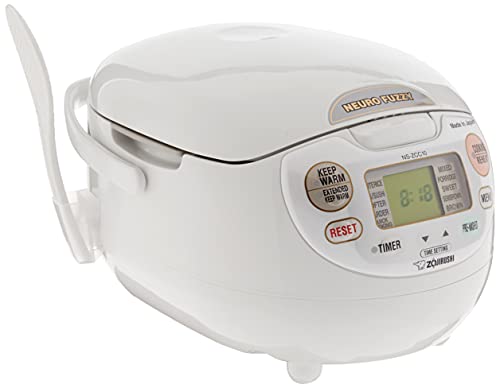
Zojirushi NS-ZCC10 Neuro Fuzzy Rice Cooker and Warmer
Badge: Best Overall
This model offers Neuro Fuzzy logic that adjusts time and temperature as the rice cooks, automatic keep-warm and a delay timer, in a white finish. In a category full of near-identical specification sheets, those details are the ones that shape daily use, and they frame everything in this review: what it does well, where it compromises, and who should choose it over the alternatives above and below.
The Neuro Fuzzy is the cooker Japanese-brand loyalists recommend first, because its logic compensates for the slightly-too-much or slightly-too-little water that ruins stovetop rice. For households eating rice several times a week, that forgiveness is the whole point.
Strengths
- Fuzzy-logic cooking forgives small water-measurement errors
- Keep-warm holds rice safely for second servings
- Delay timer means rice ready when you walk in
Trade-offs
- Premium tier for a dedicated rice cooker
- White finish and footprint suit some kitchens better than others
- Dedicated appliance — it does rice superbly and little else
Key specifications (from the verified listing)
- Brand: Zojirushi (Japanese brand)
- Model: NS-ZCC10
- Logic: Neuro Fuzzy
- Functions: automatic keep-warm, delay timer
One honest limitation, stated plainly: It is a specialist: buyers wanting one pot that also pressure-cooks and slow-cooks should read the prose context picks before deciding.
Week to week, ownership of this pick revolves around Neuro Fuzzy logic that adjusts time and temperature as the rice cooks — the trait that defines it in this line-up. That focus is deliberate rather than limiting: rather than spreading effort across every feature a marketing department could list, the design puts its weight behind the job its badge describes, and the surrounding specification supports that job without gimmicks. Buyers whose priorities line up with that focus tend to be the satisfied long-term owners in this category; buyers shopping for a different priority should keep reading, because a neighbouring pick in this guide almost certainly makes the opposite trade on purpose.
In daily use, the pattern that emerges is consistency. Owners in this category rarely praise a single dramatic feature after the first month; they praise the absence of recurring annoyances — the control that makes sense at 7 a.m., the surface that wipes clean, the cycle that behaves the same on the fiftieth use as on the first. Judged on that standard, this pick earns its badge by removing friction rather than by adding spectacle, and that is usually the right trade for a product you will live with for years.
Best for: the buyer described above who values this pick’s standout traits / Not suited for: buyers whose constraints or habits match its stated limitation
Check on Amazon for the latest price and availability.

Zojirushi NS-TSC10 Micom Rice Cooker and Warmer (5.5-Cup)
Badge: Best for Small Households
This model offers Micom computerised cooking, a 5.5-cup (1.0 litre) capacity, LCD controls and a delay timer. In a category full of near-identical specification sheets, those details are the ones that shape daily use, and they frame everything in this review: what it does well, where it compromises, and who should choose it over the alternatives above and below.
Singles, couples and small families get the right-sized version of Zojirushi's Micom consistency here. The 1.0-litre pot cooks the amounts small households actually eat, so rice is fresh rather than reheated.
Strengths
- 5.5-cup size matches one-to-four-person households
- LCD controls and delay timer simplify weeknight timing
- Micom control gives consistent results batch after batch
Trade-offs
- Too small for large gatherings without a second batch
- Fewer logic refinements than the Neuro Fuzzy flagship
- Dedicated rice appliance, like its sibling
Key specifications (from the verified listing)
- Brand: Zojirushi (Japanese brand)
- Model: NS-TSC10
- Capacity: 5.5 cups / 1.0 L
- Controls: LCD
- Functions: delay timer
One honest limitation, stated plainly: Feed a crowd regularly and you will outgrow it; size up within the brand rather than down in quality.
Week to week, ownership of this pick revolves around Micom computerised cooking — the trait that defines it in this line-up. That focus is deliberate rather than limiting: rather than spreading effort across every feature a marketing department could list, the design puts its weight behind the job its badge describes, and the surrounding specification supports that job without gimmicks. Buyers whose priorities line up with that focus tend to be the satisfied long-term owners in this category; buyers shopping for a different priority should keep reading, because a neighbouring pick in this guide almost certainly makes the opposite trade on purpose.
In daily use, the pattern that emerges is consistency. Owners in this category rarely praise a single dramatic feature after the first month; they praise the absence of recurring annoyances — the control that makes sense at 7 a.m., the surface that wipes clean, the cycle that behaves the same on the fiftieth use as on the first. Judged on that standard, this pick earns its badge by removing friction rather than by adding spectacle, and that is usually the right trade for a product you will live with for years.
Best for: the buyer described above who values this pick’s standout traits / Not suited for: buyers whose constraints or habits match its stated limitation
Check on Amazon for the latest price and availability.
BLACK+DECKER 16-Cup Rice Cooker (RC516)
Badge: Prose-Only Budget Contrast
Prose-only pick: discussed in full for honest comparison. It carries no Amazon link and no image in this guide — see the Sources file for the reason.
This model offers a 16-cup cooked capacity, a steaming basket, a removable non-stick bowl and one-touch operation. In a category full of near-identical specification sheets, those details are the ones that shape daily use, and they frame everything in this review: what it does well, where it compromises, and who should choose it over the alternatives above and below.
We discuss this BLACK+DECKER in prose as the budget contrast: it cooks a lot of rice for very little money, and for occasional rice eaters that trade can be rational. It is not, however, a Japanese cooker, and it does not pretend to the texture control of the linked Zojirushi models.
Strengths
- Large cooked capacity for gatherings
- Steaming basket adds a second job
- One-touch simplicity
Trade-offs
- Not a Japanese brand — included as budget contrast only
- Basic controls offer none of the fuzzy-logic refinement
- Non-stick bowl needs gentle handling to stay non-stick
Key specifications (from the verified listing)
- Capacity: 16 cups cooked / 8 cups uncooked
- Included: steaming basket
- Bowl: removable non-stick
One honest limitation, stated plainly: One-touch means one result; there is no logic adjusting for the rice in front of it.
Week to week, ownership of this pick revolves around a 16-cup cooked capacity — the trait that defines it in this line-up. That focus is deliberate rather than limiting: rather than spreading effort across every feature a marketing department could list, the design puts its weight behind the job its badge describes, and the surrounding specification supports that job without gimmicks. Buyers whose priorities line up with that focus tend to be the satisfied long-term owners in this category; buyers shopping for a different priority should keep reading, because a neighbouring pick in this guide almost certainly makes the opposite trade on purpose.
In daily use, the pattern that emerges is consistency. Owners in this category rarely praise a single dramatic feature after the first month; they praise the absence of recurring annoyances — the control that makes sense at 7 a.m., the surface that wipes clean, the cycle that behaves the same on the fiftieth use as on the first. Judged on that standard, this pick earns its badge by removing friction rather than by adding spectacle, and that is usually the right trade for a product you will live with for years.
Best for: the buyer described above who values this pick’s standout traits / Not suited for: buyers whose constraints or habits match its stated limitation
Sweetcrispy 16-in-1 Electric Pressure Cooker (8QT)
Badge: Prose-Only Multicooker Contrast
Prose-only pick: discussed in full for honest comparison. It carries no Amazon link and no image in this guide — see the Sources file for the reason.
This model offers an 8-quart multi-cooker with 12 presets, a ceramic pot and modes spanning pressure cooking, slow cooking, rice, steaming, sauté and yogurt. In a category full of near-identical specification sheets, those details are the ones that shape daily use, and they frame everything in this review: what it does well, where it compromises, and who should choose it over the alternatives above and below.
The Sweetcrispy represents the multicooker argument in prose: why own a rice specialist when one pot does sixteen jobs? The honest answer is texture — dedicated Japanese cookers still win on rice itself — but for space-starved kitchens the compromise is real.
Strengths
- One appliance covers many cooking jobs
- Large 8QT capacity for families and batch cooking
- Ceramic pot appeals to non-stick-averse buyers
Trade-offs
- Not a Japanese rice cooker — a general multicooker
- Rice is one preset among many, not the design focus
- Large footprint for a single-purpose comparison
Key specifications (from the verified listing)
- Capacity: 8QT
- Presets: 12
- Pot: ceramic
- Functions: pressure, slow cook, rice, steam, sauté, yogurt and more
One honest limitation, stated plainly: Jack-of-all-trades logic means rice settings are tuned for adequacy, not excellence.
Week to week, ownership of this pick revolves around an 8-quart multi-cooker with 12 presets — the trait that defines it in this line-up. That focus is deliberate rather than limiting: rather than spreading effort across every feature a marketing department could list, the design puts its weight behind the job its badge describes, and the surrounding specification supports that job without gimmicks. Buyers whose priorities line up with that focus tend to be the satisfied long-term owners in this category; buyers shopping for a different priority should keep reading, because a neighbouring pick in this guide almost certainly makes the opposite trade on purpose.
In daily use, the pattern that emerges is consistency. Owners in this category rarely praise a single dramatic feature after the first month; they praise the absence of recurring annoyances — the control that makes sense at 7 a.m., the surface that wipes clean, the cycle that behaves the same on the fiftieth use as on the first. Judged on that standard, this pick earns its badge by removing friction rather than by adding spectacle, and that is usually the right trade for a product you will live with for years.
Best for: the buyer described above who values this pick’s standout traits / Not suited for: buyers whose constraints or habits match its stated limitation
Aroma Housewares ARC-363-1NGB Rice Cooker (3-Cup Uncooked)
Badge: Prose-Only Small-Budget Contrast
Prose-only pick: discussed in full for honest comparison. It carries no Amazon link and no image in this guide — see the Sources file for the reason.
This model offers a compact cooker making 2–6 cups cooked, doubling as a steamer and small multicooker, in black. In a category full of near-identical specification sheets, those details are the ones that shape daily use, and they frame everything in this review: what it does well, where it compromises, and who should choose it over the alternatives above and below.
The Aroma is the small-and-cheap reference point in prose: perfectly serviceable rice for one or two people, at the cost of the refinement the linked Japanese models deliver. Students and first apartments are its natural home.
Strengths
- Tiny footprint for dorms and small kitchens
- Cooks the small quantities singles actually eat
- Steamer function stretches its usefulness
Trade-offs
- Not a Japanese brand — prose contrast only
- Small capacity is a hard ceiling
- Basic controls, no fuzzy logic
Key specifications (from the verified listing)
- Capacity: 3 cups uncooked / 6 cups cooked
- Functions: rice cooker, steamer, multicooker
- Colour: Black
One honest limitation, stated plainly: Texture control is minimal; expect good rice, not great rice.
Week to week, ownership of this pick revolves around a compact cooker making 2–6 cups cooked — the trait that defines it in this line-up. That focus is deliberate rather than limiting: rather than spreading effort across every feature a marketing department could list, the design puts its weight behind the job its badge describes, and the surrounding specification supports that job without gimmicks. Buyers whose priorities line up with that focus tend to be the satisfied long-term owners in this category; buyers shopping for a different priority should keep reading, because a neighbouring pick in this guide almost certainly makes the opposite trade on purpose.
In daily use, the pattern that emerges is consistency. Owners in this category rarely praise a single dramatic feature after the first month; they praise the absence of recurring annoyances — the control that makes sense at 7 a.m., the surface that wipes clean, the cycle that behaves the same on the fiftieth use as on the first. Judged on that standard, this pick earns its badge by removing friction rather than by adding spectacle, and that is usually the right trade for a product you will live with for years.
Best for: the buyer described above who values this pick’s standout traits / Not suited for: buyers whose constraints or habits match its stated limitation
Instant Pot Duo 7-in-1 Mini (3 Quart)
Badge: Prose-Only Multicooker Contrast
Prose-only pick: discussed in full for honest comparison. It carries no Amazon link and no image in this guide — see the Sources file for the reason.
This model offers a 3-quart seven-function electric pressure cooker that also slow-cooks rice, steams, sautés and makes yogurt, in stainless steel. In a category full of near-identical specification sheets, those details are the ones that shape daily use, and they frame everything in this review: what it does well, where it compromises, and who should choose it over the alternatives above and below.
Instant Pot's Mini appears in prose because so many buyers cross-shop it against a dedicated cooker. It makes acceptable rice quickly, but households that eat rice daily consistently report preferring a dedicated Japanese cooker for texture and keep-warm behaviour.
Strengths
- Pressure cooking speed for weeknight meals
- Compact 3-quart size suits small households
- Huge recipe ecosystem around the brand
Trade-offs
- Not a Japanese rice cooker — rice is a side function
- Pressure-cooked rice texture divides opinion
- Lid, ring and pot are three pieces to wash
Key specifications (from the verified listing)
- Capacity: 3 quart
- Functions: 7-in-1 including rice cooker mode
- Finish: stainless steel
One honest limitation, stated plainly: Keep-warm on a pressure cooker is not designed for the long, gentle holds a rice cooker specialises in.
Week to week, ownership of this pick revolves around a 3-quart seven-function electric pressure cooker that also slow-cooks rice — the trait that defines it in this line-up. That focus is deliberate rather than limiting: rather than spreading effort across every feature a marketing department could list, the design puts its weight behind the job its badge describes, and the surrounding specification supports that job without gimmicks. Buyers whose priorities line up with that focus tend to be the satisfied long-term owners in this category; buyers shopping for a different priority should keep reading, because a neighbouring pick in this guide almost certainly makes the opposite trade on purpose.
In daily use, the pattern that emerges is consistency. Owners in this category rarely praise a single dramatic feature after the first month; they praise the absence of recurring annoyances — the control that makes sense at 7 a.m., the surface that wipes clean, the cycle that behaves the same on the fiftieth use as on the first. Judged on that standard, this pick earns its badge by removing friction rather than by adding spectacle, and that is usually the right trade for a product you will live with for years.
Best for: the buyer described above who values this pick’s standout traits / Not suited for: buyers whose constraints or habits match its stated limitation
Comparison Table
| Pick | Badge | Key spec | Also note | Link |
|---|---|---|---|---|
| Zojirushi NS-ZCC10 Neuro Fuzzy Rice Cooker and Warmer | Best Overall | Brand: Zojirushi (Japanese brand) | Model: NS-ZCC10 | Check on Amazon |
| Zojirushi NS-TSC10 Micom Rice Cooker and Warmer (5.5-Cup) | Best for Small Households | Brand: Zojirushi (Japanese brand) | Model: NS-TSC10 | Check on Amazon |
| BLACK+DECKER 16-Cup Rice Cooker (RC516) | Prose-Only Budget Contrast | Capacity: 16 cups cooked / 8 cups uncooked | Included: steaming basket | Prose-only |
| Sweetcrispy 16-in-1 Electric Pressure Cooker (8QT) | Prose-Only Multicooker Contrast | Capacity: 8QT | Presets: 12 | Prose-only |
| Aroma Housewares ARC-363-1NGB Rice Cooker (3-Cup Uncooked) | Prose-Only Small-Budget Contrast | Capacity: 3 cups uncooked / 6 cups cooked | Functions: rice cooker, steamer, multicooker | Prose-only |
| Instant Pot Duo 7-in-1 Mini (3 Quart) | Prose-Only Multicooker Contrast | Capacity: 3 quart | Functions: 7-in-1 including rice cooker mode | Prose-only |
No prices or ratings appear in this table by design: prices move, and the verified specifications are the stable basis for comparison.
How to Choose the best rice cookers from japan
Choose logic before size. Fuzzy-logic and Micom cookers sense and adjust as cooking progresses, forgiving small water errors and handling mixed grains better than one-touch models. If rice is a daily staple, the logic is where the money visibly goes; occasional rice eaters feel the difference less.
Size by uncooked cups, honestly. A 5.5-cup cooker suits one to four people; larger households and batch cooks should size up within the Japanese brands rather than down in logic. Remember the rating counts uncooked rice, and cooked yield roughly doubles it.
Judge keep-warm if you eat in shifts. Japanese cookers’ extended keep-warm is a headline feature for households where dinner happens across an evening. If rice is always served immediately, keep-warm matters less and a simpler model suffices.
Consider your grains. Brown rice, mixed grains and porridge benefit most from programmed cycles and longer, logic-managed cooks. White-rice-only households get excellent results from the mid-tier Micom models without paying for the flagship’s full repertoire.
Count the counter space. A dedicated cooker is a permanent resident. Multicookers tempt with versatility, but if rice is daily, the specialist’s smaller daily footprint of effort — scoop, rinse, press, perfect — wins the long game.
For a neighbouring angle on the same cluster, see Best Small Brown Rice Cookers.
How to Cook Better Rice in a Japanese Cooker
Rinse until the water runs mostly clear. This removes surface starch that makes rice gummy, and it is the single highest-value habit in rice cooking. Use the cooker’s own cup for measuring — it is sized to the water lines in the pot, and mixing measuring systems is the most common cause of soggy or dry results.
Rest before serving. When the cooker switches to keep-warm, leave the lid closed for about ten minutes, then fluff gently with the paddle, folding bottom rice to the top. This equalises moisture and gives the glossy, separate grains Japanese cookers are bought for.
Care for the pot and seals. Wash the inner pot with a soft sponge — the non-stick surface is the cooker’s long-term asset — and wipe the lid gasket and steam vent, where starch residue builds. A cooker that smells faintly of old rice needs its lid parts washed, not replaced.
Troubleshooting
Problem: Rice comes out soggy → what to do: Measure with the cooker’s cup and the pot’s water lines, rinse less aggressively if grains are very fresh, and confirm you selected the right menu setting for the grain.
Problem: Bottom layer crisps or yellows on keep-warm → what to do: You are holding rice too long or with too little moisture; serve or refrigerate sooner, and avoid reheating the same batch repeatedly in the pot.
Problem: Brown rice stays firm → what to do: Use the dedicated brown-rice setting and allow the longer cycle to finish; a pre-soak of 30 minutes helps older or very dry grain.
Our companion research on Best Small Crock Pot Slow Cookers covers the adjacent use case in the same spirit.
The Japanese Field Beyond Zojirushi
Zojirushi anchors this guide because its models verified cleanly for linking, but the Japanese tradition is wider. Tiger, another Osaka-rooted maker, is known for tacook synchronised cooking that prepares a main dish above the rice. Panasonic’s Japanese lines bring induction heating and long experience in Micom control. We discuss these makers in prose only — no links, no images — so you can research them with the same questions this guide teaches: what logic, what keep-warm, what capacity, and which parts are replaceable years from now.
Fuzzy Logic, Explained Without the Mystique
A one-touch cooker is a thermostat and a timer: heat until the water is gone, then stop. Fuzzy logic adds sensors and a processor that interpret the cooking curve — how fast temperature rises, how the pot behaves — and adjust time and heat mid-cook. Practically, that means the cooker compensates when you add a splash too much water, when the rice is older and drier, or when the kitchen is cold. It is not magic; it is feedback control, and daily rice eaters taste its value in consistency.
Additional Considerations Before You Buy
Rice itself deserves a sentence in a guide about cookers. Fresh-crop short-grain, everyday medium-grain and fragrant long-grain behave differently in the same machine, and the first week with a Japanese cooker is best spent learning your household’s preferred rice at the standard setting before experimenting with firmer or softer adjustments.
Water quality shows in rice more than in most cooking, because rice absorbs its cooking water entirely. If your tap water tastes strongly of chlorine, filtered water is a cheap, immediate upgrade that no cooker purchase can substitute for.
Think of the cooker as a ten-year appliance. Japanese brands support their cookers with replacement inner pots, gaskets and paddles; confirming that the model you choose has parts available is the unglamorous check that separates a decade of service from a premature replacement.
Take your time with the decision in proportion to how long the product will serve you. Items in this category are rarely impulse purchases that get replaced next season; they are bought once and lived with for years. An extra evening spent comparing the verified specifications in this guide against your own measurements and habits is the cheapest quality upgrade available, because it costs nothing and prevents the most common failure in the category — a good product bought for the wrong situation.
Keep your paperwork together after purchase: the order confirmation, the model number, the manual and any warranty details. It sounds like housekeeping rather than buying advice, but the households that get the fastest help from any manufacturer are the ones who can state their exact model and purchase date without searching. A single folder, physical or digital, created on delivery day, pays for itself the first time a part or a setting needs identifying.
If you are buying as part of a larger project — a remodel, a refit, a new home setup — sequence this purchase with the work around it. Products in this category often depend on measurements, connections or preparatory work that other trades control, and the smooth projects are the ones where the appliance decision was made before the surrounding work was finalised, not discovered afterwards. Share the specification sheet with whoever is doing the surrounding work.
Consider who else will use the product and brief them properly. A second user who understands the controls, the care routine and the one or two things that must never be done will extend the product’s life more than any extended warranty. Most early damage in this category is not defective manufacture; it is an uninformed user doing something reasonable-sounding that the manual quietly forbids.
Budget a small contingency beyond the headline price. Delivery, installation extras, the odd fitting or accessory and the first round of consumables reliably add a modest percentage to projects in this category. Buyers who plan for it experience these as line items; buyers who do not experience them as nasty surprises, and the difference is purely the planning.
Read the manual’s maintenance schedule once, fully, on the first day, and put its recurring items in whatever calendar or reminder system you actually use. The products in this guide are not fragile, but every one of them has a short list of periodic tasks — a seal to wipe, a filter or cycle to run, a connection to check — and the entire difference between a five-year and a fifteen-year service life usually lives on that list.
When something behaves unexpectedly in the first weeks, work the simple checks before concluding anything: connections, settings, levels, placement and the troubleshooting table in this guide and in the manual. A striking share of early problems in this category resolve at that level, and the checks take minutes. Keep notes on what you tried; if you do need support, that record turns a vague complaint into a quick diagnosis.
Think about the end of the product’s life at the beginning. Favour models whose wear parts — seats, seals, trays, hoses, valves, elements — are identifiable and replaceable, and note the part numbers somewhere durable. A product designed to be maintained is a product that stays out of landfill, and in categories like this one, that design intent is visible in the parts diagram long before it is visible in the marketing.
Do not overlook delivery and access when you plan the purchase. Measure the route the product will travel — doorways, hall turns, stairwells, gates, docks — with the same care you gave the final position, because a product that cannot reach its home cannot be installed in it. Delivery crews solve remarkable problems daily, but the ones they cannot solve are pure geometry, and geometry is knowable in advance with a tape measure and ten honest minutes.
If the product replaces an older unit, plan the changeover as part of the project: what happens to the old one, whether any connections or fittings carry over, and how long the household or boat or kitchen will be without the function in between. A replacement planned as a swap is an afternoon; the same replacement discovered to need preparatory work becomes a week. The reviews and checklists in this guide assume a straightforward swap, and flag the models where that assumption needs checking.
Where a product offers settings, modes or configurations, resist the urge to master all of them in the first week. Learn the two or three you will use daily until they are automatic, then add the rest one at a time as real needs arise. Owners who learn a product this way retain more and enjoy it sooner; owners who attempt the full manual on day one often end up using less of the product than either group, because the learning itself became the obstacle.
Photograph the installation or setup when it is complete and correct — connections, positions, settings, serial labels. Memory fades and households change; a photograph taken in the first week answers questions in year three that no amount of squinting at a dusty connection can. Store it with the paperwork folder recommended earlier in this section, and the product effectively documents itself for whoever maintains it next.
A word about reviews and opinions you will encounter elsewhere: weigh recent, specific accounts over old or vague ones, and look for comments about the exact use you intend rather than the product in general. A product can be excellent for one household’s pattern and wrong for another’s without anyone lying. Your pattern is the one that matters, and this guide’s per-pick verdicts are written to be matched against it — use them that way, as a matching exercise rather than a league table.
Seasonality is real in this category, in both directions. Demand peaks strain delivery times and installer schedules at predictable moments of the year, while the quieter months often bring faster service and more attentive support. If your purchase is not urgent, timing it away from the peak is a legitimate way to buy the same product with a smoother experience around it — the product does not change, but everything that delivers and installs it does.
Finally, let your own usage be the referee after purchase. Live with the product for a month before judging it against this guide or any other: learn its settings, run its routines, and notice what your household actually does rather than what you predicted. Most satisfaction in this category comes from the match between product and habit, and habit only reveals itself in use — which is why the honest limitations in each review above deserve a second read once the product is home.
Ownership Costs and Long-Term Care for Cookers
The purchase price is the beginning of ownership in the cookers category, not the total of it. Running costs differ sharply between the philosophies represented in this guide — consumables, energy or water, replacement wear parts and the occasional professional visit all belong in an honest budget. None of the picks here is unusually expensive to own by category standards, but the cheapest to buy is rarely the cheapest to run for a decade, and the reviews above flag the specific running-cost character of each model so the arithmetic can be done before, not after, the order.
Long-term care follows a pattern across the whole category: keep the parts that move, seal or heat clean and inspected; replace wear items at the first sign of decline rather than after failure; and keep the manual’s schedule rather than your memory’s. Products in this category reward that modest discipline with very long service lives, and punish its absence with failures that feel sudden but were announced quietly for months. Build the routine in the first month, while the purchase is still new enough to feel worth protecting.
Common Buying Mistakes
- Measuring rice with a standard cup but water with the cooker’s lines — mismatched systems ruin batches.
- Skipping the rinse and blaming the cooker for gummy rice.
- Buying the biggest capacity for a two-person household and eating reheated rice all week.
- Expecting a multicooker’s rice preset to match a specialist, then concluding Japanese cookers are hype.
- Scrubbing the inner pot with abrasives and destroying the surface the results depend on.
Final Recommendation
Start with Zojirushi NS-ZCC10 Neuro Fuzzy Rice Cooker and Warmer and Zojirushi NS-TSC10 Micom Rice Cooker and Warmer (5.5-Cup) — the verified picks at the head of this guide, and the two we would shortlist first for most buyers. Work down the reviews from there: every linked pick in this guide earned its place against the same criteria, and the right choice among them is the one whose strengths match your constraints and whose stated limitation you can genuinely live with.
Readers who arrived here from a related search may also want Best Small Elecreic Oressure Cookers before they decide.
Frequently Asked Questions
Are Japanese rice cookers really better?
For daily rice, the logic, keep-warm and consistency differences are real and repeatable. For occasional rice, a basic cooker may be entirely sufficient — the guide’s prose picks mark that boundary.
Are Zojirushi cookers made in Japan?
Zojirushi is a Japanese brand; models sold in the US may be manufactured in China. What defines them is Japanese design and cooking logic, and we describe them that way.
What size should a couple buy?
A 5.5-cup (uncooked) model like the linked NS-TSC10 covers couples and small families with headroom for guests.
Can these cookers handle brown rice and grains?
Yes — Micom and fuzzy-logic models include settings tuned for brown rice and mixed grains, with longer cycles that one-touch cookers lack.
How long can rice stay on keep-warm?
Follow the maker’s guidance; quality is best within several hours. Japanese cookers hold rice far better than basic models, but refrigeration is the right call for long storage.
Why are the budget alternatives prose-only?
They are not Japanese cookers, so on this keyword they serve as honest contrast — included, labelled, and unlinked — while the verified Japanese picks carry the recommendations.


