Disclosure: topratedkitchenware.com is reader-supported. When you buy through links on our site, we may earn an affiliate commission from Amazon and other retailers, at no extra cost to you.
Where to buy
For the best standing mixers for cookie dough, one pick in this pool is a true standing mixer — the Cuisinart SM-50 — and it is the linked pick. The five hand mixers are reviewed in full prose below, because they can make good cookies in standard batches, but they are not standing mixers and this guide will not pretend otherwise.
- LILPARTNER Hand Mixer Electric, 7-Speed (Light Pink) — covered in prose only in this guide (see the review below for why)
- KitchenAid 5 Ultra Power Speed Hand Mixer (KHM512, Black Matte) — covered in prose only in this guide (see the review below for why)
- Hamilton Beach 6-Speed Hand Mixer with Easy Clean Beaters (62636J) — covered in prose only in this guide (see the review below for why)
- Hamilton Beach 6-Speed Hand Mixer with QuickBurst (62682G) — covered in prose only in this guide (see the review below for why)
- Cuisinart Power Advantage Plus 9-Speed Hand Mixer (HM-90S) — covered in prose only in this guide (see the review below for why)
- Cuisinart Stand Mixer, 12 Speed, 5.5 Quart (SM-50, Onyx) — Check on Amazon
Read the full guide ↓
The best standing mixers for cookie dough have to survive the hardest journey in home baking: a gentle creaming of butter and sugar at the start, and a stiff, chip-loaded dough that fights the paddle at the finish. This guide judges every pick in the verified pool against that journey. One machine in the pool is a genuine standing mixer, and it earns the only purchase link; the five hand mixers are covered in honest prose, because several of them are genuinely useful cookie tools for standard batches — they simply are not standing mixers, and your wrist becomes the stand.
Read the guide in that spirit: the stand mixer is the recommendation for the keyword as written, and the prose reviews exist so that readers whose budgets or cupboards rule out a countertop machine can still choose the least-wrong hand mixer with open eyes about batch size and effort.
If you are comparing neighbouring topics while you shop, our notes on Best Mixers For Amaretto sit in the same cluster.
Key Takeaways
- The Cuisinart SM-50 (Onyx) is the pool’s only true standing mixer — and this guide’s linked recommendation for cookie dough.
- Cookie dough tests two opposite skills: patient creaming first, stiff-dough strength last. Judge mixers on both.
- Hand mixers here handle standard batches; double or very stiff doughs are where they strain.
- Cream at medium speed until pale and fluffy — more speed melts butter and flattens cookies.
- A 5.5-quart bowl covers double cookie batches, the batch size cookie bakers actually make.
In this guide
Quick Picks
| Pick | Badge | Why it earns its place |
|---|---|---|
| LILPARTNER Hand Mixer Electric, 7-Speed (Light Pink) | Best Budget Hand Mixer | Seven speeds — the widest dial among the hand mixers in this guide |
| KitchenAid 5 Ultra Power Speed Hand Mixer (KHM512, Black Matte) | Best for Frostings and Soft Doughs | Turbo Beaters are shaped to mix dense ingredients without clogging |
| Hamilton Beach 6-Speed Hand Mixer with Easy Clean Beaters (62636J) | Most Complete Hand-Mixer Kit | The fullest hand-mixer toolkit here: easy-clean beaters, traditional beaters, dough hooks and a whisk |
| Hamilton Beach 6-Speed Hand Mixer with QuickBurst (62682G) | Best Simple Hand Mixer | 250-watt peak motor with a QuickBurst button for short blasts of extra power through thick spots |
| Cuisinart Power Advantage Plus 9-Speed Hand Mixer (HM-90S) | Best Slow-Start Control | Nine speeds with SmoothStart — a gentle anti-splatter start that protects dry ingredients |
| Cuisinart Stand Mixer, 12 Speed, 5.5 Quart (SM-50, Onyx) | Best Overall — The True Standing Mixer | Full SM-50 stand-mixer package: 5.5-quart stainless bowl, paddle, dough hook, chef’s whisk |
How These Picks Were Chosen
We started from the verified pool for the mixers category and cross-checked every product against its listing data. Then we applied this keyword’s two filters in order: first, is it a standing mixer — the format the searcher explicitly asked for? Second, how does it behave across the cookie-dough journey, from creaming to the stiff finish? Only one product passed the first filter, so it is the only linked pick; the rest are reviewed in prose with their cookie strengths and limits stated plainly, because a guide that linked five hand mixers under a standing-mixer title would be lying in its headline.
We also cross-checked each product against the manufacturer’s own listing data before writing, and we were honest about format: where a product in the verified pool did not match the core promise of this keyword, it is reviewed in prose only — no link, no image — with the reason stated in its review. Readers who want the neighbouring angle can also see Best Mixers For Dark Rum.
A note on method and limits: this is research-led guidance, not a lab test. We compared verified specifications, in-box contents, design and the documented strengths of each model, and we weighted them for the specific job in this keyword rather than for an abstract ‘best’. We do not claim hands-on testing we did not do, we publish no prices because prices move, and we publish no star ratings or review counts because those change constantly and would mislead within months. What we can stand behind is the reasoning: every pick below is matched, in plain language, to the buyer it genuinely suits and the buyer it does not.
Best Standing Mixers for Cookie Dough — The Six Picks in Detail
LILPARTNER Hand Mixer Electric, 7-Speed (Light Pink)
Badge: Best Budget Hand Mixer
Prose-only pick: Hand mixer — not a standing mixer; fails the keyword’s core format attribute.
Strengths
- Seven speeds — the widest dial among the hand mixers in this guide
- Five stainless steel accessories are named in the title, covering whipping and dough tasks
- Attachments are dishwasher safe, which keeps cleanup to a rinse-and-rack routine
Trade-offs
- A value-brand model: long-term parts and service support are less established than the legacy brands here
- Hand-held only — no stand, no bowl, no hands-free mixing
- The light pink finish will not suit every kitchen or every buyer
| Mini spec box | |
|---|---|
| Type | Electric hand mixer |
| Speeds | 7 speeds |
| Attachments named | 5 stainless steel accessories |
| Cleaning | Dishwasher-safe attachments |
| Color | Light Pink |
The LILPARTNER suits budget-minded bakers and smaller households who want speed range and a full accessory set without paying legacy-brand prices, and who like a bit of color in the drawer.
Seven speeds let you separate jobs that cheaper mixers blur together — a true low for folding, mid speeds for batter, top speeds for whipping — and five stainless accessories mean the whisk and dough tools are in the box rather than a later purchase. For cakes, cream and light doughs it covers the everyday map well.
The honest limitation is provenance and format: it is a hand mixer from a value brand, so expect to hold it through every batch and to treat heavy, stiff dough as occasional work rather than a daily routine.
Best for: value hunters who want the widest speed range and a full accessory set in a hand mixer / Not suited for: heavy daily dough work, or buyers who prioritize long-established brand support
KitchenAid 5 Ultra Power Speed Hand Mixer (KHM512, Black Matte)
Badge: Best for Frostings and Soft Doughs
Prose-only pick: Hand mixer — not a standing mixer; fails the keyword’s core format attribute.
Strengths
- Turbo Beaters are shaped to mix dense ingredients without clogging
- Lockable swivel cord keeps the cable out of the bowl for left- or right-handed use
- One-press beater eject and dishwasher-safe beaters make cleanup quick
Trade-offs
- Five speeds only — less granular than the 6-, 7- and 9-speed models here
- No storage case or extra tools are named in the title
- Hand-held format; no hands-free or stand option
| Mini spec box | |
|---|---|
| Type | Electric hand mixer |
| Speeds | 5 speeds |
| Attachments named | Turbo Beaters |
| Cord | Lockable swivel cord |
| Cleaning | Dishwasher-safe beaters |
| Color | Black Matte |
This Black Matte KHM512 suits bakers who want KitchenAid’s beater design and ergonomics in a finish that matches darker appliances, and whose mixing is mostly batters, frostings and soft mixtures.
Turbo Beaters earn their name in thick frostings and dense batters where standard beaters pack up; the open profile keeps mixture moving. The swivel cord sounds minor until you have dragged a cable through cake batter — locking it to the side you are not working from is a daily-quality-of-life feature.
The limitation is the short toolkit: beaters only as named, five speeds, and your arm supplies the stamina. Cookie dough in small, soft batches is fine; a standing, hands-free dough routine is not what this machine is.
Best for: KitchenAid fans who mix batters and frostings and want clog-resistant beaters / Not suited for: stand-mixer shoppers or anyone needing dough hooks in the box
Hamilton Beach 6-Speed Hand Mixer with Easy Clean Beaters (62636J)
Badge: Most Complete Hand-Mixer Kit
Prose-only pick: Hand mixer — not a standing mixer; fails the keyword’s core format attribute.
Strengths
- The fullest hand-mixer toolkit here: easy-clean beaters, traditional beaters, dough hooks and a whisk
- 275-watt motor is the strongest named in this hand-mixer group
- Snap-on storage case keeps all four tool types clipped together
Trade-offs
- Hand-held format means heavy dough work is still your arm versus the batch
- Easy-clean beaters trade some traditional beater rigidity for their smooth, food-shedding profile
- White finish and a case full of tools take a little more drawer planning than a bare mixer
| Mini spec box | |
|---|---|
| Type | Electric hand mixer |
| Speeds | 6 speeds |
| Motor | 275 watts (per title) |
| Attachments named | Easy-clean beaters, traditional beaters, dough hooks, whisk |
| Storage | Snap-on storage case |
| Color | White |
If you want one hand mixer that covers the widest range of jobs — batter, dough, whipped cream — without buying tools separately, this Hamilton Beach kit is the most complete box in the group.
The 275-watt motor plus actual dough hooks means it can pull together a small pizza or cookie dough in a way beater-only models should not attempt, and the whisk handles cream and egg whites properly instead of asking beaters to fake it. The easy-clean beaters are the everyday set: their smooth profile sheds batter and rinses fast.
The limitation is physics: dough hooks on a hand mixer still transmit every bit of resistance to your wrist, so big or stiff dough batches belong on a stand mixer. Treat the hooks as a small-batch convenience, not a bread program.
Best for: hand-mixer buyers who want every attachment in one case, including real dough hooks / Not suited for: bread bakers making large or stiff doughs several times a week
Hamilton Beach 6-Speed Hand Mixer with QuickBurst (62682G)
Badge: Best Simple Hand Mixer
Prose-only pick: Hand mixer — not a standing mixer; fails the keyword’s core format attribute.
Strengths
- 250-watt peak motor with a QuickBurst button for short blasts of extra power through thick spots
- Bowl Rest feature lets the mixer sit on the edge of the bowl between additions, keeping beaters out of the batter
- Snap-on storage case keeps the traditional beaters clipped to the mixer instead of loose in a drawer
Trade-offs
- It is a hand mixer, so your arm does the holding and guiding through every batch
- Only traditional beaters are listed in the box — no dough hooks or whisk are named in the title
- Six speeds is plenty for batters, but there is no slow-start feature named, so flour can puff on first contact
| Mini spec box | |
|---|---|
| Type | Electric hand mixer |
| Speeds | 6 speeds plus QuickBurst |
| Motor | 250 watts (peak power, per title) |
| Attachments named | Traditional beaters |
| Storage | Snap-on storage case |
| Color | White |
This is the straightforward, keep-it-in-a-drawer mixer for bakers who make cakes, brownies, whipped cream and mashed potatoes a few times a month and do not want a heavy appliance living on the counter.
The 250-watt motor and QuickBurst button are aimed at the moment a batter thickens — folding in chocolate chips, finishing a stiff frosting, or pulling the last lumps out of a potato pot. The Bowl Rest is a small feature that earns its keep: instead of laying a dripping mixer on the counter, you perch it on the bowl rim while you scrape or add eggs.
The honest limitation is format and toolkit: it is hand-held, so long or heavy mixing sessions are arm work, and with only traditional beaters named you should not plan on kneading bread or cookie dough with hooks this model does not list.
Best for: occasional bakers who want a simple, storable hand mixer with a genuinely useful bowl-rest design / Not suited for: anyone who needs a true stand mixer that works hands-free, or a model that ships with dough hooks
Cuisinart Power Advantage Plus 9-Speed Hand Mixer (HM-90S)
Badge: Best Slow-Start Control
Prose-only pick: Hand mixer — not a standing mixer; fails the keyword’s core format attribute.
Strengths
- Nine speeds with SmoothStart — a gentle anti-splatter start that protects dry ingredients
- Snap-on storage case keeps the mixer and its tools together
- The widest speed granularity of any hand mixer in this guide
Trade-offs
- Hand-held format: nine speeds do not change the arm-work of heavy batches
- More speeds than most bakers will consciously use — the value is in the slow end, not the count
- White finish shows batter splashes more than darker models
| Mini spec box | |
|---|---|
| Type | Electric hand mixer |
| Speeds | 9 speeds |
| Feature named | SmoothStart anti-splatter |
| Storage | Snap-on storage case |
| Color | White |
The HM-90S suits bakers who are tired of the flour-cloud start: SmoothStart ramps up gently, and nine speeds let you find exactly the pace a recipe wants, from folding nuts into brownie batter to whipping cream to soft peaks.
In practice the low speeds are the story — controlled incorporation of flour and cocoa without the countertop dusting — while the top end handles meringue and cream. The snap-on case means the whole kit goes into the cupboard as one object, which is how hand mixers actually survive in real kitchens.
The honest limitation is that it remains a hand mixer: no bowl, no stand, no hands-free kneading, and the title names the case and SmoothStart rather than a long attachment list, so confirm the exact tools in the box on the listing before you buy.
Best for: bakers who value a splatter-free slow start and fine speed control / Not suited for: anyone who needs hands-free mixing or a stand mixer’s dough capacity
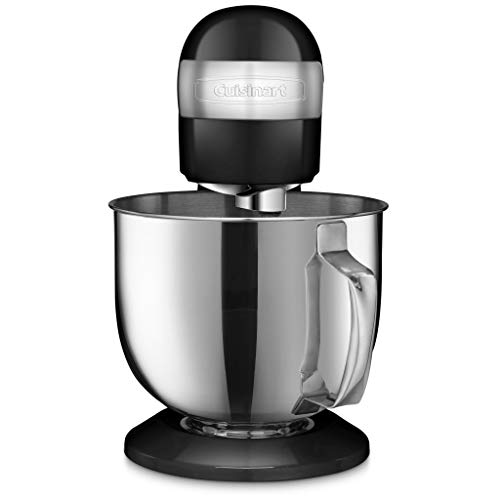
Cuisinart Stand Mixer, 12 Speed, 5.5 Quart (SM-50, Onyx)
Badge: Best Overall — The True Standing Mixer
Strengths
- Full SM-50 stand-mixer package: 5.5-quart stainless bowl, paddle, dough hook, chef’s whisk
- 12 speeds span gentle folding through fast whipping in one dial
- Onyx finish hides flour dust and fits darker, modern kitchens
Trade-offs
- Same core specification as the White Linen and Ruby Red versions — finish is the only difference
- Heavy, counter-dwelling format; overkill for a twice-a-year baker
- Small batches can under-fill a 5.5-quart bowl
| Mini spec box | |
|---|---|
| Type | Stand mixer |
| Speeds | 12 speeds |
| Bowl | 5.5-quart stainless steel |
| Attachments named | Mixing paddle, dough hook, chef’s whisk |
| Extras | Splash guard with pour spout |
| Color | Onyx |
The Onyx SM-50 is for the baker who wants the complete stand-mixer toolkit in the most kitchen-neutral finish — the one that disappears into a modern counter line-up and shrugs off visible flour dust between bakes.
Everything the SM-50 does well applies here: hands-free kneading with the dough hook, thorough creaming with the paddle, real whipping volume with the chef’s whisk, and a splash guard that makes adding a cup of flour at speed two a calm event instead of a whiteout. The 5.5-quart bowl is sized for double cookie batches and family cake layers.
The limitation is the same as its color siblings: it is a commitment of counter space and money, and it shares its spec sheet with them, so if the finish does not matter to you there is no performance reason to prefer one SM-50 over another.
Best for: regular bakers who want the full stand package in a low-key, dust-forgiving finish / Not suited for: anyone short on counter space or baking only occasionally
Comparison Table
| Pick | Badge | Key attributes | Best for | Link |
|---|---|---|---|---|
| LILPARTNER Hand Mixer Electric, 7-Speed (Light Pink) | Best Budget Hand Mixer | Type: Electric hand mixer; Speeds: 7 speeds; Attachments named: 5 stainless steel accessories | value hunters who want the widest speed range and a full accessory set in a hand mixer | Prose only |
| KitchenAid 5 Ultra Power Speed Hand Mixer (KHM512, Black Matte) | Best for Frostings and Soft Doughs | Type: Electric hand mixer; Speeds: 5 speeds; Attachments named: Turbo Beaters | KitchenAid fans who mix batters and frostings and want clog-resistant beaters | Prose only |
| Hamilton Beach 6-Speed Hand Mixer with Easy Clean Beaters (62636J) | Most Complete Hand-Mixer Kit | Type: Electric hand mixer; Speeds: 6 speeds; Motor: 275 watts (per title) | hand-mixer buyers who want every attachment in one case, including real dough hooks | Prose only |
| Hamilton Beach 6-Speed Hand Mixer with QuickBurst (62682G) | Best Simple Hand Mixer | Type: Electric hand mixer; Speeds: 6 speeds plus QuickBurst; Motor: 250 watts (peak power, per title) | occasional bakers who want a simple, storable hand mixer with a genuinely useful bowl-rest design | Prose only |
| Cuisinart Power Advantage Plus 9-Speed Hand Mixer (HM-90S) | Best Slow-Start Control | Type: Electric hand mixer; Speeds: 9 speeds; Feature named: SmoothStart anti-splatter | bakers who value a splatter-free slow start and fine speed control | Prose only |
| Cuisinart Stand Mixer, 12 Speed, 5.5 Quart (SM-50, Onyx) | Best Overall — The True Standing Mixer | Type: Stand mixer; Speeds: 12 speeds; Bowl: 5.5-quart stainless steel | regular bakers who want the full stand package in a low-key, dust-forgiving finish | Check on Amazon |
How to Choose the Best Standing Mixers for Cookie Dough
Cookie dough is a specific mechanical problem, and it is worth understanding before you spend anything. A chocolate chip or oatmeal dough starts as a creaming job — butter and sugar beaten until pale and aerated, which is where the cookie’s texture is decided — and ends as a stiff, heavy mass that resists the tool, especially once flour, oats, chips and nuts go in. The mixer you want is the one that handles both ends of that journey: gentle and thorough at the creaming stage, unbothered at the stiff stage, and sized so a full batch does not climb the beaters or stall the motor.
Format is the first fork in the road. A true stand mixer — the Cuisinart SM-50 in this guide is the one genuine example in the pool — parks its weight on the counter, holds a 5.5-quart bowl, and works a stiff dough hands-free with a paddle while you scoop the previous tray. That is the format the keyword asks for, and for weekly or double-batch cookie baking it is the right answer. Hand mixers enter the picture honestly as the budget and storage alternative: several here carry dough hooks or clog-resistant beaters and can absolutely produce good cookies in standard batches, but your arm is the stand, and very stiff or doubled doughs are where they reach their limit. This guide links the stand mixer and covers the hand mixers in prose, so you can see the whole field without confusing the two formats.
While you weigh the factors below, it can help to compare how a neighbouring brief frames the same shelf — see Best Mini Sound Mixers for a related take.
Creaming quality is the second factor, and it is about the tool’s shape and the low-to-mid speeds. A flat paddle on a stand mixer folds and presses butter and sugar against the bowl in a way that builds the tiny air pockets a cookie needs. On hand mixers, beater design matters the same way — KitchenAid’s Turbo Beaters are shaped to keep dense mixtures moving instead of clogging, which is exactly the failure mode of cheap beaters in cookie dough. Whatever the format, you want a controlled medium speed for creaming: too slow and nothing aerates, too fast and you fling sugar and warm the butter toward greasy.
Capacity math for cookies is simple and worth doing. A standard batch of chocolate chip cookies makes roughly two to three dozen and needs a bowl that lets the paddle or beaters move the finished dough — about four quarts of working room once the dough stiffens. Doubling, which cookie bakers do constantly because cookies freeze beautifully, pushes you to the 5.5-quart class or to mixing in two batches. On a hand mixer, doubling a stiff dough is the point where wrists complain and motors strain; splitting the batch is not a failure, it is the correct technique for the format.
Finally, judge the details that touch cookie dough specifically: a splash guard or slow start for the flour addition, a bowl you can scrape efficiently, tools that release chips and dough instead of trapping them, and dishwasher-safe parts because cookie dough is greasy and sets like cement. The best cookie mixer is not the most powerful on paper — it is the one whose creaming, capacity and cleanup match the way you actually bake.
How to Mix Cookie Dough Properly, Step by Step
Good cookies from any mixer follow the same choreography. The sequence below is written for cookie dough specifically — it works on the stand mixer in this guide and, with the batch-size adjustments noted, on the hand mixers too.
- Start with butter at the right temperature. Cool room temperature — it dents under a finger but does not shine or slump. Too cold and it will not cream; too warm and the cookies spread into lace. No mixer setting fixes wrong butter.
- Cream butter and sugar properly. Two to four minutes at a steady medium with the paddle or beaters, scraping once halfway, until the mixture is visibly paler and fluffy. This step is the cookie’s texture being built; rushing it is the most common home-baking error.
- Add eggs one at a time, then vanilla. Mix each egg in fully before the next. On a stand mixer this is where hands-free operation shines — you can crack and add while the paddle keeps moving.
- Add the dry ingredients in two stages, at the lowest speed. Mix only until the last streak of flour disappears. Every extra ten seconds develops gluten and trades tenderness for toughness.
- Fold in chips, nuts and oats last, briefly. A few turns of the paddle or beaters — or finish by hand with a spatula for very chunky doughs — distributes the good bits without crushing them or overworking the dough.
- Rest the dough, then clean the tools immediately. Thirty minutes of chilling firms the dough for scooping and better shape. Meanwhile wash the paddle and bowl now: fresh cookie dough rinses away, dried cookie dough is a construction material.
Troubleshooting
Problem: Cookies spread flat and greasy → what to do: The butter was too warm or the creaming ran too long at high speed, melting the butter’s structure. Chill the portioned dough before baking and cream at medium, not maximum.
Problem: The mixer stalls or labors when the flour and chips go in → what to do: The dough has passed the format’s comfortable load. On a hand mixer, finish the last incorporation with a sturdy spatula or split the batch; on any mixer, add mix-ins in two smaller additions.
Problem: Dough climbs the beaters or paddle → what to do: The batch is small relative to the tool or the speed is too high for a stiff dough. Drop a speed, push the dough down with a spatula between short bursts, and let the tool work low in the bowl.
Problem: Cookies bake up tough and bready → what to do: The flour stage was overmixed. Mix dry ingredients only until the streaks vanish — a few pale traces are fine because portioning and resting finish the job gently.
For a deeper dive into one adjacent setup question, Best Mixers For Peach Vodka covers ground this guide only touches.
Why Cookie Dough Is the Test Every Mixer Should Be Judged By
Most mixing jobs are forgiving. Batters are fluid, whipped cream is light, and even bread dough, for all its stiffness, is a single consistent mass. Cookie dough is different: it changes character completely inside one recipe, starting as a delicate aeration exercise and finishing as one of the stiffest mixtures in home baking, studded with hard inclusions that catch on tools. A mixer that handles cookie dough well — creaming patiently, incorporating flour gently, and muscling through the finish without drama — will handle nearly everything else a home baker asks of it.
That is why this guide reads every pick through the cookie lens first. The stand mixer’s paddle and bowl, the Turbo Beaters’ anti-clog shape, the dough hooks in the fuller hand-mixer kits — each feature either proves itself on cookie dough or reveals itself as decoration. When you shop with the hardest common job as your benchmark, you rarely buy wrong.
Batch Strategy: Singles, Doubles and the Freezer
Cookie bakers are batch strategists whether they know it or not, because cookie dough is the most freezer-friendly dough in the kitchen. Scoop a double batch into balls, freeze them solid on a tray, and a bag of ready-to-bake cookies lives in the freezer for weeks — which means the mixing session is the one moment of work, and the mixer’s capacity and stamina at that moment matter more than its day-to-day speed.
Plan the batch to the machine, honestly. Stand-mixer owners can double as a default. Hand-mixer owners do better with two sequential standard batches than one heroic double: the dough stays in the format’s comfort zone, the creaming is better controlled, and the total time is nearly the same. Either way, the freezer strategy converts your mixer from an occasional tool into a standing supply of fresh-baked cookies — the strongest argument there is for buying the format that fits your batch style.
Troubleshooting Your Cookies, Not Your Mixer
When a batch disappoints, bakers blame the machine first and the variables last — usually backwards. Flat cookies point to butter temperature, an old leavening agent, or dough that went into the oven warm. Dry, cakey cookies point to flour measured heavy or a flour stage mixed past the disappearance of the streaks. Pale, soft cookies point to under-creaming — the one fault that is partly the mixer’s, and even then it is usually the operator stopping the creaming early out of impatience rather than the machine lacking power.
Keep a one-line note on each batch — butter state, creaming time, chill time, bake time — and your cookies will improve faster in six batches than a new mixer would improve them in sixty. The bakers whose cookies people request are not the ones with the most expensive stand mixer; they are the ones who know exactly what they did last time. Buy the machine that fits your format and your batch size, then invest your attention where cookies are actually decided.
Ingredient Variables That Matter More Than the Mixer
Honest guides admit hierarchy: for cookie quality, the mixer ranks third. First is butter — its temperature at creaming and its quality decide spread and flavor more than any machine. Butter that is cool and pliable creams into a stable foam; butter that is warm and glossy makes a batter that bakes into puddles, and no paddle geometry rescues it. Second is flour measurement: a cup scooped from the bag can carry a quarter more flour than a cup spooned and leveled, and that error — dry, cakey cookies — gets blamed on mixers constantly. Weigh flour if you can; if you cannot, spoon and level, every time.
The mixer ranks third because its job is consistency: the same creaming, the same incorporation, batch after batch, so that when you change one variable you can taste what it did. That is the real gift of a good machine to a learning baker — not power, but repeatability. The stand mixer’s steady paddle and the better hand mixers’ controlled speeds both deliver it; the baker’s discipline about butter and flour decides whether it matters.
From Dough to Tray: Portioning, Chilling and Baking Off
What happens after mixing decides half the cookie, and it is worth a section in a guide that takes cookie dough seriously. Portion the dough before chilling — scoops or a scale give you even pieces, and even pieces bake evenly, which no oven can do for uneven ones. Chill the portioned dough until it is firm; cold dough spreads slower, giving you the thick, chewy center that warm dough trades away. If you freeze portions, bake them from frozen with a small time allowance and enjoy the strange luxury of two fresh cookies on a Tuesday.
Bake on a light-colored sheet if you have one — dark pans brown bottoms aggressively — and leave real space between portions, because cookies that merge into one slab are a portioning failure, not a mixing one. Pull the tray when the centers still look slightly underdone; carryover heat finishes them, and the difference between that cookie and one baked two minutes longer is the difference between chewy and crisp. The mixer’s work ended at the bowl; these habits are how you protect it.
Scoop consistency is the hidden partner of mixer choice. A mixed dough that is uniform — no butter streaks, no flour pockets — portions evenly, and even portions bake evenly. The scrape-down habit during mixing is what makes a cheap mixer produce uniform dough and a great mixer produce it faster; the habit matters more than the badge.
If you bake cookies for bake sales or gifts, think in trays, not batches: a mixer that handles a double batch comfortably halves your mixing sessions across a big baking day, and the stand format lets you portion the previous batch while the next one creams. Workflow, not wattage, is the real capacity.
Brown butter is the cookie upgrade that asks something of your mixer: the butter is melted and toasted first, then cooled until it is opaque and soft before creaming — and because it starts softer than standard butter, creaming runs shorter and the dough benefits even more from a thorough chill. A stand mixer’s steady paddle handles the softer mixture without flinging it; on a hand mixer, work at a lower speed than instinct suggests.
Mix-in strategy is a quiet mixer topic: chips and nuts added at the very end, mixed for only a few turns, stay whole and distribute without streaking the dough with chocolate smears. Reserve a small handful to press onto the tops of portioned dough balls and your cookies will look like the bakery case — a cosmetic trick that costs nothing and that no one at the table will mind.
A note on noise and timing for cookie bakers: the stiff finish of a cookie dough is the loudest, hardest-working minute of a mixer’s life. If you regularly bake early or late in a small home, that minute on a stand mixer is steadier and lower-pitched than a hand mixer at full effort — a small quality-of-life point that never appears on a spec sheet but matters across hundreds of batches.
Setting Up a Cookie Station That Makes Any Mixer Better
The bakers whose cookies stay consistent run a station, not a scramble, and the station is mostly free. Ingredients come out before the mixer starts: butter cut and tempering, eggs warming in their shells in lukewarm water so they do not chill the creamed butter, flour whisked with its leavening and salt in a separate bowl so the dry addition is one motion instead of four, chips and nuts measured into a small bowl within reach. This mise en place is not fussiness — it is what allows the creaming to run uninterrupted, the flour to go in at the right moment, and the mix-ins to land in the final ten seconds where they belong. On a stand mixer the station matters even more, because the machine’s hands-free running tempts you to prep mid-mix; resist, and let the machine’s steadiness and your readiness compound.
The supporting tools are humble and decisive. A flexible spatula for the scrape-downs this guide keeps insisting on. A scale, if you bake more than occasionally, because weighed flour ends the dry-cookie mystery permanently. A scoop matched to your favorite cookie size, so portions match and bake times become trustworthy. Parchment or a silicone mat, so trays cycle without washing between batches. None of these cost what a mixer costs, and together they raise the ceiling of every mixer in this guide — including the prose-only hand mixers, whose owners benefit most of all from a station that removes every demand except the mixing itself.
A Short Note on Altitude, Humidity and Other Kitchen Weather
Cookies respond to the weather inside your kitchen more than bakers expect, and the mixer cannot compensate for all of it — but technique can. In humid weather flour absorbs moisture from the air and doughs run stickier; hold back a spoonful of the recipe’s liquid, or accept a slightly longer chill, and the dough returns to spec. In dry or high-altitude kitchens the same dough can crumble at the edges; a teaspoon of milk worked in at the very end restores it without toughening, because it arrives after the flour’s structure is set. Whipping stages shift too — cream and egg whites move faster at altitude and over-whip sooner, which is one more argument for the controlled mid speeds this guide keeps praising.
The lesson is not to fear the variables but to expect them. The same recipe, the same mixer and the same baker will produce slightly different dough in August and in January, and the bakers who adjust — a chill here, a spoonful there — are the ones whose cookies seem mysteriously consistent. Your mixer provides the repeatable half of the equation. The weather provides the other half, and now you know its moves.
Common Buying Mistakes
- Buying a hand mixer for double-batch cookie production. Standard batches, fine. Weekly doubles of stiff dough will strain the motor and your wrist; that workload is the stand mixer’s reason to exist.
- Creaming at maximum speed. Fast creaming warms butter and wrecks its structure. Medium speed, pale and fluffy, is the target — more speed is not more better.
- Mixing the flour until the dough looks ‘smooth’. Cookie dough should come together, not develop. Stop when the flour streaks disappear or tenderness goes with them.
- Skipping the chill. Warm, freshly mixed dough spreads. A short rest firms the butter and gives you taller, chewier cookies from the exact same batch.
- Judging a mixer by its cake performance. Batter is easy. Judge by the stiff final dough — that is where formats and beater designs separate.
Final Recommendation
For the keyword as written — a standing mixer, judged on cookie dough — the Cuisinart SM-50 is the pool’s one true answer, and it is a good one: proper paddle creaming, a 5.5-quart bowl for doubles, and hands-free strength at the stiff finish.
Start with the Cuisinart Stand Mixer, 12 Speed, 5.5 Quart (SM-50, Onyx) — it is the pick that matches this keyword’s core promise most completely, and it is the one most readers should buy first.
Whichever you choose, buy the format that matches your real routine rather than your aspirational one, and keep the neighbouring brief at Best Mixers For Radio Stations in mind if your needs turn out to sit between two categories.
Frequently Asked Questions
What type of mixer is best for cookie dough?
A stand mixer with a flat paddle is the benchmark: it creams thoroughly, handles stiff finished dough hands-free, and holds a double batch in a bowl around 5.5 quarts. Good hand mixers with strong beaters or dough hooks handle standard batches well and are the right choice when budget or storage rules the decision.
Can a hand mixer really handle cookie dough?
Yes, within its format. Standard batches of most cookie doughs are fine, especially with clog-resistant beaters or dough hooks. Very stiff doughs — dense oatmeal, heavily loaded fruit-and-nut — and double batches are where hand mixers strain; split the batch or finish by hand.
Paddle or beaters for creaming butter and sugar?
Both work; the paddle’s flat profile presses the mixture against the bowl and aerates evenly, while beaters whip more air with a lighter texture. What matters more than the tool is the butter temperature and creaming at a steady medium speed until pale.
Why do my cookies spread even with a good mixer?
Usually butter temperature, not the mixer: butter that was too soft at creaming, or dough baked warm. Chill portioned dough before baking and check that your creaming speed is not so high it melts the butter.
How do I keep dough from climbing the beaters?
Work at a lower speed once the dough stiffens, keep the beaters low in the bowl, and pause to push dough down with a spatula. It is a technique issue more than a power issue.
Should I chill cookie dough before baking?
For most drop cookies, yes — even thirty minutes firms the butter, deepens flavor and improves shape. Scoop first, then chill the portioned dough for the easiest handling.


