Disclosure: topratedkitchenware.com is reader-supported. When you buy through links on our site, we may earn an affiliate commission from Amazon and other retailers, at no extra cost to you.
Where to buy
This guide to best wood smokers 21017 brings together six verified picks you can order online today. The 21017 ZIP code — the Belcamp area of Harford County, Maryland — means a smoker here works four real seasons: humid summers, wet springs, and winters cold enough to test any cooker’s insulation and fuel discipline. All six picks below are genuine wood smokers, pellet and electric-chip models alike, assessed with that climate in front of them rather than in a showroom.
- Traeger Pro 22 Wood Pellet Grill & Smoker — the benchmark pellet cooker, sized for a typical local household.
- Pit Boss 500 Carbon Series Wood Pellet Grill & Smoker — full-range pellet cooking that fits smaller Harford County patios.
- EAST OAK 30-inch Electric Smoker, Mist Black — big electric cabinet: no fire to tend when it is cold out.
- Masterbuilt 30-inch Digital Electric Smoker with Leg Kit — the established digital cabinet, raised on a leg kit.
- Masterbuilt 30-inch Electric Smoker, Analog — analog control and chrome racks — smoking without software.
- Royal Gourmet SE2805 28-Inch Electric Smoker — the smallest local option for a first smoking season.
Read the full guide ↓
Shopping for the best wood smokers 21017 households can run is a climate question before it is a brand question. Harford County sits in the humid Mid-Atlantic, where summer cooks happen in heavy, damp air, autumn is prime smoking season, and winter briskets are entirely possible but punish thin steel, damp pellets and any machine that needs babysitting outdoors. A smoker that delights in a dry, mild climate can be merely adequate here, and the differences show up in fuel storage, temperature recovery and how much of the cook you can monitor from inside the house.
The verified pool for this search gives the area a fair spread: one Traeger pellet grill, three Pit Boss and Masterbuilt-class machines across pellet and digital electric formats, an EAST OAK electric cabinet, and two simpler electrics including an analog model. All six burn wood for smoke — pellets in the firepot or chips over an element — so all six are linked, and the reviews sort them by how their formats behave across a Maryland year. Readers comparing the wider category will find Best Smokers Under $1500 useful for the step-up shelf, and Best Small Smokers Grill for the compact end of the same decision.
Local practicalities run through the whole guide: pellets and chips must be stored sealed and dry in a humid climate, electric models need a properly protected outdoor outlet, and every model benefits from a cover and, ideally, a sheltered spot out of the prevailing weather. None of that is glamorous, and all of it decides whether a smoker in 21017 is a pleasure in February as well as in June.
Key Takeaways
- In the humid Mid-Atlantic, fuel storage is half the purchase: pellets and chips must live sealed, dry and preferably indoors.
- Digital control earns its keep in winter, when temperature recovery after a lid opening separates good machines from frustrating ones.
- The pool spans 454 to 932 sq in; most 21017 households will land between the 543 sq in compact pellet and the 725 sq in electric cabinet.
- Electric cabinets are the low-effort winter option — no fire to tend in the cold — while pellets give deeper smoke for autumn’s big cooks.
- A fitted cover and a sheltered placement are not accessories here; they are part of the machine’s working life.
- Meat probes are included or built in across most of the pool, which matters when the cook is monitored from indoors.
In this guide
Quick Picks
Badges are assigned with the local year in mind: all-season pellet performance, winter-friendly electric ease, compact value, and the simple analog option for fair-weather cooks.
| Pick | Badge | Why it made the list | Link |
|---|---|---|---|
| Traeger Pro 22 Wood Pellet Grill & Smoker | Best All-Season Pellet Pick | 572 sq in, an 18 lb hopper and 6-in-1 range cover the local year from ribs to roasts. | Check on Amazon |
| Pit Boss 500 Carbon Series Wood Pellet Grill & Smoker | Best Compact for Local Patios | 543 sq in, digital control and a 500°F ceiling in the pool’s compact pellet footprint. | Check on Amazon |
| EAST OAK 30-inch Electric Smoker, Mist Black | Best Winter-Effortless Pick | 725 sq in, side loader and a viewing window — the fewest trips outside in January. | Check on Amazon |
| Masterbuilt 30-inch Digital Electric Smoker with Leg Kit | Best Digital Cabinet Alternative | 710 sq in, digital control and a side loader from the category’s best-known cabinet name. | Check on Amazon |
| Masterbuilt 30-inch Electric Smoker, Analog | Best Simple Cabinet | 535 sq in of straightforward electric smoking for hands-on, fair-weather cooks. | Check on Amazon |
| Royal Gourmet SE2805 28-Inch Electric Smoker | Best Small-Footprint Starter | 454 sq in and 1350W in a compact vertical — the starter cabinet for small spaces. | Check on Amazon |
How These Picks Were Chosen
Every product in the verified pool is a true wood smoker — the pellet models burn wood pellets as fuel, the electrics burn wood chips for smoke over an element — so all six are linked and the selection work was climate sorting rather than gatekeeping. The Traeger Pro 22 and Pit Boss 500 represent pellet cooking at benchmark and compact sizes. The EAST OAK and the two Masterbuilt electrics represent the cabinet family, in digital forms suited to monitored, low-effort cooks, while the Royal Gourmet’s analog simplicity is badged honestly as a fair-weather, hands-on choice.
Specifications come only from the verified pool titles: cooking areas, temperature ranges, hopper sizes, wattage and stated features. Climate judgements are general Mid-Atlantic reasoning — humidity’s effect on fuel, cold’s effect on heat recovery — rather than claims about tested performance in this ZIP code, and no hands-on testing is claimed. Where a model’s listed features speak directly to local needs, like a 30-pound-class hopper for long winter cooks or a side chip loader for fewer door openings, the review says so.
The 6 Best Wood Smokers Suited to 21017 and the Mid-Atlantic
Each review weighs the machine against a Harford County year: humid July, perfect October, cold January. Check the latest price on Amazon through the links — prices are not printed here because they change with the seasons too.

Traeger Pro 22 Wood Pellet Grill & Smoker
Badge: Best All-Season Pellet Pick
Strengths
- Hopper size supports long cooks with minimal cold-weather trips outside
- 6-in-1 range replaces a separate grill for many households
- Benchmark parts and knowledge base simplify ownership
Trade-offs
- 450°F ceiling is the pool’s lowest among pellet picks
- No app connectivity in the listed features for indoor monitoring
- Pellet discipline — dry storage — is on you in this humidity
| Cooking space | 572 sq in |
|---|---|
| Temperature | Up to 450°F max |
| Hopper | 18 lb |
| Versatility | 6-in-1: grill, smoke, bake, roast, braise, BBQ |
| Included | Meat probe |
For a 21017 household that wants one machine for the whole year, the Pro 22 is the natural centre of this guide: big enough for the autumn brisket, versatile enough to grill through summer, and hoppered generously enough that a winter cook means one loading, not a patrol. Its 6-in-1 brief matters locally — a household replacing an ageing grill and adding smoking in one purchase gets both, which is how most patios here actually evolve.
Its winter honesty: there is no app in the listed specification, so monitoring a January cook means the probe, the porch and a warm coat, and the 450°F ceiling caps the high-heat work its Pit Boss rivals reach. Neither flaw is large. Both are the kind of thing a local buyer should know before the first snow rather than during it.
Best for: households wanting one proven pellet machine for all four seasons / Not suited for: app-dependent cooks or maximum-heat specialists

Pit Boss 500 Carbon Series Wood Pellet Grill & Smoker
Badge: Best Compact for Local Patios
Strengths
- Highest temperature ceiling in a compact body
- Digital control steadies winter cooks
- Footprint suits townhouse and smaller patios common in the area
Trade-offs
- 13.5 lb hopper needs a plan for the longest cooks
- Capacity crowds at gathering scale
- No connectivity in the listed specification
| Cooking space | 543 sq in |
|---|---|
| Temperature | 180°F to 500°F |
| Hopper | 13.5 lb |
| Controller | LCD digital |
| Included | Meat probe |
Townhouse patios and compact yards are a real part of 21017 housing, and the 500 Carbon is the pellet pick that respects them: a true wood-pellet cooker with digital control and the full 180°F to 500°F range in 543 square inches. The high ceiling is locally useful beyond searing — a cooker that can run hot recovers temperature faster after a cold-day lid opening, which is when compact machines in winter either earn trust or lose it.
The hopper is the scheduling fact: 13.5 pounds is ample for ribs and shoulders, and a known top-up for an overnight brisket. Households whose smoking life is weekend-daytime will never notice; overnight devotees should look at the Traeger’s larger hopper or accept the ritual.
Best for: smaller patios and couples who still want real pellet range / Not suited for: overnight cooks without a refill ritual

EAST OAK 30-inch Electric Smoker, Mist Black
Badge: Best Winter-Effortless Pick
Strengths
- Side loader and window minimise door openings in cold weather
- Built-in probe supports indoor-style monitoring
- Large capacity in a footprint that shelters easily
Trade-offs
- Chip smoke is milder than pellet smoke
- Needs a suitable protected outdoor outlet
- Electric format cannot grill or sear
| Cooking area | 725 sq in |
|---|---|
| Fuel | Electric element with wood chips |
| Loader | Side chip loader, up to 6x longer uninterrupted smoking (per maker) |
| Extras | Built-in meat probe, clear viewing window |
The EAST OAK is the winter strategist’s pick. Electric heat does not care about a cold snap, the side chip loader keeps smoke rolling for up to six times longer per load, and the viewing window plus built-in probe mean a January pork shoulder can be supervised largely from the doorway rather than from the patio. Its 725 square inches handle the batch cooking — holidays, meal prep, a freezer’s worth of pulled pork — that cabinets exist for.
The trade is depth: chip smoke over an element is a gentler flavour than a pellet fire delivers, and in summer, when tending a fire is a pleasure rather than a penance, pellet households will feel they own the more interesting machine. As the low-effort half of a local year, though, this cabinet has no peer in the pool.
Best for: big batches and cooks who value low effort in cold months / Not suited for: deep-smoke seekers or grill duties

Masterbuilt 30-inch Digital Electric Smoker with Leg Kit
Badge: Best Digital Cabinet Alternative
Strengths
- Digital control with a side loader — the full modern cabinet kit
- Leg kit raises the working height sensibly
- 710 sq in matches its EAST OAK rival closely
Trade-offs
- Two near-identical cabinets in one guide — choose on features, not both
- Electric smoke profile stays mild
- Vertical format is smoking-only
| Cooking space | 710 sq in |
|---|---|
| Fuel | Electric element with wood chips |
| Loader | Side wood chip loader |
| Extras | Digital control, leg kit included |
Masterbuilt’s digital cabinet is the establishment candidate: 710 square inches, digital control, a side wood chip loader and a leg kit that lifts the whole operation to a comfortable height. Against the EAST OAK it trades the viewing window and built-in probe emphasis for the category’s most familiar name and layout — a genuine coin-flip of a decision that should be settled by which feature list matches your habits, and by the current listing’s details.
Locally, everything said about electric cabinets applies: effortless winter running, mild smoke, an outlet to protect from Maryland weather. It is a strong, conventional choice, and conventional is a compliment in a category where reliability across seasons is the product.
Best for: buyers who prefer the established cabinet name and layout / Not suited for: window-and-probe prioritists (see the EAST OAK)
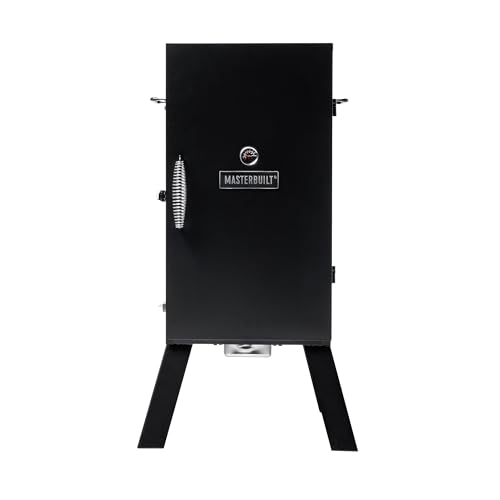
Masterbuilt 30-inch Electric Smoker, Analog
Badge: Best Simple Cabinet
Strengths
- Nothing digital to learn, pair or update
- Adequate capacity for most family smokes
- Simple format that stores and shelters easily
Trade-offs
- Analog control is vaguest exactly when winter demands precision
- No side loader in the listed features — more door openings
- Smaller capacity than the digital cabinets
| Cooking space | 535 sq in |
|---|---|
| Fuel | Electric element with wood chips |
| Control | Analog temperature control |
| Racks | Chrome smoking racks |
The analog Masterbuilt is the guide’s honest traditionalist: a vertical electric smoker you run by dial, experience and a separate thermometer you trust. In the long Mid-Atlantic smoking season — April through November — a hands-on cook will make excellent food with it and enjoy the ritual. Its 535 square inches cover family-scale smoking without the digital cabinets’ size or price of admission.
Its season is the caveat. Analog vagueness plus winter cold is the combination that produces the area’s familiar January disappointment, and chip management without a loader means more door openings losing heat. Buy it as a fair-weather, hands-on machine and it is a good one; buy it as a four-season instrument and the digital picks above exist to correct you.
Best for: hands-on cooks smoking mainly in the warm three seasons / Not suited for: winter precision or set-and-forget expectations

Royal Gourmet SE2805 28-Inch Electric Smoker
Badge: Best Small-Footprint Starter
Strengths
- Smallest footprint in the guide
- Three grates make modest cooks organised
- Simple operation for a first season
Trade-offs
- Smallest capacity — gatherings outgrow it
- Analog control shares the winter caveat
- No loader or probe in the listed features
| Cooking space | 454 sq in |
|---|---|
| Power | 1350W electric |
| Control | Analog temperature control |
| Layout | Vertical, 3 cooking grates |
The Royal Gourmet closes the guide as the starter’s cabinet: 454 square inches, three grates, analog control and a footprint that fits the smallest patio corner in the ZIP code. For a household testing whether smoking belongs in its life, it answers the question across one warm season at the lowest commitment in the pool, and its simplicity means the answer arrives quickly.
Outgrowing it is the expected success case, and winter is its honest limit, for the same analog reasons as its Masterbuilt sibling. Treat it as a first season’s tuition — many local smokers began on exactly this class of machine — and its place in the guide is honourable and clear.
Best for: first-season smokers in small spaces / Not suited for: winter cooking or growing gatherings
Comparison Table
Sort the table by your dominant season. Winter-first buyers should read the control and loader columns; summer-first buyers can let capacity and smoke depth lead.
| Pick | Format | Standout trait | Watch-out | Link |
|---|---|---|---|---|
| Traeger Pro 22 Wood Pellet Grill & Smoker | Pellet, 572 sq in | Benchmark versatility, 18 lb hopper | No connectivity listed | Check on Amazon |
| Pit Boss 500 Carbon Series Wood Pellet Grill & Smoker | Pellet, 543 sq in | Compact with 500°F ceiling | Hopper size | Check on Amazon |
| EAST OAK 30-inch Electric Smoker, Mist Black | Electric cabinet, 725 sq in | Side loader, viewing window | Milder smoke | Check on Amazon |
| Masterbuilt 30-inch Digital Electric Smoker with Leg Kit | Electric cabinet, 710 sq in | Digital control, leg kit | Close rival overlap | Check on Amazon |
| Masterbuilt 30-inch Electric Smoker, Analog | Electric vertical, 535 sq in | Analog simplicity | Cold-weather vagueness | Check on Amazon |
| Royal Gourmet SE2805 28-Inch Electric Smoker | Electric vertical, 454 sq in | Compact starter format | Capacity and analog limits | Check on Amazon |
How to Choose: best wood smokers 21017 — a Wood Smoker for Four-Season Mid-Atlantic Cooking
Let the local year vote first. If your smoking ambition peaks at autumn gatherings and summer weekends, pellet depth and capacity should lead, and the Traeger or the compact Pit Boss are your machines. If your ambition is year-round reliability with minimum outdoor labour — the household that smokes in January because the freezer is empty — the digital electric cabinets are the rational purchase, and their milder smoke is the accepted price of that ease. Analog machines belong to households whose smoking is a warm-season hobby, and there is no shame in that season being enough.
Then let your space vote. The vertical cabinets deliver 700-plus square inches on a footprint a townhouse patio can spare, while pellet grills trade footprint for versatility. Measure the spot, check the outlet situation for electrics, and plan the cover and shelter before the machine arrives — in this climate, the storage plan is part of the specification. Fuel storage deserves the same forethought: a sealed indoor bin for pellets or chips is the difference between a smoker that works in humid August and one that sulks.
Finally, buy the monitoring you will actually use. Probes appear across this pool because they matter here — every check you can make without opening a door in cold weather is heat and smoke kept. Households comparing the step beyond this pool will find Best Smokers Under $3000 a useful boundary marker at the budget end, while this guide’s six cover the ground most 21017 patios will ever ask for.
How to Smoke Through a Mid-Atlantic Year
The routine below is the standard smoking method with the local adjustments that humidity and cold demand.
- Store all fuel sealed and dry, indoors where possible. In this humidity, the storage bin matters as much as the brand.
- Preheat longer in winter and let the temperature stabilise fully before loading food; cold steel lies to impatient cooks.
- Load fuel for the whole cook up front — a full loader or a hopper with a top-up scheduled — so mid-cook openings stay rare.
- Cook to probe temperature, and rest meat indoors where the season cannot steal its heat.
- In summer humidity, ventilate storage and check pellets or chips for freshness before a big cook, not during it.
- Cover the machine between cooks, keep electrics’ connections protected, and clear ash before it can cake in damp air.
Troubleshooting local problems
Problem: temperature sags after every check in winter → you are opening the cooker too often; use the probe and window if fitted, and batch your checks. Problem: smoke tastes stale or the fire struggles in August → the fuel has taken on humidity; replace the exposed fuel and fix the storage, not the machine. Problem: an electric trips or will not heat → check the outdoor outlet and extension arrangement first; electrics in wet climates fail at the connection more often than at the element.
Winter Smoking in Harford County: Worth It, With the Right Machine
Winter is when the local smoker earns its stories. Cold air is not the enemy of smoked meat — some cooks swear cold-season smoke is cleaner — but it is the enemy of vague machines. Digital control, generous fuel loads and probe-based monitoring convert a January brisket from an endurance event into a schedule, and the electric cabinets remove the fire-tending entirely. The analog machines can do it too, in the hands of an owner who has learned their offsets in kinder months.
The practical winter kit is short: a cover that actually comes off and goes on easily, fuel stored warm and dry, a wind-sheltered placement, and a thermometer you trust. With those, the smoking season in 21017 is twelve months long, and the households that smoke through winter tend to become the neighbourhood’s reference cooks by spring.
Humidity: The Quiet Variable in Every Local Cook
Outsiders underestimate Mid-Atlantic humidity as a smoking variable because its effects hide inside other complaints. Pellets that have absorbed moisture burn cooler and dirtier; chips stored open lose their punch; ash left in a firepot cakes into a damp plug. Half the ‘machine problems’ in humid climates are storage problems wearing a disguise, which is why this guide mentions the sealed bin in nearly every section.
The fix is boring and total: fuel lives indoors or in a gasketed container, ash is cleared promptly, and the cooker itself stays covered between sessions. Do those three things and the same machines that frustrate a careless owner in August will run sweetly for a careful one — a truth that applies from Best Small Smokers Serious Eats territory all the way up to the flagship class.
Season by Season: A Harford County Smoking Calendar
Spring in 21017 is the smoker’s rehearsal season: mild air, pollen on every surface, and the first ribs of the year. It is the right season to learn a new machine — forgiving temperatures, short cooks, and mistakes that cost an afternoon rather than a holiday. Electric owners should check outdoor connections after winter, pellet owners should start the season on fresh fuel rather than the tail of last year’s bag, and everyone should clean and inspect before the first cook rather than discovering winter’s residue during it.
Summer is capacity season and humidity season at once. The cabinets earn their keep at gatherings, the pellet grills at long weekend cooks, and fuel discipline matters most now: pellets and chips stored anywhere damp will announce themselves in the smoke. Cook early or late to spare the cook the worst of the heat, keep the machine covered between sessions against the season’s storms, and remember that a smoker running in heavy, still air needs its vents respected — the machine breathes the same thick air you do.
Autumn is the prime season, the one local smokers plan around: cool air, steady temperatures, brisket weather. This is when hopper sizes and cabinet capacities stop being specifications and become the calendar’s enabling facts, and when a machine bought well in spring pays its dividend. Winter, finally, is the connoisseur’s season and the analog machines’ examination — digital control, dry fuel and probe monitoring convert it from a dare into a routine, and the households that smoke through it tend to keep the habit, and the neighbourhood reputation, for good.
Placement, Power and Covers: The Local Setup Decisions
Where the smoker lives decides how it ages in this climate. The ideal local placement is level, sheltered from the prevailing weather, close enough to the house for winter convenience and far enough for smoke to drift clear of windows — a balance every patio strikes differently. Vertical cabinets forgive small footprints and tuck into corners a pellet grill cannot use; pellet grills need their clearance and their ash managed with the respect a wood fire always deserves. Decide the spot before the machine arrives, not after, because moving a hot habit is harder than placing a cold one.
Power is the electric models’ local chapter. A protected outdoor outlet, an arrangement that follows the manufacturer’s electrical guidance exactly, and connections kept out of standing water and weather are the whole discipline — unglamorous, absolute, and the difference between a cabinet that serves for years and one that trips its way through its first wet spring. Pellet owners have the lighter version of the same duty: a reliable outlet for the auger and controller, and a cord route that winter feet and summer hoses will not find.
The cover is the third decision and the one most often postponed past its usefulness. In a climate of humid summers, wet springs and freezing winters, an uncovered smoker ages in dog years: seams, electronics and steel all pay for exposure. Buy the fitted cover with the machine, use it between every cook, and store the fuel it protects with equal seriousness. These three decisions — placement, power, cover — cost little beside the machine itself and determine more of its local lifespan than any feature on its box.
What to Smoke First in Each Machine: A Local Starter Menu
Every machine in this guide has a first cook that teaches its owner the most, and choosing it deliberately beats defaulting to whatever is on sale. For the pellet picks, start with a pork shoulder: forgiving of temperature wander, generous in size, and the cut that demonstrates smoke depth and hopper behaviour in a single session. For the digital cabinets, start with ribs — a half-day cook that exercises the loader, the probe and the chamber’s layering without committing a brisket’s hours to an unlearned machine.
For the analog models, start smaller and earlier in the day: chicken or a small shoulder, in fair weather, with a notebook. The analog apprenticeship is real learning — dial behaviour, chip timing, the machine’s personal offsets — and it compounds fastest when the first lessons are cheap and the weather is kind. By the third cook an analog owner in this guide’s sense is no longer guessing; they are operating, which is the entire difference the digital picks automate.
Whatever the machine, keep the first season’s menu local in spirit: the cuts your household actually eats, at the sizes your gatherings actually need. A smoker mastered on your own repertoire is worth more than a smoker admired on someone else’s, and the Mid-Atlantic year will provide every test that matters — heat, humidity, cold and company — in its own good order.
Fuel and Supply: Keeping a 21017 Smoker Fed Year-Round
A smoker’s supply chain is part of its ownership, and in Harford County it has a local shape. Pellets and chips are consumables with a freshness life governed by humidity, so the household rule is to buy in quantities the season will consume — a bag or two ahead, not a pallet in spring turning musty by autumn. Store the working supply sealed and dry, off concrete floors that wick moisture, and rotate stock so the oldest fuel cooks first. The cook who follows that rotation never meets the stale-smoke problem that fills local advice threads every August.
Winter deserves its own supply note, because it is the season when a forgotten empty hopper or a damp last bag cancels a planned cook outright. Keep the winter supply indoors if space allows, check it when the first cold snap is forecast rather than when the brisket is already trimmed, and treat the pre-winter stock-up as part of the machine’s seasonal service, alongside the clean and the cover check. None of this is elaborate; all of it is the difference between a smoker that is ready whenever the household is and one that is ready whenever the shopping is done.
Accessories follow the same local logic. A fitted cover is a supply, bought with the machine and replaced when it fails. A spare probe is a supply for the digital households. Gaskets, ash tools and a dedicated fuel bin complete a short list whose theme is readiness — the quality that, in a four-season climate, separates the smokers that get used from the smokers that get photographed.
Neighbourhoods, Smoke and Being a Good Local Cook
Smoking is an aromatic hobby, and in the denser parts of 21017 — townhouses, close-set streets — a good local cook thinks about where the smoke goes. The courtesies are simple and effective: favour the cleaner-burning end of your machine’s behaviour, since thin, clean smoke smells like dinner while thick, stale smoke smells like a complaint; time the smokiest first hour of a cook with a little consideration for open windows next door; and keep the machine’s placement, decided in this guide’s setup section, working for the neighbours as well as for the cook.
The reward for that consideration is real: smoked food is the most shareable of cooking, and the household whose brisket appears, sliced, at the right moment becomes a local institution faster than any other kind of cook. Many long smoking habits in neighbourhoods like this one are sustained socially — a standing invitation, a holiday tradition, a reputation to feed — and the machine that fits that social life will be used more, maintained better and kept longer than a technically superior machine that does not.
Regulations deserve a plain sentence: follow your community’s and property’s rules about outdoor cooking equipment, distances and fuel storage as they apply to your home, and let those rules inform placement from the start rather than after a complaint. Within them, every machine in this guide has a happy local life available to it — which is, after all, the outcome this entire page exists to arrange.
A Buyer’s Shortlist by Household Type in 21017
Translate the whole guide into the households that will actually read it, and the shortlist writes itself. The townhouse household, short on patio and long on ambition, belongs to the compact Pit Boss or a vertical cabinet — pellet depth in the first case, cabinet capacity in the second — and should decide by whether its cooking leans toward smoky projects or effortless batches. Either machine fits the space; the household’s palate is the only remaining variable, and it should be allowed to decide without apology.
The family household on a standard lot, cooking monthly and gathering seasonally, is the Traeger’s natural owner or the digital cabinets’, depending on the same palate question at a larger scale. Its deciding evidence should be the calendar: count the year’s intended cooks, note their seasons, and observe that winter cooks vote electric while autumn gatherings vote capacity. The machine that wins the calendar wins the purchase, and both finalists in this guide will serve the household for years.
The beginner household should resist both flagships and analog nostalgia in equal measure, and start where the learning is kindest: a digital machine, cabinet or compact pellet, whose control forgives the first season’s mistakes while the cook learns the cuts. The analog pair in this guide are honourable second machines and first machines for the deliberately hands-on — a smaller group than the internet suggests, and one that knows itself when it reads the description.
The upgrading household, finally, should buy against its named frustration and nothing else. If the frustration is effort, the digital cabinets are the correction; if it is smoke depth, the pellet pair; if it is capacity, the big cabinets; if it is winter, the loader and the probe. A purchase aimed at a named frustration succeeds almost every time, and a purchase aimed at a vague sense of more succeeds at random — the most local lesson of all, and the one this ZIP code’s four seasons will teach any household that ignores it.
Service, Seasons and the Second Year
The second year is when a smoker’s purchase quality reveals itself, in this climate as in all of them: the cover that was actually used, the fuel that was actually rotated, the ash that was actually cleared. Build the small rituals in the first season — cover on after every cook, fuel checked at every season’s turn, a clean before the big autumn cooks — and the machine’s second year will resemble its first, which is the whole ambition of ownership. Neglect them, and the Mid-Atlantic will conduct its own maintenance programme, at its own prices.
Keep the paperwork of the purchase — the model number, the manual, the listing’s specification — somewhere findable, because parts and answers in year three are found by model, not by memory. This guide’s spec boxes are a fair template for the note to keep: cooking area, fuel, control, the features your household actually uses. Five lines, kept with the cover, will outserve any warranty registration card.
And let the second year expand the repertoire rather than the equipment. A household that smokes the same six cuts better in year two than in year one has gained more than a household that buys a second machine. The 21017 year offers every test and every season for that improvement — the rest is patience, dry fuel, and a machine chosen, as this guide has tried to arrange, to be worth the patience.
The Local Verdict, Stated Plainly
If this guide’s several thousand words had to compress into the advice given to a neighbour across a Harford County fence, it would be this: buy digital unless you deliberately want the apprenticeship, buy the size your monthly cooking asks for rather than your annual party, keep the fuel dry as if the whole purchase depended on it — because in this humidity it nearly does — and put the cover on. The Traeger for the all-season pellet household, the compact Pit Boss for the small patio, the digital cabinets for effortless capacity, the analog pair for the hands-on and the unhurried: every household in the ZIP code is in that sentence somewhere.
The rest — the seasons, the smoke, the neighbours, the second year — is the life the machine makes possible rather than the purchase itself, and it is the better half of the subject. A smoker chosen well for 21017 disappears into that life within a season, becoming simply the way brisket happens, the way January is answered, the way the street knows whose house the good smell is coming from. Choose for that disappearance, and the choice will have been the right one.
Common Buying Mistakes
The local mistake is buying for June and meeting January unprepared: an analog machine, fuel in an open garage bag, no cover. Each element is forgivable alone; together they are the county’s standard disappointing winter.
Second, storing pellets or chips anywhere damp and then blaming the smoker’s fire. Third, running an electric on an unsuitable extension arrangement in wet weather — read the manual’s electrical guidance and follow it literally. And fourth, sizing for the annual party instead of the monthly reality, which leaves a flagship crowding a small patio for fifty weeks to serve two.
Final Recommendation
For 21017, the honest shortlist is a climate shortlist: the Traeger for all-season pellet cooking, the compact Pit Boss for smaller patios, the digital cabinets for effortless winter capacity, and the analog pair for fair-weather simplicity.
Start with the Traeger Pro 22 Wood Pellet Grill & Smoker if you want the safest first purchase: you want the proven all-season centre of the category.
Choose the Pit Boss 500 Carbon Series Wood Pellet Grill & Smoker instead if winter ease matters most and the side loader keeps you indoors.
And keep the EAST OAK 30-inch Electric Smoker, Mist Black on your shortlist if your patio is small but your temperature ambitions are not.
Choose by your dominant season, store your fuel like it matters — because here it does — and the machine you pick will still be earning its patio space years from now.
Frequently Asked Questions
What does the 21017 in this search refer to?
It is the ZIP code for the Belcamp area of Harford County, Maryland. This guide treats it as a climate and lifestyle lens — humid summers, cold winters, mixed patio sizes — and assesses each smoker against that local year.
Can you smoke through a Maryland winter?
Yes, with the right setup: digital control or well-learned analog habits, generous dry fuel, probe monitoring and a sheltered, covered machine. The digital electric cabinets are the lowest-effort winter option in this guide.
How should pellets be stored in a humid climate?
Sealed, dry and ideally indoors, in a gasketed container. Pellets that absorb humidity burn cooler and produce poorer smoke, and most ‘machine problems’ in this climate trace back to fuel storage.
Electric or pellet for a Harford County patio?
Pellets for deeper smoke and versatility across the warm seasons; electrics for capacity, simplicity and winter ease. Many local households would honestly be served by either — the deciding factors are patio size and how much tending you enjoy.
What size smoker suits a townhouse patio?
The compact pellet pick at 543 sq in or a vertical electric cabinet, which delivers 700-plus square inches on a small footprint. Measure the spot and plan the cover before ordering.
Do electric smokers work in cold weather?
Yes — electric heat is indifferent to cold, though the cabinet loses heat at each door opening like any smoker. Side loaders and probes, both featured in this guide’s digital cabinets, minimise those openings.


