Disclosure: topratedkitchenware.com is reader-supported. When you buy through links on our site, we may earn an affiliate commission from Amazon and other retailers, at no extra cost to you.
Where to buy
A lightweight down alternative blanket promises two things at once: warmth without feathers, and warmth without weight. The six synthetic sherpa and fleece throws below deliver that combination as layering pieces — over a sheet, across a bed’s foot, or on the sofa where down blankets never quite belong. Each was verified before listing; follow the links to check the latest price on Amazon, since none of the value in this category survives a stale price tag.
- Bedsure GentleSoft Sherpa Fleece Blanket, Twin (Grey) — Best Overall — Check on Amazon
- Bedsure Soft Fleece Throw Blanket (Grey) — Best Truly Lightweight
- Bedsure GentleSoft Sherpa Fleece Throw Blanket (Navy) — Best for Deep Winter Layering
- Bedsure Soft Throw Blanket (Beige) — Best Soft Everyday Throw
- Bedsure GentleSoft Sherpa Throw Blanket (Beige) — Best Warm Sherpa Throw
- Bedsure GentleSoft Throw Blanket (Off White) — Best Gentle on Skin
Read the full guide ↓
The best down lightweight alternative blankets solve a problem down itself created: plenty of sleepers love the idea of a warm blanket and dislike everything about owning down — the feathers escaping at the seams, the washing anxiety, the sheer hot weight of a duvet on a mild night. The alternative category answers with synthetic pile that traps air the way down clusters do, in formats light enough to use as layers rather than commitments. This guide ranks six of them, all fleece or sherpa throws, by how well they perform that double promise.
Format is the first thing to understand about this particular list. These are throws and one twin blanket, not queen duvet replacements, and that is a deliberate reading of the keyword: the lightweight alternative most households actually need is a layer — the piece that goes over the sheet in September, under the main blanket in January, and onto the sofa in between. A throw-format alternative gets used three hundred nights a year; a second duvet gets used thirty.
Every pick is synthetic, machine washable and feather-free, verified against Amazon’s catalogue data before inclusion. Warmth here comes from pile structure, and the reviews are candid about the spread: two of these are genuinely light, three are mid-weight sherpa whose warmth outruns their weight class, and one is a gentle all-rounder. None contains down, none leaks fill, and none asks for a dry cleaner.
If your household’s down question is really a living-room question — throws that live on sofas rather than beds — our Best Eco Friendly Throw Blankets guide covers that territory, including the durability case for synthetics. Here, the bed is home base, and the sofa is a bonus.
A final note on method before the picks: warmth in this guide is always described comparatively and seasonally, never as an invented rating, and every product below was checked against its current listing before being linked. What you are buying is a system of honest layers — the reviews now take them one at a time.
Key Takeaways
- The useful down alternative is usually a layer, not a second duvet: throws that move between sheet, bed and sofa earn their keep nightly.
- Synthetic sherpa and fleece trap air like down clusters, with no feathers, no leakage and no special washing.
- Lightweight is a spectrum in this list — the grey fleece is the true featherweight; the sherpa picks trade grams for warmth, openly.
- Two light layers beat one heavy blanket across a year of real weather. That dial, not any single blanket, is the real product being bought here.
- Feather-free bedding plus weekly washing is the simplest comfort upgrade a sensitive sleeper can make.
- Buy the format your bed lacks: most homes need the layer, not another anchor blanket.
In this guide
Quick Picks
Ranked as layering pieces first. The twin sherpa is the only pick that can anchor a single bed alone; the rest are throws designed to work over, under and alongside your existing bedding. Use it as the map; the reviews are the territory.
| Pick | Badge | Size | Material / build |
|---|---|---|---|
| Bedsure GentleSoft Sherpa Fleece Blanket, Twin (Grey) | Best Overall | 60″ x 80″ | Sherpa fleece, non-heated, thick and warm |
| Bedsure Soft Fleece Throw Blanket (Grey) | Best Truly Lightweight | 50″ x 60″ | Lightweight fuzzy fleece |
| Bedsure GentleSoft Sherpa Fleece Throw Blanket (Navy) | Best for Deep Winter Layering | 50″ x 60″ | Sherpa fleece, non-heated, thick and warm |
| Bedsure Soft Throw Blanket (Beige) | Best Soft Everyday Throw | 50″ x 60″ | Soft fluffy fleece throw |
| Bedsure GentleSoft Sherpa Throw Blanket (Beige) | Best Warm Sherpa Throw | 50″ x 60″ | GentleSoft fleece with sherpa side, non-heated |
| Bedsure GentleSoft Throw Blanket (Off White) | Best Gentle on Skin | 50″ x 60″ | GentleSoft fleece |
How These Picks Were Chosen
We selected these six from a verified pool of synthetic fleece and sherpa throws, checking every listing against Amazon’s catalogue data before linking a single one. The criteria started with the alternative test — no down content, air-trapping pile, full machine washability — and continued with the questions layering pieces must answer: Does it drape without bulk? Does it stay where it is placed on a bed? Does its warmth arrive in a useful increment, neither negligible nor overwhelming?
Weight honesty shaped the ranking. The pool for this keyword is sherpa-heavy, and sherpa is a mid-weight construction whatever the marketing says. Rather than pretend otherwise, we ranked the one genuinely lightweight fleece at the top of its class, placed the versatile twin sherpa as the overall anchor, and labeled each sherpa pick with its true trade: more warmth than the brief strictly wants, in exchange for fewer layers needed on cold nights. Readers deserve that arithmetic in the open.
We also weighed hand feel heavily, because a layer lives against skin and sheets in a way an outer duvet does not. GentleSoft-style faces, smooth fleece and even sherpa all passed; anything scratchy, papery or prone to shedding its own fibers was marked down, since a blanket that irritates is a blanket that migrates to a cupboard.
This guide is research-led, built from verified specifications and material reasoning rather than hands-on sleep testing, and it does not claim otherwise. It also avoids invented warmth ratings: the category has no standard scale, so warmth is described comparatively — this pick warmer than that one, this layer sufficient for that season — which is the most any honest guide can offer.
The 6 Best Down Lightweight Alternative Blankets

Bedsure GentleSoft Sherpa Fleece Blanket, Twin (Grey)
Badge: Best Overall
Strengths
- 60 x 80 inch twin format can anchor a single bed by itself
- Sherpa fleece warmth replaces a down layer without feathers
- Grey is the most forgiving color for a hard-working blanket
Trade-offs
- Mid-weight — not the lightest option here
- Too warm alone for summer in hot climates
- Narrow for anyone sharing the blanket
Mini spec box
- Brand: Bedsure
- Size: 60″ x 80″
- Material / build: Sherpa fleece, non-heated, thick and warm
The twin GentleSoft sherpa takes Best Overall because it is the only pick that can be a bed’s main event. At 60 x 80 inches it covers a twin or daybed completely, and its sherpa pile delivers the sustained, even warmth people associate with a down blanket — generated entirely by synthetic pile trapping the sleeper’s own heat. For a single bed, a dorm, a guest daybed or a child’s room graduating to grown-up bedding, it is the complete alternative in one piece.
Its weight sits honestly in the middle: heavier than the fleece throw below, lighter in effect than a winter duvet because it lies flatter and breathes better than baffled down. In a heated home it can serve as the only blanket from autumn through spring, with a sheet beneath it; in a cold house it becomes the warm base under which a second light layer is rarely needed. That range is what ‘overall’ means in this guide.
Grey completes the practical case. A blanket that anchors a bed gets used, washed and seen daily, and grey hides the week’s accumulation while suiting every bedding color it will ever meet. Wash it on rhythm, dry it fully, and this is the pick most likely to still be on the bed, performing, five years from now — the quiet definition of the best in a category built on everyday use. For a dorm or first apartment, this is also the blanket that survives the social life of the building — borrowed, draped over desk chairs, washed in machines of unknown temperament — and comes home still working. Anchor pieces earn their name by absorbing that chaos without becoming it.
Best for: Single beds, dorms, daybeds and guest rooms / Not suited for: Couples or committed ultralight layering purists

Bedsure Soft Fleece Throw Blanket (Grey)
Badge: Best Truly Lightweight
Strengths
- Listing describes a lightweight fuzzy fleece — the brief, stated plainly
- 50 x 60 inch throw layers without adding perceptible bulk
- Grey tone works over any bedding and hides service marks
Trade-offs
- Least warm pick here — a layer, never a winter anchor
- Thin profile offers no duvet-like cocoon
- Slides on smooth sheets unless layered between them
Mini spec box
- Brand: Bedsure
- Size: 50″ x 60″
- Material / build: Lightweight fuzzy fleece
If the lightweight half of the keyword is your whole reason for shopping, this grey Bedsure fleece is your pick. Its own listing calls it lightweight, and the blanket honors the word: a fine, fuzzy fleece that adds a real increment of warmth — the difference between a sheet alone and a proper bed in spring and autumn — while adding almost nothing in weight, bulk or storage. It is the alternative as a whisper rather than a statement.
That lightness is a system feature. Two of these, or one of these over the twin sherpa, reproduce a duvet’s warmth range with a dial down’s single piece cannot offer, and each layer washes and dries faster than any duvet ever will. Warm sleepers who have spent years kicking off duvets at 3 a.m. will recognize this blanket as the first one weighted correctly for their lives.
Use it where layers live: between sheet and main blanket, across the foot of the bed, on the reading chair. It will not anchor a winter bed and does not pretend to. Judged on the exact promise of its keyword — down-free warmth at minimum weight — it is the purest product in this guide, and the one we would pack, gift and repurchase without a second thought. It doubles as the household’s measuring stick: once you know how warm this single light layer feels in your rooms, every other blanket decision becomes arithmetic. Owners who start here rarely buy a wrong blanket afterward, because they finally own a reference point instead of a pile of guesses.
Best for: Warm sleepers, layering systems, travel and gifts / Not suited for: Cold rooms as the only blanket
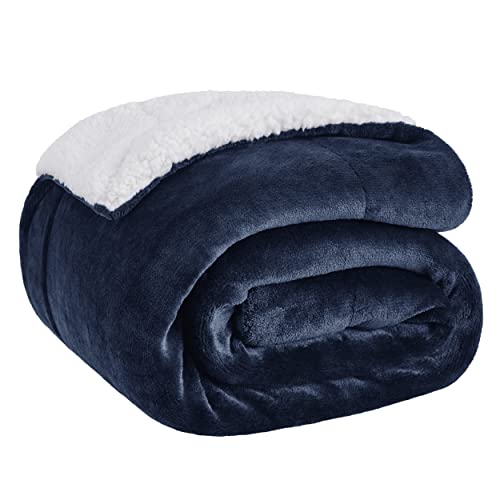
Bedsure GentleSoft Sherpa Fleece Throw Blanket (Navy)
Badge: Best for Deep Winter Layering
Strengths
- Dense navy sherpa adds the biggest warmth increment per layer
- Non-heated and thick as listed — passive warmth only
- Dark navy hides everything a winter blanket endures
Trade-offs
- Heaviest throw here; ‘lightweight’ only by duvet comparison
- Slow to dry after its weekly wash
- Overkill above a warm duvet in a heated home
Mini spec box
- Brand: Bedsure
- Size: 50″ x 60″
- Material / build: Sherpa fleece, non-heated, thick and warm
Every layering system needs a top gear, and this navy sherpa is it. Added over the lightweight fleece, it converts a shoulder-season bed into a winter bed in one move, because its dense, curled pile traps more still air per layer than anything else at throw size. In a cold bedroom, this is the piece that makes the synthetic system stop feeling like a compromise and start feeling like the warmer option outright.
Navy is the right uniform for the job. The winter layer is the blanket that gets dragged to the sofa, wrapped around shoulders at a desk, and pressed into service during illnesses; a dark, forgiving color keeps it presentable through all of that between washes. It is also, being non-heated, the safe way to add serious warmth — a point worth making in a category where shoppers often drift toward heated products, whose supervision demands our Best Eelectric Blankets coverage spells out and bedrooms rarely meet.
Accept its two honest costs: it is the slowest pick here to dry, and it is lightweight only in comparison to the duvet it replaces. Neither matters in its role. A system is allowed one heavy lifter, and this sherpa — deployed in the cold months, stored clean in the warm ones — lifts exactly as designed. One caution for layering stacks: place this navy sherpa where hands can reach it in the dark. A booster layer that requires getting up to fetch will not be used at 3 a.m., and the system’s elegance depends on adjustments being effortless at exactly the hour when effort is least available.
Best for: Cold bedrooms, winter layering, shoulder-season insurance / Not suited for: Hot sleepers or ultralight packing

Bedsure Soft Throw Blanket (Beige)
Badge: Best Soft Everyday Throw
Strengths
- Fluffy soft pile is the most immediately comfortable face here
- Listed machine washable for a true weekly rhythm
- Beige layers beautifully into neutral bedding
Trade-offs
- Pale shade shows marks sooner than grey or navy
- Mid warmth — a layer, not an anchor
- Fluffy pile holds dust until wash day
Mini spec box
- Brand: Bedsure
- Size: 50″ x 60″
- Material / build: Soft fluffy fleece throw
The beige Bedsure throw is the alternative for people who choose bedding by hand first. Its fluffy pile is the softest first touch in this list, and in a layering system the layer people touch is the layer they judge — which makes this the blanket most likely to convert a down loyalist at a single stroke. Spread over a sheet or a plain duvet cover, it gives a bed the soft, finished, inviting surface that photographs and guests respond to.
It works as hard as it charms. The listing confirms machine washability, and the throw’s moderate weight means it washes and dries at the pace a weekly rhythm needs — no small thing, since the against-the-sleeper layer is the one that should be washed most and is, in duvet households, washed least because the duvet is a production. Lightness of care is this category’s founding argument, and this throw embodies it.
Its beige tone is both the appeal and the tax: beautiful in a layered bed, quick to show a week’s service. Keep it as the top, decorative, most-washed layer — the role its softness suits — and let darker picks do the heavy winter work beneath or beside it. In that role it has no real rival here. Beige also forgives the layering look itself: mismatched blankets stacked on a bed read as clutter in strong colors and as intentional texture in neutrals. If your bed is visible from the door — studio apartments, guest rooms — this is the layer that makes the system look designed rather than accumulated.
Best for: Layered beds, guest rooms, touch-first buyers / Not suited for: Hard service where marks must hide

Bedsure GentleSoft Sherpa Throw Blanket (Beige)
Badge: Best Warm Sherpa Throw
Strengths
- GentleSoft sherpa face feels warm the instant it touches skin
- Thick, plush build suits cold sleepers and drafty rooms
- Beige pairs with the beige layering pick for a matched system
Trade-offs
- Warmth exceeds the lightweight brief — a winter-leaning throw
- Thick pile dries slowly
- Pale color plus thick pile is the highest-upkeep combination here
Mini spec box
- Brand: Bedsure
- Size: 50″ x 60″
- Material / build: GentleSoft fleece with sherpa side, non-heated
This GentleSoft sherpa throw is the comfort maximalist among the alternatives: a thick, plush blanket whose sherpa warmth arrives instantly on contact, the quality cold sleepers actually mean when they say a blanket is cozy. As the top layer on a winter bed or the sole blanket on a sofa in a drafty room, it delivers the enveloping feel that down loyalists believe only down can give — from washable synthetic pile.
It pairs deliberately with the beige Bedsure above: same color family, different jobs. The fluffy throw is the soft top layer for mild nights; this sherpa is the deep-warmth layer for cold ones; together over a sheet they constitute a complete down-free bed with a dial. Bought as a pair, they are the most coherent small system this guide can assemble, and the reviews’ badges are designed to make that pairing easy to spot.
The upkeep honesty: thick pile in a pale color is the highest-maintenance combination in the list, needing its wash on schedule and its drying done properly. Cold sleepers will pay that tax gladly — warmth this immediate is rare at any weight — but warm sleepers and low-laundry households should take the grey fleece instead and never look back. In children’s rooms this sherpa earns a second reputation: it is the blanket fort and reading-nook blanket, warm enough for a small person wrapped in it on the floor, washable enough for the life that follows. Few bedding purchases serve a bed, a fort and a sick day with equal grace.
Best for: Cold sleepers, drafty rooms, matched beige layering / Not suited for: Warm sleepers or minimal-laundry homes

Bedsure GentleSoft Throw Blanket (Off White)
Badge: Best Gentle on Skin
Strengths
- Smooth GentleSoft fleece face — no texture to irritate skin
- Moderate warmth suits the widest range of sleepers
- Off white brightens a bed and shows honestly when a wash is due
Trade-offs
- Light color demands the weekly rhythm be kept
- Smooth face grips sheets less — it can migrate in the night
- Mid warmth only; winter needs it layered
Mini spec box
- Brand: Bedsure
- Size: 50″ x 60″
- Material / build: GentleSoft fleece
The GentleSoft off white throw closes the list as the skin-first alternative. Its smooth, even fleece face has no loops, ribs or sculpted texture — nothing to press, rub or imprint on a sleeper who runs the blanket against their face and arms all night, as many do. For sensitive skin and for children old enough for a throw of their own, that plainness is a genuine feature, and it is rarer in this category than it should be.
Its warmth is the moderate middle of this list, which turns out to be the most useful setting of all: enough over a sheet for most of the year in a heated home, and a willing middle layer when winter asks for the sherpa above it. Alternatives live or die by this versatility, because a blanket with exactly one season is a blanket in storage for the other three.
The off white color enforces the hygiene this category promises: it shows when a wash is due, and in a feather-free bedding system built on freshness, that honesty is a virtue disguised as a chore. Keep the weekly rhythm and this is the gentlest, easiest, most universally suitable alternative in the guide — the one to buy for a household whose sleepers cannot agree on anything else. If a household can keep only one alternative, the argument for this off white all-rounder is breadth: it offends no skin, no season and no color scheme, and it layers in both directions. Specialists beat it at every extreme — and it beats every specialist on the ordinary Tuesday night that most of life consists of.
Best for: Sensitive skin, children, all-season layering / Not suited for: Households that wash less than weekly
Comparison Table
All six are throws or twin format, so the comparison turns on warmth increment and weight honesty. The standout trait column tells you each layer’s job in a system. Nothing here hides its weight class.
| Pick | Badge | Size | Standout trait | Shop |
|---|---|---|---|---|
| Bedsure GentleSoft Sherpa Fleece Blanket, Twin (Grey) | Best Overall | 60″ x 80″ | Only anchor-sized alternative here | Check on Amazon |
| Bedsure Soft Fleece Throw Blanket (Grey) | Best Truly Lightweight | 50″ x 60″ | The genuine featherweight of the six | Check on Amazon |
| Bedsure GentleSoft Sherpa Fleece Throw Blanket (Navy) | Best for Deep Winter Layering | 50″ x 60″ | Biggest warmth increment per layer | Check on Amazon |
| Bedsure Soft Throw Blanket (Beige) | Best Soft Everyday Throw | 50″ x 60″ | Softest first-touch pile | Check on Amazon |
| Bedsure GentleSoft Sherpa Throw Blanket (Beige) | Best Warm Sherpa Throw | 50″ x 60″ | Warmest instant-contact sherpa | Check on Amazon |
| Bedsure GentleSoft Throw Blanket (Off White) | Best Gentle on Skin | 50″ x 60″ | Smoothest, gentlest face here | Check on Amazon |
How to Choose the Best Down Lightweight Alternative Blankets
Buy the layer your bed is missing. Audit the bed first: if you own a warm duvet, you need the light fleece, not another anchor; if you own only sheets and a thin blanket, the twin sherpa is your missing main layer. Alternatives disappoint when they duplicate what a bed already has. The keyword’s promise is a system completed, not a product acquired.
Interrogate ‘lightweight’. The word spans everything from the grey fleece here — a genuine featherweight — to sherpa throws that are light only next to a duvet. Decide which meaning you need before you shop: minimum weight for layering and travel, or moderate weight for single-blanket warmth. This guide labels each pick with its true class; hold every other listing to the same standard.
Prefer pile to fill. Synthetic alternatives come in two constructions: filled comforters that imitate duvets, and pile blankets — fleece and sherpa — that warm by structure. Pile wins on washability, longevity and weight, and loses only on silhouette. Since a blanket’s job is warmth in a real laundry life, pile is the engineer’s choice, and it is the only construction in this list.
Plan for the car and the couch too. A throw-format alternative moonlights: it is the travel blanket, the car blanket for a cold passenger, the sofa’s winter layer. Our Best Electric Blankets For Cars research makes the same point from the powered side — the blanket that travels is the one that is light, washable and already owned. Choose the throw you will use everywhere, and the bed gets it as a by-product.
Let washability arbitrate ties. When two alternatives seem equal, the one that washes weekly without drama wins the year. Down’s defeat in most households was never about warmth; it was about the third winter of laundry dread. Do not re-enlist in that war by buying a delicate alternative.
Do not forget the bed’s other half. Pillows, duvet covers and mattress protectors carry their own feather and care questions. A down-free blanket over a feather pillow is a half-finished project; when you commit to the alternative system, walk the whole bed once and list what else needs to change, then change it in order of contact with the sleeper.
How to Layer a Lightweight Down-Free Bed
Start with the sheet as layer zero. A smooth cotton or microfiber sheet against the skin keeps the fleece layers cleaner longer and gives the bed its slide. Then add the light fleece as the first warmth layer for spring, summer and heated homes — for many sleepers, in many houses, the system is complete right there for most of the year.
Add warmth in increments. First cold step: the beige or off white throw across the whole bed. Second step: the sherpa across the foot and lower body, where cold is felt most and extra weight is best tolerated. Final step, for genuinely cold rooms: twin sherpa as the base blanket with the light fleece above it. Each step is a layer you already own, added in minutes and removed in seconds.
Leave the layers loose. Trapped air between layers is insulation; a bed tucked drum-tight squeezes it out. Lay each blanket with drape, fold the top layer back at the chest, and let the sleeper — not the hospital corner — decide the final arrangement. Loose layering is also why these systems suit restless sleepers: nothing binds, everything adjusts.
Wash inside-out by layer. The layer against the sleeper washes weekly; outer layers fortnightly. Shake each out first, wash gentle and warm, dry completely. Rotating which throw sits against the skin spreads wear evenly across the set and doubles the system’s working life for free.
Troubleshooting.
Problem: the bed feels warm at bedtime but cold by morning → a layer is migrating off; choose a larger format for the base layer, or place the sherpa — the grippiest surface — against the sheet to anchor the stack.
Problem: too hot by 3 a.m. → your top layer is doing winter work in a shoulder season; drop one increment and keep the removed layer folded at the foot, where feet can find it if the night turns.
Problem: layers bunch and twist together → the smoothest blanket is sliding against the sheet; swap the order so a textured or sherpa surface touches the sheet and the smooth fleece rides on top.
Alternatives for Every Kind of Sleeper
Hot sleepers are this category’s natural citizens. For them the grey lightweight fleece over a cotton sheet is often the first blanket setup that has ever worked year-round: enough to feel covered, never enough to trigger the 3 a.m. kick-off. Their down duvet was not a bad product; it was a winter tool used in all seasons, and the alternative system’s adjustability is the actual cure.
Cold sleepers should read the same list from the other end: twin sherpa as the anchor, navy sherpa as the booster, and the soft beige throw as the against-skin comfort layer. Stacked, that is warmth beyond most duvets, with the decisive advantage that each piece can be peeled as spring arrives instead of the whole bed changing at once. Cold sleepers also benefit most from pre-warming the bed with their own routine — the layers hold body heat well once it is there.
Couples with different thermostats get the system’s neatest trick: asymmetric layering. One side carries the sherpa, the other only the light fleece, meeting at a fold down the middle. No duvet ever offered that, and for many households it ends a decade-long negotiation more completely than any purchase either partner expected to make.
Camping, Cabins and the Travel Case for Fleece Alternatives
Down keeps one fortress: ultralight backpacking, where its warmth-to-weight and compression are unmatched. Everywhere below that extreme, the fleece alternative wins on the merits that matter outdoors — it insulates when damp, shakes off dirt, dries by a fire or on a line in hours, and costs little enough that a torn or scorched blanket is an annoyance rather than a disaster. Car camping, cabins, boats and camper vans are fleece country.
The layering logic travels too. A light fleece plus a sherpa throw covers a trip’s temperature range the way it covers a year’s, and both pieces serve in the vehicle, around the fire and in the tent without ever being precious. Our Best Electric Blankets For Camping guide reaches the complementary conclusion for powered warmth: batteries and elements have their place, but the passive synthetic layer is the foundation everything else supplements.
Pack the blanket the sleeper already knows. Familiar texture and smell help children and adults alike sleep in strange places, and a blanket that has a home role and a travel role justifies its cupboard space twice over — the quiet economics that make simple synthetic blankets the most-used textiles their owners possess.
What to Do With the Down You Are Replacing
Replacing down raises a practical question most guides skip: the old blanket still exists. If it is sound, it has honorable second careers — the guest bed’s winter layer, the car emergency kit’s warmth for people (kept dry and bagged), or a donation to a shelter that accepts bedding, where a warm blanket in good condition is genuinely useful. Feather bedding should be clean and intact for any of these; a leaking, matted blanket helps no one.
If it is worn out, check textile recycling rather than landfill where your area offers it, and retire it without guilt: a blanket that served a decade of winters has completed its lifecycle honestly. What not to do is keep it in the rotation ‘just in case’ — a fifth-best blanket that nobody washes is how bedding cupboards become museums and laundry systems become archaeology.
Then let the new system be the system. The households that succeed with alternatives commit to the layers they bought, wash them on rhythm, and stop maintaining a parallel down infrastructure for hypothetical guests. Simplicity is the benefit the category promised; it arrives only when the old regime is actually stood down.
Reading Listings Like an Engineer
Alternative-blanket listings reward a particular reading skill: separating construction facts from atmosphere. Facts sound like this — a size in inches, a material name, a fabric weight, a care instruction. Atmosphere sounds like the rest. The strongest listings in this guide state their sizes and materials plainly; the weakest lean on words like ‘cloud’ and ‘dream’ precisely where a number should be.
Apply three questions to any listing in this category. What is it made of, exactly? What are its dimensions, exactly? What does its care label permit? A product that answers all three can be compared, layered and owned with confidence. A product that answers none is asking to be bought as a photograph, and photographs are notoriously cold at 3 a.m.
This discipline matters more in the alternative category than most, because its vocabulary — alternative, lightweight, loft, warmth — is unregulated. The shopper who reads like an engineer ends up with a bed that works; the shopper who reads like a poet ends up with a cupboard of beautiful disappointments and, eventually, another down duvet.
Common Buying Mistakes
Buying a throw to do a duvet’s whole job. Throws are layers. A cold sleeper with one throw has bought an ingredient and blamed it for not being dinner.
Believing every ‘lightweight’ label. Sherpa is mid-weight whatever the listing says. Read construction and size, and use this guide’s honest classes as your calibration.
Keeping the down in parallel forever. Two systems means two laundry burdens and neither done well. Commit, donate or recycle the old regime.
Tucking layers tight. Compressed layers lose their trapped air and their point. Drape, fold back, and let the sleeper arrange.
Washing the whole stack every time. Only the against-skin layer needs the weekly cycle. Over-washing outer layers wastes their pile life.
Judging by the first night. Layering systems tune over a week of small adjustments. Give the dial a few nights before declaring the blanket wrong.
Treating the first configuration as final. A layering bed tunes over a week. Owners who rearrange twice sleep well for years; owners who judge on night one return good blankets and keep bad sleep.
Final Recommendation
Build the system around the layer your bed lacks, keep the weights honest, and down becomes a choice you no longer need. Start with the layer you lack, and let the seasons do the rest of the deciding for you, one honest increment of warmth at a time. Start with the Bedsure Soft Fleece Throw Blanket (Grey) if you want the safest all-round choice, and look at the Bedsure GentleSoft Sherpa Fleece Blanket, Twin (Grey) if the runner-up profile described in its review fits your home better.
Frequently Asked Questions
What counts as a down lightweight alternative blanket?
A synthetic blanket that traps air for warmth — as down does — without feathers, in a light format suited to layering. In this guide they are fleece and sherpa throws and one twin blanket: no down content, fully machine washable, and light enough to add, remove and move around the house as seasons and sleepers change.
Is a fleece throw really warm enough to replace down?
As a system, yes. One light fleece replaces a light down blanket; layered with a sherpa throw it matches winter duvet warmth for indoor use, while washing far more easily. A single throw alone in a cold room is not a duvet replacement and this guide does not claim it is — layering is the method, not a marketing line.
Which of these is the lightest option?
The grey Bedsure fleece throw, whose listing states its lightweight build and whose fine pile adds warmth with minimal bulk. The sherpa picks are progressively warmer and heavier, and the twin sherpa is the anchor format. The reviews label each pick’s true weight class so you can choose with open eyes.
Are down alternatives better for allergies?
They remove feathers — a common bedding irritant — from the bed entirely, and their easy weekly washing keeps bedding fresher, which helps many sensitive sleepers. That is a bedding-engineering statement, not a medical one; anyone with significant symptoms should take a clinician’s advice alongside the new blanket.
How many layers do I need in winter?
Most sleepers in heated homes need two: a light fleece over the sheet, plus a sherpa layer in the coldest weeks. Unheated or drafty rooms may add the twin sherpa as a base. The right number is the one that lets you sleep without waking hot or cold — tune it over a week rather than guessing once.
Can I use these throws on a queen bed?
As layers, absolutely — across the foot, over one sleeper, or as the top layer over a plain duvet or blanket. As the bed’s sole coverage, a 50 x 60 inch throw will not drape a queen mattress; that job belongs to a full-size blanket, with these throws doing the adjustable work they are designed for.
How should I store the layers I am not using?
Washed, fully dry and loosely folded in a breathable place. Compression storage crushes the pile that provides the insulation, and damp storage invites mildew. A linen-cupboard shelf is ideal; bring layers back into service with a shake and an airing, and wash again if they have sat for a full season.
Do these alternatives work for children?
Yes, with the usual bedding sense: throws and layers suit older children well, are easy to wash after the inevitable incidents, and contain no feathers to manage. For infants, follow current safe-sleep guidance and keep loose blankets out of the sleep space entirely — alternatives are for children old enough for bedding of any kind.
How do fleece alternatives handle night sweats and warm rooms?
Better than down, because the system can be peeled to a single breathable layer in seconds and because fleece does not hold moisture the way a damp duvet does. In warm rooms, run the minimum configuration — sheet plus the grey lightweight fleece — and keep the sherpa folded at the foot for the small hours when rooms cool.
What is the difference between this guide and other down alternative roundups?
Scope and honesty about format. This list is throws and one twin blanket, chosen as layering pieces, with each pick’s true weight class stated in its review. If you need a full queen-size duvet replacement in one piece, that is a different product format; these alternatives deliberately serve the layering strategy instead.
Can I put a fleece alternative inside a duvet cover?
You can, and some households do to keep a familiar cover in service, but it is rarely the best arrangement: the throw can bunch inside an oversized cover, and you lose the quick layering that makes the system work. These blankets are designed to be seen and used as themselves; if a covered look matters, choose sizes close to the cover and secure the corners.