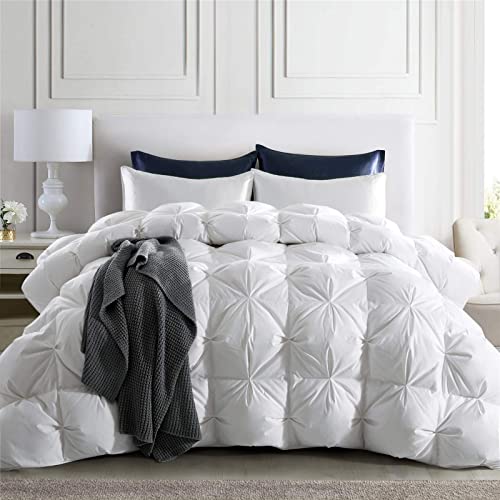
Where to buy
Check the latest price, availability and delivery on Amazon. Orders are placed on Amazon. We may earn a commission from qualifying purchases.
- Best overall: puredown Goose Down Comforter, 800 Fill Power, Full/Queen Oversized — Check on Amazon
- Globon Winter White Goose Down Comforter, Queen — Check on Amazon
- Beautyrest Hungarian White Goose Down Comforter, Full/Queen — Check on Amazon
- APSMILE Down Comforter, All Season, Queen — Check on Amazon
See 2 more Amazon options
- Brooklinen All Season Luxury Down Alternative Comforter, Full/Queen — Check on Amazon
- Egyptian Bedding Luxurious Goose Down Fiber Comforter, Queen — Check on Amazon
Read the full guide ↓
Disclosure: As an Amazon Associate, topratedkitchenware.com earns from qualifying purchases. Links to Amazon on this page are affiliate links; they cost you nothing extra. Listing details such as price and availability change often, so check the current Amazon listing before you buy.
Four hundred dollars is a serious amount of money to spend on anything in a rented apartment, and this guide will not pretend otherwise. A comforter in this tier is not a duvet insert you toss in a donation bag at the end of the lease; it is a piece of bedding you will carry through three or four addresses, and it has to earn that loyalty in a building you do not control. Apartment heating is the first reason it can: radiators that roast one room and ignore the next, single-pane windows, a thermostat the landlord keeps at a setting chosen for the landlord’s bill. A genuinely warm, genuinely light comforter is one of the few heating upgrades a renter is allowed to make. The second reason is longevity. A good down comforter can last ten-plus years — provided you can wash it, store it and move it without wrecking it, and those three apartment problems are what this guide grades hardest.
Sizing in this guide is for the queen size — full/queen where a brand sells a combined size — because comforter sizing changes with size and a king guide helps nobody here. The six picks are the same six verified in our under-$400 comforter research, re-judged here through the apartment lens: care logistics without an in-unit washer, storage in a home with no linen closet, weight and bulk on moving day, and warmth in rooms whose temperature you do not set. For most apartment sleepers we would begin with the puredown 800 fill power comforter — 93% goose down, the highest down content we could verify on Amazon; check price on Amazon — but with a warning that runs through this whole guide: it is dry clean only, and in an apartment that is not a footnote, it is a logistics plan. If your building has no laundry room and your weekends are precious, the Globon below makes the same fill power claim for far less and forgives far more. Below you will find a quick picks table, detailed notes on each of the six, a comparison table, a buying checklist written for renters, an honest account of when a premium comforter makes sense in a rental and when it does not, the mistakes apartment shoppers make most in this tier, and answers to the questions that come up again and again.
In this guide
Quick Picks
Short on time, or comparing several options at once? Each row below names a buyer type and the product that suits it, with a link to the listing. All picks are shown in queen size; check the current price on Amazon, as prices and availability change with sales and size selections.
| Buyer type | Pick | Why it stands out | Link |
|---|---|---|---|
| Best overall | puredown Goose Down Comforter, 800 Fill Power, Full/Queen Oversized (98 x 90 Inch) | 93% goose down at a maker-rated 800 fill power in a 700 thread count cotton shell — the warmest light layer for a cold rental bedroom | Check on Amazon |
| Best value premium down | Globon Winter White Goose Down Comforter, Queen (90 x 90 Inch) | An 800+ fill power claim and winter weight at a mid-tier price — flagship warmth without flagship moving-day anxiety | Check on Amazon |
| Best named-origin down | Beautyrest Hungarian White Goose Down Comforter, Full/Queen (90 x 98 Inch) | 75% Hungarian white goose down at 750 fill power in a 500 thread count cotton shell | Check on Amazon |
| Best mid-price natural fill | APSMILE Down Comforter, All Season, Queen (90 x 90 Inch) | 46 ounces of down and feather fiber fill — check price on Amazon — the natural workhorse of a flagship-and-backup rotation | Check on Amazon |
| Best premium down alternative | Brooklinen All Season Luxury Down Alternative Comforter, Full/Queen (90 x 90 Inch) | A cotton sateen shell and baffle-box build that machine washes — the premium pick a laundromat routine can actually support | Check on Amazon |
| Best shell-first classic | Egyptian Bedding Luxurious Goose Down Fiber Comforter, Queen (90 x 90 Inch) | 100% Egyptian cotton cover over 48 ounces of down fiber fill; on Amazon since 2009 | Check on Amazon |
How These Picks Were Chosen
The first filter was the budget, applied to the queen size specifically. Every product below is a real Amazon listing presented in the under-$400 tier in the United States; for every pick, check price on Amazon and check the current price on Amazon before weighing anything else in its review. Anything whose identity we could not verify at all was named unlinked or left out, however famous the brand.
The second filter was the apartment itself, and it re-ordered nothing but re-judged everything. We read maker listings and specification pages, compared fill percentages, fill powers, fill weights, shell fabrics and care instructions, and then asked the renter’s questions of each: Can this comforter be cleaned by someone whose laundry options are a basement laundry room, a laundromat or a dry cleaner’s counter? Where does it live in July in a one-bedroom with one closet? What does it weigh, and how small does it pack, on the day it has to go down three flights of stairs in a garbage bag or a tote? Does its warmth solve the specific cold of a rental — a bedroom over an unheated garage, a window that leaks January — or does it assume a thermostat set to a civilized 70 degrees?
One thing we graded hardest was the honesty of the numbers. Fill power is a real, testable measure of down quality — the cubic inches one ounce of down lofts to — but it is a maker-reported figure on every listing here, and it only means anything alongside two other numbers: the percentage of the fill that is actually down clusters, and the fill weight in ounces. A comforter claiming high fill power for a fill that is mostly feather fiber is playing a different game from a comforter that is 93% down at 800. Where a listing’s own language blurred those lines, the review below says so plainly. Warmth, loft and softness figures are reported as maker claims throughout, because that is what they are.
The 6 Best Comforters for Apartments Under $400
puredown Goose Down Comforter, 800 Fill Power, Full/Queen Oversized (98 x 90 Inch, 40 oz Fill)
Who it suits: Renters in genuinely cold apartments — top-floor heat loss, drafty pre-war windows, a bedroom the radiator forgets — who want the highest verified down content on Amazon and will organize their cleaning life around it.
The specifications are the reason this comforter leads the guide, and they survive the apartment re-judging better than you might expect. The listing specifies 93% white goose down — under US labeling rules a fill must be at least 75% down to be called down at all, and 93% is at the top of what consumer listings offer — at a maker-rated 800 fill power, with 40 ounces of fill in the full/queen size. The shell is 100% cotton at a 700 thread count, the highest shell specification in this guide, and the dimensions are a true oversized 98 by 90 inches, so the drape over a thick mattress is generous rather than apologetic. The brand states the down is ethically sourced and certified to RDS and OEKO-TEX Standard 100. Check price on Amazon for the full/queen size before ordering, and confirm the current price still fits this guide’s budget.
For an apartment, the physics are the pitch. Eight hundred fill power down traps more air per ounce than anything else here, which means this is simultaneously the warmest comforter in the guide and one of the lightest on the body — and in a rental, light matters twice. It matters on the bed, where a heavy comforter over a sleeper in a small, stuffy room can feel like a lid. And it matters on moving day: 40 ounces of high-loft down compresses into a storage bag a fraction of the size of the 46- and 48-ounce fiber comforters below, and weighs less doing it. The apartment penalty is care, and it is real: roundup coverage of this model reports dry clean only. In a house with a laundry room that means an errand; in an apartment it means finding a cleaner who handles queen down, carrying a bulky bag there and back, and paying a queen-comforter fee once or twice a year. The duvet-cover discipline described later in this guide is not optional with this pick — it is what keeps those trips rare. In a well-heated modern apartment, warm sleepers will find it a lot of comforter, and the Globon or the APSMILE will serve them better.
- 93% goose down at a maker-rated 800 fill power — the strongest fill specification verified in this guide, and the warmest warmth-per-ounce here.
- 700 thread count 100% cotton shell and a true oversized 98 x 90 inch full/queen.
- Check price on Amazon; high-loft down compresses small for storage and moving.
Honest limitation: Care is dry clean only per roundup coverage of this model — in an apartment without a car or a nearby cleaner, that is a recurring cost and a recurring errand, not a line on a label. The winter weight will overwhelm warm sleepers in well-heated buildings: check the current price on Amazon first to confirm it still fits this guide’s budget.
Choose it if your apartment is cold, your lease has years to run or your next home will also be yours to keep warm, and you will actually use a duvet cover from day one. Skip it if your building runs hot, your cleaning plan is “the laundromat, eventually,” or the current price on Amazon is outside this guide’s budget — the Globon below makes the same fill power claim for far less.
Globon Winter White Goose Down Comforter, Queen (90 x 90 Inch)
Who it suits: Value hunters in cold rentals who want a genuine high-fill-power down comforter for winter and are willing to trade brand polish and shell luxury for a much lower price — and a much smaller loss if apartment life damages it.
The Globon is the puzzle of this tier, and this guide will present it as one rather than smoothing it over. The listing — sold on Amazon since 2017 — claims 800+ fill power white goose down in a 420 thread count shell, in a winter-weight queen measuring 90 by 90 inches, with corner tabs and a 3D baffle-box style construction in roundup descriptions. Independent coverage adds the details the headline omits: the shell is a cotton-polyester blend (68% cotton, 32% polyester in roundup specifications), the fill weight is around 37 ounces in the queen per one detailed comparison, and the down carries a maker treatment called Texcote-Nano that the brand says helps it handle moisture. Its positioning is the puzzle’s other half: premium specifications in the middle of this tier, from a maker that has sold down bedding for decades — check price on Amazon.
The apartment lens is kind to this comforter in ways the specification sheet is not. Positioned well below the flagship end of this tier, it is the premium down a renter can own without insuring it against life: a roommate’s spilled coffee, a subletter’s rough winter, a leak from the unit above — the disasters that actually happen to bedding in rentals — sting far less than they would with a flagship pick. The standard 90 by 90 size is also the easiest in the guide to house: it fits the storage bags and closet shelves sized for ordinary queens, and its winter weight answers the most common apartment complaint, the cold bedroom, head-on. What gives, partly, is what direct-import down costs when the brand spends on fill rather than retail presence: no department-store shelf, no hotel program and no large advertising presence behind it. Partly, the savings are visible in the specification sheet — a blended shell instead of pure cotton, and a fill percentage the listing states less prominently than its fill power, which is exactly the number this guide teaches you to ask for. Judge it as what it verifiably is: a winter-weight down comforter with a very high stated fill power, a mid-grade shell, and a long sales history, positioned in the tier like a comforter with far more modest claims.
- Maker-rated 800+ fill power in a winter-weight queen — the highest fill power claim in this guide.
- Positioned in the middle of this tier for the queen — check price on Amazon.
- Sold on Amazon since 2017, with RDS and OEKO-TEX certifications reported in roundup coverage.
Honest limitation: The shell is a cotton-polyester blend, not the pure cotton its 420 thread count headline suggests, and the listing foregrounds fill power over fill percentage — read the full specification on the listing, and treat the 800+ figure as a maker claim that has not been independently lab-verified in the sources we could check. It is a winter weight: in a steam-heated apartment that runs hot all January, it will spend the season folded at the foot of the bed.
Choose it if winter warmth within this tier is the whole game and your building’s heat is unreliable. Skip it if a pure cotton shell matters to you, you want an all-season rather than winter weight, or a claim this far ahead of its price makes you want the receipts only a bigger brand provides.
Beautyrest Hungarian White Goose Down Comforter, Full/Queen (90 x 98 Inch)
Who it suits: Renters signing a long lease — or renewing one — who want named-origin down from a mainstream American bedding brand, in an oversized queen that drapes like hotel bedding over a thick apartment mattress.
Beautyrest’s entry in this tier is a study in specifications done properly. The fill is stated precisely: 75% Hungarian white goose down and 25% white goose feather, at a maker-rated 750 fill power. Seventy-five percent is the threshold at which US rules allow a fill to be labeled down without qualification, and Beautyrest prints it rather than hiding behind the word “luxury.” The shell is 100% US-grown cotton in a damask stripe at 500 thread count, and the full/queen measures 90 by 98 inches — eight inches longer than the standard queen square, which tucks and drapes the way hotel comforters do.
Check price on Amazon for this pick before weighing anything else: our research verified the listing, the fill specification and the shell from the maker’s own product description, and the live listing is the first fact to establish. If the current price on Amazon fits this guide’s under-$400 budget, it belongs in this guide on its specifications; above that, it belongs to the next tier’s conversation. For the apartment buyer, the oversized length is the quiet virtue — rental mattresses are often thick, aging pillow-tops, and eight extra inches of drape is the difference between a comforter that covers two sleepers and one that starts a nightly negotiation. The counterweight is the same length in a closet: oversized bedding folds bigger, and in a one-closet apartment that is a real, if minor, tax. What the specifications promise, for the record, is the balanced premium profile — real cluster down at a strong fill power, a breathable all-cotton shell, all-season warmth, and a brand with a warranty infrastructure behind it.
- 75% Hungarian white goose down at a maker-rated 750 fill power, percentages printed plainly.
- 500 thread count 100% US-grown cotton damask stripe shell; oversized 90 x 98 inch full/queen.
- Oversized length helps the comforter drape over thick rental mattresses.
Honest limitation: Check the current price on Amazon for this ASIN — if the listing shows it outside this guide’s budget, it falls outside this guide’s promise entirely.
Choose it if named-origin down and a printed fill percentage matter more to you than a headline fill power, and the live price lands in budget. Skip it if you want the maximum down percentage for the money — the puredown’s 93% is a different league — or the live price has drifted out of the tier.
APSMILE Down Comforter, All Season, Queen (90 x 90 Inch)
Who it suits: Apartment sleepers who want natural fill and a true all-season medium weight at a mid-tier price — and, in the rotation this guide recommends below, the comforter that takes the everyday wear while a flagship stays in reserve.
APSMILE is a factory-direct down and feather maker, and its all-season queen is the natural-fill value of the guide’s middle. The listing specifies a 90 by 90 inch queen with 46 ounces of fill and corner tabs, described in the maker’s materials line as down fibers and feather fibers, in a medium-warm, all-season weight. Check price on Amazon for this pick. Roundup coverage of the APSMILE line credits the brand’s comforters with baffle-box construction, double-stitched piping and OEKO-TEX certified materials, and the brand markets its line at 750 fill power — a figure this guide attributes to the brand’s marketing rather than to this listing, whose own copy says “high fill-power” without printing a number we could verify.
That distinction is the review, so let it be explicit. Down fiber and feather fiber are processed fills — not the intact down clusters of the puredown and Beautyrest above. Processed fiber fill is soft, warm, quiet and durable, and 46 ounces of it is a genuinely substantial all-season weight; it also lofts less per ounce than cluster down and carries more weight for the same warmth, which is part of why this comforter sits in the middle of this tier rather than at the flagship end. The apartment lens adds two judgments. In its favor: an all-season medium weight is the right default for buildings whose heat you cannot tune — warm enough for a January cold snap with a blanket over it, light enough not to be exiled to the closet by April — and it is positioned like a workhorse, which is exactly the role the flagship-and-backup rotation below asks of it. Against it: 46 ounces of fiber fill is the bulkiest package in this guide to store and to move, because fiber does not compress the way cluster down does. In a small apartment, that bulk is a shelf, permanently. Judged as the best version of its own category — a thick, natural, medium-warm comforter from a maker that has produced down bedding for decades — it earns its place. Judged as a cut-price cluster-down duvet, it would disappoint.
- 46 ounces of fill in a 90 x 90 inch queen — a substantial, genuinely all-season weight.
- Positioned in the middle of this tier — check price on Amazon.
- Corner tabs for a duvet cover, from a factory-direct maker with decades in down bedding.
Honest limitation: The fill is down and feather fiber, not down clusters, whatever the “goose down comforter” phrasing elsewhere in the brand’s marketing implies; the 750 fill power figure attached to the brand’s line in roundups is not printed for this specific listing, so do not buy it as a 750 fill power comforter. It is also the bulkiest pick here to store in a small apartment.
Choose it if you want natural fill and real fill weight at a mid price, with your eyes open about fiber versus clusters — or a durable everyday comforter to rotate under a premium one. Skip it if cluster loft is the point — step up to the Globon or the puredown — or your storage is one shallow closet shelf.
Brooklinen All Season Luxury Down Alternative Comforter, Full/Queen (90 x 90 Inch)
Who it suits: Feather-free households, and any renter whose cleaning reality is a laundromat card and a Sunday afternoon — this is the premium comforter in the guide that a normal apartment laundry routine can actually maintain.
Every other pick in this guide is a down product, and this one exists because the best comforter under $400 for some beds is not. Brooklinen’s all-season down alternative wraps its fill — a recycled polyester microfiber, described by the brand as vegan — in a 100% cotton sateen shell with baffle-box construction, at 90 by 90 inches for the full/queen. The shell is the story: at every tier below this one, down alternative comforters arrive in microfiber shells that sleep warm and feel synthetic, and the Brooklinen’s cotton sateen is the surface of a premium comforter, quiet and breathable against the skin. Check price on Amazon for the full/queen all-season.
The trade is the category’s trade, stated at this tier’s higher standard. Polyester fill, however well engineered, does not loft like 800 fill power down, does not breathe like goose fill, and will not last as many years as a well-kept down comforter; what it does is wash easily, cost less, and ask nothing of anyone avoiding animal products — and in an apartment, “washes easily” deserves more weight than house guides give it. A queen comforter still needs a large-capacity machine, which at a laundromat is simply the big washer you were going to use anyway. Brooklinen supports the comforter on its own store with a 365-day trial and a one-year warranty — those are the brand store’s terms; Amazon purchases follow Amazon’s return policies instead. As the premium down alternative on Amazon, against a field of budget microfiber inserts, it has remarkably little direct competition.
- 100% cotton sateen shell and baffle-box construction — premium surfaces, no animal fill.
- Check price on Amazon for the full/queen all-season.
- Recycled polyester fill that machine washes without a care-label negotiation — the laundromat-friendly pick of the guide.
Honest limitation: It is a polyester comforter positioned at a down comforter’s level in this tier: the loft, breathability and lifespan sit a class below the puredown and Beautyrest, and the long-term evidence is thinner than the brand’s reputation. Polyester also compresses less willingly than down in a storage bag.
Choose it if your bed is feather-free, or easy washing outranks ultimate loft — the most common apartment trade there is. Skip it if you are choosing this tier for down-like loft — buy actual down, above — or the cotton shell would be wasted inside a duvet cover you already own.
Egyptian Bedding Luxurious Goose Down Fiber Comforter, Queen (90 x 90 Inch)
Who it suits: Shell-first renters in older, colder buildings who believe the fabric against the bed matters as much as the fill inside it, and who want a heavy, traditional, hotel-weight comforter.
Some listings survive a season; this one has been sold on Amazon since November 2009, in substantially the same form: 48 ounces of fill — 80% goose down fiber and 20% waterfowl feather fiber per the listing — inside a 100% Egyptian cotton cover, with baffle-box construction to hold the fill in place. The listing states the fill is certified to the Responsible Down Standard, Downpass and OEKO-TEX Standard 100, a certification stack none of the budget picks in our lower-tier guides could match. Egyptian cotton here is long-staple, smooth, breathable and durable, wrapped around a heavy 48-ounce fill that sleeps with the substantial, tucked-in weight traditionalists prefer — useful in a drafty pre-war rental.
The honesty notes are two, and both are printed rather than buried. First, the fill is down fiber, the processed fill this guide has flagged in every tier: warm, soft and heavy, with less loft per ounce than clusters, and no fill power figure is printed for it because none applies the way it does to cluster down. Second, the listing’s own warmth language contradicts itself — coverage of this ASIN notes it is described in places as both lightweight and extra warm — and a 48-ounce fiber fill resolves that argument in one direction: this is a warm, weighty comforter, not a summer one. The apartment-specific charge is bulk: at 48 ounces of fiber fill, this is the heaviest, least compressible comforter in the guide, and in a small apartment it will claim the largest storage volume and be the load you notice most on the stairs at move-out. Like the Beautyrest above, check price on Amazon for this pick and treat the live listing as the authority; its specifications position it in the middle of this tier, not at the flagship end.
- 100% Egyptian cotton cover — the shell-first pick of the guide.
- 48 ounces of fill with RDS, Downpass and OEKO-TEX certifications stated on the listing.
- Sold on Amazon in this form since 2009 — the longest track record here.
Honest limitation: Down fiber fill, not clusters, with a warm and heavy hand; the listing’s warmth descriptions contradict each other; it is the bulkiest pick here to store and move; check the current price on Amazon and confirm it fits this guide’s budget.
Choose it if the Egyptian cotton shell and a heavy, traditional feel are what you are buying, and your building runs cold. Skip it if you want cluster loft or a light summer weight, your storage is measured in inches, or the current price on Amazon has climbed toward the flagship end of this tier — at that point the Globon and puredown are the honest competition.
Comparison Table
| Product | Type | Best use | Link |
|---|---|---|---|
| puredown Goose Down Comforter, 800 Fill Power, Full/Queen | 93% goose down, 700 TC cotton shell | Maximum down content and winter loft for cold rentals | Check on Amazon |
| Globon Winter White Goose Down Comforter, Queen | Goose down, 800+ fill power claim, blended shell | Premium fill claims at a mid-tier price | Check on Amazon |
| Beautyrest Hungarian White Goose Down Comforter, Full/Queen | 75% Hungarian goose down, 500 TC cotton shell | Named-origin down from a mainstream brand | Check on Amazon |
| APSMILE Down Comforter, All Season, Queen | Down and feather fiber, 46 oz fill | Natural fill weight at a mid price; the rotation workhorse | Check on Amazon |
| Brooklinen All Season Down Alternative Comforter, Full/Queen | Recycled polyester, cotton sateen shell | The premium feather-free, laundromat-friendly option | Check on Amazon |
| Egyptian Bedding Luxurious Comforter, Queen | Down fiber, 100% Egyptian cotton shell | Shell quality and traditional weight for cold old buildings | Check on Amazon |
How to Choose a Comforter for an Apartment Under $400
- Read all three fill numbers together. Percentage of down clusters, fill power, and fill weight in ounces. Any listing that trumpets one and whispers the others is telling you which number is weak.
- Know the labeling rule. In the US, a fill labeled simply “down” must be at least 75% down clusters. “Down fiber” and “feather fiber” are processed fills — legitimate, warm, and a different product from clusters at any price.
- Diagnose your building’s heat before your budget. A steam-heated walk-up that runs at 78 degrees all winter needs an all-season weight; a garden unit over an unheated garage needs winter weight. The comforter cannot fix the thermostat, but it has to match the room the thermostat actually produces.
- Price the care before the comforter. Dry-clean-only down at queen size carries a recurring fee and a recurring trip; if your honest cleaning plan is a laundromat’s large washer, the washable picks in this guide are the honest better buys.
- Measure your storage before your bed. A queen comforter off-season lives somewhere: a closet shelf, an under-bed bin, the top of a wardrobe. High-loft cluster down compresses smallest; 46–48 ounces of fiber fill (APSMILE, Egyptian Bedding) will claim the most space. If you cannot picture where it goes in July, size your ambitions accordingly.
- Fix your size before your budget. Every pick in this guide is shown in queen size. Standard queens run 90 x 90 inches; oversized queens (the puredown at 98 x 90, the Beautyrest at 90 x 98) drape properly over thick rental mattresses and are worth preferring if you toss and share.
- Choose the shell like it is half the product — it is. Cotton at 500–700 thread count (puredown, Beautyrest) breathes and quiets best; Egyptian cotton (Egyptian Bedding) is the durability classic; a cotton-poly blend (Globon) is where value picks save their money.
- Prefer baffle-box construction at this tier. Fabric walls between the layers let high fill power down actually loft; sewn-through quilting pinches the fill at every seam and wastes exactly what you paid for.
- Budget for the duvet cover as part of the purchase. A cover protects a premium fill from spills and skin oils and stretches the cleaning interval by months; picks with corner tabs or loops (Globon, APSMILE) stay put inside one. In an apartment, the cover is not styling — it is your cleaning plan.
- Let it loft before you judge it. Premium down ships compressed. Give any pick here 48 to 72 hours of airing and shaking before deciding the loft is a lie — high fill power down expands slowly and keeps expanding.
A $400 Comforter in a Rented Room: When It Makes Sense and When It Does Not
The case for spending premium money on bedding in a home you do not own rests on one fact renters learn early: the bed is the one system in an apartment that is entirely yours. You cannot insulate the walls, replace the windows, re-zone the radiators or lower the ceiling. You can absolutely decide what you sleep under, and because a quality down comforter is portable property — it leaves when you leave, owing nothing to the deposit — it is closer to buying good boots than to renovating a bathroom. A cluster-down comforter kept dry and covered is a ten-year purchase, and that long life is what makes a premium purchase easier to justify than repeatedly replacing cheaper comforters. If your lease is stable, your building is cold, and you expect to keep the bed size through your next move, the premium purchase is not indulgence; it is the rational heating upgrade available to you.
The case against is just as concrete, and this guide will make it plainly. It does not make sense if your tenancy is genuinely temporary — a six-month furnished sublet, a first apartment you already plan to leave — because every premium comforter’s value is back-loaded into years you will not be there to collect. It does not make sense if the building’s problem is heat rather than cold: in the classic overheated pre-war rental, a winter-weight flagship is expensive closet furniture for ten months a year. It does not make sense if queen is a transitional size — a couple about to buy a king, a single sleeper downsizing to a full — because premium bedding in the wrong size is a sunk cost with loft. And it does not make sense if the purchase crowds out the unglamorous kit that protects it: a flagship comforter with no duvet cover, no storage bag and no cleaning budget is a worse buy than the Globon with all three. Spend at this tier when the bed, the building and the timeline are stable. When any of the three is in motion, buy the tier below and keep the difference for the move.
Dry Cleaning Without a Laundry Room: The Logistics Tax
House guides treat “dry clean only” as a preference. Apartment life treats it as a recurring logistics operation, and at this tier the operation deserves a line in the budget. The puredown — this guide’s flagship — is dry clean only per the coverage we checked. Cleaning a queen down comforter professionally is a real fee, not a shirt fee; it involves a cleaner equipped for bulky down, because the wrong process strips the clusters’ natural loft; and the comforter is gone for days, which means the bed needs something else on it in the meantime. Getting it there is its own problem: a lofted queen comforter fills a laundry cart, and for renters without a car it means a cleaner within walking distance chosen for geography rather than quality. None of this is a reason to refuse the flagship. All of it is a reason to buy it with the system that makes cleaning rare: a duvet cover from the first night, washed with the sheets; a shake and an airing when the bedding changes; spills blotted at the cover, not soaked through to the fill. Discipline like that stretches the cleaner’s interval to once a year or less, and at that cadence the logistics tax is a fair trade for 93% down.
The other picks spread across the care spectrum, and the apartment buyer should weigh position on that spectrum as heavily as fill power. The Brooklinen’s polyester fill is the low-maintenance end: it goes in a laundromat’s large-capacity washer, dries in the big dryer, and comes home the same afternoon — the only premium pick here whose care routine matches the laundry routine a renter already has. The fiber fills (APSMILE, Egyptian Bedding) sit in the middle: follow their specific care labels, use a large machine, and dry completely, because any down-family fill stored or slept on damp will clump and mildew beyond rescue. Whatever the method, the rule that outranks all others in a small home is the last one: never put a comforter away — on the bed, in a bag, on a shelf — until it is completely dry. In an apartment with no spare room to drape things in, that means planning the wash for a day the comforter can occupy the shower rod until it is done.
One Flagship, One Backup — and Where Either of Them Lives
The most practical premium-bedding strategy in a rental is not one perfect comforter; it is a rotation of two. The flagship — the puredown, or the Beautyrest — is the comforter you sleep under in the cold months, inside its cover, treated like the decade-long purchase it is. The backup is a cheap, washable comforter or one of this guide’s mid-priced workhorses, and it exists for the three moments a single-comforter household dreads: the flagship is at the cleaner, a guest is sleeping on the air mattress or the sofa bed, or something has been spilled at 11 p.m. and the bed needs to be remade tonight, not after a wash cycle. A rotation also halves each comforter’s wear and gives down its rest days. In this guide’s own lineup, the natural rotation pairs the puredown flagship with the APSMILE as the everyday-and-guest layer, or the Globon as flagship with an existing budget comforter demoted to backup duty. The total spend can still land under this guide’s ceiling if the flagship is the Globon — one of the quiet arguments for the value pick.
Storage is where the rotation meets the apartment’s hardest constraint, because two queen comforters off-season is a volume problem in a home with one closet and no linen cupboard. The workable hierarchy: the in-use comforter lives on the bed; the backup lives compressed in a breathable storage bag — cotton or the bag the comforter shipped with — on the closet’s top shelf or in an under-bed bin, never in a vacuum bag for months at a time, because compression is a shipping tool and crushed down clusters recover slowly. High-loft cluster down is the storage-friendly fill, compressing to a fraction of its lofted size; the fiber comforters compress least, which is one more reason the APSMILE-as-backup plan should be adopted with your shelf dimensions in mind. If your apartment genuinely has nowhere for a second comforter to live, that is information, not failure: buy one excellent comforter, keep a washable blanket as the emergency layer, and let the rotation go. The best storage plan is the one that fits the closet you have, and every plan in this section beats the default — a flagship comforter balled up on a closet floor under the shoes.
Common Buying Mistakes
- Chasing the highest fill power number while ignoring fill weight — and buying a lofty-sounding summer comforter for a cold house.
- Believing a “goose down” headline without reading the fill percentage, and paying cluster prices for down fiber.
- Comparing a king price in one listing with a queen price in another; sizes share listings, and the headline price is usually the smallest size’s.
- Skipping the care label until the first spill, then discovering a dry-clean-only comforter in a building with no laundry room and no cleaner nearby.
- Judging loft in the first hour out of the packaging; premium down needs two to three days to reach its real volume.
- Storing a down comforter compressed in its shipping vacuum bag, then blaming the fill when it never fully lofts again.
- Buying winter weight for a steam-heated apartment because the specification looked impressive, then sleeping hot for a decade.
- Spending the whole budget on the comforter and nothing on the duvet cover that protects it — the fastest way to turn a ten-year purchase into a stained one.
- Buying premium bedding in a size you are about to leave behind: the queen flagship is a sunk cost the month you buy a king bed.
- Putting a comforter away damp after a laundromat wash because the apartment has nowhere to drape it — plan the drying space before the wash, not after.
Final Recommendation
- Most buyers: puredown Goose Down Comforter, 800 Fill Power, Full/Queen Oversized.
- Premium fill on a budget: Globon Winter White Goose Down Comforter, Queen.
- Named-origin down, mainstream brand: Beautyrest Hungarian White Goose Down Comforter, Full/Queen.
- Natural fill, mid price: APSMILE Down Comforter, All Season, Queen.
- Feather-free beds: Brooklinen All Season Luxury Down Alternative Comforter, Full/Queen.
- Shell-first traditionalists: Egyptian Bedding Luxurious Goose Down Fiber Comforter, Queen.
Our top two are the puredown and the Globon, because between them they frame the only real decision this tier asks an apartment sleeper. If the budget is genuinely $400, the winters in your building are genuinely cold, and you will run the duvet-cover discipline that keeps a dry-clean-only flagship clean, the puredown is the honest flagship: 93% down is a specification no other Amazon listing we could verify matches, the 700 thread count shell is the best surface in the guide — check price on Amazon to confirm it fits the budget before you plan the duvet cover it deserves. If the same fill power claim well below the flagship end of this tier tempts you — and for renters it should, because it leaves room in the budget for the cover, the storage bag and the backup comforter — the Globon is the value play of the tier, bought with open eyes about its blended shell and its maker-reported numbers. The Beautyrest is the connoisseur’s middle: named Hungarian down, percentages printed, a brand behind it, pending one live price check. The APSMILE and the Egyptian Bedding serve the fiber-fill faithful at two weights and two shell philosophies, and the Brooklinen keeps feather-free beds — and laundromat routines — in premium company. None of these is a heritage luxury duvet, and none pretends to be. Read the three fill numbers, match the weight to your building’s heat, plan where it will be cleaned and where it will sleep in July, check the live price on the listing — and buy the one that matches the apartment you actually live in.
Frequently Asked Questions
Is it sensible to buy a $400 comforter for a rented apartment?
It can be, because a comforter is portable property: it leaves with you, owes nothing to the deposit, and a well-kept down comforter lasts a decade or more across several addresses. It makes the most sense when your lease is stable, your building runs cold, and you expect to keep the same bed size. It makes the least sense in a short or transitional tenancy, in an overheated building, or when the purchase leaves nothing for the duvet cover and cleaning that protect it.
Is a comforter under $400 really better than one under $100?
In the specific ways this guide measures, yes. Under $100, real goose fill means feather fiber; under $400, it means 75% to 93% down clusters at 600 to 800 fill power, in cotton shells of 500 to 700 thread count with baffle-box construction. The result is more warmth per ounce, higher loft, better breathability and a longer working life. Whether that difference is worth the step up to this tier depends on your winters and how much you notice bedding — but the difference itself is material, not marketing.
What fill power should I buy?
For most sleepers, 600 to 750 fill power with a generous fill weight is the sweet spot: genuinely premium loft without paying for scarcity. Choose 800 fill power — the puredown or the Globon here — if you want maximum warmth at minimum weight, or your apartment is cold enough to justify it. Above 800, you are buying rarity as much as performance, and on Amazon that territory starts above this guide’s budget.
Why does this guide not print prices?
Because listing prices change often, this guide does not print a static price for any pick. Check the current price on Amazon for every pick, including the Beautyrest and the Egyptian Bedding. If any pick shows outside the under-$400 budget when you check, it has left this guide’s tier.
Is down fiber the same as down?
No, and the distinction decides two of this guide’s six picks. Down clusters are the intact, quill-free undercoat that lofts to a rated fill power. Down fiber is a processed fill made from down and feathers: soft, warm and durable, but heavier for the same warmth and without a comparable fill power rating. Both are real goose-derived fills. The APSMILE and Egyptian Bedding here are fiber comforters and are reviewed as such; the puredown, Globon and Beautyrest are cluster-down comforters.
How do I clean a premium comforter without an in-unit washer?
Match the pick to your routine before you buy. The puredown is dry clean only per the coverage we checked, so its plan is a duvet cover washed with the sheets, plus a professional cleaning once a year or so. The Brooklinen’s polyester fill can go through a laundromat’s large-capacity washer and dryer in one trip. Fiber fills sit between the two — follow the specific care label, use a large machine, and dry completely before the comforter goes back on the bed or into storage.
Where do I store a queen comforter in a small apartment?
Loose or lightly compressed in a breathable cotton storage bag — never in a vacuum bag for months — on a closet top shelf, in an under-bed bin, or on top of a wardrobe. High-loft cluster down compresses smallest; fiber fills take the most room. If a second comforter is part of a flagship-and-backup rotation, measure the shelf before you buy the pair, not after.
How long should a comforter at this tier last?
A well-kept cluster-down comforter is a ten-year-plus purchase: down clusters recover their loft for years if they are kept dry, aired and uncompressed in storage. Fiber and polyester fills generally flatten sooner, which is part of what the premium down premium buys. Loft that fades is usually a cleaning and storage issue before it is a fill failure — professional cleaning restores more loft than most owners expect.
Should I size up to a king comforter on a queen bed?
If drape is your frustration, the oversized queens in this guide solve it more cheaply: the puredown at 98 x 90 inches and the Beautyrest at 90 x 98 already hang like a king on a queen mattress, without moving up to a king size or a king duvet cover. Size up to a true king only if even those dimensions leave your shoulders negotiating for coverage.
