Where to buy
Check the latest price, availability and delivery on Amazon. Orders are placed on Amazon. We may earn a commission from qualifying purchases. Every pick in this guide is for the queen / full-queen size — the size most small bedrooms with a real bed actually run, and the size every pick below was specified in. Check price on Amazon for the current figure for that size.
- Best overall: puredown Goose Down Comforter, 800 Fill Power, Full/Queen Oversized — Check on Amazon
- Globon Winter White Goose Down Comforter, Queen — Check on Amazon
- Beautyrest Hungarian White Goose Down Comforter, Full/Queen — Check on Amazon
- APSMILE Down Comforter, All Season, Queen — Check on Amazon
See 2 more Amazon options
- Brooklinen All Season Luxury Down Alternative Comforter, Full/Queen — Check on Amazon
- Egyptian Bedding Luxurious Goose Down Fiber Comforter, Queen — Check on Amazon
Read the full guide ↓
Disclosure: As an Amazon Associate, topratedkitchenware.com earns from qualifying purchases. Links to Amazon on this page are affiliate links; they cost you nothing extra. Listing details such as price and availability change often, so check the current Amazon listing before you buy.
In a small bedroom, the bed is not one piece of furniture among several — it is most of the room. It takes the majority of the floor, it is the first thing seen from the doorway, and the comforter on top of it is the largest single surface in the space, bigger than any rug you could fit and more visible than the walls. That changes what a premium comforter is for. At under $400, this tier buys genuine down clusters — 75%, even 93% down by the maker’s own label — at 600 to 800 fill power, inside cotton shells of 500 to 700 thread count with real baffle-box construction. In a large house that is a warmth purchase. In a small bedroom it is also the room’s decor, its texture and its color, worn every day and seen from every angle the room allows. A cheap comforter in a small room does not hide in a corner; it is the corner, the wall and most of the view.
The small room also removes the usual escape routes. There is no linen closet, so the one-flagship-comforter strategy most premium guides assume is not a preference here — it is the only option, and the comforter you buy has to be the comforter for every season, or small enough in storage to share the room with you. So this guide re-judges the six verified picks of our under-$400 research through those constraints: how each looks as the room’s main surface, how small it stores, and what its care routine demands of a room with no spare space and no spare bedding. For most small bedrooms we would begin with the puredown 800 fill power comforter — 93% goose down, the highest down content we could verify on Amazon — with its dry-clean logistics charged honestly below; check price on Amazon for its current figure, as it sits near the top of this tier. If that care routine does not fit your room, the Globon makes the same fill power claim while sitting much lower in the tier, and the Brooklinen washes like an ordinary blanket. Below: a quick picks table, detailed notes on each pick, a comparison table, a small-room buying checklist, common mistakes, and FAQs.
In this guide
Quick Picks
Short on time, or comparing several options at once? Each row below names a buyer type and the product that suits it, with a link to the listing. This guide does not print product prices: prices change, sizes share listings, and the live Amazon listing is the only reliable figure — check the current price on Amazon for the queen / full-queen size before you judge any pick against the under-$400 budget.
| Buyer type | Pick | Why it stands out | Link |
|---|---|---|---|
| Best overall | puredown Goose Down Comforter, 800 Fill Power, Full/Queen Oversized (98 x 90 Inch) | 93% goose down at a maker-rated 800 fill power — and a pinch-pleat surface that reads as decor; check price on Amazon | Check on Amazon |
| Best value premium down | Globon Winter White Goose Down Comforter, Queen (90 x 90 Inch) | An 800+ fill power claim and winter weight positioned in the middle of the tier, in a standard queen footprint; check price on Amazon | Check on Amazon |
| Best named-origin down | Beautyrest Hungarian White Goose Down Comforter, Full/Queen (90 x 98 Inch) | 75% Hungarian white goose down at 750 fill power in a 500 thread count cotton shell; check price on Amazon | Check on Amazon |
| Best mid-price natural fill | APSMILE Down Comforter, All Season, Queen (90 x 90 Inch) | 46 ounces of down and feather fiber fill in the middle of the tier — the all-season one-comforter candidate; check price on Amazon | Check on Amazon |
| Best premium down alternative | Brooklinen All Season Luxury Down Alternative Comforter, Full/Queen (90 x 90 Inch) | A cotton sateen shell and baffle-box build that washes at home — no cleaner trips, no animal fill; check price on Amazon | Check on Amazon |
| Best shell-first classic | Egyptian Bedding Luxurious Goose Down Fiber Comforter, Queen (90 x 90 Inch) | 100% Egyptian cotton cover over 48 ounces of down fiber fill; on Amazon since 2009; check price on Amazon | Check on Amazon |
How These Picks Were Chosen
The first filter was the budget, applied to the queen size specifically, and it is the filter from our base under-$400 research: every product below is a real Amazon listing whose queen or full/queen version belongs in this under-$400 tier in the United States, with its ASIN verified against the listing. Because listing prices change, this guide prints no product prices and asks you to check the current price on Amazon instead; if a live price has moved above the tier, treat that pick as belonging to the next tier’s conversation. Nothing was invented to fill a gap, and anything whose identity could not be verified at all was named unlinked or left out, however famous the brand.
The second filter is the small bedroom itself. A pick had to survive three questions a large-house guide never asks. First, how does it look as the room’s dominant surface — the visual center of the only room you sleep, dress and often work in. Second, how small does it store — there is no linen closet, so anything off the bed has to fit under it, on a shelf or in a corner of a full wardrobe. Third, what does its care routine cost in logistics — a dry-clean-only queen means days with a bare bed and nowhere to air anything. Picks are ranked here by how gracefully they live in a room with no slack, not by warmth alone.
We also graded the honesty of the numbers. Fill power — the cubic inches one ounce of down lofts to — is maker-reported on every listing here, and only means anything alongside the percentage of fill that is actually down clusters and the fill weight in ounces. That matters doubly for the fiber picks: the APSMILE and the Egyptian Bedding use down and feather fiber, a processed fill that is soft and durable but is not cluster down, lofts less per ounce, and stores bulkier — a real cost where storage is scarcest. Where a listing blurred those lines, the review says so. Warmth, loft and softness figures are maker claims throughout.
The 6 Best Comforters for Small Bedrooms Under $400
puredown Goose Down Comforter, 800 Fill Power, Full/Queen Oversized (98 x 90 Inch, 40 oz Fill)
Who it suits: Small-bedroom owners making the one-flagship purchase — cold sleepers who want the highest verified down content on Amazon and a comforter whose surface can carry a whole room’s look, and who can run a dry-clean routine with no spare bedding.
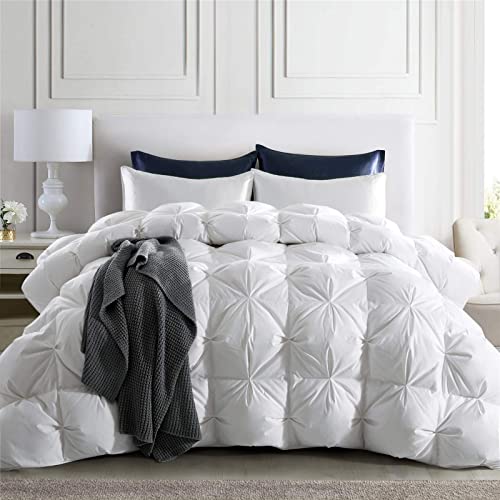
The specification is the strongest in this guide, and in a small bedroom it is not only a warmth specification. The listing specifies 93% white goose down — under US labeling rules a fill must be at least 75% down to be called down at all, and 93% is at the top of what consumer listings offer — at a maker-rated 800 fill power, with 40 ounces of fill in the full/queen size. The shell is 100% cotton at a 700 thread count, the highest shell specification here, and the pinch-pleat styling gives the surface a finished, made-bed texture without a cover — which, in a room where the bed is the decor, is a genuine feature rather than a styling footnote: the pleats break up the largest flat surface in the room and make an unmade-looking bed look intentional. The brand states the down is ethically sourced and certified to RDS and OEKO-TEX Standard 100. This pick sits near the top of the under-$400 tier, so check the current price on Amazon before ordering and confirm it is still inside the budget.
Eight hundred fill power down is also the most compressible serious fill here: high-loft clusters squeeze down small and recover, so when this comforter does leave the bed it stores in a fraction of the space the fiber picks need. The oversized 98 by 90 inch cut drapes generously over a thick mattress, making the bed look like furniture rather than camping equipment. Forty ounces of 800 fill power down is a substantial winter fill, and roundups place this model among heavyweight, cold-sleeper comforters; in a small, well-heated room, warm sleepers will find it a lot of comforter for much of the year.
- 93% goose down at a maker-rated 800 fill power — the strongest fill specification verified in this guide.
- 700 thread count cotton shell with pinch-pleat styling: the room’s main surface, finished without a cover.
- Cluster down compresses smallest of any fill here — the flagship that stores like a spare.
- Positioned near the top of this tier — check price on Amazon before you order.
Honest limitation: Care is dry clean only per roundup coverage of this model, and in a small bedroom that is a logistics problem, not a footnote: the comforter leaves for days, there is no spare, the bed — the room — sits bare or under a thin blanket in the meantime, and there is nowhere at home to drape a queen comforter to air before or after. Add the oversized cut: on a full-size bed in a genuinely tight room, 98 inches of width can puddle rather than drape. And because it sits near the top of the tier, a live price above the budget would move it out of this guide — confirm the current price on Amazon first.
Choose it if you are buying one flagship comforter for a small room, your winters are real, and a cleaner run twice a year — timed for a weekend away — is a routine you can actually run. Skip it if you sleep hot in a small heated room, you have no backup layer for cleaning days, or the live price has crossed the under-$400 line — the Globon below makes the same fill power claim while sitting much lower in the tier.
Globon Winter White Goose Down Comforter, Queen (90 x 90 Inch)
Who it suits: Small-bedroom value hunters who want a genuine high-fill-power down comforter for winter in a standard queen footprint — no oversized drape to manage — and who will trade brand polish and shell luxury for a position much lower in the tier.
The Globon is the puzzle of this tier, and this guide presents it as one rather than smoothing it over. The listing — sold on Amazon since 2017 — claims 800+ fill power white goose down in a 420 thread count shell, in a winter-weight queen measuring a standard 90 by 90 inches, with corner tabs and a 3D baffle-box style construction in roundup descriptions. That standard footprint matters in a small room: it drapes a queen properly and fits a full bed without the excess yardage of the oversized picks pooling on a floor you may not have. Independent coverage adds the details the headline omits: the shell is a cotton-polyester blend (68% cotton, 32% polyester in roundup specifications), the fill weight is around 37 ounces in the queen per one detailed comparison, and the down carries a maker treatment called Texcote-Nano that the brand says helps it handle moisture. Its positioning is the puzzle’s other half: premium specifications in the middle of the tier, from a maker that has sold down bedding for decades — check price on Amazon for the current figure.
So what gives? Partly, direct-import down spends on fill rather than retail presence. Partly, the savings are visible in the specification sheet — a blended shell instead of pure cotton, and a fill percentage stated less prominently than fill power, exactly the number this guide teaches you to ask for. The cluster fill compresses nearly as well as the hero’s, so storage is not the compromise; the surface is. A cotton-poly shell at 420 thread count is decent fabric, but it will not read as richly as the puredown’s 700 thread count cotton or the Egyptian Bedding’s long-staple cover — under a duvet cover, that gap disappears, and the corner tabs keep it seated in one. Judge it as what it verifiably is: a winter-weight comforter with a very high stated fill power, a mid-grade shell, and a long sales history, positioned well below the flagship end of this tier.
- Maker-rated 800+ fill power in a winter-weight queen — the highest fill power claim in this guide.
- Standard 90 x 90 inch cut: full drape without oversized fabric pooling in a tight room.
- Positioned in the middle of the tier for the queen — check price on Amazon.
- Sold on Amazon since 2017, with RDS and OEKO-TEX certifications reported in roundup coverage.
Honest limitation: The shell is a cotton-polyester blend, not the pure cotton its 420 thread count headline suggests, and the listing foregrounds fill power over fill percentage — read the full specification on the listing, and treat the 800+ figure as a maker claim that has not been independently lab-verified in the sources we could check. It is also a winter weight: in a small heated bedroom, that is a commitment, not a year-round default.
Choose it if winter warmth for the tier is the whole game and the comforter will live under a duvet cover, where its shell stops mattering. Skip it if the bare shell is your room’s main surface and you want it to look like it, you want an all-season rather than winter weight, or a claim this far ahead of its tier position makes you want the receipts only a bigger brand provides.
Beautyrest Hungarian White Goose Down Comforter, Full/Queen (90 x 98 Inch)
Who it suits: Small-bedroom buyers who want named-origin down — Hungarian goose down has a genuine reputation for large, resilient clusters — from a mainstream American bedding brand, and whose bed is the room’s centerpiece in the literal, visual sense.
Beautyrest’s entry in this tier is a study in specifications done properly. The fill is stated precisely: 75% Hungarian white goose down and 25% white goose feather, at a maker-rated 750 fill power. Seventy-five percent is the threshold at which US rules allow a fill to be labeled down without qualification, and Beautyrest prints it rather than hiding behind the word “luxury.” The shell is 100% US-grown cotton in a damask stripe at 500 thread count — a woven stripe, not a printed one, which in a small bedroom is the difference between a surface that looks textured from the doorway and one that only looks textured in the listing photo. The full/queen measures 90 by 98 inches, eight inches longer than the standard queen square, which tucks and drapes the way hotel comforters do; on a small room’s bed, that extra length is what lets the foot of the bed look finished instead of short-sheeted.
On price, this guide prints none for any pick: check the current price on Amazon, and treat that live figure as the first fact to establish. At a live price inside the under-$400 budget it belongs in this guide on its specifications; above that, it belongs to the next tier’s conversation. What the specifications promise, for the record, is the balanced premium profile — real cluster down at a strong fill power, a breathable all-cotton shell, all-season warmth, and the storage friendliness of cluster down, which compresses small when the room needs it off the bed. For a small bedroom that wants one beautiful flagship without the puredown’s dry-clean-only care label hanging over it — always confirm the care label on the live listing before assuming — this is the connoisseur’s middle path.
- 75% Hungarian white goose down at a maker-rated 750 fill power, percentages printed plainly.
- 500 thread count 100% US-grown cotton damask stripe shell; oversized 90 x 98 inch full/queen.
- Balanced premium profile in the upper part of this tier — check price on Amazon.
Honest limitation: The live price check is not a formality here, it is the fact that decides the pick: if the listing shows the comforter above the under-$400 budget it falls outside this guide’s promise entirely. The oversized length also deserves a thought in the smallest rooms: it is a virtue on the bed and extra fabric everywhere else.
Choose it if named-origin down and a printed fill percentage matter more to you than a headline fill power, and the live price lands in budget. Skip it if you want the maximum down percentage for the tier — the puredown’s 93% is a different league — or the live price has drifted out of the tier.
APSMILE Down Comforter, All Season, Queen (90 x 90 Inch)
Who it suits: Small-bedroom sleepers running the strict one-comforter strategy — one natural-fill, true all-season comforter that stays on the bed twelve months a year because there is nowhere to store a second one — and who read fill labels closely enough to know what they are getting.
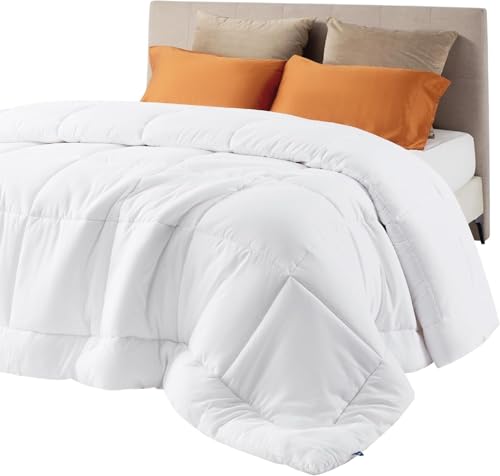
APSMILE is a factory-direct down and feather maker, and its all-season queen is the natural-fill value of the guide’s middle. The listing specifies a 90 by 90 inch queen with 46 ounces of fill and corner tabs, described in the maker’s materials line as down fibers and feather fibers, in a medium-warm, all-season weight. It sits in the middle of this tier — check price on Amazon for the current figure. Roundup coverage of the APSMILE line credits the brand’s comforters with baffle-box construction, double-stitched piping and OEKO-TEX certified materials, and the brand markets its line at 750 fill power — a figure this guide attributes to the brand’s marketing rather than to this listing, whose own copy says “high fill-power” without printing a number we could verify.
That distinction is the review. Down fiber and feather fiber are processed fills — the same family as the Serta hero of our lower-tier guide — not the intact down clusters of the puredown and Beautyrest above. Processed fiber is soft, warm and durable, and 46 ounces is a substantial all-season weight; it also lofts less per ounce than cluster down and carries more weight for the same warmth, which is why this pick sits in the middle of the tier. Fiber fill is also the bulkiest to store here. Its defense is that it is built never to come off the bed — a true medium weight survives a small room’s whole year, neither a winter commitment nor a summer layer needing a partner. Judged as the best version of its own category it earns its place; judged as a cut-price cluster-down duvet, it would disappoint.
- 46 ounces of fill in a 90 x 90 inch queen — a substantial, genuinely all-season weight.
- Positioned in the middle of the tier — check price on Amazon.
- Corner tabs for a duvet cover, from a factory-direct maker with decades in down bedding.
Honest limitation: The fill is down and feather fiber, not down clusters, whatever the “goose down comforter” phrasing elsewhere in the brand’s marketing implies; the 750 fill power figure attached to the brand’s line in roundups is not printed for this specific listing, so do not buy it as a 750 fill power comforter; and the fiber fill stores bulky — the one-comforter strategy is not just its strength, it is close to a requirement.
Choose it if you want natural fill and real fill weight in the middle of the tier, one comforter on the bed all year, with your eyes open about fiber versus clusters. Skip it if cluster loft and compact storage are the point — step up to the Globon or the puredown — or you need a verified fill power number on the specific product you order.
Brooklinen All Season Luxury Down Alternative Comforter, Full/Queen (90 x 90 Inch)
Who it suits: Feather-free small bedrooms, and anyone whose room has no slack for a care routine — this is the premium pick that washes at home, dries without ceremony, and asks for no cleaner trips, no airing space and no backup bedding.
Every other pick in this guide is a down product, and this one exists because the best comforter under $400 for some beds is not. Brooklinen’s all-season down alternative wraps its fill — a recycled polyester microfiber, described by the brand as vegan — in a 100% cotton sateen shell with baffle-box construction, at 90 by 90 inches for the full/queen. The shell is the story, and in a small bedroom it is a bigger story than usual: at every tier below this one, down alternative comforters arrive in microfiber shells that sleep warm and feel synthetic, while the Brooklinen’s cotton sateen is the surface of a premium comforter, quiet and breathable against the skin — and in a small room, that surface is the room’s largest visible texture, the thing the light lands on all day. The brand supports the comforter on its own store with a trial and warranty — note carefully that those are the brand store’s terms, and purchases made through Amazon follow Amazon’s return policies instead. Check price on Amazon for the current figure for this size.
The trade is the category’s trade. Polyester fill does not loft like 800 fill power down, does not breathe like goose fill, and will not last as many years as well-kept down; it also stores at full bulk, with no resilient clusters to compress. What it does is wash easily, sit below the flagship end of the tier, and eliminate the small bedroom’s worst logistics problem: no dry cleaner, no days with a bare bed, no queen-size drape airing over the shower rail. As the premium down alternative on Amazon, against a field of budget microfiber inserts, it has remarkably little direct competition.
- 100% cotton sateen shell and baffle-box construction — premium surfaces, no animal fill.
- Positioned in the upper-middle of this tier — check the current price on Amazon.
- Recycled polyester fill that machine washes without a care-label negotiation — the zero-logistics pick.
Honest limitation: It is a polyester comforter positioned where down comforters also compete: the loft, breathability and lifespan sit a class below the puredown and Beautyrest, it stores at full bulk with no compression advantage, and the long-term evidence for this listing is thinner than the brand’s reputation.
Choose it if your bed is feather-free, or easy home washing outranks ultimate loft — in a small bedroom, that is a more respectable trade than it sounds. Skip it if you are expecting down-like loft at this tier position — buy actual down, above — or storage space is so tight that a comforter which cannot compress is a problem in itself.
Egyptian Bedding Luxurious Goose Down Fiber Comforter, Queen (90 x 90 Inch)
Who it suits: Shell-first small-bedroom buyers who believe the fabric the room sees matters as much as the fill inside it, and who want a heavy, traditional, hotel-weight comforter as the room’s anchor piece.
Some listings survive a season; this one has been sold on Amazon since November 2009, in substantially the same form: 48 ounces of fill — 80% goose down fiber and 20% waterfowl feather fiber per the listing — inside a 100% Egyptian cotton cover, with baffle-box construction to hold the fill in place. The listing states the fill is certified to the Responsible Down Standard, Downpass and OEKO-TEX Standard 100, a certification stack none of the budget picks in our lower-tier guides could match. Egyptian cotton is the shell argument in its classic form: long-staple, smooth, breathable and durable, the fabric the luxury hotel trade built its reputation on. In a small bedroom, that shell is doing double duty — it is the bed’s surface and the room’s largest textile, the thing that catches window light and sets the room’s tone — wrapped here around a heavy 48-ounce fill that sleeps with the substantial, tucked-in weight traditionalists prefer.
The honesty notes are two, and both are printed rather than buried. First, the fill is down fiber, the processed fill this guide has flagged in every tier: warm, soft and heavy, with less loft per ounce than clusters, no fill power figure printed for it because none applies the way it does to cluster down — and, the small-room consequence, the least compressible fill in the guide, so plan on it living on the bed rather than in storage. Second, the listing’s own warmth language contradicts itself — coverage of this ASIN notes it is described in places as both lightweight and extra warm — and a 48-ounce fiber fill resolves that argument in one direction: this is a warm, weighty comforter, not a summer one. On price, this guide prints none: it belongs in the middle of this tier by its specifications, and the live listing is the authority — check price on Amazon before you weigh anything else in this review.
- 100% Egyptian cotton cover — the shell-first pick of the guide, and the room’s main textile.
- 48 ounces of fill with RDS, Downpass and OEKO-TEX certifications stated on the listing.
- Sold on Amazon in this form since 2009 — the longest track record here.
Honest limitation: Down fiber fill, not clusters, with a warm and heavy hand and the bulkiest storage profile in the guide; the listing’s warmth descriptions contradict each other; and its tier position should be confirmed on the live listing — check the current price on Amazon and expect a mid-tier position, not a premium-down one.
Choose it if the Egyptian cotton shell and a heavy, traditional feel are what you are buying, and the comforter will live on the bed year-round. Skip it if you want cluster loft, compact storage or a light summer weight, or the live price has climbed toward the cluster-down end of the tier — at that point the Globon and puredown are the honest competition.
Comparison Table
| Product | Type | Best use | Link |
|---|---|---|---|
| puredown Goose Down Comforter, 800 Fill Power, Full/Queen | 93% goose down, 700 TC cotton shell | Maximum down content, winter loft, smallest storage footprint | Check on Amazon |
| Globon Winter White Goose Down Comforter, Queen | Goose down, 800+ fill power claim, blended shell | Premium fill claims positioned in the middle of the tier, standard queen cut | Check on Amazon |
| Beautyrest Hungarian White Goose Down Comforter, Full/Queen | 75% Hungarian goose down, 500 TC cotton shell | Named-origin down from a mainstream brand | Check on Amazon |
| APSMILE Down Comforter, All Season, Queen | Down and feather fiber, 46 oz fill | One all-season comforter on the bed all year | Check on Amazon |
| Brooklinen All Season Down Alternative Comforter, Full/Queen | Recycled polyester, cotton sateen shell | The premium feather-free, wash-at-home option | Check on Amazon |
| Egyptian Bedding Luxurious Comforter, Queen | Down fiber, 100% Egyptian cotton shell | Shell quality and traditional weight as the room’s anchor | Check on Amazon |
How to Choose a Comforter for a Small Bedroom Under $400
- Start with the storage question, not the warmth question. In a small bedroom, where a comforter goes when it is off the bed decides more purchases than fill power does. If the honest answer is “nowhere,” you are buying one all-season flagship — the APSMILE’s medium weight or a cluster-down pick you will layer — not a winter specialist.
- Read all three fill numbers together. Percentage of down clusters, fill power, and fill weight in ounces. Any listing that trumpets one and whispers the others is telling you which number is weak — and in this guide, the fiber picks’ missing fill power is a category fact, not an oversight.
- Know the labeling rule. In the US, a fill labeled simply “down” must be at least 75% down clusters. “Down fiber” and “feather fiber” are processed fills — legitimate, warm, and a different product from clusters at any tier, with a bulkier storage profile as the small-room price of admission.
- Judge the shell as the room’s largest surface. In a small bedroom you will look at this fabric more than any wall. Cotton at 500–700 thread count (puredown, Beautyrest) breathes and reads richest bare; Egyptian cotton (Egyptian Bedding) is the durability classic; a cotton-poly blend (Globon) is where value picks save their money — and a duvet cover erases the difference, if you run one.
- Measure the drape against the room, not just the bed. Standard queens run 90 x 90 inches; oversized queens (the puredown at 98 x 90, the Beautyrest at 90 x 98) drape properly over thick mattresses — but on a full bed in a tight room, the excess can pool on a floor you walk on. Know your bed size and your floor clearance before preferring oversized.
- Prefer baffle-box construction at this price. Fabric walls between the layers let high fill power down actually loft; sewn-through quilting pinches the fill at every seam and wastes exactly what you paid for.
- Price the care logistics, not just the care. Dry-clean-only down at queen size costs a fee, an errand, and — in a one-comforter small bedroom — several nights with a bare bed. If you have no backup layer and no weekend-away rhythm to hide the gap, a washable pick is the honest better buy.
- Treat certifications as tiebreakers, not headlines. RDS and OEKO-TEX marks (puredown, Egyptian Bedding) are real, checkable standards for sourcing and processing — worth having, and worth more than any unverifiable “luxury” adjective.
- Plan the duvet cover decision as a space decision. A cover protects a premium fill and stretches the cleaning interval, and picks with corner tabs or loops (Globon, APSMILE) stay put inside one. In a small room it also lets one comforter change the room’s whole look for the cost of a cover — the cheapest redecoration available to you.
- Let it loft before you judge it. Premium down ships compressed. Give any pick here 48 to 72 hours of airing and shaking before deciding the loft is a lie — in a small room that means planning where it expands, because a queen comforter at full loft is a piece of furniture.
The Bed Is the Room: Your Comforter Is the Largest Surface You Own
A queen bed occupies roughly twenty square feet of floor before bedding; dressed, its visible top surface is the largest expanse of any one material in the room — larger than the rug that fits around it, larger than any one wall once windows, doors and the wardrobe take their shares. Every design decision is therefore downstream of the bedding. The comforter’s color is the room’s color scheme, its texture — pinch pleats, damask stripe, plain sateen — is the room’s texture, and whether the bed looks made is whether the room looks kept. In a small room there is no sightline that excludes it.
This is the real argument for spending at the $400 tier in a small bedroom. In a large house, a premium comforter is a sleep upgrade that disappears under a bedspread. In a small bedroom, it is the room’s principal furnishing decision — closer to choosing the sofa than the sheets. The puredown’s pinch-pleated 700 thread count cotton and the Egyptian Bedding’s long-staple cover are surface purchases as much as fill purchases. The Globon’s blended shell is the opposite lesson: its savings are taken where a small room can least hide them, on the surface — unless a duvet cover intervenes, in which case the cover becomes the surface and the Globon becomes the smartest buy in the guide. Choose which layer is your room’s face — shell or cover — and spend on that layer.
One Comforter, No Linen Closet: The Storage Math
Standard premium-comforter advice assumes a linen closet: winter and summer comforters rotating through storage. A small bedroom deletes the assumption — the realistic inventory is under the bed, one shelf, and the top of the wardrobe, all already spoken for. The strategy is therefore one flagship comforter at a weight the room can live with all year, layered with a throw in the coldest weeks rather than swapped. That is why the APSMILE’s medium weight is a serious small-room specification, and why “all season” — a phrase this guide treats skeptically elsewhere — is a genuine virtue here.
When a comforter does have to store, fill type decides the footprint. Cluster down compresses smallest: the resilient clusters in the puredown, Globon and Beautyrest squeeze to a fraction of their lofted volume and recover. Fiber fills — the APSMILE and the Egyptian Bedding — store near their working bulk, and polyester stores at full bulk. Two cautions: compression is a transport tool, not a storage method — down kept crushed in a vacuum bag for months recovers slowly, so store a flagship loose in a breathable cotton bag; and everything stored must be completely dry and clean first. In a small bedroom, storage is the second job the purchase has to do.
Dry-Clean Logistics: The Hidden Cost in a One-Bedroom Life
In a small bedroom, dry-clean-only care is more than a fee and an errand. A queen comforter at the cleaner is gone for days; with no spare, that means several nights under whatever thin layer the room can improvise — and the bed, which is the room, sitting visibly undressed. There is also nowhere to drape a queen comforter to air except over the shower rail or the door.
None of this disqualifies the puredown; it schedules it. Tie cleaning to absence — drop it on the way out of town, collect it on the way back — or keep one thin, highly compressible throw purely as the understudy. What does not work is discovering the care label at the first spill. The Brooklinen washes at home and returns to the bed the same day, which in a one-comforter room is a luxury no fill power can match; confirm the fiber picks’ care on their live listings before purchase. At this tier, in this room, the care label is a tenancy agreement between the comforter and the space it lives in.
Common Buying Mistakes
- Buying a winter-weight flagship for a small, well-heated bedroom because the specification looked impressive, then sleeping hot in the room that heats fastest in the home.
- Chasing the highest fill power number while ignoring fill weight — and buying a lofty-sounding summer comforter for a cold house.
- Believing a “goose down” headline without reading the fill percentage, and paying cluster-tier money for down fiber — then discovering the fiber’s storage bulk in a room with no closet.
- Planning a two-comforter rotation with nowhere to store the off-season one, and spending the year stepping around a vacuum bag.
- Storing a down comforter compressed in its shipping vacuum bag for months, then blaming the fill when it never fully lofts again.
- Skipping the care label until the first spill, then discovering a dry-clean-only comforter, no spare bedding, and a bed that is the whole room sitting bare.
- Comparing prices across sizes in one listing — a king figure in one place with a queen figure in another; sizes share listings, and the headline figure is usually the smallest size’s.
- Buying an oversized queen for a full bed in a tight room and living with drape pooled on the floor.
- Paying for a premium shell and then hiding it inside a duvet cover — or using an insert-style pick bare as the room’s main surface and wondering why the room looks unfinished.
- Judging loft in the first hour out of the packaging, in a room where the expanding comforter has temporarily taken over the bed, the chair and the floor.
Final Recommendation
- Most small bedrooms: puredown Goose Down Comforter, 800 Fill Power, Full/Queen Oversized.
- Premium fill on a budget: Globon Winter White Goose Down Comforter, Queen.
- Named-origin down, mainstream brand: Beautyrest Hungarian White Goose Down Comforter, Full/Queen.
- One comforter, every season: APSMILE Down Comforter, All Season, Queen.
- Feather-free, zero-logistics beds: Brooklinen All Season Luxury Down Alternative Comforter, Full/Queen.
- Shell-first traditionalists: Egyptian Bedding Luxurious Goose Down Fiber Comforter, Queen.
Our top two are the puredown and the Globon, because between them they frame the decision a small bedroom actually asks. If the budget is genuinely $400, the puredown is the honest flagship: 93% down is a specification no other Amazon listing we could verify matches, its pinch-pleated 700 thread count shell is the best surface in the guide for a room that will look at it all day, its cluster fill stores smaller than anything else here — and its dry-clean-only care is a routine you must be able to schedule around trips away, because the room has no spare. If that routine does not fit your life, the Globon is the value play of the tier, bought with open eyes about its blended shell — ideally under a duvet cover, where the shell stops being the room’s face — and the Brooklinen is the pick that removes the logistics question altogether by washing at home. The Beautyrest is the connoisseur’s middle: named Hungarian down, percentages printed, a damask shell that earns its place as the room’s centerpiece, pending one live price check on Amazon. The APSMILE is the strict one-comforter answer, and the Egyptian Bedding serves shell-first traditionalists whose comforter never leaves the bed. None of these is a heritage duvet from well above this tier, and none pretends to be. Read the three fill numbers, match the weight to your room’s real temperature, plan where the comforter goes when it is off the bed and where you sleep when it is at the cleaner — and buy the one that fits the room you actually have.
Frequently Asked Questions
Is a comforter under $400 really worth it in a small bedroom?
More than in a large one, arguably — because in a small bedroom the comforter is not just bedding, it is the room’s largest visible surface and its main piece of soft furnishing. The tier’s genuine differences — 75% to 93% down clusters at 600 to 800 fill power, cotton shells of 500 to 700 thread count, baffle-box construction — buy warmth per ounce, loft and breathability for sleep, and a surface that carries the room’s look all day. If the bed is the room, the thing on the bed is the purchase that matters most in it.
Where do I store a second comforter when there is no linen closet?
The honest answer is that in most small bedrooms, you do not — you run one all-season flagship and layer it in winter. If a second layer must store, choose by fill: cluster down compresses smallest and recovers, so a down spare in a breathable cotton bag under the bed is the only version of the plan that costs little space. Fiber and polyester comforters store near their full bulk. And never store any down comforter vacuum-compressed for months; compression is for moving day, not for the season.
What do I sleep under while my comforter is at the dry cleaner?
Plan for it rather than improvising: either time the cleaning to a trip away — drop off on the way out, collect on the way back — or keep one thin, highly compressible understudy layer (a light throw or summer blanket) that stores in almost no space because it is only asked to cover a few nights a year. This matters most with the puredown, the guide’s dry-clean-only pick; the Brooklinen, by contrast, washes at home and is back on the bed the same day.
Is down fiber the same as down?
No, and the distinction decides two of this guide’s six picks. Down clusters are the intact, quill-free undercoat that lofts to a rated fill power. Down fiber is a processed fill made from down and feathers: soft, warm and durable, but heavier for the same warmth, without a comparable fill power rating — and bulkier to store, which is the small-bedroom cost. Both are real goose-derived fills. The APSMILE and Egyptian Bedding here are fiber comforters and are reviewed as such; the puredown, Globon and Beautyrest are cluster-down comforters.
Will an oversized queen overwhelm a small room?
On a queen bed, no — the oversized cuts in this guide (the puredown at 98 x 90 inches, the Beautyrest at 90 x 98) simply drape the way hotel bedding does, and generous drape makes a small room’s bed look finished rather than larger. On a full or double bed in a tight room, be careful: the same extra fabric has nowhere to go but the floor. Match the comforter’s dimensions to your bed and your floor clearance, not to the size name.
Why does this guide not print prices?
Because listing prices change, and a printed figure would go stale. This guide therefore gives no static product price for any pick — not for the Beautyrest and the Egyptian Bedding, and not for the other four — and directs you to the live listing instead: check the current price on Amazon for the exact queen / full-queen ASIN. If a pick shows above $400 when you check, it has left this guide’s tier; judge the remaining picks, all positioned inside the budget, on their specifications, storage and care fit.
Should I use a duvet cover in a small bedroom?
It is the hardest-working accessory available to a small room. A cover protects a premium fill from spills and skin oils, stretches the cleaning interval — which, for a dry-clean-only flagship with no spare behind it, is a logistical lifeline — and lets one comforter change the room’s entire look for the cost of a cover instead of a second comforter you have nowhere to store. Picks with corner tabs or loops (the Globon and APSMILE here) stay seated inside one. Used bare instead, shell quality matters twice as much — which is the puredown’s and Egyptian Bedding’s home ground.
How long should a comforter at this price last in a small room?
A well-kept cluster-down comforter is a ten-year-plus purchase: down clusters recover their loft for years if they are kept dry, aired and uncompressed in storage. Fiber and polyester fills generally flatten sooner, which is part of what the premium down premium buys. Small rooms add one hazard of their own — the comforter is also the sofa, the desk chair and the reading nest, so it takes more daily wear than a bedroom-only comforter; a duvet cover is the cheapest way to keep that wear off the fill. Loft that fades is usually a cleaning and storage issue before it is a fill failure.
- Best Comforter For Small Bedrooms Under $200
- Best Comforter For Small Bedrooms Under $700
- Best Comforter Under $400
- Best Storage Bed Frame For Small Bedrooms
- Best Duvet Cover Set Under $100
- Best Bed Sheet Set For Small Bedrooms