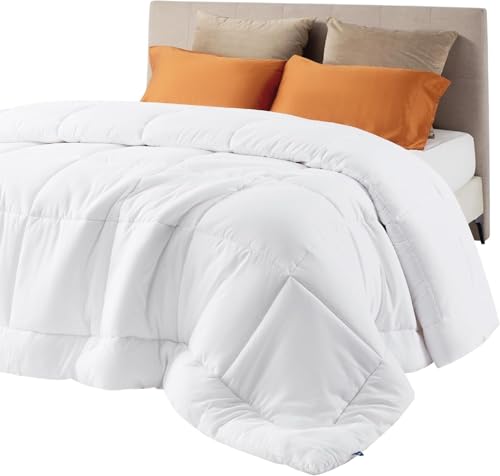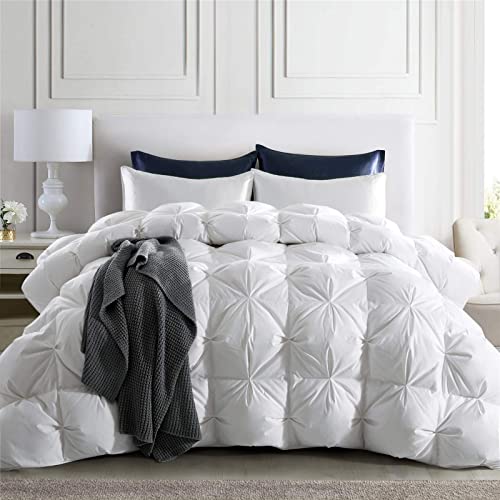
Where to buy
Check the latest price, availability and delivery on Amazon. Orders are placed on Amazon. We may earn a commission from qualifying purchases. Every pick in this guide is shown in the queen / Full-Queen size — comforter listings headline their cheapest twin size, and queen is the size most apartment beds actually are, so queen is the size we focused on throughout. Check price on Amazon for the current price of each pick.
- Best overall: puredown Goose Down Comforter, Full/Queen, 800 Fill Power — Check on Amazon
- Brooklinen All Season Down Alternative Comforter, Full/Queen — Check on Amazon
- Buffy Cloud Comforter, Full/Queen — Check on Amazon
- Buffy Breeze Comforter, Full/Queen — Check on Amazon
See 2 more Amazon options
- Egyptian Bedding Siberian Goose Down Comforter, Queen — Check on Amazon
- REST Evercool Cooling Comforter, Full/Queen — Check on Amazon
Read the full guide ↓
Disclosure: As an Amazon Associate, topratedkitchenware.com earns from qualifying purchases. Links to Amazon on this page are affiliate links; they cost you nothing extra. Listing details such as price and availability change often, so check the current Amazon listing before you buy.
A $1,000 comforter budget in an apartment starts with two facts, and this guide will not soften either of them. The first is about Amazon: no single queen comforter on Amazon verifiably costs anywhere near $1,000. We looked hard. The most expensive single queen comforter we could verify with a real listing and a fulfilment trail is the puredown 800 fill power goose down below — check price on Amazon — and the famous flagship names sit at a similar level in the premium tier. Above that premium tier and up to this budget, Amazon’s comforter shelf is, verifiably, almost empty. The comforters that genuinely sit in the highest luxury tier — 850 and 900 fill power European goose down, eiderdown, the heritage down houses — are sold direct or through boutiques, not through Amazon listings we could verify.
The second fact is about renting. A comforter is the rare furnishing that is entirely yours: it is not sized to the room, not bolted to the landlord’s wall, and it leaves with you at the end of the lease in a single box. That cuts both ways: premium bedding is a purchase a renter keeps in full, but the usual apartment traps apply — no in-unit laundry for a dry-clean-only flagship, little storage for a rotation, and a lease that may end early. So this guide does two honest things. It gives you the six best premium comforters that genuinely sell on Amazon at or under this budget for a queen, re-judged for apartment life. And it shows you how a $1,000 budget is actually best spent here — not on one mythical thousand-dollar quilt, but on a system, with the remainder deliberately left unspent.
For most apartment dwellers we would begin with the puredown 800 fill power: the highest verified specification on Amazon — a maker-stated 800 fill power and 93 percent goose down — while still leaving much of this budget in your pocket. But read its review before you buy it, because it is dry clean only, and in a walk-up with a basement laundry room that single line may matter more than the fill power. If care logistics rule your life, the washable Buffy Cloud further down is the pick most renters actually live happiest with. Below you will find a quick picks table, detailed notes on each of the six, a comparison table, a buying checklist for renters, an account of when flagship money makes no sense in a rental, the mistakes apartment shoppers make most, and answers to common questions.
In this guide
Quick Picks
Short on time, or comparing several options at once? Each row below names a buyer type and the product that suits it, with a link to the listing. Each pick is shown for the queen size — check the current price on Amazon before you buy, as premium comforter prices move with deals and coupons.
| Buyer type | Pick | Why it stands out | Link |
|---|---|---|---|
| Best overall | puredown Goose Down Comforter, Full/Queen, 800 Fill Power | The highest verified spec on Amazon: stated 800 fill power, 93% goose down — check price on Amazon | Check on Amazon |
| Best premium down-alternative | Brooklinen All Season Down Alternative Comforter, Full/Queen | Cotton sateen shell and recycled fill from the flagship DTC brand — check price on Amazon | Check on Amazon |
| Best for renters without laundry | Buffy Cloud Comforter, Full/Queen | Lyocell shell, recycled fill, machine washable at home — check price on Amazon | Check on Amazon |
| Best summer weight | Buffy Breeze Comforter, Full/Queen | 100% eucalyptus lyocell, shell and fill — check price on Amazon | Check on Amazon |
| Best down value | Egyptian Bedding Siberian Goose Down Comforter, Queen | Maker-stated 750 fill power and 60 oz of down — check price on Amazon | Check on Amazon |
| Best for hot apartments | REST Evercool Cooling Comforter, Full/Queen | Purpose-built cooling shell — check price on Amazon | Check on Amazon |
How These Picks Were Chosen
The first filter was verification, and at this budget it was the filter that did the most work. Every linked product below is a real Amazon listing whose ASIN we could tie to the exact product, size and configuration, and whose identity we could trace to a listing and to the exact product, size and configuration. That sounds like a low bar until you shop this tier: the web is full of roundup pages quoting four-figure comforters “on Amazon” that turn out to be brand-site prices, king sizes, or listings with no featured offer at all. Where a famous product could be identified but its exact queen ASIN could not — Brooklinen’s all-season down comforter is the case in point — we name it in the text and tell you the reason it carries no link, rather than guess an ASIN and hope. An ASIN in this guide is a promise; we do not make promises we could not check.
The second filter was the lease. A comforter bought for an apartment has to survive apartment conditions, so each pick was re-judged on four renter questions. Can you actually clean it — at home, in a shared laundry room, or only at a dry cleaner you will have to carry it to? Where does it live when it is not on the bed, in a unit whose entire linen storage may be one shelf? Does it move well — light, compressible, indifferent to being boxed for a month between leases? And does its lifespan make sense against your horizon: a flagship down comforter is a ten-year object, and ten years is four or five leases for most renters. Picks that failed a question were not dropped — at this tier there are only six honest picks — but the failure is printed in their reviews, in the open, where it belongs.
We did not sleep under these comforters ourselves. We read the maker listings and specification pages, compared fill types, down content percentages, fill-power claims, fill weights, shell fabrics and dimensions, and cross-checked details against retailer listings, Amazon-fulfilled mirror listings and expert coverage. Warmth words — all-season, heavyweight, extra warm — are maker descriptions, and we treat them that way throughout: a comforter’s real warmth is set by how much fill is inside it and how lofty that fill is, not by the adjectives on the box. Fill-power figures are always attributed to the maker, because fill power is a laboratory number the maker reports, not a fact a listing page can prove. Where a maker calls a comforter “hypoallergenic,” we repeat it only as the maker’s label; nothing in this guide treats bedding as a treatment for anything.
One thing we checked carefully was what each fill actually is. At the top of the market the listings mix four different things — cluster down, down fiber, feather fiber and synthetic down-alternative — and they are not interchangeable, however similar the product photos look. Each review names the fill precisely as the maker states it, including the percentages where the maker publishes them, so you know whether you are buying down clusters, processed fiber, or polyester wearing a down costume. At this premium level, the difference between 93 percent down clusters and 90 percent feather fiber is most of what distinguishes one pick from another, and it should never be blurred.
The 6 Best Comforters for Apartments Under $1,000
puredown Goose Down Comforter, Full/Queen, 800 Fill Power
Who it suits: Cold sleepers on a long lease — renters in drafty, under-heated buildings who want the highest specification that can actually be verified on Amazon, and who have a dry-cleaning routine they will honestly keep.
This is the ceiling of the verifiable Amazon market, and it earns the hero spot on specification rather than branding. The fill is 93 percent white goose down — the highest down content we could verify in a queen comforter on Amazon — at a maker-stated 800 fill power, with 40 ounces of fill in the Full/Queen size. The finished dimensions are an oversized 98 by 90 inches, the shell is 100 percent cotton at a stated 700 thread count, and the construction is a 3D baffle box with a pinch-pleat face and corner tabs for a duvet cover. Puredown claims RDS and OEKO-TEX Standard 100 certification for the down; both are maker claims, printed here as such. Check price on Amazon for the current price of this pick. Put the specification in context: an 800 fill power cluster down with a 93 percent down content is, on paper, the grade of fill that direct-to-consumer down houses position in their higher tiers — Puredown’s own website lists made-in-Germany 800 fill power lines and a luxury white goose down line above this Amazon pick in its own range.
Now the apartment re-judgment, because this pick’s strengths and its one serious weakness are both amplified by renting. The strength is portability of value: unlike a sofa bought for one living room’s dimensions, a flagship comforter fits every bed you will ever rent, and spread over a decade of leases, a flagship like this can earn its place through long-term use. The oversized 98 by 90 cut is a mixed blessing in a small rental bedroom — the drape is luxurious, but on a queen bed pushed against a wall, the extra eight inches pool on the wall side and bunch. The weakness is care. This comforter is dry clean only, full stop. In a house with a laundry room that is an errand; in a fourth-floor walk-up it is a recurring expedition — a bulky, heavy bag hauled down the stairs and across the neighborhood, twice a year, every year you own it. A good duvet cover, washed weekly at home, stretches the interval between cleanings enormously, and for most owners that is the honest system: cover takes the wear, flagship goes out rarely. But if you know you will not do it — if the realistic future is a flagship that gets dirtier and flatter because the trip never happens — the washable picks below will serve you better and ask far less of you.
- Maker-stated 800 fill power with 93% goose down — the highest verified spec in this guide.
- Oversized 98 × 90 in queen with 40 oz of fill and a 700 TC cotton shell.
- Premium flagship tier on Amazon — check price on Amazon.
Honest limitation: Care is dry clean only — a real, recurring logistics cost for a renter without in-unit laundry — and the 800 fill power figure is the maker’s own, not independently certified on the listing. It is also a genuinely warm winter-weight comforter: in a radiator-heated apartment you do not control, it will be too much blanket for much of the year.
Choose it if your building runs cold, your lease horizon is long, and you will protect it with a duvet cover and actually dry clean it. Skip it if your apartment runs hot, your laundry is a laundromat trip, or you expect to move within the year — take the Buffy Cloud below and keep the change.
Brooklinen All Season Down Alternative Comforter, Full/Queen
Who it suits: Studio and one-bedroom renters whose bed is also the room’s main piece of furniture — shoppers who want the flagship-brand look on display every day, without animal fill.
Brooklinen is the brand most people picture when they picture a premium comforter, and its down-alternative is the version we can link with a clear conscience: the Full/Queen All Season ASIN verified, measuring 90 by 90 inches, with a 100 percent cotton sateen shell over a fill of RPET microfiber spun from recycled plastic bottles, in baffle-box construction with corner loops. Brooklinen positions the Full/Queen All Season in the premium tier of its own range; check the current price on Amazon before judging it, as the brand’s pricing moves with its frequent promotions. The maker describes the comforter as vegan, which it is — the fill is recycled polyester — and as hypoallergenic, a label we repeat only as the maker’s, since no comforter treats allergies.
The apartment case for this pick is presentational. In a studio, the bed is the sofa, the backdrop for video calls and the largest surface in the home; a comforter that drapes with a soft, matte, finished look is doing furniture work, not just bedding work. The cotton sateen shell is what delivers that look — it reads like bedding from a good hotel rather than gear from a camping shop — and the baffle boxes keep the recycled fill distributed so the bed looks made rather than lumpy. Why does a synthetic sit second in a $1,000 guide? Because at the top of the market, what the extra money buys is not always more warmth — it is shell quality, construction and consistency. Its natural partner is the puredown above: one genuine down flagship for winter, one branded alternative for the rest of the year, together forming a two-comforter rotation. Note the Amazon-specific caveat: this listing’s Amazon presence is still limited, because most Brooklinen buyers buy direct; judge it by the specification and the brand’s record, and check which warmth level — Lightweight, All Season or Ultra Warm — the listing has selected before ordering.
- 100% cotton sateen shell — the finish that separates premium alternatives from budget ones.
- Recycled-bottle RPET fill in baffle-box construction, with corner loops.
- Full/Queen All Season sits in the premium tier of the brand’s range — check price on Amazon.
Honest limitation: It is a synthetic fill and will not match down’s warmth-to-weight ratio; Brooklinen does not recommend machine washing it, which removes the usual down-alternative advantage and matters in an apartment — plan on a duvet cover and spot care, or a commercial machine; and its Amazon review base is thin because the brand sells mainly direct.
Choose it if the bed is on display in a small space and you want the branded, finished look without animal fill. Skip it if easy home washing is the whole point of going synthetic — the Buffy Cloud below is built for the machine.
Buffy Cloud Comforter, Full/Queen
Who it suits: Most renters, honestly — anyone who wants a premium-feeling, all-season comforter that goes in a washing machine, in a building where the dry cleaner is a trip and the laundry room is shared.
The Cloud is the comforter that built Buffy’s name, and it returns here from our under-$200 guide because a $1,000 budget does not change what it is: the washable premium benchmark. The shell is eucalyptus lyocell — listed as rayon from eucalyptus on the Amazon page — which feels smooth and cool rather than papery, and the fill is layers of fiber made from recycled plastic bottles; Buffy says each comforter keeps about 50 bottles out of landfill, a maker claim, but the fill itself is real, lofty and evenly distributed. The Full/Queen measures 90 by 90 inches and has corner tabs for a duvet cover. It is sold by Buffy Inc. itself on Amazon — check the current price on Amazon, and re-check the size selector before ordering.
In an apartment the Cloud’s virtue compounds. It is the comforter you actually wash: no dry-cleaning bag, no expedition, just the machine — and while a queen comforter is a load all by itself in a shared laundry room, it is a load that fits and finishes in one visit, rather than a cleaner’s bill. That makes it the sensible workhorse of the allocation plans below: the everyday layer that takes the spills, the pets, the coffee in bed and the weekly wear, while a down flagship — if you buy one — stays pristine under a cover. It is also the easiest pick here to move: light, unbothered by being rolled and boxed, and, as a washable premium pick rather than a flagship, a moving-day scuff is an annoyance rather than a loss. It is an all-season weight, and warm sleepers in heated bedrooms will find it plenty. Note the size trap carried over from the $200 guide: the King/Cal King sits in a higher size tier, and queen shoppers should make sure the Full/Queen option is the one in the cart.
- Eucalyptus lyocell shell that feels cool and smooth, not plasticky.
- Machine washable at home — the only flagship here that asks nothing of a dry cleaner.
- Washable premium pick in Buffy’s range — check price on Amazon.
Honest limitation: A synthetic fill, however good: it will not match real down’s warmth-to-weight ratio or its decades-long lifespan, and a queen load still monopolizes a shared laundry-room machine for a full cycle. Very cold sleepers in unheated rooms will want a heavier winter weight over it.
Choose it if you want one washable, all-season comforter that feels premium and asks nothing of you — the default renter’s pick in this guide. Skip it if you are set on genuine down, or you sleep genuinely cold and need a winter-weight fill as your only comforter.
Buffy Breeze Comforter, Full/Queen
Who it suits: Hot sleepers and top-floor renters building a seasonal system — this is the summer layer that lets the winter flagship rest, and the lightest thing in this guide to store and to move.
The Breeze is Buffy’s second comforter and its most single-minded: shell and fill are both 100 percent eucalyptus lyocell, with no polyester anywhere in it, built as a lightweight summer insert that still carries corner tabs for a duvet cover. The Full/Queen is 90 by 90 inches and about five pounds — a fraction of the puredown’s heft — and coverage of the line notes OEKO-TEX Class I certification, a maker-side claim we print as such. Check the current price on Amazon for this pick; pricing for this line can vary by retailer and promotion, so the live listing check matters.
The Breeze’s place in an apartment guide is storage arithmetic. The single most common way premium comforters disappoint renters is seasonal: a magnificent winter down quilt is a misery in July, so it gets stuffed into the top of the only closet, in a plastic bin that eats a quarter of the household’s storage. A two-comforter rotation only works in a small unit if the off-season half stores small — and at five pounds of lyocell, the Breeze folds flat, breathes in a cotton bag and takes a fraction of the space a synthetic winter comforter would. It is also the synthetic-free option here, and on moving day it is the easiest object in this guide to carry. What it is not is a year-round answer anywhere with a real winter: five pounds of lyocell is a summer layer, and the guide that tells you otherwise is selling, not advising.
- 100% eucalyptus lyocell, shell and fill — no polyester, no animal fill.
- Featherweight summer layer at about 5 lb in Full/Queen, with corner tabs.
- Summer layer in Buffy’s premium range — check price on Amazon.
Honest limitation: Summer weight only — it will not carry a cold bedroom — and pricing for this line can vary between sources, so the live listing check matters more for this pick than any other.
Choose it if you run hot, live somewhere warm, or are building the two-season rotation this guide recommends and need the off-season half to store small. Skip it if you want one comforter for the whole year in a cold climate.
Egyptian Bedding Siberian Goose Down Comforter, Queen
Who it suits: Down lovers furnishing a first proper apartment bed — or a spare-room and sofa-bed setup — inside a bigger budget: the most genuine down for its tier that we could verify anywhere on Amazon.
This pick returns from our under-$200 guide, where it was the value sensation, and it earns its place here for a different reason: in a $1,000 apartment system it is the second-bed down comforter, the one that lets a guest setup, a daybed or a partner’s different-temperature bed sleep under real down too. The specification remains startling for its tier — a maker-stated 750 fill power, 60 ounces of Siberian goose down fill in the queen, a 600 thread count 100 percent Egyptian cotton cover, baffle-box construction, 90 by 90 inches. Mattress Clarity’s reviewers, who did sleep under it, called it one of the loftiest down comforters they had tried. Check the current price on Amazon before ordering.
The honest context is the brand. Egyptian Bedding is an Amazon-native label, not a heritage down house: its thread-count and origin language is marketing-rich, its customer service is not Brooklinen’s, and some owners report the occasional escaping feather, the classic down-comforter tax. Buy it for the fill, inspect it on arrival, and air and fluff it properly before judging the loft, because vacuum-packed down needs hours to recover. For renters there is one more consideration: down stores badly when it is stored wrong. Sixty ounces of it will live happily in a large breathable cotton bag under the bed, but it should never spend a summer vacuum-compressed in a space-saver bag — the clusters that make it lofty are exactly what long compression damages. In the two-bed plan below it takes the spare and second-bed role, chosen for its fill specification rather than for brand premium.
- Maker-stated 750 fill power goose down — a flagship-grade claim at a mid-market price.
- 60 oz fill weight in queen, in a 600 TC Egyptian cotton baffle-box shell.
- Down value pick in the lower part of the premium range — check price on Amazon.
Honest limitation: An Amazon-native brand with marketing-heavy copy, occasional feather leakage reported, and buyers should check the current price on Amazon before ordering. Like all down here, it asks for breathable storage an apartment may have to improvise.
Choose it if real down loft is the point and the bed is a second, guest or spare bed. Skip it if brand pedigree, a sleep trial and painless returns matter more to you than fill specifications — that is what the Brooklinen premium buys.
REST Evercool Cooling Comforter, Full/Queen
Who it suits: Renters in hot apartments — top-floor units, west-facing windows, radiator buildings where the heat is on full from October to April and you control none of it.
The Evercool is a different species from the other five picks: a lightweight cooling blanket-comforter whose proprietary Evercool shell fabric — a nylon and spandex blend — is engineered to feel cool on contact, wrapped around a light plant-based fiber fill that secondary coverage identifies as a Sorona blend. It measures 90 by 90 inches in Full/Queen, weighs about 5.5 pounds, is machine washable, and carries Good Housekeeping bedding awards, which the listing makes much of. REST does not publish a Q-Max coolness figure for the fabric, a point in its favor for honesty: the Q-Max numbers quoted by rival cooling brands describe a fraction of a second of first contact, not the temperature under the quilt at 3 a.m. What owners consistently report is simpler — it feels cool when you get in and does not turn into a sauna by morning. Check the current price on Amazon for this pick. It sits in the premium cooling tier, below the flagship down picks in this guide’s range.
Apartment heat is a special misery because it is so often someone else’s decision: the boiler serves the whole building, the radiator valve is painted shut, and the bedroom sits at a temperature you would never choose. A down flagship cannot help you there. The Evercool addresses the actual condition of the room, and it does so in a 5.5-pound, machine-washable package that suits a renter’s life: light to carry to the laundry room, quick to wash between heat waves, easy to fold away if the building’s heating season ends and a normal comforter comes back out. Its limits are the mirror of the puredown’s: at 5.5 pounds it is a warm-weather instrument, and the household that buys it as a winter comforter for a cold, drafty unit will be cold and cross. Buy it as what it is — the premium answer to a hot apartment — and it has no verified rival on Amazon.
- Purpose-built cooling shell that feels cool on contact, in a lightweight 5.5 lb build.
- Machine washable, and a repeat Good Housekeeping award winner per the maker.
- Premium cooling tier — check price on Amazon.
Honest limitation: A summer-weight cooling layer, not a winter comforter; the cooling effect is a contact and breathability effect, not refrigeration, and REST publishes no laboratory coolness figure to compare against rivals.
Choose it if your apartment overheats and you do not control the thermostat — this solves the problem you actually have. Skip it if your unit runs cold and you want year-round warmth from a single purchase.
Comparison Table
| Product | Fill (as maker states) | Best use | Link |
|---|---|---|---|
| puredown Goose Down Comforter, Full/Queen | 93% goose down, stated 800 fill power, 40 oz | Flagship winter down — check price on Amazon | Check on Amazon |
| Brooklinen Down Alternative Comforter, Full/Queen | Recycled RPET microfiber, cotton sateen shell | Branded premium alternative — check price on Amazon | Check on Amazon |
| Buffy Cloud Comforter, Full/Queen | Recycled fiber, lyocell shell | Washable all-season premium — check price on Amazon | Check on Amazon |
| Buffy Breeze Comforter, Full/Queen | 100% eucalyptus lyocell | Summer layer for the rotation — check price on Amazon | Check on Amazon |
| Egyptian Bedding Siberian Goose Down, Queen | Goose down, stated 750 fill power, 60 oz | Second-bed real down — check price on Amazon | Check on Amazon |
| REST Evercool Cooling Comforter, Full/Queen | Plant-based fiber, cooling shell | Hot apartments — check price on Amazon | Check on Amazon |
How to Choose a Comforter for an Apartment Under $1,000
- Start from the ceiling, not the budget. The verifiable top of Amazon for a single queen comforter sits well below the $1,000 budget. Any plan for $1,000 here is a system plan — flagship plus seasonal layers — and any listing implying a single comforter near the full budget on Amazon deserves deep suspicion.
- Count your lease, not just your money. A flagship down comforter is a ten-year object. On a twelve-month lease with a likely move, the short horizon and the moving hassle argue for the washable mid-tier picks; on a long, stable tenancy, the flagship has the years it needs to earn its place.
- Decide about washing before you buy. Premium down is dry clean or commercial machine only — a recurring cost and, in a walk-up, a recurring expedition. If home or laundry-room washing matters, the Buffy Cloud and the Evercool are the picks built for it, and a duvet cover is what keeps a dry-clean-only flagship out of the cleaner’s hands for months.
- Know your building’s temperature, not the season’s. Radiator buildings overheat; garden units and drafty older buildings run cold. Buy for the bedroom you actually sleep in — the Evercool for the overheated unit, the puredown for the cold one — not for the climate zone on the map.
- Plan the storage before the rotation. A two-comforter system needs somewhere for the off-season half to live. Lyocell folds flat; down needs a large breathable bag and must never spend months vacuum-compressed. If there is genuinely no shelf, one all-season comforter is the honest system.
- Decide the fill family first. Cluster down is lightest and loftiest, feather and down fiber are heavier and cheaper, and premium synthetics offer shells and consistency. The six picks split across the families on purpose; pick the family, then the product.
- Read down content before fill power, and fill power with fill weight. 93 percent down at a stated 800 fill power and 75 percent down at 800 are different products wearing the same headline. The puredown pairs a stated 800 with 40 oz; the Siberian pairs a stated 750 with 60 oz. Either number quoted alone is marketing.
- Check the queen size, not the headline. Comforter listings lead with the twin size, and king sizes of the flagships sit in a higher tier than the queen. Every pick in this guide is shown in the queen or Full/Queen size; confirm the size selector and check price on Amazon before comparing anything.
- Count the loops if you use a duvet cover. In an apartment the cover is not decoration — it is the washing strategy. Corner tabs are the minimum; check your cover’s ties match, and let the cover take the weekly laundry-room trips instead of the comforter.
- Leave the remainder unspent on purpose. A $1,000 budget that ends well below the budget on verified comforters is a success, not a shortfall. The unspent remainder is not a failed search; it reflects the Amazon market as it actually is — and it is your moving fund.
When a Renter Should Not Spend Flagship Money
Most comforter guides assume a house, a linen closet and a decade in one bedroom. Apartment life breaks all three assumptions, and there are four common situations where the flagship money in this guide is simply the wrong spend — where the honest advice is to buy the washable Buffy Cloud pick, or a simpler option still, and keep the rest.
The first is the short or uncertain lease. A premium down comforter earns its price across years of nightly use; if you are on a twelve-month lease in a city you may leave, in a furnished sublet, or between a graduation and a first job in another state, the flagship’s economics have no time to work. The second is the move itself: every object you own is something you will carry down stairs, fit in a car or pay a mover to box, and while a comforter is among the easiest furnishings to move, a rotation of three is three bags on the truck. The third is care you will not perform. A dry-clean-only flagship owned by someone whose realistic cleaning plan is “eventually” is not a luxury purchase; it is a slow write-off, because down that is never cleaned and never aired loses the loft that justified its price. The fourth is a room the comforter cannot fix: if the bedroom is hot because the building’s boiler is fierce, winter down is worse than useless, and the cooling layer is the flagship purchase for that room.
Notice what is not on that list: renting itself. The walls are the landlord’s; the bed is yours, it is the piece of the home you spend a third of your life in, and it is the one premium category that moves with you undiminished — no re-measuring, no “it doesn’t fit the new place,” no resale at a loss. A renter on a stable lease who buys one verified flagship and uses it for a decade across three apartments has made a better purchase than a homeowner who buys a mediocre comforter for a house. The question is never renter versus owner. It is horizon, heat and laundry — and those three, answered honestly, pick the comforter.
One Flagship, One Rotation Partner: Spending $1,000 in a Small Rental
Given a verified ceiling that sits well below this budget, the interesting question at this budget stops being “which one?” and becomes “which combination?” A comforter is a seasonal instrument: the fill weight that is perfect in January is a punishment in July, and the households that sleep best on premium bedding almost never own one comforter — they own a rotation. In an apartment the rotation has one extra rule: the off-season half has to store small. Here are two complete plans, built only from the picks in the reviews above, with the remainder deliberately left unspent.
Plan one — one bed, three seasons. The puredown 800 fill power is the winter flagship — check price on Amazon. The Buffy Breeze is the summer layer — five pounds of lyocell that folds flat into a drawer for the months it is not on the bed. The Buffy Cloud is the all-season middle and the washable workhorse for the shoulder months and laundry weeks. Three comforters, every season covered, and part of the budget still in your pocket — which, in an apartment, is best understood as the duvet-cover and storage fund, or simply the deposit on the next place. This is the plan we would hand to most readers with $1,000, one bed and a lease they expect to renew.
Plan two — bed plus guest setup, both in real down or better. The puredown takes your bed — check price on Amazon. The Brooklinen down-alternative takes the guest setup — the sofa bed, the daybed, the spare room in a two-bedroom — where a branded, handsome, low-maintenance comforter is worth more than a second fill specification, and where it will also be the comforter visitors actually see. The Egyptian Bedding Siberian becomes the spare: the winter layer for whichever bed runs colder, or the loaner that makes a last-minute guest feel hosted rather than accommodated. Two sleeping spots finished and one spare in the closet, without chasing a single direct-sale luxury comforter.
Notice what neither plan does: chase the number. There is no filler purchase, no fourth comforter bought to make the total look intentional, no accessory at an invented price padding the arithmetic. A budget is a ceiling, not a target — and for a renter, the unspent remainder is not an abstraction. It is next month’s rent buffer, the movers’ tip, the deposit. Leaving part of a comforter budget unspent is not failing to shop; it is the correct outcome when the verified market for a single queen sits well below the budget.
Moving Day: The Bedding That Leaves With You
Every renter knows the inventory of regret: the bookshelf that only fit one apartment, the rug sized to a room that no longer exists, the couch sold for a third of its price because the new stairwell turned the wrong way. Bedding is the glorious exception, and it is worth understanding why before you decide what premium bedding is worth to you. A queen comforter fits the next queen bed, in the next city, on the next lease, with no measurement and no adaptation. Of everything in a home, it is the furnishing whose value transfers between addresses at one hundred percent — which is the strongest argument in this entire guide for buying it well.
Moving it well takes three small disciplines. Pack down clean and completely dry, in a breathable cotton bag rather than a sealed plastic bin, because trapped moisture mildews a flagship in storage. Resist the vacuum bag for anything longer than the move itself, since months of compression break down the clusters that make down lofty. And air everything on arrival — boxed down needs hours, ideally a day, of fluffing before its loft returns.
The care logistics follow the same pattern across a tenancy. Without in-unit laundry, your system is: duvet covers washed weekly in the shared machines, washable comforters washed as single queen loads when they need it, and the dry-clean-only flagship cleaned rarely and deliberately — timed, ideally, to the seasonal swap. Run that way, a flagship asks for less effort than a basic comforter washed badly and replaced yearly.
Common Buying Mistakes
- Believing a roundup’s “near-budget comforter on Amazon” without checking whether the price is a brand-site figure, a king size, or a listing with no featured offer.
- Buying a dry-clean-only flagship with no cleaning plan, then watching it flatten and dull in a building where the cleaner is a bus ride away.
- Reading fill power without fill weight — a stated 800 with a skimpy fill is a summer blanket wearing a luxury number — or without down content: 93 percent down and 75 percent down at the same fill power are different products.
- Buying winter-weight down for a radiator-heated apartment you cannot cool down, then spending the winter sleeping on top of a flagship comforter.
- Storing down vacuum-compressed for a whole off-season, or sealed in plastic between leases, and destroying the loft the money bought.
- Building a three-comforter rotation with no shelf, bin or under-bed space to hold the two that are off the bed.
- Judging vacuum-packed down in its first hour, before a day of airing and fluffing has restored the loft you paid for.
- Comparing a twin headline price against a rival’s queen price — at this tier the size steps move a pick into a noticeably higher tier.
- Skipping the duvet cover on a dry-clean-only flagship comforter, then paying for cleanings a washable cover would have prevented.
- Spending flagship money weeks before a move you already know is coming, instead of after you have seen the new bedroom’s size and temperature.
- Trying to spend the whole $1,000 because it was budgeted — the unspent remainder is the correct outcome when the verified market tops out well below the budget.
Final Recommendation
- Most buyers: puredown Goose Down Comforter, Full/Queen, 800 Fill Power.
- Branded premium alternative: Brooklinen All Season Down Alternative Comforter, Full/Queen.
- The renter’s default: Buffy Cloud Comforter, Full/Queen.
- Summer layer: Buffy Breeze Comforter, Full/Queen.
- Second-bed down value: Egyptian Bedding Siberian Goose Down Comforter, Queen.
- Hot apartments: REST Evercool Cooling Comforter, Full/Queen.
Our top two are the puredown for the flagship job and the Buffy Cloud for everything else, because between them they state this guide’s whole argument: the best verifiable down specification on Amazon is the puredown, the best washable premium comforter is the Buffy Cloud, and together — with the Breeze added for summer — they build a three-season system that no single comforter we could verify on Amazon can match. Which of the two leads your own purchase depends on your apartment, not on the products: cold building, long lease and a cleaning routine you will keep — flagship first. Hot unit, shared laundry and a move on the horizon — Cloud first, and let the flagship wait for the lease that deserves it. If brand provenance matters more to you than specification, the Brooklinen down-alternative is your linked route, and Brooklinen’s down comforter itself is discussed by name in the base research for this tier as the first swap-in if its exact queen ASIN verifies. None of these will out-provenance a boutique flagship from a heritage down house, and they do not try to. Check the queen size is selected, check the current price on Amazon, and let the rest of the $1,000 stay where it belongs — unspent, and ready for the next lease.
Frequently Asked Questions
Does any comforter on Amazon really cost $1,000?
Not that we could verify in a queen size. The most expensive single queen comforters with a verifiable listing and fulfilment trail sit well below this budget in the premium tier — the puredown 800 fill power and Brooklinen’s down comforter on its Amazon storefront are among them. Check price on Amazon for each. Comforters that genuinely cost $1,000 or more — 850 to 900 fill power European down, eiderdown, heritage brands — are sold direct or through boutiques. If a page shows you a four-figure “Amazon” comforter, check whether the price is a brand-site figure or a king size before believing it.
Is a premium comforter a sensible purchase for a renter?
It can be the most sensible premium purchase a renter makes, because bedding is the one furnishing that transfers between apartments at full value — same bed, same comforter, no refitting and no resale loss. The conditions are horizon and care: a lease you expect to renew (or a life in which you will keep a queen bed for years), a building temperature the comforter suits, and a cleaning plan you will actually follow. Fail any of those and the washable mid-tier picks in this guide are the better buy.
How do I care for a down comforter without in-unit laundry?
With a system rather than a machine. A washable duvet cover, laundered weekly in the shared laundry room, takes nearly all the soil; the comforter itself airs on the bed regularly and goes to a dry cleaner or a commercial large-capacity machine rarely — twice a year, timed to the seasonal swap, is a realistic rhythm. The picks that need none of this are the Buffy Cloud and the Evercool, both built for ordinary machine washing, though a queen comforter is always a full load on its own.
Should I buy one flagship comforter or a system?
For most apartments, a system — with a storage caveat. A winter flagship plus a summer layer covers the year better than one all-season compromise, and the puredown, the Buffy Breeze and the Buffy Cloud together form a complete system without the cost of one direct-sale luxury comforter — check price on Amazon for each pick. But a rotation needs somewhere for the off-season comforter to live: if your unit genuinely has no shelf or under-bed space, one good all-season comforter — the Cloud — is the honest system.
How should I store a comforter in a small apartment?
Clean, fully dry, and breathing. Down goes in a large cotton storage bag — under the bed is the classic apartment answer — and never spends months vacuum-compressed, because long compression damages the clusters that create loft. Synthetics and lyocell are more forgiving: the Breeze folds flat enough for a drawer. Whatever the fill, store it washed; a season in storage amplifies whatever was on the fabric when it went in.
What does 800 fill power actually buy me?
Warmth per ounce. An 800 fill power down traps more air per ounce than a 650, so the comforter can be equally warm at less weight, with a loftier drape. It does not guarantee more total warmth — that is fill power multiplied by fill weight — and above roughly 700 to 750, the gains per step get smaller while the price per step gets larger. Read it together with the fill weight and the down content percentage, never alone.
Why is Brooklinen’s down comforter named but not linked?
Because we could identify the product in Full/Queen on Amazon’s Brooklinen storefront, but not isolate the exact Full/Queen All Season ASIN: Brooklinen issues a separate ASIN per size and weight, and the ASINs we could verify were the King all-season and the Full/Queen lightweight. Rather than link the wrong size, we name it and flag it in this guide’s sources as the first swap-in if the correct ASIN verifies at publish time.
Will a premium comforter survive my next move?
Better than almost anything else you own. Pack it clean and dry in a breathable bag, keep vacuum compression to the move itself rather than the storage after it, and give it a day of airing and fluffing at the new place before judging its loft. Down and lyocell both travel well; what damages comforters in moves is moisture sealed in plastic and months of compression, not the journey.