Where to buy
Check the latest price, availability and delivery on Amazon. Orders are placed on Amazon. We may earn a commission from qualifying purchases. Every price in this guide is for the queen size — comforter listings headline their cheapest twin price, and queen is the size most small bedrooms actually hold, so queen is the size we priced throughout.
- Best overall: puredown Goose Down Comforter, Full/Queen, 800 Fill Power — Check on Amazon
- Brooklinen All Season Down Alternative Comforter, Full/Queen — Check on Amazon
- Buffy Cloud Comforter, Full/Queen — Check on Amazon
- Buffy Breeze Comforter, Full/Queen — Check on Amazon
See 2 more Amazon options
- Egyptian Bedding Siberian Goose Down Comforter, Queen — Check on Amazon
- REST Evercool Cooling Comforter, Full/Queen — Check on Amazon
Read the full guide ↓
Disclosure: As an Amazon Associate, topratedkitchenware.com earns from qualifying purchases. Links to Amazon on this page are affiliate links; they cost you nothing extra. Listing details such as price and availability change often, so check the current Amazon listing before you buy.
Let us start with the finding that shapes this entire guide, because it is probably not the one you expected: on Amazon, in the queen size, there is no single comforter that verifiably costs anywhere near $1,000. We looked hard. The most expensive single queen comforters we could verify with a real listing and a fulfilment trail — the puredown 800 fill power goose down below and Brooklinen’s all-season down comforter in Full/Queen on Amazon’s own Brooklinen storefront — sit well below this budget, at the top of the verifiable range. Above them, up to this budget, Amazon’s comforter shelf is, verifiably, almost empty. The comforters that genuinely cost $1,000 and more — 850 and 900 fill power European goose down, eiderdown, the heritage down houses — are sold direct or through boutiques, not through Amazon listings we could verify.
Now add the small bedroom, because a small bedroom changes what premium money even means. In a big room, a comforter is bedding. In a small one, the bed takes up a third to a half of the floor, and the comforter on it is the largest single surface in the room — bigger than the rug, bigger than any wall you can actually see, and on display every waking hour, not just at night. It is the sofa, the desk chair and the room’s whole color scheme rolled into one. That cuts both ways, and this guide will argue both sides honestly: a beautiful flagship earns its keep in a small room in a way it never does in a large one, because you look at it all day — and a small room is also where an expensive mistake is hardest to hide, where a second comforter has nowhere to live, and where a modest pick chosen well can beat a flagship chosen for the wrong season.
So this guide does two honest things. First, it gives you the six best premium comforters that genuinely sell on Amazon at or under this budget for a queen, re-judged for small rooms: how each one looks as the room’s main surface, how much space it eats when it is not on the bed, and whether it can survive as the only comforter in a home with no linen closet. Second, it re-scopes the spending honestly: the two-bed allocation plans in our main under-$1,000 guide collapse, in a small bedroom, into a one-bed question — flagship plus one seasonal layer — with the remainder of the budget deliberately left unspent.
For most small bedrooms we would begin with the puredown 800 fill power: it is the highest verified specification on Amazon — a maker-stated 800 fill power and 93 percent goose down — and down has a small-room superpower nothing else matches, which is that it compresses to a fraction of its loft when it has to be stored. If your room has no storage at all and one comforter must do everything, the washable Buffy Cloud below is the honest alternative. Below you will find a quick picks table, detailed notes on each of the six, a comparison table, a buying checklist written for small rooms, an honest account of what $1,000 does and does not buy, the mistakes small-bedroom shoppers make most at this level, and answers to the questions that come up again and again.
In this guide
Quick Picks
Short on time, or comparing several options at once? Each row below names a buyer type and the product that suits it, with a link to the listing. All picks are for the queen size; premium comforter prices move with sales and stock, so check the current price on Amazon before you buy.
| Buyer type | Pick | Why it stands out | Link |
|---|---|---|---|
| Best overall | puredown Goose Down Comforter, Full/Queen, 800 Fill Power | The highest verified spec on Amazon — stated 800 fill power, 93% goose down — and down compresses smallest for storage — check price on Amazon | Check on Amazon |
| Best-looking surface | Brooklinen All Season Down Alternative Comforter, Full/Queen | Cotton sateen shell with a matte, upholstery-like finish — the comforter as furniture — check price on Amazon | Check on Amazon |
| Best one-comforter answer | Buffy Cloud Comforter, Full/Queen | Machine washable at home and all-season — the pick for a room with no linen closet — check price on Amazon | Check on Amazon |
| Best summer layer | Buffy Breeze Comforter, Full/Queen | 100% eucalyptus lyocell at about 5 lb — folds away to almost nothing — check price on Amazon | Check on Amazon |
| Best down value | Egyptian Bedding Siberian Goose Down Comforter, Queen | Maker-stated 750 fill power and 60 oz of down — check price on Amazon | Check on Amazon |
| Best for hot small rooms | REST Evercool Cooling Comforter, Full/Queen | Purpose-built cooling shell in a thin 5.5 lb profile — check price on Amazon | Check on Amazon |
How These Picks Were Chosen
The first filter was verification, and at this budget it was the filter that did the most work. Every linked product below is a real Amazon listing whose ASIN we could tie to the exact product, size and configuration, and whose queen listing we could trace and verify. That sounds like a low bar until you shop this tier: the web is full of roundup pages quoting four-figure comforters “on Amazon” that turn out to be brand-site prices, king sizes, or listings with no featured offer at all. Where a famous product’s price could be verified but its exact queen ASIN could not — Brooklinen’s all-season down comforter is the case in point — we name it in the text, describe its place in this tier and the reason it carries no link, rather than guess an ASIN and hope. An ASIN in this guide is a promise; we do not make promises we could not check.
The second filter is the one this variant adds: the small-bedroom test. Every pick had to answer three questions a big-room guide never asks. What does it look like as the room’s dominant surface — because in a small bedroom the comforter is effectively a piece of furniture, seen from the doorway, the desk and the bed itself, all day? What does it cost in space when it is not on the bed — because a small bedroom usually has no linen closet, and a spare comforter lives in a vacuum bag under the bed, on the closet’s only shelf, or not at all? And can it work as the only comforter — because the classic two- or three-comforter rotation assumes storage a small home may simply not have? Picks that failed the storage question were not excluded, but they were charged for it in their reviews, in the open.
We did not sleep under these comforters ourselves. We read the maker listings and specification pages, compared fill types, down content percentages, fill-power claims, fill weights, shell fabrics and dimensions, and cross-checked prices against retailer listings, Amazon-fulfilled mirror listings and expert coverage. Warmth words — all-season, heavyweight, extra warm — are maker descriptions, and we treat them that way throughout: a comforter’s real warmth is set by how much fill is inside it and how lofty that fill is, not by the adjectives on the box. Fill-power figures are always attributed to the maker, because fill power is a laboratory number the maker reports, not a fact a listing page can prove.
Finally, the budget itself was applied honestly, in both directions. Nothing linked below costs more than $1,000 in queen — that part is easy, because nothing verifiable comes close. The harder discipline was the reverse: refusing to pad this guide with invented four-figure prices to make the budget look well matched. The spending plan further down is built only from the verified picks reviewed here, with no invented figures.
The 6 Best Comforters for Small Bedrooms Under $1,000
puredown Goose Down Comforter, Full/Queen, 800 Fill Power
Who it suits: Small-bedroom owners who want one flagship winter comforter with the highest specification that can actually be verified on Amazon — and whose spare-comforter storage is a single under-bed bag.
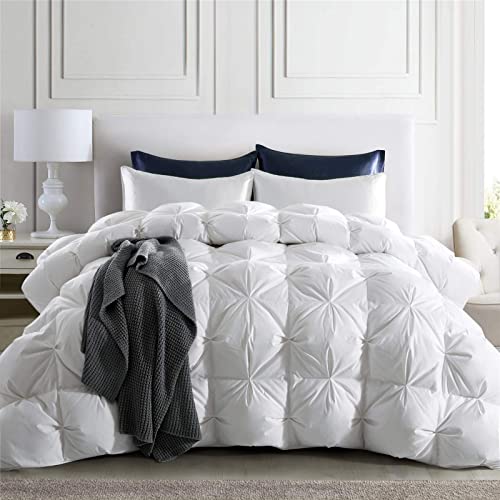
This is the ceiling of the verifiable Amazon market, and it earns the hero spot on specification rather than branding. The fill is 93 percent white goose down — the highest down content we could verify in a queen comforter on Amazon — at a maker-stated 800 fill power, with 40 ounces of fill in the Full/Queen size. The finished dimensions are an oversized 98 by 90 inches, the shell is 100 percent cotton at a stated 700 thread count, and the construction is a 3D baffle box with a pinch-pleat face and corner tabs for a duvet cover. Puredown claims RDS and OEKO-TEX Standard 100 certification for the down; both are maker claims, printed here as such. Check the current price on Amazon for the Full/Queen size before you buy.
The small-bedroom case for this pick rests on a property no synthetic can copy: down compresses. Forty ounces of high-loft cluster down is a mountain on the bed and a modest bundle off it — rolled or gently compressed in a breathable storage bag, the off-season flagship takes up less room than a folded budget polyester comforter, because polyester’s loft is mostly trapped air held open by springy fiber, while down’s loft collapses to nearly the volume of the feathers themselves. In a home where the entire linen closet is one under-bed bin, that is not a footnote; it is the difference between owning a rotation and not owning one. On the bed, the pinch-pleat face is the other small-room argument: it reads as a finished, tailored surface rather than a puffy duvet, and in a room where the bed is the furniture, that tailored look does the work a headboard and a bed skirt do elsewhere.
Two charges must be made honestly. The oversized cut — 98 by 90 inches — drapes generously on a queen in a large room, but on a bed pushed against a wall, the common small-bedroom layout, the extra eight inches pool on the floor side or bunch against the wall, and the drape you paid for becomes a daily straightening chore. And care is dry clean only: in a one-comforter small home, a dry-clean trip means nights under a substitute blanket, so this pick pairs best with a duvet cover from day one and, ideally, with the thin summer layer below as its understudy.
- Maker-stated 800 fill power with 93% goose down — the highest verified spec in this guide.
- Down compresses to a fraction of its loft — the smallest-storing flagship here.
- Pinch-pleat face reads as a finished surface in a room where the bed is the furniture.
- Check price on Amazon for the current Full/Queen price.
Honest limitation: Care is dry clean only, the 800 fill power figure is the maker’s own and not independently certified on the listing, the oversized cut pools on wall-side beds, and this is a genuinely warm winter-weight comforter — hot sleepers in small, warm rooms will roast under it outside the cold months.
Choose it if you want one flagship winter comforter with a top-grade verified specification and your storage is measured in inches. Skip it if you need home machine washing, your bed sits against a wall and you hate re-draping, or your small room runs warm — take the Brooklinen alternative or the Evercool below instead.
Brooklinen All Season Down Alternative Comforter, Full/Queen
Who it suits: Small-bedroom shoppers who care most about how the bed looks at 2 p.m. — the comforter as the room’s main visual surface — and who want the flagship-brand finish without animal fill.
Brooklinen is the brand most people picture when they picture a premium comforter, and its down-alternative is the version we can link with a clear conscience: the Full/Queen All Season ASIN verified, measuring 90 by 90 inches, with a 100 percent cotton sateen shell over a fill of RPET microfiber spun from recycled plastic bottles, in baffle-box construction with corner loops. Check the current price on Amazon for the Full/Queen All Season before you buy; the brand’s pricing moves with its frequent promotions, so judge the live listing on its own terms. The maker describes the comforter as vegan, which it is — the fill is recycled polyester — and as hypoallergenic, a label we repeat only as the maker’s, since no comforter treats allergies.
The small-bedroom argument for this pick is the shell. Cotton sateen has a soft, matte finish that behaves visually like upholstery rather than bedding: it does not shine under lamplight, it drapes in soft folds instead of ballooning, and on a bed that doubles as the room’s sofa, desk and dining annex, it reads as a deliberate surface rather than a duvet that happens to be visible. In a large bedroom that finish is a nicety. In a small one, where this object occupies more of your field of view than every picture and curtain combined, the finish is most of what you are buying — and on that measure the Brooklinen is the best-looking pick in this guide.
The charges are storage and care. A recycled-polyester fill does not compress like down: off the bed, this comforter wants roughly the volume it has on it, so a rotation built around it needs a real home for the spare. And Brooklinen does not recommend machine washing it, which removes the usual down-alternative advantage and matters doubly in a small home where the comforter is also the daytime surface — spills land on it at lunch, not just at night. A duvet cover is close to mandatory here, which in a small room is also an opportunity: the cover becomes the changeable decor, the comforter the constant underneath.
- 100% cotton sateen shell — the matte, furniture-like finish that suits a bed on all-day display.
- Recycled-bottle RPET fill in baffle-box construction, with corner loops.
- Full/Queen All Season — check price on Amazon.
Honest limitation: It is a synthetic fill and will not match down’s warmth-to-weight ratio; it stores bulky compared with down; Brooklinen does not recommend machine washing it; and its Amazon review base is thin because the brand sells mainly direct.
Choose it if the bed’s daytime look is the priority and you will keep it in a duvet cover. Skip it if home washing is the whole point of going synthetic — the Buffy Cloud below is built for the machine — or if storage space for a bulky spare simply does not exist in your room.
Buffy Cloud Comforter, Full/Queen
Who it suits: The true one-comforter small bedroom — no linen closet, no spare, no rotation — where the single comforter must be all-season, good-looking and washable in a home machine.
The Cloud is the comforter that built Buffy’s name, and it returns here from our under-$200 guide because a $1,000 budget does not change what it is: the washable premium benchmark. The shell is eucalyptus lyocell — listed as rayon from eucalyptus on the Amazon page — which feels smooth and cool rather than papery, and the fill is layers of fiber made from recycled plastic bottles; Buffy says each comforter keeps about 50 bottles out of landfill, a maker claim, but the fill itself is real, lofty and evenly distributed. The Full/Queen measures 90 by 90 inches and has corner tabs for a duvet cover. It is sold by Buffy Inc. itself on Amazon — check the current price on Amazon, and if the figure looks out of line with this tier, re-check that the Full/Queen size is the one selected.
In a small bedroom the Cloud’s machine washability is not a convenience, it is the whole strategy. The one-comforter home has no understudy: when the comforter is washed, the bed is bare. A comforter that goes in the home machine in the morning is back on the bed by night; a dry-clean-only flagship is gone for days, and in a small room there is nowhere to hide the substitute blanket pile in the meantime. The Cloud is also the right visual register for a small room — smooth, calm, unpatterned — and as an all-season weight it makes the honest one-comforter compromise: warm enough for most heated rooms in winter with a throw at the foot, light enough that most sleepers survive summer with it pushed down. Note the size trap carried over from the under-$200 guide: the King/Cal King sits in a higher tier, and queen shoppers should make sure the Full/Queen option is the one in the cart.
- Eucalyptus lyocell shell that feels cool and smooth, not plasticky.
- Machine washable at home — the only flagship here that asks nothing of a dry cleaner.
- Check price on Amazon for the current Full/Queen price.
Honest limitation: A synthetic fill, however good: it will not match real down’s warmth-to-weight ratio or its decades-long lifespan, it stores bulkier than down, and very cold sleepers in unheated rooms will want a heavier winter weight over it.
Choose it if one washable, all-season comforter has to do every job in a small room. Skip it if you are set on genuine down, or you sleep genuinely cold and need a winter-weight fill as your only comforter.
Buffy Breeze Comforter, Full/Queen
Who it suits: Hot sleepers in small, warm rooms — and anyone building a two-layer system whose off-season layer must fold away to almost nothing.
The Breeze is Buffy’s second comforter and its most single-minded: shell and fill are both 100 percent eucalyptus lyocell, with no polyester anywhere in it, built as a lightweight summer insert that still carries corner tabs for a duvet cover. The Full/Queen is 90 by 90 inches and about five pounds — a fraction of the puredown’s heft — and coverage of the line notes OEKO-TEX Class I certification, a maker-side claim we print as such. Check the current price on Amazon for the Full/Queen size; pricing evidence for this pick varied between sources during research, so the live listing check matters more here than for any other pick.
Small rooms run hot — a small volume of air, one or two bodies, electronics, and often the apartment’s worst ventilation — and the Breeze is the pick shaped by that fact twice over. On the bed it is the thinnest, airiest layer here, adding no visual bulk to a room that already feels full: where a lofty winter duvet makes a small bed look like it is swallowing the room, the Breeze lies flat and calm. Off the bed it is the storage champion of the synthetics: five pounds of lyocell folds into a drawer, a shelf corner, the top of the wardrobe — places a folded polyester comforter simply will not go. In the one-bed plan below it is the summer half of the rotation, and its storage footprint is the reason that plan is realistic in a small room at all. What it is not is a year-round answer anywhere with a real winter: five pounds of lyocell is a summer layer, and the guide that tells you otherwise is selling, not advising.
- 100% eucalyptus lyocell, shell and fill — no polyester, no animal fill.
- Featherweight summer layer at about 5 lb in Full/Queen — folds away to almost nothing.
- Check price on Amazon for the current Full/Queen price.
Honest limitation: Summer weight only — it will not carry a cold bedroom — and pricing evidence varied between sources during research, so the live listing check matters more for this pick than any other.
Choose it if your small room runs hot, or you are building the flagship-plus-summer-layer plan this guide recommends. Skip it if you want one comforter for the whole year in a cold climate.
Egyptian Bedding Siberian Goose Down Comforter, Queen
Who it suits: Small-bedroom buyers who want genuine down loft on the only bed they own, at a mid-market price — and who have one under-bed bin to give it in summer.
This pick returns from our under-$200 guide, where it was the value sensation, and it earns its place here for a small-room reason: it is the cheapest route to real down as a primary comforter, which matters in a one-bed home that cannot justify the flagship. The specification remains startling for the money — a maker-stated 750 fill power, 60 ounces of Siberian goose down fill in the queen, a 600 thread count 100 percent Egyptian cotton cover, baffle-box construction, 90 by 90 inches. Mattress Clarity’s reviewers, who did sleep under it, called it one of the loftiest down comforters they had tried. No live Amazon price could be captured during research for this pick, so check the current price on Amazon first — it sits in the lower part of this tier, which is the point of the pick.
Re-judged for a small bedroom, two things change. The 60 ounces of fill — half again the puredown’s fill weight, at a lower fill power — makes this the loftiest-looking bed in the guide, and loft is a visual decision in a small room: a high, cloud-like bed is either the cozy centerpiece you want or a volume of white that eats the room’s remaining air, depending on your taste and your ceiling height. The second change is storage: like all down it compresses well, but 60 ounces compresses to a bigger bundle than 40, and its standard 90 by 90 cut at least drapes a wall-side bed without the puredown’s pooling. The honest context is the brand. Egyptian Bedding is an Amazon-native label, not a heritage down house: its thread-count and origin language is marketing-rich, its customer service is not Brooklinen’s, and some owners report the occasional escaping feather, the classic down-comforter tax. Buy it for the fill, inspect it on arrival, and air and fluff it properly before judging the loft, because vacuum-packed down needs hours to recover.
- Maker-stated 750 fill power goose down — a flagship-grade claim at a mid-market price.
- 60 oz fill weight in queen — the loftiest bed in this guide, in a 600 TC Egyptian cotton shell.
- Sits in the lower part of this tier — check price on Amazon.
Honest limitation: An Amazon-native brand with marketing-heavy copy, occasional feather leakage reported, the bulkiest down bundle here to store, and — uniquely in this guide — no live Amazon price could be captured during research, so the live check is mandatory.
Choose it if real down loft is the point and the budget has other claims on it. Skip it if brand pedigree, a sleep trial and painless returns matter more to you than fill specifications — that is what the Brooklinen premium buys.
REST Evercool Cooling Comforter, Full/Queen
Who it suits: Hot sleepers in small rooms that overheat — the premium cooling flagship, and the one pick in this guide whose job is to feel cool rather than warm.
The Evercool is a different species from the other five picks: a lightweight cooling blanket-comforter whose proprietary Evercool shell fabric — a nylon and spandex blend — is engineered to feel cool on contact, wrapped around a light plant-based fiber fill that secondary coverage identifies as a Sorona blend. It measures 90 by 90 inches in Full/Queen, weighs about 5.5 pounds, is machine washable, and carries Good Housekeeping bedding awards, which the listing makes much of. REST does not publish a Q-Max coolness figure for the fabric, a point in its favor for honesty: the Q-Max numbers quoted by rival cooling brands describe a fraction of a second of first contact, not the temperature under the quilt at 3 a.m. What owners consistently report is simpler — it feels cool when you get in and does not turn into a sauna by morning. Check the current price on Amazon; it sits in the middle of this tier and well within this budget.
The small-room case is thermal and visual at once. A small bedroom is the room most likely to sleep hot — least air to share the heat, often the last room the air conditioning reaches — and it is also the room where a thin, flat comforter profile helps most, because the bed’s bulk is the room’s bulk. At 5.5 pounds the Evercool lies almost flat, stores in a drawer when a colder snap sends you back to a winter layer, and washes at home between heat waves. Its limits are the mirror of the puredown’s: it is a warm-weather instrument, and the household that buys it as a winter comforter will be cold and cross. Buy it as what it is — the premium answer to a hot small room — and it has no verified rival on Amazon.
- Purpose-built cooling shell that feels cool on contact, in a lightweight 5.5 lb build.
- Thin, flat profile — the least visual bulk of any pick here, and drawer-storable.
- Check price on Amazon for the current Full/Queen price.
Honest limitation: A summer-weight cooling layer, not a winter comforter; the cooling effect is a contact and breathability effect, not refrigeration, and REST publishes no laboratory coolness figure to compare against rivals.
Choose it if overheating is your small room’s actual problem and you want the premium purpose-built fix. Skip it if you want year-round warmth from a single purchase.
Comparison Table
| Product | Fill (as maker states) | Small-bedroom note | Link |
|---|---|---|---|
| puredown Goose Down Comforter, Full/Queen | 93% goose down, stated 800 fill power, 40 oz | Compresses smallest in storage; oversized drape pools on wall-side beds — check price on Amazon | Check on Amazon |
| Brooklinen Down Alternative Comforter, Full/Queen | Recycled RPET microfiber, cotton sateen shell | Best-looking daytime surface; stores bulky — check price on Amazon | Check on Amazon |
| Buffy Cloud Comforter, Full/Queen | Recycled fiber, lyocell shell | The one-comforter answer: all-season and home-washable — check price on Amazon | Check on Amazon |
| Buffy Breeze Comforter, Full/Queen | 100% eucalyptus lyocell | Summer layer that folds into a drawer — check price on Amazon | Check on Amazon |
| Egyptian Bedding Siberian Goose Down, Queen | Goose down, stated 750 fill power, 60 oz | Loftiest bed here; biggest down bundle to store — check price on Amazon | Check on Amazon |
| REST Evercool Cooling Comforter, Full/Queen | Plant-based fiber, cooling shell | Thinnest profile for hot small rooms — check price on Amazon | Check on Amazon |
How to Choose a Comforter for a Small Bedroom Under $1,000
- Start from the ceiling, not the budget. The verifiable top of Amazon for a single queen comforter sits well below this budget. Any plan for $1,000 here is a system plan — flagship plus a seasonal layer — and any listing implying a single comforter near this budget on Amazon deserves deep suspicion.
- Measure your storage before your bed. In a small bedroom the binding constraint is rarely the mattress; it is the under-bed bin, the half shelf, the drawer. Decide where the off-season comforter will live before you decide to own one.
- Prefer down if you will rotate. Down compresses to a fraction of its loft; polyester and lyocell fills store at close to their working volume. A two-comforter rotation in a no-linen-closet home is a down flagship plus the thinnest summer layer you can find.
- Judge the shell like furniture. This object is the largest visible surface in your room. Matte cotton sateen and tailored pinch pleats read as furnishings; shiny, ballooning shells read as bedding that escaped. Look at the daytime photos, not the sleep photos.
- Check the drape against your layout. An oversized 98 × 90 queen drapes beautifully on a bed with floor on both sides and pools against the wall on a bed without it. Wall-side beds want standard 90 × 90 cuts.
- Read down content before fill power. 93 percent down at 800 fill power and 75 percent down at 800 fill power are different products wearing the same headline number. The percentage is printed in the specification table, not the title.
- Read fill power and fill weight together. Fill power is loft per ounce; fill weight is how many ounces you get. The puredown pairs a stated 800 with 40 oz; the Siberian pairs a stated 750 with 60 oz. Either number quoted alone is marketing.
- Decide about washing before you buy. Premium down is dry clean or commercial machine only — and in a one-comforter home, that means nights with a bare bed. If that is unacceptable, the Buffy Cloud and the Evercool are the picks built for the home machine.
- Count the loops if you use a duvet cover. In a small room the cover is your decor system: it protects a dry-clean-only flagship, takes the weekly washing, and changes the room’s whole look for the price of a sheet set. Corner tabs are the minimum; check your cover’s ties match.
- Leave the remainder unspent on purpose. A $1,000 budget that ends with only part of it spent on verified comforters is a success, not a shortfall. The unspent money is not a failed search; it is the honest price of the Amazon market as it actually is.
The Bed Is the Room: Your Comforter Is the Biggest Surface You Own
Do the arithmetic of a small bedroom honestly. A queen bed is roughly 33 square feet of footprint. In a 10-by-11-foot room — 110 square feet, a normal small bedroom — the bed is 30 percent of the floor before a single other object enters. Add the visible top surface and the drape down the sides, and the comforter is the largest continuous expanse of color and texture in the room: larger than the rug, larger than the curtains drawn together, larger than any stretch of wall not hidden behind the bed itself. Interior advice for small rooms obsesses over paint and mirrors, but the object your eye actually lands on, from the doorway and from inside the room, all day, every day, is the comforter.
That is the honest argument for premium money in a small room, and it is stronger than the usual warmth argument. A flagship comforter in a small bedroom is not bedding that happens to be visible; it is the room’s upholstery. It is sat on, worked on, eaten off (carefully), and looked at across every hour the room is used awake — and small bedrooms are used awake more than big ones, because the bed is the only soft furniture there is. A comforter that drapes well, holds a calm matte finish and keeps its loft even makes the whole room look considered; a shiny, lumpy, half-collapsed one makes the whole room look tired, at exactly the same rent. Cost per hour of looking at the thing is a real metric, and on that metric a flagship in a small room can be better value than a budget comforter in a spare room nobody enters.
It is also why the duvet cover matters more here than anywhere else. In a large home a cover is protection. In a small room it is the decor system: one good insert, two covers in different weights and colors, and the room has a summer face and a winter face for the price of two sheet sets — while the covers, washed weekly, take the daytime wear that would otherwise go to a dry-clean-only flagship. If you take one structural idea from this guide, take that: in a small bedroom, buy the insert for warmth and storage, and buy the look separately, in covers you can change and wash.
No Linen Closet: Where the Second Comforter Actually Lives
Every rotation plan in bedding assumes a linen closet, and small bedrooms are where that assumption goes to die. The spare comforter in a small home lives in exactly four places: compressed in a bag under the bed, folded on the closet’s top shelf (displacing everything else), in a storage ottoman that is also furniture, or draped over the bed as a second layer whether it is needed or not. Which of those is available to you decides which plan below is real, before price enters into it at all.
This is where fill choice stops being about warmth and becomes about volume. Down compresses: cluster down’s loft is air held in a three-dimensional feather structure that collapses under gentle pressure and re-lofts when released, so a 40-ounce down flagship in a breathable storage bag occupies a fraction of the shelf its on-bed size suggests. Polyester and recycled fills spring back against compression — that springiness is their loft mechanism — so a synthetic comforter stored is nearly a synthetic comforter in use, volume-wise. The exception among synthetics is weight, not material: the 5-pound Buffy Breeze and the 5.5-pound Evercool are thin enough to fold into a drawer, which is a different and equally valid route to small storage. The worst storage object in this guide is a heavyweight synthetic; notably, none of the six picks is one.
So here is the spending plan, re-scoped from our main under-$1,000 guide to the one bed a small bedroom actually has. That guide’s two-bed plan — flagship, guest-room alternative and a spare — is honest planning for a house with a guest room; in a small bedroom it furnishes a bed that does not exist, and we are not going to pretend otherwise. The one-bed plans, built from the same verified picks, are these. Flagship plus summer layer — the puredown for the cold months, the Buffy Breeze for the warm ones, the down compressed under the bed in summer and the Breeze in a drawer in winter, with a large share of the budget deliberately unspent. Flagship plus washable middle — the puredown with the Buffy Cloud as the shoulder-season and laundry-week layer, again leaving much of the budget unspent. And if your storage genuinely allows all three, the full three-season set — puredown, Breeze and Cloud — still leaves a substantial remainder unspent. Check the current price on Amazon for each pick before you add anything up. Notice what none of these plans does: chase the number. A budget is a ceiling, not a target, and in a small room the unspent remainder is doubly correct, because every object the money might have bought would have needed somewhere to live.
Is Premium Money Worth It in a Small Room? An Honest Audit
Having made the case for the flagship, this guide owes you the case against it, because small rooms punish premium mistakes harder than big ones. Start with the strongest counter-argument: the Buffy Cloud is all-season, washes at home, looks calm and finished, and for a large share of small bedrooms it is simply enough. The step from the Cloud to the puredown buys real things — down’s warmth-to-weight, its compression in storage, a decade-plus lifespan against a synthetic’s gradual loft loss — but it also buys dry-clean-only care in the home least able to spare the bed for days, and an oversized cut in the room least able to drape it. Premium is a bundle, and in a small room some items in the bundle are liabilities.
The second counter-argument is seasonal risk. A small room concentrates every comfort problem: it overheats in summer, it is the coldest room in winter in many older buildings, and there is no other room to retreat to when the bed is wrong. A single winter-weight flagship bought in January can be a five-month mistake discovered in June, with no closet to exile it to and no spare budget line to replace it. The layered plans above exist precisely to de-risk that: the flagship decision is halved by pairing it with a light layer, and the total still lands well under this budget.
Where does that leave the honest verdict? Premium money in a small bedroom is worth it when it buys the two things small rooms actually reward — a surface you are happy to look at all day, and a fill that stores small or washes at home — and it is wasted when it buys specification for its own sake: a higher fill-power number on a bed against a wall, in a room that runs hot, in a home with no dry-cleaning habit. Read the six reviews above with those two tests in hand and the right pick usually names itself. And if the tests point you to the washable pick and most of the budget stays in your pocket, that is not settling. That is the guide working as intended.
Common Buying Mistakes
- Believing a roundup’s claim of a near-budget comforter on Amazon without checking whether the price is a brand-site figure, a king size, or a listing with no featured offer.
- Buying the rotation before measuring the storage — a second comforter with nowhere to live becomes a permanent, resentful layer on the bed.
- Choosing an oversized comforter for a bed pushed against a wall, then fighting the pooled drape every morning.
- Judging a comforter by how it sleeps and ignoring how it looks at noon — in a small room, the daytime surface is most of the product.
- Reading fill power without fill weight — a stated 800 with a skimpy fill is a summer blanket wearing a luxury number.
- Reading fill power without down content: 93 percent down and 75 percent down at the same fill power are different products.
- Ordering a dry-clean-only flagship as your only comforter, then discovering wash week means a bare bed and a blanket pile with nowhere to hide.
- Skipping the duvet cover on a flagship, then paying for cleanings a cover would have prevented — and losing the one cheap way to change the room’s look.
- Buying winter weight for a small room that overheats, because small rooms concentrate heat and the mistake has no other room to escape to.
- Trying to spend the whole $1,000 because it was budgeted — in a one-bed room the correct total is often well under budget, and the remainder is the win.
Final Recommendation
- Most small bedrooms: puredown Goose Down Comforter, Full/Queen, 800 Fill Power.
- Best-looking surface: Brooklinen All Season Down Alternative Comforter, Full/Queen.
- One-comforter homes: Buffy Cloud Comforter, Full/Queen.
- Summer layer: Buffy Breeze Comforter, Full/Queen.
- Real down on a budget: Egyptian Bedding Siberian Goose Down Comforter, Queen.
- Hot small rooms: REST Evercool Cooling Comforter, Full/Queen.
Our top two are the puredown for the flagship job and the Brooklinen down-alternative as its surface-first rival, because between them they state this guide’s whole small-bedroom argument: the best verifiable down specification on Amazon compresses into the smallest storage footprint here, while the best-looking daytime surface asks only for a duvet cover in return. Pair the puredown with the Breeze for summer and you have a two-season system for one small bed, with a large share of the budget honestly unspent. If washing at home outranks everything, take the Cloud and stop reading. None of these will out-provenance a boutique flagship sold well above this budget, and they do not try to. Check the queen size is selected, check the current price on Amazon, measure the space the spare will live in — and let the rest of the $1,000 stay where it belongs.
Frequently Asked Questions
Does any comforter on Amazon really cost $1,000?
Not that we could verify in a queen size. The most expensive single queen comforters with a verifiable listing and fulfilment trail — the puredown 800 fill power and Brooklinen’s down comforter on its Amazon storefront — sit well below this budget, at the top of the verifiable range. Comforters that genuinely cost $1,000 or more — 850 to 900 fill power European down, eiderdown, heritage brands — are sold direct or through boutiques. If a page shows you a four-figure “Amazon” comforter, check whether the price is a brand-site figure or a king size before believing it.
Is a premium comforter worth it in a small bedroom?
More often than in a big room, with one condition. The comforter is the largest visible surface in a small bedroom and doubles as daytime furniture, so a flagship’s drape, finish and loft are on display — and in use — all day, which is where premium quality actually shows. The condition is logistics: the premium has to survive your storage and your laundry reality. A flagship that compresses small (down) or washes at home (the Buffy Cloud) earns its money here; a bulky, dry-clean-only comforter in a home with neither space nor routine is an expensive ornament.
How do I store a second comforter with no linen closet?
Choose fills that store small and use the space the room already wastes. Down compresses to a fraction of its loft in a breathable storage bag — never a sealed vacuum bag for long-term down storage — and slides under the bed or onto a closet’s top shelf. Thin summer layers like the 5 lb Buffy Breeze fold into a drawer. Heavyweight synthetics are the problem case: they store at nearly their working volume, so in a no-closet home, either make the synthetic your only comforter or do not build a rotation around one.
Will an oversized comforter work on a bed pushed against a wall?
Poorly, as a rule. The puredown’s oversized 98 × 90 cut drapes beautifully when there is floor on both sides of the bed; against a wall, the extra width pools on the floor side or bunches at the wall, and the tailored look you paid for becomes a daily straightening chore. Wall-side beds are better served by the standard 90 × 90 picks in this guide — the Brooklinen, both Buffys and the Evercool — with the oversized flagship reserved for beds you can walk around.
Can one comforter really cover the whole year in a small room?
Yes, if it is chosen as a compromise on purpose. An all-season washable pick like the Buffy Cloud, with a throw added at the foot for the coldest weeks and pushed down in summer, covers most heated homes adequately — and in a one-comforter home, adequate all year beats perfect in January and miserable in July. The exception is the genuinely hot small room, where a summer layer stops being optional: there, the flagship-plus-Breeze plan is the honest minimum system.
Can I machine wash a premium down comforter?
Usually not at home, and the listing’s care label is the authority. The puredown in this guide is dry clean only; most flagship down asks for a commercial large-capacity machine, gentle cycle and complete low-heat drying if it allows washing at all. The synthetics split: the Buffy Cloud and the Evercool are built for home machines, while Brooklinen does not recommend machine washing its down-alternative. In a small home the practical answer is a washable duvet cover, laundered weekly, which keeps any of them out of the wash for months at a time.
Why is Brooklinen’s down comforter named but not linked?
Because we could verify the product in Full/Queen on Amazon’s Brooklinen storefront but not isolate the exact Full/Queen All Season ASIN: Brooklinen issues a separate ASIN per size and weight, and the ASINs we could verify were the King all-season and the Full/Queen lightweight. Rather than link the wrong size, we name it, give the verified price, and flag it in this guide’s sources as the first swap-in if the correct ASIN verifies at publish time.
- Best Comforter Under $200
- Best Comforter Under $400
- Best Comforter For Small Bedrooms Under $200
- Best Duvet Cover Set Under $100
- Best Bed Sheet Set Under $400
- Best Cooling Pillow Under $100
