Disclosure: As an Amazon Associate, topratedkitchenware.com earns from qualifying purchases. Links on this page are affiliate links; they cost you nothing extra. Prices and availability change often, so check the current Amazon listing before you buy.
This blender review takes the long way around on purpose. A modern full-size blender — represented here by the long-running premium design most other machines are measured against — is easy to judge in a five-minute demo and surprisingly hard to judge for a five-year ownership. The demo shows you a smoothie. Ownership shows you the Tuesday-morning noise, the jar that either rinses clean in seconds or fights you for a week, the greens that either vanish or linger as string, and the motor that either shrugs at frozen fruit in year four or starts to smell warm doing it. So this review works through design, setup, and real performance job by job, then sets the machine against its closest rivals and tells you plainly who should buy it and who should walk past it.
Key Takeaways
- A premium full-size blender earns its place on texture: completely smooth green smoothies, silky soups, and ice crushed to an even slush that cheaper machines cannot reproduce.
- The design philosophy that matters most is simplicity — a dial, a pulse, a tamper — because it removes friction from daily use and removes electronics from the list of things that can fail.
- Performance stays consistent across years in a way mid-tier machines rarely match; the gap between this class and the tier below widens with age, not the reverse.
- The honest limitations are noise, height, price tier, and a minimum batch size that makes tiny jobs awkward in a full-size jar.
- It suits daily blenders, soup and sauce cooks, and buy-once households. It is the wrong purchase for solo soft-drink users and the smallest kitchens.
Verdict up front: for a household that blends several times a week, a well-built full-size blender of this class is one of the most satisfying appliances you can own, and the premium is repaid in texture and longevity rather than features. For a household blending soft drinks twice a month, it is beautifully engineered overkill, and the money is better spent lower down the range — a judgement we pressure-test from the other side in is a blender worth it. If you are still deciding which type of machine belongs in your kitchen at all, start with our blender buying guide; this review assumes the type is settled and asks how the flagship execution performs.
In this guide
Blender Review: What This Class of Blender Is and Where It Fits
The full-size countertop blender is the kitchen’s generalist heavy tool: a powerful motor base, a large pitcher, and a blade assembly designed to create a vortex that drags ingredients down and through the cutting path until the mixture is uniform. Within that category, the premium tier — the class this review examines through its best-known representative — separates itself not with programs or screens but with build: stronger motors that sustain torque under load, jars moulded thick enough to absorb years of ice shock, metal drive components where cheaper machines use plastic, and controls reduced to the essentials. The philosophy is closer to a workshop tool than a gadget. Nothing on the machine is there to impress you in the shop; everything is there to still be working in a decade.
Where does it fit in a real kitchen’s division of labour? It owns everything liquid and everything frozen: smoothies, shakes, soups, purées, sauces, dressings, batters, frozen drinks, nut milks, and — with patience and a tamper — nut butters and thick dips. It does not own dry prep: slicing, shredding, dough, and even chopping belong to the food processor, and small one-cup jobs belong to personal blenders or immersion tools, a boundary explored in blender vs immersion blender. Understanding that fit matters for judging this machine fairly. Reviewed as a universal kitchen replacement it would disappoint; reviewed as the master of the liquid-and-frozen domain, it is close to untouchable.
The market context matters too. Below this class sits a crowded mid tier of capable machines that blend well for a few years, and below that a bargain tier that promises the same jobs and delivers them briefly, if at all — the pattern we catalogue in blender pros and cons. The premium class exists because the jobs are violent: ice, frozen fruit, and fibrous greens punish weak engineering every single day. What you are buying at this level is not a longer feature list. It is the absence of the failure modes — stalling, leaking, cracking, burning out — that define the tiers below.
The Reference Model for This Review
Throughout this review, the reference point is the long-running premium design with the tall jar, the simple speed dial, the pulse, and the tamper — the machine sold for years as the category’s benchmark and still the comparison target for every new flagship. Its enduring presence in the range, with jars and parts continuously available, is itself part of the review: a manufacturer does not keep a design in production that long unless it keeps satisfying the households that bought it. Where this review says “the machine,” it means this class executed at this standard; the rivals named later are judged against it directly. To see the current listing and specification for this model before you buy, check price on Amazon.
Design, Build and Setup
Pick the machine up and the design intent announces itself in weight and simplicity. The base is dense and stable, planted on the counter with the kind of heft that does not walk across the worktop when the jar is full of ice. The jar is tall and comparatively narrow — a shape chosen for vortex strength rather than cupboard convenience, with thick walls, a comfortable handle, and measurement marks that remain legible because they are moulded rather than printed. The lid seals firmly with a removable plug that doubles as a small measure and, more importantly, allows steam to vent and ingredients to be added mid-blend. The tamper — a sturdy plunger that reaches toward the blades without touching them — is not an accessory in this design; it is part of how the machine is meant to be used, and its presence quietly signals that thick mixtures are a core job, not an edge case.
The control scheme deserves its own paragraph because it is the feature owners praise most after a year: a central dial for variable speed, a pulse switch, and nothing else. Variable speed under your hand, rather than a menu of presets, teaches you the machine quickly — start low, climb as the vortex forms — and gives you a control that presets cannot, because you are responding to what the mixture is actually doing. There is no screen to fail, no touch panel to misread with wet hands, and no program library to date the machine. It also means the machine asks something of you — presence, attention, a hand willing to learn the dial — and this review counts that as part of the product, not a footnote to it: the cooks who thrive with this design are the ones who wanted a tool, and the cooks who wanted an appliance that thinks should read the comparison section with particular care before deciding. In an appliance category increasingly stuffed with electronics, this restraint reads as confidence.
Setup out of the box is closer to unpacking a tool than configuring a device: wash the jar, seat it on the base, read the fill lines, and blend. The jar sits on the drive socket without locking twists or alignment rituals, which sounds trivial until you have fought a cheaper machine’s bayonet fitting with wet hands at seven in the morning. First-use impressions are dominated by two things — the solidity of every contact point, and the height. Assembled, this class of machine is tall, and under-cabinet clearance is a genuine planning item, not a footnote; many owners store the jar beside the base or accept the machine living permanently on the counter, which its design, to be fair, seems to anticipate.
Build quality reveals itself in the small interfaces. The drive connection is metal where bargain machines use plastic gearing that rounds off under ice loads. The blade assembly is sealed and integrated rather than a screw-off stack of parts, which removes the leak path that plagues removable-blade designs — the trade-off being that you clean around fixed blades with a brush rather than dismantling them, a routine covered fully in how to clean a blender. The power cord is long enough to reach a sensible socket without the base hugging the wall. Feet grip. Switches click with mechanical certainty. Nothing creaks. These are not luxuries; they are the visible surface of the engineering that decides whether the machine is blending in year ten.
One design choice divides opinion and deserves an honest airing: the jar material. Premium machines of this class use advanced copolyester plastic rather than glass, because glass at this power level is heavy and vulnerable to the thermal and impact shocks of the job. The plastic is tough, light, and shatter-resistant, and it keeps the full jar liftable — a full glass jar of soup is a genuinely heavy object. The counterpoints are that plastic can cloud over years, can hold strong colours and smells if washing is lazy, and simply feels less classic to some buyers. On balance the engineering case is strong, but if your heart is set on glass, know that you are shopping in a different, generally less powerful class of machine.
Performance in Real Use
Performance claims in this category are usually made with a single heroic smoothie, so this section deliberately spreads the judgement across the five jobs a household actually rotates through — drinks, hot work, ice, thick mixtures, and small everyday tasks — because a flagship should be excellent at the first four and honest about the fifth. Each job below is judged on the result in the glass or bowl, the effort the cook had to contribute, and the consistency of the outcome across repetitions, since a machine that produces one brilliant smoothie and three mediocre ones has a technique problem disguised as a specification.
Smoothies and Green Smoothies
This is the test that sells the class, and it passes in a way that redefines expectations. Frozen fruit, ice, leafy greens, seeds, and liquid go in; what comes out is uniformly smooth — not “smooth for a home smoothie,” but smooth in the absolute sense, with no kale string, no seed grit, and no unblended chunk waiting at the bottom of the glass. The mechanism is the vortex: the tall jar and blade geometry keep the entire mixture circulating, so every ingredient passes through the cutting path dozens of times. Green smoothies are the sharpest demonstration, because greens are where weaker machines confess — they blend the soft fruit, leave the leaves as flecks, and produce a drink that is technically blended and practically chewy. Here, spinach and kale simply disappear into the drink. For households whose routine is a daily green smoothie, this single result justifies the category, and our focused roundups of the best blenders for smoothies with ice show how the leading designs compare on exactly this work.
Soups and Hot Blending
Hot performance is the second pillar. A pot of roasted vegetables and stock becomes a soup with a texture closer to velvet than to purée — the kind of finish that makes a simple carrot or tomato soup taste deliberately luxurious. The vented lid handles steam correctly, the jar tolerates the heat, and the sustained power means fibrous ingredients like celery and leek break down completely instead of leaving threads. This class can also run long enough that friction itself heats a soup, a party trick that turns out to be genuinely useful for raw-ingredient soups on busy nights. The working rules are simple and worth internalising: fill no more than halfway with hot liquid, start on the lowest speed, keep a hand on the lid with a towel, and climb gradually. Observed, they make hot blending one of the safest and most rewarding jobs the machine does; the full safety routine lives in how to clean a blender alongside the washing method.
Frozen Drinks and Ice
Ice is the blender’s violence test, and this class treats it as routine. Cubes go in whole and come out as even slush — no surviving shards to ambush a straw, no powder-fine layer at the bottom and boulders at the top. Frozen cocktails, slushies, and thick smoothie bowls all depend on this evenness, and it is where the combination of torque, jar shape, and blade design earns its keep most visibly. The noise, it must be said, is considerable: crushing ice at full power is the loudest sustained sound most kitchens produce, and no honest review should bury that. What the premium class offers is not quiet — it is brevity. The job finishes fast, evenly, and without the motor straining, so the loud minute replaces the cheaper machine’s three loud, uneven minutes.
Nut Butters, Dips and Thick Mixtures
Thick work is where the tamper stops being an accessory and becomes the technique. Nuts, a little patience, and continuous tamping turn into butter; chickpeas and tahini become hummus with a whipped lightness processors struggle to match; frozen fruit with minimal liquid becomes the thick, spoonable base of smoothie bowls. The honest limitations: this is the most demanding work for any blender, it generates heat in the mixture, and it rewards technique — scrape, tamp, rest if needed — over brute force. Quantities matter too; too little in a big jar will not circulate, which is the standing argument for the smaller containers this class offers as companions. Judged fairly, thick mixtures are a genuine strength of the design rather than a brochure claim, provided the cook learns the tamper in the first week.
Everyday Small Jobs
A review should also record where the flagship is merely adequate. Single small smoothies are slightly awkward in a full jar — the mixture spreads thin and the result, while smooth, involves washing a large vessel for a small drink, which is the entire reason blender vs personal blender exists as a debate. Dressings and sauces in modest quantities share the issue. The machine will do these jobs well; it simply does them at family scale. Households whose blending is mostly solo and small should read this section twice, because it, not power, is the strongest argument against buying the flagship.
Strengths and Trade-Offs
Strengths
- Texture ceiling: the smoothest results in the category across smoothies, soups, and frozen drinks, delivered consistently rather than on a good day.
- Durability and support: metal drive components, a jar and parts ecosystem that stays available, and a design kept in production because it keeps working — the buy-once proposition in physical form.
- Control simplicity: a variable dial and pulse that respond to the mixture in front of you, with no electronics standing between the cook and the result.
Trade-offs
- Noise and height: it is loud at full power and tall on the counter, and neither fact can be accessorised away.
- Premium tier commitment: the machine only makes sense if your blending frequency is real; as an occasional appliance it is capital sitting idle.
- Minimum batch reality: the big jar wants family quantities, so solo small jobs carry a cleanup overhead that smaller machines avoid entirely.
How It Compares
| Machine | Class | Where It Challenges the Reference | Where the Reference Stays Ahead |
|---|---|---|---|
| KitchenAid K400 | Mid-tier full-size | Polished design, strong smoothie performance, calmer presence on the counter | Sustained heavy work, parts longevity, thick-mixture authority |
| Ninja Professional Plus | Entry-to-mid full-size | Ice crushing and capacity at a far gentler tier | Green-smoothie finesse, build lifespan, hot blending confidence |
| Blendtec Classic | Premium full-size | Preset programs, wide jar that scrapes clean easily, blunt-blade safety | Manual control feel, small-batch vortex, tamper technique for thick work |
KitchenAid K400 — The Polished Challenger
The K400 is the machine for buyers who want most of the flagship experience with a more domestic design language and a mid-tier commitment. Its smoothie performance is genuinely strong, its controls are friendly, and it sits more gracefully in a styled kitchen. Where the reference pulls away is endurance work — nut butters, daily frozen loads across years — and the depth of the parts ecosystem behind it. Best for: smoothie-led households wanting polish. Not suited for: the heaviest daily abuse. Check price on Amazon to see its current listing.

Ninja Professional Plus — The Value Challenger
The Ninja’s argument is capability per tier: it crushes ice, handles family batches, and asks far less of the budget. Against the reference it loses on finesse — green smoothies carry more texture — and on expected lifespan, where plastic-forward construction tells over years. For households blending a few times a month, that trade is often the correct one, and this review will not pretend otherwise. Best for: frozen drinks and family smoothies on a budget. Not suited for: daily green-smoothie perfectionists. Check price on Amazon for the current listing.
Who Should Buy It, and Who Should Skip It
Buy this class of blender if you blend at least several times a week; if green smoothies, hot soups, or frozen drinks are structural parts of your cooking rather than novelties; if you have been through a cheap blender already and recognise the failure pattern; or if you simply prefer buying tools once. The profile that extracts maximum value is the daily-use household with counter space to give the machine a permanent home — permanence matters, because a blender that lives out gets used, and use is what converts the premium into value. Soup-and-sauce cooks who batch for the freezer belong here too, as do smoothie-bowl and nut-butter makers, whose jobs sit at the demanding end where this class separates itself.
Skip it if your blending is a solo soft drink a few times a week — a personal blender will make you happier for a fraction of the commitment, as our comparison in blender vs personal blender sets out. Skip it if your kitchen cannot house it visibly or accessibly; a flagship in a high cupboard is a poor appliance at any quality. Skip it if your cooking is prep-heavy and liquid-light, where a food processor is the honest priority. And skip it, finally, if the premium tier would strain the budget enough to breed resentment — a well-chosen mid-tier machine used happily beats a flagship bought with gritted teeth, every single week of its life. Our side-by-side of the wider field in blender reviews places this machine among its peers for readers still narrowing the list.
Setup, Care and Maintenance Essentials
Daily care is a ninety-second discipline: rinse the jar immediately after use, then run the self-clean cycle — warm water, a drop of washing-up liquid, thirty seconds climbing to high speed — rinse again, and leave the jar to dry unsealed. Thick mixtures earn a soak and a brush around the blade assembly; never a sponge pushed by fingers, and never a hand inside a jar whose blades you cannot see clearly. The full method, including stain and smell rescue for jars that have been neglected, is laid out in how to clean a blender. Monthly, check the lid plug and gasket areas for residue build-up and give the base a wipe with a barely damp cloth, keeping moisture away from the drive socket.
Long-term maintenance is mostly about respect for the machine’s envelope. Do not run dry, hard loads the design is not rated for; do not blend carbonated liquids; let very thick jobs rest rather than forcing a hot motor; and store the jar dry and unsealed so seals stay fresh. Replacement jars, lids, and tampers for this class are standard catalogue items rather than special orders, which is precisely the support structure that makes a decade of ownership plausible. Treat the machine like the workshop tool it resembles and it will repay the treatment with the most boring and desirable trait an appliance can have: it will simply keep working.
Final Verdict
Judged as what it is — a premium, full-size, liquid-and-frozen specialist built for daily use over many years — this class of blender earns the strongest recommendation this review format allows. Its texture performance is the category’s ceiling, its controls are a lesson in useful simplicity, and its build converts the premium tier from a gamble into an annuity: the longer you own it, the better the decision looks. Its weaknesses are honest ones — noise, height, batch minimums, and a price of admission that demands real usage to justify — and none of them is hidden. Buy it for a blending life you actually live, give it a permanent home on the counter, and it will quietly become one of the most-used and most-trusted objects in your entire kitchen. One closing observation from long-term ownership patterns: this is the rare appliance whose owners tend to grow more satisfied over time, because its virtues are the compounding kind — reliability, consistency, support — while its annoyances are the static kind that households simply absorb into routine. Most gadgets travel the opposite road, delighting early and irritating late. That inversion is the deepest reason the design has stayed in production while flashier rivals have cycled through model years, and it is the quality to weigh heaviest if you intend, as most buyers of this class do, to keep the machine for a very long time. Readers whose priority is soup above all should also browse the best blenders for soup making, and those chasing the thickest frozen blends the best blenders for thick smoothies.
Living With It: How the Machine Behaves Across a Season of Use
Reviews are usually written in the first fortnight, but blenders reveal themselves across seasons, so it is worth describing the arc honestly. In the first weeks, everything is experimentation: smoothie ratios get tuned, the soup setting earns its place, and the tamper feels like a skill to learn. The machine’s size dominates impressions — where it lives, whether it fits, how the jar handles. By the second month the novelty has burned off and what remains is the routine the machine actually supports. This is where the premium class quietly separates itself: the blends are identical in quality to week one, the jar rinses as easily, and the dial has become muscle memory. Nothing has loosened, faded, or started to smell faintly of warm motor after frozen loads.
Summer exposes the frozen-drink workload — the loudest, hardest season — and the machine treats weekend batches for guests as a non-event, which is precisely the point of buying torque you rarely use at full stretch. Autumn turns it into a soup engine, and the vented hot blending that felt like a rules list in spring becomes second nature. Through both, the recurring small pleasures are operational rather than spectacular: the jar seats with one hand, the lid never fights, the self-clean cycle handles nearly everything, and the cord reaches the sensible socket. Ownership satisfaction in this category is mostly the absence of friction, repeated hundreds of times, and on that measure this class of machine is close to exemplary.
The recurring small frictions deserve equal honesty. The jar is a large object in the sink and the dishwasher’s top rack politics are real. The machine is tall enough that pulling it from under a low cabinet becomes a small daily negotiation for some kitchens. Guests will comment on the noise the first time ice is crushed at full power. And the minimum-batch reality never goes away: a single small smoothie in the big jar will always feel like using a lorry to fetch milk. Owners adapt — a smaller companion container, a personal blender for solo mornings — but a review that omitted the adaptation would be selling you the brochure version of ownership.
Technique: Getting the Best From This Class of Machine
Because the controls are manual, results improve with technique in a way preset-driven machines do not reward, and a short apprenticeship pays for itself. Layering is the first skill: liquids first, then soft ingredients, then greens, then frozen items and ice on top, so the vortex forms early and pulls the hard material down into an already-moving mixture. Speed ramping is the second: start low to gather the mixture, climb steadily to high once circulation is visible, and resist the beginner’s urge to start at full power, which flings ingredients up the jar walls and traps air at the blades. The third skill is listening. A circulating blend has a steady, deep note; a cavitating one — an air pocket at the blades — chatters and surges, and the correct responses are the tamper, a touch more liquid, or a brief pause to let the mixture settle, in that order.
Thick mixtures reward a fourth habit: patience with the tamper, pushing the corners down in rotation while the machine runs, letting the mixture fold rather than forcing it. Hot blending has its own drilled routine — vent open, fill restrained, speed low to start, towel over the lid — described in the performance section above. None of this is difficult, and all of it is learnable in a week of regular use, but it is part of the honest specification of a manual machine: it trades the one-button convenience of preset rivals for control, and owners who enjoy cooking tend to experience that trade as a feature, while owners who want the machine to think for them should look at the program-driven premium rivals instead.
Accessories and the Wider System
A flagship blender is rarely the whole purchase over a long ownership, and the surrounding system deserves review space. Smaller containers are the most valuable addition for most households, solving the minimum-batch problem for single smoothies, spice grinds, and small sauces while keeping the big jar for family work. Dry-grain containers, where offered, extend the machine into flour and coffee territory with blade geometry shaped for pushing material down rather than circulating liquid. Extra jars make sense for households that blend back-to-back — soup in one, smoothie in the other — and for keen cooks who keep a dedicated jar for pungent work like curry pastes and garlic-heavy sauces, since even diligent washing leaves ghosts in seals over time.
The support ecosystem matters as much as the accessory list. Jars crack, lids get lost in house moves, tampers get chewed by enthusiastic use — and on this class of machine every one of those is a catalogue order rather than a catastrophe, with the design’s long production run keeping the parts pipeline alive. That is a structural advantage no first-week review can photograph, and it is one of the main reasons the premium tier’s total cost of ownership converges with, and often beats, the mid tier’s across a decade. Buyers comparing listings should weigh it deliberately: a machine is not just the object in the box, it is the decade of jars, seals, and support standing behind the box.
Blendtec Classic — The Other Premium Philosophy
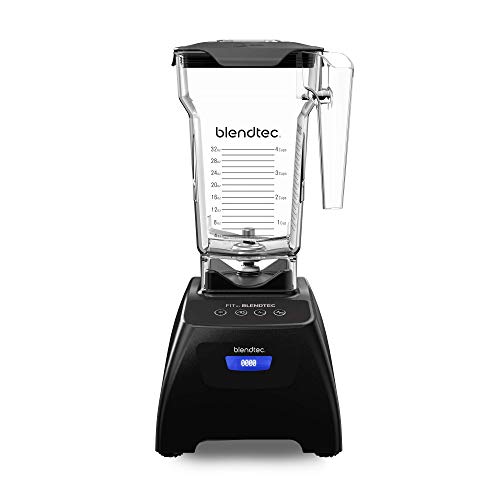
No review of this class is complete without its longest-running rival, because the two machines embody opposite answers to the same questions. Where the reference chooses a tall jar, manual dial, and a tamper, the Blendtec line chooses a wide jar that a spatula can actually reach, pre-programmed cycles you start and walk away from, and a blunt blade design that pulverises rather than slices and is safer to handle in the sink. Owners of each tend to be evangelical, and the honest summary is that both philosophies work: the wide jar wins on big-batch scraping and small-kitchen height, the tall jar wins on small-batch circulation and hands-on control of thick mixtures. If your cooking is program-and-go — press smoothie, unload the dishwasher, return to a finished drink — the Blendtec approach may suit you better, and choosing it over the reference is a matter of temperament, not quality. Best for: large households, preset devotees, and kitchens short on vertical clearance. Not suited for: cooks who like to steer a blend by hand and ear. Check price on Amazon to compare its current listing with the reference model.
Value Over Time: What the Premium Actually Buys
Since this review format forbids itself the comfort of a simple verdict on cost, the value question has to be argued in structure rather than numbers. The premium buys four things. First, a texture ceiling that does not degrade: the thousandth smoothie is as smooth as the first, because the components that determine smoothness — motor torque under load, jar geometry, blade condition — are built with margin to spare. Second, it buys time: blends finish faster, cleanup is a rinse rather than a project, and no part of the routine involves coaxing a struggling machine. Third, it buys the parts-and-support decade described above, which converts accidents and wear from replacement events into maintenance events. Fourth, and least tangibly, it buys the absence of a second purchase — the cheap machine bought first and the real machine bought after it fails is the most expensive path in this category, and the commonest.
Against that, the honest counter-argument: a mid-tier machine bought by a household that blends twice a month delivers nearly all the value that household will ever use, and the premium’s advantages are frequency-dependent. Durability you do not use is not value; texture headroom you never call on is not value. This is why the review keeps returning to the same fork — your real blending rhythm, not your aspirations — and why the verdict at the top of this page is conditional rather than universal. The machine is superb. Whether it is superb for you is a question about your kitchen, and the preceding sections have tried to give you every fact needed to answer it without a showroom, a salesperson, or a leap of faith.
Common Complaints About This Class, Examined
A review earns trust by taking the standard criticisms seriously rather than waving them away, so here are the five that follow this class of machine everywhere, with a fair hearing for each. The first is jar clouding: after a year or two of mineral-heavy water, ice, and abrasive ingredients, the jar’s interior can lose its showroom clarity. It is cosmetic, it does not affect performance or hygiene, and a periodic soak with a baking-soda paste or a vinegar rinse restores much of it — but buyers who prize pristine looks should know it happens and that it is the price of a tough, shatter-resistant material doing violent work.
The second complaint is the absence of presets. Rival machines offer one-touch programs for smoothies, soups, and ice cream, and their absence here is a deliberate philosophy, not an omission: the dial puts the cook in charge. Whether that reads as purity or as missing features depends entirely on the cook, which is why the comparison sections above treat it as temperament rather than score. The third complaint is noise, and it is simply valid — the mitigation is brevity and timing, not denial. The fourth is the walk-away factor: a manual machine asks you to stand with it for the minute it blends, tamper in hand for thick work. Households that blend while doing three other things will feel this; cooks who treat blending as cooking will not.
The fifth complaint is the premium itself, usually phrased as “it is only a blender.” The fair response is the one this review has built section by section: the premium is not for the noun, it is for the decade — the texture that does not fade, the parts that exist, the motor that does not tire. If your usage does not reach into that decade, the complaint is correct and the mid tier is waiting. If it does, the complaint dissolves into arithmetic. Either way, the decision deserves better than a slogan, and a buyer who has read this far has everything needed to make it on evidence.
Blender: What Long-Term Use Reveals That a First Test Misses
Start with how a {p} holds up once the novelty wears off and routines settle in. Most coverage of a blender concentrates on the first week of ownership, yet the decisions that matter most tend to surface later, once the blender has to earn its place in an ordinary weekday routine rather than a carefully staged first attempt. Write down the three jobs you expect it to do most often, in the order you actually do them, and judge every claim you read against that short personal list instead of against a generic ideal.
Use a short decision checklist to finish. One, does it fit the space and the storage you really have. Two, does it handle your three most common jobs without a workaround. Three, do the edge cases you listed stay manageable. Four, can every wear part be cleaned or replaced without drama. Five, would you still choose it if a friend described the same drawbacks in their own kitchen. A blender that passes all five is a sound buy; one that fails two or more is a compromise you are choosing with open eyes, which is a very different thing from being surprised later.
Work through a realistic scenario, not a best case. Picture the busiest version of the job: more people to serve, less time than planned, ingredients or materials that are slightly out of the ordinary, and a clean-up waiting at the end. Ask how the blender behaves at that upper edge, because a model that only shines on a small, simple load will disappoint precisely when you need it most. If the honest answer is that you would split the job into batches or fall back on an older method, factor that into the decision now rather than discovering it later.
Maintenance decides how long the good results last. Set a simple rhythm: a quick wipe or rinse after each use, a deeper clean on a fixed day, and a periodic check of the parts that move, seal or bear weight. A blender that needs fiddly disassembly for basic care will be cleaned less often, and performance drifts long before anything actually breaks. Prefer designs where the parts that get dirtiest are the parts that are easiest to reach, and be honest with yourself about which cleaning steps you will genuinely keep up.
Edge cases deserve a deliberate pass. Think about the odd shapes, the thicker or thinner than usual loads, the leftovers, the second helping and the guest with different preferences. A well-chosen blender handles the exceptions gracefully, or at least predictably, while a poor match turns every exception into a workaround. List your two or three most common exceptions in advance and check, from the manual or the listing details, that nothing about them is ruled out by size, shape, material or care requirements.
Finally, plan the first fortnight deliberately. Use the blender for one familiar job first, so you have a baseline you trust, then introduce the harder cases one at a time and note what changes. Small adjustments to arrangement, timing, quantity or preparation usually close most of the gap between disappointing first results and the performance the design is capable of. That short learning period is also the fairest test of long-term ownership: if the routine has not settled by the end of it, the mismatch is real, and it is better to know while returning or exchanging is still straightforward.
When you check listings such as Vitamix 5200, KitchenAid K400 and Ninja Professional Plus, use them as worked examples: run through the same checks below on each one in turn, so the comparison stays honest and like for like rather than based on whichever listing happens to shout loudest.
Troubleshooting is easier when you expect the usual failure points. With any blender, the recurring problems tend to cluster in the same places: uneven results from overloading or poor arrangement, wear showing first on the parts handled most often, and small annoyances with lids, seals, handles, controls or fittings that only appear after repeated use. Before buying, look for whether those wear parts can be cleaned properly, replaced or worked around, and whether the instructions address them directly rather than pretending they never happen.
Measure before you commit. Note the footprint, the clearance above and behind the spot where the blender will live, and the route you will carry it by when it is hot, full or awkward. A blender that technically fits but blocks a cupboard door, crowds a neighbouring appliance or has to be dragged across a worktop every time will quietly fall out of use, whatever its merits on paper. In the Kitchen Appliances category especially, a few centimetres of clearance and a sensible storage plan separate a daily tool from a bulky regret.
One more check worth doing with any blender is to read the care and safety instructions in full before the first use, not after the first problem. The manual for a blender usually states plainly which materials, loads and cleaning methods are off limits, and most early disappointments trace back to a line in those pages that was skimmed. Five minutes with the instructions is the cheapest performance upgrade available in the whole Kitchen Appliances category.
Keep notes for the first few weeks. A single line each time you use the blender — what you made or did, what you adjusted, and what you would change — turns vague impressions into a pattern you can act on. By the end of a month you will know exactly which settings, quantities or arrangements suit your household, and that personal record is worth more than any generic advice, because it describes your kitchen, your ingredients and your habits rather than somebody else’s.
Frequently Asked Questions
Is a premium blender really smoother than a mid-tier one?
Yes, and the difference concentrates exactly where mid-tier machines struggle: leafy greens, seeds, and frozen mixtures. A mid-tier blender makes a good smoothie; the premium class makes a completely uniform one, with no flecks or grit, because its vortex keeps the whole mixture circulating through the blades for the full cycle. If your drinks are soft fruit and protein powder, you may never notice the gap. If kale, frozen mango, and flaxseed are regulars, you will notice it in the first glass.
How loud is it in practice?
Loud enough to plan around. Soft blending at low speeds is unremarkable, but ice and frozen fruit at full power produce a roar that pauses conversation and will wake light sleepers in a small home. Owners manage it by blending at sociable hours, crushing ice before guests arrive, and resting the base on a folded towel to calm counter vibration. What the premium class offers is speed: the loud job finishes quickly and evenly instead of dragging on.
Can it make nut butter and dough?
Nut butter, yes — with the tamper, patience, and sensible batch sizes, it produces smooth nut butters reliably, though the mixture heats as it works and short rests help. Dough, no: kneading belongs to food processors and stand mixers, and asking a blender to do it strains the motor and produces poor dough. The blender’s thick-mixture talent is real but specific — butters, dips, and frozen desserts — and respecting that boundary is part of owning the machine well.
Is the tall jar a problem in a small kitchen?
It is the most practical objection to the class. Assembled, the machine may not fit beneath wall cabinets, so owners either give it permanent counter residence, store the jar separately, or choose a lower-profile design instead. Measure your clearance before buying; if the numbers fail and no storage arrangement works, treat that as a genuine disqualification rather than an inconvenience you will somehow overcome, because a blender that is awkward to reach is a blender that stops being used.
How long will a blender of this class last?
With daily use and basic care, many years — a decade of service is a realistic expectation for the well-built end of the category, with a jar or lid replaced along the way rather than the machine. Longevity comes from the unglamorous details: metal drive parts, a sealed blade assembly, sustained-torque motor design, and a manufacturer that keeps parts in the catalogue. It is the central reason the premium tier exists, and the main thing a cheaper machine cannot imitate, no matter how closely a cheaper machine’s feature list appears to match on the day both are new.
What should I blend first to learn the machine?
Start with a forgiving smoothie — banana, frozen berries, yoghurt, and a splash of liquid — starting on low speed and climbing as the vortex forms, so you learn the sound and rhythm of a mixture circulating properly. Follow with a cooked vegetable soup to learn the venting and fill rules while the stakes are low. Save nut butter and thick frozen desserts for the second week, once the tamper feels natural in your hand and the sounds of a healthy blend are familiar. Three jobs, learned in that order, teach you nearly everything the machine does well.