Disclosure: As an Amazon Associate, topratedkitchenware.com earns from qualifying purchases. Links on this page are affiliate links; they cost you nothing extra. Prices and availability change often, so check the current Amazon listing before you buy.
Blender reviews are only useful when they argue with each other a little. Read six product pages and every machine is powerful, versatile, and beloved; read honest blender reviews side by side and a more useful picture emerges — one where each model is genuinely excellent at something, genuinely ordinary at something else, and the right choice depends entirely on which something matches your kitchen. This roundup reviews the six designs that define the modern market, from the premium benchmark to the personal cup that lives in a gym bag, judging each on texture, toughness, daily usability, and the ownership details that never make the box. No single winner is crowned, because crowning one would be a lie; instead, each review ends with the household it serves best.
Key Takeaways
- The premium full-size machines separate themselves on green-smoothie finesse, thick-mixture authority, and how many years the performance lasts — not on feature lists.
- The mid tier is the sweet spot for most households: strong smoothies, family capacity, and honest build without the premium commitment.
- Personal blenders are not small versions of big blenders; they are a different tool that wins on speed and cleanup for solo drinks and loses on everything hot, big, or tough.
- Jar shape is a real dividing line — tall jars circulate small batches better, wide jars scrape and store better — and it matters more than small differences in motor figures.
- Every model below is a long-running design with a track record, reviewed in prose so the reasoning stays visible; check the current listing before you buy.
How to use this page: find your profile first — daily smoothie household, soup cook, frozen-drink host, solo commuter, family batch cook — then read the two or three reviews that speak to it and ignore the rest with a clear conscience. If you want the deep single-machine examination, our blender review takes the premium reference apart piece by piece; if you want the decision framework before the models, the blender buying guide comes first in the reading order. Readers who already know their budget tier can skim the badges under each model’s name, where the tier is given in words — entry, mid, premium — because that positioning, not a number, is what stays true.
In this guide
Blender Reviews: The Six Models That Define the Market
A word on method before the reviews themselves. Each model is judged against the same five jobs — green smoothies, hot soup, crushed ice and frozen drinks, thick mixtures like nut butter and hummus, and small everyday tasks — and against the same ownership questions: how it cleans, how it stores, how its parts are supported, and how it is likely to behave in year five. Models earn their place here by longevity in the market, not novelty; a design that has survived years of daily use in thousands of kitchens has passed a test no launch-week review can simulate. Where a model is weak, the review says so in plain terms, because a roundup that praises everything helps no one. One more methodological honesty: these reviews weigh the jobs a blender does weekly far above the tricks it can perform once for a camera. A machine that mills grain impressively but makes an ordinary Tuesday smoothie is, for nearly every household, the lesser machine — and the rankings implied throughout this page follow that weighting openly, so readers whose priorities run the other way can re-weight the verdicts for themselves with the reasoning left visible rather than hidden behind a score.

Vitamix 5200 — Best Overall for Daily, Heavy Use · Premium Tier
The benchmark, and after years on the market still the machine other full-size blenders are quietly measured against. Its formula is almost stubbornly simple: a tall jar shaped for a powerful vortex, a variable-speed dial with a pulse, a tamper, and construction that treats daily frozen loads as the design brief rather than an abuse case. Green smoothies are its signature — kale and spinach vanish completely, seeds grind smooth, and frozen fruit emerges without grit or chunks — because the whole mixture keeps circulating through the blades instead of stratifying. Hot soup is the second signature: vented, heat-tolerant, and capable of a silkiness that makes simple vegetables taste deliberate. Thick work follows with the tamper, turning nuts toward butter and frozen fruit toward spoonable bowls with a patience cheaper machines cannot afford, because their motors heat and falter where this one simply continues.
The criticisms are structural, not incidental. It is tall — genuinely tall — and kitchens with low wall cabinets must plan around it. It is loud at full power in the way of all serious machines, and its manual controls ask the cook to participate rather than press and wander off. The big jar also imposes a minimum sensible batch, so a single small smoothie feels oversized. None of these is a defect; they are the shape of the priorities. Best for: daily blenders, green-smoothie households, soup cooks, and buy-once buyers. Not suited for: tiny kitchens, solo soft-drink routines, or anyone who wants presets to do the thinking. Check price on Amazon for the current listing.
Vitamix E310 — Best Entry Point to Premium Build · Premium Tier, Lower Step
The E310 exists to answer a fair question: how much of the flagship experience can be kept when the size and the commitment shrink a step? Its answer is most of it. The jar is a little smaller and the stance a little more compact, the controls keep the same honest dial-and-pulse philosophy, and the blending character — strong vortex, complete green breakdown, confident ice work — is recognisably from the same school. For households of one to three, the smaller jar is not a compromise at all; it is a better match, circulating modest batches more willingly than a big pitcher does and washing up faster. Soup performance remains a strength, and the machine’s heat tolerance and venting follow the family pattern.
What you give up against the flagship is headroom: the very largest family batches, the longest sustained thick-mixture sessions, and a measure of the flagship’s sheer unkillable feel. What you keep is the essential thing — premium build logic, parts support, and texture quality that sits clearly above the mid tier. In these blender reviews it is the model we would hand to a smaller household that blends daily and intends to keep the machine for years. Best for: one-to-three-person households wanting premium longevity in a saner size. Not suited for: big-batch entertainers or buyers who need the absolute maximum capacity. Check price on Amazon for the current listing, and see how its sibling performs under the microscope in our blender review.
Blendtec Classic — Best for Presets and Big Batches · Premium Tier
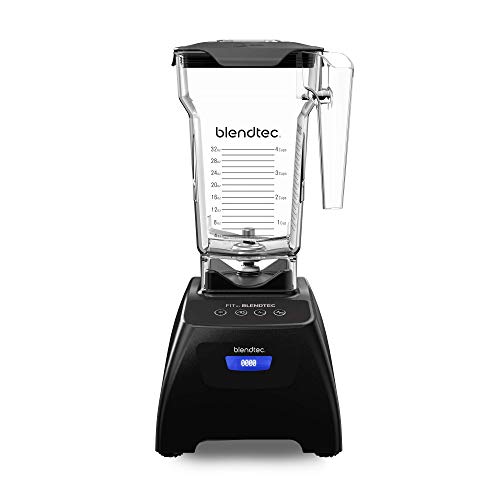
The other premium philosophy, and the most interesting argument in the category. Blendtec’s wide jar is the design’s manifesto: it sits lower on the counter, welcomes a spatula to the very bottom, and handles family-scale batches with an ease tall jars cannot match. The blade is deliberately blunt — it pulverises by force rather than slicing — which makes it safer to handle during washing and brutally effective on ice and frozen fruit. Pre-programmed cycles define the user experience: press the smoothie program and walk away, a convenience the manual-dial school cannot offer and many households genuinely prefer. Texture results at this level are excellent; smoothies are smooth, soups are silky, and frozen drinks are the machine’s home crowd.
The trade-offs mirror the philosophy. The wide jar needs a reasonable volume to build its flow, so small batches are its weakest work, and without a tamper tradition, the thickest mixtures ask for more stopping and scraping than the tall-jar rival. The blunt blade’s approach also produces a slightly different character in delicate work. None of this diminishes the machine; it defines its owner. Best for: families, preset lovers, big batches, and kitchens where height is scarce. Not suited for: small-batch specialists or hands-on cooks who enjoy steering a blend. Check price on Amazon for the current listing.
KitchenAid K400 — Best Mid-Tier All-Rounder · Mid Tier
The K400 is the machine these blender reviews recommend most often to the largest number of people, because it occupies the honest middle with unusual grace. Its smoothie performance is the headline: a well-shaped jar and an asymmetric blade design that pulls ingredients down convincingly, producing green smoothies that satisfy all but the most demanding palates. It looks like it belongs in a considered kitchen — the design language is domestic rather than industrial — and its controls are friendly to households where several people of different confidence levels will use it. Capacity suits family drinks and soup batches, and the machine handles ice with the competence its tier promises.
The distance from the premium tier shows in endurance rather than in any single blend: sustained nut-butter sessions, years of twice-daily frozen loads, and the depth of the parts catalogue behind it. For a household blending a few times a week, that distance may never become visible, which is precisely the K400’s case. Best for: smoothie-led families wanting polish and value in balance. Not suited for: the heaviest daily thick-mixture work or decade-scale buy-once expectations. Check price on Amazon for the current listing.

Ninja Professional Plus — Best Value for Frozen Drinks and Families · Entry-to-Mid Tier
The Ninja’s proposition is blunt and appealing: serious crushing power and generous capacity at a tier that does not require a family meeting. Its stacked-blade design and strong motor chew through ice and frozen fruit with real enthusiasm, making it the frozen-drink and party-batch champion of its price class, and its large pitcher swallows family smoothie sessions whole. For households whose blending peaks at weekends — smoothies for the children, frozen drinks for guests, the occasional sauce — it delivers the visible results people actually ask about, and it delivers them immediately.
The compromises live in finesse and lifespan. Stacked blades blend fast but can leave green smoothies with more texture than vortex designs, and the plastic-forward construction, while perfectly serviceable, is not built to the decade standard of the premium tier; heavy daily use will find its limits years sooner. It is also a big, tall presence, and its many parts ask a little more of the washing-up. Judged as what it is — the value athlete of the category — it is an easy recommendation; judged as a buy-once heirloom, it is the wrong tool. Best for: families and entertainers wanting maximum capability per tier. Not suited for: green-smoothie perfectionists or daily heavy users planning in decades. Check price on Amazon for the current listing.
NutriBullet Pro — Best for Solo Smoothies and Small Kitchens · Mid Tier, Personal Class
The personal blender that defined its class, and still the cleanest expression of the idea: blend in the cup, swap the blade for a lid, drink, rinse one vessel, done. For the solo weekday smoothie — the single most common blending routine in modern kitchens — nothing in this roundup touches it for total effort, because the blending takes a minute and the cleanup takes twenty seconds. Its extractor blade and cup geometry produce genuinely smooth single drinks from fresh and frozen fruit, greens included, provided portions stay sensible, the cup is not overfilled, and liquid ratios are respected. It stores like a kettle and travels like a bottle, which is why it colonised dorm rooms, desks, and small apartments where a full-size machine would be furniture.
The boundaries are absolute and must be respected: no hot liquids, no family batches, no nut butters, and ice only in modest, liquid-supported quantities. Treating it as a small full-size blender destroys it; treating it as the specialist it is makes it one of the highest-satisfaction appliances in this entire roundup — a contrast drawn out in blender vs personal blender. Best for: solo smoothie routines, small kitchens, commuters. Not suited for: soups, families, entertaining, or any hot work. Check price on Amazon for the current listing.
How the Six Compare at a Glance
| Model | Class | Tier | Signature Strength | Honest Limitation |
|---|---|---|---|---|
| Vitamix 5200 | Full-size, tall jar | Premium | Texture ceiling and longevity | Height, noise, batch minimum |
| Vitamix E310 | Full-size, compact | Premium, lower step | Premium build in a smaller footprint | Less batch headroom |
| Blendtec Classic | Full-size, wide jar | Premium | Presets and big-batch ease | Small batches, thick-work scraping |
| KitchenAid K400 | Full-size | Mid | Polished all-round smoothie work | Endurance below premium tier |
| Ninja Professional Plus | Full-size, large capacity | Entry to mid | Ice and capacity per tier | Finesse and lifespan |
| NutriBullet Pro | Personal | Mid | Speed and cleanup for one | No heat, no batches, no heavy work |
Read the table vertically and the market’s logic appears: every row trades the same currencies — texture, capacity, convenience, longevity — in different proportions, and the rows are ordered by commitment rather than quality. A household that understands its own routine can locate its row in seconds. A household that does not should borrow the framework from our blender buying guide before spending anything, because the costliest mistake in this category is buying a magnificent answer to somebody else’s question. Job-specific readers can go deeper with the best blenders for smoothies with ice for frozen work and the best blenders for soup making for the hot end of the repertoire.
What Separated the Winners in Each Job
Green smoothies rewarded vortex discipline above all: the tall-jar premium machines and the K400 kept fibrous leaves circulating until they disappeared, while faster, looser designs left evidence. Hot soup rewarded venting, heat tolerance, and sustained power, which is why the premium full-size machines own the job and the personal class is disqualified from it entirely. Ice and frozen drinks rewarded raw crushing violence tempered by evenness — the Ninja’s enthusiasm and the premium machines’ control both passed, while grit and surviving shards marked down anything underpowered. Thick mixtures rewarded the tamper and the motor’s cooling, the two least glamorous specifications in the category and the two that decide whether nut butter is a recipe or a repair bill. Small everyday jobs inverted the hierarchy completely: the smallest machine won by being already out, already fast, and already washed while the flagships were still being assembled.
Two lessons generalise beyond these six models. First, headline power predicted almost nothing on its own; jar geometry and blade design explained most of the differences that mattered, which is why these blender reviews spend more words on shapes than on figures. Second, every machine’s worst job was predictable from its design philosophy — there were no surprises, only trade-offs honoured or ignored. Buyers who internalise those two lessons can read any future model’s design and forecast its review before reading a word of it, which is a more durable skill than memorising this year’s rankings. A third lesson deserves stating because it is the one first-time buyers resist hardest: consistency across repetitions is the true premium feature. Any competent machine can produce one excellent smoothie for a demonstration; the machines at the top of this roundup produce the same smoothie on a tired Thursday in February, with a fuller jar, older bananas, and a cook who is measuring nothing. That repeatability — the absence of blending roulette — is what daily users are actually describing when they call a machine reliable, and it is invisible in specifications. It emerges only from design margin: a motor loafing where others strain, a vortex that forms across a range of fill levels, seals that behave identically in month one and month forty. When these reviews praise the premium tier, this invisible consistency is most of what they are praising.
Care and Cleaning Across the Six
Ownership effort varies more across these six than their blending does. The personal blender is the effortless outlier — one cup, one blade unit, a rinse — which is the core of its appeal and the reason its owners blend more often. The full-size machines cluster around the same routine: immediate rinse, the warm-water self-clean cycle, a brush around fixed blades, and periodic attention to seals and lid plugs, all detailed in how to clean a blender. Removable and stacked blade systems trade the fixed blade’s leak-proofing for more pieces in the sink; wide jars trade vortex strength for the easiest scraping and drying in the class. Dishwasher claims vary by part and maker, and the honest habit — hand-rinse the jar, let the dishwasher handle cups and lids where permitted — serves all six. The machine you will clean without resentment is the machine you will still be using in year three, which is why this section belongs in a reviews roundup at all.
Which One Should You Actually Buy?
Decide by household, not by hierarchy. The daily blending household of two or more, especially with green smoothies or soups in the routine, belongs with the premium tall-jar reference or, at a smaller scale, its compact sibling — the two reviews above that use the word decade without flinching. The family that blends in bursts — weekend smoothies, party drinks, holiday batches — should choose between the wide-jar premium’s presets and the value champion’s capacity-per-tier, depending on whether the commitment is about longevity or about budget. The smoothie-led household wanting a polished everyday machine without the premium step will be happiest in the mid tier, where the K400’s balance is genuinely hard to beat. The solo drinker should stop reading full-size reviews altogether and buy the personal machine, possibly adding a full-size model later only if life expands into soups and batches — the two-machine household is a legitimate destination, not an indulgence. And the reader still torn between types altogether should settle the structural questions with blender pros and cons and the money question with is a blender worth it before returning here to pick a badge.
Blender Reviews by Use Case
For the Daily Green-Smoothie Household
Your defining ingredient is fibre, and fibre is merciless: it exposes every weakness in circulation within one glass. The premium tall-jar machine and its compact sibling are the reviews to reread, because their vortices were built for exactly this — leaves entering the blade path again and again until the drink pours uniformly and drinks clean, with no chewing and no green confetti. The mid-tier K400 is the credible alternative, close enough that only side-by-side glasses reveal the difference, and entirely sufficient for households whose greens are spinach rather than raw kale stems. What to avoid is the fast-but-loose design: speed without circulation leaves the signature fleck, and no extension of blending time fully rescues it, because the leaves simply ride above the blades. If your mornings are green, buy circulation first and everything else second.
For the Soup-and-Sauce Cook
Your defining constraints are heat and volume. The machine must vent steam safely, tolerate sustained hot work, and hold enough to make a pot of soup a two-batch job rather than a five-batch saga. The premium full-size pair lead again, with the wide-jar machine’s capacity making it the batch cook’s particular friend, while the immersion alternative — considered in blender vs immersion blender — tempts with its in-pot convenience and concedes the final silkiness. Sauces split the difference: a full-size jar emulsifies pan sauces and curry bases beautifully in quantity, while single-cup dressings belong to smaller tools. Soup cooks should also weigh the transfer ritual honestly: pouring hot liquid between pot and jar, twice per batch, is the tax this class charges for its texture, and cooks who make soup twice a week pay it gladly while monthly soup makers may not.
For the Frozen-Drink Host
Your defining load is ice, in quantity, on deadline, with an audience. Every full-size machine in this roundup can do the job; the differences are evenness and stamina across back-to-back batches. The value champion earns its loudest applause here — capacity and crushing enthusiasm at a gentle tier — while the premium machines add control: slush that pours uniformly, batch after batch, without the motor’s note changing. The wide jar scrapes clean between batches fastest, a small mercy at a party. The personal machine is excused from this duty entirely. Hosts should also plan the noise: crush early, blend before guests settle, and let the machine’s minute of thunder happen in an empty kitchen rather than over a conversation.
For the Small Kitchen and the Solo Routine
Your defining constraint is space, and your defining job is one drink, fast, on a weekday. The personal blender is not the compromise choice here; it is the correct engineering answer, and the full-size reviews above are, for you, a catalogue of other people’s appliances. Its cupboard footprint is a drawer, its cleanup is a rinse, and its performance on a single smoothie — fresh or frozen, greens included — is genuinely good rather than merely adequate. The only reason to look upward is a second job: if soups, batches, or entertaining enter your life, the compact premium model is the step that adds them without annexing the kitchen. Until then, the bravest sentence in appliance buying is “this small one is enough,” and in this roundup it happens to be true.
Reading a Blender Listing Like a Reviewer
Because these blender reviews will age while listings multiply, it is worth handing over the reading method itself. Start with jar geometry, not the motor figure: a photograph tells you whether the jar is tall and vortex-minded or wide and batch-minded, and that single fact predicts small-batch behaviour, scraping, storage, and half the texture story. Next, look at the drive and blade construction — metal where it counts, a blade assembly that is either sealed and integrated or honestly serviceable — because those details forecast the fifth year better than any launch claim. Then read the controls as a philosophy statement: a dial promises participation and longevity; a program panel promises convenience and electronics; neither is wrong, but they are different products wearing similar silhouettes.
Continue with the parts page, the least-read and most-revealing document in the category. A maker that sells jars, lids, gaskets, tampers, and blade assemblies individually is telling you the machine was designed to be maintained; a maker that sells none of them is telling you the machine was designed to be replaced. Check the hot-liquid rules next if soup matters — venting design and fill limits are printed plainly by honest makers — and treat any personal blender that invites hot use as a listing to close immediately. Finally, weigh the warranty as an engineering confession: manufacturers price their confidence into its length, and a long warranty on a simple machine is one of the few marketing facts that costs the maker money when it is wrong. Apply those five readings — geometry, construction, controls, parts, warranty — and you can review a blender you have never touched with more accuracy than most first-week owners.
One more habit separates reviewers from shoppers: read the complaints before the praise, and sort them by pattern rather than by volume. Isolated failures happen to every product that ships in quantity. Patterns — the same gasket, the same crack, the same stall on the same ingredient, recurring across years of ownership notes — are the truth of a design, and they are almost always visible if you look for repetition instead of outrage. The six models in this roundup earned their places partly by the thinness of their pattern files: things owners criticise about them are the known trade-offs printed in these reviews, not surprises waiting in month nine. That, more than any single blend, is what a mature product looks like.
Extended Notes: Living With Each Design
The Tall-Jar Premium Pair, Day to Day
Ownership of the two premium tall-jar models settles into a recognisable rhythm: the machine lives on the counter because it is used too often to store, the dial becomes as automatic as a tap, and the tamper hangs within reach like a wooden spoon. Owners consistently describe the same surprise — how quickly the manual controls stop feeling manual. A week of smoothies teaches the ear what a circulating blend sounds like, and from then on the machine is operated the way a bicycle is ridden, without conscious instruction. The jar’s height shapes the kitchen around it slightly: a shelf is cleared, a spot under no cabinet is claimed. In exchange, the texture standard quietly rises for the whole household, and drinks or soups from lesser machines — cafes included — start to taste unfinished. That recalibration, more than any single feature, is what owners mean when they say they could not go back.
The Wide-Jar Premium, Day to Day
The wide-jar household’s rhythm is different: batch day is a pleasure rather than a project, because the jar swallows a family quantity and surrenders every last spoonful to a spatula. The preset programs integrate the machine into other routines — start the smoothie cycle, pack the lunches, return to a finished drink — and that walk-away quality, dismissed by purists, turns out to be the feature busy families actually use. Washing is the easiest of the full-size class, helped by the blade design that forgives a careless hand. The compromises appear at the edges of the week: the single small sauce that will not circulate, the thick mixture that wants one more scrape than the owner wanted to give. Households whose blending is mostly family-scale never meet those edges, which is why this design’s owners are as loyal as the tall-jar school’s, and why the argument between the two camps is really an argument about batch sizes wearing the clothes of an argument about quality.
The Mid-Tier and Value Machines, Day to Day
The K400’s owners describe a machine that simply fits: it looks right on the counter, everyone in the house can run it, and the smoothies are good enough that the premium question stops arising. Its ownership story is the absence of story, which for most households is the highest available praise. The value champion’s story has more plot: an enthusiastic honeymoon of party batches and family smoothies, followed — under daily heavy use — by the gradual realisation that it is being asked to live a premium life on a value constitution. Under the rhythm it was designed for, a few blends a week, that second act never arrives, and the machine retires years later having been exactly the bargain it promised to be. The lesson these two reviews teach together is that mid and value tiers fail by mismatch far more often than by defect.
The Personal Blender, Day to Day
The personal machine’s ownership story is measured in seconds: the twenty-second rinse, the cup that goes from base to bag, the base that never leaves its corner because putting it away would take longer than using it. Its owners blend more often than any other group in this roundup, precisely because the friction is lowest, and frequency is the hidden variable behind most appliance satisfaction. Its failures are equally characteristic — the cracked cup from an overfilled frozen load, the seal that tired after a year of daily twisting — and they arrive when the machine is treated as a small version of something it is not. Kept within its brief, it is the roundup’s quiet overachiever: the least capable machine here, and for its specific household, the most loved.
How Households Evolve Between These Machines
Few households keep their first blender forever, not because the machines fail but because lives change shape, and the migration patterns between these six reviews are so consistent they are worth mapping. The commonest journey starts with the personal machine in a first apartment, adds a full-size model when smoothies become a household ritual or soup enters the repertoire, and keeps both — the little one for weekday solos, the big one for everything else. The second journey starts with a value full-size machine bought for a young family, which serves honourably through the party years and is then replaced — not in anger but in knowledge — by a premium model whose buyer now knows exactly which jobs matter, because the first machine taught them. The third journey is the shortest: the household that researches once, buys the premium reference first, and simply never shops for a blender again.
None of these journeys is a mistake, and reviewers do the category a disservice when they pretend the first purchase must be the final one. A personal blender that serves three years of weekday mornings has repaid its tier many times over before the household outgrows it. A value machine that teaches a family its real blending rhythm has provided information no review can. The only genuinely wasteful pattern is the repeated one — bargain after bargain, each failing at the same job — because that household has identified its requirement (a strong machine) and keeps declining to meet it. If you recognise your own history in that pattern, the correct move is not another experiment; it is the step up, taken once, to the tier your usage has been describing for years. Our best blenders for thick smoothies roundup is a useful next read for households whose journey is being driven by frozen, spoonable blends in particular.
A Note on Tiers, Since Prices Change
These blender reviews describe tiers in words — entry, mid, premium — because a tier is a durable fact about a machine’s construction and intent, while any number attached to it would be stale before the season turned. What a tier actually encodes is worth spelling out. The entry tier spends its budget on headline capability: strong first impressions, generous capacity, lighter construction. The mid tier balances capability against finish and support, and is where most households’ needs are fully met. The premium tier spends on margin — torque in reserve, parts in the catalogue, a design expected to be serviced rather than replaced — and its premium is therefore best understood as buying years rather than features. When you compare listings, compare within a tier first and across tiers second; a machine that seems expensive beside its tier-mates needs a reason, while a machine that seems cheap for its tier usually has one, and the reason is rarely in your favour.
The Bottom Line of This Roundup
Six machines, six honest answers. The premium tall-jar reference remains the closest thing the category has to a universal recommendation — for the households whose blending is daily, varied, and expected to continue for years. Its compact sibling translates the same virtues for smaller households without surrendering the essential build. The wide-jar premium makes the opposite geometry feel equally inevitable for families who blend in batches and prefer to press a program and get on with the morning. The mid-tier all-rounder is the roundup’s quiet centre of gravity, the machine most households would be happiest with if they stopped reading at the point of sufficiency. The value champion proves how much visible capability a gentle tier can buy when the workload is weekend-shaped. And the personal blender, the least powerful object on the page, is for its owner the most perfectly fitted — a reminder that in this category, fit beats force every time the two are confused.
If a single sentence must carry the whole roundup, it is this: decide the jobs, the batch size, and the frequency first, and the correct model selects itself from the six above with almost no deliberation left over. The deliberation that remains — tall jar or wide, dial or programs, now or after the current machine dies — is the pleasant kind, between good options. Readers who want the framework before the field should begin with the blender buying guide; readers who want one machine interrogated to the last gasket should go to the blender review. Everyone else has, we hope, already found their row in the table — and can now check the current listing for that model, in the confidence that the reasoning behind the choice will still look sound in five years.
Blender: What Long-Term Use Reveals That a First Test Misses
Start with how a {p} holds up once the novelty wears off and routines settle in. Most coverage of a blender concentrates on the first week of ownership, yet the decisions that matter most tend to surface later, once the blender has to earn its place in an ordinary weekday routine rather than a carefully staged first attempt. Write down the three jobs you expect it to do most often, in the order you actually do them, and judge every claim you read against that short personal list instead of against a generic ideal.
Measure before you commit. Note the footprint, the clearance above and behind the spot where the blender will live, and the route you will carry it by when it is hot, full or awkward. A blender that technically fits but blocks a cupboard door, crowds a neighbouring appliance or has to be dragged across a worktop every time will quietly fall out of use, whatever its merits on paper. In the Kitchen Appliances category especially, a few centimetres of clearance and a sensible storage plan separate a daily tool from a bulky regret.
Troubleshooting is easier when you expect the usual failure points. With any blender, the recurring problems tend to cluster in the same places: uneven results from overloading or poor arrangement, wear showing first on the parts handled most often, and small annoyances with lids, seals, handles, controls or fittings that only appear after repeated use. Before buying, look for whether those wear parts can be cleaned properly, replaced or worked around, and whether the instructions address them directly rather than pretending they never happen.
Work through a realistic scenario, not a best case. Picture the busiest version of the job: more people to serve, less time than planned, ingredients or materials that are slightly out of the ordinary, and a clean-up waiting at the end. Ask how the blender behaves at that upper edge, because a model that only shines on a small, simple load will disappoint precisely when you need it most. If the honest answer is that you would split the job into batches or fall back on an older method, factor that into the decision now rather than discovering it later.
Maintenance decides how long the good results last. Set a simple rhythm: a quick wipe or rinse after each use, a deeper clean on a fixed day, and a periodic check of the parts that move, seal or bear weight. A blender that needs fiddly disassembly for basic care will be cleaned less often, and performance drifts long before anything actually breaks. Prefer designs where the parts that get dirtiest are the parts that are easiest to reach, and be honest with yourself about which cleaning steps you will genuinely keep up.
Edge cases deserve a deliberate pass. Think about the odd shapes, the thicker or thinner than usual loads, the leftovers, the second helping and the guest with different preferences. A well-chosen blender handles the exceptions gracefully, or at least predictably, while a poor match turns every exception into a workaround. List your two or three most common exceptions in advance and check, from the manual or the listing details, that nothing about them is ruled out by size, shape, material or care requirements.
Use a short decision checklist to finish. One, does it fit the space and the storage you really have. Two, does it handle your three most common jobs without a workaround. Three, do the edge cases you listed stay manageable. Four, can every wear part be cleaned or replaced without drama. Five, would you still choose it if a friend described the same drawbacks in their own kitchen. A blender that passes all five is a sound buy; one that fails two or more is a compromise you are choosing with open eyes, which is a very different thing from being surprised later.
Finally, plan the first fortnight deliberately. Use the blender for one familiar job first, so you have a baseline you trust, then introduce the harder cases one at a time and note what changes. Small adjustments to arrangement, timing, quantity or preparation usually close most of the gap between disappointing first results and the performance the design is capable of. That short learning period is also the fairest test of long-term ownership: if the routine has not settled by the end of it, the mismatch is real, and it is better to know while returning or exchanging is still straightforward.
When you check listings such as Vitamix 5200, Vitamix E310 and Blendtec Classic, use them as worked examples: run through the same checks below on each one in turn, so the comparison stays honest and like for like rather than based on whichever listing happens to shout loudest.
One more check worth doing with any blender is to read the care and safety instructions in full before the first use, not after the first problem. The manual for a blender usually states plainly which materials, loads and cleaning methods are off limits, and most early disappointments trace back to a line in those pages that was skimmed. Five minutes with the instructions is the cheapest performance upgrade available in the whole Kitchen Appliances category.
Keep notes for the first few weeks. A single line each time you use the blender — what you made or did, what you adjusted, and what you would change — turns vague impressions into a pattern you can act on. By the end of a month you will know exactly which settings, quantities or arrangements suit your household, and that personal record is worth more than any generic advice, because it describes your kitchen, your ingredients and your habits rather than somebody else’s.
Frequently Asked Questions
Which blender is best overall in these reviews?
For a household that blends daily and heavily, the premium tall-jar reference model earns the overall nod on texture, versatility, and longevity — it has no weak job among the big four of smoothies, soups, ice, and thick mixtures. But “overall” dissolves on contact with real kitchens: the best blender for a solo commuter in this same roundup is the personal model, and the best for a family on a budget is the value full-size machine. Match the badge to the household rather than chasing a single crown that was only ever designed for somebody else’s kitchen, somebody else’s routine, and somebody else’s definition of what a blender is actually for.
Are premium blenders worth the step up from mid-tier?
They are worth it when usage is heavy and frequent, because the premium buys durability, parts support, and a texture ceiling that does not fade — advantages that compound with every blend. A household blending a few times a week may never reach the workloads where the mid tier starts to show its limits, and for them the step up buys headroom they will not use. Frequency, as always in this category, is the honest deciding variable, the one question that outranks every specification, feature, and badge in this entire roundup of reviews.
Which blender handles green smoothies best?
The premium vortex machines lead, because their jar geometry keeps kale and spinach circulating through the blades until no fibre survives, and the mid-tier K400 follows closely enough to satisfy most drinkers. Personal blenders do a respectable job on a single green smoothie with enough liquid. The designs that struggle are those that blend fast but circulate loosely, leaving flecks no amount of extra time fully removes.
Can one blender really do both smoothies and hot soup?
Yes — the full-size machines in this roundup are built for exactly that span, with vented lids, heat-tolerant jars, and the sustained power fibrous vegetables demand. The exceptions are the personal class, which must never take hot liquid, and any machine whose lid seals without venting. If soup is a priority, confirm the venting design and the hot fill limit before buying, and follow the start-low routine every time.
Which is the easiest blender to clean?
The personal blender, by a wide margin: one cup and a blade unit, rinsed in seconds. Among full-size machines, wide jars scrape and dry most easily, while tall jars rely on the self-clean cycle, which handles most mixtures in half a minute of blending warm soapy water. Stacked-blade designs have the most pieces to wash. In every case, rinsing immediately after use matters far more than any of the design differences between these six machines, however real those differences may be.
How long should I expect these blenders to last?
Expectations should follow the tier. Premium full-size machines are decade-scale appliances with replaceable jars and parts. Mid-tier machines typically deliver several strong years of regular use. Value machines asked to work daily will show their limits sooner, while personal blenders live or die by how respectfully their cups, seals, and motors are treated. In all cases, matching the machine to the workload extends its working life more than any single feature, accessory, or specification printed anywhere on the box it arrived in.