Disclosure: As an Amazon Associate, topratedkitchenware.com earns from qualifying purchases. Links on this page are affiliate links; they cost you nothing extra. Prices and availability change often, so check the current Amazon listing before you buy.
These ceramic cookware set reviews assess the six sets that define the category’s range — from a light, colourful entry bundle to a hard-anodized premium line with a bonded induction base — using one consistent standard: how well each set cooks the everyday foods ceramic exists for, how honestly it is built, and how gracefully it will age in a real kitchen. A ceramic cookware set lives or dies by two things, the quality of its pan bodies and the care its owner gives the coating, so each review below covers construction, cooking character, strengths, trade-offs and the buyer each set genuinely suits. Where a set’s marketing outruns its material, the review says so.
Key Takeaways
- Best overall: GreenPan Valencia Pro — the sturdiest construction in the category, with induction compatibility and a body that outlasts its coating gracefully.
- Best design and storage: Caraway — a curated four-piece core with an organisation system that quietly protects the coating.
- Best mid-tier all-rounder: Cuisinart Ceramica XT — a complete, conventional set from a legacy cookware brand.
- Best budget: GreenLife Soft Grip — light, cheerful and accessible, with lifespan expectations set accordingly.
- Best big bundle: T-fal Initiatives Ceramic — generous piece count including utensils, for equipping a kitchen in one box.
- Best colourful mid option: GreenPan Rio — a step up from entry tier with the brand’s coating experience behind it.
In this guide
How These Reviews Assess a Set
Every set here is judged on the same evidence. Construction: what the body is made of, how flat and thick the base is, how handles and lids are executed. Cooking character: release for eggs and fish, evenness for pancakes and sauces, simmer control in the lidded pieces, and honesty about the searing ceiling all ceramic shares. Ownership: how the set will age — which pieces tire first, whether replacements are sold individually, how much care the coating demands. And fit: which stovetops it works on, which kitchens its inventory suits, which buyers should look elsewhere. Prices are deliberately not printed; check price on Amazon for the configuration you are considering, because bundles shift. Our single-set deep dive, ceramic cookware set review, explains the category standard these six are measured against, and the ceramic cookware set buying guide turns the criteria into a shopping method.
Ceramic Cookware Set Reviews: The Six Sets in Detail

GreenPan Valencia Pro — Best Overall
Construction is the headline: hard-anodized aluminum bodies with a bonded magnetic base, metal handles, and the brand’s flagship ceramic coating. In the hand the pans feel like instruments — balanced, flat, calm on the burner. On induction they respond immediately; on gas and glass they sit with the planted stability that thin pans never achieve. Cooking character follows the build: eggs release cleanly, pancakes brown in even rounds that testify to the base’s flatness, and the sauté work holds a steadier temperature when cold ingredients land than anything else in this roundup. The lidded pieces simmer patiently, and the whole set tolerates oven work within the maker’s stated limits thanks to those metal handles.
Strengths: the category’s best base and the longest useful afterlife — when the coating eventually mellows, this is still an excellent hard-anodized pan that takes a film of oil and keeps working. Induction compatibility removes the category’s most common deal-breaker. Trade-offs: the premium tier asks premium commitment, and the coating — however good the body beneath it — still follows the category’s renewal logic; buyers paying this level should do so for the construction, not for a promise of permanent slickness. The weight, while modest, is the heftiest here, which matters to cooks who chose ceramic partly for lightness. Who it suits: daily cooks, induction households, and anyone upgrading from a tired entry set who knows exactly which weaknesses they are paying to remove. Check price on Amazon.
Caraway Cookware Set — Best Design and Storage
Caraway’s proposition is curation: a frypan, saucepan, sauté pan and Dutch oven with lids, finished in the category’s most considered colours, shipped with a storage system that keeps pans separated and lids organised. That system is this set’s sleeper feature. Coating damage in real kitchens comes as much from stacking and drawer chaos as from cooking, and Caraway is the only line here that treats storage as part of the product. The aluminum-core pans cook with the responsiveness the material promises, the set is induction compatible, and the interiors release as well as anything in the roundup during the coating’s prime.
Strengths: design that makes a kitchen look intentional, storage that extends coating life, and an inventory with zero filler — every piece earns its place. Trade-offs: the curated four will not cover every kitchen; there is no dedicated large stockpot for gallon-batch soup cooks, and no second frypan for two-pan breakfasts. The premium tier pricing buys design and organisation more than metal, so pure value calculators should compare the Valencia Pro’s construction at a similar commitment. Who it suits: organised smaller kitchens, design-led buyers, gifters, and cooks whose storage has historically been a pan pile. Check price on Amazon. Readers comparing the brand’s wider range can browse Caraway cookware sets.

Cuisinart Ceramica XT — Best Mid-Tier All-Rounder
Cuisinart brings a legacy cookware name to the category, and the Ceramica XT sets are built the way that heritage suggests: aluminum bodies, the brand’s ceramic interior, tempered glass lids, and compositions that mirror what family kitchens actually use — frypans in two sizes, saucepans, a stockpot, and a sauté piece in the larger configurations. Nothing here is theatrical. The pans heat evenly for everyday work, the handles and lids feel conventional in the reassuring sense, and the set slots into a kitchen replacing a worn traditional nonstick bundle without asking anyone to learn new habits beyond ceramic’s standard care rules.
Strengths: completeness and familiarity at a mid tier, broad availability, and the confidence of a brand whose cookware support infrastructure is well established. Trade-offs: the base is a clear step below the hard-anodized premium construction, so flatness and longevity lean more heavily on the owner’s heat discipline; induction buyers must verify the specific listing rather than assume compatibility. The aesthetic is workmanlike next to Caraway’s. Who it suits: households that want the category’s benefits in a complete, no-drama bundle and prefer an established name. Check price on Amazon.

GreenLife Soft Grip — Best Budget
GreenLife’s Soft Grip sets are the category’s welcome mat: light aluminum pans with soft-touch handles that stay comfortable, bright colours, and bundles sized for real starter kitchens. The coating in its prime is genuinely delightful — eggs slide, grilled cheese releases, and the pans wash in seconds — and the featherweight build makes these the easiest pans in the roundup for smaller or older cooks to handle confidently. For a first apartment or a lightly used kitchen, the experience-per-commitment ratio is the best in this article.
Strengths: accessibility, lightness, colour choice, and an honest entry point into the category. Trade-offs, stated plainly because this set deserves honest framing rather than faint praise: the thin bodies demand gentle heat to avoid warping and coating stress, the set is not the induction answer, and the coating’s prime will be the shortest in this roundup under equal use. This is the set most likely to be loved for a year and judged harshly in the second by owners who were never told the category’s rules. Told the rules — medium heat, soft tools, hand washing, no sprays — a gentle household can stretch its service considerably. Who it suits: first kitchens, light-duty cooks, and anyone testing whether ceramic fits their cooking before committing higher. Check price on Amazon.

T-fal Initiatives Ceramic — Best Big Bundle
T-fal equips kitchens the way starter households actually need: generously. Its ceramic sets typically combine the core pans with utensils and extras, so a buyer with an empty drawer and bare cupboards can cook a full repertoire the same evening. The pans themselves are entry-tier aluminum with the brand’s ceramic coating — competent, light, and designed for uncomplicated weeknight cooking rather than technique showcase. T-fal’s long nonstick heritage shows in the ergonomics: handles shaped for real grips, lids that fit, pans that balance.
Strengths: bundle completeness and one-box convenience at an entry tier; a sensible gift for a first home. Trade-offs: buyers who already own utensils are paying for duplicates, and the same money buys a better base elsewhere — the eternal bundle question. Construction and coating longevity sit with the entry tier, so the care rules matter and the renewal horizon should be understood. Who it suits: new households starting from zero, students, and anyone furnishing a rental or second kitchen in a single purchase. Check price on Amazon.
GreenPan Rio — Best Colourful Mid Option
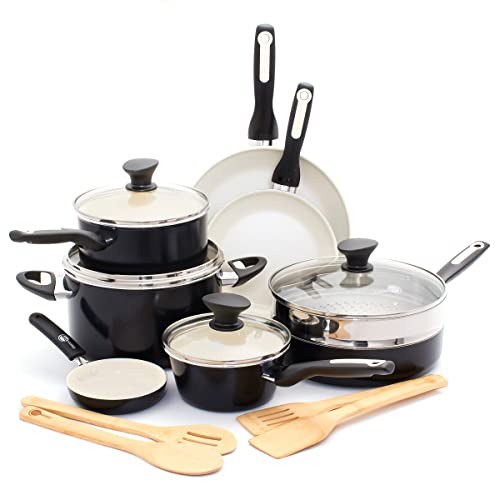
The Rio line sits between GreenLife’s entry lightness and the Valencia Pro’s premium build: aluminum bodies in vivid colours with the brand’s ceramic coating, sold in sets that cover the standard inventory. It benefits from GreenPan’s long focus on this exact coating technology — the brand has iterated on ceramic nonstick longer than most — and the pans cook with a slightly more substantial feel than the entry tier while keeping the category’s easy handling. For buyers who like the Valencia idea but not its tier, Rio is the same family’s middle path.
Strengths: colour range, brand coating experience, and a step up in substance from entry sets. Trade-offs: it is not the hard-anodized, bonded-base construction of the flagship, and induction shoppers should verify the specific set. As with all ceramic, the coating’s life will be written by the owner’s habits. Who it suits: colour-led buyers who cook regularly and want more than the entry tier without going premium. Check price on Amazon. The brand’s broader catalogue is surveyed in GreenPan cookware sets.
Side-by-Side: The Six Sets
| Set | Tier | Construction | Induction | Choose it if… |
|---|---|---|---|---|
| GreenPan Valencia Pro | Premium | Hard-anodized, bonded base | Yes | You cook daily and want the strongest build |
| Caraway | Premium | Aluminum core, curated + storage | Yes | Design and organisation matter to you |
| Cuisinart Ceramica XT | Mid | Aluminum, full conventional set | Verify listing | You want a complete set from a legacy brand |
| GreenPan Rio | Mid-entry | Aluminum, colourful | Verify listing | You want colour with a step up in substance |
| GreenLife Soft Grip | Entry | Lightweight aluminum | No | Budget and lightness lead your list |
| T-fal Initiatives Ceramic | Entry | Aluminum, bundle with utensils | Verify listing | You are equipping a kitchen from zero |
Which Set for Which Cook
Match the set to the kitchen, not the advertisement. The induction household has exactly two certain candidates here — Valencia Pro and Caraway — and should choose between them on inventory: the fuller conventional spread versus the curated four. The daily family cook who hand-washes without resentment will get the most from the Valencia Pro’s build or the Ceramica XT’s completeness, depending on tier. The design-led smaller kitchen is Caraway’s home turf, provided its four pieces cover the household’s repertoire. The first-apartment buyer should take GreenLife or the T-fal bundle without a moment’s guilt — at light use, entry ceramic delivers the category’s joys at the category’s friendliest commitment, and the money saved buys good knives. The colour-led regular cook lands on Rio. And the searing-first cook should take the hint running through every review above: buy one ceramic frypan from any of these lines for eggs and fish, and put the set money into steel. The balance of strengths behind those matches is weighed in full in ceramic cookware set pros and cons.
What All Six Sets Share — and What That Means
Step back from the individual verdicts and the roundup teaches one lesson: the differences between these sets are differences of body, bundle and design, while the coating’s fundamental character — superb release, gentle-heat preference, gradual mellowing — is common to all six. That is why the reviews keep returning to construction and care. A buyer choosing between these sets is really choosing how substantial a pan they want beneath a similar surface, how complete an inventory they need, and how much design they value. The surface itself will ask the same things of everyone: medium heat, soft utensils, hand washing, no aerosol sprays, separated storage. Owners who give any of these six sets that care will report the good version of ceramic ownership; owners who do not will report the other version, and the set’s badge will have had little to do with it. If you are still deciding whether the category itself earns a place in your kitchen, is a ceramic cookware set worth it argues the value question directly.
Care Essentials That Apply to Every Set Here
Wash before first use. Cook on low to medium heat and let the aluminum’s conductivity work; preheat briefly, never blast an empty pan. Add a little fat for flavour and browning even though the surface often needs none. Use wood, silicone or nylon tools regardless of what any listing tolerates. Hand wash with a soft sponge; if release ever seems to fade early, perform a baking-soda paste deep clean before blaming the coating, because baked-on spray and oil films imitate wear convincingly — the full method is in how to clean ceramic cookware set. Store pans separated by cloth or felt, or hung. Replace pieces individually when a frypan eventually tires, if the brand sells open stock. Those habits, applied to the cheapest set here, will out-perform neglect applied to the most expensive — the roundup’s most practical sentence.
Durability Expectations, Set by Set
Because longevity is the category’s sensitive question, this roundup states an expectation for each line, assuming the standard care described in these pages. The Valencia Pro’s coating works on the strongest foundation, so its frypans should hold strong release longest of the six, and — uniquely valuable — the pans remain first-rate ordinary cookware when the slick era ends, which reframes renewal as optional rather than forced. Caraway’s pans should age similarly in the frypan, with the storage system quietly removing the stacking damage that shortens many sets’ lives; its Dutch oven, living in liquid and braises, should stay slick for a very long time. The Ceramica XT’s mid-tier base puts more of the outcome in the owner’s hands: careful households will report good service, rough households will find the base’s limits before the coating’s. Rio follows the same logic a half-step behind the flagship of its own brand. GreenLife and T-fal entry sets should be bought with the shortest horizon in mind — a horizon that gentle, light use can stretch surprisingly far, and that daily heavy use will reach quickly. In every case, the saucepans and stockpots will outlast the frypans by a wide margin, and judging any of these sets by its stockpot is as misleading as judging it only by its hardest-worked skillet.
Patterns in Owner Experience
Across the category, owner reports repeat with almost musical regularity, and the patterns are more useful than any individual verdict. Delight clusters in the first months and around specific dishes — eggs, fish, pancakes, cheese sauces — exactly the foods these reviews identify as the surface’s showcase. Disappointment clusters around three discoveries: that high heat was quietly spending the coating, that the dishwasher label was a permission rather than a recommendation, and that a pale interior keeps the marks of enthusiastic cooking. Notably, disappointment rarely mentions the pan bodies in the premium lines — handles, flatness and lids hold up their end — while in entry lines the body complaints (warping, lightness that reads as flimsiness) join the coating complaints. The other recurring pattern is the resurrection story: owners who deep-cleaned a “dead” pan with baking soda and recovered most of its release, having been defeated by spray residue rather than wear. A shopper reading owner feedback on any of these six sets should therefore sort comments by the habits they reveal before sorting by enthusiasm, and should treat construction complaints — repeated, specific, identical — as the most trustworthy signal in the pile.
Valencia Pro or Caraway? The Premium Decision in Detail
Since the two premium sets anchor the roundup, their head-to-head deserves its own paragraph block. Choose the Valencia Pro if your priority is the pan itself: the hard-anodized body and bonded base are the category’s most serious cooking hardware, the set compositions run more conventional and complete, and the pans’ afterlife as uncoated-quality cookware is the best hedge against the coating’s finitude. Choose Caraway if your priority is the kitchen around the pan: the curated inventory suits smaller repertoires, the storage system actively protects the investment, and the design coherence — colours, lids, organisers — delivers a daily pleasure the spec sheet cannot capture. Cooking performance in the coating’s prime is close enough that neither buyer will feel they chose the lesser pan; the decision is genuinely about whether your money should buy metal or system. Households with both induction and limited storage face the pleasant version of this dilemma, and households that batch-cook soups should note Caraway’s Dutch oven is a braiser first and a stockpot second. Either way, check price on Amazon for the configuration on the day, because premium bundles are the most frequently reconfigured in the category.
Colours, Finishes and Living With the Look
All six lines compete partly on appearance, so the reviews close the survey with the practical side of beauty. Light interiors — cream and white, common across these brands — give excellent visibility while cooking and show staining soonest; owners who cook tomato-heavy and spice-heavy food should expect a working patina and decide in advance not to mind it. Darker interiors, where offered, are the low-maintenance aesthetic. Exteriors range from Caraway’s colour palette and GreenLife’s brights to Cuisinart’s more conventional finishes; bright exteriors chip at contact points if the sink and storage are rough, while plain metal finishes age invisibly. None of this affects a single meal, and all of it affects whether the set still pleases its owner in year two — which, in a category whose pleasures are daily and domestic, is a legitimate review criterion rather than a superficial one. Buy the finish your kitchen’s habits flatter, not the one the photograph flatters.
Judged Piece by Piece
Sets are bought whole but lived with piece by piece, so the roundup also scores the components. For frypans — the pieces that define the category — the Valencia Pro’s are the most convincing: the base’s evenness shows in pancake after pancake, and the pan’s balance makes the toss-and-turn work genuinely one-handed. Caraway’s frypan matches it for release and adds the best-looking silhouette on the stove. GreenLife’s small frypan is the surprise charmer of the entry tier, featherlight and perfect for a single egg, provided the heat stays kind. For saucepans and rice duty, the Ceramica XT’s conventional lineup is the most complete, with sizes that map onto real recipes without improvisation. For the big lidded piece, Caraway’s Dutch oven is the braising star — wide, handsome, oven-friendly — while the conventional stockpots in the Cuisinart and T-fal bundles win on sheer soup capacity. For lids, the premium lines fit best and rattle least; across all six, glass lids share the category’s universal caveat of lower oven limits than the pans. A buyer whose cooking leans heavily on one piece — the daily-breakfast frypan cook, the Sunday-soup stockpot cook — should weight that piece’s review above the set’s average, because that is the pan their satisfaction will actually be made of.
Warranty, Support and the Afterlife of a Set
The ownership story continues after the cooking, and the six lines differ here too. Warranties across the category cover manufacturing defects rather than coating wear — a distinction every buyer should absorb before purchase, because the gradual mellowing of release is classified as normal use, not failure. What varies is the support experience around genuine defects: established brands with mature cookware operations, Cuisinart and T-fal among them, tend to make defect claims straightforward, and GreenPan’s category focus shows in guidance that is unusually specific about care. The afterlife question matters as much: a set whose frypan can be replaced individually, and whose tired pieces remain useful for reheating and low-stick duties, delivers years more value than its coating’s prime suggests. Buyers should also think one step ahead about disposal and demotion — a mellowed ceramic pan is an excellent dedicated pan for warming tortillas, toasting spices or reheating pizza, duties where absolute slickness is irrelevant. Planned this way, even the entry sets retire gradually into useful roles instead of ending in a single disappointed trip to the bin, and the premium sets may never fully retire at all.
The Roundup’s Verdict, Restated Plainly
Six sets, one surface technology, and a clear spread of execution. The Valencia Pro is the set for cooks who want ceramic’s experience on the most serious hardware available. Caraway is the set for cooks who want the experience curated, organised and beautiful. Ceramica XT is the set for households that want the category without ceremony, from a name they already trust. Rio is the colourful middle path from the category’s longest-running specialist. GreenLife is the set that makes trying ceramic nearly effortless. T-fal’s bundle is the set that equips an empty kitchen in one box. None of them repeals the category’s central law — the coating is a renewable surface whose life your habits will write — and the reviews have tried to make sure that law reads as information rather than warning. Choose the body and bundle that fit your kitchen, give the surface its three simple kindnesses of moderate heat, soft tools and hand washing, and whichever of these six you bring home will do the job it was honestly sold to do.
One Menu, Six Sets: A Standard Test Walked Through
To make the differences tangible, walk one demanding weeknight menu through the field: fried eggs and pancakes at breakfast; a tomato soup simmered and held; fish fillets with a pan sauce; a one-pan chicken braise; and a sticky cheese sauce — the cleanup final boss. At breakfast, all six sets delight; the separation is in the pancakes, where the Valencia Pro’s base produces the most uniform batch and the entry pans ask the cook to rotate for evenness. The tomato soup separates the lidded pieces: the premium lids hold the gentlest simmer with the least evaporation drama, the entry lids vent more steam and need the occasional top-up, and every pale interior in the field takes a faint blush from the tomatoes that only the dark interiors shrug off. The fish test is the coating’s showcase across all six — release is universal — but the pan sauce that follows separates the bases again, because a pan that holds steady heat deglazes more willingly. The braise rewards the sauté pieces: Caraway’s Dutch oven and the Valencia sauté pan brown thighs most convincingly before the liquid goes in, while the entry sets manage the same dish at a gentler pace with a lighter crust. The cheese sauce, finally, is where the whole category smiles at once: every set rinses clean in moments where steel would soak. The walk-through’s conclusion matches the roundup’s: in the coating’s prime the six sets are cousins; they diverge in evenness, capacity, simmer manners and build — the qualities that decide years two and three.
What the Listings Will Not Tell You
Reviews exist partly to say what listings omit, so this roundup closes its evidence with the omissions. No listing in the category prints an expected nonstick lifespan, though every maker has the data to estimate one; the buyer must supply the number from independent guidance — a few years for frypans under kind use is the honest planning figure. Listings foreground the pan’s oven limit and footnote the lid’s. Piece counts include lids and, in bundles, utensils, so the working inventory is always smaller than the headline. “Metal utensil safe” means the coating survives contact, not that contact is free. Dishwasher-safe means survivable, not advisable. Induction compatibility, where absent, is absent silently — the listing simply never mentions your stove type. And colour photographs are taken of new pans under kind light; the working patina of year two is yours to imagine from the durability sections above. None of this makes the six sets poor purchases — several are excellent purchases — but a buyer who reads listings with these translations in hand will choose among them more accurately than the marketing departments intend, which is rather the point of a reviews page.
The Case for the Entry Tier, Made Properly
Review culture sneers at budget tiers by reflex, so this roundup makes the entry case in full. GreenLife and T-fal’s sets deliver the essential ceramic experience — the release, the cleanup, the lightness — to kitchens that cook a few times a week, and at that cadence their coatings can serve for years, because coatings age with use rather than with birthdays. For a student, a first flat, a holiday home, a caravan kitchen or a gift, the entry set is not a compromise but the correct specification: paying premium money for construction that light use will never test is its own kind of waste. The entry tier is also the category’s laboratory — the inexpensive way to learn whether your household’s habits flatter ceramic before the serious money follows the evidence. The honest conditions are the ones repeated throughout these reviews: the buyer must know the horizon is shorter, the heat must stay gentle, and the dishwasher must stay a stranger. An entry set bought with those three understandings is one of the best-value objects in the modern kitchen. An entry set bought as a lifetime promise is a complaint waiting for its second year.
The Case for the Premium Tier, Made Properly
The premium case is equally specific. Daily cooking is a thousand small interactions a year with a pan’s balance, flatness, lid fit and handle — and premium construction wins a meaningful share of those interactions. The bonded base removes induction doubt and glass-top wobble together. The hard-anodized body converts the set’s endgame from disposal to demotion: a premium pan with a mellowed coating is still a pan you reach for, which quietly doubles the purchase’s useful life. Design and storage, in Caraway’s case, protect the surface and please the eye daily. None of that is coating magic, and the reviews have not pretended otherwise; it is the argument that in a category where the surface is rented, the building should be owned. Households that cook constantly, run induction, or have already worn out an entry set and diagnosed exactly why, are the premium tier’s natural citizens — and for them, the upgrade is not indulgence but the correction of a measured mismatch.
Companions Worth Adding to Any of the Six
Whichever set wins your kitchen, a short list of companions protects the purchase. Felt pan protectors or simple cloths between stacked pans cost almost nothing and remove the category’s most pointless source of wear. A set of wooden and silicone utensils ends the metal-tool question permanently. A simple oil mister you fill yourself replaces aerosol sprays, whose baked residue is the leading false diagnosis of coating death in owner reports. A soft, non-abrasive sponge dedicated to the coated pans keeps scouring pads at a safe distance. And one heavy uncoated pan — steel, iron or carbon steel, whichever your cooking prefers — completes the system by taking the searing work ceramic should not be asked to do. None of these companions is glamorous, and together they are the difference between the ownership story told by the delighted reviewers and the one told by the disappointed. The sets provide the surface; the companions provide the conditions; the cook provides the habits. All three are required, and the reviews would be incomplete without saying so plainly.
Scores in Words, for the Skimmers
For readers who want the roundup compressed: cooking performance in the coating’s prime — excellent across all six, with the premium bases ahead on evenness. Construction — Valencia Pro first, Caraway a close and more beautiful second, Ceramica XT solidly mid, Rio a step above entry, GreenLife and T-fal honestly built to their tier. Longevity outlook — governed everywhere by the owner’s habits, with the premium bodies offering the best afterlife. Value — GreenLife and T-fal for light use, Ceramica XT for the complete-set household, Valencia Pro and Caraway for daily cooks who will use what the premium buys. Ease of ownership — Caraway’s storage gives it a quiet edge; every set rewards hand washing and moderate heat. There is no wooden spoon in this field, only mismatches waiting to be avoided — and avoiding them is what the preceding pages are for.
How We Would Spend, Tier by Tier
If the budget is the entry tier, spend it on GreenLife for pure pans or the T-fal bundle for a from-zero kitchen, and spend the savings on the companions listed above — protectors, proper utensils, an oil mister — because at this tier the owner’s kit influences longevity more than any upgrade within the tier could. If the budget is the middle, the Ceramica XT is the completeness play and Rio the colour play; choose by whether your kitchen lacks pieces or lacks joy, and do not apologise for either answer. If the budget reaches the premium, the decision is the Valencia-versus-Caraway question answered earlier — metal or system, conventional completeness or curated design — and it should be made by standing in your own kitchen, looking at your stove and your storage, rather than by staring at photographs. At every tier, the final instruction is identical: check price on Amazon for the exact configuration, because these bundles are reconfigured often enough that yesterday’s comparison can quietly expire. The reviews will still be true next month; the boxes may not be.
A Note on Gifting From This Roundup
Cookware sets are wedding-registry and housewarming staples, so the roundup ends its advice where many purchases begin. For a couple setting up a first real kitchen, the Ceramica XT or the T-fal bundle covers the widest repertoire without a specialist decision, and either will be used daily from the first week. For the design-conscious recipient, Caraway is the set that gets photographed, thanked for twice, and — thanks to its storage — protected by default. For a parent upgrading a beloved but tired kitchen, the Valencia Pro respects their experience: it is the set least likely to feel like a downgrade from whatever it replaces. Whichever you gift, include the one-line coaching that doubles the surface’s life — medium heat, soft tools, hand wash — written on the card without apology. It is the rare gift accessory that costs nothing and is worth more than the ribbon.
Ceramic Cookware Set: What Long-Term Use Reveals That a First Test Misses
Start with how a {p} holds up once the novelty wears off and routines settle in. Most coverage of a ceramic cookware set concentrates on the first week of ownership, yet the decisions that matter most tend to surface later, once the ceramic cookware set has to earn its place in an ordinary weekday routine rather than a carefully staged first attempt. Write down the three jobs you expect it to do most often, in the order you actually do them, and judge every claim you read against that short personal list instead of against a generic ideal.
When you check listings such as GreenPan Valencia Pro, Caraway Cookware Set and Cuisinart Ceramica XT, use them as worked examples: run through the same checks below on each one in turn, so the comparison stays honest and like for like rather than based on whichever listing happens to shout loudest.
Edge cases deserve a deliberate pass. Think about the odd shapes, the thicker or thinner than usual loads, the leftovers, the second helping and the guest with different preferences. A well-chosen ceramic cookware set handles the exceptions gracefully, or at least predictably, while a poor match turns every exception into a workaround. List your two or three most common exceptions in advance and check, from the manual or the listing details, that nothing about them is ruled out by size, shape, material or care requirements.
Work through a realistic scenario, not a best case. Picture the busiest version of the job: more people to serve, less time than planned, ingredients or materials that are slightly out of the ordinary, and a clean-up waiting at the end. Ask how the ceramic cookware set behaves at that upper edge, because a model that only shines on a small, simple load will disappoint precisely when you need it most. If the honest answer is that you would split the job into batches or fall back on an older method, factor that into the decision now rather than discovering it later.
Use a short decision checklist to finish. One, does it fit the space and the storage you really have. Two, does it handle your three most common jobs without a workaround. Three, do the edge cases you listed stay manageable. Four, can every wear part be cleaned or replaced without drama. Five, would you still choose it if a friend described the same drawbacks in their own kitchen. A ceramic cookware set that passes all five is a sound buy; one that fails two or more is a compromise you are choosing with open eyes, which is a very different thing from being surprised later.
Finally, plan the first fortnight deliberately. Use the ceramic cookware set for one familiar job first, so you have a baseline you trust, then introduce the harder cases one at a time and note what changes. Small adjustments to arrangement, timing, quantity or preparation usually close most of the gap between disappointing first results and the performance the design is capable of. That short learning period is also the fairest test of long-term ownership: if the routine has not settled by the end of it, the mismatch is real, and it is better to know while returning or exchanging is still straightforward.
Measure before you commit. Note the footprint, the clearance above and behind the spot where the ceramic cookware set will live, and the route you will carry it by when it is hot, full or awkward. A ceramic cookware set that technically fits but blocks a cupboard door, crowds a neighbouring appliance or has to be dragged across a worktop every time will quietly fall out of use, whatever its merits on paper. In the Kitchen Cookware category especially, a few centimetres of clearance and a sensible storage plan separate a daily tool from a bulky regret.
Troubleshooting is easier when you expect the usual failure points. With any ceramic cookware set, the recurring problems tend to cluster in the same places: uneven results from overloading or poor arrangement, wear showing first on the parts handled most often, and small annoyances with lids, seals, handles, controls or fittings that only appear after repeated use. Before buying, look for whether those wear parts can be cleaned properly, replaced or worked around, and whether the instructions address them directly rather than pretending they never happen.
Maintenance decides how long the good results last. Set a simple rhythm: a quick wipe or rinse after each use, a deeper clean on a fixed day, and a periodic check of the parts that move, seal or bear weight. A ceramic cookware set that needs fiddly disassembly for basic care will be cleaned less often, and performance drifts long before anything actually breaks. Prefer designs where the parts that get dirtiest are the parts that are easiest to reach, and be honest with yourself about which cleaning steps you will genuinely keep up.
One more check worth doing with any ceramic cookware set is to read the care and safety instructions in full before the first use, not after the first problem. The manual for a ceramic cookware set usually states plainly which materials, loads and cleaning methods are off limits, and most early disappointments trace back to a line in those pages that was skimmed. Five minutes with the instructions is the cheapest performance upgrade available in the whole Kitchen Cookware category.
Frequently Asked Questions
What is the best ceramic cookware set overall?
On construction and versatility, the GreenPan Valencia Pro leads this roundup: hard-anodized body, bonded induction-ready base, and a pan that stays excellent as its coating ages. Caraway matches it for design-led buyers who value the storage system and curated inventory. The best set remains the one matched to your stovetop and repertoire. It is worth adding that “best overall” in a coated category always carries an asterisk no steel review needs: best means best at delivering the ceramic experience — release, cleanup, lightness, composition — for the years the surface provides it, and the sets are ranked here on how completely and durably they deliver exactly that.
Are expensive ceramic cookware sets worth it?
The premium buys base quality, handles, induction plates and design — not a permanent coating. Daily cooks and induction households extract real value from that construction. Light-duty cooks often get equal satisfaction from mid or entry tiers, because gentle use stretches any coating’s life. Pay for construction you will use, not for lifespan promises. The cleanest test is your last set: if it died by warping, loose handles or a body you stopped respecting, premium construction answers your actual complaint; if it died purely by coating fade, a premium badge will not change your next set’s ending, and the mid tier plus a renewal plan is the smarter spend.
How long do the sets in these reviews last?
The bodies last for years; the nonstick surfaces mellow over a few years of regular use, frypans first. Premium bases remain useful as ordinary pans afterwards, which softens the renewal question. Heat, dishwashers, metal tools and cooking sprays are the main accelerants of decline in every set reviewed here. The most useful mental model is per-piece rather than per-set: expect to renew a hard-worked frypan while its saucepan siblings are still going strong, and choose brands whose open-stock availability makes that renewal a small purchase instead of a new set decision.
Which ceramic set is best for induction?
Sets with bonded magnetic bases — in this roundup, the Valencia Pro and Caraway lines are the certain candidates. Other sets vary by configuration, so verify the exact listing before ordering. An aluminum pan without a magnetic base will not heat on induction at all, regardless of its coating. A quick home test exists if you already own a pan and a magnet: if the magnet grips the base firmly, the pan will almost certainly work on induction; if it slides off, no setting on the hob will persuade it.
Which set should a beginner buy?
Beginners do well with GreenLife Soft Grip or the T-fal bundle: light, forgiving, inexpensive to learn on, and complete enough to cook widely. The one piece of coaching that matters is to learn ceramic’s heat habits from the first day — medium heat and hand washing turn an entry set from a short experiment into a long service. Beginners have one advantage experienced cooks often lack: no inherited habits from steel to unlearn. A new cook who starts on ceramic’s rules — warm the pan gently, add food, keep the flame moderate, wash by hand — is not making sacrifices at all, just learning cooking the way this material teaches it, and their entry set will reward that innocence with a lifespan that surprises the sceptics.
Do any of these sets handle high-heat searing well?
None of them is the right tool for aggressive, sustained high-heat searing; that work belongs to stainless steel, cast iron or carbon steel. The premium ceramic sets brown respectably at medium-high, which covers most weeknight needs. Buyers whose cooking centres on hard sears should treat ceramic as a specialist addition, not the main set — the honest division of labour that keeps both the steaks and the coating in good condition for years.
Related Reading
Start from the category shortlist in the best ceramic cookware sets, work through the selection method in how to choose a ceramic cookware set, and keep the head-to-head with the incumbent technology in ceramic cookware set vs nonstick cookware set for the final decision. If you finish this roundup with a shortlist of two, that is the correct outcome — the remaining choice is almost always a kitchen question rather than a product question, hinging on your stove, your storage and your repertoire. Answer those three honestly and the reviews above will have done their work: not choosing for you, but making sure the choice you make is the one your own kitchen would have made. One last practical habit separates satisfied owners of every set reviewed here from the rest, and it costs nothing: decide, on the day the box arrives, that these pans live at medium heat, meet only soft utensils, and wash by hand. Owners who make that small promise on day one are the ones still praising their sets when the second year arrives.