Disclosure: As an Amazon Associate, topratedkitchenware.com earns from qualifying purchases. Links on this page are affiliate links; they cost you nothing extra. Prices and availability change often, so check the current Amazon listing before you buy.
This enameled dutch oven pros and cons breakdown refuses the easy summary, because this pot inspires strong opinions in both directions and both camps are partly right. Owners praise the braises, the bread and the freedom from seasoning for years; critics point at the weight, the care rules and the stains and ask why anyone accepts them. The honest answer is that the advantages and the disadvantages come from the same three facts — heavy iron, a glass-like enamel coating, and a sealing lid — so this article takes each pro and each con seriously, explains where it comes from, and finishes by showing which cooks each trade-off actually matters to.
Enameled Dutch Oven Pros and Cons: Quick Verdict and Key Takeaways
Short verdict: the pros dominate for cooks who braise, bake, simmer acidic food and serve from the pot; the cons dominate for cooks who need light, fast, carefree cookware. Neither verdict is universal, and the sections below exist so you can locate yourself honestly.
- Biggest pro: one vessel sears, braises, bakes, simmers and serves, with no seasoning and no fear of tomato or wine.
- Biggest con: the weight, which is permanent and grows serious when the pot is full.
- Enamel is both the freedom and the fragility — easy washing, but no metal tools, no thermal shock, no abrasive cleaning.
- Light interiors teach browning and show stains; dark interiors hide stains and hide browning. Pick your frustration.
- The pot rewards slow, planned cooking and punishes rushed, high-heat improvisation.
In this guide
The Pros
It Braises Better Than Almost Anything Else in a Home Kitchen
Braising is the home ground of the enameled Dutch oven. Tough, flavourful cuts soften slowly in a shallow bath of liquid, the heavy walls even out the heat so nothing catches at the base, and the lid keeps the environment moist and steady for hours. Tomato, wine and vinegar — the ingredients that make braises taste alive — are exactly the ingredients bare seasoned iron dislikes and enamel ignores, so the full repertoire of wine-braised beef, tomato-rich chicken and vinegar-finished beans is open without a second thought. Keep the simmer gentle rather than rolling, check occasionally that the liquid still laps at the food, and rest the finished dish in the pot, where the iron holds warmth while flavours settle. A pot that braises this well changes weekly cooking: the cheapest cuts become the most requested dinners, and leftovers improve overnight in the same vessel that cooked them.
It Ignores Acidic Food Completely
Tomato sauces, wine reductions, vinegar finishes, citrus — the ingredients that define whole cuisines are simply non-events for enamel. There is no seasoning layer to strip, no metallic note to manage, and no need to decant a long sauce into another pan for its final hour. For cooks whose repertoire runs Mediterranean, Mexican, Indian or anywhere tomato-rich, this single freedom quietly justifies the category, because it removes a calculation from every recipe: the pot never has to be protected from the food.
It Sears and Then Becomes the Sauce
Searing is where enameled iron earns much of its reputation. The mass of the pot holds heat when cold meat lands in it, so pieces brown instead of steaming in their own juices, and the enamel surface releases that fond willingly when liquid arrives. Work in batches rather than crowding the base, let each piece sit undisturbed long enough to take colour, and watch the fond rather than the clock — on a light interior you can see it deepen from gold to mahogany, while on a dark interior you judge more by smell and by how the surface feels under a wooden spoon. Deglaze with wine, stock or water and scrape gently with wood or silicone, never metal, and every bit of that flavour joins the sauce. Because the same pot then goes on to braise what it seared, nothing is lost between pans, which is the quiet efficiency at the heart of this style of cooking.
It Bakes Bread Like a Steam Oven
Bread bakers adopted this pot for a physical reason: a preheated, lidded iron pot is the closest a home oven comes to a professional steam oven. The dough goes into the hot pot, the lid seals in the moisture the dough itself releases, and the loaf expands and sets its crust in that steamy chamber before the lid comes off to finish the colour. Enamel helps here in two ways — it releases the finished loaf cleanly, and it wipes clean afterwards without the seasoning worries of bare iron. Handle this routine with extra respect for heat: the pot, the lid and the knob are all fiercely hot, gloves are mandatory, and the loaf should be lowered in on its parchment rather than dropped. Let the pot cool gradually afterwards instead of rinsing it hot. Bakers who bake weekly often find the bread alone justifies the purchase; occasional bakers should be honest that a pot bought only for bread must still earn its storage space.
It Washes Without Ceremony and Needs No Seasoning
Everyday cleaning of enamel is deliberately unexciting, and that is the point. Let the pot cool until it is warm rather than hot, then wash it in warm water with a soft sponge or cloth and ordinary washing-up liquid. Food releases far more easily after a short soak in warm water — a soak measured in minutes while you eat, not hours left overnight, because prolonged soaking is unkind to the exposed iron rim and pointless for the enamel itself. For stuck patches, simmer a little water in the cooled-then-rewarmed pot and loosen the residue with a wooden spoon or a soft scraper, and for stubborn staining a gentle paste of bicarbonate of soda and water, applied with a soft cloth, does most of what you need. Never reach for metal scourers, steel wool or aggressive abrasive pads: they scratch and dull the enamel, and scratched enamel stains faster and cleans harder forever after. Dry the pot thoroughly, pay attention to the bare rim, and store it fully dry.
It Goes to the Table and Keeps Food Warm
Table service is an underrated part of the case for enamel. The pot that cooked the meal carries it to the table looking like it belongs there, keeps second helpings warm without a return to the hob, and turns an ordinary stew into something that feels hosted. That is also why colour and finish matter more in this category than in most cookware: the pot lives in public. Choose a colour you will still enjoy when it is no longer new, remember that pale interiors show the evening’s work while dark ones hide it, and accept that a pot used at the table will gather the small marks of gatherings. Most owners come to read those marks fondly.
The Cons
It Is Heavy — and Heaviest Exactly When It Matters
Weight deserves its own honest paragraph in any discussion of this pot, because it shapes every single use. An enameled Dutch oven is heavy empty and very heavy full of stew, and pretending otherwise helps nobody. The safe technique never changes: clear the route from hob to counter or table before you lift, put on proper oven gloves even for a short move, take a handle in each hand, keep the pot level and close to your body, and set it down on a trivet or board rather than a cold or wet surface. Never try to carry a full pot one-handed, never let a helper grab one handle while you take the other without agreeing the move first, and never leave a child to wrestle a lid that weighs more than they expect. If your wrists, shoulders or grip make that routine sound difficult, believe that feeling now rather than after the purchase — a smaller pot you lift confidently will cook far more meals than a large one you dread moving.
The Enamel Can Chip, Craze or Crack if You Abuse Temperature
Thermal shock is the one enemy enamel cannot argue with. The coating is a glass-like layer bonded to iron, and the two materials react to sudden temperature change at different rates, which is how crazing and cracks begin. The habits that protect it are simple and absolute. Warm the pot gradually rather than blasting it on a fierce heat from cold, and never leave it heating empty for a long stretch, because an empty pot climbs in temperature far faster than a full one and stresses the enamel. Add oil or liquid before serious heat, let a pot from the fridge come closer to room temperature before it meets a hot oven, and at the end of cooking let it cool on the hob or a board before any water touches it. Above all, never pour cold water into a hot pot and never plunge a hot pot into a sink of water — that single impatient moment is responsible for more ruined enamel than years of ordinary cooking.
It Stains, and Chasing the Stains Can Do Real Damage
Staining is the cosmetic tax enamel charges for its convenience, and it helps to separate stains from damage. A light interior will gradually take on shadows from turmeric, tomato, red wine and years of fond, and those marks are a record of cooking rather than a failure of care. They do not affect how the pot cooks, they do not harbour flavours from one meal to the next in any way a normal palate detects, and chasing a showroom finish after every stew leads people to exactly the harsh scrubbing that does cause real harm. Gentle methods — warm soaks, bicarbonate paste, patience — lift most of what matters. A dark interior hides the same history almost completely, which is a genuine practical argument for choosing one if you know visible staining will bother you. What should concern you is different: chips that expose iron, cracks, or a network of fine crazing lines, because those are structural, and a pot showing them deserves assessment rather than another round of cleaning.
It Demands the Right Tools and Habits
Metal utensils are out, metal scourers are out, and the dishwasher is a poor idea for a pot this heavy with an exposed iron rim. None of the replacement habits is difficult — wooden spoons, silicone spatulas, a soft sponge — but they are habits, and a household that cooks on autopilot will break them. The cook who shares a kitchen with people who grab the nearest metal ladle should count that as a genuine con, because enamel records every shortcut permanently in a way stainless steel forgives.
It Responds Slowly
Iron’s steadiness is slowness viewed from the other side. The pot takes time to preheat, holds heat when you wanted it gone, and cannot be hurried from a rolling boil to a gentle hold the way a thin pan can. Skilled users plan around this — preheating while they chop, turning heat down early — but a cook whose style is fast, reactive weeknight improvisation may experience the pot’s greatest virtue as daily friction. This con is really about temperament, and it is one of the most reliable predictors of whether an owner ends up loving or resenting the purchase.
It Takes Real Storage Space
Storage sounds trivial until a heavy pot meets a crowded cupboard. Keep the pot somewhere you can lift it from safely with two hands — a low, sturdy shelf beats a high one, and the hob itself is where many owners happily leave it, since a handsome enameled pot earns its place on display and stays within easy reach. Protect the enamel in storage: do not nest other pans inside it without a cloth or felt between them, keep the lid seated or store it with a cloth protecting the rim, and never drag the pot across a glass hob or a stone counter. If you stack cookware, the Dutch oven goes at the bottom as the foundation, never balanced on top of lighter pans. A pot stored where it is easy to reach gets used; a pot buried behind rarely used equipment quietly becomes the expensive object this guide is trying to help you avoid buying.
What the Trade-Offs Mean for You
If You Cook Slow Food Weekly, the Pros Win Easily
Weekly braises, soups, beans and loaves mean the pot’s strengths are exercised constantly and its weaknesses become routine. The weight becomes a known technique, the care rules become reflexes, and the cost spreads across hundreds of meals. For this cook the cons read less like warnings and more like the ordinary terms of owning a serious tool.
If You Cook Fast Food Nightly, the Cons Deserve More Weight
Quick stir-fries, rapid pasta nights and reactive cooking ask for lightness and instant response — the two things this pot does not offer. Such a household may still enjoy the pot for weekends, but should buy it as a weekend tool at a sensible tier rather than as a premium centrepiece, and should keep a light pan as the true weeknight default.
If Strength or Mobility Is a Concern, Believe the Weight Warning
No pro on the list above survives a pot you cannot lift safely. A smaller size, a lighter alternative for big liquid dishes, or a two-person serving routine can rescue the idea, but if even the empty pot feels like a struggle in the shop, walk away with your dignity and your wrists intact — good cooking exists in lighter vessels too.
How the Pot Compares With the Alternatives
The honest alternatives deserve a fair hearing. A bare cast iron Dutch oven costs less commitment in enamel care and shrugs off metal tools and fierce preheats, but asks for seasoning discipline and sulks with acidic food. A stainless steel stockpot is dramatically lighter and excellent for pasta water and big soups, but cannot hold a sear or a braise in the same way and gives bread nothing like the same crust. A slow cooker braises conveniently and unattended, yet cannot sear, bake or go to the table with the same presence. A ceramic or glass casserole suits gentle oven dishes but not hob searing. None of these is a failed product; each simply trades away part of what the enameled pot combines in one vessel. The enameled Dutch oven earns its place when you want that combination — sear, braise, bake, simmer and serve — often enough that one heavy pot replaces several lighter compromises.
How to Buy Smart
Size is the decision buyers get wrong most often, usually by buying for the biggest meal they can imagine instead of the meals they actually cook. Think in households and habits rather than in wishes. A smaller household that cooks soups and braises for two, with leftovers, is well served by a mid-size round pot that heats efficiently and lifts kindly. A family that batch-cooks, entertains, or bakes large loaves needs the larger formats, and should choose them with eyes open about the full weight. Oval pots cradle whole chickens and long cuts and look magnificent on a table, but heat less evenly on a round burner and store less neatly; round pots are the even-heating, easy-stirring default. Whichever direction you lean, run the honest tests: will it fit your oven, your hob, your sink and your storage, and can you lift it full, with gloves, without hesitation? A pot that passes those tests in a modest size will out-cook a grander pot that fails any one of them.
The lid is not an accessory; it is half the cooking system. A heavy, well-seated lid holds moisture in a slow braise so the liquid you start with is close to the liquid you finish with, it traps the steam that gives a loaf of bread its crackling crust, and it keeps a soup at a bare simmer without constant topping up. When you compare pots, lift the lid and set it back down. It should sit evenly with no rocking, feel reassuringly heavy without being awkward, and have a knob you can grip securely with a gloved hand or a folded cloth. Remember that the knob and the lid handle are as hot as the pot itself after oven cooking — treat every part of the lid as hot, every time, and lift it tilting away from you so the escaping steam passes clear of your face and hands. A lid that fits well and is handled with respect is the difference between a braise that concentrates and one that quietly dries out.
Setup and Care That Reduce the Cons
Most cons shrink under good routine. Keep wooden and silicone tools beside the hob so the right tool is the nearest tool. Build the two-handed, gloved lift into muscle memory from the first use. Warm and cool the pot gradually as a matter of doctrine. Wash warm, soak briefly, dry fully, and store the pot where it is easy to reach so using it never starts with a wrestling match. None of this is talent; it is arrangement, and arranged well, the con list becomes a short set of house rules taped inside a cupboard door.
The recurring mistakes in this category are predictable, which means they are avoidable. Buyers choose size by ambition rather than by household, then discover the full weight at the worst moment. They use metal utensils out of habit and score the enamel in the first month. They heat the pot empty on high to save time, rinse it hot under a cold tap, or leave it soaking overnight, and then blame the coating when crazing appears. They store it wet, nest pans inside it unprotected, or slide it across a glass hob. And they skip the unglamorous checks — oven fit, burner fit, sink fit, lid fit — that decide daily satisfaction far more than colour does. Every one of these errors is a habit rather than a catastrophe, and the cooks who keep enamel beautiful for years are not more talented, just more consistent about the small protections.
Models Worth Weighing Against the Trade-Offs
Four reference models show how the same pros and cons land at different tiers — the trades do not change, but how much refinement softens them does.
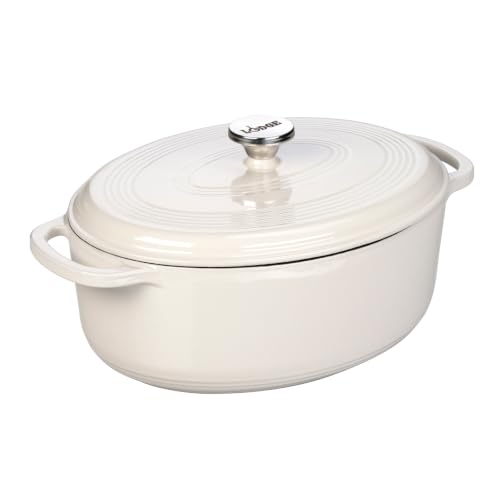
Lodge Enameled Cast Iron Dutch Oven
Entry tier positioning. the practical starting point in this category. It covers the core jobs — braising, simmering, baking and roasting — in a straightforward design that puts function ahead of decoration, with wide loop handles that are easier to grip with thick oven gloves than smaller handles tend to be. The enamel interior is light in tone…
Best for: the cook described above. Not suited for: priorities pointing the other way. Check price on Amazon for linked listings when they appear at publication; this prose-first draft claims no unverified link.
Le Creuset Signature Enameled Cast Iron Dutch Oven
Premium tier positioning. the refined benchmark many shoppers measure the category against. The enamel finish is notably smooth, the light interior makes browning easy to judge, and the larger handles and considered lid fit give it a composed feel in daily use. It suits a cook who plans to keep one pot for a very long time, cooks…
Best for: the cook described above. Not suited for: priorities pointing the other way. Check price on Amazon for linked listings when they appear at publication; this prose-first draft claims no unverified link.
Staub Enameled Cast Iron Cocotte
Premium tier positioning. the cocotte takes a slightly different path, with a dark interior that hides staining gracefully and a lid designed to encourage moisture to rain back over the food as it braises. Cooks who braise often tend to praise that self-basting character, and the dark cooking surface shows less discolouration over time than pale enamel does.…
Best for: the cook described above. Not suited for: priorities pointing the other way. Check price on Amazon for linked listings when they appear at publication; this prose-first draft claims no unverified link.

Tramontina Enameled Cast Iron Dutch Oven
Entry-to-mid tier positioning. a value-minded option that has introduced many households to enameled cooking. The formula is familiar — heavy iron, glossy enamel, a light interior on common versions and handles sized for gloved hands — delivered without premium positioning. It suits a family cook who wants a dependable braising and soup pot, a second pot for big-batch…
Best for: the cook described above. Not suited for: priorities pointing the other way. Check price on Amazon for linked listings when they appear at publication; this prose-first draft claims no unverified link.
Bottom Line
The enameled Dutch oven is a bundle of trades that happen to align beautifully for slow, generous, acidic, oven-and-hob cooking — and align poorly for fast, light, careless cooking. Decide which kitchen you actually run, and the pros and cons stop being an argument and become a description of your own cooking, which is the only review that ever mattered.
Practical Notes From Everyday Cooking
There is a rhythm to cooking in heavy iron that lighter pans never teach. You learn to start earlier and rush less: the pot comes up to heat gradually, the sear is given its time, the braise is left alone for long stretches, and the finished dish rests in the vessel while you set the table. Cooks who enjoy that rhythm find the pot almost meditative; cooks who want instant response from a pan often find it ponderous, and neither reaction is wrong. Knowing which cook you are is worth more than any single feature comparison, because the pot will ask for that patience every time you use it, and reward it every time you give it.
Leftovers behave differently in iron. A braise cooled and refrigerated in its pot, then gently rewarmed in the same vessel the next day, often tastes better than it did fresh, because the flavours have had a night to settle and the reheating is even and unhurried. Respect the temperature rules on that journey — cool before chilling, warm gradually when reheating, and never take the pot straight from fridge to fierce heat. Decanting into storage containers is kinder to the pot’s rim over the long term if the food will sit for days, but for the classic next-day stew, the pot itself is part of the recipe.
Practical Notes From Everyday Cooking
Table service is an underrated part of the case for enamel. The pot that cooked the meal carries it to the table looking like it belongs there, keeps second helpings warm without a return to the hob, and turns an ordinary stew into something that feels hosted. That is also why colour and finish matter more in this category than in most cookware: the pot lives in public. Choose a colour you will still enjoy when it is no longer new, remember that pale interiors show the evening’s work while dark ones hide it, and accept that a pot used at the table will gather the small marks of gatherings. Most owners come to read those marks fondly.
One pot also changes how a small kitchen works. When a single vessel sears, braises, bakes, simmers and serves, several other pans stop earning their cupboard space, and the cook who owns less but uses all of it tends to cook more, not less. That consolidation is a real argument for spending properly on the one pot: the budget of two or three mediocre pans gathered into a single good Dutch oven usually produces the better kitchen. The counter-argument is equally real — a household that rarely braises or bakes gains nothing by consolidating around a pot it will not use.
Guests reveal the truth about cookware. Nobody comments on a stockpot, but a handsome enameled pot arriving at the table starts conversations, and the cook who braises in it tends to cook for people more often. That social dimension is not frivolous: tools that make hosting easier get used, and tools that get used justify themselves. If your cooking life includes feeding friends from one big pot, the enameled Dutch oven is close to purpose-built for it. If your cooking is mostly quick solo meals on weeknights, be honest that the pot’s greatest strengths — slow, generous, shared food — point away from your routine rather than towards it.
Practical Notes From Everyday Cooking
Leftovers behave differently in iron. A braise cooled and refrigerated in its pot, then gently rewarmed in the same vessel the next day, often tastes better than it did fresh, because the flavours have had a night to settle and the reheating is even and unhurried. Respect the temperature rules on that journey — cool before chilling, warm gradually when reheating, and never take the pot straight from fridge to fierce heat. Decanting into storage containers is kinder to the pot’s rim over the long term if the food will sit for days, but for the classic next-day stew, the pot itself is part of the recipe.
Seasonal cooking flatters this pot in every quarter. Winter is its obvious season — stews, beans, braises and bread — but spring soups, summer tomato sauces cooked low and slow, and autumn roasts all sit naturally in it. The oven work warms the kitchen, which is a pleasure in January and a consideration in August; summer cooks tend to keep the pot on the hob for sauces and beans instead. A buyer weighing the purchase should picture their cooking across the whole year rather than in the mood of the month they happen to shop in, because the pot’s value is the sum of all four seasons.
There is a rhythm to cooking in heavy iron that lighter pans never teach. You learn to start earlier and rush less: the pot comes up to heat gradually, the sear is given its time, the braise is left alone for long stretches, and the finished dish rests in the vessel while you set the table. Cooks who enjoy that rhythm find the pot almost meditative; cooks who want instant response from a pan often find it ponderous, and neither reaction is wrong. Knowing which cook you are is worth more than any single feature comparison, because the pot will ask for that patience every time you use it, and reward it every time you give it.
Practical Notes From Everyday Cooking
One pot also changes how a small kitchen works. When a single vessel sears, braises, bakes, simmers and serves, several other pans stop earning their cupboard space, and the cook who owns less but uses all of it tends to cook more, not less. That consolidation is a real argument for spending properly on the one pot: the budget of two or three mediocre pans gathered into a single good Dutch oven usually produces the better kitchen. The counter-argument is equally real — a household that rarely braises or bakes gains nothing by consolidating around a pot it will not use.
Guests reveal the truth about cookware. Nobody comments on a stockpot, but a handsome enameled pot arriving at the table starts conversations, and the cook who braises in it tends to cook for people more often. That social dimension is not frivolous: tools that make hosting easier get used, and tools that get used justify themselves. If your cooking life includes feeding friends from one big pot, the enameled Dutch oven is close to purpose-built for it. If your cooking is mostly quick solo meals on weeknights, be honest that the pot’s greatest strengths — slow, generous, shared food — point away from your routine rather than towards it.
Table service is an underrated part of the case for enamel. The pot that cooked the meal carries it to the table looking like it belongs there, keeps second helpings warm without a return to the hob, and turns an ordinary stew into something that feels hosted. That is also why colour and finish matter more in this category than in most cookware: the pot lives in public. Choose a colour you will still enjoy when it is no longer new, remember that pale interiors show the evening’s work while dark ones hide it, and accept that a pot used at the table will gather the small marks of gatherings. Most owners come to read those marks fondly.
Practical Notes From Everyday Cooking
Seasonal cooking flatters this pot in every quarter. Winter is its obvious season — stews, beans, braises and bread — but spring soups, summer tomato sauces cooked low and slow, and autumn roasts all sit naturally in it. The oven work warms the kitchen, which is a pleasure in January and a consideration in August; summer cooks tend to keep the pot on the hob for sauces and beans instead. A buyer weighing the purchase should picture their cooking across the whole year rather than in the mood of the month they happen to shop in, because the pot’s value is the sum of all four seasons.
There is a rhythm to cooking in heavy iron that lighter pans never teach. You learn to start earlier and rush less: the pot comes up to heat gradually, the sear is given its time, the braise is left alone for long stretches, and the finished dish rests in the vessel while you set the table. Cooks who enjoy that rhythm find the pot almost meditative; cooks who want instant response from a pan often find it ponderous, and neither reaction is wrong. Knowing which cook you are is worth more than any single feature comparison, because the pot will ask for that patience every time you use it, and reward it every time you give it.
Leftovers behave differently in iron. A braise cooled and refrigerated in its pot, then gently rewarmed in the same vessel the next day, often tastes better than it did fresh, because the flavours have had a night to settle and the reheating is even and unhurried. Respect the temperature rules on that journey — cool before chilling, warm gradually when reheating, and never take the pot straight from fridge to fierce heat. Decanting into storage containers is kinder to the pot’s rim over the long term if the food will sit for days, but for the classic next-day stew, the pot itself is part of the recipe.
Practical Notes From Everyday Cooking
Guests reveal the truth about cookware. Nobody comments on a stockpot, but a handsome enameled pot arriving at the table starts conversations, and the cook who braises in it tends to cook for people more often. That social dimension is not frivolous: tools that make hosting easier get used, and tools that get used justify themselves. If your cooking life includes feeding friends from one big pot, the enameled Dutch oven is close to purpose-built for it. If your cooking is mostly quick solo meals on weeknights, be honest that the pot’s greatest strengths — slow, generous, shared food — point away from your routine rather than towards it.
Table service is an underrated part of the case for enamel. The pot that cooked the meal carries it to the table looking like it belongs there, keeps second helpings warm without a return to the hob, and turns an ordinary stew into something that feels hosted. That is also why colour and finish matter more in this category than in most cookware: the pot lives in public. Choose a colour you will still enjoy when it is no longer new, remember that pale interiors show the evening’s work while dark ones hide it, and accept that a pot used at the table will gather the small marks of gatherings. Most owners come to read those marks fondly.
One pot also changes how a small kitchen works. When a single vessel sears, braises, bakes, simmers and serves, several other pans stop earning their cupboard space, and the cook who owns less but uses all of it tends to cook more, not less. That consolidation is a real argument for spending properly on the one pot: the budget of two or three mediocre pans gathered into a single good Dutch oven usually produces the better kitchen. The counter-argument is equally real — a household that rarely braises or bakes gains nothing by consolidating around a pot it will not use.
Practical Notes From Everyday Cooking
There is a rhythm to cooking in heavy iron that lighter pans never teach. You learn to start earlier and rush less: the pot comes up to heat gradually, the sear is given its time, the braise is left alone for long stretches, and the finished dish rests in the vessel while you set the table. Cooks who enjoy that rhythm find the pot almost meditative; cooks who want instant response from a pan often find it ponderous, and neither reaction is wrong. Knowing which cook you are is worth more than any single feature comparison, because the pot will ask for that patience every time you use it, and reward it every time you give it.
Leftovers behave differently in iron. A braise cooled and refrigerated in its pot, then gently rewarmed in the same vessel the next day, often tastes better than it did fresh, because the flavours have had a night to settle and the reheating is even and unhurried. Respect the temperature rules on that journey — cool before chilling, warm gradually when reheating, and never take the pot straight from fridge to fierce heat. Decanting into storage containers is kinder to the pot’s rim over the long term if the food will sit for days, but for the classic next-day stew, the pot itself is part of the recipe.
Seasonal cooking flatters this pot in every quarter. Winter is its obvious season — stews, beans, braises and bread — but spring soups, summer tomato sauces cooked low and slow, and autumn roasts all sit naturally in it. The oven work warms the kitchen, which is a pleasure in January and a consideration in August; summer cooks tend to keep the pot on the hob for sauces and beans instead. A buyer weighing the purchase should picture their cooking across the whole year rather than in the mood of the month they happen to shop in, because the pot’s value is the sum of all four seasons.
Practical Notes From Everyday Cooking
Table service is an underrated part of the case for enamel. The pot that cooked the meal carries it to the table looking like it belongs there, keeps second helpings warm without a return to the hob, and turns an ordinary stew into something that feels hosted. That is also why colour and finish matter more in this category than in most cookware: the pot lives in public. Choose a colour you will still enjoy when it is no longer new, remember that pale interiors show the evening’s work while dark ones hide it, and accept that a pot used at the table will gather the small marks of gatherings. Most owners come to read those marks fondly.
One pot also changes how a small kitchen works. When a single vessel sears, braises, bakes, simmers and serves, several other pans stop earning their cupboard space, and the cook who owns less but uses all of it tends to cook more, not less. That consolidation is a real argument for spending properly on the one pot: the budget of two or three mediocre pans gathered into a single good Dutch oven usually produces the better kitchen. The counter-argument is equally real — a household that rarely braises or bakes gains nothing by consolidating around a pot it will not use.
Putting the Ledger to Work: A Week With the Enameled dutch oven
Treat this diary as the practical sequel to the ledger above: for one ordinary week, note each time the enameled dutch oven delights you and each time it irritates you, in the moment rather than from memory at the end. Record the jobs where the advantages felt largest, because a strength that only appears on tasks you rarely do is worth less than the summary tables suggest. Record the irritations with equal honesty, and mark whether each one came from the product itself, from your space, or from a habit you could change once and forget. Pay attention to the setup and put-away minutes, since trade-offs that look trivial on paper become the deciding factor when they repeat twice a day for years.
Note who else used the enameled dutch oven during the week and what they struggled with, because a drawback that only affects the most patient person in the house is easy to underestimate. Watch for the workaround you invent by day three, and judge it fairly: a painless workaround retires a con, while a fiddly one confirms it. Where a shortlist names specific examples, such as Lodge Enameled Cast Iron Dutch Oven, run these same checks against that listing line by line rather than assuming the general verdict transfers unchanged. Apply the identical test to Le Creuset Signature Enameled Cast Iron Dutch Oven as well, on the same day and under the same conditions, because a fair comparison needs one ruler rather than two moods.
- Log delights and irritations as they happen
- Time the setup and the put-away honestly
- Test the worst job, not the easiest one
- Note the workaround you invent by day three
- Ask a second user for their verdict
- Write the sentence you would tell a friend
If Staub Enameled Cast Iron Cocotte is also in contention, give it the same worksheet and let the three sets of answers sit side by side before anyone reaches for a checkout button. Test the loudest, messiest, or slowest mode at the time of day you would actually use it, not at a forgiving hour chosen to make the product look good. Check the cleaning burden after the worst realistic job rather than the easiest one, since the honest version of that chore is the one you will live with. Notice whether the headline strength survives ordinary ingredients, ordinary timing, and an ordinary tired evening, because strengths that need perfect conditions are narrower than they appear.
Write down any benefit you had not expected, since unlisted advantages discovered in use are often the ones that keep a product in the house for a decade. Write down any drawback that no review mentioned, and consider whether it is specific to your space, your water, your power supply, or your household size. Compare the week against the tool or appliance the enameled dutch oven replaced, task by task, instead of against an idealised version of what ownership would feel like. Ask whether the cons cluster at the start of each session, in the middle of the work, or in the cleanup, because that pattern tells you whether habit can fix them.
Frequently Asked Questions
What is the biggest disadvantage of an enameled Dutch oven?
The weight. The pot is heavy empty and very heavy full, and it must be lifted with two gloved hands every time, which rules it out for some cooks and some kitchens. The second disadvantage is enamel care: no metal tools, no sudden temperature changes and no abrasive cleaning, for the whole life of the pot.
Do enameled Dutch ovens stain permanently?
Light interiors gradually take on shadows from tomato, wine, turmeric and fond. These marks are cosmetic, do not affect cooking, and lift partly with warm soaks and a gentle bicarbonate paste. Dark interiors hide the same history. Chasing a spotless finish with harsh scrubbing causes more harm than the stains ever will.
Can the enamel crack from normal cooking?
Normal cooking does not crack enamel. Cracks and crazing come from thermal shock — heating the pot empty on fierce heat, or adding cold water to a hot pot — and chips usually come from impacts or metal tools. Gradual heating and cooling, plus wood or silicone utensils, keep the coating sound for many years.
Is an enameled Dutch oven better than bare cast iron?
It is more convenient rather than simply better. Enamel handles acidic food freely, needs no seasoning and washes easily. Bare iron tolerates metal tools, fierce preheats and outdoor fire, and costs less commitment in coating care. Braising and sauce cooks usually prefer enamel; high-heat and camp cooks often prefer bare iron.
Who should not buy an enameled Dutch oven?
Anyone who cannot lift a heavy full pot safely, cooks who mostly make fast weeknight food needing instant heat response, and households where metal utensils and rough handling are unavoidable. Those cooks are better served by stainless steel or lighter cookware, and may enjoy a smaller enameled pot only as an occasional tool.
Does an enameled Dutch oven need seasoning?
No. The enamel surface is the finish, and it needs no seasoning, no oiling routine and no special first use beyond a wash. The only exposed iron is usually the rim, which simply needs thorough drying after washing so it does not discolour or rust at the edge.
Related Guides and Next Steps
Continue with the companion guides in this series and the closest live guides on the same shelf: Enameled Dutch oven buying guide Enameled Dutch oven reviews How to clean enameled Dutch oven Is an enameled Dutch oven worth it Best enameled Dutch ovens Enameled Dutch ovens for bread baking Best Staub Dutch ovens Best Lodge Dutch ovens How to make a simple stew in a Dutch oven
Read the companion pieces before you buy if you are still torn — each one approaches the same pot from a different angle, and the overlap is deliberate: the decision improves every time you test it against a new question.