Disclosure: As an Amazon Associate, topratedkitchenware.com earns from qualifying purchases. Links on this page are affiliate links; they cost you nothing extra. Prices and availability change often, so check the current Amazon listing before you buy.
These enameled dutch oven reviews take the six models most buyers actually cross-shop and review them the way owners live with them: lifting them full, searing in them weekly, washing them nightly and storing them somewhere sensible. A single spectacular braise can make any heavy pot look heroic, so each review below weighs the daily details — handles through oven gloves, lid fit, interior colour, enamel behaviour with acidic food, and how the pot feels after months rather than minutes. Read the set together and a pattern emerges: the cooking is close across the field, and the right choice is the one whose details match your hands, your hob and your habits.
Enameled Dutch Oven Reviews: Shortlist and Key Takeaways
- Every model here braises, bakes and simmers capably — separation comes from finish, interior, handles and tier, not from basic competence.
- Entry models are the honest way to learn the category; premium models repay weekly use with refinement.
- Light interiors suit learners and sauce cooks; dark interiors suit braise-heavy cooks who dislike visible staining.
- All six demand the same handling: two gloved hands, gradual heat, soft tools, gentle washing.
- Choose by household size and lifting confidence first, brand second.
In this guide
How These Reviews Were Framed
Each model was judged on the same work: a wine-rich braise, a tomato sauce held at a long simmer, a batch of beans, a loaf of bread, and the washing-up that followed each one. Weight was judged full, not empty, because that is the lift that matters. Enamel was judged on release, staining behaviour and how confidently it faced acidic food. Handles and lids were judged through thick oven gloves, because that is how they are actually used. Where a model is described by tier, that positioning is deliberately in words — entry, mid or premium — because the useful question is what the tier buys in ownership, not a number that changes with every sale and season. No model here is a bad pot; the reviews exist to match good pots to the right kitchens, which is a different and more useful exercise than crowning a single winner for everyone.
Searing is where enameled iron earns much of its reputation. The mass of the pot holds heat when cold meat lands in it, so pieces brown instead of steaming in their own juices, and the enamel surface releases that fond willingly when liquid arrives. Work in batches rather than crowding the base, let each piece sit undisturbed long enough to take colour, and watch the fond rather than the clock — on a light interior you can see it deepen from gold to mahogany, while on a dark interior you judge more by smell and by how the surface feels under a wooden spoon. Deglaze with wine, stock or water and scrape gently with wood or silicone, never metal, and every bit of that flavour joins the sauce. Because the same pot then goes on to braise what it seared, nothing is lost between pans, which is the quiet efficiency at the heart of this style of cooking.
The Reviews, Model by Model
Six reviews, six kitchens they suit best. Read the one that sounds like your cooking first, then read its nearest rival — the contrast will tell you more than either review alone.
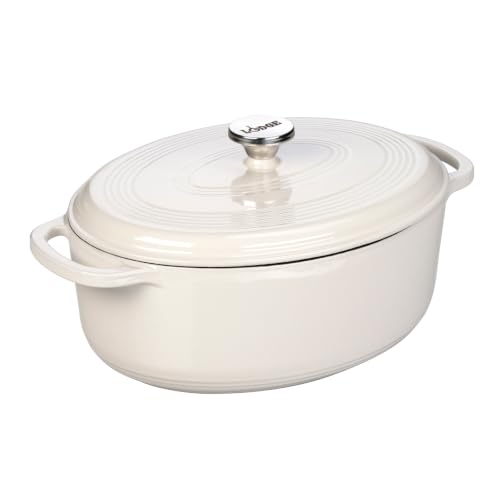
Lodge Enameled Cast Iron Dutch Oven
Entry tier positioning. the practical starting point in this category. It covers the core jobs — braising, simmering, baking and roasting — in a straightforward design that puts function ahead of decoration, with wide loop handles that are easier to grip with thick oven gloves than smaller handles tend to be. The enamel interior is light in tone on many versions, which helps you watch fond develop while you sear, and the overall feel is sturdy rather than refined. It suits a first-time buyer who wants the enameled experience without a premium commitment, and a busy household that will use the pot hard every week. It is less suited to a cook chasing the smoothest enamel finish or the most polished detailing, and like every pot here it is very heavy when full, so two-handed lifts with gloves are the rule from the first day.
Best for: cooks whose habits match the strengths above. Not suited for: anyone whose priorities point the other way. Check price on Amazon for linked listings when they appear at publication; in this prose-first draft the pick is presented without a link so nothing is claimed that has not been verified.
Le Creuset Signature Enameled Cast Iron Dutch Oven
Premium tier positioning. the refined benchmark many shoppers measure the category against. The enamel finish is notably smooth, the light interior makes browning easy to judge, and the larger handles and considered lid fit give it a composed feel in daily use. It suits a cook who plans to keep one pot for a very long time, cooks acidic sauces often, and values finish and long-term support as part of the purchase. Bread bakers like the even heat and the way the sealed lid traps steam around a loaf. It is less suited to a buyer who will resent paying a premium for refinement they may not notice, or to anyone who wants a pot they can treat roughly without thinking about the enamel. Treat it gently — no metal scouring, no thermal shock — and it rewards that care for years.
Best for: cooks whose habits match the strengths above. Not suited for: anyone whose priorities point the other way. Check price on Amazon for linked listings when they appear at publication; in this prose-first draft the pick is presented without a link so nothing is claimed that has not been verified.
Staub Enameled Cast Iron Cocotte
Premium tier positioning. the cocotte takes a slightly different path, with a dark interior that hides staining gracefully and a lid designed to encourage moisture to rain back over the food as it braises. Cooks who braise often tend to praise that self-basting character, and the dark cooking surface shows less discolouration over time than pale enamel does. It suits a braise-first cook, a cook who prefers a darker interior for presentation at the table, and anyone who dislikes seeing every mark a meal leaves behind. It is less suited to a beginner who relies on watching colour change closely while searing, because a dark surface makes fond harder to read at a glance. As with the other premium option, the commitment only makes sense if the pot will be used weekly rather than admired monthly.
Best for: cooks whose habits match the strengths above. Not suited for: anyone whose priorities point the other way. Check price on Amazon for linked listings when they appear at publication; in this prose-first draft the pick is presented without a link so nothing is claimed that has not been verified.

Tramontina Enameled Cast Iron Dutch Oven
Entry-to-mid tier positioning. a value-minded option that has introduced many households to enameled cooking. The formula is familiar — heavy iron, glossy enamel, a light interior on common versions and handles sized for gloved hands — delivered without premium positioning. It suits a family cook who wants a dependable braising and soup pot, a second pot for big-batch cooking alongside a main one, and a buyer testing whether the category fits their cooking before spending more. It is less suited to a perfectionist who will examine enamel edges and lid fit with a critical eye, and its long-term finish should be judged as good-for-the-tier rather than best-in-class. For weeknight soups, beans and casseroles, that trade is one many kitchens happily accept.
Best for: cooks whose habits match the strengths above. Not suited for: anyone whose priorities point the other way. Check price on Amazon for linked listings when they appear at publication; in this prose-first draft the pick is presented without a link so nothing is claimed that has not been verified.
Cuisinart Chef’s Classic Enameled Cast Iron Dutch Oven
Mid tier positioning. a classic, unfussy take from a broad kitchen brand, offered in shapes that cover both everyday round cooking and wider oval roasts. The enamel and iron do the same fundamental work as every pot in this guide — steady heat, a sealing lid, a surface that tolerates tomato and wine — with a presentation that leans traditional rather than fashion-led. It suits a cook who wants a known name in the middle of the market, a gift buyer who wants something handsome and safe, and households that cook a mix of soups, roasts and oven casseroles. It is less suited to a cook who wants the most refined enamel or the most distinctive lid design. Judged as a middle path — neither the cheapest nor the flagship — it makes a calm, sensible case for itself.
Best for: cooks whose habits match the strengths above. Not suited for: anyone whose priorities point the other way. Check price on Amazon for linked listings when they appear at publication; in this prose-first draft the pick is presented without a link so nothing is claimed that has not been verified.
Milo Enameled Cast Iron Dutch Oven
Mid tier positioning. a newer, minimalist entrant that strips the category back to essentials: heavy enameled iron, clean lines and a direct-to-buyer story rather than a long retail history. It suits a cook who likes uncluttered design, wants a pot that looks at home left out on the hob, and is comfortable choosing a younger brand over a heritage one. The cooking fundamentals are the same ones this whole guide is built on — mass, lid seal and enamel that shrugs off acidic food — so the decision is mostly about design taste and how much weight you give to a long track record. It is less suited to a buyer who wants decades of owner history behind a purchase, or who wants the widest choice of shapes and colours in the category.
Best for: cooks whose habits match the strengths above. Not suited for: anyone whose priorities point the other way. Check price on Amazon for linked listings when they appear at publication; in this prose-first draft the pick is presented without a link so nothing is claimed that has not been verified.
Head-to-Head: Where the Field Actually Separates
For Braising Above All
Braising is the home ground of the enameled Dutch oven. Tough, flavourful cuts soften slowly in a shallow bath of liquid, the heavy walls even out the heat so nothing catches at the base, and the lid keeps the environment moist and steady for hours. Tomato, wine and vinegar — the ingredients that make braises taste alive — are exactly the ingredients bare seasoned iron dislikes and enamel ignores, so the full repertoire of wine-braised beef, tomato-rich chicken and vinegar-finished beans is open without a second thought. Keep the simmer gentle rather than rolling, check occasionally that the liquid still laps at the food, and rest the finished dish in the pot, where the iron holds warmth while flavours settle. A pot that braises this well changes weekly cooking: the cheapest cuts become the most requested dinners, and leftovers improve overnight in the same vessel that cooked them.
For Bread Above All
Bread bakers adopted this pot for a physical reason: a preheated, lidded iron pot is the closest a home oven comes to a professional steam oven. The dough goes into the hot pot, the lid seals in the moisture the dough itself releases, and the loaf expands and sets its crust in that steamy chamber before the lid comes off to finish the colour. Enamel helps here in two ways — it releases the finished loaf cleanly, and it wipes clean afterwards without the seasoning worries of bare iron. Handle this routine with extra respect for heat: the pot, the lid and the knob are all fiercely hot, gloves are mandatory, and the loaf should be lowered in on its parchment rather than dropped. Let the pot cool gradually afterwards instead of rinsing it hot. Bakers who bake weekly often find the bread alone justifies the purchase; occasional bakers should be honest that a pot bought only for bread must still earn its storage space.
For Sauces, Soups and Beans
For soups, beans and sauces, the virtues are steadiness and forgiveness. Thick walls spread heat so a tomato sauce can murmur for an afternoon without scorching at the base, and a pot of beans holds a gentle simmer that keeps them intact instead of battering them apart. Enamel matters here more than anywhere: long, acidic simmers that would strip seasoning from bare iron and pick up metallic notes simply cook cleanly, and the pot can go from hob to table to fridge without decanting into a second container. That fridge habit comes with one caution — let the pot cool before it goes in, and let it lose its chill before it goes back on the heat, so the enamel never faces a sudden temperature swing. Big-batch cooks should think about the full weight of a pot of soup before choosing the largest size, because the moment of lifting it off the hob is the moment size stops being abstract.
Ownership Realities Every Review Agrees On
Weight deserves its own honest paragraph in any discussion of this pot, because it shapes every single use. An enameled Dutch oven is heavy empty and very heavy full of stew, and pretending otherwise helps nobody. The safe technique never changes: clear the route from hob to counter or table before you lift, put on proper oven gloves even for a short move, take a handle in each hand, keep the pot level and close to your body, and set it down on a trivet or board rather than a cold or wet surface. Never try to carry a full pot one-handed, never let a helper grab one handle while you take the other without agreeing the move first, and never leave a child to wrestle a lid that weighs more than they expect. If your wrists, shoulders or grip make that routine sound difficult, believe that feeling now rather than after the purchase — a smaller pot you lift confidently will cook far more meals than a large one you dread moving.
Thermal shock is the one enemy enamel cannot argue with. The coating is a glass-like layer bonded to iron, and the two materials react to sudden temperature change at different rates, which is how crazing and cracks begin. The habits that protect it are simple and absolute. Warm the pot gradually rather than blasting it on a fierce heat from cold, and never leave it heating empty for a long stretch, because an empty pot climbs in temperature far faster than a full one and stresses the enamel. Add oil or liquid before serious heat, let a pot from the fridge come closer to room temperature before it meets a hot oven, and at the end of cooking let it cool on the hob or a board before any water touches it. Above all, never pour cold water into a hot pot and never plunge a hot pot into a sink of water — that single impatient moment is responsible for more ruined enamel than years of ordinary cooking.
Everyday cleaning of enamel is deliberately unexciting, and that is the point. Let the pot cool until it is warm rather than hot, then wash it in warm water with a soft sponge or cloth and ordinary washing-up liquid. Food releases far more easily after a short soak in warm water — a soak measured in minutes while you eat, not hours left overnight, because prolonged soaking is unkind to the exposed iron rim and pointless for the enamel itself. For stuck patches, simmer a little water in the cooled-then-rewarmed pot and loosen the residue with a wooden spoon or a soft scraper, and for stubborn staining a gentle paste of bicarbonate of soda and water, applied with a soft cloth, does most of what you need. Never reach for metal scourers, steel wool or aggressive abrasive pads: they scratch and dull the enamel, and scratched enamel stains faster and cleans harder forever after. Dry the pot thoroughly, pay attention to the bare rim, and store it fully dry.
Staining is the cosmetic tax enamel charges for its convenience, and it helps to separate stains from damage. A light interior will gradually take on shadows from turmeric, tomato, red wine and years of fond, and those marks are a record of cooking rather than a failure of care. They do not affect how the pot cooks, they do not harbour flavours from one meal to the next in any way a normal palate detects, and chasing a showroom finish after every stew leads people to exactly the harsh scrubbing that does cause real harm. Gentle methods — warm soaks, bicarbonate paste, patience — lift most of what matters. A dark interior hides the same history almost completely, which is a genuine practical argument for choosing one if you know visible staining will bother you. What should concern you is different: chips that expose iron, cracks, or a network of fine crazing lines, because those are structural, and a pot showing them deserves assessment rather than another round of cleaning.
Which Review Should You Believe?
Believe the review whose kitchen resembles yours. A family batch-cook should weight capacity and value; a bread baker should weight lid seal and heat; a sauce cook should weight the interior and the sear; a cook with limited lifting strength should weight the full-pot lift above every other sentence in this article. The models are close enough that fit beats ranking, and every reviewer of this category who is being honest eventually says the same thing: the best enameled Dutch oven is the one sized and shaped for the meals you demonstrably cook, bought at the highest tier you can justify by how often you will use it.
Size is the decision buyers get wrong most often, usually by buying for the biggest meal they can imagine instead of the meals they actually cook. Think in households and habits rather than in wishes. A smaller household that cooks soups and braises for two, with leftovers, is well served by a mid-size round pot that heats efficiently and lifts kindly. A family that batch-cooks, entertains, or bakes large loaves needs the larger formats, and should choose them with eyes open about the full weight. Oval pots cradle whole chickens and long cuts and look magnificent on a table, but heat less evenly on a round burner and store less neatly; round pots are the even-heating, easy-stirring default. Whichever direction you lean, run the honest tests: will it fit your oven, your hob, your sink and your storage, and can you lift it full, with gloves, without hesitation? A pot that passes those tests in a modest size will out-cook a grander pot that fails any one of them.
Judging value in this category means thinking in cost per year of service rather than cost on the day. These are among the longest-lived objects in a kitchen: the iron does not wear out, the enamel asks only for protection from shock and metal, and a well-kept pot is measured in decades. Against that lifespan, the gap between an entry pot and a premium one spreads into something small per year — but only if the pot is actually used, which returns the whole question to size, weight and fit with your cooking. The expensive mistake is not buying premium; it is buying any tier of pot that sits unused because it is too heavy, too large or wrong for the food you make. The cheap mistake is buying purely on price and then fighting a thin-feeling lid or a finish you dislike every week for years. Value lives where the tier, the size and your habits meet, and this category rewards buyers who are honest about all three.
Final Word on the Field
Taken together, these reviews describe a mature category with no traps at the level of basic performance. The traps are all personal: the wrong size, the wrong interior for your temperament, the wrong weight for your wrists, the wrong tier for your frequency of use. Avoid those four, and whichever of these six lands in your kitchen is likely to become the most reached-for pot you own.
Practical Notes From Everyday Cooking
Guests reveal the truth about cookware. Nobody comments on a stockpot, but a handsome enameled pot arriving at the table starts conversations, and the cook who braises in it tends to cook for people more often. That social dimension is not frivolous: tools that make hosting easier get used, and tools that get used justify themselves. If your cooking life includes feeding friends from one big pot, the enameled Dutch oven is close to purpose-built for it. If your cooking is mostly quick solo meals on weeknights, be honest that the pot’s greatest strengths — slow, generous, shared food — point away from your routine rather than towards it.
Table service is an underrated part of the case for enamel. The pot that cooked the meal carries it to the table looking like it belongs there, keeps second helpings warm without a return to the hob, and turns an ordinary stew into something that feels hosted. That is also why colour and finish matter more in this category than in most cookware: the pot lives in public. Choose a colour you will still enjoy when it is no longer new, remember that pale interiors show the evening’s work while dark ones hide it, and accept that a pot used at the table will gather the small marks of gatherings. Most owners come to read those marks fondly.
Practical Notes From Everyday Cooking
There is a rhythm to cooking in heavy iron that lighter pans never teach. You learn to start earlier and rush less: the pot comes up to heat gradually, the sear is given its time, the braise is left alone for long stretches, and the finished dish rests in the vessel while you set the table. Cooks who enjoy that rhythm find the pot almost meditative; cooks who want instant response from a pan often find it ponderous, and neither reaction is wrong. Knowing which cook you are is worth more than any single feature comparison, because the pot will ask for that patience every time you use it, and reward it every time you give it.
Leftovers behave differently in iron. A braise cooled and refrigerated in its pot, then gently rewarmed in the same vessel the next day, often tastes better than it did fresh, because the flavours have had a night to settle and the reheating is even and unhurried. Respect the temperature rules on that journey — cool before chilling, warm gradually when reheating, and never take the pot straight from fridge to fierce heat. Decanting into storage containers is kinder to the pot’s rim over the long term if the food will sit for days, but for the classic next-day stew, the pot itself is part of the recipe.
Seasonal cooking flatters this pot in every quarter. Winter is its obvious season — stews, beans, braises and bread — but spring soups, summer tomato sauces cooked low and slow, and autumn roasts all sit naturally in it. The oven work warms the kitchen, which is a pleasure in January and a consideration in August; summer cooks tend to keep the pot on the hob for sauces and beans instead. A buyer weighing the purchase should picture their cooking across the whole year rather than in the mood of the month they happen to shop in, because the pot’s value is the sum of all four seasons.
Practical Notes From Everyday Cooking
Table service is an underrated part of the case for enamel. The pot that cooked the meal carries it to the table looking like it belongs there, keeps second helpings warm without a return to the hob, and turns an ordinary stew into something that feels hosted. That is also why colour and finish matter more in this category than in most cookware: the pot lives in public. Choose a colour you will still enjoy when it is no longer new, remember that pale interiors show the evening’s work while dark ones hide it, and accept that a pot used at the table will gather the small marks of gatherings. Most owners come to read those marks fondly.
One pot also changes how a small kitchen works. When a single vessel sears, braises, bakes, simmers and serves, several other pans stop earning their cupboard space, and the cook who owns less but uses all of it tends to cook more, not less. That consolidation is a real argument for spending properly on the one pot: the budget of two or three mediocre pans gathered into a single good Dutch oven usually produces the better kitchen. The counter-argument is equally real — a household that rarely braises or bakes gains nothing by consolidating around a pot it will not use.
Guests reveal the truth about cookware. Nobody comments on a stockpot, but a handsome enameled pot arriving at the table starts conversations, and the cook who braises in it tends to cook for people more often. That social dimension is not frivolous: tools that make hosting easier get used, and tools that get used justify themselves. If your cooking life includes feeding friends from one big pot, the enameled Dutch oven is close to purpose-built for it. If your cooking is mostly quick solo meals on weeknights, be honest that the pot’s greatest strengths — slow, generous, shared food — point away from your routine rather than towards it.
Practical Notes From Everyday Cooking
Leftovers behave differently in iron. A braise cooled and refrigerated in its pot, then gently rewarmed in the same vessel the next day, often tastes better than it did fresh, because the flavours have had a night to settle and the reheating is even and unhurried. Respect the temperature rules on that journey — cool before chilling, warm gradually when reheating, and never take the pot straight from fridge to fierce heat. Decanting into storage containers is kinder to the pot’s rim over the long term if the food will sit for days, but for the classic next-day stew, the pot itself is part of the recipe.
Seasonal cooking flatters this pot in every quarter. Winter is its obvious season — stews, beans, braises and bread — but spring soups, summer tomato sauces cooked low and slow, and autumn roasts all sit naturally in it. The oven work warms the kitchen, which is a pleasure in January and a consideration in August; summer cooks tend to keep the pot on the hob for sauces and beans instead. A buyer weighing the purchase should picture their cooking across the whole year rather than in the mood of the month they happen to shop in, because the pot’s value is the sum of all four seasons.
There is a rhythm to cooking in heavy iron that lighter pans never teach. You learn to start earlier and rush less: the pot comes up to heat gradually, the sear is given its time, the braise is left alone for long stretches, and the finished dish rests in the vessel while you set the table. Cooks who enjoy that rhythm find the pot almost meditative; cooks who want instant response from a pan often find it ponderous, and neither reaction is wrong. Knowing which cook you are is worth more than any single feature comparison, because the pot will ask for that patience every time you use it, and reward it every time you give it.
Practical Notes From Everyday Cooking
One pot also changes how a small kitchen works. When a single vessel sears, braises, bakes, simmers and serves, several other pans stop earning their cupboard space, and the cook who owns less but uses all of it tends to cook more, not less. That consolidation is a real argument for spending properly on the one pot: the budget of two or three mediocre pans gathered into a single good Dutch oven usually produces the better kitchen. The counter-argument is equally real — a household that rarely braises or bakes gains nothing by consolidating around a pot it will not use.
Guests reveal the truth about cookware. Nobody comments on a stockpot, but a handsome enameled pot arriving at the table starts conversations, and the cook who braises in it tends to cook for people more often. That social dimension is not frivolous: tools that make hosting easier get used, and tools that get used justify themselves. If your cooking life includes feeding friends from one big pot, the enameled Dutch oven is close to purpose-built for it. If your cooking is mostly quick solo meals on weeknights, be honest that the pot’s greatest strengths — slow, generous, shared food — point away from your routine rather than towards it.
Table service is an underrated part of the case for enamel. The pot that cooked the meal carries it to the table looking like it belongs there, keeps second helpings warm without a return to the hob, and turns an ordinary stew into something that feels hosted. That is also why colour and finish matter more in this category than in most cookware: the pot lives in public. Choose a colour you will still enjoy when it is no longer new, remember that pale interiors show the evening’s work while dark ones hide it, and accept that a pot used at the table will gather the small marks of gatherings. Most owners come to read those marks fondly.
Practical Notes From Everyday Cooking
Seasonal cooking flatters this pot in every quarter. Winter is its obvious season — stews, beans, braises and bread — but spring soups, summer tomato sauces cooked low and slow, and autumn roasts all sit naturally in it. The oven work warms the kitchen, which is a pleasure in January and a consideration in August; summer cooks tend to keep the pot on the hob for sauces and beans instead. A buyer weighing the purchase should picture their cooking across the whole year rather than in the mood of the month they happen to shop in, because the pot’s value is the sum of all four seasons.
There is a rhythm to cooking in heavy iron that lighter pans never teach. You learn to start earlier and rush less: the pot comes up to heat gradually, the sear is given its time, the braise is left alone for long stretches, and the finished dish rests in the vessel while you set the table. Cooks who enjoy that rhythm find the pot almost meditative; cooks who want instant response from a pan often find it ponderous, and neither reaction is wrong. Knowing which cook you are is worth more than any single feature comparison, because the pot will ask for that patience every time you use it, and reward it every time you give it.
Leftovers behave differently in iron. A braise cooled and refrigerated in its pot, then gently rewarmed in the same vessel the next day, often tastes better than it did fresh, because the flavours have had a night to settle and the reheating is even and unhurried. Respect the temperature rules on that journey — cool before chilling, warm gradually when reheating, and never take the pot straight from fridge to fierce heat. Decanting into storage containers is kinder to the pot’s rim over the long term if the food will sit for days, but for the classic next-day stew, the pot itself is part of the recipe.
Practical Notes From Everyday Cooking
Guests reveal the truth about cookware. Nobody comments on a stockpot, but a handsome enameled pot arriving at the table starts conversations, and the cook who braises in it tends to cook for people more often. That social dimension is not frivolous: tools that make hosting easier get used, and tools that get used justify themselves. If your cooking life includes feeding friends from one big pot, the enameled Dutch oven is close to purpose-built for it. If your cooking is mostly quick solo meals on weeknights, be honest that the pot’s greatest strengths — slow, generous, shared food — point away from your routine rather than towards it.
Table service is an underrated part of the case for enamel. The pot that cooked the meal carries it to the table looking like it belongs there, keeps second helpings warm without a return to the hob, and turns an ordinary stew into something that feels hosted. That is also why colour and finish matter more in this category than in most cookware: the pot lives in public. Choose a colour you will still enjoy when it is no longer new, remember that pale interiors show the evening’s work while dark ones hide it, and accept that a pot used at the table will gather the small marks of gatherings. Most owners come to read those marks fondly.
One pot also changes how a small kitchen works. When a single vessel sears, braises, bakes, simmers and serves, several other pans stop earning their cupboard space, and the cook who owns less but uses all of it tends to cook more, not less. That consolidation is a real argument for spending properly on the one pot: the budget of two or three mediocre pans gathered into a single good Dutch oven usually produces the better kitchen. The counter-argument is equally real — a household that rarely braises or bakes gains nothing by consolidating around a pot it will not use.
Practical Notes From Everyday Cooking
There is a rhythm to cooking in heavy iron that lighter pans never teach. You learn to start earlier and rush less: the pot comes up to heat gradually, the sear is given its time, the braise is left alone for long stretches, and the finished dish rests in the vessel while you set the table. Cooks who enjoy that rhythm find the pot almost meditative; cooks who want instant response from a pan often find it ponderous, and neither reaction is wrong. Knowing which cook you are is worth more than any single feature comparison, because the pot will ask for that patience every time you use it, and reward it every time you give it.
Leftovers behave differently in iron. A braise cooled and refrigerated in its pot, then gently rewarmed in the same vessel the next day, often tastes better than it did fresh, because the flavours have had a night to settle and the reheating is even and unhurried. Respect the temperature rules on that journey — cool before chilling, warm gradually when reheating, and never take the pot straight from fridge to fierce heat. Decanting into storage containers is kinder to the pot’s rim over the long term if the food will sit for days, but for the classic next-day stew, the pot itself is part of the recipe.
The First-Week Scorecard: Testing This Enameled dutch oven at Home
Apply the identical test to Le Creuset Signature Enameled Cast Iron Dutch Oven as well, on the same day and under the same conditions, because a fair comparison needs one ruler rather than two moods. If Staub Enameled Cast Iron Cocotte is also in contention, give it the same worksheet and let the three sets of answers sit side by side before anyone reaches for a checkout button. Score the storage reality: whether the enameled dutch oven and its parts return to their spot without a rearrangement ritual, and whether anything migrates to a counter because it has no home. Score the noise, heat, steam, or vibration against the room it lives in, at the hour you most often use it, and note whether anyone in the household comments unprompted.
Score the small parts: lids, seals, trays, attachments, and fasteners, because in long ownership the small parts are where satisfaction quietly leaks away. Score the documentation by looking up one real question mid-task and timing how long the answer takes to find, in the booklet or on the maker’s support pages. Score the fit against the measurements you took before ordering, and note any surprise, generous or otherwise, while the details are still fresh enough to help another buyer. Score the second user experience by watching someone else in the household use the enameled dutch oven without coaching, and noting exactly where they hesitate or guess.
- Time the box-to-ready setup
- Repeat the core job on two separate days
- Time the full clean including drying
- Watch a second user try without coaching
- Deliberately make the common mistake once
- File the scorecard with the receipt
Score the worst job, not the best: the largest load, the trickiest ingredient, or the latest tired evening, because that score predicts your feelings in month six. Score the recovery: deliberately make the common mistake, such as overfilling, mis-seating a part, or choosing the wrong setting, and judge how obvious and forgiving the fix is. Add the scores without weighting them, then read the lowest two again, because those are the entries that decide whether this example stays in your house. If a low score surprises you, repeat that single test once before concluding anything, since first attempts often measure the operator rather than the product.
Keep the finished scorecard with the receipt and warranty details, so a future claim, resale, or replacement decision starts from evidence rather than from a fading impression. Revisit the card after a month and change only the scores that genuinely moved, because the difference between week one and month one is the learning curve made visible. Note which score you would check first if you were buying a second enameled dutch oven as a gift, since that priority usually reveals what the product is really about. Finish by writing one sentence describing who should not buy this example, because a clear exclusion is the most useful line in any honest assessment.
Whatever the category, photograph your intended spot with the neighbouring items in place, because a picture exposes crowding that measurements alone politely ignore. Keep every measurement, tally, and note from these checks in one place, ideally with the receipt, so the next decision in this category starts from your evidence rather than from scratch. Involve the household early where the product is shared, since a decision everyone helped measure is a decision nobody relitigates at the first inconvenience. Prefer the option that fits your existing routine with the fewest new habits, because each new habit is a small tax collected every single day.
Frequently Asked Questions
Which enameled Dutch oven is best for beginners?
A mid-size round entry or mid-tier model with a light interior is the friendliest start. The light surface teaches browning quickly, the size covers the core recipes without punishing weight, and the smaller commitment lets you learn the category before deciding whether premium refinement is worth it to you.
What is the difference between the premium and entry models in practice?
In cooking, surprisingly little — both braise, bake and simmer the same recipes well. In ownership, the premium models bring smoother enamel, more refined handles and lid fit, broader finish choices and long support. Weekly cooks feel those details constantly; occasional cooks may never notice them enough to justify the step up.
Should I choose a light or dark interior?
Choose light if you sear and make sauces often and want to watch browning and fond develop; accept that it will show staining over time. Choose dark if you braise heavily and prefer an interior that hides its history. The cooking performance is equivalent — this is a preference about what you look at, not what you eat.
How many of these pots does a household need?
One, for almost every household — a single well-chosen size covers the category’s work. A second, smaller or larger pot earns its place only in homes that regularly cook two covered dishes at once or entertain at scale. Buying one pot you use constantly beats owning two that share the work and the cupboard resentment.
Do these pots work for bread as well as for stews?
Yes — the same mass and sealing lid that braise well also trap steam around a loaf, giving home bakers a crisp, well-risen crust. Models differ little here; technique matters more. Preheat gradually, lower the loaf in on parchment, use proper gloves for every move, and let the pot cool slowly afterwards.
What matters more, brand or size?
Size, by a wide margin. A perfectly sized pot from a modest tier will cook your household’s meals happily for years, while a famous name in the wrong size will frustrate weekly. Settle size, shape and interior first, using your actual meals and lifting strength, then choose the brand and tier that fit what remains.
Related Guides and Next Steps
Continue with the companion guides in this series and the closest live guides on the same shelf: Enameled Dutch oven review Enameled Dutch oven pros and cons How to choose an enameled Dutch oven Enameled Dutch oven buying guide Best enameled cast iron Dutch oven, compared Enameled Dutch ovens for braising Best Dutch oven, the wider field Best Le Creuset Dutch ovens How to use enameled cast iron on the stove
Read the companion pieces before you buy if you are still torn — each one approaches the same pot from a different angle, and the overlap is deliberate: the decision improves every time you test it against a new question.


