Disclosure: As an Amazon Associate, topratedkitchenware.com earns from qualifying purchases. Links on this page are affiliate links; they cost you nothing extra. Prices and availability change often, so check the current Amazon listing before you buy.
Asking is an electric tea kettle worth it is really asking whether your tea routine contains the problems this appliance solves. An electric tea kettle costs more than a basic kettle, occupies real counter space, and asks for descaling and infuser care in return for two capabilities: water held at the temperature each tea family prefers, and, on infuser models, brewing in the same vessel. If your week holds green tea that keeps turning bitter, oolong you are guessing at, or loose leaf you skip because the pot-and-strainer routine is too much friction on a weekday, the kettle is worth it almost by definition. If your week holds one bagged breakfast blend, it is worth very little, and no honest review should pretend otherwise. This page argues the question profile by profile, counts the real costs beyond money, and ends with a checklist that gives you a verdict for your household rather than a verdict in general. The shortlist, once the answer is yes, lives in electric tea kettle buying guide.
Short answer: Worth it if you drink two or more families of tea, brew loose leaf several times a week, or take a second cup within the hour of the first. Not worth it if one bagged tea is your whole shelf, your counter has no spare footprint, or your descaler bottle will honestly never be opened.
Key Takeaways
- The value is flavour insurance: presets stop boiling water from ruining delicate teas, every single day.
- The true costs are counter space, a monthly descale and a weekly infuser brush — small, recurring and non-negotiable.
- Daily drinkers recover the premium quickly in better cups; weekly drinkers may never recover it.
- The alternatives are respectable: a basic kettle plus a good pot serves black-tea households completely.
- Buy mid-range unless automation or design is your specific, daily need.
What You Actually Get
What you get, concretely, is control over the variable that decides whether good leaf tastes good. Tea is unforgiving about water temperature in a way coffee drinkers, whose water is always near boiling, rarely appreciate.
Water temperature is the whole reason this category exists, so it deserves plain numbers. These are the widely used brewing ranges taught by tea sellers and used by the preset buttons on the kettles above; treat them as starting points and adjust a few degrees at a time to your own leaf.
- Delicate and white teas: the coolest water of the main families, roughly the range a kettle labels for delicate or white tea. Water near boiling flattens their gentle flavour and can bring out a cooked taste.
- Green teas: hot but well short of boiling. Japanese greens usually want the cooler end of the green range, Chinese greens tolerate a little more heat. Boiling water on green leaf is the single most common cause of a harsh, bitter cup.
- Oolong teas: the middle ground, and the widest range, because oolongs themselves range from green-like to nearly black. Start mid-range for a lightly oxidised ball oolong and hotter for a dark, roasted one.
- Black teas and herbal infusions: full, freshly boiled water. These leaves and botanicals need the heat to extract properly, and holding back only produces a thin cup.
- French press coffee and pour over: just off the boil is the usual advice, which is why so many tea kettles include a coffee preset alongside the tea buttons.
If you only remember one rule, make it this one: the paler and more delicate the leaf, the cooler the water. A kettle with presets simply turns that rule into a button press, and a kettle without them turns it into a waiting game of boiling, resting and guessing.
Beyond temperature, you get a routine. Presets mean the kettle remembers what a sleepy household forgets. Keep-warm means the second cup does not need a second boil. An infuser means loose leaf becomes a one-vessel act instead of a small ceremony, which quietly changes what you brew on weekdays. And you get consolidation: one appliance that handles tea water, press coffee water and kitchen hot water, often replacing a basic kettle entirely. What you do not get is better tea from bad leaf, or any rescue for stale stock — the kettle perfects the water, and the water is only half the cup. Judge the purchase as buying the water half, done properly, every day.
In this guide
The Real Costs Beyond Money
Money is the smallest cost and the only one listings mention. Space is the second: a tea kettle claims a permanent footprint plus clearance to lift, fill and pour, and automatic models claim the most. In a small kitchen that footprint is taken from something else, every day, whether tea happens or not. Maintenance is the third cost, and it is a subscription paid in minutes: a weekly brush of the infuser, a monthly descale in hard-water homes, the rinse-boils that follow. Skip the payments and the appliance quietly demotes itself to a basic kettle with extra buttons, which is the worst value outcome available. The learning curve is the fourth cost, and it is small but real: a week of learning presets, minimum fills and basket habits. Finally there is complexity risk — boards, sensors and motors that can fail in ways a basic kettle’s switch cannot — which belongs in any honest accounting of a premium appliance expected to last years.
Who It Pays Off For
The Rotating-Shelf Household
Black at breakfast, green at lunch, herbal at night: this household uses the preset panel at full stretch, and every cup is the argument. The kettle pays off fastest here, because its defining feature is exercised three times a day. Mid-range or premium, sized to the family round, and the purchase is close to unarguable.
The Daily Loose-Leaf Drinker
For the drinker who brews leaf daily, the infuser’s friction reduction is the payoff: more proper brews, fewer weekday surrenders to bags, one vessel to wash. Add forgetfulness about steep times and the automatic tier joins the argument. This profile recovers the premium in rescued and upgraded cups within a season.
The Slow-Morning, Second-Cup Drinker
Keep-warm is this profile’s whole case, and it is a good one. Water held at temperature across a long morning, without reboiling, changes the texture of that morning. If your cups arrive one at a time across an hour, the feature is not a luxury; it is the product.
Who Should Skip It
The One-Tea Bag Drinker
Your tea wants boiling water, which everything delivers. The presets will sit untouched, the infuser unfilled, and the premium unrecovered. Buy the honest entry kettle or a good basic model, and put the difference into the tea itself — the only upgrade your cup will actually register.
The Twice-a-Week Brewer
Infrequent use cannot amortise space, upkeep or cost. A stovetop kettle among the tea kettles for stovetops or a basic electric model serves occasional tea with zero maintenance subscription, and the counter stays free for appliances you use daily.
The Maintenance Realist
If you know the descale will not happen, believe yourself. An unmaintained temperature kettle drifts inaccurate and brews through a clogged basket, delivering basic-kettle results at a premium price — the one outcome worse than not buying. A simpler appliance, honestly kept, beats a sophisticated one honestly neglected.
The Strengths and Trade-Offs of Owning One
Strengths of ownership
- Better-tasting delicate teas from the same leaf, starting with the first cup.
- A calmer, shorter morning routine built on presets and keep-warm.
- Loose leaf becomes weekday-easy, which improves what you drink without new habits.
Trade-offs of ownership
- A permanent counter footprint and a recurring cleaning subscription.
- Premium cost and complexity risk that a basic kettle never carries.
- Accuracy that depends on your descaling discipline for its whole life.
The full two-sided ledger, with evidence per item, is set out in electric tea kettle pros and cons.
Alternatives to Consider
Three respectable alternatives deserve a hearing before any purchase. A basic electric kettle plus a good teapot — the teapots for loose leaf tea cover the pot side — serves black and herbal drinkers completely and loose-leaf drinkers willingly, at lower cost and upkeep. A temperature-control kettle without an infuser, from the wider electric kettles with temperature control field, splits the difference: precise water, your own pot, less cleaning. And a gooseneck kettle serves the household whose hot-water life is really led by pour over coffee, with tea as the second act. Each alternative is the right answer for someone, which is precisely why the worth-it question must be answered per household.
How to Get the Most Value If You Buy
Buy the tier your profile needs and no higher: mid-range presets for rotators, automation only for the genuinely forgetful, design only where the counter is small and the kettle will be seen daily. Then protect the purchase with the habits that keep it accurate — fresh water rather than reboiled, a brushed basket, a descale on schedule.
Scale is the white or grey mineral crust that hard water leaves on the element, the floor of the kettle and the mesh of the infuser. It slows the boil, flakes into cups, and makes temperature control less accurate, because the sensor is reading through an insulating layer of mineral. The fix is simple and cheap. Fill the kettle partway with equal parts water and plain white vinegar, or water with a spoonful of citric acid, bring it to a gentle heat, switch off and leave it to stand until the fizzing stops and the crust loosens. Pour the solution away, wipe any residue with a soft cloth, then boil a full kettle of fresh water and discard it — twice if the vinegar smell lingers. The infuser needs its own attention: steep it in the same warm descaling solution, then scrub the mesh gently with an old soft toothbrush, because clogged mesh slows the brew and holds the flavour of the last strong tea. How often depends on your water: monthly in a hard-water area, a few times a year where the water is soft. The fuller routine, including glass care and lid seals, is covered step by step in how to clean an electric tea kettle and the general method in how to descale an electric kettle.
An electric tea kettle is a litre or more of near-boiling water on a powered base, and it deserves the same respect as a pan on the stove. Fill between the minimum and maximum marks: below the minimum you risk boiling dry and stressing the element, above the maximum the water can surge out of the spout as it boils. Keep the kettle on its base on a stable, dry surface, route the cord so it cannot be caught by a passing sleeve, and pour slowly with the lid closed — most scalds from kettles happen during an impatient pour, not during the boil. Let the kettle cool before refilling it for a descale or a deep clean, never immerse the base or the kettle body in water, and keep the whole appliance out of the reach of small children, who see a shiny kettle at exactly their height on many counters. If a kettle ever boils dry, smells of hot plastic, or trips your electrics, unplug it and retire it rather than coaxing it along.
Finally, spend on leaf in proportion to the kettle. The appliance perfects water; the leaf provides everything the water extracts. A household that pairs a premium kettle with tired leaf has bought the smaller half of the cup.
The Decision Checklist
- Do you drink two or more families of tea in a normal week?
- Has boiling water ever ruined a green or white tea you cared about?
- Do you brew loose leaf at least three times a week, or want to?
- Do you regularly take a second cup within an hour of the first?
- Can your counter give a kettle a permanent home?
- Will you honestly descale monthly and brush the infuser weekly?
- Would the same money spent on better leaf improve your cup more?
Four or more yes answers, with the last question answered no, and the kettle is worth it for your household: proceed to electric tea kettle reviews and choose your pattern. Mostly no answers and the honest purchase is a basic kettle and better tea, revisited if your shelf ever changes.
Is An Electric Tea Kettle Worth It? The Verdict by Household
Compressed to a table of households, the argument of this page reads as follows. The multi-tea household: worth it, clearly, at mid-range or above. The daily loose-leaf drinker: worth it, with the infuser as the deciding feature. The second-cup slow morning: worth it, with keep-warm as the deciding feature. The forgetful brewer: worth it only at the automatic tier, which is the one profile whose answer changes with the budget. The single-tea bag drinker: not worth it, at any tier, and the money belongs to the leaf. The small kitchen: worth it only in compact form, because a kettle in a cupboard is a kettle unused. The maintenance sceptic: not worth it until the habit exists, because the category’s precision is rented monthly. Every row of that table is argued in full in the sections around it; the table exists so a reader in a hurry can find their household and take the verdict with the reasoning one scroll away.
The Money Argument, Done Honestly
Strip the question to arithmetic and it still refuses to be about the ticket. A kettle’s cost spreads across every brew of its life, so the meaningful figure is the cost per cup, and that figure is dominated by how often you brew. A daily drinker pushes the per-cup cost of even a premium kettle toward invisibility within its first year, while a weekly drinker may retire the appliance with the per-cup cost still embarrassingly visible. Against that, count the rescued cups: every pot of green tea not ruined by boiling water is the price of the leaf returned to you, and loose-leaf drinkers who make the switch typically stop pouring away the expensive mistakes that the guessing routine produced weekly. Count also the avoided second appliance: a temperature kettle that replaces a basic kettle and serves press coffee has not added its full price to the kitchen, only the difference. Done honestly, the money argument favours frequent, varied drinkers overwhelmingly and infrequent, single-tea drinkers not at all — which is the same conclusion the flavour argument reaches, by a different road.
The Flavour Argument, Cup by Cup
Imagine the same prized green tea brewed three ways. From a basic kettle at a rolling boil, it arrives bitter at the edges, its sweetness scalded into the background, drinkable and disappointing. From boiled water rested by guesswork, it arrives better on the days the guess was right and harsh on the days it was not, and the drinker never knows which morning produced which cup or why. From a preset kettle, it arrives as the leaf intended, on the first morning and the fiftieth, and when the drinker adjusts the steep by thirty seconds the difference is visible because the water stopped moving. That third cup, repeated daily, is the entire flavour case for the category. Drinkers who have never had the third cup owe it to themselves to borrow one before deciding; drinkers whose teas are all boil-proof can skip the experiment, because their first cup already is the third cup.
What Changes After a Year of Ownership
Owners a year in describe a settled pattern. The kettle has disappeared into the kitchen’s furniture of habits, which is success. The preset panel is pressed without looking. The descale has become a calendar triviality, like the filter change in a coffee machine, and the infuser brush lives by the sink. The tea shelf, interestingly, has usually improved — because when water stops being the variable, leaf becomes the interesting purchase, and households report spending their experimentation budget there instead of on gadgets. The minority report is equally consistent: kettles bought for a tea habit that never formed become the counter’s quiet reproach, and the lesson their owners pass on is not that the appliance failed, but that the order of operations was wrong. Habit first, hardware second, is the year’s wisdom.
The Counterfactual Kitchen
Run the experiment in reverse. Take the kettle away from a household that has lived with one for a year and hand back the basic boiler. The black tea survives the change untouched. The first green tea of the week announces the loss immediately, and the boil-wait-guess routine returns with its small daily tax of attention and its occasional ruined pot. The loose leaf migrates back toward weekends, when there is time for the pot and the strainer, and weekday drinking quietly narrows to bags. Nothing breaks; everything slightly worsens, in the specific places the kettle was quietly working. That counterfactual is the fairest test of worth available, and households can run it in imagination before purchase: if the reversed picture costs you nothing you care about, keep your money; if it dims three mornings a week, the verdict has already arrived.
If the Answer Is Yes: The Three Patterns to Choose Between
Households that clear the checklist divide into three purchasing patterns, represented here prose-first. The full comparisons are in electric tea kettle reviews.
Cuisinart PerfecTemp Tea Kettle
The Cuisinart PerfecTemp is the reference point for this category, the kettle most other tea kettles get compared against, because it built its name on the one feature tea drinkers actually need: labelled temperature presets for different teas instead of a single rolling boil. One-touch buttons for delicate, green, white, oolong, coffee and black or herbal teas take the guesswork out of water that is too hot for the leaf in your cup. A keep-warm function holds the chosen temperature while you finish a first cup, and a removable infuser basket on many configurations lets the kettle brew as well as heat. The stainless body feels substantial, the controls are legible without a manual, and the whole machine behaves like an appliance designed by people who drink several kinds of tea in one household.
Best for: the rotating-shelf household whose yes came from variety
Not suited for: households whose yes came from forgetfulness rather than variety
Strengths
- Presets convert the worth-it argument into daily practice
- Steel durability protects the investment
- Keep-warm serves the second-cup pattern
Trade-offs
- No automation for the absent-minded
- Fixed preset ranges
- Premium tier to justify
Tier: premium. Check price on Amazon.

Breville Smart Tea Infuser
The Breville Smart Tea Infuser is the automation play in this category. Rather than simply heating water and leaving the steeping to you, it manages the brew cycle itself: the basket lowers into the water at the set temperature and lifts when the steep time ends, so a forgotten pot does not turn bitter on the counter. Presets cover the main tea families, strength settings adjust the cycle, and a keep-warm hold keeps the finished tea ready for a second cup. It is the largest commitment of counter space and budget in this group, and it earns that footprint only in households that brew loose leaf daily and genuinely want the machine to watch the clock for them.
Best for: the household whose yes came from ruined, forgotten pots
Not suited for: households whose yes was about temperature alone
Strengths
- Automation repays its premium in rescued tea
- Strength settings deepen control
- Finished tea held ready
Trade-offs
- The largest space and upkeep costs
- Premium tier at its highest here
- Most parts to keep clean
Tier: premium. Check price on Amazon.

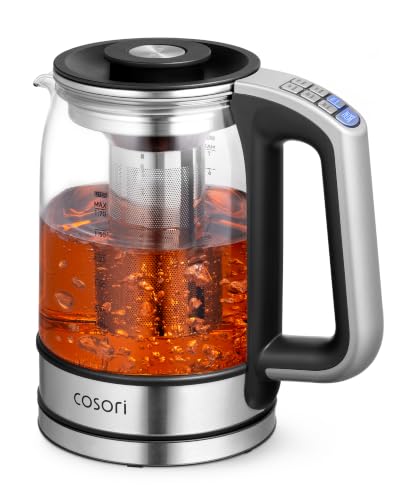
COSORI Electric Tea Kettle with Infuser
The COSORI tea kettle with infuser is the glass option most buyers land on, and the glass is the point: you can watch the water approach the boil, watch the leaf open, and see at a glance how much water remains. The borosilicate body pairs with a stainless infuser that drops into the pot for loose leaf brewing, and the base carries straightforward temperature control rather than a bare on-off switch. Glass asks for gentler handling than steel and shows scale sooner, which is either a flaw or a useful reminder to descale, depending on your temperament. For tea drinkers who brew visually and drink several types, it is the balanced middle of this category.
Best for: the visual, loose-leaf household whose yes came from the daily ritual
Not suited for: households that need a kettle to survive a boisterous counter
Strengths
- The ritual itself becomes part of the value
- Mid-range tier eases the money question
- Infuser included for the leaf habit
Trade-offs
- Fragility is a permanent term
- Hard water keeps the descale honest
- Capacity suits rituals, not crowds
Tier: mid-range. Check price on Amazon.
Signals Your Household Is Ready
Readiness announces itself in small frustrations. You have started letting boiled water stand before pouring, and resenting the wait. A gift of good loose leaf sits half-used because the weekday routine defeats it. Someone in the house has said the green tea tastes better at a café and nobody could say why. A second cup regularly means a second boil of the same water. Each signal is the kettle’s job description written by your own kitchen, and two or more of them together are a stronger argument than any review, including the careful one in electric tea kettle review. Conversely, a household with no signals should not manufacture them: contentment with a basic kettle is a finished state, not a problem awaiting a purchase.
Signals to Wait a Year
Waiting is also a decision, and sometimes the right one. Wait if your tea habit is younger than the kettle’s likely first descale, because habits declare themselves over seasons. Wait if a kitchen renovation will redraw the counter within the year, because footprint decisions made twice are made badly once. Wait if the household is divided — one partner devoted to tea, one devoted to uncluttered counters — until the compact end of the category can be considered together, because a kettle resented by half its household is used by neither. And wait, always, if the honest blocker is the maintenance: a year of proving the descale habit on a basic kettle is the cheapest possible tuition, and the household that emerges with the habit will choose its tea kettle once, correctly, and keep it for years.
The Opportunity Cost Shelf
Every purchase is also the purchases it displaces, and the worth-it question is incomplete without naming them. The same budget buys a season of noticeably better leaf, which improves every cup including the ones a basic kettle makes. It buys the good teapot your current kettle has been waiting to serve. It buys a water filter that improves tea, coffee and cooking at once. The tea kettle wins this contest only when water temperature and brewing friction are demonstrably your binding constraints — which is why this page keeps returning to evidence from your own routine rather than to the appliance’s virtues in the abstract. Where the kettle is the binding constraint, it is not merely worth it; it is the missing piece. Where it is not, the shelf of alternatives is not a consolation prize but the correct answer wearing work clothes.
The Upgrade Path: Worth It Later, If Not Now
Worth-it verdicts have a shelf life, and the honest page says so. The household that correctly declines a tea kettle today — one tea, bags, a small counter — may be the household that correctly buys one in two years, after a loose-leaf gift takes root or a second drinker moves in with a shelf of greens. The signals section of this page is written to be reread: when two or three of those small frustrations have accumulated, the verdict has changed and the purchase has become the correction of a documented problem rather than a leap of faith. Conversely, households can grow out of the category — children leave, habits simplify, a beloved stovetop ritual returns — and a kettle sold or passed on in good order closes the account honourably. Judge the appliance by the years it will actually serve your actual routine, and let the verdict be revised when the routine is. That is not indecision; it is the correct way to price any durable good whose value lives entirely in daily use.
A Word for the Sceptical Reader
This page has argued both sides because the question deserves it, but it owes the sceptic a direct summary of the strongest case against, undiluted. The strongest case is this: tea was made well for centuries with a fire and a pot, the temperature problem can be managed free of charge with patience and a thermometer’s worth of attention, and every appliance added to a kitchen taxes space, money, maintenance and eventual disposal in exchange for convenience that a contented household may not need. That case is true. The worth-it case does not refute it; it locates the households for whom the tax is smaller than the daily friction it removes. If you finish this page unsure which household is yours, the tie-breaker is empirical and cheap: borrow the routine for a week — boil, rest the water properly for your greens, brew in a simple basket, keep a second cup warm by planning — and notice what you resent. Resent the fuss, and the kettle is worth it. Resent nothing, and you have saved a premium with a clear conscience, which is the second-best outcome this page can give you.
The Verdict, Restated Without Hedges
For the household that drinks widely, brews loosely and returns for second cups, an electric tea kettle is worth it — not as a luxury, but as the correction of a daily, measurable defect in how its tea was being made. For the household that drinks narrowly, brews from bags and finishes in one sitting, it is not worth it — not as a failure of the appliance, but as a mismatch the buyer’s honesty can prevent. Between those poles sits a minority of households whose answer depends on a single feature, and this page has named them: the forgetful, who should buy automation or nothing; the space-poor, who should buy compact or nothing; the maintenance-honest, who should buy simple or nothing. Everyone else can stop deliberating. The kettle question was never really about the kettle; it was about whether your mornings contain the problem it solves, and by now you know whether yours do.
The Question Behind the Question
Households rarely ask whether a kettle is worth it in the abstract; they ask because something in the tea routine has begun to itch. It is worth identifying the itch precisely before spending, because the category sells several distinct reliefs and only some itches are kettle-shaped. If the itch is bitter delicate tea, the relief is temperature and the kettle is the answer. If the itch is weekday friction, the relief is the infuser and the kettle is the answer. If the itch is forgotten pots, the relief is automation and only one tier is the answer. But if the itch is that the tea itself has become boring, the relief is new leaf and no kettle will scratch it; if the itch is a tired kitchen, the relief is a clear-out and a coat of paint; if the itch is a household’s mornings being rushed and graceless in general, the relief is a schedule, and a kettle — even a very good one, even one with keep-warm — is only a supporting actor. The worth-it question, answered well, is a small act of household diagnosis. This page’s checklist was built to perform it, and its final advice is to trust the diagnosis over the desire: buy the relief for the itch you actually have, and the purchase will feel, every morning afterward, less like a gadget acquired and more like a problem retired.
One Last Comparison: The Money Spent Three Ways
Take the same household budget and spend it three ways, in imagination, across one year. Spent on leaf alone, it raises every cup’s ceiling while leaving the water problem untouched — the greens still scorch on bad mornings, the loose leaf still waits for weekends. Spent on the kettle alone, it perfects the water for leaf that may not deserve it, and the household drinks impeccable mediocrity. Split — a mid-range kettle and a real improvement in the leaf shelf — it produces the year every section of this page has been quietly recommending: water that stops being the problem, leaf that starts being the pleasure, and a routine calm enough to notice both. The worth-it question is usually framed as kettle or nothing, and that framing is the last error this page will correct. The true contest is between balanced and lopsided spending, and on that contest the verdict is not close.
The Answer for the Reader Still Counting
One reader remains unaddressed by profiles and checklists: the one who has read this far because the decision itself is enjoyable, and who suspects — correctly — that the deliberation has become the hobby. For that reader the worth-it answer has a time dimension the rest of this page has politely ignored. Every week spent deliberating is a week of greens brewed by guesswork or loose leaf left in its tin, and the cost of the perfect decision, pursued long enough, quietly exceeds the cost of a merely good one. The category is forgiving to the decisive: its mid-range is strong, its mistakes are resalable, and its daily returns begin the morning after the box is opened. So the final counsel of this page is procedural rather than material. Run the checklist once, honestly. If it says yes, buy the pattern it points to within the week and spend the saved deliberation on the tea itself. If it says no, close the question with equal finality and revisit it only when the signals change. A worth-it question answered either way is worth more than a perfect answer postponed — because tea, unlike kettles, is brewed fresh every morning, and it does not wait for the ideal appliance to arrive.
The Household Meeting: Deciding Together
Many kettle decisions are really household negotiations, and the worth-it question deserves a closing word on deciding together, because a kettle bought over one partner’s objection delivers its verdicts to a divided jury every morning. The productive way to hold the meeting is with evidence rather than taste: a week of noticing, together, how many teas the shelf actually holds, how many pots were forgotten, how many second cups were reboiled, how much counter is genuinely free. Households that gather that week of evidence usually find the argument settles itself, because the worth-it question was never about the appliance’s virtues — it was about the household’s facts, and facts, once shared, are hard to argue with. Where the evidence splits — one drinker’s daily delight against another’s daily clutter — the compact and simple end of the category is the traditional peace treaty, and a fair one: it gives the tea drinker temperature and the sceptic a footprint they can forget. Decide on evidence, size the compromise honestly, and the kettle that arrives will be the household’s kettle rather than one person’s appliance tolerated by the rest — which, as this page has argued from its first paragraph, is the difference between worth it and merely bought.
Worth It, Finally, Is a Morning Measurement
Every argument in this page can be tested tomorrow morning with the equipment already in the house, and the test is the fitting close. Brew the day’s first tea with deliberate care: water rested properly for the leaf, the steep timed, the second cup planned rather than reboiled. Then notice, honestly, what the care cost in attention and what it returned in the cup. If the return was real and the cost was friction you would gladly delegate, the worth-it question has answered itself in the only laboratory that matters. If the care felt like ceremony you enjoyed, keep the ceremony and skip the appliance — a ritual performed by hand is not a problem awaiting automation. The kettle is worth it for the households whose mornings improve when the care is delegated. This page has spent its length identifying those households; the morning test identifies yours.
Worth It, Measured at the Table
There is a final measurement no checklist captures, and it happens at the table rather than the counter. Watch what a household does with its tea once the water is right: the green that used to be endured is suddenly discussed, the loose leaf that used to wait for weekends appears on a Tuesday, the second cup that used to be a compromise becomes the best one. Worth, for an appliance like this, is not the sum of its features but the small expansion of a daily pleasure — more kinds of tea, brewed more often, with less friction and fewer failures. Households that experience that expansion stop asking the worth-it question, because the answer has become part of the furniture of their mornings. Households that do not, should sell the kettle to someone who will and spend the proceeds on leaf, without a backward glance. Both outcomes are successes of the same kind: a household that knows, from evidence, what its tea is worth.
The Small Print of This Verdict
Every verdict in this article carries the same small print, and it is fair to print it once, largely. The judgements assume the kettle is maintained as its makers intend, bought at the tier its profile requires rather than the tier its advertising prefers, and matched to a household whose facts were gathered honestly. Change any of those conditions and the verdicts change with them — a neglected premium kettle is worth less than a kept basic one, and a mis-sized family kettle is worth less than either. Worth, in this category, is not a property stamped on the box. It is an outcome a household produces, jointly with the appliance, across a thousand mornings — which is why this page has spent so long on the household and so little on the box.
Electric Tea Kettle: The Break-Even Test: When the Purchase Pays Off
Start with how often a {p} must actually be used before it earns its counter or cupboard space. Most coverage of a electric tea kettle concentrates on the first week of ownership, yet the decisions that matter most tend to surface later, once the electric tea kettle has to earn its place in an ordinary weekday routine rather than a carefully staged first attempt. Write down the three jobs you expect it to do most often, in the order you actually do them, and judge every claim you read against that short personal list instead of against a generic ideal.
Use a short decision checklist to finish. One, does it fit the space and the storage you really have. Two, does it handle your three most common jobs without a workaround. Three, do the edge cases you listed stay manageable. Four, can every wear part be cleaned or replaced without drama. Five, would you still choose it if a friend described the same drawbacks in their own kitchen. A electric tea kettle that passes all five is a sound buy; one that fails two or more is a compromise you are choosing with open eyes, which is a very different thing from being surprised later.
Finally, plan the first fortnight deliberately. Use the electric tea kettle for one familiar job first, so you have a baseline you trust, then introduce the harder cases one at a time and note what changes. Small adjustments to arrangement, timing, quantity or preparation usually close most of the gap between disappointing first results and the performance the design is capable of. That short learning period is also the fairest test of the break-even calculation: if the routine has not settled by the end of it, the mismatch is real, and it is better to know while returning or exchanging is still straightforward.
Troubleshooting is easier when you expect the usual failure points. With any electric tea kettle, the recurring problems tend to cluster in the same places: uneven results from overloading or poor arrangement, wear showing first on the parts handled most often, and small annoyances with lids, seals, handles, controls or fittings that only appear after repeated use. Before buying, look for whether those wear parts can be cleaned properly, replaced or worked around, and whether the instructions address them directly rather than pretending they never happen.
When you check listings such as Cuisinart PerfecTemp Tea Kettle, Breville Smart Tea Infuser and COSORI Electric Tea Kettle with Infuser, use them as worked examples: run through the same checks below on each one in turn, so the comparison stays honest and like for like rather than based on whichever listing happens to shout loudest.
Maintenance decides how long the good results last. Set a simple rhythm: a quick wipe or rinse after each use, a deeper clean on a fixed day, and a periodic check of the parts that move, seal or bear weight. A electric tea kettle that needs fiddly disassembly for basic care will be cleaned less often, and performance drifts long before anything actually breaks. Prefer designs where the parts that get dirtiest are the parts that are easiest to reach, and be honest with yourself about which cleaning steps you will genuinely keep up.
Measure before you commit. Note the footprint, the clearance above and behind the spot where the electric tea kettle will live, and the route you will carry it by when it is hot, full or awkward. A electric tea kettle that technically fits but blocks a cupboard door, crowds a neighbouring appliance or has to be dragged across a worktop every time will quietly fall out of use, whatever its merits on paper. In the Coffee & Tea category especially, a few centimetres of clearance and a sensible storage plan separate a daily tool from a bulky regret.
Frequently Asked Questions
Is an electric tea kettle worth it for green tea drinkers?
Yes, more clearly than for any other profile. Green tea is the family most damaged by boiling water, and a kettle’s green preset removes the boil-wait-guess routine that produces most bitter home-brewed green tea. If green or white teas appear in your week even a few times, the temperature control alone can justify the category; the infuser and keep-warm are bonuses on top of a settled case.
Is an electric tea kettle worth it if I only drink black tea?
Generally no. Black tea and herbal infusions want freshly boiled water, which any competent kettle delivers, so the presets and fine control go unused. The exceptions are households that value keep-warm for staggered second cups. Otherwise, an entry kettle plus better leaves improves your cup more per unit of money than any premium tea kettle can.
How long does an electric tea kettle take to pay for itself?
There is no cash payback; the return is in cups. Daily drinkers who rotate teas typically feel the purchase justified within weeks, because the improvement arrives with every brew and rescued pots stop going down the sink. Weekly drinkers spread the same improvement over far fewer cups, which is why frequency, more than price, decides the worth-it question.
Is an automatic tea maker worth the extra over a kettle with an infuser?
Only for the profile whose problem is time rather than temperature: the brewer who starts a pot, walks away, and returns to over-steeped tea often enough to resent it. The automatic basket solves exactly that. If you stay near your tea, a manual infuser kettle gives the same cup with less cost, less counter and less to clean and maintain.
What is the cheapest way to get most of the benefit?
A mid-range, preset-led kettle without automation captures the large majority of the category’s value: correct temperatures, an infuser, a keep-warm hold. The premium tiers add automation, finer adjustment and design, which are worth paying for only when they match a daily need. Pairing that mid-range kettle with fresh, well-stored leaf beats a premium kettle on stale leaf every time.
Will an electric tea kettle raise my electricity bill noticeably?
No. Boiling water costs roughly the same in any kettle, and the habits around the kettle matter more than the model: heating only what you need, and not reboiling the same water repeatedly. Keep-warm uses a small ongoing draw while it holds temperature. A household that fills to the cup rather than the maximum line will not detect the kettle in its bill.
Related Reading
- electric tea kettle buying guide
- electric tea kettle reviews
- electric tea kettle pros and cons
- electric tea kettle review
- best electric kettles for tea
- electric tea makers
- how to choose a tea kettle