Disclosure: As an Amazon Associate, topratedkitchenware.com earns from qualifying purchases. Links on this page are affiliate links; they cost you nothing extra. Prices and availability change often, so check the current Amazon listing before you buy.
This immersion blender review treats the category itself as the product on trial: what an immersion blender is, how the current generation of models behaves across a real week of cooking, where the design shines, where it honestly falls short, and which of the named models below deserves which kitchen. If you have never owned one, this is the single long read that tells you what ownership actually feels like, the rhythm of reaching for it, the technique it quietly teaches you, and the small print that brochures skip. Model recommendations are prose-only while listing verification is pending, with pick slots marking where verified links and images will land.
Key Takeaways
- Verdict in one line: the modern immersion blender is a mature, excellent tool for soups, sauces and small batches, and a poor substitute for a countertop blender’s frozen work.
- Design has converged on detachable shafts, variable speed and anti-splash, anti-suction guards; the differences now are refinement, not concept.
- Performance in real use is technique-sensitive: submerged, low-start, constant movement turns any good model silky.
- Strengths: in-pot blending, storage, cleaning speed, texture control. Trade-offs: power ceiling, hand labour, blade respect.
- Buy the model that matches your thickest recipe and your main pot; the six profiles below map the territory.
In this guide
Immersion Blender Review: What the Category Is and Where It Fits
An immersion blender is a motorised handle driving a small blade inside a guard at the end of a shaft, designed to be lowered into food rather than to receive food into a jar. That inversion sounds trivial and changes everything: hot soup is puréed in its pot, sauces are finished in their pans, and a single serving of smoothie happens in a beaker instead of a full-size jug. The category sits between the knife and the countertop blender in a kitchen’s division of labour, closer to a daily utensil than to an occasional appliance, and it is priced, stored and cleaned like a utensil too.
Where it fits best is a household that cooks fresh food several times a week: soups in rotation, sauces and dressings made rather than bought, small batches blended at the moment of need. Where it fits worst is a household whose blending is mostly frozen drinks and large smoothies, or one that rarely cooks at all. This review judges the category by the standards of the first household while keeping the second in view, and the model profiles at the end translate the verdict into specific, prose-only recommendations. For the buying framework behind them, see the companion buying guide in this series.
Design, Build and Setup
Current models share a settled architecture: a motor body with a trigger or dial, a shaft, metal on most mid and premium lines, plastic on lighter ones, and a bell guard shaped to move food through the blade while limiting splashing and suction. Detachable shafts are now the norm above the entry tier, and they are the single design feature owners praise most, because they convert cleaning from a careful whole-appliance operation into rinsing one part at the sink. Setup, such as it is, consists of clicking the shaft on, plugging in or fitting the battery, and choosing a vessel, which makes the category’s learning curve about technique rather than assembly.
Attachments decide how much of your kitchen the tool can cover. The near-universal extras are a whisk, a mini chopper bowl and a blending beaker. The whisk turns the motor into a light-duty mixer for cream, egg whites and batters, saving the stand mixer for small jobs. The chopper bowl handles onions, herbs, nuts in modest quantities, breadcrumbs and baby portions with a tidiness the open shaft cannot match, and it contains the mess that chopping boards spread. The beaker is the emulsion and smoothie vessel, sized for one or two servings. Bundles vary widely, and the honest question is which of these you will actually wash and use; an attachment that lives in its box adds cost and cupboard clutter, not capability.
Detachable shafts matter more than most accessory lists admit. A shaft that clicks off the motor body rinses clean in seconds, fits in a cutlery drawer or a slim cupboard slot, and can go in the dishwasher where the maker allows it, while a fixed-shaft design must be washed carefully as one long, awkward piece with the motor kept dry. Metal shafts tolerate hot pots indefinitely; plastic shafts are lighter and kinder to delicate pan coatings but should be kept out of the very hottest liquids and can stain with turmeric and tomato. Neither is a deal-breaker. What matters is matching the design to your pans, your storage and your patience for washing up.
Start with the rule that governs everything else in this guide: the blades of an immersion blender are extremely sharp, far sharper than most people expect from a small kitchen appliance, and they sit exposed at the end of the blending shaft with only a shallow guard around them. Treat the blade end the way you would treat the edge of a chef’s knife that happens to spin. Before cleaning, before handling the blade end for any reason, and before reaching anywhere near the guard, unplug a corded model from the wall or remove the battery pack from a cordless one. A trigger brushed by a wet hand or a curious child can start the blades in an instant, and the injury that follows is the kind that sends people to urgent care. Never put fingers near the blade guard, even to flick off a stuck piece of food; use a spoon handle or a spatula, with the power source disconnected, every single time.
Keep the appliance away from children at every stage, not just while it runs. A hand blender left plugged in on the counter, or stored in a low drawer a toddler can open, is an accident waiting for a quiet moment. Store it unplugged, ideally in a high cupboard or a drawer fitted with a guard, and never let a child hold the motor body while you guide the shaft, however much they want to help with the soup. Older children who cook should learn the unplug-first rule before they are allowed anywhere near the tool, and they should be supervised until the habit is automatic. These are not cautious extras; they are the operating conditions the tool was designed around, and every maker guidance sheet says some version of the same thing.
Performance in Real Use
Soups: The Home Ground
Soup is where this tool posts its best numbers, if experience counts as numbers. A pot of simmered vegetables, stock and seasoning becomes a smooth soup in a few minutes of guided passes, with texture chosen on the fly: stop early for body, continue for silk, hold back a ladle of chunk to stir through at the end. Thick bean and lentil soups separate the field; confident motors keep the vortex moving through dense mixtures while light ones labour and need help in the form of extra liquid and patience. Across the models profiled below, the premium entries earn their tier precisely here, in the thickest pot of the week.
The core technique is simple to describe and takes a few batches to feel. Lower the shaft into the food at a slight angle so air is not trapped under the guard, submerge the blade completely, start on low, and then move the blender slowly up and down and around the vessel in overlapping passes. The up-and-down motion matters: food circulates through the blade zone in a vortex, and a blender held still will polish one column of soup while leaving the corners chunky. For a large pot, work in quadrants and finish with a slow sweep around the edges where pieces hide. Short bursts with pauses give you control over texture; continuous running is for the final smoothing pass once the big pieces are already broken down.
Texture control is the immersion blender’s party trick, and it comes from stopping early rather than from any special setting. For a rustic soup, a few short pulses leave body and visible pieces; keep going and the same pot turns silky. For sauces and dressings, the narrow beaker that ships with many models is the right vessel: the tight walls keep a small volume of liquid in constant contact with the blade, which is exactly what an emulsion like mayonnaise needs to form. Wide bowls defeat small batches, because the ingredients spread into a shallow layer the blade skims over. Match vessel to volume and most ‘my blender does not work’ complaints quietly disappear.
Sauces, Dressings and Emulsions
The beaker work is the connoisseur’s department. Mayonnaise forms under the guard in a narrow jar with a reliability that startles first-time users; vinaigrettes emulsify to a gloss; pan sauces smooth out in their own pans; gravy loses its lumps without a sieve. Variable speed matters here more than power, because emulsions reward a slow start and a gradual build. Models with trigger-variable control feel purpose-built for this work, while two-speed models manage it with a little more care. Either way, this is performance a countertop blender cannot easily copy, because its jar is simply too big for a small sauce to reach the blade.
Smoothies, Shakes and Small Batches
For fresh, soft ingredients, a banana, berries, yoghurt, milk, protein powder, the beaker-and-stick combination is fast, proportionate and nearly wash-free, and for many single-person households it quietly replaces the big blender entirely. The boundary is frozen content: ice and frozen-solid fruit belong to countertop machines, and every honest review should say so plainly. Within the fresh boundary, performance differences between models are small; beyond it, no model in this review pretends to compete, and the profiles below mark the distinction wherever it matters.
Hot liquid is where immersion blenders earn their reputation and where most burns happen, so the technique matters as much as the tool. Keep the blade fully submerged before you press the trigger and keep it submerged until the blades have stopped completely. The moment a spinning blade breaks the surface of a hot soup, it throws a fan of scalding droplets across the stove, your hands and your shirt. Start at the lowest speed, let the vortex form under the surface, and only then raise the speed or begin to move. Let very hot liquids cool slightly before blending, following your maker’s guidance; a soup taken straight off a rolling boil steams, expands and spits far more than the same soup rested for a short while, and the gentler temperature is also kinder to plastic beakers and seals.
Watch for suction on pan bottoms, the second classic surprise. The bell-shaped guard can seal itself against the base of a pot under power, tugging the blender downward and holding it there while the motor strains. Break the seal by tilting the shaft slightly or lifting a fraction as you move, and keep the blender travelling in slow passes rather than parked in one spot. Modern anti-suction guard designs reduce the effect, but none eliminate it, and the habit of constant gentle movement also blends more evenly. Work in a pot deep enough that the liquid sits well below the rim, because a submerged blade displaces and churns; a shallow pan of hot liquid plus a spinning blade is a splatter equation that never favours the cook.
Whipping, Mixing and Attachment Work
With a whisk fitted, the motor body becomes a light mixer that whips cream, beats eggs and smooths thin batters with real competence, saving the stand mixer for small jobs and the cook’s wrist for everything. Chopper attachments handle the onion-herb-nut class of tasks neatly and contain their mess. None of this replaces dedicated machines at volume, but as a review finding it matters: the modern immersion blender, bought as a system, covers a startling share of a small kitchen’s powered work, and that coverage is a large part of why owners rate the category so warmly.
Strengths and Trade-Offs
Strengths
- Blends in the pot or pan: no hot transfers, no extra vessels, better safety and texture for soups and sauces.
- Drawer-sized storage and about a minute of cleaning, so it is used constantly rather than occasionally.
- Hand-controlled texture and superb emulsions in small quantities that big jars cannot reach.
Trade-offs
- A firm power ceiling: ice, frozen fruit, hard loads and nut butters belong to countertop blenders.
- Your hand supplies the labour and the judgement; big thick jobs fatigue, and careless technique splatters.
- Extremely sharp blades impose permanent habits: unplug before handling, no fingers near the guard, store away from children.
The fuller two-sided ledger, with six entries on each side, lives in the companion pros-and-cons article in this series, and it reaches the same conclusion this review does: the trade-offs are the price of the strengths, charged by the same design.
How It Compares
The comparison every buyer runs is against the countertop blender, and the honest answer is that they overlap rather than replace. A full-size blender wins on raw power, on ice and frozen fruit, on large smoothies, on nut butters and on set-and-forget batch work where its jar and lid contain everything. The immersion blender wins on hot soup in the pot, on small quantities, on emulsions in a beaker, on storage, on washing up, and on the price tier it occupies, which is generally a step below serious countertop machines. Many kitchens that cook soup weekly end up owning both and reaching for the stick ninety times out of a hundred, because convenience compounds: the tool that is out, plugged and rinsed in a minute is the tool that gets used.
Against the food processor, the split is similar. A processor slices, grates, kneads and chops with a precision and speed the stick cannot approach, and its bowl handles dry ingredients the shaft simply stirs around. The hand blender purées in place, in the serving pot, with almost no washing up, where the processor demands transfer, assembly and a sink full of parts. For a small kitchen, the stick plus a sharp knife covers a surprising share of daily cooking; for a household that batches dough, slaw and pastry weekly, the processor earns its shelf. Neither purchase makes the other foolish. They solve different frictions, and naming your friction honestly is the whole of wise buying.
| Model | Character in one line | Qualitative tier |
|---|---|---|
| KitchenAid Variable Speed Hand Blender | The balanced all-rounder with trigger-finesse | mid |
| Breville Control Grip | The control and pan-care specialist | premium |
| Vitamix Immersion Blender | The thick-mixture heavy lifter | premium |
| Braun MultiQuick | The attachment system for variety cooks | mid to premium |
The Models Behind This Review

KitchenAid Variable Speed Hand Blender
Badge: Best for Everyday Versatility · Tier: mid tier (qualitative positioning; check price on Amazon on the current listing once verified links are added).
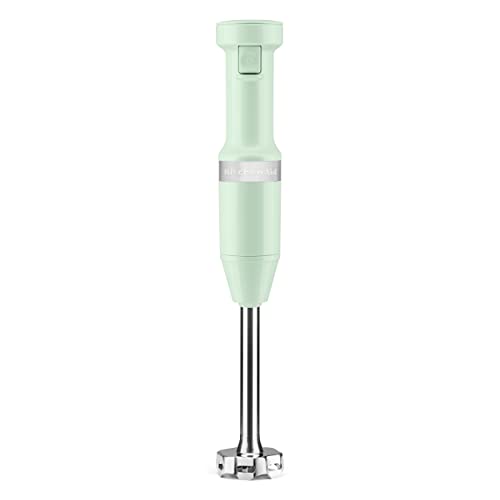
The KitchenAid Variable Speed Hand Blender is the household name in this category for a reason: it is built around the simple idea that one trigger should give you a gentle stir for a delicate sauce and a firm push for a pot of squash soup, with the speed following your squeeze rather than a dial you must stop and set. The removable blending arm clicks off for rinsing, the included blending jar suits smoothies and dressings, and the overall balance suits cooks who blend often and want the tool to disappear into the routine. As with every pick here, treat it as prose-only buying guidance for now: check the current listing for the exact configuration, attachments and finish on offer before you buy.
Best for: households that blend several times a week and want one dependable all-rounder. Not suited for: cooks who mainly crush ice or blend frozen fruit, who should be looking at a full-size countertop blender instead. Strengths: intuitive variable speed at the trigger, detachable arm for easy washing, a jar that makes small batches practical. Trade-offs: corded design ties you to a socket near the stove, and the attachment ecosystem is smaller than some rivals offer. Keep the blade fully submerged before squeezing the trigger, as with any model, and unplug before you handle the blade end.

Vitamix Immersion Blender
Badge: Best for Power Within the Category · Tier: premium tier (qualitative positioning; check price on Amazon on the current listing once verified links are added).
The Vitamix Immersion Blender brings the countertop giant’s blending pedigree to the stick format, and it is the pick for cooks who found lighter hand blenders wanting against thick bean soups, dense purées and big pots. The metal shaft, the simple speed control and the solid, workmanlike build aim at performance and longevity rather than accessory sprawl. It is a premium-tier tool with a premium-tier brief: fewer extras, more blending. If your cooking leans toward hearty, fibrous, chunky starting points that must end silky, this is the model in the line-up that asks the fewest apologies. Verify the current listing’s configuration before buying, as with every prose-only pick in this guide.
Best for: serious soup and sauce cooks, large households and anyone upgrading from an underpowered stick. Not suited for: buyers who want a big attachment bundle, or very small kitchens where a slimmer, lighter tool will be used more. Strengths: confident performance on thick mixtures, durable metal construction, simple controls that stay out of the way. Trade-offs: weight in the hand over long sessions, premium tier, and a bundle that focuses on the blender itself. Respect the usual disciplines: blade submerged before power, gentle movement to avoid suction, power disconnected before the blade end is handled.

Breville Control Grip
Badge: Best for Control and Anti-Suction Design · Tier: premium tier (qualitative positioning; check price on Amazon on the current listing once verified links are added).
The Breville Control Grip is the control enthusiast’s pick, shaped around an ergonomic handle and a bell-shaped guard designed to reduce the suction that glues lesser blenders to the bottom of the pan and to cut down on splashing. Its non-scratch guard rim is a thoughtful touch for cooks blending in coated or enamelled pots, and the bundled jug and whisk extend it beyond soup duty. It sits in the premium tier, and the premium buys refinement rather than brute force: steadier handling, calmer blending, less mess on the hob. Check the current listing for the exact bundle before buying, since packages and finishes vary.
Best for: frequent soup makers with good pans they want to protect, and cooks who value control over raw aggression. Not suited for: anyone shopping strictly at the entry tier, or cooks who need a cordless tool. Strengths: guard design that fights suction and splatter, comfortable grip for longer blending sessions, pan-friendly rim. Trade-offs: premium positioning, and a slightly larger footprint in the drawer than the slimmest sticks. As ever, submerge the blade fully before starting, start low, and disconnect the power before cleaning or touching the blade end.

Braun MultiQuick
Badge: Best for Attachment Versatility · Tier: mid to premium tier (qualitative positioning; check price on Amazon on the current listing once verified links are added).
The Braun MultiQuick line is the modular thinker’s choice, built around a motor body that pairs with a family of attachments, from the standard blending shaft to whisks, choppers and, on some configurations, more besides. The splash-conscious guard design and easy-click attachment changes suit cooks who want one motor to cover many small jobs: soup in the pot, herbs in the chopper, cream with the whisk. Which configuration is on sale matters enormously with this line, because bundles differ a great deal, so read the current listing carefully and buy the set that matches your cooking rather than the biggest box. All guidance here is prose-only pending verified listings.
Best for: cooks who genuinely use attachments and want one appliance to replace several small ones. Not suited for: minimalists who will blend soup and nothing else, who pay for flexibility they never touch. Strengths: broad attachment system, tidy click-on changes, guard design that keeps splatter down. Trade-offs: bundle confusion is real, and stored attachments need a home. The safety routine is unchanged: unplug before swapping or cleaning attachments, keep fingers away from every blade, and keep the blade submerged while it spins.
Who Should Buy It, and Who Should Skip It
Buy with confidence if you cook soups or sauces weekly, your kitchen is small or your counters are full, you make dressings and small batches, and you are willing to learn three habits: submerge, start low, keep moving. Skip or defer if your blending is mostly frozen drinks, you want set-and-forget batch processing, or your household will not run the storage and unplugging rules that sharp blades require. Pre-purchase checklist: shaft reaches your deepest pot; guard suits your pan coatings; speed control matches your emulsion ambitions; socket or battery suits your kitchen geography; cleaning routine, set out in how to clean an immersion blender, sounds like something you will actually do.
Setup, Care and Maintenance Essentials
Cleaning is easiest in the first minute after blending, and the classic trick earns its fame: fill a tall jug with warm water and a drop of washing-up liquid, submerge the blade, and run the blender briefly so it washes itself. Then disconnect the power, detach the shaft if your model allows it, rinse, and dry the blade area carefully with a cloth moved from the shaft toward the guard, never across the edge. Dried-on food is the enemy; a soup left to set on the guard turns a one-minute rinse into a scrubbing session with a bottle brush around a sharp edge, which is precisely the situation the safety rules exist to prevent. Build the rinse into the cooking routine and the tool stays the lowest-effort appliance you own.
The motor body never goes under the tap and never into water. Wipe it with a damp cloth, keep moisture away from the vents and the coupling, and let everything dry fully before storage so seals and bearings stay happy. Check the cord for nicks if it lives near the stove, store the shaft where the guard will not be knocked or used as a hook for hanging utensils, and keep the whole appliance out of children’s reach, unplugged or with its battery removed. Once in a while, run your eye over the guard and blades for dings from bones or cutlery; a damaged guard changes how the tool handles and is a reason to contact the maker about parts rather than to press on regardless.
Ownership costs are measured in minutes and cupboard inches more than in money. The tool asks for a rinse after each use, a dry store, an occasional inspection of guard and cord, and a drawer or slim cupboard slot to live in. It gives back the transfer-free soup, the thirty-second sauce rescue, the beaker smoothie that does not justify washing a full blender jar, and the gravy smoothed in the pan it was made in. There is a short learning curve, mostly around submersion, speed and movement, and it flattens within a few uses for most cooks. After that the appliance fades into the background of the kitchen, which is the highest compliment a utility tool can earn.
Longevity follows care more than brand tier. Motors die early when they are strained against frozen loads, run dry, or left running continuously far beyond the short duty cycles these tools are designed for; makers consistently describe them as burst tools, not marathon runners. Blend in passes, let the motor rest between long jobs, keep liquid in the mix so the blade is never chewing air or paste alone, and the same machine serves for years. When a model does tire, the usual suspects are a worn coupling, a tired motor after heavy abuse, or a damaged guard, and reputable makers sell parts or service for their lines. Buy from a maker with a real support channel and the purchase behaves like an investment in a tool, not a ticket in a lottery.
Final Verdict
The immersion blender, reviewed as a category, is one of the few kitchen tools whose reputation undersells it. It is not a small countertop blender and should never be bought as one; it is a different instrument, better at the hot, small, frequent work that real cooking consists of, and content to leave the frozen theatre to bigger machines. Buy the model that fits your thickest recipe and your real habits, learn the three movements, respect the blade, and it will earn its drawer every week for years. The model-by-model companion article in this series takes each named pick in turn.
Baby and toddler food is a chapter many households discover by accident. Steamed vegetables, soft fruits, cooked lentils and porridges purée in the beaker or a small pan to exactly the consistency a given month demands, smoother at first, textured later, in portions that match a small appetite rather than a freezer-filling batch. Hygiene rules apply with extra force: spotless equipment, freshly cooked ingredients, prompt chilling of leftovers, and the usual unplug-before-cleaning discipline so the tool that feeds the smallest eater is handled with the most care. A hand blender bought for soup often ends up remembered as the weaning appliance.
Entertaining changes the arithmetic again. Dips, whipped toppings, cocktail foams, a soup course blended to order: the stick moves between jobs with a rinse between each, where a single-jar blender becomes a bottleneck and a washing-up argument. Hosts use it tableside in a jug for dramatic effect and in the kitchen for the unglamorous work of smoothing, emulsifying and rescuing. Guests never see the tool, but they taste the difference between a sauce that was fixed and a sauce that was served apologetically. For households that cook for friends often, that quiet reliability is a large part of the value case.
Small kitchens make the strongest structural argument. A stick blender lives in a drawer, hangs from a rail or stands in a utensil crock; it asks for no counter footprint, no permanent parking spot, no negotiation with the coffee machine about territory. In a flat or a compact galley kitchen, that difference decides whether a blending capability exists at all. Renters and students lean on it for the same reason: one modest tool that covers soups, shakes, sauces and batters, moves house in a cutlery box, and never becomes the appliance that has to be left behind for lack of space.
Leftovers are where the tool quietly saves money. The last of a roast chicken becomes a soup, the soup’s second day becomes a smoother, richer version of itself, vegetable odds and ends become a sauce for pasta, and stale bread becomes crumbs in the chopper attachment. None of these transformations needs a big appliance; all of them need blending or chopping in modest quantities, in the vessel the food already occupies. A kitchen that wastes less because repurposing is easy will repay a modest hand blender’s tier many times over, in groceries unthrown and takeaways unordered, across a single season of cooking.
The learning curve deserves an honest paragraph. The first blend usually splashes a little, because everyone lifts the blade too early once. The second usually suctions, because everyone parks the blender once. By the third or fourth use the disciplines, submerge first, start low, keep moving, stop before surfacing, have become muscle memory, and the tool feels obvious. This is worth knowing before judging the category from a single messy attempt: the skill involved is small, real and quickly learned, and nearly every negative first impression traces back to technique that one more careful attempt would have fixed.
Seasonal cooking flatters the tool in rotation. Autumn and winter bring the soup pots, squash, roots, beans and lentils that are its heartland. Spring adds pea and asparagus soups and herb sauces. Summer shifts the work to gazpacho, smoothies, iced drinks with the beaker, dressings and dips for grilled food. Across the year the same stick covers the calendar without a single seasonal attachment or storage shuffle, which is more than can be said for many single-purpose appliances that shine for one month and gather dust for eleven. Versatility across seasons is a form of value that rarely appears on a specification sheet.
A word on gifting, because this category is a common present. A hand blender suits a new household, a student leaving home, or a keen cook whose kitchen lacks blending power, provided the recipient actually cooks the foods it loves. Add a note about the safety basics, unplug before cleaning, blade submerged, keep away from children, and the gift arrives with its most important accessory: good habits. Choose a mid-tier all-rounder rather than the cheapest or the most elaborate bundle, and the present has the best chance of becoming a daily tool instead of a cupboard monument to good intentions.
Consider the humble weeknight tomato sauce, because it demonstrates the whole value system in one pan. The onions and garlic soften, the tomatoes go in, and twenty minutes later the sauce is delicious but rough, with skins and seeds interrupting every forkful. Thirty seconds of careful blending in the pan, heat off, blade submerged, starting low, and the same sauce turns glossy and cohesive while keeping a little rustic body, because you stopped when it looked right rather than when a timer said so. No extra pot, no sieve, no blender jar sweating on the counter. Multiply that small upgrade by every sauce in a season and the tool’s reputation stops looking like enthusiasm and starts looking like arithmetic.
Hummus and bean dips deserve an honest technique note, because they sit at the thick edge of what this tool enjoys. The method that works is patience and liquid: blend the cooking liquid or water in first, add the beans in stages, move the shaft slowly so the vortex keeps feeding the blade, and stop to rest the motor on a big batch. The result will be a little more rustic than a food processor’s, which many people prefer, and the beaker-sized batch, the amount a household actually eats fresh, is exactly the scale where the stick beats the big machine on effort. Expecting a silky catering quantity from it is the category error; expecting a superb small batch is simply reading the design correctly.
Whipped cream exposes a different talent. With the whisk attachment fitted, a small amount of cream, the quantity a single dessert actually needs, whips quickly and controllably, and the cook can stop at soft peaks by eye rather than by programme. The same applies to a couple of egg whites for a soufflé omelette or a small batch of meringue. Nobody sensible whips cream for a wedding cake this way, and nobody needs to: the point is that the small, frequent whipping jobs of real cooking stop requiring either a big machine’s assembly or a wrist-aching hand whisk, and start being thirty-second decisions instead of projects.
Breakfast porridge and overnight oats are a quieter use that converts many sceptics. A brief blend of oats with milk or yoghurt before cooking gives a smoother, creamier porridge; a few pulses through cooked porridge breaks the line between rustic and baby-food smooth, letting one pot serve the whole table at different textures. Add fruit purée swirled through at the end, blended in the serving jug, and a weekday breakfast gains the kind of small luxury that usually belongs to cafés. Tools earn their keep on Tuesdays, not on dinner-party Saturdays, and this is Tuesday work of the highest order.
Cocktail and mocktail makers find their own uses. Crushed-fruit coolers, blended citrus drinks with soft ingredients, foams and flavoured syrups all sit within the tool’s fresh-and-soft empire, and the beaker doubles as a mixing vessel that pours neatly. The boundary stays where it always is: ice belongs to the countertop machine, so the stick handles the fruit, herb and emulsion side of the glass while its bigger sibling handles the frozen side. Hosts who own both stop thinking of them as rivals and start thinking of them as a team, which is the mature view of this entire category.
Think about the cook who lives alone, because appliance marketing rarely does. Their blending is a soup for two days, a sauce for one, a shake for now. Every full-size appliance taxes them with washing scaled for a family, while the stick blender’s beaker, shaft and one-minute rinse are proportioned exactly to their life. For this cook the category is not a compromise at all; it is the correctly sized tool, and the bigger machines are the awkward ones. A great deal of the worth-it debate dissolves once you notice that ‘best’ in kitchen tools usually means ‘best matched to the household’, and households come in ones as often as in fours.
There is also the matter of confidence for newer cooks. A stick blender is unusually legible: you see the food change under the guard, you hear the motor’s note shift as the mixture smooths, you stop the instant the texture matches the picture in your head. That feedback teaches blending as a skill rather than a setting, and skills transfer, to soups judged by eye, sauces rescued without panic, and a general sense that texture is something a cook controls. Several of the habits it teaches, patience with hot liquids, respect for sharp blades, cleaning as you go, are simply good kitchen craft wearing an appliance’s clothes.
Travel and second homes make a smaller, practical case. A stick blender packs into a suitcase corner or a car boot box, weighs little, and turns a holiday rental’s blunt knives and single saucepan into a workable soup and sauce kitchen. Families with a caravan, a boat or a grandparent’s house to stock often keep an entry-tier model at the second location rather than transporting the good one. It is not the use anyone buys for first, but it is the use that makes owners describe the tool as indispensable in a tone usually reserved for corkscrews and phone chargers.
A note on noise and neighbours, because nobody prints it on the box. Immersion blenders are not quiet, but their jobs are short: the burst pattern of blending means the sound arrives in seconds-long episodes rather than the sustained roar of a big machine working through a frozen load. Early-morning smoothie makers in thin-walled flats learn to use the beaker, keep bursts brief and close the kitchen door, and the same courtesy applies late at night. It is a minor point with a real effect on how welcome a tool feels in a shared home, and worth one honest paragraph in any complete account.
Immersion Blender: What Long-Term Use Reveals That a First Test Misses
Start with how a {p} holds up once the novelty wears off and routines settle in. Most coverage of a immersion blender concentrates on the first week of ownership, yet the decisions that matter most tend to surface later, once the immersion blender has to earn its place in an ordinary weekday routine rather than a carefully staged first attempt. Write down the three jobs you expect it to do most often, in the order you actually do them, and judge every claim you read against that short personal list instead of against a generic ideal.
Measure before you commit. Note the footprint, the clearance above and behind the spot where the immersion blender will live, and the route you will carry it by when it is hot, full or awkward. A immersion blender that technically fits but blocks a cupboard door, crowds a neighbouring appliance or has to be dragged across a worktop every time will quietly fall out of use, whatever its merits on paper. In the Kitchen Appliances category especially, a few centimetres of clearance and a sensible storage plan separate a daily tool from a bulky regret.
Troubleshooting is easier when you expect the usual failure points. With any immersion blender, the recurring problems tend to cluster in the same places: uneven results from overloading or poor arrangement, wear showing first on the parts handled most often, and small annoyances with lids, seals, handles, controls or fittings that only appear after repeated use. Before buying, look for whether those wear parts can be cleaned properly, replaced or worked around, and whether the instructions address them directly rather than pretending they never happen.
Use a short decision checklist to finish. One, does it fit the space and the storage you really have. Two, does it handle your three most common jobs without a workaround. Three, do the edge cases you listed stay manageable. Four, can every wear part be cleaned or replaced without drama. Five, would you still choose it if a friend described the same drawbacks in their own kitchen. A immersion blender that passes all five is a sound buy; one that fails two or more is a compromise you are choosing with open eyes, which is a very different thing from being surprised later.
When you check listings such as KitchenAid Variable Speed Hand Blender, Vitamix Immersion Blender and Breville Control Grip, use them as worked examples: run through the same checks below on each one in turn, so the comparison stays honest and like for like rather than based on whichever listing happens to shout loudest.
Work through a realistic scenario, not a best case. Picture the busiest version of the job: more people to serve, less time than planned, ingredients or materials that are slightly out of the ordinary, and a clean-up waiting at the end. Ask how the immersion blender behaves at that upper edge, because a model that only shines on a small, simple load will disappoint precisely when you need it most. If the honest answer is that you would split the job into batches or fall back on an older method, factor that into the decision now rather than discovering it later.
Frequently Asked Questions
What does this immersion blender review actually test?
The category as a working tool: design and build across current models, performance on soups, sauces, emulsions and small batches, the strengths and trade-offs that follow from the design, and how the named models differ in character. Because listings verification is pending, models are recommended in prose without links or prices, with pick slots marking where verified links and images will be added. The judgements here are about fit and behaviour, which age far better than any single season’s figures.
Which immersion blender is best for thick soups?
In this review’s profiles, the Vitamix Immersion Blender is the thick-mixture specialist, with the Breville Control Grip close behind for cooks who also prize anti-suction control and pan care. The KitchenAid variable-speed model covers most households’ thick soups comfortably. What matters is motor confidence plus guard flow in dense mixtures, and a metal shaft for hot pots. If your thickest pot is a bean or lentil soup, shop in that upper group rather than at the entry tier.
Can an immersion blender replace my countertop blender?
For soups, sauces, dressings, fresh smoothies and small batches, largely yes, and with less washing up. For ice, frozen fruit, large frozen smoothies and nut butters, no: that work needs the countertop machine’s power and jar geometry. Many households replace the big blender’s daily role while keeping it for frozen work; households that never blend frozen food often find the stick replaces the countertop blender entirely. Your menu, not the marketing, settles the question.
Are immersion blenders hard to learn?
No, but there is a short, real technique: keep the blade fully submerged before starting and until it stops, start at low speed, move slowly and constantly to avoid suction and to blend evenly, and use deep vessels for hot food. Most people splash once, suction once, and then never again. Within a few uses the movements are automatic, and the texture control that felt fussy at first becomes the feature owners praise most.
How do I clean the models in this review safely?
The routine is identical across them: unplug or remove the battery first, run the self-wash in warm water with a drop of washing-up liquid, detach the shaft and brush around the guard without ever putting fingers near the blades, wipe the motor body with a damp cloth, dry fully and store out of children’s reach. The step-by-step, including dried-on food and staining, is in the companion cleaning guide in this series.
Is a premium immersion blender worth the higher tier?
If you blend thick mixtures often, yes: stronger motors, better guards, metal build and finer speed control are daily, tangible differences, and support and parts extend the tool’s life. If your work is thin soups, sauces and shakes, a mid-tier model delivers the same results and the premium difference buys little. The companion worth-it analysis in this series runs the numbers in time, space and habits rather than in currency.
Related Guides and Next Steps
Keep reading with the companion guides in this series and the closest matches from the wider catalogue: how to choose an immersion blender; how to clean an immersion blender; the immersion blender buying guide; immersion blender pros and cons; immersion blender reviews, model by model; blenders built for soup making; blenders for soups and smoothies; blenders for smoothies with ice; blenders for smoothies with vegetables.