Disclosure: As an Amazon Associate, topratedkitchenware.com earns from qualifying purchases. Links on this page are affiliate links; they cost you nothing extra. Prices and availability change often, so check the current Amazon listing before you buy.
So, is a knife set worth it for your kitchen? The honest short answer is: worth it if you cook most days, want matched tools that live in one organised home, and will actually maintain them — hand-washed, dried immediately and stored in a block, sheath or magnetic strip rather than loose in a drawer. It is not worth it if you only ever use one knife, cook rarely, or know you will not keep up the basic care, because an unmaintained set becomes a block of dull blades taking up counter space. The long answer below weighs what a set genuinely gives you, the costs beyond money, the cooks it pays off for, and the alternatives worth considering first.
Key Takeaways
- A knife set is worth it when its core pieces — chef’s knife, paring knife, serrated knife, utility knife — match how you actually cook, several times a week.
- The real costs are counter space, hand-washing discipline, honing and sharpening upkeep, and keeping blades stored safely out of children’s reach.
- Sets pay off fastest for new kitchens, upgraders from a single dull knife, and households where several cooks share the same tools.
- They pay off least for minimalists who live on one good chef’s knife, and for anyone who will only ever dishwasher the set.
- Judge a set by its weakest everyday piece and its storage system, not by the headline piece count.
In this guide
What You Actually Get
What a knife set actually buys you is coverage and consistency. Coverage means the right shape is already in the kitchen when the task appears: the chef’s knife for the nightly pile of vegetables, the paring knife for hulling strawberries and deveining prawns at the board, the serrated blade for crusty bread and ripe tomatoes, the utility knife for the in-between jobs, and often steak knives that take the same shapes to the table. Bought separately, those pieces arrive over years, in mismatched styles, usually after a frustrating session with the wrong tool. A set ends that improvisation in one purchase, which is the core of its value for anyone building or rebuilding a kitchen.
Consistency is the quieter benefit. Pieces from one line share a handle shape, a balance philosophy and a maintenance routine, so your grip and habits transfer from knife to knife, and whoever else cooks in the household learns the same tools. The set also arrives with its storage solved — a block, or a system designed around sheaths or a strip — and storage is not an accessory but a safety and sharpness system: knives stored in a block, sheath or magnetic strip keep their edges apart and protected, while knives loose in a drawer dull against each other and wait dangerously for a reaching hand. A set that includes sensible storage has quietly solved the problem that ruins more knives than cooking does.
There is also a genuine economy of decision. Choosing individual knives well takes research per piece; a reputable set concentrates that research into one decision about one maker’s approach to steel, handles and composition. For most home cooks, the difference between a thoughtfully chosen set and a theoretically perfect hand-built collection is far smaller than the difference between either of those and the blunt, unbalanced knives they replace. If you want the criteria for that one decision spelled out, our knife set buying guide walks through them, and the broader round-up of best knife sets for home kitchens shows what home-focused compositions look like.
The Real Costs Beyond Money
The price is the least interesting cost of a knife set. The first real cost is space: a counter block claims a permanent footprint and needs clearance, a magnetic strip needs wall, and either must be positioned out of children’s reach. Small kitchens feel this honestly, and a set whose storage does not fit your kitchen will end up exiled to a drawer — loose, which is the one storage outcome that damages edges and risks hands. Measure your space against the storage before you judge the knives.
The second cost is maintenance discipline. A set multiplies edges, and every edge wants the same basic care: hand-wash individually — never leave a knife hidden in a sink of soapy water — dry immediately, hone regularly to realign edges, and sharpen occasionally when honing no longer restores the bite, because honing realigns while sharpening removes metal to rebuild an edge. None of this is hard, and most of it is covered step by step in our guide to how to clean knife set pieces, but it is a standing commitment. A household that knows it will throw everything in the dishwasher should price in faster dulling and a shorter useful life, and may honestly be better served by a couple of inexpensive individual knives it can mistreat without regret.
The third cost is the filler problem. Set value is diluted by pieces you never touch — the extra specialty blades and duplicate small knives that inflate the count on the box. A set is only worth it to the extent that its composition matches your cooking; a compact set of pieces you use daily beats a sprawling one where half the slots gather dust. Finally there is a learning cost, smaller but real: several cooks sharing one set must share the rules too — cut away from the body on a stable board, wash individually, store properly — or the most careless user sets the maintenance standard for everyone.
Who It Pays Off For
The clearest winners are people equipping a kitchen from near zero: first homes, fresh starts, wedding-list builders. For them the set replaces a dozen separate decisions with one good one, arrives with storage included, and immediately raises every meal’s prep from struggle to routine. The second winning profile is the upgrader living with one or two tired knives and a drawer of steak knives pressed into prep service; a set transforms their daily cooking more than almost any other single kitchen purchase, because knives touch nearly every meal.
The third profile is the multi-cook household. When two or three people cook, matched tools with one storage home and one care routine end the low-grade friction of missing, mismatched or mysteriously dulled knives. Busy family kitchens also benefit from the set’s table side — steak knives that match and perform — which individual-knife collectors often never get around to buying. If that sounds like your table, the dedicated look at best steak knife sets is a useful companion read.
Who Should Skip It
Skip the set if your cooking genuinely runs on one knife. Plenty of confident cooks do ninety percent of their work with a single chef’s knife or santoku they love, adding only a paring knife and a bread knife. For them, a set spends money and space on slots that will never earn their keep, and the same budget concentrated on one or two excellent individual pieces — plus a sheath or strip to protect them — delivers more daily pleasure. The head-to-head in our knife set review shows how set pieces compare with that focused approach in real prep.
Also skip it if your storage reality is a single crowded drawer you cannot reorganise, or if small children currently turn every counter into a climbing frame and you have no out-of-reach home for a block or strip. Safety is not negotiable here: knives must be stored protected and out of children’s reach, and if your kitchen cannot offer that today, two sheathed individual knives in a high cupboard are the responsible purchase. And skip the set if you are chasing a very specific blade tradition — a dedicated Japanese knife path, for instance — where individual makers and shapes are the whole point.
The Strengths and Trade-Offs of Owning a Set
On the strength side: one decision equips the kitchen; storage arrives solved; handles and care routines are consistent across pieces and cooks; the core shapes are covered from the first day; and the cost per genuinely used piece is usually kinder than buying the same coverage individually from the same tier. Sets also gift well and register well precisely because they are complete — the recipient is not left one knife short of a working kitchen.
On the trade-off side: you accept the maker’s choices everywhere, including the piece you would have specced differently; headline piece counts flatter most sets; quality is averaged across the set rather than concentrated where you work hardest; and the block’s footprint is permanent. The full two-sided ledger is laid out in our knife set pros and cons analysis, which is worth reading before any shortlist. Owning a set also concentrates risk: one careless household habit — dishwasher, soaking, loose drawer — degrades every piece at once, whereas a lone knife suffers alone.
Alternatives to Consider
The strongest alternative is the small, deliberate trio: one chef’s knife you have held and loved, one paring knife, one serrated knife, each bought individually and stored on a magnetic strip or in sheaths. It maximises quality per piece and minimises space, at the cost of more decisions and usually no matching steak knives. A second alternative is the compact set — the short compositions most makers offer beneath their flagship counts — which keeps the one-decision convenience while cutting the filler; for many households this is the sweet spot of the whole category.
A third route is the hybrid: buy the set for coverage, then upgrade the single hardest-working slot — usually the chef’s knife — individually later when you know your preferences. Several of the lines below make that easy because their open-stock pieces match. Whichever route you take, the storage decision travels with it: browse best magnetic knife strips if wall storage suits your kitchen, or best knife storage for small kitchens if space is the binding constraint.
Sets Worth Shortlisting, by Tier
The six lines below are the reference points this site uses when readers ask where set money is well spent. Each is prose-only here while verification is pending, positioned honestly by tier.
Wüsthof Classic Knife Set
The Wüsthof Classic line is the traditional forged German benchmark in this group: full-tang blades, triple-riveted handles and a reassuring heft that suits cooks who like a knife with presence. As a set it covers the core shapes most home kitchens actually use, and its character is control and durability rather than featherweight agility. Treat it as the premium tier of this cluster, hand-wash and dry it immediately, and store every piece in its block slot rather than loose in a drawer.
Best for: cooks whose priorities match this set’s character. Not suited for: buyers expecting a different tier of steel, weight or finish than a premium set honestly offers.

Henckels International Classic Knife Set
The Henckels International Classic line is a long-running stamped-and-forged-look staple from the Zwilling group’s value brand: triple-rivet styling, a familiar European profile and set compositions built around everyday cooking. It sits in the mid-range tier, aimed at households that want a matched, traditional-looking set without stepping into premium forged money. Edges benefit from regular honing between sharpenings, and the pieces store best in the supplied block or on a magnetic strip.
Best for: cooks whose priorities match this set’s character. Not suited for: buyers expecting a different tier of steel, weight or finish than a mid-range set honestly offers.

Cuisinart Triple Rivet Knife Set
Cuisinart’s Triple Rivet line applies the brand’s appliance-era polish to cutlery: contoured handles, a block presentation designed for counters and set lists that lean generous. It is a mid-range option for cooks who value how a set looks as a unit and want one purchase to cover prep, carving and table steak knives. Keep expectations aligned with the tier, hone little and often, and never leave a piece hidden in a sink of soapy water while washing up.
Best for: cooks whose priorities match this set’s character. Not suited for: buyers expecting a different tier of steel, weight or finish than a mid-range set honestly offers.

Mercer Culinary Genesis Knife Set
Mercer Culinary built its name supplying professional kitchens and culinary schools, and the Genesis line carries that working-kitchen DNA: grippy, practical handles, sensible blade shapes and set compositions that skip decorative filler. It sits in the entry-to-mid tier and suits cooks who care more about grip security with wet hands than about counter display. The handles tolerate busy kitchens well, but the blades still deserve individual hand-washing, immediate drying and proper block, sheath or strip storage.
Best for: cooks whose priorities match this set’s character. Not suited for: buyers expecting a different tier of steel, weight or finish than a entry-to-mid set honestly offers.

Victorinox Fibrox Pro Knife Set
Victorinox, maker of the Swiss Army knife, builds the Fibrox Pro line around textured, slip-resistant handles and light, agile blades that many working cooks reach for daily. As a set it is an entry-to-mid tier workhorse: easy to handle for long prep sessions, forgiving for newer cooks, and composed around genuinely useful shapes. It will not feel like a heavy forged German set, and that lightness is precisely its appeal for smaller hands and high-volume chopping.
Best for: cooks whose priorities match this set’s character. Not suited for: buyers expecting a different tier of steel, weight or finish than a entry-to-mid set honestly offers.
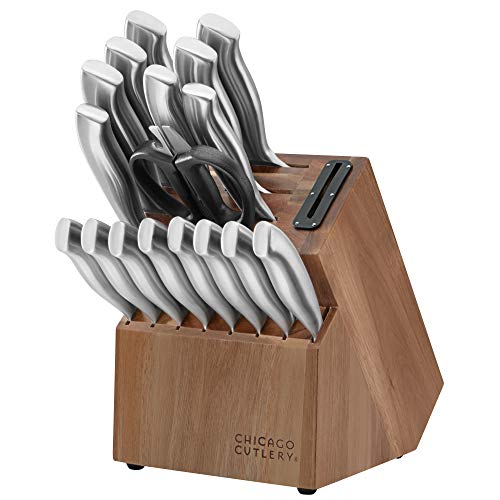
Chicago Cutlery Fusion Knife Set
Chicago Cutlery’s Fusion line is the entry-tier household name in this group: modern handle styling, broad set compositions that often include steak knives and shears, and a low-commitment route into matched cutlery for first kitchens. It suits occasional cooks and starter homes best. Edges at this tier benefit most from frequent honing and gentle treatment — hand-wash individually, dry straight away, and keep blades out of the dishwasher and out of loose drawer storage.
Best for: cooks whose priorities match this set’s character. Not suited for: buyers expecting a different tier of steel, weight or finish than a entry set honestly offers.
How to Get the Most Value If You Buy
Value from a set is extracted through use and care, not at the till. Put the storage where your prep actually happens — within safe reach of the main board, out of children’s reach — and use the whole set deliberately in the first month: reach for the paring knife instead of muscling small jobs with the chef’s knife, use the serrated blade for tomatoes and bread rather than crushing them with a straight edge, and let each piece teach you its job. Cook on a stable board — wood or quality plastic, sized generously — and cut away from your body with a claw grip on the guiding hand; technique protects both you and the edges.
Then run the maintenance rhythm from day one: hone the straight edges lightly and often, wash every knife individually by hand after use, dry immediately, and return it to the block, sheath or strip. Sharpen only when honing stops restoring the bite. Sets reward this rhythm disproportionately, because consistent care keeps every slot performing like the showroom piece, and the set you maintain is the set that makes the purchase look smarter every year. The head-to-head experiences in our knife set reviews round-up show how differently sets age under different care habits.
The Decision Checklist
Answer honestly: Do you cook at home at least four times a week? Do at least four of the set’s core pieces match meals you actually make? Do you have a block footprint, wall for a strip, or organised sheath storage — out of children’s reach — ready for it? Will everyone who uses the set hand-wash, dry and store the knives properly? Is the weakest everyday piece in the set still good enough for daily work? And would you choose this maker’s handle and weight if you were buying just one knife? Five or six yeses: the set is worth it. Three or fewer: buy the trio of individual knives instead and revisit sets when your kitchen or habits change.
Is A Knife Set Worth It for Your Household?
Strip the question down and it becomes arithmetic about attention. A set converts money into readiness: every common cutting task already has its tool, maintained the same way, stored in the same place. Households feel that readiness as a small ease repeated three times a day, and over years that ease is what the purchase actually was. The households that regret sets rarely regret the knives; they regret the mismatch — the composition that did not match their menu, the block that did not match their counter, the care the household never intended to give. Worth, in other words, is decided less by which set than by whether set-ownership itself matches your kitchen’s reality.
Run the reality check concretely. Picture your last ten dinners: how many different blades would have helped, and how many times did you improvise with the wrong one? Picture your counter: where exactly does a block live, out of children’s reach, clear of the hob? Picture your washing up: who does it, and will they honestly hand-wash a chef’s knife at the end of a long day, dry it and put it away, rather than leaving it hidden in a sink of soapy water for the morning? The answers to those three pictures predict your satisfaction more reliably than any brand comparison.
The Five-Year View
Judge the purchase over five years, because that is the honest horizon for a decent set. In year one, everything is keen and the composition feels generous. By year two, the household’s real pattern has declared itself: four pieces do the work, the specialists earn their slots or do not, and the care routine has either become invisible habit or a resented chore. By year five, a maintained set is simply the kitchen’s furniture — edges refreshed by honing, sharpened a handful of times, handles aged gracefully — while a neglected set has become a block of compromises that everyone works around. The five-year view reframes the price entirely: spread across thousands of meals, even a premium set’s daily cost is trivial, provided the meals actually happen and the care actually happens.
That proviso is the whole game. A set’s value compounds with use and maintenance and evaporates without them, which is why the same product collects devoted and disappointed owners in roughly equal numbers. If your five-year picture shows daily cooking and a household that treats tools decently — knives washed individually, dried, stored in their block, sheath or strip, honed as a rhythm — the set is one of the safest buys in the kitchen. If the picture shows sporadic cooking and chaotic washing up, the honest five-year answer is a couple of forgiving individual knives and no block at all.
What Owners Actually Say After the First Year
Long-term owners’ comments cluster into a few themes worth more than any launch-day impression. First, nobody wishes they had bought more pieces; many wish they had bought fewer, better ones, because the dusty slots become a small daily reminder of money parked in the wrong slots. Second, the block’s placement matters more than expected — sets within an arm’s reach of the main board get used fully, while sets exiled across the kitchen quietly lose pieces to the drawer. Third, the serrated knife and the paring knife are the surprise favourites, the pieces owners would replace first if lost.
Fourth, households split cleanly on care: those who built the wash-dry-store habit in the first month report the set feels self-maintaining, while those who did not describe a slow decline they blame on the product. Fifth, safety comments are uniformly about storage discipline — blocks kept out of children’s reach, strips mounted high, no knives ever left soaking invisibly or stored loose — and owners with children rate a set’s storage design as a buying feature in its own right, not an accessory. If those themes sound like your household’s future, the set will likely earn its place; if they sound like someone else’s household, believe them.
Renting, Small Budgets and Other Edge Cases
Renters ask a fair version of the question: is a set worth it when the kitchen is temporary? Usually yes, with a format adjustment — blocks travel well between homes, while wall strips depend on mounting permission, and sheath-based sets travel best of all. A set is one of the few kitchen purchases that moves house with you intact, unlike fitted storage or appliances, so temporary kitchens argue for, not against, a portable block or sheathed set. Students and first-flat cooks sit at the other edge: the entry tier exists precisely for them, and a complete cheap set that teaches real knife habits beats a drawer of inherited bluntness, provided the safety basics — stable board, cuts away from the body, proper storage — come with it.
Households with keen cooks at different levels raise another edge case: will a set satisfy the enthusiast without intimidating the beginner? The mid tiers thread this needle best, offering real performance without the cost anxiety that makes people afraid to use the good knives. And households replacing a worn set should ask the diagnostic question first: did the old set fail, or did the routine fail it? If the routine failed, a new set inherits the same fate, and the money is better spent after the habits — honing steel, dry towels, a storage home out of children’s reach — are in place.
The Opportunity Cost, Honestly Stated
Every set purchase is also a decision not to spend the same money elsewhere in the kitchen, and the comparison deserves one honest paragraph. The strongest rival for the budget is a single excellent chef’s knife plus a great board, a combination that transforms daily prep for the one-knife cook more than any set can. The second rival is the compact set, which captures most of the coverage value while leaving budget for that better board or a proper honing and sharpening setup. The third rival is patience: buying two individual pieces now and adding others as cooking proves the need, which maximises fit at the cost of years of improvisation.
None of these rivals defeats the set for the household the set is designed for — multi-dish, multi-cook, building a kitchen — because coverage and storage are the very things the rivals lack. But naming the opportunity cost protects you from the one genuinely bad outcome: a full-price block bought by a household whose cooking, space or habits belonged to a different purchase all along. Decide which household you are first; the set question answers itself afterwards.
The Wedding-List and Gift Angle
A large share of sets enter homes as gifts and registry choices, and the worth question changes shape there: the giver wants completeness and presentation, the recipient needs fit and composition. A set is worth it as a gift when it is chosen like a purchase — core pieces strong, count modest, storage sensible — rather than like a gesture, where the biggest box wins. Recipients quietly confirm this for years afterwards: the gifted sets still in daily use are the composed ones, while the gesture sets are the ones re-gifted, stored or split into drawer knives within a year.
If you are the recipient deciding whether to keep, exchange or supplement a gifted set, run the same checklist as a buyer: does the chef’s knife fit your hand, does the composition match your cooking, does the block fit your counter out of children’s reach? A gifted set that passes is worth a great deal, having cost you nothing but the care routine. A gifted set that fails on fit is worth exchanging without guilt — a knife you cannot hold comfortably is not a present, it is an obligation with an edge.
How the Answer Changes as Cooking Changes
Worth is not a one-time verdict, because cooking lives change. The household that cooked twice a week and bought a set on optimism often grows into it: a new interest in baking makes the serrated knife essential, a baby makes batch cooking — and the full core four — suddenly load-bearing, a move to a bigger kitchen gives the block its proper home. The reverse also happens: children leave, cooking simplifies, and a large set becomes more system than the household needs, at which point the graceful move is to keep the working core in daily storage and sheath the rest properly rather than letting them rattle loose in a drawer.
This fluidity is actually an argument for the format. Individual knives bought for one life stage can strand when life changes; a set’s breadth absorbs change, because the piece you need next year is already in the block, maintained by the same routine. When you weigh the purchase, weigh it against the household you are becoming, not only the one ordering today.
The Resale and Hand-Me-Down Reality
Good sets have a second life that flimsy kitchen gear does not: they move to student flats, first homes and younger relatives, still working. A maintained set is genuinely hand-me-down worthy — edges restored by sharpening, handles sound, block intact — and that residual usefulness belongs in the worth calculation, especially for the mid and premium tiers. The sets that get handed down share the same biography: hand-washed, dried, stored protected, honed. The sets that get thrown away share the opposite one. Worth, once again, is care compounded over time.
There is a quieter version of the same point inside one household: a set’s main knife can be upgraded individually years later while the rest of the set continues in service, so the original purchase never becomes worthless even when it is outgrown. Few kitchen purchases offer that kind of graceful partial obsolescence, and it softens the risk of buying before you know exactly what kind of cook you will become.
Comparing the Set with a Knife Roll of Individuals
The enthusiast alternative deserves a fair paragraph: a roll or case of individually chosen knives, each selected for a job and a hand. For a single dedicated cook, that collection can outperform any set on pure fit, and its owners are right to love it. But compare the whole picture honestly: the roll asks for a dozen good decisions, costs more in total for equivalent steel, offers no table service, lives in a cupboard rather than at the point of use, and teaches the household’s other cooks nothing consistent. The set is the democratic option — slightly less perfect for the best cook, dramatically better for everyone else and for the kitchen as a shared system.
Households containing both an enthusiast and everyday cooks often land on the hybrid this site recommends elsewhere: the set as the shared system, one or two individual treasures reserved for the enthusiast’s own work, all stored with the same discipline. In that arrangement the set is not the compromise; it is the infrastructure that makes the treasures possible.
Environmental and Waste Considerations
A durable set, maintained for a decade or more, is the low-waste option in a category full of disposable thinking. The wasteful pattern is the cheap set bought carelessly, dulled within two years by dishwasher and drawer, and replaced whole — steel, block and packaging landfilled together, repeatedly. Buying once at a tier your care can honour, then maintaining it with honing, occasional sharpening and proper storage, keeps material in service and money in your pocket. Even end-of-life is gentler: a retired quality knife can be wrapped and recycled as metal rather than mixed waste.
None of this requires premium spending. It requires the match this whole article argues for: composition you will use, storage you will respect, care you will actually perform. A modest set inside that match is worth more — financially, practically, environmentally — than a flagship set outside it.
If You Decide Yes: the First Month Plan
Make the purchase pay from week one with a deliberate first month. Week one: set up the storage in its measured home, wash and dry every piece, and cook something that uses each core knife so your hands learn the set. Week two: practise the wash-dry-store rhythm until it is automatic, and hone the straight edges once, lightly, to learn the motion before you need the result. Week three: invite the household in — show every cook the storage rules, the individual washing, the out-of-reach logic — because a set maintained by one person and abused by two others is a losing bet. Week four: review honestly which pieces you have not touched, and let that inform any future additions rather than buying companions for slots that stay dusty.
Households that run this month almost never ask the worth question again; the set has become how the kitchen works. Households that skip it often ask the question at month six, staring at a block that never quite integrated. The difference was never the product. It was the adoption — and adoption, unlike steel quality, is entirely within your control from the day the box opens.
The Confidence Dividend
One return on a set rarely appears in value calculations: confidence. Cooks with the right, sharp tool for the task attempt more — they break down the whole chicken instead of buying portions, they bake the crusty loaf the serrated knife was made for, they slice the ripe tomato thin instead of wedging it. Skills compound from attempts, and attempts follow equipment that invites them. Owners frequently describe a set purchase as the moment their cooking ‘got serious’, not because the knives were magical but because the friction disappeared and practice became pleasant. A year of that compounding is worth more than the steel.
The dividend runs the other way for households that buy beyond their habits: an intimidating premium set, or a block so large it dominates a small kitchen, can quietly discourage the very cooking it was meant to serve. Which is why this article keeps returning to fit — of composition to menu, storage to space, tier to care. The confidence dividend is paid only on sets that fit, and it is often the largest dividend of all.
When the Answer Flips: Life Events That Change the Verdict
Certain events reliably flip the worth verdict, and recognising them helps timing. A household merger — moving in together, marriage — flips it to yes, because two partial knife collections become one coherent system with storage. A first child flips the safety calculation first and the verdict second: the set remains worth it, but only with its storage repositioned out of reach and its routines tightened. A new passion — bread baking, barbecue, a cuisine with different knife work — flips specific compositions rather than the category: suddenly the serrated slot or the carving pair carries the argument. A downsizing move flips it toward compact and strip formats rather than toward no set at all.
The pattern is that the verdict tracks the household, not the market. Nothing about the sets themselves changes when these events occur; what changes is the cooking, the space and the people. That is the deepest reason this article refuses a universal answer — and why the checklist, answered honestly at the moment of your life you are actually in, is the only reliable instrument.
A Word on Buying Once, Crying Once
The old advice to buy the best you can afford and cry once has a kernel of truth for knife sets, because the category punishes false economy: a set bought below your care and cooking level gets replaced, and two purchases cost more than one right one. But the advice misleads when ‘best’ is read as ‘most expensive’ rather than ‘best matched’. The set worth crying once over is the one whose composition matches your menu, whose handles match your hands, whose storage matches your kitchen and whose tier matches your maintenance honesty. Bought on those terms, even a mid-tier set delivers the buy-once outcome; bought on price alone, even a flagship can become the first of two purchases.
Practically: if the budget forces a choice between a larger composition at a lower tier and the core composition at a higher one, choose the core at the higher tier, every time. You can add a specialty piece later; you cannot retrofit quality into the four knives you use every day.
The Trial You Can Run Before Buying
If the verdict is still balanced on a knife edge, run a two-week trial with what you already own. Cook as usual, but log two things: every moment you wished for a blade you do not have, and every moment your current tools frustrated you. Also log the care reality — how the washing up actually went, night after night. At the end of the fortnight the log answers the article’s question with your own data. Frequent missing-blade moments plus a care routine that already treats your current knives decently means a set will be used and kept; few gaps plus chaotic washing up means the honest purchase is one better individual knife and a sheath, with the set question postponed to a household that is ready for it.
The Fridge-Door Tally: Testing the Case Before You Buy
Borrow, rent, or simulate before you commit if you possibly can, and run the knife set through your real week rather than an imagined improved version of it. Keep a plain tally of uses for a month, on paper on the fridge if necessary, because the honest count of actual uses is the number every value judgement secretly depends on. Note what each use replaced: a purchase, a chore done by hand, another appliance’s time, or nothing at all because the job would simply not have happened. Record the minutes the knife set saves or costs across a whole session, including setup and cleaning, since value lives in the full cycle and not in the headline moment.
Write down the uses that felt like genuine pleasure rather than mere efficiency, because enjoyment is a legitimate return and pretending otherwise distorts the arithmetic. Ask who else in the household benefits and who merely tolerates the storage, the noise, or the counter space, and count those votes without weighting your own twice. Where a shortlist names specific examples, such as Wüsthof Classic Knife Set, run these same checks against that listing line by line rather than assuming the general verdict transfers unchanged. Apply the identical test to Henckels International Classic Knife Set as well, on the same day and under the same conditions, because a fair comparison needs one ruler rather than two moods.
- Tally real uses for one full month
- Log what each use actually replaced
- Count full-cycle minutes including cleaning
- Give the space a vote in the decision
- Imagine a breakdown in year two
- Set a decision deadline with a default
If Cuisinart Triple Rivet Knife Set is also in contention, give it the same worksheet and let the three sets of answers sit side by side before anyone reaches for a checkout button. Consider the space as a cost with a rent of its own: a knife set that earns its footprint weekly is a different proposition from one that squats on it monthly. Think about the season ticket question: whether your interest is a durable habit or a project-shaped enthusiasm that will fade when the project ends. Compare against the honest alternative, which is usually doing the job with what you already own, slowly and imperfectly, rather than against doing it not at all.
Imagine the knife set breaking in year two and ask whether you would replace it immediately, eventually, or never, since that imagined answer is the cleanest verdict available before buying. Factor in the learning period without resenting it, but do not let a promise of future ease excuse a present that your tally says is not working. Notice whether you keep finding new jobs for it or keep finding excuses to use it, because the difference between those two patterns is the difference between value and clutter. Give the decision a deadline and a default: if the tally has not persuaded you by that date, the answer is no for now, and no is a complete decision rather than a failure.
Revisit the question if your household, space, or routine changes materially, because worth is a property of a match between product and life, not of the product alone. Write the sentence that would make it worth it, in advance and in numbers you can check, so the verdict comes from evidence you gathered rather than from mood at the checkout. Count the accessories you would genuinely buy alongside it as part of the commitment, since a product that only works with extras is really the bundle, sized as such. Ask whether the same money and space spent on your current setup, on better ingredients, storage, or a repair, would beat the improvement the knife set promises.
Talk to your future self at the spring clean: will this be in the used-weekly group, the stored hopefully group, or the why-do-we-own-this group, and what in the tally supports that guess? Accept that a narrow, wholehearted yes for one weekly job is worth more than a broad, lukewarm yes across ten occasional ones. Close the question by deciding what happens to the tool or appliance it replaces, because keeping both forever is often the hidden cost that tips a fair yes into a no. Whatever the category, photograph your intended spot with the neighbouring items in place, because a picture exposes crowding that measurements alone politely ignore.
Keep every measurement, tally, and note from these checks in one place, ideally with the receipt, so the next decision in this category starts from your evidence rather than from scratch. Involve the household early where the product is shared, since a decision everyone helped measure is a decision nobody relitigates at the first inconvenience. Prefer the option that fits your existing routine with the fewest new habits, because each new habit is a small tax collected every single day. Be wary of solving a storage problem by creating a carrying problem, since distance between storage and use is where good equipment goes to be forgotten.
Frequently Asked Questions
Is a knife set worth it for a beginner?
Usually yes, provided it is a sensibly composed set at an entry or mid tier and the beginner commits to the basic care routine: hand-wash individually, dry immediately, store in the block, sheath or strip, and hone the straight edges regularly. A set gives a new cook the right shape for each task from day one, which teaches good habits faster than improvising with one knife. Beginners should avoid both extremes — huge counts full of filler, and premium forged sets whose cost makes every early mistake feel expensive.
Is it cheaper to buy a set or individual knives?
For equivalent coverage from the same maker and tier, a set almost always works out kinder per piece, because the maker bundles the core shapes and the storage into one package. Individual knives win on value only when you need very few pieces — a chef’s knife, a paring knife and a bread knife can cover many kitchens — or when you want to concentrate the whole budget on one outstanding blade. Compare cost per piece you will genuinely use weekly, not cost per headline piece, which flatters big sets.
How long should a knife set last?
A decent set, maintained properly, serves for many years of daily home cooking; the steel in even mid-tier sets is rarely the limiting factor. What ends sets early is abuse: dishwasher cycles, soaking in the sink, loose drawer storage that chips edges, and never sharpening once honing stops working. Handles and blocks usually show age before blades fail. Treat lifespan as a care outcome — hand-wash, dry, store protected, hone often and sharpen occasionally — and a set becomes one of the longest-lived purchases in the kitchen.
What pieces must a worthwhile set include?
The non-negotiables are a chef’s knife sized to your hands, a paring knife, a serrated bread knife and a utility or petty knife for in-between work; most households also value a set of steak knives and kitchen shears. Everything beyond that should justify itself against your actual cooking — a santoku if you favour that profile, a carving pair if you roast often. A set whose core four are strong is worth more than a set with double the count built on a mediocre chef’s knife, because the core four do nearly all the work.
Can a knife set be worth it in a small kitchen?
Yes, if its storage fits the kitchen honestly. A compact set in a slim block, an in-drawer tray with individual slots, or a small set paired with a wall-mounted magnetic strip can give full coverage without surrendering the counter. What does not work is a large block bought on optimism and then exiled, knives loose, into a drawer. Measure first, choose the storage format that fits, keep it out of children’s reach, and a small kitchen can enjoy the same one-decision convenience as a large one.
When is a knife set definitely not worth it?
When you know the care will not happen — everything will be dishwashed, soaked and drawer-stored — because the set will dull and degrade as a group and the money is better spent on a couple of inexpensive individual knives. Also when your cooking truly uses one blade, when you are pursuing a specific individual-knife tradition, or when there is no safe, out-of-reach storage available in your kitchen right now. In those cases the honest answer is no, and the alternatives section above points to better uses of the same budget.
Related Reading
- knife set buying guide
- how to clean knife set pieces
- knife set pros and cons
- knife set review
- knife set reviews
- best Wusthof knife set options
- best steak knife sets
- best magnetic knife strips
- best knife sets for home kitchens


