Disclosure: As an Amazon Associate, topratedkitchenware.com earns from qualifying purchases. Prices and availability change; check Amazon for the latest.
Where to buy
Check the latest price, availability and delivery on Amazon. Orders are placed on Amazon. We may earn a commission from qualifying purchases.
- Best overall: Sleep On Latex Pure Green Natural Latex Mattress Topper, Soft, 2 Inch, Queen — Check on Amazon
- ViscoSoft Select High Density 3 Inch Memory Foam Mattress Topper, Queen — Check on Amazon
- Sleep Innovations Dual Layer 4 Inch Gel Memory Foam Mattress Topper, Queen — Check on Amazon
- LeWinBedding 3 Inch Goose Feather Mattress Topper, Queen — Check on Amazon
See 2 more Amazon options
- BedStory 3 Inch Copper and Gel Fusion Mattress Topper, Queen — Check on Amazon
- LINENSPA 3 Inch Gel Infused Memory Foam Mattress Topper, Queen — Check on Amazon
Read the full guide ↓
Disclosure: As an Amazon Associate, topratedkitchenware.com earns from qualifying purchases. Links to Amazon on this page are affiliate links; they cost you nothing extra. Listing details such as price and availability change often, so check the current Amazon listing before you buy.
A small bedroom changes the mattress topper maths in ways the standard guides ignore. The topper still has to fix your bed — soften a surface that is sound but too firm, even out pressure at shoulders and hips, buy an aging mattress a more comfortable year or two. But in a small room it also has to fit a vertical budget: every inch of topper is an inch added to the total height of a platform bed under a low ceiling, an inch less headroom when you sit up in bed, an inch more for your fitted sheets to swallow. It has to have somewhere to live if it ever comes off the bed, because a small room has no spare corner for a rolled-up foam slab. And when it first arrives, it has to air out in the very room you sleep in, because there is no guest room to exile it to while it off-gasses.
The good news is that $200 is the budget where the topper category stops being a foam-slab monoculture, and variety is exactly what a small room needs. Under $100, a queen budget buys memory foam or a quilted pad. At $200 the material map genuinely opens: natural latex appears for the first time, high-density foam built to outlast the budget slabs appears next to it, a genuine featherbed becomes affordable, and dual-layer designs — foam below, washable pillow top above — move comfortably into budget. That spread matters here because the small-room trade-offs differ by material. The thinnest serious pick is a 2-inch latex slab. The most storable pick is a featherbed that folds into a closet. The firmest pick turns a bed that doubles as daytime seating into something you can actually sit on. Every pick in this guide is for the queen size in the thickness named; where a listing also sells twin and full sizes — the sizes many small bedrooms actually run — we say so, and you should check the current price on Amazon for the size you select.
One honesty rule before the picks. A topper is a surface fix, not a rescue. It cannot rebuild a sagging mattress core, and nothing in this guide treats back pain or any other condition; where a listing reaches for medical language, we have left that language on the listing. If pain is persistent, or comes with numbness or weakness, that is a conversation for a clinician, not a checkout page. For most small-bedroom readers we would start with the Sleep On Latex Pure Green: it is the only natural latex queen that verifiably sells under $200 on Amazon, it adds the least height of any pick here, and it lives permanently on the bed, which in a small room is a feature — there is nothing to store. Below you will find the quick picks, detailed notes on all six products, a comparison table, a buying checklist written for small rooms, the mistakes shoppers make most in tight spaces, and the questions that come up again and again.
In this guide
Quick Picks
Short on time, or comparing several options at once? Each row below names a buyer type and the product that suits it, with a link to the listing.
| Buyer type | Pick | Why it stands out | Link |
|---|---|---|---|
| Best overall | Sleep On Latex Pure Green Natural Latex Mattress Topper, Soft, 2 Inch, Queen | The only natural latex queen under $200 — and the thinnest pick here, so it adds the least height | Check on Amazon |
| Best memory foam | ViscoSoft Select High Density 3 Inch Memory Foam Mattress Topper, Queen | Density over 3 lb/ft³ with cover and straps — the foam slab built not to pack down or slide | Check on Amazon |
| Best dual layer | Sleep Innovations Dual Layer 4 Inch Gel Memory Foam Mattress Topper, Queen | Foam support plus a washable pillow-top cover — but the tallest stack in this guide | Check on Amazon |
| Best for storage | LeWinBedding 3 Inch Goose Feather Mattress Topper, Queen | A real featherbed that folds away into a closet when the bed has to be a sofa | Check on Amazon |
| Best firm foam | BedStory 3 Inch Copper and Gel Fusion Mattress Topper, Queen | The firm option — the one that keeps a bed usable as daytime seating | Check on Amazon |
| Best value | LINENSPA 3 Inch Gel Infused Memory Foam Mattress Topper, Queen | The benchmark budget slab — the value end of this guide’s budget | Check on Amazon |
How These Picks Were Chosen
Every pick below had to clear the same bar: a queen-size listing on Amazon whose ASIN we could verify from the listing itself, a tracker record or a catalog record for that exact product, and a position inside this guide’s budget that we could confirm from research sources. Where a product failed either half of that test, it is named without a link rather than linked on a guess. The clearest near-miss: the ELEMUSE goose down feather topper sits inside this budget on price, but its queen ASIN could not be confirmed from any record this session, so it stands as the first swap-in, named unlinked, until that ASIN verifies. A genuine wool topper failed on price instead: the established wool names sit above this budget in a queen, so wool is discussed honestly as a material this budget does not reach.
Within the budget, we deliberately spread the six slots across constructions rather than ranking six near-identical foam slabs — one natural latex, one high-density memory foam, one dual-layer foam-and-fiber design, one genuine featherbed, one firm copper-infused foam, and one value slab — and then re-judged each one through the small-bedroom lens: how much height it adds to the bed stack, whether it can be stored if it ever comes off, how it behaves on a bed that doubles as seating, and what its first three days of airing out will be like in a room with no spare space. A note on sizes: small bedrooms run twins and fulls as often as queens, and most of these listings sell those sizes too, but every pick in this guide is the queen in the thickness named. Select your size on the listing and check the current price on Amazon attached to it; do not assume a smaller size sits in the same tier as the queen, or the other way round.
The 6 Best Mattress Toppers for Small Bedrooms Under $200
Sleep On Latex Pure Green Natural Latex Mattress Topper, Soft, 2 Inch, Queen (80 x 60 x 2 Inch)
Who it suits: Small-room sleepers who want a softer surface without memory foam’s slow sink — and whose bed stack cannot afford much extra height.
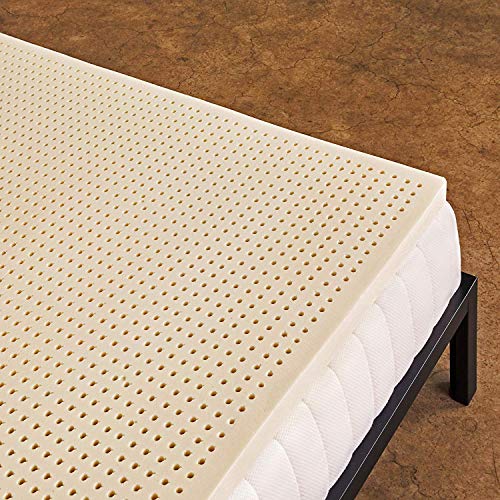
This is the pick that justifies the whole budget, and in a small bedroom it wins on geometry as much as feel. The Pure Green is a 2-inch slab of natural Dunlop latex, GOLS certified organic — check the current price on Amazon for the queen. Two inches is the thinnest serious topper in this guide, which makes it the safest add to a tall platform bed, a loft-adjacent setup, or any bed where sitting up already brings your head close to a shelf, a sloping ceiling or a wall-mounted light. Latex behaves differently from every foam here: it is buoyant rather than enveloping, so you lie on it more than in it, it responds instantly when you change position instead of holding a body-shaped mould, and its open-cell structure breathes in a way gel infusions only imitate. The soft firmness (the maker rates it around 20 ILD) takes the hard edge off a too-firm mattress while keeping the surface lively.
Durability is the second half of the argument, and it has a small-room edge: natural latex is the longest-lived topper material in this category, routinely outlasting memory foam by years, which means fewer bulky replacements to haul up narrow stairs and fewer dead slabs to dispose of from a flat with no storage. Spread over its longer life, that durability is where much of its value lies, compared with a budget slab that packs down in eighteen months to two years. Two cautions belong in the open. This ASIN is the bare topper — no cover — and covered variants sit on separate ASINs, so budget for a protector if you do not already own one. And latex is heavy and floppy at roughly 24 pounds in this size: it lives on the bed permanently rather than rolling into a closet, which most small-room owners will count as a relief, and it is the wrong purchase entirely for anyone with a latex allergy.
- Genuine natural Dunlop latex, GOLS certified organic — the only latex queen under $200.
- Only 2 inches thick: the smallest addition to your total bed height of any pick here.
- Check the current price on Amazon for the queen size.
Honest limitation: It arrives bare, with no cover, and 2 inches of soft latex moderates a firm mattress rather than transforming it — if your bed needs a dramatic change in feel, the 3-inch foams below move the needle further.
Choose it if you dislike memory foam’s sink, sleep warm, have limited headroom above the bed, or want the topper most likely to still feel like itself in five years. Skip it if you have a latex allergy, want deep plush contouring, or need a topper you can fold away between uses.
ViscoSoft Select High Density 3 Inch Memory Foam Mattress Topper, Queen (79 x 59 x 3 Inch)
Who it suits: Memory foam loyalists whose last topper packed down — heavier sleepers, and anyone whose bed doubles as seating and needs a topper that stays put.
If the Pure Green is the anti-memory-foam pick, this is memory foam done properly. The Select High Density is a 3-inch block of gel-infused memory foam with a stated density over 3 pounds per cubic foot — density being the unglamorous spec that decides whether a foam topper still works in year three or has compressed into a shallow trench exactly where your hips land. It ships with a removable rayon cover and non-slip straps, two things the bare slabs in this guide mostly lack, and the straps earn their keep in a small room: a bed that serves as sofa, desk chair overflow and guest bed gets sat on, perched on and slid across, and an unstrapped topper migrates an inch a week under that treatment. Check the current price on Amazon before you count on this pick sitting inside this guide’s budget, because its value argument depends on it staying in tier — this topper’s pricing has historically varied between the maker’s own positioning and the Amazon listing, so confirm where it sits when you order.
The feel is the classic memory foam experience executed at a higher density: a slow, even contour that spreads load across shoulders and hips, with a medium-firm landing rather than the marshmallow sink of cheap plush foam. That density cuts both ways. It supports heavier bodies without bottoming out, and it is the pick here least likely to develop a body impression — but a dense 3-inch block is also a warm, still sleep surface, and light side sleepers may find it firmer than the word “topper” suggests. ViscoSoft backs it with a 5-year warranty per Sleep Foundation’s coverage, the longest foam warranty in this guide alongside the dual layer’s ten.
- Density over 3 lb/ft³ (maker figure) — the durability spec that matters in foam.
- Removable cover and non-slip straps included; 79 x 59 inch queen cut.
- Check the current price on Amazon for the queen; 5-year warranty.
Honest limitation: Dense memory foam sleeps warm and still, whatever the gel infusion promises, and its position in this guide’s budget is worth confirming when you order — check the current price on Amazon, and if it sits above the budget at that point, it has left this guide’s tier.
Choose it if you want memory foam’s contour with the best available insurance against packing down, on a bed that gets sat on as much as slept on. Skip it if you sleep hot, change position constantly, or want a buoyant surface.
Sleep Innovations Dual Layer 4 Inch Gel Memory Foam Mattress Topper, Queen
Who it suits: Sleepers who want foam’s support with a softer, more conventional first touch — and who can spare the headroom, because this is the tallest stack in the guide.
The dual-layer idea is simple and genuinely different: instead of one slab doing everything, this topper stacks 2 inches of gel memory foam for contouring under 2 inches of quilted fiberfill in a removable, washable pillow-top cover. The foam does the pressure work; the pillow top supplies the plush first impression and, not incidentally, the layer you can actually launder — a real consideration in a small room where the bed is also the sofa, the laundry pile’s neighbor and sometimes the dining chair, and where a trip to the laundromat with a washable cover beats spot-cleaning a bare slab. Check the current price on Amazon for the queen — it sits at the more accessible end of this guide’s budget. It is made in the USA and carries a 10-year warranty, the longest in this guide. One variant warning: the newer 3-inch-plus-1-inch model is a different listing; the pick here is the classic 2-inch-plus-2-inch design.
Independent testing adds a useful honesty check: TechRadar’s hands-on review found the pressure relief genuinely good but could not detect a cooling effect from the gel layer itself, crediting the breathable cover for most of the perceived freshness. That is the right way to read every gel claim in this category, this pick included. The small-room cost is height. Four inches of total stack is the most in this guide, and it lands on top of whatever mattress and frame you already have: measure before ordering, check that you can still sit up in bed comfortably, and assume deep-pocket sheets — standard pockets will pop their corners on night one.
- Two constructions in one: 2-inch gel foam base plus 2-inch quilted pillow-top cover.
- The cover removes and washes — the only fully washable sleep surface among the foam picks.
- Check the current price on Amazon; made in USA; 10-year warranty.
Honest limitation: Four inches of total height will defeat standard fitted sheets and can crowd a low ceiling or a tall platform bed, and the gel layer’s cooling is more cover story than mechanism — testers found the comfort real and the cooling mostly in the breathable top.
Choose it if you want foam support with a plush, washable surface, the longest warranty here, and a bed stack with height to spare. Skip it if your ceiling is low, your frame is already tall, or your sheets are shallow.
LeWinBedding 3 Inch Goose Feather Mattress Topper, Queen (60 x 80 x 3 Inch)
Who it suits: Small-room sleepers whose bed has to disappear into daytime mode — a featherbed is the one pick here that genuinely stores away.
Three of this guide’s picks are foam and one is latex; this is the one that is neither, and its small-room virtue is unique: it folds. The LeWinBedding is a genuine featherbed — 3 inches of RDS-certified goose feather in a cotton cover, built in baffle boxes so the fill stays distributed instead of migrating to the corners, held on the bed with anchor bands — check the current price on Amazon for the queen. Off the bed, it folds or rolls loosely into a closet shelf, a storage ottoman or the top of a wardrobe, which makes it the only pick that suits a studio rhythm: loft and softness at night, a clear, sittable bed by day. Read the label the way the maker wrote it: this is feather, not down. Feather is heavier, cheaper and less lofty per ounce than down clusters, and that honesty is exactly why a real featherbed exists inside this budget while a real down topper does not exist at this budget at all.
The feel is the featherbed signature — a soft, yielding loft that takes the bite out of a hard spring mattress without foam’s contour or sink. It adds cushion and essentially no support, it breathes better than any foam here, and it asks for maintenance in return: a daily shake to redistribute fill, and patience with the two honest featherbed taxes. Quills occasionally work through even good cotton ticking — a few owners report a poke-through inside the first month — and a vacuum-packed feather product arrives with a barnyard smell that needs a day or two of airing before first use. In a small room that airing takes planning (see the airing section below); neither tax is a defect, both are the material being itself.
- Genuine goose feather fill, RDS certified, in baffle-box construction with anchor bands.
- Folds away into a closet or ottoman — the only pick that truly stores in a small room.
- Full 60 x 80 inch queen cut; cotton cover; check the current price on Amazon.
Honest limitation: Feather means quills and upkeep — occasional poke-through, daily fluffing, and an airing-out period on arrival — and it cushions without supporting, so it will not firm up a bed that already sags.
Choose it if you want loft and breathability, dislike everything about foam, or need the topper to vanish into storage between uses. Skip it if you have a feather or down sensitivity, want set-and-forget bedding, or need actual pressure contouring.
BedStory 3 Inch Copper and Gel Fusion Mattress Topper, Queen
Who it suits: Firmer-bed fans — back and stomach sleepers, heavier bodies, and anyone whose small-room bed doubles as the sofa and needs a surface that holds an edge.
Most toppers in this guide compete to be softer; this one competes to be firmer, and firmness is a seating feature as much as a sleeping one. A plush topper on a bed that doubles as daytime seating swallows anyone who perches on it; an extra-firm 3-inch slab keeps the bed sittable, keeps its edge under you while you put on shoes, and adds surface tension over a too-soft mattress — the one configuration in this guide that adds firmness instead of removing it, useful for stomach sleepers whose hips sink. BedStory’s queen pairs copper and gel infusions with bamboo charcoal and green tea in a CertiPUR-US certified foam, finished with a 500 GSM knitted cover — check the current price on Amazon for the queen. The copper’s legitimate role is thermal conduction — metal moves heat better than foam alone — and on a firm slab that sleeps noticeably less warm than the plush competition. That is the whole defensible claim, and this review will not pretend otherwise: the listing’s suggestion that copper improves blood circulation is marketing without evidence, quoted here only so you can discount it there.
Two cautions. BedStory sells a thicket of near-identical listings differing by firmness, cover and infusion, so confirm the listing you land on is the 3-inch queen copper/gel fusion with the 500 GSM cover before ordering — the lookalikes are a genuine ordering hazard. And firm is unforgiving: on an already-firm mattress this adds little, and side sleepers will find it does nothing for shoulder pressure.
- The firm option: 3 inches of extra-firm foam for sleepers — and sitters — who dislike sink.
- Copper and gel infusions in a CertiPUR-US foam with a 500 GSM knitted cover.
- Check the current price on Amazon for the queen.
Honest limitation: BedStory’s lookalike listings are a genuine ordering hazard — verify the exact variant — and the maker’s circulation claims for copper are unsupported; buy it for firmness and conduction, not for therapy.
Choose it if your bed is too soft, you sleep on your back or stomach, your bed doubles as seating, or plush foam feels like a trap. Skip it if you are a side sleeper chasing pressure relief, or your mattress is already firm.
LINENSPA 3 Inch Gel Infused Memory Foam Mattress Topper, Queen (59 x 79 x 3 Inch)
Who it suits: The pragmatist — anyone who wants the proven budget slab and would rather spend the other hundred dollars on the storage furniture a small room actually needs.
Every guide in this series needs its control group, and this is it: the same LINENSPA 3-inch gel slab that anchors the under-$100 guide — check the current price on Amazon for the queen — with a long track record accumulated over years on sale. Nothing about it changes at this budget, and that is the point of including it. If your mattress is firm and flat and your complaint is ordinary — hard surface, sore shoulders, a bed that feels like a countertop — this slab fixes it at the value end of the budget, and in a small room the money you do not spend here is not abstract: it can go toward the under-bed boxes, the narrower nightstand, the door-mounted storage that the room was actually short of. The remaining picks in this guide only earn their premium if your needs are more specific than “the bed is too hard.”
Know its limits as clearly as its virtues. It is a bare foam slab with no washable cover, its foam is the ordinary-density kind that reviewers expect to soften over eighteen months to two years of nightly use, it is cut an inch shy of a true queen at 59 by 79 inches — check it against your frame before assuming a flush fit — and crawls of this listing have at times shown no featured offer, so check the current price on Amazon and that a live offer exists before ordering. Bought with those caveats in view, it remains what it has been for years: the benchmark against which every premium claim in this guide has to justify itself.
- The category’s benchmark slab: 3 inches of gel-infused memory foam, CertiPUR-US certified.
- Check the current price on Amazon for the queen — the value end of this guide’s budget.
- A long track record on sale; its failure modes are as documented as its strengths.
Honest limitation: Ordinary-density foam with an ordinary lifespan, no cover included, and a listing whose featured offer has flickered in past crawls — confirm a live offer exists and check the current price on Amazon before ordering.
Choose it if your problem is a plain too-firm mattress and you value proven over premium — or the room needs the leftover budget more than the bed needs a fancier topper. Skip it if you want latex’s bounce, a featherbed’s loft and storability, or a foam built to last.
Comparison Table
| Pick | Material | Thickness | Price | Small-bedroom note | Link |
|---|---|---|---|---|---|
| Sleep On Latex Pure Green, Soft | Natural Dunlop latex | 2 in | Check price on Amazon | Least added height; lives on the bed — nothing to store | Check on Amazon |
| ViscoSoft Select High Density | Gel memory foam, 3+ lb/ft³ | 3 in | Check price on Amazon | Straps stop slide on a bed that doubles as seating | Check on Amazon |
| Sleep Innovations Dual Layer | Gel foam + fiber pillow top | 4 in total | Check price on Amazon | Tallest stack; washable cover; needs deep-pocket sheets | Check on Amazon |
| LeWinBedding Goose Feather | Goose feather, baffle box | 3 in | Check price on Amazon | Folds into a closet or ottoman between uses | Check on Amazon |
| BedStory Copper/Gel Fusion | Copper/gel memory foam, firm | 3 in | Check price on Amazon | Firm surface keeps a daybed-style bed sittable | Check on Amazon |
| LINENSPA Gel Infused | Gel memory foam | 3 in | Check price on Amazon | The value end of the budget — leaves room for storage furniture | Check on Amazon |
How to Choose a Mattress Topper for a Small Bedroom Under $200
Name the problem first. A topper fixes exactly three complaints: a mattress that is sound but too firm, a surface that sleeps warmer than you like, and a bed whose feel you want to change without replacing it. If your mattress sags in the middle, has a broken-down core, or dips where you lie, no pick in this guide fixes that — the topper will follow the dip down. Spend the $200 toward a mattress instead.
Measure the stack, not just the bed. Add frame height, mattress thickness and the topper’s full thickness, then sit on the result mentally: can you still sit up without ducking a shelf or a sloping ceiling, and do your feet still reach the floor comfortably? In a small room the topper’s inches compete with headroom, which is why the 2-inch latex and the 4-inch dual layer are not interchangeable recommendations.
Decide where it lives. If the topper will never leave the bed, latex and dense foam are free to be heavy and permanent. If it has to come off for guests, for a futon-style fold-away, or so the bed can be a sofa, only the featherbed folds without a fight — foam rolls reluctantly and springs back, and latex flops. Choose the material your storage can actually hold.
Choose the material by feel, not by marketing. Latex is buoyant and durable, memory foam is contouring and still, feather is lofty and breathable, and a dual layer splits the difference with a washable face. These are genuinely different sleep surfaces. The single most common regret at this budget is buying a beautifully made topper in a material whose feel you dislike.
In foam, density beats thickness. A dense 3-inch slab outlasts and out-supports a fluffy 4-inch one. When a listing publishes density, anything at or above 3 lb/ft³ is the serious end of the consumer market; when it publishes only thickness and adjectives, assume ordinary foam.
Check the size on the selector, not the headline. Every pick in this guide is the queen in the named thickness. These listings also sell twin and full sizes — the sizes many small bedrooms actually run — and king sizes and thicker variants of several picks sit in higher tiers. Select your size and thickness, check the current price on Amazon, and confirm it sits inside your budget before checkout.
Plan for the cover question. Bare foam and bare latex should not sleep against a sheet alone for years; a washable protector over any topper extends its life and keeps the warranty conversation simple. If washability is the priority, the dual layer’s removable pillow top is the only pick here that builds it in.
Respect the allergy lines. Latex picks are wrong for latex allergies, feather picks are wrong for feather and down sensitivities, and no certification logo changes that. Foam off-gassing, by contrast, is a temporary nuisance — but in a small room it is a concentrated one, so plan the airing window described below before the box arrives.
Total Sleep Height: The Measurement Small Bedrooms Run Out Of
Standard topper advice treats thickness as a comfort dial: 2 inches moderates, 3 inches transforms, 4 inches indulges. Small bedrooms add a second dial the standard guides never mention — total sleep height. Your bed is a stack: the frame, the foundation or slats, the mattress, and now the topper on top of all of it. Every layer is invisible in a product photo and very visible in a room where the bed is the largest piece of furniture and the ceiling is eight feet away, or less in a converted attic, a basement room or a space under a mezzanine.
Run the arithmetic before you order. A platform frame at 12 inches, a 10-inch mattress and the 4-inch dual layer puts the sleep surface at roughly 26 inches, with your head, sitting up, another two and a half feet above that. Under a sloping ceiling, beside a wall-mounted reading light, or beneath a low shelf, that stack can cost you the ability to sit up in bed at all. The same mattress with the 2-inch latex topper lands two inches lower and keeps the room’s geometry intact — a difference that sounds trivial on a spec sheet and decides whether a small room works. Height cuts the other way at the bottom of the stack, too: a tall bed in a small room can leave too little clearance underneath for the storage boxes that were the point of choosing a high frame, and a topper that pushes the surface up does nothing to the space below — but a topper bought instead of a thicker mattress keeps the under-bed volume free, which is often the smarter small-room trade.
The practical rule: measure from the floor to where your head would be, sitting up against the headboard, with each candidate’s thickness added. If the 4-inch option leaves you ducking, the guide’s answer is not to suffer it — it is to take the 2-inch latex or a 3-inch foam and let the room keep its headroom. Comfort you cannot sit up in is not comfort.
Where Does a Topper Live? Storage, Seating and the Bed That Does Two Jobs
In a larger home a topper that is not on the bed goes to a linen closet and is forgotten. A small bedroom has no such mercy, so storage is a genuine selection criterion here — and the six picks split sharply. The featherbed is the only true stowaway: shaken out, folded or loosely rolled, it gives up its air and fits a closet shelf, a storage ottoman or the top of a wardrobe, which is why it suits rooms where the bed converts — a studio that hosts guests on an air mattress some weekends, a spare room that is an office five days a week. Memory foam can be rolled, but it resists, expands against its straps, and claims a cylinder of closet space roughly the size of a water heater’s younger sibling; plan on it living on the bed. Latex does not store at all in any practical sense — 24 pounds of floppy rubber that folds into nothing tidy — and the dual layer, with its quilted cover, is nearly as committed. For most small-room buyers the honest conclusion is that the topper is a permanent resident, and the storage question is really a question about the one pick, the featherbed, that breaks the rule.
The bed’s second job matters just as much. In a small room the bed is also the sofa, the reading chair, the laundry-folding table and the place guests sit. A topper changes that surface. Plush memory foam and feather loft both swallow a seated person — fine for lounging, poor for perching with a laptop or putting on shoes. The firm BedStory holds an edge and a seated posture; the ViscoSoft’s density and straps keep a contouring surface from sliding under daytime use; latex splits the difference, springy enough to sit on without the slow sink. If your bed works a day shift, weigh the reviews above for sitting as well as sleeping — and if it truly has to be a sofa by day and a soft bed by night, the featherbed over a firm base, folded away or shaken up as the hour demands, is the combination this guide would build.
Airing Out a New Topper in a Small Space
Every topper in this guide arrives compressed, and every one needs air before its first night: foam off-gasses for 24 to 72 hours, and the featherbed arrives with a natural barnyard scent that takes a day or two to clear. In a house, you exile the thing to a spare room. In a small bedroom, the topper airs in the same air you breathe, at roughly double the concentration a larger room would give it — noticeable, occasionally headache-adjacent for sensitive sleepers, and worth planning around rather than enduring.
The workable routine is simple. Unbox in the morning, not at bedtime. Lay the topper flat on the bed or across two chairs, open the window, and run whatever fan you own pointed at it or, better, exhausting out of the room; a bathroom exhaust fan with the door open helps more than nothing. If you have access to a balcony, a hallway outside your door, or a bathtub in a ventilated bathroom, the first eight hours spent there are the worst of the smell spent elsewhere. Sensitive to smells, or sleeping in a studio where there is no “elsewhere” in your own home? Time the delivery for a day you will be out, or a weekend away, and let the room air empty. What not to do: seal the topper in its protector and sheets on night one and judge it by that experience, spray it with fragrance to mask off-gassing (you will simply own both smells), or conclude the product is defective because day one smells like a factory — the smell is the packaging, and it fades on the schedule the makers describe. Judge the topper on night three, in a room that has had its window open, and not before.
Common Buying Mistakes
Buying the headline price. Topper listings often headline the twin or the thinnest variant. Every pick in this guide is the queen in the named thickness — reproduce that check on any listing before you compare it against this page, and check the current price on Amazon attached to your own size if you are buying a twin or a full.
Ignoring total bed height. A 4-inch topper on an already tall platform bed can cost you the ability to sit up under a low ceiling or shelf. Measure the whole stack before ordering, not after the return window opens.
Assuming a topper can be stored. Foam rolls reluctantly and latex barely folds. If your plan requires the topper to live in a closet, only the featherbed honors that plan.
Expecting a topper to fix a sag. It will not, at this price or any other. Lay a straight edge across the mattress: if the middle sits visibly lower, the topper will settle into the same valley, and the money belongs toward a mattress or a foundation repair.
Believing infusion claims at face value. Gel, copper, charcoal and green tea are minor comfort tweaks with real but modest effects — conduction and airflow, not refrigeration, and certainly not circulation therapy. Buy the construction; let the infusions be a tiebreaker.
Ordering feather or latex without checking the allergy line. Certifications describe sourcing and cleanliness, not personal tolerance. If feathers or latex have ever bothered you, they will bother you nightly at topper scale.
Forgetting the sheets. A 3- or 4-inch topper raises the sleep surface enough to pop the corners off standard fitted sheets — a more expensive surprise in a small room, where the bedding drawer holds exactly one spare set. Check pocket depth first.
Skipping the airing-out — or judging night one. Foam arrives compressed and smelly, feather arrives compressed and barnyard-scented, and a small room concentrates both. Air for one to three days with a window open before a fair first impression.
Final Recommendation
For most small-bedroom readers, buy the Sleep On Latex Pure Green. It is the only natural latex queen under $200, it adds the least height of any pick here, it breathes without making claims it cannot keep, and it will outlast every foam in this guide — a permanent resident you will not have to replace, store or think about again. If you already know memory foam is your feel and your last slab died young, the ViscoSoft Select High Density puts its value in density, a cover and straps instead — but check the current price on Amazon and confirm it still sits under $200 before ordering. Choose the Sleep Innovations if a washable surface matters most and your bed stack has height to spare, the LeWinBedding if the topper has to fold away into a closet between uses, the BedStory if your bed doubles as seating or every other topper feels too soft, and the LINENSPA if your mattress is simply firm and the room needs the leftover budget more than the bed does. Whichever you choose, confirm the size and thickness on the listing, check the current price on Amazon and that it still sits under $200, measure your total bed height, and give the topper its airing days before you judge it.
Frequently Asked Questions
Is a latex topper worth it over memory foam at this price?
For most sleepers, yes — latex is the more durable material by a wide margin, it responds instantly instead of holding a mould, and it sleeps cooler without relying on gel claims. In a small room it has a second virtue: at 2 inches, the Pure Green adds the least height to your bed stack. Memory foam wins if you specifically love the slow, contouring sink, in which case buy the densest version you can, like the ViscoSoft in this guide. The exception is absolute: a latex allergy rules latex out entirely.
Which of these toppers can I actually store in a small room?
Only the featherbed, honestly. The LeWinBedding folds or loosely rolls into a closet shelf or storage ottoman. Memory foam can be rolled under straps but claims serious closet volume and fights back; latex is heavy, floppy and effectively lives on the bed; the dual layer is the same. If storage is a hard requirement rather than a preference, that requirement chooses the featherbed for you.
Will a mattress topper fix a sagging mattress?
No. A topper changes the surface, not the support, and soft material laid over a dip settles into the dip. If the middle of your bed sits visibly lower than the edges, the money belongs toward a mattress or a foundation repair. If the mattress is level but feels too hard, that is precisely the problem a topper solves — and in a small room, a topper is often the smarter purchase than a thicker replacement mattress, because it adds comfort without adding as much height.
Can I buy a wool or down topper for under $200?
Not verifiably on Amazon in a queen. Established wool toppers sit above this guide’s budget, and true down toppers — mostly down clusters — sit higher still, as does Talalay latex in a queen. What the budget does buy is a genuine featherbed like the LeWinBedding, which is feather rather than down and is labeled as such. One down-and-feather hybrid, the ELEMUSE queen, sits inside this budget on price, but its queen ASIN could not be verified, so it is named here without a link as the first swap-in rather than linked on a guess.
How thick should a topper be in a small bedroom?
As thick as your comfort problem requires and no thicker than your headroom allows. Two inches moderates a mattress that is slightly too firm and suits tall beds and low ceilings; three inches is the transformation most people are picturing; four inches — the dual layer’s total — changes the feel completely and demands both sitting-up clearance and deep-pocket sheets. Measure the full stack — frame, mattress, topper, and you sitting up — before choosing.
Do gel and copper infusions really cool a topper?
Modestly and briefly. Copper conducts heat away from the surface until the slab warms through; gel absorbs a little heat at first contact. Neither refrigerates, and hands-on testing of gel toppers routinely finds the cooling hard to detect beyond the first part of the night — testers of the dual layer credited its breathable cover, not its gel. Latex and feather cool more honestly, by airflow. No passive topper at any price holds a set temperature — that requires an active system well above this guide’s budget. And one claim deserves a direct answer: the suggestion in one listing that copper improves circulation is marketing without evidence, and no pick here is recommended on that basis.
Will a topper help with back pain or night sweats?
A topper is a comfort product, not a treatment, and nothing in this guide is recommended for any condition. A softer or firmer surface may feel better or worse to any individual sleeper, and listings that promise pain relief are making claims this guide does not repeat. Persistent pain, numbness or weakness, or night sweats with no obvious cause, deserve a clinician’s attention rather than a bedding purchase.
How do I air out a new topper when I sleep in the same room?
Unbox in the morning, lay the topper flat, open the window and run a fan; use a balcony, hallway or ventilated bathroom for the first hours if you have one. Foam off-gassing fades over 24 to 72 hours and the featherbed’s barnyard scent over a day or two. If you are smell-sensitive, time delivery for a day you will be out. Judge the topper after that window — first impressions of compressed bedding in a closed small room are unreliable.
Related guides: