Disclosure: As an Amazon Associate, topratedkitchenware.com earns from qualifying purchases. Prices and availability change; check Amazon for the latest.
Where to buy
Check the latest price, availability and delivery on Amazon. Orders are placed on Amazon. We may earn a commission from qualifying purchases.
- Best overall: LINENSPA 3 Inch Gel Infused Memory Foam Mattress Topper, Queen — Check on Amazon
- MLILY EGO 3 Inch Gel Memory Foam Mattress Topper, Queen — Check on Amazon
- Best Price Mattress 3 Inch Ventilated Memory Foam Mattress Topper, Queen — Check on Amazon
- MUXHOMO 3 Inch 7-Zone Egg Crate Memory Foam Mattress Topper, Queen — Check on Amazon
See 2 more Amazon options
- Niagara Sleep Solution Ultra Soft Bamboo Mattress Topper, Queen — Check on Amazon
- Amazon Basics Quilted Plush Mattress Pad, Queen — Check on Amazon
Read the full guide ↓
Disclosure: As an Amazon Associate, topratedkitchenware.com earns from qualifying purchases. Links to Amazon on this page are affiliate links; they cost you nothing extra. Listing details such as price and availability change often, so check the current Amazon listing before you buy.
A small bedroom runs out of floor long before it runs out of wishes. The bed already takes the biggest share of the room, a bigger bed is not coming, and most upgrades — a new frame, a bench, a reading chair — are really requests for square feet you do not have. A mattress topper is the exception, and it is worth understanding why: it is the one meaningful bed upgrade that spends height instead of floor. It adds three inches upward, where a small room usually has a little room to spare, and zero inches outward. If the bed in your small room is structurally fine but too hard on shoulders and hips, a topper fixes the feel of the room’s biggest object without asking the room for anything.
And $100 is the budget where the fix gets real. Below it, you are mostly buying quilted pads with ambitious names. At it, three honest constructions open up in the queen size: a proper 3-inch memory foam slab that changes how a too-firm mattress feels, a zoned egg-crate foam that trades some cushion for airflow and a firmer surface, and washable fiber pads that add softness you can fold away. What $100 does not buy is stated just as plainly in this guide: no natural latex topper, no dual-layer pillow-top foam design, no copper-infused foam and no quality 4-inch slab verifiably sells at or under $100 in a queen on Amazon. Those start higher, and the ceiling section below names them as above-budget options. Pricing is quoted per size, so check the current price on Amazon for the queen size — a twin price wearing a queen headline is the oldest trick in this category.
Two small-room questions run through every review below, because they decide whether a topper suits a tight space at all. The first is storage: when a topper is not on the bed — between guests, say, or while the futon is a sofa — where does it live? A queen foam slab rolls up and claims a real share of the one closet; a pad folds toward drawer size. The second is height: three added inches come straight out of a loft bed’s guardrail margin and can matter under a low ceiling. Neither question has a wrong answer, but both have to be answered before ordering, not after. One boundary, as always: a topper changes the surface of a bed, not its support. It cannot rebuild a sagging core, and nothing in this guide treats back pain, night sweats or any other condition — these are comfort products, and where a maker’s listing reaches for medical language we have left that language on the listing.
In this guide
Quick Picks
Short on time, or comparing several options at once? Each row below names a small-room situation and the product that suits it, with a link to the listing.
| Buyer type | Pick | Why it stands out | Link |
|---|---|---|---|
| Best overall for a small room’s only bed | LINENSPA 3 Inch Gel Infused Memory Foam Mattress Topper, Queen | The benchmark 3-inch slab — maximum comfort, zero added footprint | Check on Amazon |
| Best value foam | MLILY EGO 3 Inch Gel Memory Foam Mattress Topper, Queen | Same 3-inch job at a medium feel, positioned below the hero pick in this tier — check price on Amazon | Check on Amazon |
| Best for the futon or daybed | Best Price Mattress 3 Inch Ventilated Memory Foam Mattress Topper, Queen | A genuine foam slab at the lower end of this budget — the second bed’s rescue | Check on Amazon |
| Best for a warm, close room | MUXHOMO 3 Inch 7-Zone Egg Crate Memory Foam Mattress Topper, Queen | Zoned egg-crate surface that breathes and sits less enveloping | Check on Amazon |
| Best that folds away | Niagara Sleep Solution Ultra Soft Bamboo Mattress Topper, Queen | Washable pillow-top softness that stores between uses | Check on Amazon |
| Best budget layer | Amazon Basics Quilted Plush Mattress Pad, Queen | A thin fitted layer that lives in a drawer | Check on Amazon |
How These Picks Were Chosen
The first filter was the budget, applied to the queen size only. Every product below is a real Amazon listing whose queen size sits within the under $100 budget — check the current price on Amazon, as topper prices are among the most promotion-volatile in bedding and the live listing is the only price that counts on the day. Two famous names failed this filter in an instructive way: the Lucid 3-inch gel queen sits within this budget tier on positioning, and the Zinus 3-inch green tea queen’s ASIN checks out, but neither could be tied to a verified queen ASIN and current US availability within this budget at the same time, so both are named without links in the ceiling section rather than linked on a guess.
The second filter was construction. “Mattress topper” is one search term covering at least three different products — a foam slab, a shaped foam layer, and a fiber-filled pad — and a guide that ranks them as if they were interchangeable helps nobody. So the six picks deliberately span the honest range of the budget: three flat memory foam slabs across this budget, one zoned egg-crate foam, one pillow-top pad and one quilted fitted pad, each judged on the job it actually does.
The third filter is this variant’s own: the small-room test. A pick had to make sense in a room where floor space and storage are the scarce resources. That means footprint neutrality — a topper inherits the mattress’s footprint exactly, so the full-versus-queen decision belongs to the mattress you already own, and no pick here pretends otherwise. It means a storage answer — every pick below is judged on where it lives when it is not on the bed, argued qualitatively, because a rolled slab’s share of a closet is a real cost in a small home even when nobody publishes its rolled dimensions. And it means second-bed duty: in a small home the futon or daybed is the guest room, the office and sometimes the living room, so the cheaper picks are judged on that job too. We did not sleep on these products ourselves. We read the maker listings and specification pages, compared thicknesses, dimensions, foam types, certifications and warranty terms across trackers and roundups, and favored products whose listings publish real numbers over products sold on adjectives. Gel infusions are described as what they are: a comfort feature that can make foam feel cooler at first touch, not a refrigeration system — and one that matters less here than fit, storage and thickness.
The 6 Best Mattress Toppers for Small Bedrooms Under $100
LINENSPA 3 Inch Gel Infused Memory Foam Mattress Topper, Queen (59 x 79 x 3 Inch)
Who it suits: The small room’s one real bed — a sound but too-firm mattress that has to be comfortable every night, because there is no other bed to escape to.
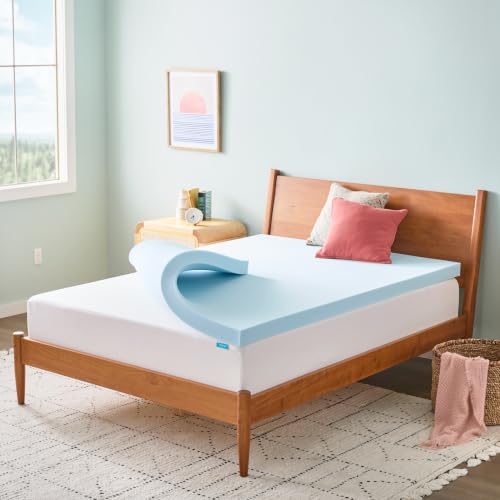
This is the product the rest of the price class is measured against. Three inches of gel-infused memory foam, cut 59 by 79 inches for a queen, CertiPUR-US certified, with a plush feel that softens a hard mattress more decisively than anything else under $100. Check the current price on Amazon for the queen size. It has a long track record, long enough that its failure modes are as well documented as its strengths, which in this tier is a feature in itself. In a small room the case is simple: this is the maximum comfort change available that asks the room for nothing. The footprint after is the footprint before, to the inch.
Two small-room details deserve noting. The 59-by-79 cut sits an inch inside a true 60-by-80 queen on both dimensions; most sleepers never notice, but in a tight room the slightly shy cut is, if anything, marginally easier to dress and tuck. And the storage answer is honest: a slab like this lives on the bed. Rolled, a queen foam slab claims a substantial share of a small room’s only closet, so buy this pick as a permanent layer, not a sometimes one. The foam arrives compressed and needs a day or two to reach full height, it carries the usual new-foam smell for the first days — noticeable in a small, closed room, so air it with the window open — and on a mattress that already dips in the middle, three inches of soft foam will dip with it. No topper at any price fixes that.
- Full 3-inch memory foam slab — the most softening this budget buys, at zero added footprint.
- CertiPUR-US certified foam with a long, heavily reviewed track record.
- Queen size sits near the top of this budget tier — check price on Amazon.
Honest limitation: It is a bare foam slab with no washable cover, and crawls of this listing have at times shown no featured offer even while roundups listed it — confirm a live offer on the listing and check the current price on Amazon before ordering.
Choose it if the bed is permanent, the mattress is firm and flat, and you want the biggest feel change under $100. Skip it if the topper needs to store away between uses, or your mattress sags.
MLILY EGO 3 Inch Gel Memory Foam Mattress Topper, Queen (80 x 60 x 3 Inch)
Who it suits: Small rooms where the bed doubles as seating — and buyers who want the 3-inch job done with room left in the budget for the protector a slab needs.
The EGO is the value engine of this guide: three inches of gel memory foam — MLILY calls its blend AeroFusion — with a ventilated, perforated design, a stated medium feel, and CertiPUR-US certification — check price on Amazon. It is cut a true 80 by 60 inches, a small but real point of honesty next to the hero pick’s shy cut. The medium feel is the small-room argument: a plush slab turns a bed into a nest, which is lovely at night and less lovely when the same bed is the room’s sofa, desk chair and laundry-folding surface by day. The EGO’s middle-ground feel sits flatter and reads less “swallowed” for the bed that does double duty.
Secondary coverage credits this topper with a five-year limited warranty, longer than the three-year terms typical in this tier — though at least one review source has cited three years for the same product, so confirm the term on the live listing if the warranty is part of your decision. Care is spot clean only, and the listing does not promise a washable cover, which is the standard arrangement for foam slabs and the reason the money this pick saves is well spent on a protector. Storage is the same story as the hero: a full queen slab, rolled, is a closet commitment. Expansion runs 24 to 72 hours out of the box; in a small room, plan where a queen-size slab airs out for three days before it arrives — the top of the bed itself is the usual answer.
- Three inches of ventilated gel memory foam in the middle of this budget — check price on Amazon.
- True 80 x 60 inch queen cut and a medium feel that suits a bed that is also seating.
- CertiPUR-US certified; secondary sources credit a five-year warranty.
Honest limitation: No washable cover and spot-clean care only, and the warranty term is reported inconsistently across sources — verify it on the listing rather than taking either figure on faith.
Choose it if you want the benchmark job done for less, prefer medium over plush, and sit on the bed by day. Skip it if a removable, washable cover is a requirement rather than a nice-to-have.
Best Price Mattress 3 Inch Ventilated Memory Foam Mattress Topper, Queen (79 x 59 x 3 Inch)
Who it suits: The small home’s second bed — the futon or daybed that doubles as the guest room — and shoppers who want a genuine foam slab at the lower end of this budget.
Positioned at the lower end of this budget, this is a real topper at the floor of the foam tier: three inches of gel-infused memory foam, perforated across its whole surface for airflow, CertiPUR-US certified, cut 79 by 59 inches — check price on Amazon. A three-year manufacturer’s warranty is stated in the listings. In a small home, the second bed is usually the worst surface in the house — a futon pad worn thin, a daybed mattress bought for looks — and it is also the bed guests judge you by. A slab in this part of the tier is an economical way to make that surface genuinely sleepable, and the perforations help on a futon base that breathes less than slats do.
Size discipline matters here more than anywhere in the guide. Pricing in this guide is for the queen; most futons are full size, and a queen topper on a standard full futon (54 by 75 inches) overhangs by roughly three inches on each side and about five at the foot. Some owners fold the excess under or let it drape; a tidier answer is to check the listing’s other sizes — pricing is quoted per size, so check the current price on Amazon for the size you need. What the lower positioning in the tier costs you is everything around the foam: there is no cover at all, and on a futon that works as a sofa by day, bare foam is a spill and a worn elbow away from looking tired, so a protector or cover is part of the real purchase. This listing has also flickered in past crawls — older reads showed no featured offers available even as deal sites listed it — so check the current price on Amazon before you plan around it.
- Lower-end positioning in this budget for a true 3-inch foam slab — check price on Amazon.
- Full-surface ventilation perforations plus gel infusion.
- CertiPUR-US certified, with a stated three-year warranty.
Honest limitation: Bare foam with no cover included — a real extra cost on a futon or daybed — and the listing’s featured offer has flickered in past crawls, so confirm it is live and check the current price on Amazon before ordering.
Choose it if the futon or second bed is the patient and budget is the whole brief. Skip it if you want a finished, covered product out of the box, or the bed it must fit is a twin daybed rather than the queen size covered here.
MUXHOMO 3 Inch 7-Zone Egg Crate Memory Foam Mattress Topper, Queen
Who it suits: Small, warm rooms with little airflow, and sleepers who find a flat memory foam slab too enveloping — including on a bed that is sat on all day.
Instead of a flat slab, the MUXHOMO’s surface is cut into a seven-zone egg-crate profile — firmer and softer regions mapped roughly to shoulders, waist and legs — in a lavender gel-infused memory foam — check price on Amazon. The peaks-and-valleys surface does two honest things: it lets air move through the valleys instead of trapping it under your body, which matters in a small room that holds the day’s heat, and it gives the topper a springier, less sinking first impression than a flat slab of the same thickness, because your weight lands on the peaks first. That second quality is a small-room virtue: a bed that serves as the room’s seat feels less like sitting in a hole on an egg crate than on plush flat foam.
The trade is depth of cushion. The valleys are thinner than 3 inches by definition, so the maximum pressure relief at a bony hip is less than a full slab delivers, and committed side sleepers with sharp pressure points will feel the difference. The lavender infusion is a scent feature, and a small room concentrates it: what reads as a faint perfume in a large bedroom fills a small, closed one, at least for the first weeks before it fades. Scent-sensitive shoppers in small rooms should treat that as a genuine mark against, not a footnote. Orientation matters too: the zones only map to your body if the topper is laid the way the listing’s diagram shows, and egg-crate toppers work points-up, however tidy points-down looks in the product photos. Like the slabs, it stores rolled or not at all — plan on it living on the bed.
- Seven-zone egg-crate profile for airflow and a less enveloping feel.
- Positioned in the middle of this budget — check price on Amazon.
- Three inches overall, in a lavender gel-infused memory foam.
Honest limitation: The valleys thin the foam where the profile dips, so peak pressure relief is a step below a flat 3-inch slab — and the lavender scent is concentrated by a small room and cannot be switched off on day one.
Choose it if the room runs warm, you sleep on your back or stomach, or flat foam feels like quicksand. Skip it if you are a side sleeper buying specifically for hip and shoulder pressure, or scents bother you.
Niagara Sleep Solution Ultra Soft Bamboo Mattress Topper, Queen
Who it suits: The small room that cannot give a slab a home — a guest bed, futon or daybed that needs softness in rotation, and a topper that folds away when the room goes back to its day job.
This pick is not foam at all, and that is its entire case. The Niagara is a pillow-top pad: a deep-pocket fitted cover with a bamboo-viscose top, filled with down-alternative fiber to roughly a two-inch loft — check price on Amazon — and — the feature no foam slab in this guide can match — machine washable. The feel is the opposite of memory foam’s slow contour: instant, surface-level plushness, the soft first inch of a good hotel bed. For the small room, though, the headline is storage. A pad like this folds down toward drawer or linen-shelf size between uses, which is a category of answer no 3-inch slab can give: the guest bed gets its softness for the weekend, and the room gets its closet back on Monday.
Set expectations by construction. Fiberfill compresses: the loft that feels generous in month one will be noticeably thinner by month six under the hips, and no amount of fluffing fully restores it, which is why pads like this are best understood as a renewable layer with a service life, not a decade-long fixture. It also adds softness without adding support or pressure-mapped cushion — if the problem is a shoulder digging into a hard slab of mattress or a worn futon, two inches of fiber will blunt it, not solve it, and the foam picks above exist for exactly that job. The fitted design also means size discipline cuts the other way from the slabs: a queen pad will not fit a full futon, so match the size to the bed and check that size’s current price on Amazon rather than assuming the queen positioning travels.
- Pillow-top softness with no foam sink, for sleepers who dislike memory foam.
- Machine washable — the only pick here that fully is — and folds away between uses.
- Positioned in the lower part of this budget — check price on Amazon; deep pocket fits thick mattresses.
Honest limitation: Fiberfill flattens with use, fastest under the hips; expect the loft to thin over the first months rather than holding its day-one height.
Choose it if storage and washability matter more than deep pressure relief, or the topper rotates on and off a guest bed. Skip it if your pain point is a shoulder or hip bottoming out on a hard surface.
Amazon Basics Quilted Plush Mattress Pad, Queen
Who it suits: The smallest budgets and the most occasional beds — a futon that hosts twice a year, a daybed that is mostly a sofa — where the topper’s main job is to be a fresh, soft layer that lives in a drawer.
Positioned at the lowest end of this budget, the Amazon Basics quilted pad is the floor of the category, and it is honest about it. It is a fitted, quilted plush pad: a thin layer of padding stitched into squares so it stays distributed, with a stretch skirt that pulls over the mattress like a fitted sheet. What it adds is real but modest — a softer first contact than a bare mattress ticking, a sacrificial layer between sleepers and a mattress you would rather keep clean, and a touch of evenness over minor surface lumps. Its small-room virtue is total: folded, it takes the least storage of anything in this guide, effectively the space of a folded sheet.
What it does not add is equally clear, and this guide will not blur it: a quilted pad is measured in millimeters of comfort, not inches. It will not soften a genuinely hard mattress in any way a side sleeper would notice, it will not rescue a worn futon, and its padding compresses flat in the sleep zone within months. Buy it as bedding maintenance — the layer that takes the wear, the spills and the wash cycles — and it is excellent value. Buy it as a mattress rescue and it will disappoint you. The deep-pocket question matters here too: over a mattress plus another topper, a basic skirt runs out of reach, so measure the full stack before ordering.
- Lowest-end pick in this budget for the queen — check price on Amazon.
- Quilted construction keeps the thin padding evenly distributed.
- Fitted-skirt design installs in a minute, washes like a sheet, and stores like one too.
Honest limitation: The padding is thin by design; it maintains and mildly softens a bed but cannot change how a hard or tired mattress actually feels to sleep on.
Choose it if the bed is occasional, already comfortable, or just needs a fresh layer between guests. Skip it if you are trying to fix a mattress that hurts to sleep on — that money belongs toward the foam picks.
Comparison Table
| Product | Type | Thickness | Small-room read | Link |
|---|---|---|---|---|
| LINENSPA 3 Inch Gel Infused, Queen | Memory foam slab | 3 in | Lives on the bed; maximum comfort for the room’s only bed | Check on Amazon |
| MLILY EGO 3 Inch, Queen | Memory foam slab | 3 in | Medium feel for a bed that is also the room’s seating | Check on Amazon |
| Best Price Mattress 3 Inch Ventilated, Queen | Memory foam slab | 3 in | The futon and second-bed rescue at the lower end of the budget for foam | Check on Amazon |
| MUXHOMO 3 Inch 7-Zone Egg Crate, Queen | Shaped memory foam | 3 in profile | Airflow for a warm room; scent is concentrated by small spaces | Check on Amazon |
| Niagara Sleep Solution Ultra Soft Bamboo, Queen | Pillow-top pad | ~2 in loft | Folds toward drawer size; washable softness in rotation | Check on Amazon |
| Amazon Basics Quilted Plush Pad, Queen | Quilted fitted pad | Thin | Stores like a sheet; maintenance layer for occasional beds | Check on Amazon |
How to Choose a Mattress Topper for a Small Bedroom Under $100
- Start with the mattress you already own. A topper inherits its footprint exactly — a queen topper covers about 33 square feet of floor’s worth of bed, a full about 28 — so the full-versus-queen question was settled when the mattress was bought. Pricing in this guide is for the queen size; confirm the size selector matches your bed and check the current price on Amazon before comparing anything.
- Decide where it lives before you decide what it is. On the bed permanently, or stored between uses? A 3-inch queen slab rolls up and claims a real share of a small closet; a pad folds toward drawer size. If storage is the binding constraint, the pad picks win before comfort is even discussed.
- Pick the construction before the brand. Foam slab for real softening, egg crate for airflow and a firmer surface, fiber pad for washable surface plushness, quilted pad for maintenance. Brand shopping inside the wrong construction fixes nothing.
- Count the height, not just the floor. Three inches of topper raises the sleep surface three inches. Under a loft bed that comes straight out of the guardrail margin, and many loft and bunk frames print a maximum mattress thickness on the label — the topper counts toward the stack. Measure before ordering.
- Give the second bed its own measurement. Futons are usually full size and daybeds usually twin; a queen topper overhangs a standard full futon by roughly three inches a side and five at the foot, and a fitted pad in the wrong size simply will not fit. Measure the platform, not the room’s main bed.
- Measure your sheet depth. Mattress plus 3 inches of topper defeats standard pockets. If your fitted sheets are not deep-pocket, budget for one set that is — or the topper will spend its life escaping.
- Plan for a protector. Most foam slabs are spot-clean only and one pick here is bare foam entirely. A washable protector over the topper is the difference between a topper that lasts years and one that lasts until the first spilled coffee — doubly true on a futon that doubles as a sofa.
- Mind the room’s air. Small rooms hold heat and scent. An egg crate’s valleys genuinely move more air; a lavender-infused foam’s perfume genuinely fills a smaller volume. Weigh both at small-room strength, not showroom strength.
- Respect the expansion window. Compressed foam needs 24 to 72 hours to reach full height and lose its packing smell — in a small room, that usually means it expands on the bed itself. Judge any foam pick on night three, not hour one, and keep the packaging until then.
- Check the current price on Amazon and the featured offer. This is the most promotion-volatile corner of bedding, and individual listings in this guide have flickered in and out of featured-offer status before. The live listing is the only price that counts.
The One Upgrade That Costs No Floor Space
Run the arithmetic of a small bedroom and the bed is the budget. A queen mattress covers 60 by 80 inches — about 33 square feet of floor. In a 10-by-10 room, that is a third of everything, spent before a dresser, a desk or a doorway swing gets a vote. A full mattress, at 54 by 75 inches, covers about 28 square feet: roughly five square feet cheaper, paid for with three inches less width per sleeper — 27 inches each instead of 30. That trade was made, for better or worse, when the mattress was bought. What a topper adds to either bed is three inches of height and not one inch of floor. It is the only purchase in the bedroom that improves the biggest object in the room while leaving the room’s scarcest resource untouched.
That is also why the full-versus-queen question, argued endlessly in small-room forums, does not reopen here. If you are buying the mattress too, the five-square-foot difference is real money in a small room, and the topper budget follows the mattress size. If the mattress already exists — the normal case — the topper simply inherits it, and the only honest advice is size discipline: buy the topper in the size of the bed, check the current price on Amazon for that size, and be suspicious of any listing whose headline price belongs to a smaller size than the one in your cart. The hero pick’s 59-by-79 cut is a useful reminder of how small the real-world variations are: an inch shy on both dimensions, about 32 square feet of coverage, and a difference most sleepers will only ever meet as slightly easier sheet-tucking.
The vertical direction is not free, though — it is just cheaper. Three inches of height raises the bed’s profile in a room where sightlines are short, brings the sleep surface closer to a low ceiling’s warmth, and, on a loft or bunk, spends guardrail margin that exists for safety. The footprint sections of most buying guides ignore height entirely; in a small room, height is the currency you are actually spending, so spend it knowingly: measure the stack, check the frame’s stated maximum mattress thickness if there is one, and let the pads — which spend almost no height at all — win the rooms where even three inches is too much.
Where It Lives When It Is Not on the Bed
Every topper in a small home has two addresses: on the bed, and wherever it goes when it comes off. The second address is the one shoppers forget to assign, and it sorts this guide’s six picks more decisively than any feel description. The foam slabs — all three — store rolled, strapped and bulky. Nobody publishes a rolled dimension for them, and this guide will not invent one; it is enough to know that a rolled queen slab is a closet-scale object, and in a small room the closet is usually already spoken for. A slab bought for occasional use is therefore a slab that will live on the bed anyway, or live in the way. Buy slabs as permanent layers and they are the best value in this guide; buy them as occasional layers and the storage bill arrives immediately.
The pads answer the same question in the opposite direction. The Niagara folds down toward the size of a folded blanket or a drawer of bedding; the Amazon Basics pad folds like the sheet it resembles. Neither asks the room for anything it was not already giving to linen storage. That is why the guest-bed math in a small home so often favors the pads despite their thinner comfort: the guest bed in a small room is a futon or a daybed that must become furniture again on Monday, and a topper that folds into the linen drawer lets the room change back. The foam slab wins the bed it stays on; the pad wins the bed it has to leave.
One care note belongs in any storage discussion. Foam that is rolled for a weekend is fine; foam kept compressed for a season can take a set and lose loft, which is why makers ship toppers compressed but do not recommend storing them that way. In practice: roll a slab to move it or to air a room, store it flat on the bed it serves, and let the pads be the family’s only truly storable toppers. A small room rewards the buyer who plans both addresses before checkout and punishes, with a permanent closet obstruction, the one who plans only the first.
The Second Bed Problem: Futons, Daybeds and Loft Beds
In a large home, the guest room is a room. In a small one, it is a piece of furniture with a second job: the futon in the studio, the daybed in the room that is also an office, the loft bed with a desk underneath. These second beds share two traits — their stock surfaces are usually the thinnest and hardest in the home, and their dimensions are usually not the queen this guide prices. A futon is typically full size, a daybed typically twin. A topper is the standard rescue for both, and the rescue works — three inches of real foam over a worn futon pad is a transformation a guest will notice — but it works honestly only with the size arithmetic on the table: a queen topper draped over a full futon overhangs by roughly three inches a side and five at the foot, which some households fold under, some drape, and some solve by buying the futon’s own size and checking its current price on Amazon.
The fitted picks obey stricter rules. A pad’s skirt either reaches around its own size of mattress or it does not fit at all, so the Niagara and Amazon Basics pads must be bought in the second bed’s actual size, with the current price for that size checked on Amazon — the queen positioning in this guide indicates the tier, not a promise about other sizes. The slabs are more forgiving of a size mismatch but less forgiving of a missing cover: a futon that spends its days as a sofa puts elbows, laptops and coffee on whatever covers it, and the bare-foam pick in this guide needs a protector as a condition of the job, not an accessory.
The loft bed is the second bed’s vertical cousin, and its rule is the simplest in this guide: height is safety equipment there. Guardrails protect a sleeper only while the sleeping surface sits well below the rail’s top, and frames commonly print a maximum mattress thickness for exactly that reason. A 3-inch topper consumes three inches of that margin. Measure from the top of the proposed stack — mattress plus topper — to the top of the rail, compare it with the frame maker’s stated limit, and if the margin fails, the honest picks for a loft are the pads, which add softness measured in millimeters and spend almost none of the margin. No comfort upgrade in this guide is worth trading against a rail doing its job.
What $100 Does Not Buy
A budget guide earns its keep at the ceiling, so here is this one’s, stated plainly. Natural latex — the bouncy, durable, heat-neutral foam that tops most “best topper” lists — starts far above this tier in a queen: the Sleep On Latex Pure Green 2-inch queen sits well above this budget, and Talatex’s queen latex sits in a higher premium tier. Dual-layer designs, a foam base married to a pillow-top layer in one product like the Sleep Innovations dual-layer queen, also sit above this budget. Copper-infused foams, such as ViscoSoft’s, sit in a higher tier in a queen, and the premium passive names — Tempur-Pedic’s TEMPUR-Adapt line and Saatva’s graphite foam — live in a different budget conversation entirely. Even a fourth inch of ordinary quality foam mostly escapes: the 3-inch slabs in this guide, spanning the lower to upper parts of this budget, are the tier’s real shape.
Two near-misses deserve naming because you will meet them in search results. The Lucid 3-inch gel queen sits within this budget tier on positioning, but its queen-specific ASIN could not be verified, so it is named here without a link as the first candidate to swap in if that changes. The Zinus 3-inch green tea queen is the mirror case: the ASIN verifies cleanly, but no current US availability within the under $100 budget could be pinned to it, with marketplace mirrors showing it out of stock. A guide that links first and verifies later would include both; this one would rather tell you they exist and why they are not linked. And one absence to note for the “hypoallergenic” shoppers: no topper at any price in this guide makes a health claim, because a foam or fiber layer is not a medical intervention, whatever a listing’s bullet points imply.
Common Buying Mistakes
- Buying the queen because its price was the headline, for a full futon or a twin daybed it cannot fit — the category’s oldest size trap, and small homes own the beds it catches.
- Buying a foam slab “for guests” with no storage plan, then donating a share of the only closet to a rolled queen slab for the other fifty weekends of the year.
- Adding 3 inches under a loft bed’s guardrail without measuring the remaining margin or checking the frame’s maximum mattress thickness.
- Judging a compressed foam topper in its first hour, before the 24-to-72-hour expansion window has run — in a small room, judging it while it is still airing out on the bed it will serve.
- Skipping the protector on a spot-clean-only or bare foam slab, then discovering what “spot clean” means after a spill — on a futon that is also the sofa, usually in front of guests.
- Forgetting sheet depth: mattress plus topper outgrows standard pockets, and corners pop off all night.
- Stacking two cheap foam slabs to imitate a thick topper, and getting sliding, heat and instability instead — plus double the storage problem on the day they come off.
- Reading a lowest-ever tracker price as a current price; in this category the dip and the going rate can be far apart.
- Expecting a topper to bridge a sagging futon frame or a dipped mattress. Soft foam flows into a dip; it does not bridge it — lay a straight edge across the dip, and if you can slide fingers under it, the money belongs in a mattress fund.
- Believing medical language on a listing. A topper can be comfortable; it does not treat back pain, night sweats or any condition, and persistent pain or numbness is a reason to see a clinician, not to upgrade foam.
Final Recommendation
- Most small rooms: LINENSPA 3 Inch Gel Infused Memory Foam Mattress Topper, Queen.
- Same job, less money, bed-as-seating feel: MLILY EGO 3 Inch Gel Memory Foam Mattress Topper, Queen.
- The futon or second bed on a budget: Best Price Mattress 3 Inch Ventilated, Queen — in the futon’s size; check the current price on Amazon for that size.
- Warm rooms and airflow: MUXHOMO 3 Inch 7-Zone Egg Crate, Queen.
- Must fold away between uses: Niagara Sleep Solution Ultra Soft Bamboo, Queen.
- Occasional beds and maintenance: Amazon Basics Quilted Plush Mattress Pad, Queen.
Our top two are the LINENSPA for the fullest version of what this budget buys and the MLILY EGO for the same job with money left over, because between them they cover the decision most small-room shoppers are actually making: how much of the $100 budget to spend on the foam itself, on the one bed that has to work every night. If the topper has to disappear between uses, that is what the Niagara is for — and if the bed in question is an occasional futon or daybed that needs freshening rather than fixing, take the lower-end Amazon Basics pad without a second thought. Whichever you choose, confirm the size matches the bed it will actually sleep on, check the current price on Amazon and the featured offer on the day, measure the height if a rail or a low ceiling is involved, and give any foam pick three nights before you judge it.
Frequently Asked Questions
Will a topper make my small bedroom feel smaller?
No — not by floor space, which is the dimension small rooms run out of. A topper adds height, not footprint: the bed covers exactly the same square feet the day after as the day before. A taller bed can read slightly larger visually in a tight room, and the sleep surface sits closer to the ceiling’s warm air, but the walkways, door swing and dresser clearance are untouched.
Can I put a queen topper on a full-size futon?
You can, with your eyes open: a queen is about six inches wider and five inches longer than a standard full futon, so expect roughly three inches of overhang per side and five at the foot, to drape or fold under. Foam slabs tolerate this; fitted pads do not — a pad must be bought in the futon’s own size. And pricing in this guide is for the queen size, so check the current price on Amazon for the size you actually need.
Where do I store a foam topper in a small room?
Honestly, on the bed. A rolled queen slab is a closet-scale object, and no folded or rolled dimension in this guide is invented to pretend otherwise. Roll a slab to move it or air the room, store it flat in service, and if the topper genuinely has to disappear between uses, buy one of the pads — they fold toward drawer or linen-shelf size, which is the only storage answer a small room gives for free.
Is a 3-inch topper safe on a loft bed?
Only if the guardrail margin survives it. The rail protects the sleeper only while the sleeping surface sits well below its top, and many loft and bunk frames print a maximum mattress thickness on the label — the topper counts toward that stack. Measure from the top of mattress plus topper to the top of the rail and follow the frame maker’s limit; if the margin fails, use a pad, which spends almost no height.
For a small bedroom, is full or queen the better bed?
The topper cannot change the answer, but the arithmetic is short: a queen gives each of two sleepers about 30 inches of width over roughly 33 square feet of floor; a full gives about 27 inches each over roughly 28 square feet. Couples who fit the full keep five square feet; solo sleepers lose nothing either way. Decide at the mattress purchase — the topper inherits whichever bed you chose.
Will a topper fix a sagging futon or a dipped mattress?
No. A topper replaces the comfort layer, not the support core. On a flat but hard surface it works very well; over a dip it flows into the dip and your hips end up in the same place. Check for sag with a straight edge across the bed before spending anything — futon frames with a broken slat or a bent bar fail the same test.
Which pick suits a bed that is also my sofa or desk?
The medium-feel EGO sits flatter and less enveloping than the plush hero, and the MUXHOMO’s egg-crate peaks push back sooner than either flat slab — both read better as seating. The pads add the least height and the least sink of all, which is why daybeds that work as sofas daily often end up with a pad for guests and nothing the rest of the time.
Will a topper help with back pain or night sweats?
A topper can make a bed more comfortable, and comfort is a legitimate reason to buy one. It is not a treatment for back pain, night sweats, hot flashes or any other condition, whatever a listing implies. If pain persists, wakes you, or comes with numbness, that is a conversation for a clinician — no purchase in this guide substitutes for it.