Disclosure: As an Amazon Associate, topratedkitchenware.com earns from qualifying purchases. Links on this page are affiliate links; they cost you nothing extra. Prices and availability change often, so check the current Amazon listing before you buy.
These stainless steel skillet reviews exist because no single pan in this category is right for every kitchen — so instead of crowning one winner, this page reviews the field the way buyers actually shop it: the reference tri-ply, the five-ply heavyweight, the modern direct-sold pan, the mid-tier staples and the entry-tier surprise, each judged on the same work. Searing, sauteing, saucing, the oven run, the wash-up. A stainless steel skillet is a decades-long commitment, and the differences that matter across that span are construction, balance and how a pan treats its owner on an ordinary Tuesday — not the shine in the product photograph. Read the mini-reviews, match them to your cooking, and buy once.
Stainless Steel Skillet Reviews: Key Takeaways
- Every pan reviewed here is fully clad — the category’s non-negotiable — so the contest is about refinement, not adequacy.
- Best all-round: the reference tri-ply class. Best value: the entry-tier clad pan that cooks far above its position.
- Five-ply buys stability and evenness on poor burners; it does not change what the pan can cook.
- Mid-tier staples win on approachability and lids; premium pans win on balance, finish and the last degree of evenness.
- All pans share the category truths: preheating is the skill, eggs are the weakness, fond is the glory.
In this guide
What a Stainless Steel Skillet Actually Is
A stainless steel skillet is a wide, shallow pan with sloped sides, a flat cooking floor and a long handle, built from stainless steel — usually with an aluminium or copper core bonded inside it. The sloped sides are not decoration: they let you slide a spatula under food, toss vegetables with a flick of the wrist and reduce sauces quickly because more surface is exposed to the air. Unlike a nonstick pan, the cooking surface is bare metal with no coating at all, which is the single fact that explains everything else about how it cooks and how long it lasts. There is nothing to peel, flake or wear through, so the surface you cook on in year ten is the same surface you cooked on in year one. That permanence is the core of the stainless proposition. The pan trades the effortless release of a coating for durability, high-heat tolerance and the ability to build fond — the browned layer of flavour that nonstick surfaces simply cannot create in the same way.
Clad, Disc Base and Single-Ply: The Construction Question
Bare stainless steel on its own is a mediocre conductor, so nearly every good stainless steel skillet is a composite. Fully clad pans bond a core of aluminium (or, in some lines, copper) between stainless layers across the entire body — floor and walls alike — so heat travels evenly everywhere and the walls cook as well as the base. Disc-base pans attach a thick conductive disc only to the bottom; they can sear well, but the thin walls scorch sauces and the junction line can show unevenness at the edges. Single-ply pans, with no core at all, are the budget end of the market: light, cheap and prone to hot spots that burn garlic while the centre of the pan is still warming up. For a skillet you plan to cook in daily, fully clad tri-ply is the sweet spot most buyers should aim for. Five-ply and copper-core variants add evenness and stability at the top of the market, and they are genuinely nicer on bad burners, but tri-ply already delivers the great majority of the performance. What matters most is that the cladding is full-body, not a disc, and that the pan sits perfectly flat on your hob.
The Reviews: Six Skillets, Judged on the Same Work
Each review below follows the same pattern — build and feel, cooking performance, the honest limitation, and a verdict in the form the template demands: who it suits, in a line, and who should walk past it. All six are prose-only presentations; check price on Amazon for the current listing of any that makes your shortlist.
All-Clad D3 Stainless Fry Pan
The All-Clad D3 line is the reference point most other stainless skillets get measured against, and the fry pan shows why. It is a fully clad tri-ply pan, which means the aluminium core runs up the sidewalls as well as across the base, so the walls cook as evenly as the floor and sauces reduce without a scorched ring at the edge. In daily use the D3 feels responsive rather than heavy: it takes heat quickly, sheds it quickly when you pull it off the burner, and gives you the kind of fine control that makes the difference between a deep golden crust and a grey, steamed surface. The long stainless handle stays comparatively comfortable during stovetop work, the rim pours cleanly, and the cooking surface develops fond exactly the way you want for pan sauces. It sits in the premium tier, and it earns that position through construction and longevity rather than decoration. Treated well, this is a buy-it-for-decades pan, the sort of skillet that outlasts several nonstick replacements and still sears like new.
Best for: cooks who want one flagship skillet for daily searing, sauteing and pan sauces. Not suited for: shoppers who want the gentlest possible learning curve on day one. Positioned in the premium tier — check price on Amazon for the current listing before you buy.
Strengths
- Fully clad tri-ply construction heats the walls as evenly as the base
- Responsive feel makes heat adjustments show up fast at the food
- Superb fond development for pan sauces and gravies
Trade-offs
- Premium tier pricing puts it out of impulse-buy territory
- Long handle can feel awkward in a crowded oven or small sink
- Shows water spots and rainbow tinting if you air-dry it carelessly
All-Clad D5 Stainless Fry Pan
The All-Clad D5 fry pan adds two more layers to the classic clad formula, alternating stainless and aluminium for five plies in total. The practical effect is not magic, but it is real: heat spreads a touch more evenly, the pan shrugs off the hot spots of an uneven burner a little better, and the whole body feels planted and stable when you are shaking a pan of vegetables over high heat. That extra structure comes with extra heft, so the D5 rewards cooks who cook with two hands nearby and a side towel ready, and it is slightly slower to shed heat than its three-ply sibling when you overshoot. For searing thick proteins, holding a steady simmer at the edge of a sauce, or working on induction where stability matters, it is a deeply reassuring tool. It lives firmly in the premium tier. If your style is fast, wristy and light, the three-ply sibling may suit you better; if your style is deliberate and heat-heavy, the D5 is the one that feels unshakeable.
Best for: cooks who run hot, busy burners and want maximum evenness and stability. Not suited for: cooks who prefer the lightest, fastest-reacting pan they can find. Positioned in the premium tier — check price on Amazon for the current listing before you buy.
Strengths
- Five-ply build smooths out burner hot spots noticeably
- Feels exceptionally stable during high-heat shaking and tossing
- Excellent for thick proteins that need an even, sustained sear
Trade-offs
- Heavier than tri-ply rivals, which not every wrist will love
- Slightly slower to cool when you overshoot the temperature
- Premium tier cost is the highest in this cluster

Made In Stainless Clad Frying Pan
Made In built its name selling clad cookware directly to home cooks, and its stainless clad frying pan is a multi-ply, fully clad design with a gently curved profile that suits tossing and stirring as much as flat searing. The cooking surface is proper bare stainless, so it browns, builds fond and deglazes exactly as a skillet in this class should, and the pan moves from stovetop to oven without drama. Owners tend to praise the balance: substantial enough to sit flat and sear hard, light enough to manoeuvre one-handed when the other hand holds tongs or a spoon. The handle shape divides opinion less than most, and the rolled rim pours sauces without the dribble down the outside that cheaper pans leave behind. It sits in the premium tier alongside the established clad names, and its appeal is straightforward: modern clad construction, honest materials and a shape that feels at home in a working kitchen rather than on a display shelf.
Best for: cooks who want clad performance with a slightly more modern, rounded feel. Not suited for: shoppers who prefer to handle a pan in a shop before committing. Positioned in the premium tier — check price on Amazon for the current listing before you buy.
Strengths
- Fully clad multi-ply body with even wall and base heating
- Curved profile is friendly for tossing and stirring
- Balanced weight suits one-handed manoeuvring
Trade-offs
- Sold mainly direct, so hands-on testing before buying is harder
- Premium tier positioning matches the big clad brands
- Bare stainless learning curve applies in full
Tramontina Tri-Ply Clad Fry Pan
The Tramontina Tri-Ply Clad fry pan is the pan that proves fully clad construction does not have to live in the premium tier. It bonds an aluminium core between stainless layers across the whole body, so it heats evenly up the walls, responds honestly to burner adjustments and builds fond like a pan several price bands above it. In the kitchen it behaves like a straightforward, well-mannered skillet: preheat it properly, add your oil, and it sears, sautes and deglazes without surprises. The trade-offs are the ones you would expect at this level — the fit and finish is workmanlike rather than jewellery-grade, the pan is a little lighter in the hand, and long-term polish will not match the flagship brands. None of that changes what lands on the plate. For a first stainless skillet, a second pan for a holiday home, or a household that would rather own two good pans than one precious one, it is the sensible entry point into clad cooking, positioned at the entry tier of the category.
Best for: first-time stainless buyers who want real tri-ply construction without premium pricing. Not suited for: cooks who want the heaviest, most overbuilt pan in the class. Positioned in the entry tier of the clad category — check price on Amazon for the current listing before you buy.
Strengths
- Genuine fully clad tri-ply construction at an entry tier position
- Even heating and honest fond development
- Easy choice as a first stainless skillet or a spare pan
Trade-offs
- Finishing details are functional rather than refined
- Feels lighter and less planted than premium rivals
- Cosmetics age faster than the cooking performance does
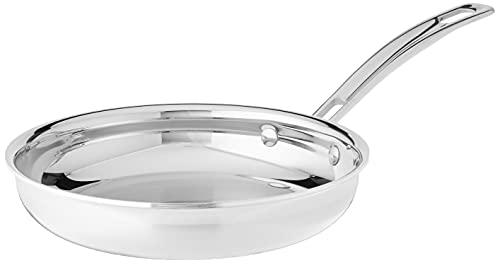
Cuisinart Multiclad Pro Stainless Skillet
Cuisinart’s Multiclad Pro skillet has been a mid tier staple for years, and its formula is familiar: tri-ply clad construction, a brushed exterior, a polished cooking surface and a tapered rim that pours neatly. It heats evenly, sears competently and handles the stovetop-to-oven move that weeknight cooking constantly demands. The cooking surface is smooth and releases proteins cleanly once the preheat is right, and the pan’s slightly lighter build makes it an easy daily driver for cooks who find the premium flagships a bit much in the hand. Where it gives ground is in raw heft and in the last degree of evenness on a weak burner; where it gains is in approachability, availability and a price position that leaves room in the budget for a second pan or a good lid. As a mid tier clad skillet for a household upgrading from thin, single-ply stainless or tired nonstick, it covers the fundamentals honestly and asks very little in return beyond proper preheating.
Best for: value-focused cooks who want clad construction and a polished, classic look. Not suited for: cooks who want the thickest core and the most heavyweight feel. Positioned in the mid tier — check price on Amazon for the current listing before you buy.
Strengths
- Proven tri-ply clad construction in the mid tier
- Tapered rim pours sauces and fats cleanly
- Lighter, approachable feel for everyday cooking
Trade-offs
- Less heft than premium flagships on weak burners
- Polish shows fingerprints and water marks readily
- Core is thinner than the top tier of the class
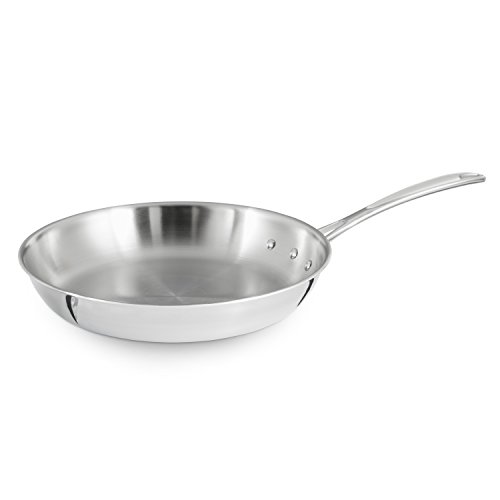
Calphalon Tri-Ply Stainless Steel Fry Pan
Calphalon’s Tri-Ply fry pan takes the same fully clad idea and gives it a slightly more substantial, deliberate character. The aluminium core runs through the body, the cooking surface is bare stainless that browns and deglazes properly, and the long handle is shaped for a secure grip when the pan is loaded and hot. In use it feels calm: it comes up to temperature evenly, holds a sear without drama and tolerates the bumps of a busy family kitchen. It is a mid tier pan that leans toward the sturdy end of mid tier, which makes it a good match for cooks who found lighter clad pans a bit skittish. The honest limitations are weight for smaller wrists and a design language that is more practical than elegant. For households that cook most nights and want one stainless skillet that simply works — eggs on the weekend with the right technique, chicken thighs on Tuesday, a pan sauce on Friday — it is a dependable, fairly positioned choice.
Best for: cooks who like a slightly heavier pan and clear, stay-cool style handles. Not suited for: shoppers chasing the absolute lightest clad option. Positioned in the mid tier — check price on Amazon for the current listing before you buy.
Strengths
- Fully clad tri-ply body with a sturdy, planted feel
- Secure handle shape inspires confidence with a full pan
- Even heating suits nightly family cooking
Trade-offs
- On the heavier side for smaller wrists
- Styling is practical rather than premium
- Mid tier polish needs a little upkeep to stay bright
Performance Themes Across the Whole Field
Searing Proteins Without the Drama
For a proper sear, three things matter: dry food, a properly preheated pan and patience. Pat proteins dry with paper towels — surface moisture is the enemy of browning because it steams instead of searing, and it spits in hot oil besides. Season just before cooking, lay the food away from you so oil splashes away from your hand, and then leave it alone. The meat will grip, sizzle fiercely and gradually quieten; when the crust has formed, a gentle nudge tells you whether it is ready, and a well-seared piece releases almost willingly. Flip once, finish to temperature, and rest the meat on a warm plate while you use the pan — still hot, still full of fond — for a sauce. Thick cuts can start on the stovetop and finish in the oven, which is where the skillet’s oven-safe, all-metal build pays off; remember that the handle comes out of the oven exactly as hot as the pan, so a towel or mitt stays on it from the moment it goes in until long after it comes out. Treat that rule as absolute and stainless will never bite you.
The Honest Truth About Eggs in Stainless
Eggs are the food that scares people away from stainless, and the truth is nuanced: a stainless steel skillet can cook eggs well, but it will never be as forgiving as nonstick, and technique does the heavy lifting. The pan must be preheated properly — the water-bead test is your friend — then taken slightly down in temperature, oiled generously, and only then given the eggs. Fried eggs cooked this way release surprisingly cleanly, especially in butter, which foams and lifts. Scrambled eggs are the hardest case: they prefer lower heat, constant gentle stirring and a willingness to accept a slightly more involved wash-up afterwards. Omelettes sit in between, achievable once you know your pan’s hot spots and your burner’s temperament. The realistic household pattern is a division of labour — stainless for the searing, sauteing and sauces it does better than anything else, and a dedicated egg pan if you eat eggs daily and value a frictionless morning. Plenty of cooks do master eggs in stainless and never look back; plenty of others keep both pans and feel no shame about it. Either is a legitimate kitchen.
Deglazing and Pan Sauces, Step by Step
A pan sauce in a stainless skillet takes four minutes and transforms an ordinary Tuesday dinner. With the protein resting, pour off excess fat if there is a lot of it, keep the pan over medium heat and add a splash of liquid — wine, stock, or water all work — while scraping the base with a wooden spoon or flat spatula. The fond dissolves as the liquid simmers, turning it deep brown and savoury. Add aromatics if you like — a knob of butter with garlic or shallot — let the sauce reduce until it coats the back of a spoon, then finish off the heat with cold butter swirled in for gloss, or a squeeze of lemon and chopped herbs for brightness. Taste, adjust salt, and spoon it over the rested meat. The same routine rescues vegetables: deglaze mushrooms with a little stock and butter and they become a side dish worth serving to guests. Because the pan is bare metal, you can scrape confidently with metal utensils and never worry about damaging a coating, which makes the whole process faster and more relaxed than in a coated pan.
Strengths and Trade-Offs of the Category
Strengths
- Browning and fond no coated pan can match, consistent across every price tier reviewed.
- Decades of service from every pan on this page — there is no coating anywhere to wear out.
- Hob-to-oven freedom and metal-utensil tolerance across the entire field.
Trade-offs
- The preheating learning curve applies to the cheapest and the dearest pan alike.
- Weight climbs with quality; the most refined pans are also the heaviest in the hand.
- Cosmetics need small habits — towel-drying, the occasional vinegar wipe — at every tier.
Choosing the Right Size
Skillets are sold by diameter, and the honest way to choose is by what you cook and how many you feed. A smaller pan in the eight-inch class is a one-person tool: a couple of eggs, a single chicken breast, a small batch of mushrooms that needs room to brown. The ten-inch class is the flexible middle — two chicken thighs, a pair of fish fillets, a generous frittata for two — and it is the size most cooks reach for most often. The twelve-inch class is the family and entertaining size, the one that sears four portions without crowding and finishes big batches of vegetables, but it is heavier, needs a large burner to heat evenly and takes more storage room. Crowding is the enemy of browning in any pan, and it is worse in stainless because steaming food cannot build fond, so if you regularly cook for three or four, the larger pan earns its space. Many households end up happiest with a pair — a mid-size daily driver and a large pan for batch cooking — rather than one compromise size that is always slightly wrong.
The Cost Story: What You Are Really Paying For
Stainless skillets span a wide price range, and it helps to know what the money buys at each level. At the entry level you are paying for honest clad construction — tri-ply that covers the whole body — in a pan with functional rather than refined finishing. In the mid tier you get better polish, better handles, more even cores and lids included more often. In the premium tier you are paying for the last degrees of evenness, five-ply or copper-core construction, superior balance and finishing, and the confidence of lines that have been refined over decades. What you are never paying for, at any level, is a coating that will wear out: the cooking surface is the same bare metal throughout the pan’s life, which is why the cost-per-year maths of stainless is so favourable. A premium pan used for twenty years costs less per year than a budget coated pan replaced every couple of years, and it cooks better in every one of those years. Buy the best clad pan your budget comfortably reaches, because the constraint in stainless is rarely performance — even the entry tier cooks beautifully — it is the pleasure of the details.
Rescuing a Burnt or Stained Pan
Every stainless owner eventually burns something — a sauce forgotten, a marinade that carbonised — and the good news is that the pan almost always comes back. Start with the gentlest method: fill the pan with water and a squirt of washing-up liquid, bring it to a simmer for a few minutes, let it cool, and scrape with a wooden spoon; the burnt layer usually lifts in sheets. For tougher residue, a paste of baking soda and a little water, spread over the stain and left to sit before scrubbing with a non-scratch pad, handles most cases. Simmering water with a splash of vinegar loosens stubborn deposits and also removes the bluish rainbow discoloration that high heat leaves on stainless — that tint is a harmless oxide layer, not damage, and it wipes away with vinegar on a cloth. A powdered stainless-steel cleanser from the supermarket is the heavy artillery for polymerised oil and heavy staining; use it as directed, rinse well, and the surface returns to bright. What you should not do is attack the pan with oven cleaner or steel wool as a first resort: work up the ladder of methods and you will almost never need them.
Which Review Should You Believe — Yours
Reviews, including these, can rank construction and describe behaviour, but the last variable is your kitchen: your burner’s temperament, your household’s portions, your wrists, your mornings. The right way to use this page is to shortlist two pans — one at the tier you planned, one a tier below — and interrogate the difference honestly. If the gap buys evenness your burner does not need and finish your cooking will not notice, take the lower tier and spend the difference on ingredients for a month of practice. If the gap buys balance you will feel three times a day for twenty years, take the higher one without guilt. Either way, buy clad, buy flat, buy the size that matches your burner, and then give the pan its week. The review that matters most is the one your own hob writes.
The Home Scorecard: How to Judge This Stainless steel skillet in Week One
Use this scorecard during the first week, while changing your mind is still easy, and run the same ordinary jobs you bought the stainless steel skillet for rather than showcase tasks chosen to flatter it. Score setup first: how long the box-to-ready journey took, whether the instructions answered the question you actually had, and whether anything needed a tool the box did not mention. Score the core job on a normal weekday portion, with your usual ingredients and timing, and write the result down before you try any advanced mode or accessory. Score consistency by repeating that same job on another day and comparing the two outcomes side by side, since repeatability is the quality that separates a good example from a lucky one.
Score the controls under real conditions, with damp hands, low light, or a timer running elsewhere, because that is the environment the stainless steel skillet will actually be judged in. Score cleaning honestly by timing it once, including the drying and reassembly, and by noting any corner, seam, or crevice that needed a second attempt. Where a shortlist names specific examples, such as All-Clad D3 Stainless Fry Pan, run these same checks against that listing line by line rather than assuming the general verdict transfers unchanged. Apply the identical test to All-Clad D5 Stainless Fry Pan as well, on the same day and under the same conditions, because a fair comparison needs one ruler rather than two moods.
- Time the box-to-ready setup
- Repeat the core job on two separate days
- Time the full clean including drying
- Watch a second user try without coaching
- Deliberately make the common mistake once
- File the scorecard with the receipt
If Made In Stainless Clad Frying Pan is also in contention, give it the same worksheet and let the three sets of answers sit side by side before anyone reaches for a checkout button. Score the storage reality: whether the stainless steel skillet and its parts return to their spot without a rearrangement ritual, and whether anything migrates to a counter because it has no home. Score the noise, heat, steam, or vibration against the room it lives in, at the hour you most often use it, and note whether anyone in the household comments unprompted. Score the small parts: lids, seals, trays, attachments, and fasteners, because in long ownership the small parts are where satisfaction quietly leaks away.
Score the documentation by looking up one real question mid-task and timing how long the answer takes to find, in the booklet or on the maker’s support pages. Score the fit against the measurements you took before ordering, and note any surprise, generous or otherwise, while the details are still fresh enough to help another buyer. Score the second user experience by watching someone else in the household use the stainless steel skillet without coaching, and noting exactly where they hesitate or guess. Score the worst job, not the best: the largest load, the trickiest ingredient, or the latest tired evening, because that score predicts your feelings in month six.
Score the recovery: deliberately make the common mistake, such as overfilling, mis-seating a part, or choosing the wrong setting, and judge how obvious and forgiving the fix is. Add the scores without weighting them, then read the lowest two again, because those are the entries that decide whether this example stays in your house. If a low score surprises you, repeat that single test once before concluding anything, since first attempts often measure the operator rather than the product. Keep the finished scorecard with the receipt and warranty details, so a future claim, resale, or replacement decision starts from evidence rather than from a fading impression.
Frequently Asked Questions
Why does food stick to my stainless steel skillet?
Food sticks when it goes into a pan that is not yet hot enough, or when it is moved before its crust has formed. Preheat the dry pan over medium heat until a flick of water beads and skitters across the surface, then add oil, let it shimmer, and add the food. Proteins grip at first and release on their own once the crust sets, so patience matters as much as temperature. Dry food also sticks less than wet food, so pat proteins dry before they meet the pan.
Can a stainless steel skillet go in the oven?
In most cases yes — the all-metal build is one of the main reasons to own one, and stovetop-to-oven cooking is a core technique for thick cuts and frittatas. Check the guidance for your specific line, since handle designs vary. The critical safety rule: the metal handle comes out of the oven exactly as hot as the pan, so drape a towel over it the moment the pan comes out and keep it there until the pan is washed.
Does a stainless steel skillet work on induction?
Most modern clad stainless skillets do, because they are built with a magnetic exterior layer, but it is worth confirming before you buy. The simple test is a fridge magnet: if it clings firmly to the base of the pan, the induction hob will recognise the pan and heat it. Induction actually suits stainless beautifully, giving fast, precise response that makes preheating easy to judge.
What is the rainbow discoloration on my pan, and is it damage?
The blue and rainbow tint that appears after high-heat cooking is a thin oxide layer on the steel surface. It is harmless, does not affect cooking, and is not damage. It wipes away easily with a cloth dampened with vinegar, or it fades on its own over subsequent uses. Water spots from air-drying are similarly cosmetic and disappear with a quick towel-dry after washing.
What size stainless steel skillet should I buy first?
For most households, the ten-to-twelve-inch class is the right first pan. Ten inches suits one or two people and smaller burners; twelve inches gives four portions room to brown without crowding, which is what makes searing work. If you regularly cook for three or more, choose the larger pan and make sure your biggest burner matches its base. A mid-size daily driver plus a large batch pan is the combination most experienced cooks end up with.
Is stainless better than nonstick?
They are better at different jobs. Stainless sears harder, builds fond for pan sauces, tolerates metal utensils and high oven heat, and lasts for decades because there is no coating to wear out. Nonstick releases delicate foods like eggs and fish with less fat and less technique. Many cooks own both and use stainless as the daily workhorse. If you can only have one and your cooking leans savoury and sauce-driven, stainless is the longer-lived choice.
Related Guides
how to choose a stainless steel skillet
how to clean a stainless steel skillet
is a stainless steel skillet worth it
the head-to-head: nonstick frying pan vs stainless steel skillet
the best stainless steel frying pans we recommend
stainless steel cookware sets for home cooks
tri-ply cookware sets explained
induction-compatible frying pans
A Note on Weight and Wrists
Weight deserves more honesty than spec sheets give it. A clad skillet has real heft, and that heft is functional — it is what keeps the pan planted when you stir vigorously and what smooths the temperature swings of a home burner. But a pan you cannot comfortably lift one-handed when it is full of food and hot oil is a pan you will hesitate to use, and hesitation is a safety issue as much as a comfort one. If you shop in person, mimic the real motion: hold the pan by the handle, tilt it as if pouring, and imagine it a third heavier with food in it. If you shop online, read the weight, then hold a bag of groceries of similar weight by one hand at arm’s length for ten seconds. Smaller cooks and anyone with wrist or grip issues should lean toward the lighter end of the clad range or the mid sizes, and should treat a helper handle as essential on a large pan. The right weight is the heaviest pan you can still move with total confidence.
How Stainless Ages: Patina, Polish and Pride
A stainless skillet does not stay showroom-bright unless you polish it like a showroom piece, and it does not need to. Over months of cooking the exterior picks up faint straw and blue tints near the base, the interior develops a soft satin glow where utensils have passed a thousand times, and the pan begins to look like what it is: a tool that works for a living. None of this affects performance in the slightest — the surface has no coating to lose, so there is no functional cliff coming, ever. Cooks split into two camps about the cosmetics. Some keep a powdered cleanser under the sink and restore a bright finish every few weeks, enjoying the ritual. Others let the pan wear its history and intervene only when residue builds up enough to feel rough under a fingertip. Both are correct. What matters is that the decision is aesthetic, not functional, which is a freedom no coated pan ever offers you: with stainless, neglect costs you shine, never the pan itself.
Cooking for a Crowd in One Pan
A large stainless skillet is a quiet entertaining weapon, because it lets you cook in deliberate batches and hold quality across all of them. The method that works: sear in uncrowded batches, moving finished pieces to a warm oven on a tray, and do not wipe the pan between batches — the fond accumulates, and the final deglaze produces a sauce with the depth of everything that went before it. Resist the urge to speed up by crowding batch two into batch one; the steaming that follows undoes the browning you are batching to protect. While the meat rests, the same pan builds the sauce, wilts the greens or fries the capers and lemon that finish the dish, so one pan produces the protein, the sauce and a side in sequence. This is the style of cooking stainless was made for, and it scales from a family of four to a table of eight without new equipment — just patience, a warm oven and the willingness to let each batch brown properly.
The Two-Minute Rule After Every Meal
If stainless has a maintenance secret, it is embarrassingly small: give the pan two minutes of attention straight after the meal and it will never need a rescue operation. While the pan is still warm — not ripping hot — run it under warm water, wash it with a sponge and a drop of washing-up liquid, dry it with a towel and put it away. Warm residue releases almost eagerly; the same residue left to cool, dry and sit overnight bonds into the kind of film that sends people searching for heavy-duty remedies. The two-minute habit also keeps polymerised oil from accumulating at the edges, which is the slow, invisible build-up that makes an old pan look amber and feel tacky. Cooks who follow the rule describe their pans as effortless; cooks who do not, describe stainless as high-maintenance. It is the same pan in both kitchens. The difference is entirely in the two minutes, which is why experienced owners are so evangelical about such a tiny routine.
Gas, Glass and the Flat-Base Test
Whatever you cook on, the flat-base test is the fastest quality check in the pan aisle. Set the skillet on any flat surface — a counter, a shelf edge, the hob itself — and press opposite sides in turn. A good pan does not rock, spin or tick against the surface; it sits with the stillness of a book on a table. On gas, a flat base keeps the flame’s energy in the metal instead of letting the pan wobble over it. On glass-ceramic and induction, flatness is even more decisive because contact is the heating mechanism: a domed or warped base touches in a ring, heats in a ring and cooks in a ring, and no amount of clad quality compensates. This is also why thermal discipline matters years into ownership — the flat base you bought is the flat base you keep only if you avoid shocking a hot pan with cold water. When you assess any skillet, in a shop or in your own cupboard, start at the bottom. Everything good about the pan is built on that flat circle of metal.
What Restaurant Cooks Know About These Pans
Professional kitchens run on stainless and aluminium for reasons that map neatly onto home cooking. Line cooks need pans that heat fast between orders, survive metal utensils, tolerate being banged on a range, deglaze into a sauce in the same pan, and wash clean without ceremony — which is a precise description of a clad stainless skillet’s strengths. The home lessons worth stealing are behavioural rather than technical. Professionals preheat as a reflex, not a decision. They keep a side towel permanently in hand, which is how the hot-handle accident almost never happens to them. They season boldly and taste at the end, trusting the fond to do quiet work in the background. And they treat the pan as infrastructure, not treasure: it gets used hard, washed fast and put back on the range. A home cook who adopts even two of those habits — automatic preheating and the permanent towel — will find a stainless skillet transforms from the demanding pan in the cupboard to the default pan on the hob within a fortnight.
Storing the Pan Without Wrecking the Finish
Storage sounds too dull to matter until you see what a badly stored pan looks like after a year: a polished exterior cross-hatched with fine scratches from nesting inside other pans, and a rim dinged by a drawer front. The fixes are free. Hang the skillet on a hook or rail if your kitchen allows it — it is the storage method that touches the pan least and keeps it driest. If it must nest, slip a folded tea towel, a felt pan protector or even a paper plate between it and its neighbours. If it lives in a drawer, give it the bottom position so nothing heavy rides on its rim. Avoid storing the pan with its lid clamped on straight from the wash; a trace of trapped moisture can leave a musty smell in the lid’s rim and water spots on the steel. None of this protects any cooking function — stainless shrugs off scratches functionally — it protects the finish you paid for and the flat rim you pour from. Two minutes of thought, once, when you first bring the pan home.
When a Second Pan Makes More Sense Than a Better Pan
There is a point in every skillet search where the honest advice stops being ‘buy a better pan’ and becomes ‘buy a second pan’. One skillet, however good, cannot be in the oven finishing chicken and on the hob frying eggs at the same time, and a single size is always a compromise between the solo breakfast and the family dinner. Households that cook daily usually get more joy from two good pans in complementary sizes than from one flagship — a mid-size clad skillet for everyday work and a large one for batches, or a stainless workhorse paired with one modest nonstick pan kept purely for eggs and delicate fish. The budget maths often surprises people: two entry-to-mid tier clad pans together can cost less than a single top-tier piece, and they cover more cooking. Start with one, cook with it for a season, and let the moments of friction — the crowded pan, the clash of timings — tell you exactly what the second pan should be.
Reading a Pan in the Shop: A Two-Minute Routine
When you are standing in a shop with a skillet in your hand, run this routine and you will learn more than an hour of online research can teach you. First, the base: set it on the flattest surface available and press opposite edges — silence and stillness are what you want. Second, the grip: hold the handle as you would mid-cooking, with your hand slightly damp if you can manage it, and tilt the pan as if pouring a sauce; the pan should not want to roll or dive. Third, the balance: lift it slowly and feel where the weight sits — close to your hand is control, out at the rim is fatigue. Fourth, the rim: run a fingertip around it and imagine pouring; rolled and tapered rims pour in a stream, square rims dribble. Fifth, the interior: look across the cooking surface at a low angle for ripples or dull patches that suggest uneven finishing. Sixth, the handle junction: rivets or welds should be flush and clean inside, because that junction is where residue hides. None of this requires expertise, and it transfers perfectly to judging your own pans at home each year.
Breakfast in Stainless: A Realistic Playbook
Breakfast is where stainless reputations go to die, so it deserves a playbook rather than a promise. For fried eggs: preheat the pan until water beads, drop the heat slightly, add butter and let it foam, then crack the eggs in and leave them alone — the whites set, the edges crisp, and the eggs release when they are ready rather than when you are impatient. For eggs on toast with sauteed mushrooms or tomatoes, cook the vegetables first in the same pan; their residue and the butter that follows make the surface kinder to the eggs that come after. For pancakes and French toast, treat the pan like a griddle: moderate heat, a thin film of fat, and small test pieces to dial the temperature before the batch commits. For bacon, start it in a cold pan — the one exception to the preheat rule, because rendering fat is a different job from searing — and pour off fat as it accumulates. The pattern across all of these is that breakfast in stainless is a set of small, learnable routines, not a talent, and after a few weekends the routines stop feeling like techniques at all.
The Sauce Repertoire This Pan Unlocks
Owning a stainless skillet quietly adds a repertoire of sauces that most home cooks never attempt, because they all begin the same way: with the fond already in the pan. The wine pan sauce is the foundation — deglaze, reduce, swirl in butter. The mustard-cream variation follows chicken beautifully, using the same fond with a spoon of mustard and a splash of cream. A lemon-caper sauce turns the pan toward fish and cutlets, bright and sharp against the browned base. Mushroom pan sauce builds on the fond with the mushrooms’ own liquor for depth nothing from a jar approaches. A simple gravy for chops or sausages uses flour whisked into the pan drippings before stock joins. Each of these takes under five minutes, uses the pan the protein just left, and washes out with the meal’s normal clean-up because the deglaze already loosened everything. This repertoire — not the sear, impressive as it is — is what owners cite years later as the reason the pan never leaves the hob.


