Disclosure: As an Amazon Associate, topratedkitchenware.com earns from qualifying purchases. Prices and availability change; check Amazon for the latest.
Where to buy
Check the latest price, availability and delivery on Amazon. Orders are placed on Amazon. We may earn a commission from qualifying purchases.
- Best overall: Sleepme Chilipad Cube Bed Cooling System, WE (Whole Queen, Dual Zone) — Check on Amazon
- Avocado Eco Organic Latex Mattress Topper, 3 Inch Plush, Queen — Check on Amazon
- BedJet 3 Climate Comfort Sleep System — Check on Amazon
- TEMPUR-Adapt (Supreme) 3 Inch Memory Foam Mattress Topper, Queen — Check on Amazon
See 2 more Amazon options
- Sleep On Latex Pure Green Natural Latex Mattress Topper, Medium, 3 Inch, Queen — Check on Amazon
- Millsave Premium Hotel Quality 5 Inch Queen White Goose Down & Feather Featherbed — Check on Amazon
Read the full guide ↓
Disclosure: As an Amazon Associate, topratedkitchenware.com earns from qualifying purchases. Links to Amazon on this page are affiliate links; they cost you nothing extra. Listing details such as price and availability change often, so check the current Amazon listing before you buy.
A guest room changes what a topper budget is for. The bed is slept on perhaps twenty nights a year, by people who did not choose it, cannot adjust to it over a month of trial, and will judge it — and mention it at breakfast — on night one. Two thousand dollars is the first topper budget that reaches a four-figure product on Amazon, and it reaches exactly one: the whole-bed, dual-zone Sleepme Chilipad Cube WE in queen size — check price on Amazon, where it is listed in stock and fulfilled by Sleepme. In a guest room it is the one configuration that answers the actual situation — two guests, two different internal thermostats, one bed, and a host who cannot poll them in advance. Each side of the bed holds its own set temperature, chosen on a remote, with no app and no subscription.
Everything below the hero is the market our lower tiers already mapped, re-judged for a bed that hosts strangers to it. The passive ceiling is still the Avocado Eco Organic topper in its 3-inch Plush build — check the current price on Amazon — because between $700 and $2,000 there is still no passive topper we could verify on Amazon — the genuine products in that band (Naturepedic’s Overture among them) are sold brand-direct only, and true high-fill-power down starts above even this cap. Every pick below is for the queen size; check the current price on Amazon before you buy, as listing details change often.
In this guide
Quick Picks
Short on time, or comparing several options at once? Each row below names a hosting situation and the product that suits it, with a link to the listing.
| Buyer type | Pick | Why it stands out | Link |
|---|---|---|---|
| Best overall | Sleepme Chilipad Cube Bed Cooling System, WE (Whole Queen, Dual Zone) | Two guests set two temperatures on one bed — check price on Amazon | Check on Amazon |
| Best set-and-forget | Avocado Eco Organic Latex Mattress Topper, 3 Inch Plush, Queen | The passive ceiling — certified Pure Talalay, nothing to brief or maintain — check price on Amazon | Check on Amazon |
| Best for one regular guest | BedJet 3 Climate Comfort Sleep System | Real moving air for one sleeper’s zone — check price on Amazon | Check on Amazon |
| Best hotel contour | TEMPUR-Adapt (Supreme) 3 Inch Memory Foam Mattress Topper, Queen | The deep contour guests recognize from good hotels — check price on Amazon | Check on Amazon |
| Best for the decade | Sleep On Latex Pure Green Natural Latex Mattress Topper, Medium, 3 Inch, Queen | GOLS-certified Dunlop latex — check price on Amazon — put it on the guest bed and forget it for years | Check on Amazon |
| Best closet-stored layer | Millsave Premium Hotel Quality 5 Inch Queen White Goose Down & Feather Featherbed | The classic hotel layer — and the only pick that stores away between visits | Check on Amazon |
How These Picks Were Chosen
Every pick below had to clear the same bar as our lower tiers: a queen-size listing on Amazon whose ASIN we could verify from the listing itself or a catalog record for that exact product. At this budget that bar lets the whole-bed Chilipad through on every count — ASIN verified from Amazon’s own product information (model CP514), and a listing showing it in stock, fulfilled by Sleepme — check the current price on Amazon. It also produced this tier’s hardest editorial decision, stated here rather than buried: the Chilipad Cube ME, the half-queen one-sleeper configuration that was a linked pick of our under-$1,000 guide, is named but not linked here. Its ASIN is verified, but across repeated research sessions its Amazon listing showed “no featured offers available” and no current offer for that exact ASIN could be confirmed. At this budget the whole-bed version verifies outright, so the guide no longer leans on an offer it cannot confirm.
On top of that bar, the guest-room lens added four tests. The unknown-sleeper test: your guests’ weights, sleep positions and temperature preferences are a sample you cannot survey, so a pick earns its place by suiting the widest plausible range on the first night, not by being perfect for one known body. The calendar test: a guest topper works perhaps twenty nights a year and waits the other three hundred and forty-five, so durability is measured in years of readiness, not nights of wear. The turnaround test: whatever the host must do between visits — refill a reservoir, shake out a featherbed, pair an app, nothing at all — is charged as part of the product. And the briefing test: a tired guest at midnight, in an unfamiliar room, will not read a manual or download an app. If a product needs explaining, that explanation is part of what it asks of you.
One pick carries a verification caveat of the other kind. For the Avocado, across repeated research sessions we could not capture a confirmed featured offer on its Amazon listing, exactly as in our under-$700 and under-$1,000 guides, so check the current price on Amazon before you buy. Both caveats appear at full strength in the reviews. One rule runs through every review: comfort claims only. A topper can soften a sound mattress, even out pressure at shoulders and hips, and change how warm the surface feels; an active system can hold a surface temperature its maker specifies. Nothing here treats back pain, night sweats, hot flashes or any other condition, and nothing here is a therapy for your guests either. Persistent pain, numbness or breathing pauses during sleep are a clinician’s territory, not a checkout page’s.
The 6 Best Mattress Toppers for Guest Rooms Under $2000
Sleepme Chilipad Cube Bed Cooling System, WE (Whole Queen, Dual Zone, 60 x 80 Inch)
Who it suits: Hosts whose guest room regularly takes couples — parents, in-laws, two friends sharing the bed — especially any pair whose temperature preferences visibly differ, and who want each guest to set a number rather than negotiate with a blanket.
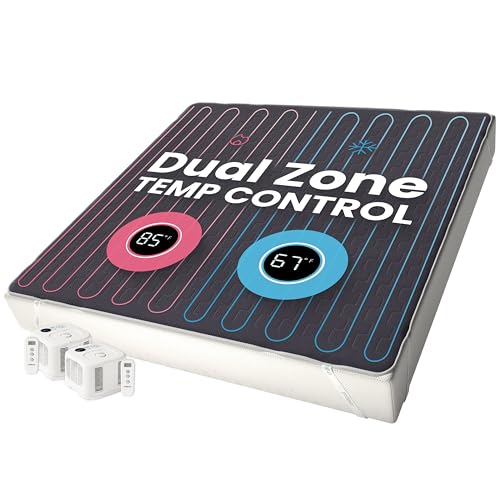
This is the tier’s genuine news, and the only four-figure product in any of our topper guides with a verified Amazon listing. The Chilipad Cube is a water-based system: a bedside cube circulates water through silicone micro-tubes in a pad, holding the surface in the maker’s stated 60 to 115°F range — no app, no subscription, remotes only. The WE configuration is the whole bed: two cubes and two half-queen pads, one independent zone per sleeper. Check the current price on Amazon — the listing shows it in stock, fulfilled by Sleepme.
The guest room is where this configuration stops being a spec sheet and becomes an answer. Two honest qualifications belong beside the headline. First, generation: the Cube is Sleepme’s previous-generation, deliberately simple system — the current Chilipad 2.0, with app scheduling, is sold only from Sleepme’s own site and its two-sleeper queen is over this cap even on sale. For a guest room, the older design is arguably the right one: a remote on each nightstand is the entire interface, there is no account to create and no phone to pair, and a guest who can work a television remote can work this. Second, ownership — and in a guest room the owner is you, between visits. Two cubes means two reservoirs to keep filled with distilled water and clean on the maker’s routine, whether or not anyone is coming; the units need floor space and clearance beside a bed that may sit in your smallest room; the maker itself notes the system is not a replacement for air conditioning; and the listing’s owner reviews include leak and circulation-failure reports alongside long-term fans — read them before spending four figures. If only one side of your guest bed ever needs it, the same line’s ME half-queen configuration is also offered by the maker; its own Amazon listing’s featured offer could not be verified in our research, which is why it is named here rather than linked as a pick.
- Real set-temperature water cooling and heating for two sleepers — the maker’s stated range is 60 to 115°F per zone, set independently.
- Check price on Amazon — listed in stock and fulfilled by Sleepme.
- No app and no subscription; wireless remotes and on-device controls only — the whole briefing is “your side, your remote.”
Honest limitation: It is the previous-generation system — Sleepme’s current Chilipad 2.0 is brand-direct only and its two-sleeper queen is over this cap even on sale — and two cubes mean two reservoirs of distilled-water upkeep that continue between visits, with leak reports among the listing’s owner reviews.
Choose it if your guest bed hosts couples, temperature is the complaint you hear, and you will fold the reservoir check into your sheet-changing routine. Skip it if your guests are almost always solo, you want app scheduling (that is the brand-direct 2.0), or the guest mattress itself is failing — this controls a surface, it does not rebuild one.
Avocado Eco Organic Latex Mattress Topper, 3 Inch Plush, Queen
Who it suits: Hosts who want the guest room finished — the most premium passive topper Amazon carries, put on the bed once, with nothing to brief, refill, pair or explain for the rest of its life.
A larger budget does not move the passive ceiling, and this topper is still it — the hero of our under-$700 guide and the leader of our under-$1,000 guide, here in second place only because the hero’s job changed. The Eco Organic topper in its 3-inch Plush build is the line’s premium queen build — check the current price on Amazon — and the Plush build sits at the top of the range for a real reason: it uses FSC-certified Pure Talalay latex, the vat-process latex that produces the most consistent, buoyant and costly foam in the category, inside a sewn-in certified organic cotton cover that rival brands sell as a separate add-on. One correction matters and we will not soften it: despite the word “organic” in the range’s name, the Plush build’s Talalay is FSC-certified, not GOLS-certified — the GOLS certification belongs to the line’s Dunlop builds. If a GOLS certificate specifically is what you are paying for, the firmer Dunlop version of this same topper, or the Pure Green below, is the honest route.
For a guest room specifically, this pick’s virtues compound. The feel is the crowd-pleasing middle of the category: springy and responsive rather than sinking, a plush surface that still pushes back when a sleeper changes position, and none of memory foam’s warm hug — the surface most likely to suit the widest range of unknown guests on a first night. Latex is also the longest-lived topper material in this guide, and a guest bed is where longevity is measured kindly: at twenty nights a year, a slab that would serve a nightly sleeper for a decade is effectively a lifetime purchase, still waiting, unchanged, between visits. Check the current price on Amazon and confirm the exact thickness and firmness selected before you buy, as a confirmed featured offer could not be captured across repeated research attempts.
- FSC-certified Pure Talalay latex — the premium latex process, verified from the maker’s own specification.
- Sewn-in certified organic cotton cover included; no separate cover purchase needed.
- 3-inch Plush queen — the passive ceiling in this guide, unchanged from the $1,000 tier — check price on Amazon.
Honest limitation: The live Amazon offer for this listing could not be verified in our research, so checking the current price on Amazon is a genuine pre-purchase step, not a formality. The Plush build is also FSC-certified rather than GOLS-certified, whatever the range’s name suggests.
Choose it if you want the best passive topper in the guide, zero guest briefing and zero upkeep, and will check the current price on Amazon first. Skip it if you need a GOLS certificate specifically, your guests are a couple who fight over temperature (that is the hero’s job), or you want an offer you can verify in full before deciding.
BedJet 3 Climate Comfort Sleep System
Who it suits: Hosts whose guest is usually one known person — the parent who visits monthly, the friend who always takes the spare room — and whose complaint is temperature, well below the hero in this tier.
The BedJet takes the opposite engineering route to the same problem. Instead of circulating water, a bedside unit blows temperature-controlled air into a perforated top sheet layer — warming in winter, ventilating in summer, set from the remote or the app. Check the current price on Amazon. The guest-room qualification is structural and decides this pick’s slot: one unit serves one sleeper’s zone properly. On a guest bed that usually holds a couple, that is half a solution — one guest gets climate control and the other gets a story about it. For the solo regular guest, the same fact barely matters, and its position well below the hero leaves room in this budget for a serious passive layer underneath it, which is exactly how the worked plans below use it.
The limitations are structural too, and the maker’s own listing states the sharpest one: the BedJet is not an air conditioner, and it is not recommended for bedrooms over 78°F with no air conditioning, because air-based cooling works with the room it is given in a way a water system set to a number does not. Its effect also depends on the bedding over its sheet, the fan is quiet but not silent (the maker’s figure is 30 to 46 dB(A)) — and the sheet layer adds a step to making the bed between visits, one more layer to strip, wash and re-fit than a plain topper asks of you. The app is optional rather than required, which keeps it on the right side of the briefing test: leave the physical remote on the nightstand and say nothing more complicated than “this one is yours.”
- Real active heating and ventilation, remote and app controlled — not a gel claim.
- Positioned well below the hero in this tier — check price on Amazon.
- Works with any mattress and any topper layered beneath its sheet; no water, no reservoirs, no tubing.
Honest limitation: It changes temperature only — no cushioning, no pressure relief — one unit serves one sleeper’s zone properly, and its cooling is bounded by the room’s own temperature in a way water cooling is not.
Choose it if your guest is usually one person whose temperature you know, and you would rather leave room in the budget for the surface layer too. Skip it if your guest bed mostly holds couples — that is the hero’s whole-bed configuration — or a guest who would need the app explained to them.
TEMPUR-Adapt (Supreme) 3 Inch Memory Foam Mattress Topper, Queen
Who it suits: Hosts chasing the feel guests describe as “like a hotel” — the deep, slow contour of real TEMPUR material over a sound guest mattress, with zero machinery and zero briefing.
The TEMPUR-Adapt Supreme is a 3-inch slab of Tempur-Pedic’s proprietary TEMPUR material in the queen size (80 x 60 x 3 inches; model 11284150, ASIN verified from the listing itself). At this budget its role is worth stating plainly: this is the premium true memory foam we can verify, positioned well below the cap. The step up over basic high-density foams buys refinement of feel and consistency of material, not a different category of performance — a slow, deep contour that spreads load evenly and makes a too-firm guest mattress feel genuinely cushioned rather than merely padded. For unknown sleepers that contour is the safest surface bet in this guide: it asks nothing of the guest, works the same on night one as night ninety, and needs nothing from the host between visits except the ordinary sheet change.
The trade-offs are the material’s own, and the guest room sharpens one of them. TEMPUR material is temperature-sensitive — firmer in a cold room, softer as it warms — and it sleeps warmer than any latex here, because a foam that moulds around a sleeper also insulates them. In your own bed you would pair that fact with your own preferences; in a guest room it means the guest who runs hot gets the warmest surface in this guide with no dial to turn, which is the honest reason this pick sits below the two systems that actually control temperature. It is also a surface fix: 3 inches of plush contour on top of a guest mattress that already sags will follow the sag, not correct it. One terms note carries up unchanged: Tempur-Pedic accepts no returns on this topper through its own channel, so buy where the return window protects you — Amazon’s — and confirm it on the listing.
- Genuine TEMPUR material, 3 inches thick — the category’s reference feel, and the one guests most often recognize.
- Check the current price on Amazon for the queen.
- ASIN and model verified directly from the Amazon listing (11284150, 80 x 60 x 3 in).
Honest limitation: It sleeps warm and still, like all dense memory foam — the wrong surface for a hot-running guest with no temperature control — and check the current price on Amazon before you buy.
Choose it if your guest mattress is sound but firm, your guests are the usual mixed crowd, and you want hotel contour with no machinery at all. Skip it if your guest room runs hot, or the mattress sags — no topper fixes a failed core.
Sleep On Latex Pure Green Natural Latex Mattress Topper, Medium, 3 Inch, Queen
Who it suits: Hosts who want the guest room solved for a decade — certified natural latex at full thickness, the value anchor of this entire tier, and the layer the worked plans build on.
The Pure Green has anchored our guides at every budget it fits, and the 3-inch Medium queen — check the current price on Amazon; listed in stock and fulfilled by the maker — is the yardstick that exposes the ceiling: this is what a mid-tier position in this guide buys, in full, with certifications published. It is a single slab of natural Dunlop latex, GOLS certified organic, from the most transparent maker in the category. The Medium build (model Q3M) is the all-rounder of the line — firmer and more supportive than the line’s Soft build, the right default for unknown guests of unknown weights, including heavier guests who bottom out soft foam — and the feel is buoyant and immediately responsive: a sleeper lies on it more than in it, and the open-cell structure breathes in a way no gel infusion imitates.
Two cautions carry up unchanged, and the guest room raises the first from a footnote to a requirement. This ASIN is the bare topper with no cover, and covered variants sit on separate listings at higher prices. On your own bed that is a preference; on a guest bed, where the layer will meet a rotation of sleepers, a washable protector over it is effectively mandatory — budget for one (the plans below leave room for exactly that) and wash it with the guest sheets. It is the wrong purchase for anyone with a latex allergy, so ask before an allergic relative’s visit. The second caution: 3 inches of Dunlop moderates and cushions a sound mattress; it does not rebuild a sagging one.
- GOLS-certified natural Dunlop latex at full 3-inch thickness for the queen — check price on Amazon.
- Buoyant, responsive, genuinely breathable; no gel or cooling claims needed.
- The longest-lived material in the guide alongside the second pick’s Talalay — at guest-room usage, effectively a lifetime layer.
Honest limitation: It arrives bare, with no cover included — for guest use a washable protector is effectively mandatory — and the Medium firmness is a deliberate middle that will not cradle a strict side-sleeping guest the way memory foam does.
Choose it if you want premium natural materials at a mid-tier price, a base layer under an active system, or a guest bed you never think about again. Skip it if a guest has a latex allergy, you want deep memory-foam contour, or you need a cover in the box.
Millsave Premium Hotel Quality 5 Inch Queen White Goose Down & Feather Featherbed
Who it suits: Hosts chasing the literal hotel layer — a deep, soft, floating featherbed over a firm guest mattress — and the only hosts in this guide whose topper can live in the closet between visits.
Every premium guide needs its reality check, and in this tier the featherbed is it — more so than ever, because $2,000 is the budget at which shoppers most confidently go looking for true luxury down. The Millsave is a 5-inch baffled featherbed for a queen, filled with about 21 pounds of goose feather and down, and its listing title says “down” in the way this category always says it: the listing’s own product description states the fill plainly — 95 percent goose feather, 5 percent goose down. That is not a scandal; it is what a featherbed is, a supportive feather base with a whisper of down softness. But at this budget the full truth deserves its sternest form: genuine high-fill-power down, the 700-fill-power Hungarian goose down of true luxury toppers, is sold direct above even this guide’s cap, and the maker’s 800-fill-power version sits higher still. Nothing within this budget, on Amazon or off it, is that product.
What the Millsave actually delivers is the thing hotels have used for decades: loft, softness and a sense of floating that no foam replicates, over a mattress firm enough to do the supporting — which is precisely the guest-room use. And it has one virtue no other pick in this guide can claim: it leaves. Between visits it rolls or folds into a closet or a storage bag, the guest room goes back to being an office or a nursery, and twenty minutes before guests arrive it shakes out over the bed — feathers want a vigorous shake to redistribute, and that shake, plus the fitted sheet over the top, is the entire setup and the entire briefing. The trade-offs ride along: it will feel warm rather than cool, quills can occasionally work through a cover, the fill will slowly compress over years of use, and on a soft or sagging guest mattress it makes things worse, not better.
- Genuine baffled featherbed construction with about 21 lb of fill — real loft, not a quilted pad.
- The classic hotel layer: softness and float that foams do not imitate, at the accessible end of this tier — check price on Amazon.
- The only pick that stores away — the guest room returns to its day job between visits.
Honest limitation: The fill is about 95 percent feather and 5 percent down despite the title — stated in the listing’s own description — and a featherbed adds softness only: on a soft or sagging mattress it makes things worse, not better.
Choose it if your guest mattress is firm and sound, the room moonlights as something else, and you want hotel-style loft you can put away. Skip it if you want support, your guests sleep hot, or you are actually shopping for a true down topper — that product sits above this budget even before Amazon enters the question.
Comparison Table
Every pick below is the queen size. Check the current price on Amazon before you buy.
| Pick | Construction | Price | Guest-room read | Watch out for |
|---|---|---|---|---|
| Sleepme Chilipad Cube, WE Whole Queen | Active water cooling/heating, two zones, two units | Check price on Amazon | Two guests, two temperatures, remotes only — the couple’s answer | Previous-generation system; two reservoirs of upkeep between visits |
| Avocado Eco Organic, 3 Inch Plush | FSC Pure Talalay latex, organic cotton cover | Check price on Amazon | Put it on once; nothing to brief, refill or maintain, ever | Check the current price on Amazon; FSC, not GOLS |
| BedJet 3 | Active air climate system | Check price on Amazon | One known guest’s temperature, solved well below the hero’s tier | One unit, one zone; no cushioning; bounded by room temperature |
| TEMPUR-Adapt (Supreme) 3 Inch | TEMPUR memory foam | Check price on Amazon | The hotel contour unknown guests adapt to in one night | Sleeps warm; follows a sagging core |
| Sleep On Latex Pure Green, Medium 3 Inch | GOLS natural Dunlop latex | Check price on Amazon | The decade pick — certified surface, zero routine between visits | Bare topper; a washable protector is effectively mandatory for guests |
| Millsave 5 Inch Featherbed | Goose feather/down, baffled, ~21 lb fill | Check price on Amazon | The hotel layer that stores in the closet between visits | ~95% feather, 5% down; softness only |
How to Choose a Mattress Topper for a Guest Room Under $2000
Count your guest-nights before you count anything else. A busy guest room — twenty nights a year, most weekends spoken for — and a quiet one — six nights, two visits — are different products wearing the same keyword. A busy calendar is what makes a premium active system easier to justify; on a quiet calendar the same guests will often sleep just as well on the passive ceiling, with no upkeep and no briefing. The plans section below runs both directions honestly.
Count sleepers per visit, not beds. This tier finally resolves the zone question that defined the $1,000 guide: the whole-bed, two-zone configuration fits the budget on Amazon — check the current price on Amazon. If your guest bed usually holds a couple, one-sleeper configurations — however good — are half a solution. If it usually holds one person, you are buying a second zone you may never switch on, and the one-sleeper options named in the hero’s review do the same job for less.
Decide who does the work between visits. Every pick in this guide charges its host differently. The Cube WE charges a reservoir check folded into the sheet change. The BedJet charges an extra layer in the wash. The featherbed charges a shake and a closet shelf. The latex and memory foam picks charge nothing at all. None of these is disqualifying; all of them are part of the product, and the right answer is the routine you will actually keep in year three, not the one you promise in week one.
Apply the midnight test. Picture your guest at midnight, tired, in a strange room, wanting the bed cooler or warmer. If the answer involves an app download, an account, a pairing code or a manual, the product has failed the test whatever its specifications say. Remotes on nightstands pass. A passive layer passes by asking nothing. This single test is why the previous-generation, app-free hero outranks newer hardware for this particular room.
Check the guest mattress before the topper. Press into the middle of the bare guest mattress where hips sleep. Guest mattresses are often the household’s retired mattress, and if there is a permanent dip, a topper will settle into it and reproduce it — every pick here is a surface layer, and none rebuilds a failed core. An active system laid over a sagging mattress gives your guests a precisely temperature-controlled sag. A sound but imperfect mattress is the ideal candidate; a sagging one needs replacing, and a sound replacement mattress deserves consideration first.
Separate surface from temperature. They are different complaints with different products, and guests experience them on different clocks — the surface in the first minute, the temperature by 3 a.m. Too firm points to the TEMPUR-Adapt or a latex slab. Too warm, for one or both sleepers, points to the Cube WE or the BedJet. Missing the hotel feel points to the featherbed. A topper bought against the wrong problem is money spent at any price, and at $2,000 it is expensive money.
Verify the live price, the offer and the exact configuration. Listings vary by size, thickness and firmness. Confirm that the listing in your cart is the size and build the review describes, and check the current price on Amazon — before you pay, not after it arrives.
What $2,000 Does Not Buy on Amazon: The Passive Band Is Still Empty
Hosts reasonably assume that a $2,000 budget opens a shelf of passive luxury — the guest room being, after all, the one room where luxury is the brief. In this category, on Amazon, it does not. Between $700 and $2,000 there is no passive topper we could verify on Amazon at all. The verifiable Amazon ceiling for a passive queen remains where our under-$700 guide found it: the Avocado Eco Plush, whose live Amazon offer could not be captured across repeated research sessions, with the other verified passive picks positioned below it in the tier.
The genuine $700 to $2,000 passive class exists — it simply does not live on Amazon, and at this budget it finally has a flagship. Naturepedic’s Overture is a 3-inch organic luxury pillow top — organic latex, wool and cotton, the same pillow top the brand sews onto its luxury mattresses — for a queen on Naturepedic’s own site, in the upper part of this band. It is, on paper, exactly the product this keyword imagines, and there is no Amazon listing for it: repeated targeted searching found no verifiable topper ASIN for the Overture, the Adagio latex topper or the Wooly wool topper. The rest of the band is the same story: Saatva’s Organic Quilted, Avocado’s Alpaca wool topper and its plush version, and PlushBeds’ handmade queen range all sit in this upper passive band on their makers’ own sites.
Two more shelves complete the picture. True down sits above the cap entirely: the 700-fill-power Hungarian goose down topper is sold direct above this budget for a queen, and the 800-fill-power version sits higher still — while everything Amazon sells under the word “down” is a featherbed like the Millsave, feather-dominant by its own listing’s admission. And the newest active hardware is not on Amazon either: Sleepme’s Chilipad 2.0 and its clearance Chilipad 1.0, the renamed Dock Pro, are brand-direct only — the 2.0 in whole-bed form sits over this cap — as is Eight Sleep’s Pod 6 for a queen, above this cap before its mandatory Autopilot subscription. The $2,000 tier is real money. On Amazon it buys the whole-bed version of the active market and the top of the passive market, with room to spare — not a passive product positioned anywhere near the cap.
Two Guests, Two Temperatures: Why the Guest Room Is Where Dual-Zone Earns Its Money
In your own bedroom, dual-zone cooling solves a negotiation you can actually hold: you know your partner runs hot, you know you run cold, and you could split the difference with a blanket. The guest room removes every one of those comforts. Your guests arrive as an unknown pair — one may sleep under a sheet in January while the other kicks off a duvet in the same bed. That asymmetry is what the WE configuration is for. Each half of the queen is an independent zone, held at a set temperature from the maker’s stated 60 to 115°F range, all night, rather than a material that feels cool at first contact and repays the loan within the hour. It is the difference between guessing your guests’ preference once, at purchase, and letting each guest state theirs, nightly, in one button press.
The briefing problem deserves its full weight, because it is where guest-room technology usually dies. A system that needs an app asks a guest to download software, create an account and pair a device to your bed — a request no host makes and no guest accepts. The Cube’s previous-generation simplicity, a liability in a gadget buyer’s own bedroom, is the feature here: two wireless remotes, one left on each nightstand, with the temperature in numbers. The host’s whole briefing is a single sentence at the door — “your side has a remote; set it wherever you like” — and the sensible preparation is to set both sides to a mild default before guests arrive, so the first night starts neutral rather than at whatever the last visitor dialed in. Fold the reservoir check into the sheet change you already do between visits and the system asks nothing else of you all year.
The Hotel Feel, Honestly: Surface, Temperature and the Layer in the Closet
A good hotel bed is two products stacked: a plush, forgiving surface that feels luxurious in the first ten seconds, and a room held cool enough that the surface never becomes a burden by morning. This guide’s set maps onto the two halves cleanly. Surface is the TEMPUR-Adapt’s contour, the Avocado’s buoyant plush, or the Millsave’s literal hotel featherbed. Temperature is the Cube WE’s two set numbers or the BedJet’s moving air. If the budget forces a choice, fix the half your room gets wrong — most guest rooms, being the smallest and least ventilated in the house, get temperature wrong.
The second hotel lesson is about absence. A hotel room is a bedroom every hour of its life; yours is a guest room perhaps twenty nights a year and an office, a nursery or a storage room the rest of the time. That is the featherbed’s quiet case: it is the one premium layer in this guide that can leave — rolled into a closet or a bag between visits, shaken out over a firm mattress when the doorbell is about to ring — while every system and slab here lives on the bed permanently, claiming the room year-round. Match the layer to the room’s real calendar, not its name.
Spending $2,000 on a Guest Room: Three Worked Plans
Because no single verified product takes the whole budget, the rational way to shop this tier is often a combination — with the remainder deliberately left unspent rather than absorbed by a worse product. Three plans, built only from the picks in this guide, judged by guest-room calendar rather than by totals:
Plan 1 — Whole-bed climate over real latex. The Chilipad Cube WE — check price on Amazon — for both guests’ temperatures, over the Pure Green Medium 3-inch as the surface layer for the whole bed. This is the plan we would defend first for a couple-hosting guest room: the two things money genuinely buys here — active control for two, premium passive material for both — with room left in the budget for the washable protector the bare latex needs in guest service and the distilled water the cubes will use.
Plan 2 — Whole-bed climate over real contour. The Cube WE again — check price on Amazon — this time over the TEMPUR-Adapt Supreme for the host who knows their guests equate luxury with that deep hotel contour — with the review’s warning carried along: this stacks the warmest surface in the guide under the strongest temperature control, a pairing that works precisely because the system can cancel the foam’s warmth, zone by zone.
Plan 3 — Two rooms instead of one. The BedJet — check price on Amazon — and the TEMPUR-Adapt upgrade the bed you sleep in every night, while the guest room gets the Pure Green as its permanent surface and the Millsave featherbed — check the current price on Amazon — as its hotel layer, stored in the closet between visits. No single product in this guide improves two beds; this plan does, leaves the guest room with zero machinery to brief, and leaves room in the budget toward the mattress fund.
Now the argument against Plan 1, made honestly, because a quiet guest room deserves to hear it. The plans above suit a busy cadence of about twenty guest-nights a year. At six — two visits, the pattern of most spare rooms — the same guests would sleep indistinguishably well on the Avocado passive ceiling, with no reservoirs, no remotes and nothing to explain. The crossover is not a number so much as a trajectory: buy the system if the visits are frequent, the guests are couples, and the pattern is stable or growing; buy the passive ceiling if the room is quiet, the guests are usually solo, or the hosting era of your life is winding down. A guest room’s calendar, not its budget, is the specification that matters.
Common Buying Mistakes
Buying for the guests you wish you had. The costliest mistake at this tier is equipping a six-night-a-year room for a twenty-night calendar — premium climate hardware spread over two visits a year while the room’s actual guests would have praised a good passive layer. Count last year’s guest-nights, not next year’s hopes.
Assuming the budget implies a passive product. Forcing the full $2,000 into one passive purchase — usually a brand-direct topper bought unseen on final-sale terms, a king-size price misread as a queen, or a half-bed price misread as whole-bed. The verified Amazon passive market stops well below the cap; unspent money is a legitimate outcome.
Buying one zone for a two-guest bed. A couple who get one sleeper’s worth of climate control have bought half a solution at full commitment, and the uncontrolled half is the one who will mention it. This tier’s hero exists because the whole-bed configuration finally fits — check whether the configuration in front of you covers one sleeper or two before anything else.
Leaving the manual as the briefing. Any guest-room product whose setup lives in an app, an account or a booklet has outsourced its explanation to your guests. If you cannot brief it in one sentence at the bedroom door, it is the wrong product for this room.
Forgetting the between-visits work. Reservoirs left dry or uncleaned for four months, a featherbed stored damp, a sheet layer unwashed since the last visit — guest equipment fails in the closet, not on the bed. Buy the routine you will actually keep.
Layering luxury over a failed mattress. Premium materials follow a dip exactly as faithfully as cheap ones, and an active system will hold a sagging guest mattress at a very precise temperature. If the core has failed, a new mattress outperforms the finest topper laid over the failure.
Ignoring the trial, return and subscription terms. Several premium names in the ceiling section sell brand-direct with final-sale or restocking terms, and the most famous active system carries a mandatory annual subscription on top of its hardware. At this level, the terms are part of the product; read them before the materials list, not after delivery.
Final Recommendation
If your guest room hosts couples and temperature is the complaint you hear, buy the Chilipad Cube WE — check the current price on Amazon. It is the one purchase this tier makes possible that no lower tier could: both halves of a queen held at two chosen temperatures, all night, by hardware you own outright and a guest can operate from a remote, with room in the budget for the surface layer beneath it. If your guest room is quieter, or you simply want it finished forever, buy the Avocado Eco Organic in its 3-inch Plush build — after you have checked the current price on Amazon. And if neither problem is quite yours, the Pure Green remains the pick we would defend as the best value in the entire tier — check price on Amazon, put it on the guest bed, add the featherbed from the closet when the doorbell rings, keep the rest of the budget unspent, and let the ceiling be the ceiling.
Frequently Asked Questions
Can you really buy a mattress topper for $2,000?
On Amazon, you can buy one four-figure topper product in this tier: the whole-bed Chilipad Cube WE — check the current price on Amazon. You cannot buy a passive one anywhere near the cap — no latex, wool, down or foam topper we could verify sits in the upper part of this budget in a queen on Amazon. The passive products that occupy that upper band — Naturepedic’s Overture, Saatva’s Organic Quilted and Avocado’s Alpaca — are sold brand-direct.
Is dual-zone cooling worth it for guests who stay twice a year?
Probably not for a quiet room, and the calendar is the honest way to decide. A busy guest room that hosts couples often is where dual-zone earns its place; a room used only a few nights a year will usually serve the same guests just as well with the Avocado passive ceiling, with no upkeep and no briefing. Buy the system for the calendar you have, not the one you imagine.
Will my guests be able to work the Chilipad without instructions?
Yes — that is precisely why the previous-generation Cube, rather than newer hardware, is this guide’s hero for a guest room. There is no app, no account and no pairing: each side has a wireless remote with the temperature in numbers. Set both sides to a mild default before guests arrive, leave the remotes on the nightstands, and the entire briefing is one sentence. The app-driven Chilipad 2.0 fails this test by design, which is one reason it is not the pick here even before its positioning.
Is the Chilipad Cube WE the same as the Chilipad 2.0?
No. The Cube is Sleepme’s previous-generation system: remotes instead of an app, a 60 to 115°F maker-stated range, no subscription. The 2.0 adds app scheduling and in-bed detection at a 55 to 115°F range, is sold only from Sleepme’s site, and its whole-bed form sits over this guide’s cap.
Why is the one-sleeper Chilipad not a pick in this guide?
The Cube ME half-queen is a real configuration from Sleepme, but its Amazon listing showed “no featured offers available” across repeated research sessions and no current offer for that exact ASIN could be captured. In the under-$1,000 guide it was linked with that caveat printed, as the only route to water cooling inside that cap; at this budget the whole-bed version verifies outright, so this guide links what it can verify and names the ME instead.
Is true goose down available under $2,000?
Not that we could verify, anywhere. The 700-fill-power Hungarian goose down topper is sold direct above this cap for a queen, and the 800-fill-power version sits higher still. What Amazon sells under the word “down” at accessible positions in the tier is featherbeds: mostly feather with a small down fraction, including this guide’s Millsave at about 95 percent feather by its own listing’s description.
What about Eight Sleep?
The Pod 6 for a queen sits over this cap before its mandatory Autopilot subscription — over the cap on hardware alone, and sold direct rather than on Amazon. Even its one-sleeper Solo version moves over the cap once the required subscription is counted. For a guest room it fails a second test as well: it is an app-and-account product, and your guests have neither.
Will a $2,000 topper fix my guests’ back pain — or my sagging guest mattress?
Neither. No topper treats back pain or any other condition, and this guide makes comfort claims only — including for the active systems, whose makers’ temperature ranges are specifications, not therapies. A topper can change how a sound mattress feels — softer, cooler, more even — and that may well change how a guest sleeps. It cannot rebuild a sagging core, and persistent pain, numbness or weakness, or breathing pauses during sleep, deserve a clinician’s attention rather than a bedding purchase at any price.
Related guides: