Disclosure: As an Amazon Associate, topratedkitchenware.com earns from qualifying purchases. Prices and availability change; check Amazon for the latest.
Where to buy
Check the latest price, availability and delivery on Amazon. Orders are placed on Amazon. We may earn a commission from qualifying purchases.
- Best overall: Sleepme Chilipad Cube Bed Cooling System, WE (Whole Queen, Dual Zone) — Check on Amazon
- Avocado Eco Organic Latex Mattress Topper, 3 Inch Plush, Queen — Check on Amazon
- TEMPUR-Adapt (Supreme) 3 Inch Memory Foam Mattress Topper, Queen — Check on Amazon
- Millsave Premium Hotel Quality 5 Inch Queen White Goose Down & Feather Featherbed — Check on Amazon
See 2 more Amazon options
- BedJet 3 Climate Comfort Sleep System — Check on Amazon
- Sleep On Latex Pure Green Natural Latex Mattress Topper, Medium, 3 Inch, Queen — Check on Amazon
Read the full guide ↓
Disclosure: As an Amazon Associate, topratedkitchenware.com earns from qualifying purchases. Links to Amazon on this page are affiliate links; they cost you nothing extra. Listing details such as price and availability change often, so check the current Amazon listing before you buy.
A side sleeper’s problem is almost never the one this budget’s headline product solves, and this guide will say so before it sells you anything. Sleeping on your side concentrates your weight on two narrow points — the shoulder and the hip — and what relieves the pressure there is a surface: thickness and softness that let the shoulder sink and the hip settle without bottoming out. Temperature is a real problem, but for a side sleeper it is the second problem. Hold that order in mind, because the one four-figure product this tier reaches on Amazon — the whole-bed, dual-zone Sleepme Chilipad Cube WE in queen size (check price on Amazon) — is a temperature machine. It is a thin pad with water in it. It adds no cushion whatsoever, and a side sleeper who buys it to fix a sore shoulder has spent heavily on the wrong layer. Where it earns its place here is underneath — or rather over — a real pressure-relieving layer, and in the one thing two sleepers genuinely need from it: two different temperatures on two halves of one bed.
The passive half of the tier is unchanged from our general guide, and it still surprises. Between $700 and $2,000 there is no passive topper we could verify on Amazon — none. The genuine products in that band are real (Naturepedic’s Overture organic pillow top, its Adagio latex topper and its Wooly wool topper; Saatva’s Organic Quilted; Avocado’s Alpaca wool topper), and every one of them is sold brand-direct, with no verifiable Amazon listing. True high-fill-power down sits above even this cap. So the side sleeper’s honest $2,000 shelf on Amazon is: the passive ceiling, topped by the Avocado Eco Organic topper in its 3-inch Plush build (check the current price on Amazon) — soft Talalay being close to the ideal side-sleeper surface — the classic memory foam contour beneath it, a featherbed re-ranked upward because loft is pressure relief, and the one active system, bought for temperature and only for temperature.
In this guide
Quick Picks
Short on time, or comparing several options at once? Each row below names a buyer type and the product that suits it, with a link to the listing.
| Buyer type | Pick | Why it stands out | Link |
|---|---|---|---|
| Best overall | Sleepme Chilipad Cube Bed Cooling System, WE (Whole Queen, Dual Zone) | Set-temperature water cooling for both sleepers — check price on Amazon; adds temperature control, not cushion | Check on Amazon |
| Best for pressure relief | Avocado Eco Organic Latex Mattress Topper, 3 Inch Plush, Queen | Soft Pure Talalay that lets a shoulder sink without bottoming out — check the current price on Amazon | Check on Amazon |
| Best memory foam for side sleepers | TEMPUR-Adapt (Supreme) 3 Inch Memory Foam Mattress Topper, Queen | The deepest, slowest contour at shoulder and hip — check price on Amazon | Check on Amazon |
| Best soft loft | Millsave Premium Hotel Quality 5 Inch Queen White Goose Down & Feather Featherbed | Five inches of baffled feather loft that cradles a shoulder over a firm mattress | Check on Amazon |
| Best active value | BedJet 3 Climate Comfort Sleep System | Real moving air, heating and cooling — check price on Amazon; temperature only, no cushioning | Check on Amazon |
| Best natural latex value | Sleep On Latex Pure Green Natural Latex Mattress Topper, Medium, 3 Inch, Queen | Full 3-inch GOLS-certified Dunlop latex — check price on Amazon; the firmest pick here, better for combination sleepers | Check on Amazon |
How These Picks Were Chosen
Every pick below had to clear the same bar as our general under-$2,000 guide: a queen-size listing on Amazon whose ASIN we could verify from the listing itself, a tracker record or a catalog record for that exact product. The set of products is the general guide’s set, because the verified premium pool on Amazon is small and does not change when the reader does. What changes is the judging. For this guide every pick was re-scored against the side sleeper’s actual hierarchy: first, does it give the shoulder and hip somewhere to go — thickness, softness, and a surface that yields at two points without collapsing under them; second, does it hold a temperature. That re-scoring moves the featherbed up and the air system down, puts the firmest latex last despite its value, and charges the hero with the limitation that matters most to this audience, in its review, at full strength.
Two verification caveats carry over and appear at full strength in the reviews. For the Avocado, we could not capture the live featured-offer price on its Amazon listing across four research sessions, so check the current price on Amazon before ordering. And the Chilipad Cube ME — the half-queen, one-sleeper configuration — is not a linked pick here: its ASIN is verified, but across repeated research sessions its Amazon listing showed “no featured offers available” and no current Amazon price for that exact ASIN could ever be captured. At $2,000 the whole-bed version verifies outright, so this guide links what it can verify and names the ME in the hero’s review instead. One rule runs through every review: comfort claims only. A topper can soften a sound mattress and even out pressure at the shoulder and hip; an active system can hold a surface temperature its maker specifies. Nothing here treats shoulder pain, hip pain, numbness or any other condition. Persistent pain, numbness or weakness in an arm, or breathing pauses during sleep, are a clinician’s territory, not a checkout page’s.
The 6 Best Mattress Toppers for Side Sleepers Under $2000
Sleepme Chilipad Cube Bed Cooling System, WE (Whole Queen, Dual Zone, 60 x 80 Inch)
Who it suits: Side-sleeping couples whose remaining problem, once the surface is right, is temperature — especially two sleepers who want different temperatures — and who understand they are buying climate control, not cushioning.
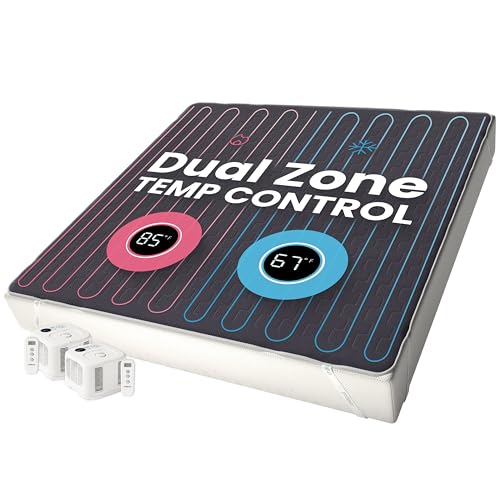
This is the tier’s genuine news, and the only four-figure product in any of our topper guides with a verified Amazon listing. The Chilipad Cube is a water-based system: a bedside cube circulates water through silicone micro-tubes in a pad, holding the surface in the maker’s stated 60 to 115°F range — no app, no subscription, remotes only. The WE configuration is the whole bed: two cubes and two half-queen pads, one independent zone per sleeper. Check price on Amazon before you buy, and note that active systems like this sit at the very top of the tier, so confirming the live listing matters more here than for any other pick.
For a side sleeper, the honest accounting has two sides. What dual-zone control genuinely buys two different bodies is two different temperatures: one partner sleeping hot against a foam layer, the other wanting the bed warmed — each side set independently, all night, in a way no passive material imitates. There is a subtler interaction too: memory foam firms up in a cold room and softens as it warms, so a controlled surface temperature makes the contour layer beneath this pad behave more consistently. But none of that is pressure relief, and the limitation below is the one this audience must read twice. Two further qualifications belong beside the headline. First, generation: the Cube is Sleepme’s previous-generation, deliberately simple system — the current Chilipad 2.0, with app scheduling, is sold only from Sleepme’s own site and its two-sleeper queen sits over this cap even on sale. Second, ownership: two cubes means two reservoirs to fill with distilled water and keep clean on the maker’s routine, the units need floor space and clearance, the maker itself notes the system is not a replacement for air conditioning, and the listing’s owner reviews include leak and circulation-failure reports alongside long-term fans — read them before spending at the top of this tier. If only one side of your bed needs temperature control, the same line’s ME half-queen configuration is the maker’s smaller option; its own Amazon listing’s featured offer could not be verified in our research, which is why it is named here rather than linked as a pick.
- Real set-temperature water cooling and heating for two sleepers — the maker’s stated range is 60 to 115°F per zone.
- The tier’s only four-figure verified Amazon option — check the current price on Amazon.
- No app and no subscription; wireless remotes and on-device controls only.
Honest limitation: For this audience, the decisive one: the pad is a thin water layer and adds no cushion at all — it will not soften a hard mattress, will not let a shoulder sink, and laid over a surface that already hurts your shoulder it gives you a precisely temperature-controlled version of the same pressure. It is also the previous-generation system, and two cubes mean two reservoirs of distilled-water upkeep, with leak reports among the listing’s owner reviews.
Choose it if your surface is already right and temperature — on one side of the bed or two different ones — is the problem left. Skip it if your shoulder or hip is what hurts: spend on the passive layer first (the plans below pair the two in the right order), or resent appliance upkeep, or your mattress itself is failing — this controls a surface, it does not rebuild one.
Avocado Eco Organic Latex Mattress Topper, 3 Inch Plush, Queen
Who it suits: Side sleepers who want the best pressure-relieving passive surface Amazon carries — soft, buoyant latex that yields at the shoulder and pushes back at the hip — and who are willing to verify the live price before ordering.
Doubling the budget does not move the passive ceiling, and for this audience this topper is the ceiling’s most relevant product. The Eco Organic topper in its 3-inch Plush build sits at the top of the verified passive range on Amazon, and the Plush build is the premium one for a real reason: it uses FSC-certified Pure Talalay latex, the vat-process latex that produces the most consistent and costly foam in the category, inside a sewn-in certified organic cotton cover that rival brands sell as a separate add-on. One correction matters and we will not soften it: despite the word “organic” in the range’s name, the Plush build’s Talalay is FSC-certified, not GOLS-certified — the GOLS certification belongs to the line’s Dunlop builds. If a GOLS certificate specifically is what you are paying for, the firmer Dunlop version of this same topper, or the Pure Green below, is the honest route.
Why soft Talalay suits a side sleeper is mechanical. Three inches of plush, consistent latex gives the shoulder — the widest, heaviest point of a side sleeper’s profile — depth to sink into, while the material’s buoyancy keeps the hip supported instead of hammocking, and its responsiveness means the surface re-forms instantly when you roll from one side to the other rather than holding the last position’s mould. It does all of that without memory foam’s warm hug or slow recovery, and latex is the longest-lived topper material in this guide — a quality Talalay slab should outlast every foam below by years, which is the real value case behind its position at the top of the passive range. The unresolved issue is the Amazon figure itself: across repeated attempts, in four sessions now, we could not capture the live featured-offer price on the Amazon listing. Check the current price on Amazon and confirm the exact thickness and firmness selected before you buy, and know that the value case depends on that live listing. Avocado’s other famous topper, the Alpaca wool model, cannot take this slot however well it fits the budget — it is sold only from Avocado’s own site.
- FSC-certified Pure Talalay latex in the Plush build — soft enough for a shoulder, supportive enough for a hip.
- Sewn-in certified organic cotton cover included; no separate cover purchase needed.
- 3-inch Plush queen at the top of the verified passive range in this guide, unchanged from the $1,000 tier — check price on Amazon.
Honest limitation: The live Amazon offer for this listing could not be verified in our research, so checking the current price on Amazon is a genuine pre-purchase step, not a formality. The Plush build is also FSC-certified rather than GOLS-certified, whatever the range’s name suggests.
Choose it if pressure at the shoulder and hip is your problem and you want the best passive answer in the guide, after confirming the live price. Skip it if you need a GOLS certificate specifically, dislike latex’s bounce, or want a price you can verify before deciding.
TEMPUR-Adapt (Supreme) 3 Inch Memory Foam Mattress Topper, Queen
Who it suits: Side sleepers whose complaint is precisely pressure at the shoulder and hip — the classic memory foam case — and who want the original material at full thickness.
Every memory foam topper on Amazon is, in some sense, an imitation of this one. The TEMPUR-Adapt Supreme is a 3-inch slab of Tempur-Pedic’s proprietary TEMPUR material in the queen size (80 x 60 x 3 inches; model 11284150, ASIN verified from the listing itself) — check price on Amazon. Memory foam is the side sleeper’s traditional answer for a physical reason: it is the material that flows away from a bony point. Under a shoulder it keeps yielding until the load spreads across the whole side of the body, which is what “pressure relief” actually means in this category — and three inches of it, rather than the two inches of budget toppers, is the thickness at which a heavier shoulder stops bottoming out onto the mattress beneath. At a $2,000 budget its value is worth stating plainly: this is the most expensive true memory foam we can verify, and it sits well below the cap. Nothing in the memory foam category above it verifies on Amazon at all.
The trade-offs are the material’s own. TEMPUR material is temperature-sensitive — firmer in a cold room, softer as it warms — and it sleeps warmer than any latex here, because a foam that moulds around you also insulates you; side sleepers whose problem is heat should solve the surface here only if they also plan for temperature, which is what the hero and the BedJet exist for. The slow recovery also means the surface holds your shape when you change position — some side sleepers love the cradle, restless ones fight it. And it is still a surface fix: 3 inches of plush contour on top of a mattress that already sags will follow the sag, not correct it. One terms note carries up unchanged: Tempur-Pedic accepts no returns on this topper through its own channel, so buy where the return window protects you — Amazon’s — and confirm it on the listing.
- Genuine TEMPUR material, 3 inches thick — the deepest contour at shoulder and hip in this guide.
- The premium end of verified memory foam on Amazon — check the current price on Amazon.
- ASIN and model verified directly from the Amazon listing (11284150, 80 x 60 x 3 in).
Honest limitation: It sleeps warm and still, like all dense memory foam, its feel changes with room temperature, and the queen’s own live Amazon price should be confirmed at checkout — check price on Amazon rather than assuming any figure.
Choose it if you are a side sleeper first and a temperature shopper second, and you love memory foam’s contour. Skip it if you sleep hot and cannot pair it with temperature control, change position constantly, or your mattress sags — no topper fixes a failed core.
Millsave Premium Hotel Quality 5 Inch Queen White Goose Down & Feather Featherbed
Who it suits: Side sleepers on a firm, sound mattress who want deep, soft loft over it — the hotel-bed layer — and who understand what a featherbed is and is not.
In our general guide this pick sat last, as the tier’s reality check. For a side sleeper it moves up, because loft is a pressure strategy: five inches of baffled feather gives a shoulder a deep, forgiving place to land, spreading load the way hotels have softened firm mattresses for decades, with a floating feel no foam replicates. But the reality check travels with it, and at this budget it deserves its sternest form. The Millsave is a 5-inch baffled featherbed for a queen, filled with about 21 pounds of goose feather and down, and its listing title says “down” in the way this category always says it: the listing’s own product description states the fill plainly — 95 percent goose feather, 5 percent goose down. That is not a scandal; it is what a featherbed is, a supportive feather base with a whisper of down softness. Genuine high-fill-power down — the 700-fill-power Hungarian goose down of true luxury toppers — sits above even this guide’s cap when sold direct. Nothing at $2,000, on Amazon or off it, is that product.
What the Millsave actually delivers, judged for this audience, is softness with a maintenance bill. Feathers need daily shaking to stay even — an unshaken featherbed develops exactly the shoulder-shaped hollow a side sleeper is trying to escape — the bed will feel warm rather than cool, quills can occasionally work through a cover, and the fill will slowly compress over years of use. It also adds no support: over a soft or sagging mattress it deepens the dip your hip already falls into. It sits at the inexpensive end of this guide — check the current price on Amazon and judge it as the inexpensive classic it is. In the plans below it is the affordable, characterful layer that lets the budget go elsewhere.
- Genuine baffled featherbed construction with about 21 lb of fill — real loft, not a quilted pad.
- Five inches of soft landing for a shoulder, over a mattress firm enough to do the supporting.
- Inexpensive enough to pair with a premium layer inside this budget — check price on Amazon.
Honest limitation: The fill is about 95 percent feather and 5 percent down despite the title — stated in the listing’s own description — and a featherbed adds softness only: it needs daily shaking to stay even, and on a soft or sagging mattress it makes things worse, not better.
Choose it if your mattress is firm and sound and you want hotel-style loft to land a shoulder in. Skip it if you want support, sleep hot, will not shake a bed daily, or are actually shopping for a true down topper — that product starts above $2,000 even before Amazon enters the question.
BedJet 3 Climate Comfort Sleep System
Who it suits: Side sleepers whose surface is already sorted and whose remaining problem is temperature — and couples who disagree about the thermostat — for considerably less than the hero’s whole-bed water system.
The BedJet takes the opposite engineering route to the hero’s problem. Instead of circulating water, a bedside unit blows temperature-controlled air into a perforated top sheet layer — warming in winter, ventilating in summer, set from the remote or the app — check price on Amazon. In this guide it ranks fifth for one stated reason: like the hero, it changes temperature only. It offers a side sleeper’s shoulder and hip nothing at all — no cushioning, no pressure relief — and for this audience that is the second problem, not the first. Its honest role is the partner purchase: the surface layer from the picks above, plus this, is how the worked plans below spend the tier.
The limitations are structural, and the maker’s own listing states the sharpest one: the BedJet is not an air conditioner, and it is not recommended for bedrooms over 78°F with no air conditioning, because air-based cooling works with the room it is given in a way a water system set to a number does not. Its effect also depends on the bedding over its sheet, the fan is quiet but not silent (the maker’s figure is 30 to 46 dB(A)), and the sheet layer adds a step to making the bed. One unit serves one sleeper’s zone properly; doubling up moves toward the Cube WE’s territory while still moving air rather than holding a set temperature. Judged as climate equipment rather than as a topper, it solves the one problem no passive pick here can.
- Real active heating and ventilation, remote and app controlled — not a gel claim.
- Check the current price on Amazon.
- Works with any mattress and any topper layered beneath its sheet; no water, no reservoirs, no tubing.
Honest limitation: It changes temperature only — no cushioning, no pressure relief for a shoulder or hip — its cooling is bounded by the room’s own temperature in a way water cooling is not, and one unit serves one sleeper’s zone properly.
Choose it if the surface is right, temperature is the whole remaining problem, and you would rather keep more of the budget for the surface layer too. Skip it if pressure is still your problem — buy the layer first — or you need a set temperature held precisely all night; that is the Cube WE’s job.
Sleep On Latex Pure Green Natural Latex Mattress Topper, Medium, 3 Inch, Queen
Who it suits: Combination sleepers who spend part of the night on their side and part on their back, and side sleepers who prefer a lifted, responsive surface to a sinking one — the value anchor of this tier.
The Pure Green has anchored our guides at every budget it fits, and the 3-inch Medium queen — check price on Amazon — is the yardstick that exposes the ceiling: this is what the mid-tier buys, in full, with certifications published. It is a single slab of natural Dunlop latex, GOLS certified organic, from the most transparent maker in the category. The feel is buoyant and immediately responsive: you lie on it more than in it, and the open-cell structure breathes in a way no gel infusion imitates. The maker’s own listing copy is the honesty anchor of the whole latex category: latex is heat-neutral, and a topper “cannot always make a bed cooler” — printed there, and repeated here, because it is true.
For this audience, though, the Medium build’s firmness is the story, and we will state it the way our general guide’s own review did: the Medium is a deliberate middle, and a strict side sleeper who wants maximum sink should know that the same maker’s Soft build exists for exactly that job — it was the latex pick of our under-$700 guide — while this Medium ASIN is the one verified for this guide and the one linked here. What Medium does offer a side sleeper is support that does not quit: the hip stays level, the surface never holds a mould, and sleepers who roll between side and back through the night often prefer exactly this. It is also the layer the worked plans build on, because it pairs with active systems while giving the whole bed a premium, certified surface. Two cautions carry up unchanged. This ASIN is the bare topper with no cover, and covered variants sit on separate listings, so budget for a protector if you do not already own one. And 3 inches of Dunlop moderates and cushions a sound mattress; it does not rebuild a sagging one. Latex is also heavy and floppy to handle, and it is the wrong purchase entirely for anyone with a latex allergy.
- GOLS-certified natural Dunlop latex at full 3-inch thickness — check price on Amazon.
- Buoyant, responsive, genuinely breathable; no gel or cooling claims needed.
- The longest-lived material in the guide alongside the second pick’s Talalay.
Honest limitation: It arrives bare, with no cover included, and the Medium firmness is firmer than a strict side sleeper’s ideal — the maker’s own Soft build is the line’s maximum-sink option, and this build will not cradle like memory foam or the Plush Talalay above.
Choose it if you are a combination sleeper, want premium natural materials at a mid-tier price, or need a proven base layer under an active system. Skip it if you have a latex allergy, sleep strictly on your side and want deep sink, or need a cover in the box.
Comparison Table
For every pick below, check the current price on Amazon for the queen size before you buy — prices change, and this guide does not print a figure in place of the live listing.
| Pick | Construction | Queen price | Best for | Watch out for |
|---|---|---|---|---|
| Sleepme Chilipad Cube, WE Whole Queen | Active water cooling/heating, two zones, two units | Check price on Amazon | Two temperatures for two sleepers, over a surface you already like | Adds no cushion; previous-generation system; two reservoirs of upkeep |
| Avocado Eco Organic, 3 Inch Plush | FSC Pure Talalay latex, organic cotton cover | Check the current price on Amazon | Pressure relief with bounce — the side sleeper’s passive ceiling | Verify the live Amazon price; FSC, not GOLS |
| TEMPUR-Adapt (Supreme) 3 Inch | TEMPUR memory foam | Check price on Amazon | Deep contour at shoulder and hip | Sleeps warm; feel firms in a cold room; follows a sagging core |
| Millsave 5 Inch Featherbed | Goose feather/down, baffled, ~21 lb fill | Check price on Amazon | Soft loft for a shoulder over a firm bed | ~95% feather, 5% down; needs daily shaking; softness only |
| BedJet 3 | Active air climate system | Check price on Amazon | Temperature problems without water or tubing | No cushioning at all; bounded by room temperature |
| Sleep On Latex Pure Green, Medium 3 Inch | GOLS natural Dunlop latex | Check price on Amazon | Combination sleepers; plan base layer | Firmest pick here; bare topper, no cover |
How to Choose a Mattress Topper for Side Sleepers Under $2000
Name the problem first — and in the right order. For a side sleeper the order is pressure, then temperature. If your shoulder aches into the mattress or your hip feels perched on a hard point, that is a surface problem, and only the passive picks here address it. If the surface feels right but you wake hot — or your partner does — that is the active systems’ job. A topper bought against the wrong problem is money spent at any price, and the most expensive version of that mistake at this tier is buying a premium temperature system for a pressure problem.
Buy thickness before softness claims. A side sleeper’s shoulder needs depth to sink into. Two-inch toppers bottom out under a shoulder on a firm mattress; every passive pick in this guide is 3 inches or, in the featherbed’s case, 5 inches of loft. Thickness is the spec that decides whether “soft” is real.
Check the mattress before the topper. Press into the middle of your bare mattress where your hips sleep. If there is a permanent dip, a topper will settle into it and reproduce it — every pick in this guide is a surface layer, and none of them rebuilds a failed core. An active system laid over a sagging mattress gives you a precisely temperature-controlled sag. A sound but too-firm mattress is the ideal candidate; a sagging one needs replacing, and $2,000 is most of the price of an excellent mattress.
Match firmness to how strictly you side-sleep. All-night side sleepers want the soft end of this guide: the Plush Talalay, the TEMPUR contour, the featherbed’s loft. Combination sleepers who spend real time on their backs often do better on the Medium latex, which keeps the hip level in both positions. “Medium” on a label is a maker’s word, not a measurement — the reviews above translate each build into what a shoulder actually feels.
Count sleepers before counting dollars. This tier finally resolves the zone question that defined the $1,000 guide: the whole-bed, two-zone configuration fits the budget on Amazon — check its current price on Amazon. Its real value for two different bodies is two different temperatures — decide whose temperature you are fixing before you fall for a headline, and if only one sleeper needs control, the one-sleeper configuration named in the hero’s review does the same job for less.
Read the specification, not the product name. This tier’s labeling traps are all documented in this guide: a latex range called organic whose premium build is FSC-certified rather than GOLS, a featherbed titled “down” that is 95 percent feather, and premium passive toppers whose prices exist only on brand sites. Fill percentages, process descriptions, certifications and dimensions are printed in every serious listing — read them.
Verify the live price, the offer and the exact configuration. Topper prices are quoted per size, thickness and firmness, and this guide’s second pick could not be captured live in our research. Confirm that the listing in your cart is the size and build the review describes, with a live offer at a price you accept — before you pay, not after it arrives.
Pressure First, Temperature Second: The Side Sleeper’s Honest Hierarchy
Every other audience for this tier can reasonably start with temperature, because temperature is what the four-figure product sells. A side sleeper cannot, and the reason is geometry. A back sleeper spreads their weight across the whole back; a side sleeper balances on the shoulder and the hip, the two widest and heaviest points of the body, on a contact patch a fraction of the size. Pressure at those points is relieved by exactly one mechanism: a surface thick and soft enough to let the point sink while the material around it rises to carry the rest of the side. Nothing about water temperature participates in that mechanism. A cooling pad laid over a mattress that is too firm gives you, with great precision and at a set number of degrees, the same shoulder pressure you started with — colder.
That is why this guide ranks the way it does. The passive ceiling — three inches of Plush Talalay — is the product that answers the side sleeper’s first question, and the classic memory foam slab answers it a second way, trading bounce for the deepest contour in the guide. The featherbed answers it a third way, with loft, at the price of daily maintenance. Temperature enters only after the surface is right — and then it genuinely matters, in two ways worth naming. First, the two-bodies problem: dual-zone control’s real value is not luxury, it is that two sleepers with different builds and different metabolisms no longer have to compromise on one number, and the WE configuration is the first time that fits this budget on Amazon with a verified listing. Second, consistency: memory foam’s firmness drifts with room temperature, firming on cold nights exactly when a shoulder wants it softest, and a controlled surface temperature — from the Cube WE over the foam, or the BedJet’s air — holds the contour layer’s behaviour steady. Temperature control, for a side sleeper, is how you protect a good surface. It is not a substitute for one.
What $2,000 Does Not Buy on Amazon: The Passive Band Is Still Empty
Shoppers reasonably assume that doubling the budget from $1,000 to $2,000 opens a new shelf of passive products. In this category, on Amazon, it does not. Between $700 and $2,000 there is no passive topper we could verify on Amazon at all. The verifiable Amazon ceiling for a passive queen remains where our under-$700 guide found it: the Avocado Eco Plush at the top of that range, its live Amazon price uncaptured across four research sessions, and everything else verified sitting in the lower and middle parts of the tier.
The genuine $700 to $2,000 passive class exists — it simply does not live on Amazon, and at this budget it finally has a flagship. Naturepedic’s Overture is a 3-inch organic luxury pillow top — organic latex, wool and cotton, the same pillow top the brand sews onto its luxury mattresses — sold on Naturepedic’s own site, in the upper part of this band. It is, on paper, exactly the product this keyword imagines, and there is no Amazon listing for it: repeated targeted searching found no verifiable topper ASIN for the Overture, the Adagio latex topper or the Wooly wool topper. The rest of the band is the same story: Saatva’s Organic Quilted, Avocado’s Alpaca wool topper (including its plush version), and PlushBeds’ handmade queen range, which tops out below the top of this band. These products are named here without links, as ceiling evidence and as legitimate brand-direct alternatives — with the warning that brand-direct terms (trials, final-sale conditions, restocking) differ from Amazon’s and deserve reading at these prices.
Two more shelves complete the picture. True down sits above the cap entirely: high-fill-power Hungarian goose down toppers — in 700-fill-power and 800-fill-power versions — are sold direct above this budget, while everything Amazon sells under the word “down” is a featherbed like the Millsave, feather-dominant by its own listing’s admission. And the newest active hardware is not on Amazon either: Sleepme’s Chilipad 2.0 (whole-bed form over this cap even discounted) and its clearance Chilipad 1.0, the renamed Dock Pro, are brand-direct only, as is Eight Sleep’s Pod 6, which sits above this cap for a queen before its mandatory Autopilot subscription is counted at all. The $2,000 tier is real money. On Amazon it buys the whole-bed version of the active market, the top of the passive market, and change — not a passive product priced anywhere near the number.
Spending $2,000 Without a Single Product Taking It All: Three Worked Plans
Because no single verified product takes the whole budget, the rational way to shop this tier is often a combination — with the remainder deliberately left unspent rather than absorbed by a worse product. For a side sleeper the plans below are sequenced by the hierarchy: surface first, temperature second. Check the current price on Amazon for each layer before you commit, since the plans are built on roles, not on printed figures:
Plan 1 — Whole-bed climate over real latex. The Chilipad Cube WE for both sleepers’ temperatures, over the Pure Green Medium 3-inch as the surface layer for the whole bed. For this audience, read the pairing honestly: the latex here is the firmest surface in the guide, so this is the plan for combination sleepers who want climate control most — strict side sleepers should look at Plan 2 first. Either way it buys the two things money genuinely buys here, with room left in the budget for the protector the bare latex needs and the distilled water the cubes will drink.
Plan 2 — Whole-bed climate over real contour. The Cube WE again, this time over the TEMPUR-Adapt Supreme. This is the side sleeper’s plan: the deepest shoulder-and-hip contour in the guide underneath the only whole-bed temperature control Amazon verifies, each layer doing the job the other cannot. If you buy one combination from this page, buy this one.
Plan 3 — Every bed in the house. The BedJet moves air on the primary bed, the TEMPUR-Adapt contours it, the Pure Green upgrades a second bed, and the Millsave featherbed (check price on Amazon) gives the guest room its hotel layer. No single $2,000 product in this guide improves three beds; this plan does, and what it leaves unspent gives the mattress fund a serious head start.
Common Buying Mistakes
Buying temperature gear for a pressure problem. The costliest mistake available to this audience: spending at the top of the tier on a cooling system whose pad adds no cushion, to fix a shoulder that hurts because the surface is too hard. Sequence the purchase — surface first, temperature second — or buy the combination plan that does both.
Going too thin. A 2-inch topper on a firm mattress bottoms out under a side sleeper’s shoulder, and the sleeper feels the mattress through it by 3 a.m. Three inches is the working thickness for this position; it is not a coincidence that every passive pick here meets it.
Trusting the word “medium.” Firmness labels are maker-relative. This guide’s own value pick is a Medium that strict side sleepers will find firm, from a maker whose Soft build exists for their job. Read the review’s translation of each build, not the label.
Assuming the budget implies a passive product. Forcing the full $2,000 into one passive purchase — usually a brand-direct topper bought unseen on final-sale terms, a king-size price misread as a queen, or a half-bed price misread as whole-bed — is the tier’s classic error. The verified Amazon passive market tops out well below the cap; unspent money is a legitimate outcome.
Misreading zone pricing. A couple who order a one-sleeper configuration expecting a whole bed of cooling have bought half a solution at full commitment. This tier’s hero exists because the whole-bed configuration finally fits — check whether the listing in front of you covers one sleeper or two before anything else.
Expecting a topper to fix a sagging mattress. Premium materials follow a dip exactly as faithfully as cheap ones, and an active system will hold a sagging surface at a very precise temperature. If the core has failed, $2,000 toward a new mattress outperforms $2,000 of the finest topper laid over the failure.
Ignoring the trial, return and subscription terms. Several premium names in the ceiling section sell brand-direct with final-sale or restocking terms, and the most famous active system carries a mandatory annual subscription on top of its hardware price. At these prices, the terms are part of the product; read them before the materials list, not after delivery.
Final Recommendation
If you sleep on your side, buy the surface first. The Avocado Eco Organic in its 3-inch Plush build — after you have confirmed its live Amazon price — is the best pressure-relieving passive topper in this guide: soft Talalay that lets a shoulder sink without surrendering the hip, cover included rather than upsold. The TEMPUR-Adapt is its equal for sleepers who prefer a deep, slow contour to bounce — check its current price on Amazon. Then, if temperature is the problem that remains — yours, your partner’s, or the war between them — buy the Chilipad Cube WE: both halves of a queen held at two chosen temperatures, all night, by hardware you own outright — check price on Amazon. Just buy it for what it is. It will keep your chosen surface at your chosen temperature; it will not make a hard bed soft, and no honest guide should let $2,000 blur that line.
Frequently Asked Questions
What makes a topper good for side sleepers?
Thickness and softness, in that order. A side sleeper’s weight lands on the shoulder and hip, so the surface needs enough depth — three inches is the working minimum in this guide — and enough give for the shoulder to sink without the hip dropping through to the mattress. Soft Talalay latex, deep memory foam contour and genuine feather loft all achieve it by different mechanisms; firm builds and thin pads do not, whatever their labels say. Everything here is a comfort claim: a good surface can feel dramatically better without treating anything.
Is the Chilipad Cube WE worth it for a side sleeper?
Only if temperature is your problem. The Cube WE holds each half of a queen at a set temperature — the maker’s stated 60 to 115°F — all night, which no passive product can do, and for two sleepers who want different temperatures it is the one purchase this tier makes possible. But its pad is a thin water layer with no cushion in it: it will not soften a mattress or relieve pressure at a shoulder. Side sleepers should buy it over a surface that already works, or as the second half of Plan 2 above.
Is memory foam or latex better for side sleepers?
They relieve pressure differently. Memory foam — the TEMPUR-Adapt here — flows away from the shoulder and spreads load with the deepest contour in the guide, at the cost of warmth and a slow, held feeling when you change position. Soft latex — the Avocado’s Plush Talalay — yields at the shoulder while pushing back at the hip, responds instantly, and sleeps temperature-neutral; the firmer Dunlop builds, like this guide’s Medium Pure Green, suit combination sleepers better than strict side sleepers. Neither is a hierarchy; match the mechanism to the sleeper.
Why is the one-sleeper Chilipad not a pick in this guide?
The Cube ME half-queen is a real configuration from Sleepme’s Cube line, but its Amazon listing showed “no featured offers available” across repeated research sessions and no current Amazon price for that exact ASIN could be captured. At $1,000 it was linked with that caveat printed, as the only route to water cooling inside that cap; at $2,000 the whole-bed version verifies outright, so this guide links what it can verify and names the ME instead.
Will a $2,000 topper fix my shoulder pain or the numb arm I wake up with?
No topper treats shoulder pain, numbness or any other condition, and this guide makes comfort claims only — including for the active systems, whose makers’ temperature ranges are specifications, not therapies. A softer, thicker surface can change how a sound mattress feels and how pressure distributes across your side, and that may well change how you sleep. Persistent pain, numbness or weakness in an arm, or breathing pauses during sleep, deserve a clinician’s attention rather than a bedding purchase at any price.
Is true goose down available under $2,000?
Not that we could verify, anywhere. High-fill-power Hungarian goose down toppers — in 700-fill-power and 800-fill-power versions — are sold direct above this cap. What Amazon sells under the word “down” at ordinary prices is featherbeds: mostly feather with a small down fraction, including this guide’s Millsave at about 95 percent feather by its own listing’s description.
What about Eight Sleep?
The Pod 6 sits above this cap for a queen on hardware alone, before its mandatory Autopilot subscription is counted, and it is sold direct rather than on Amazon. Even its one-sleeper Solo version totals above the cap once the required first subscription year is counted.
What if the topper does not help?
Give it several nights after full expansion before deciding — latex and feather both need time to reach their working loft, and first impressions of compressed bedding are unreliable. Buy where the return terms protect you: Amazon’s standard window is one reason this guide links marketplace listings where they verifiably exist, and it is worth weighing against brand-direct final-sale terms before choosing the direct route for the products named in the ceiling section.
Related guides: