Disclosure: topratedkitchenware.com is reader-supported. When you buy through links on our site, we may earn an affiliate commission from Amazon and other retailers, at no extra cost to you.
Where to buy
Start here if you already know your shortlist. The linked picks below are the verified recommendations in this guide to the best 24 volt lithium batteries for solar; each name leads to its Amazon listing, where you can check the latest price on Amazon and confirm current details. Picks marked prose-only are context and comparison entries discussed in full below — they carry no link and no image, deliberately, and the reviews explain why in each case.
- yeagulch 24V 314Ah LiFePO4 Battery — Best Overall · Check on Amazon
- dumfume 24V 100Ah LiFePO4 Battery — Best for Most Solar Setups
- yeagulch 24V 100Ah LiFePO4 Battery — Best Value Building Block
- Dyness 24V 100Ah LiFePO4 Battery — Best for Expanding Systems
- VEMDIA 12V 100Ah LiFePO4 Battery (Group 31) — Series-Pair Component (Prose) (prose-only context pick, no Amazon link)
- Qwenoer 22.2V–24V 10Ah Lithium Battery Pack — Small DIY Pack (Prose) (prose-only context pick, no Amazon link)
Read the full guide ↓ for the sizing, setup and ownership detail behind each pick.
Finding the best 24 volt lithium batteries for solar use is mostly an exercise in matching stored energy to the hours your panels are not producing. A 24V bank sits in a useful middle ground: cable runs carry half the current of an equivalent 12V system, yet the hardware stays simpler than a 48V build. The four linked picks in this guide are all native 24V LiFePO4 batteries whose listings name solar or off-grid use, and they split neatly into one very large 314Ah unit and three 100Ah building blocks.
The two remaining slots are deliberately prose-only, and the distinction matters for solar shoppers. One is a 12V battery that only reaches 24V when a matched twin is wired in series, and the other is a small 10Ah hobby pack that has no business storing a home’s solar harvest. Both appear in search results for this keyword, both are described honestly below, and neither carries a link or an image in this guide because neither meets the native 24V deep-cycle brief on its own.
Everything that follows is research-led: specifications are taken only from the verified product listings, cycle and certification claims are reported as the makers state them, and no prices or fixed ratings are printed because both change too often to be trustworthy in a static guide. What you get instead is the sizing math, the wiring logic and the cold-weather caveats that actually decide whether a solar battery bank feels generous or frustrating two winters from now.
Key Takeaways
- The linked picks are the only products in this guide with Amazon links and images; prose-only entries are labeled context, never recommendations with links.
- For solar charging and off-grid storage, the deciding factors are fit for the job, honest capacity or output figures from the listing, and the ownership routine — not headline marketing.
- Badges are used consistently from Quick Picks through the detailed reviews, so a pick’s role never changes mid-guide.
- Specifications here come only from the verified listings; where a listing is silent, this guide is silent too, rather than inventing a number.
- No prices are printed because they change; use the links to check the latest price on Amazon at the moment you buy.
In this guide
Quick Picks
Six entries, one table. If you are comparing quickly, this is the whole argument of the guide in miniature: what each pick is, what it is for, and whether it earned a link.
| Pick | Badge | Key facts from the listing |
|---|---|---|
| yeagulch 24V 314Ah LiFePO4 Battery | Best Overall | 24V (nominal); 314Ah; 8038.4Wh; built-in 200A |
| dumfume 24V 100Ah LiFePO4 Battery · Check on Amazon | Best for Most Solar Setups | 24V (nominal); 100Ah; 2560Wh; built-in 100A |
| yeagulch 24V 100Ah LiFePO4 Battery · Check on Amazon | Best Value Building Block | 24V (nominal); 100Ah; 2560Wh; built-in 100A |
| Dyness 24V 100Ah LiFePO4 Battery | Best for Expanding Systems | 24V (nominal); 100Ah; 2560Wh; smart 100A |
| VEMDIA 12V 100Ah LiFePO4 Battery (Group 31) (prose-only) | Series-Pair Component (Prose) | 12V (nominal) — not a native 24V battery; 100Ah; 1280Wh; built-in 100A smart BMS |
| Qwenoer 22.2V–24V 10Ah Lithium Battery Pack (prose-only) | Small DIY Pack (Prose) | 22.2V–24V; 10Ah — small pack, not a deep-cycle storage battery; Li-ion (not LiFePO4); 25.2V 2A charger, bare leads wire, cable connector |
How These Picks Were Chosen
This guide is research-led. Every linked pick comes from a verified product pool checked against the maker’s Amazon listing on 2026-11-22: the title, stated specifications and named features were read in full, and only products that genuinely fit the brief of best 24 volt lithium batteries for solar were linked. Products that appeared in the same searches but failed the brief — wrong voltage, wrong category, missing the keyword’s core attribute — were not quietly dropped; they are covered as prose-only entries with the reason stated, because readers meet those same products in search results and deserve an explanation.
Badges were assigned by role, not by price: the pick most readers should start with, the pick for the common alternative use case, and the specialist options are labeled as such in Quick Picks and again in the detailed reviews. Where two listings are close relatives — a color variant, a capacity sibling — the reviews say so plainly instead of manufacturing differences. Readers comparing neighboring topics may also find Best Batteries To Use For 24 Volt Trolling Motor useful alongside this guide.
A note on limits: this is desk research, not a laboratory test program, and the guide makes no hands-on testing claims. Cycle figures, output figures and lifetime framing are reported as the makers state them in their listings, and are flagged as maker claims where the distinction matters. What research can do well — and what this guide attempts — is to read the listings more carefully than a search-results page does, and to refuse to print prices, ratings or specifications that cannot be verified.
The 6 Picks in Detail

yeagulch 24V 314Ah LiFePO4 Battery
Badge: Best Overall
Strengths
- Largest single-unit energy in this guide at 8038.4Wh, so one battery can replace a bank of smaller units
- 200A BMS gives more continuous-current headroom than the 100A units here
- Low-temperature protection and UL 1973 / UN38.3 listings are named in the product title
Trade-offs
- A 314Ah unit is physically large and heavy compared with the 100Ah picks
- Far more capacity than a small system needs, so the extra size is wasted in compact setups
- Deep-cycle count is stated as 15000+ in the title, but real life still depends on depth of discharge and temperature
Key specifications (from the listing)
- Voltage: 24V (nominal)
- Capacity: 314Ah
- Energy: 8038.4Wh
- BMS: built-in 200A
- Chemistry: LiFePO4 (lithium iron phosphate)
- Protection: low-temperature protection
- Certifications named in listing: UL 1973, UN38.3
Consider where this pick sits in a guide to solar charging and off-grid storage. Its listing promises 24v (nominal); 314ah; 8038.4wh; built-in 200a, and the honest reading of that promise is narrower than the headline: those are the facts the maker chose to publish, verified for this guide, and they define both what the product will do and the questions a careful buyer should still ask the seller. Largest single-unit energy in this guide at 8038.4Wh, so one battery can replace a bank of smaller units That strength is the reason it holds the “Best Overall” badge here rather than a lower slot.
The limitations deserve equal time. A 314Ah unit is physically large and heavy compared with the 100Ah picks In practice that means this pick rewards a buyer whose use case matches its design center and quietly penalizes a buyer who needed something else and hoped the headline would stretch. Matched against the other entries in this guide, its role is specific rather than universal — which is precisely what a badge system is for, and why the comparison table below keeps its facts in one row rather than scattering them through prose.
Day-to-day life with this pick is where the second strength on its list earns its place: 200a bms gives more continuous-current headroom than the 100a units here That sounds like a small thing in a listing, and it is — right up until it becomes the detail you interact with every single time you use the product, long after the headline specifications have faded into the background. Reviewers of this category consistently underweight those recurring small interactions, because they are hard to photograph and harder to put in a comparison chart, yet they are what separate a purchase that settles into your routine from one that quietly irritates you for years. Weigh this pick’s everyday details at least as heavily as its biggest number.
There is also a second trade-off worth naming before the verdict: far more capacity than a small system needs, so the extra size is wasted in compact setups None of the six entries in this guide escapes trade-offs entirely — the honest differences are in which compromises each design chose. If the compromise named here touches something you care about daily, move to the pick whose compromises live in areas you care about less; that exchange, rather than any pursuit of a flawless product, is how readers end up satisfied with purchases in this category. Satisfaction is usually a match, not a maximum.
Best for: buyers whose needs match the “Best Overall” role described above / Not suited for: buyers outside that role, who should start with a different pick in this guide.

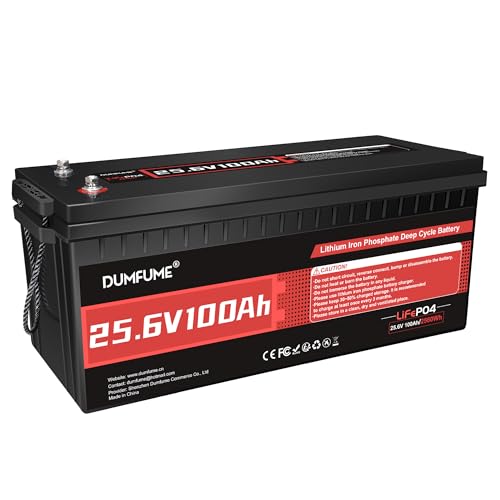
dumfume 24V 100Ah LiFePO4 Battery
Badge: Best for Most Solar Setups
Strengths
- IP65 waterproof enclosure is unusual in this group and suits exposed or marine-adjacent mounting
- Low-temperature cutoff protection is built in
- 2560Wh is a practical single-unit building block that can be paralleled as a system grows
Trade-offs
- 100A BMS limits continuous draw compared with the 200A large pick
- No series/parallel expansion figure is stated in the title, so confirm wiring plans with the maker first
- 100Ah runs a large inverter load for a shorter time than the 314Ah pick
Key specifications (from the listing)
- Voltage: 24V (nominal)
- Capacity: 100Ah
- Energy: 2560Wh
- BMS: built-in 100A
- Chemistry: LiFePO4
- Protection: low-temperature cutoff
- Enclosure: IP65 waterproof rating named in listing
- Certifications named in listing: UN38.3, UL1973
Consider where this pick sits in a guide to solar charging and off-grid storage. Its listing promises 24v (nominal); 100ah; 2560wh; built-in 100a, and the honest reading of that promise is narrower than the headline: those are the facts the maker chose to publish, verified for this guide, and they define both what the product will do and the questions a careful buyer should still ask the seller. IP65 waterproof enclosure is unusual in this group and suits exposed or marine-adjacent mounting That strength is the reason it holds the “Best for Most Solar Setups” badge here rather than a lower slot.
The limitations deserve equal time. 100A BMS limits continuous draw compared with the 200A large pick In practice that means this pick rewards a buyer whose use case matches its design center and quietly penalizes a buyer who needed something else and hoped the headline would stretch. Matched against the other entries in this guide, its role is specific rather than universal — which is precisely what a badge system is for. Readers whose needs sit at the edges of this category may also want to read Best Heavy Duty 12 Volt Truck Batteries before deciding.
Day-to-day life with this pick is where the second strength on its list earns its place: low-temperature cutoff protection is built in That sounds like a small thing in a listing, and it is — right up until it becomes the detail you interact with every single time you use the product, long after the headline specifications have faded into the background. Reviewers of this category consistently underweight those recurring small interactions, because they are hard to photograph and harder to put in a comparison chart, yet they are what separate a purchase that settles into your routine from one that quietly irritates you for years. Weigh this pick’s everyday details at least as heavily as its biggest number.
There is also a second trade-off worth naming before the verdict: no series/parallel expansion figure is stated in the title, so confirm wiring plans with the maker first None of the six entries in this guide escapes trade-offs entirely — the honest differences are in which compromises each design chose. If the compromise named here touches something you care about daily, move to the pick whose compromises live in areas you care about less; that exchange, rather than any pursuit of a flawless product, is how readers end up satisfied with purchases in this category. Satisfaction is usually a match, not a maximum.
Best for: buyers whose needs match the “Best for Most Solar Setups” role described above / Not suited for: buyers outside that role, who should start with a different pick in this guide.
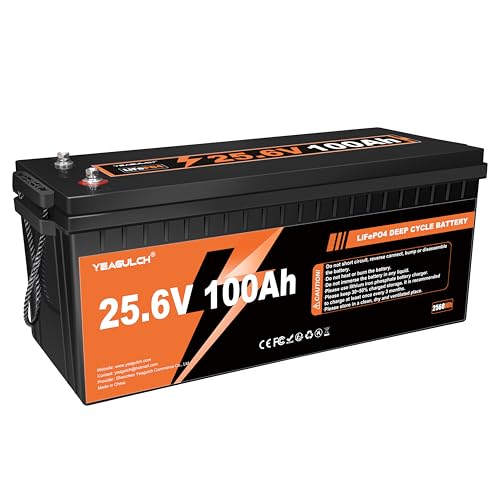
yeagulch 24V 100Ah LiFePO4 Battery
Badge: Best Value Building Block
Strengths
- Title explicitly names trolling motors, off-grid solar, RV and marine use
- Low-temperature cutoff protects the cells during cold-weather charging
- Same 2560Wh class as the other 100Ah picks, so runtime comparisons are straightforward
Trade-offs
- 100A BMS is the ceiling for continuous current; high-draw inverters may need parallel units
- No waterproof rating is stated in the title, unlike the IP65 pick
- Shares its maker’s naming with the larger 314Ah unit, so check the capacity on the label before ordering
Key specifications (from the listing)
- Voltage: 24V (nominal)
- Capacity: 100Ah
- Energy: 2560Wh
- BMS: built-in 100A
- Chemistry: LiFePO4
- Protection: low-temperature cutoff
- Certifications named in listing: UN38.3, UL1973
Consider where this pick sits in a guide to solar charging and off-grid storage. Its listing promises 24v (nominal); 100ah; 2560wh; built-in 100a, and the honest reading of that promise is narrower than the headline: those are the facts the maker chose to publish, verified for this guide, and they define both what the product will do and the questions a careful buyer should still ask the seller. Title explicitly names trolling motors, off-grid solar, RV and marine use That strength is the reason it holds the “Best Value Building Block” badge here rather than a lower slot.
The limitations deserve equal time. 100A BMS is the ceiling for continuous current; high-draw inverters may need parallel units In practice that means this pick rewards a buyer whose use case matches its design center and quietly penalizes a buyer who needed something else and hoped the headline would stretch. Matched against the other entries in this guide, its role is specific rather than universal — which is precisely what a badge system is for, and why the comparison table below keeps its facts in one row rather than scattering them through prose.
Day-to-day life with this pick is where the second strength on its list earns its place: low-temperature cutoff protects the cells during cold-weather charging That sounds like a small thing in a listing, and it is — right up until it becomes the detail you interact with every single time you use the product, long after the headline specifications have faded into the background. Reviewers of this category consistently underweight those recurring small interactions, because they are hard to photograph and harder to put in a comparison chart, yet they are what separate a purchase that settles into your routine from one that quietly irritates you for years. Weigh this pick’s everyday details at least as heavily as its biggest number.
There is also a second trade-off worth naming before the verdict: no waterproof rating is stated in the title, unlike the ip65 pick None of the six entries in this guide escapes trade-offs entirely — the honest differences are in which compromises each design chose. If the compromise named here touches something you care about daily, move to the pick whose compromises live in areas you care about less; that exchange, rather than any pursuit of a flawless product, is how readers end up satisfied with purchases in this category. Satisfaction is usually a match, not a maximum.
Best for: buyers whose needs match the “Best Value Building Block” role described above / Not suited for: buyers outside that role, who should start with a different pick in this guide.

Dyness 24V 100Ah LiFePO4 Battery
Badge: Best for Expanding Systems
Strengths
- Expansion path is stated plainly: 4P2S connection up to 20.48kWh
- Smart 100A BMS and a named brand with a stated 10-year lifetime framing
- Title explicitly covers marine, RV and solar use
Trade-offs
- Stated cycle figure (4000+) is lower than the 15000+ figures on rival listings here, so compare warranty terms carefully
- 100A BMS still caps single-unit continuous output
- Reaching the full 20.48kWh expansion means buying several more units and the cabling to match
Key specifications (from the listing)
- Voltage: 24V (nominal)
- Capacity: 100Ah
- Energy: 2560Wh
- BMS: smart 100A
- Chemistry: LiFePO4
- Expansion: 4P2S connection up to 20.48kWh named in listing
- Lifetime framing in listing: 10-year lifetime, 4000+ deep cycles
Consider where this pick sits in a guide to solar charging and off-grid storage. Its listing promises 24v (nominal); 100ah; 2560wh; smart 100a, and the honest reading of that promise is narrower than the headline: those are the facts the maker chose to publish, verified for this guide, and they define both what the product will do and the questions a careful buyer should still ask the seller. Expansion path is stated plainly: 4P2S connection up to 20.48kWh That strength is the reason it holds the “Best for Expanding Systems” badge here rather than a lower slot.
The limitations deserve equal time. Stated cycle figure (4000+) is lower than the 15000+ figures on rival listings here, so compare warranty terms carefully In practice that means this pick rewards a buyer whose use case matches its design center and quietly penalizes a buyer who needed something else and hoped the headline would stretch. Matched against the other entries in this guide, its role is specific rather than universal — which is precisely what a badge system is for, and why the comparison table below keeps its facts in one row rather than scattering them through prose.
Day-to-day life with this pick is where the second strength on its list earns its place: smart 100a bms and a named brand with a stated 10-year lifetime framing That sounds like a small thing in a listing, and it is — right up until it becomes the detail you interact with every single time you use the product, long after the headline specifications have faded into the background. Reviewers of this category consistently underweight those recurring small interactions, because they are hard to photograph and harder to put in a comparison chart, yet they are what separate a purchase that settles into your routine from one that quietly irritates you for years. Weigh this pick’s everyday details at least as heavily as its biggest number.
There is also a second trade-off worth naming before the verdict: 100a bms still caps single-unit continuous output None of the six entries in this guide escapes trade-offs entirely — the honest differences are in which compromises each design chose. If the compromise named here touches something you care about daily, move to the pick whose compromises live in areas you care about less; that exchange, rather than any pursuit of a flawless product, is how readers end up satisfied with purchases in this category. Satisfaction is usually a match, not a maximum.
Best for: buyers whose needs match the “Best for Expanding Systems” role described above / Not suited for: buyers outside that role, who should start with a different pick in this guide.
VEMDIA 12V 100Ah LiFePO4 Battery (Group 31)
Badge: Series-Pair Component (Prose)
Prose-only pick — no Amazon link and no image in this guide. Reason: it does not carry the keyword’s core attribute, or it duplicates a linked pick, as explained in the review below.
Strengths
- Useful as a matched series-pair component: two identical 12V units wired in series make a 24V bank
- Group 31 footprint fits many existing battery trays and boxes
- Low-temperature protection and a smart BMS are named in the title
Trade-offs
- On its own it is a 12V battery — it does not meet a native 24V requirement by itself
- Series wiring adds balancing and cabling considerations a single 24V unit avoids
- Only half the energy per unit of the 24V 100Ah picks
Key specifications (from the listing)
- Voltage: 12V (nominal) — not a native 24V battery
- Capacity: 100Ah
- Energy: 1280Wh
- BMS: built-in 100A smart BMS
- Form factor: Group 31
- Protection: low-temperature protection
Consider where this pick sits in a guide to solar charging and off-grid storage. Its listing promises 12v (nominal) — not a native 24v battery; 100ah; 1280wh; built-in 100a smart bms, and the honest reading of that promise is narrower than the headline: those are the facts the maker chose to publish, verified for this guide, and they define both what the product will do and the questions a careful buyer should still ask the seller. Useful as a matched series-pair component: two identical 12V units wired in series make a 24V bank That strength is the reason it holds the “Series-Pair Component (Prose)” badge here rather than a lower slot.
The limitations deserve equal time. On its own it is a 12V battery — it does not meet a native 24V requirement by itself In practice that means this pick rewards a buyer whose use case matches its design center and quietly penalizes a buyer who needed something else and hoped the headline would stretch. Matched against the other entries in this guide, its role is specific rather than universal — which is precisely what a badge system is for. Readers whose needs sit at the edges of this category may also want to read Best Priece On 12 Volt Car Battery before deciding.
Day-to-day life with this pick is where the second strength on its list earns its place: group 31 footprint fits many existing battery trays and boxes That sounds like a small thing in a listing, and it is — right up until it becomes the detail you interact with every single time you use the product, long after the headline specifications have faded into the background. Reviewers of this category consistently underweight those recurring small interactions, because they are hard to photograph and harder to put in a comparison chart, yet they are what separate a purchase that settles into your routine from one that quietly irritates you for years. Weigh this pick’s everyday details at least as heavily as its biggest number.
There is also a second trade-off worth naming before the verdict: series wiring adds balancing and cabling considerations a single 24v unit avoids None of the six entries in this guide escapes trade-offs entirely — the honest differences are in which compromises each design chose. If the compromise named here touches something you care about daily, move to the pick whose compromises live in areas you care about less; that exchange, rather than any pursuit of a flawless product, is how readers end up satisfied with purchases in this category. Satisfaction is usually a match, not a maximum.
Best for: buyers whose needs match the “Series-Pair Component (Prose)” role described above / Not suited for: buyers outside that role, who should start with a different pick in this guide.
Qwenoer 22.2V–24V 10Ah Lithium Battery Pack
Badge: Small DIY Pack (Prose)
Prose-only pick — no Amazon link and no image in this guide. Reason: it does not carry the keyword’s core attribute, or it duplicates a linked pick, as explained in the review below.
Strengths
- Handy for the small DIY jobs its title actually names, such as LED strips and CCTV cameras
- Charger and bare leads are included, which suits hobby wiring
- Compact pack format is easy to mount in small projects
Trade-offs
- 10Ah is roughly a tenth of the smallest true storage pick here — it cannot do solar-storage duty
- Li-ion chemistry, not the LiFePO4 chemistry the storage picks use
- Bare-leads hobby format has no deep-cycle BMS framing for house loads
Key specifications (from the listing)
- Voltage: 22.2V–24V
- Capacity: 10Ah — small pack, not a deep-cycle storage battery
- Chemistry: Li-ion (not LiFePO4)
- Included in listing: 25.2V 2A charger, bare leads wire, cable connector
- Named uses in listing: kids ride-on cars, DIY projects, LED strips, CCTV cameras
Consider where this pick sits in a guide to solar charging and off-grid storage. Its listing promises 22.2v–24v; 10ah — small pack, not a deep-cycle storage battery; li-ion (not lifepo4); 25.2v 2a charger, bare leads wire, cable connector, and the honest reading of that promise is narrower than the headline: those are the facts the maker chose to publish, verified for this guide, and they define both what the product will do and the questions a careful buyer should still ask the seller. Handy for the small DIY jobs its title actually names, such as LED strips and CCTV cameras That strength is the reason it holds the “Small DIY Pack (Prose)” badge here rather than a lower slot.
The limitations deserve equal time. 10Ah is roughly a tenth of the smallest true storage pick here — it cannot do solar-storage duty In practice that means this pick rewards a buyer whose use case matches its design center and quietly penalizes a buyer who needed something else and hoped the headline would stretch. Matched against the other entries in this guide, its role is specific rather than universal — which is precisely what a badge system is for, and why the comparison table below keeps its facts in one row rather than scattering them through prose.
Day-to-day life with this pick is where the second strength on its list earns its place: charger and bare leads are included, which suits hobby wiring That sounds like a small thing in a listing, and it is — right up until it becomes the detail you interact with every single time you use the product, long after the headline specifications have faded into the background. Reviewers of this category consistently underweight those recurring small interactions, because they are hard to photograph and harder to put in a comparison chart, yet they are what separate a purchase that settles into your routine from one that quietly irritates you for years. Weigh this pick’s everyday details at least as heavily as its biggest number.
There is also a second trade-off worth naming before the verdict: li-ion chemistry, not the lifepo4 chemistry the storage picks use None of the six entries in this guide escapes trade-offs entirely — the honest differences are in which compromises each design chose. If the compromise named here touches something you care about daily, move to the pick whose compromises live in areas you care about less; that exchange, rather than any pursuit of a flawless product, is how readers end up satisfied with purchases in this category. Satisfaction is usually a match, not a maximum.
Best for: buyers whose needs match the “Small DIY Pack (Prose)” role described above / Not suited for: buyers outside that role, who should start with a different pick in this guide.
Comparison Table
| Pick | Badge | Key facts | Listing |
|---|---|---|---|
| yeagulch 24V 314Ah LiFePO4 Battery | Best Overall | 24V (nominal); 314Ah; 8038.4Wh; built-in 200A | Check on Amazon |
| dumfume 24V 100Ah LiFePO4 Battery | Best for Most Solar Setups | 24V (nominal); 100Ah; 2560Wh; built-in 100A | Check on Amazon |
| yeagulch 24V 100Ah LiFePO4 Battery | Best Value Building Block | 24V (nominal); 100Ah; 2560Wh; built-in 100A | Check on Amazon |
| Dyness 24V 100Ah LiFePO4 Battery | Best for Expanding Systems | 24V (nominal); 100Ah; 2560Wh; smart 100A | Check on Amazon |
| VEMDIA 12V 100Ah LiFePO4 Battery (Group 31) | Series-Pair Component (Prose) | 12V (nominal) — not a native 24V battery; 100Ah; 1280Wh; built-in 100A smart BMS | Prose-only — no link |
| Qwenoer 22.2V–24V 10Ah Lithium Battery Pack | Small DIY Pack (Prose) | 22.2V–24V; 10Ah — small pack, not a deep-cycle storage battery; Li-ion (not LiFePO4); 25.2V 2A charger, bare leads wire, cable connector | Prose-only — no link |
Read the table by badge first and facts second. Most disappointment in this category comes from buying the right product for the wrong role, and the badge column exists to prevent exactly that. Shoppers whose brief is close but not identical may find Best Heavy Duty 12 Volt Truck Batteries a better starting point than forcing a fit here.
How to Choose the best 24 volt lithium batteries for solar
Start with the job, stated in one sentence, before you look at any product: the sentence that begins “I need this for…” and ends with the specific use. Every later decision — capacity, output, size, features — is a translation of that sentence into specifications. Buyers who skip it end up comparing products against each other instead of against their own lives, which is how capable products end up returned and unsuitable ones end up kept.
Depth of discharge is the lever that trades daily capacity against lifespan. LiFePO4 chemistry tolerates deep cycling far better than lead-acid, but a bank that is routinely emptied will still age faster than one that works in its comfortable middle. When you size a system, buying one step more capacity than the arithmetic minimum is usually cheaper over a decade than replacing an overworked smaller bank early.
Finally, think about who maintains the system. A single native 24V battery with a smart BMS asks little of its owner. A series pair or a mixed bank asks for periodic voltage checks and a willingness to notice drift. Neither answer is wrong, but the honest one is the one that matches the attention you will actually give it across years of ordinary weeks, not the enthusiasm of installation day.
Budget framing deserves a word, because this guide prints no prices. Think in tiers rather than figures: within any category there is a working tier that covers the brief competently, a step-up tier that buys durability, capacity or convenience you can name, and a prestige tier whose extra cost buys refinement more than function. Decide your tier from your usage — daily users rationally buy a tier higher than occasional users — and then let the verified picks within that tier compete on fit. Checking the latest price on Amazon for the one or two finalists, at the moment of purchase, is the only price research that stays true.
Then apply the filters in order. First, the hard constraints: the core attribute in the keyword, physical fit, and any compatibility your existing setup imposes. Second, the sizing decision, using the arithmetic in this guide rather than a headline number. Third, the ownership routine — cleaning, charging, storing, maintaining — because a product you will maintain beats a marginally better product you will not. Only after those three should badges and preferences arbitrate between the survivors, and in this guide that usually leaves exactly one pick standing.
How to Set Up a 24V Lithium Battery for Solar, Step by Step
Setting up a solar battery bank is methodical work, and the order matters. First, mount the battery where it stays dry, ventilated and as temperature-moderate as your space allows, on a surface that can take its weight without flexing. Second, confirm your charge controller is set to a lithium profile appropriate for a 24V LiFePO4 bank before any panel is connected; controller settings made for lead-acid are the most common cause of a lithium bank that never quite fills. Third, wire the battery to the controller and inverter with cable sized for your maximum current, keep runs short, and fuse the positive lead close to the battery.
Fourth, commission the system gently: charge fully, then run a known load and watch how the state of charge behaves over one full night. That single observed cycle teaches you more about your real consumption than any spreadsheet. Fifth, set calendar habits — a monthly glance at terminals and connections, a seasonal review of controller settings, and a winter check that low-temperature protection is doing its job if the battery lives somewhere cold.
Problem: the battery never reaches full charge on sunny days → check the controller profile first, then panel shading and cable voltage drop; an undersized array in winter can also simply be outmatched by loads. Problem: the system shuts down under a load it should handle → compare the load’s surge against the battery’s BMS rating; a 100A BMS is a real ceiling, not a suggestion. Problem: capacity seems to shrink in cold weather → that is normal lithium behavior compounded by charge protection; warm the battery’s space if you can, and do not force charging below freezing.
Why 24V Suits Small and Mid-Size Solar Better Than 12V or 48V
Current is the quiet tax in any battery system. Halving the voltage doubles the amperage for the same power, and amperage is what heats cables, demands thicker copper and trips undersized breakers. A 24V bank halves the current of a 12V bank at the same wattage, which is why so many cabin, RV-solar and small off-grid builds settle at 24V: the wiring stays manageable, mid-size inverters are plentiful, and a single battery or a small parallel group covers the storage without the series-string complexity of larger systems.
The step up to 48V makes sense for whole-house arrays with big inverter loads, but it also multiplies the number of cells and connections to buy and maintain. For a workshop, a boat with a solar top-up, a gate-and-lighting system or a modest off-grid cabin, 24V is usually the point where cost, safety margin and hardware choice balance out. The picks in this guide are sized for exactly that territory, from a single 2560Wh unit upward.
Sizing a 24V Solar Bank From Your Night-Time Loads
Start with the loads that run when the sun is down, because those are what the battery alone must carry. Add up watt-hours honestly: a fridge cycling overnight, lighting, a router, device charging and any medical or work equipment that cannot pause. Then divide by the usable fraction you are comfortable using. LiFePO4 tolerates deeper discharge than lead-acid, but planning around a moderate depth of discharge is kinder to cycle life and leaves a reserve for the cloudy day that always arrives.
Worked loosely, a 100Ah 24V battery stores 2560Wh on paper, so one unit covers a frugal night’s loads for a small setup, while the 314Ah pick’s 8038.4Wh supports a cabin that cooks, pumps water and runs a workspace. Panels then need to replace what the night took, with margin for winter sun angles. Buy the battery for the night you actually live, not the night you imagine, and leave an expansion route — parallel capacity or a stated multi-unit connection — for the year your loads grow.
One more cross-check before you buy: readers who arrived here from a neighboring search often benefit from Best Lithium 12 Volt Car Battery, which covers the adjacent version of this decision with its own verified picks.
Common Buying Mistakes
- Buying capacity by amp-hours alone without converting to watt-hours at 24V, which makes comparisons against 12V listings meaningless.
- Leaving the charge controller on a lead-acid profile and blaming the battery for short runtime.
- Wiring a 12V battery into a 24V plan without a matched series twin and a balancing routine.
- Installing the bank somewhere that freezes and assuming low-temperature protection makes placement irrelevant — protection prevents damage, it does not restore lost capacity.
- Sizing for summer sun and discovering in December that the array cannot refill what the longer nights consume.
Notice the pattern across those mistakes: none of them is about buying a bad product. All of them are about skipping a verification step — a measurement, a profile setting, a category check, a habit honestly assessed. The picks in this guide are capable; the mistakes are what capable products cannot survive.
Final Recommendation
For most readers building or upgrading a solar bank, start with a 100Ah native 24V unit if your night loads are modest, and step up to the 314Ah pick if you are tired of rationing power after dark.
Whichever pick you choose, buy it as the start of a routine rather than the end of a search: set it up as the how-to section describes, note your baseline experience in the first week, and keep the manual. And if your brief turns out to be the neighboring one, Best Priece On 12 Volt Car Battery is the guide written for it.
Frequently Asked Questions
Can I charge a 24V LiFePO4 battery directly from solar panels?
Not directly in any practical sense. Panels feed a charge controller, and the controller must have a lithium or user-defined profile that suits 24V LiFePO4 charging voltages. A controller set for lead-acid can undercharge or mishandle a lithium bank, so confirm the profile before connecting anything.
How many solar panels do I need for a 100Ah 24V battery?
Work in watt-hours. A 100Ah 24V battery holds 2560Wh on paper. Your array should be able to replace a typical day’s draw within your local sun hours, with margin for winter. The right panel count depends on your loads and climate far more than on the battery alone, so size panels to the daily consumption you measured, not to the battery’s full capacity.
Can I mix the 100Ah and 314Ah batteries in one bank?
Mixing capacities in parallel is poor practice. Units of different capacities share current unevenly and age unevenly. Build a bank from identical units bought together, or run separate banks for separate purposes.
Do these batteries work in freezing weather?
LiFePO4 cells should not be charged below freezing, which is why the linked picks name low-temperature protection or cutoff. Discharge in the cold is less restricted but capacity feels smaller. In an unheated space, that protection is not a luxury feature; it is the difference between a safeguard and a damaged bank.
Is a single 24V battery better than two 12V batteries in series?
For most solar builds, yes. One native 24V unit means one BMS, one set of terminals and no series balancing between two separate batteries. A series pair can work, as the prose-only pick in this guide explains, but it adds matching and maintenance obligations.
How long will a 24V lithium battery last in solar service?
Makers state cycle figures in their listings — the linked picks here range from 4000+ to 15000+ stated deep cycles — but real life depends on depth of discharge, temperature and charge discipline. Treat the stated figures as the maker’s framing, keep discharge moderate, and expect the battery to outlast a comparable lead-acid bank by a wide margin.