Disclosure: As an Amazon Associate, topratedkitchenware.com earns from qualifying purchases. Links to Amazon on this page are affiliate links; they cost you nothing extra. Listing details such as price and availability change often, so check the current Amazon listing before you buy.
A good hot and cold dispenser does not need a touch screen, a filter cartridge or an app. Most people simply want a tap for chilled water, a tap for hot water and a hot side that is locked until someone deliberately unlocks it. That is what the best basic hot and cold water coolers deliver, and this guide compares five of them from brands you can find on Amazon.
It is written for shoppers who want a plain, dependable appliance for a kitchen, hallway or small office. We cover how hot tap locks and cold tap switches work, what to look for if you want some control over hot water temperature, and where each model is likely to fit. You will also find notes on setup, safe use and routine care.
The information comes from maker listings, so read the current product page before you buy.
In this guide
Quick Picks
- Frigidaire EFWC498 Hot and Cold Water Dispenser
- Primo Top Loading Hot Cold Room Temperature Water Dispenser
- Brio Top Loading Water Cooler Dispenser CLTL520
- Avalon A1 Bottom Loading Water Cooler A1BLWATERCOOLER
- Aquaverve Hot and Cold Countertop Water Dispenser
- Best Basic Pick for Kitchens
Quick Comparison
| Product | Best for | Main point | Link |
|---|---|---|---|
| Frigidaire EFWC498 Hot and Cold Water Dispenser | Kitchens that want an appliance look | Top loading with stainless style finish | Frigidaire EFWC498 Hot and Cold Water Dispenser |
| Primo Top Loading Hot Cold Room Temperature Water Dispenser | Bottle exchange households | Three temperature options | Check on Amazon |
| Brio Top Loading Water Cooler Dispenser CLTL520 | Home offices and small shops | Plain hot and cold with simple controls | Brio Top Loading Water Cooler Dispenser CLTL520 |
| Avalon A1 Bottom Loading Water Cooler A1BLWATERCOOLER | Anyone avoiding heavy lifting | Cabinet at the base for the jug | Avalon A1 Bottom Loading Water Cooler Dispenser A1BLWATERCOOLER |
| Aquaverve Hot and Cold Countertop Water Dispenser | Compact spaces | Sits on a worktop | Aquaverve Hot and Cold Countertop Water Dispenser |
How These Options Were Chosen
We selected these coolers by reading manufacturer listings and published specifications. We have not used them ourselves, and we do not claim anything about real world noise or long term reliability.
The filter was simple: each unit offers hot and cold dispensing without extra systems, comes from a brand with a retail presence, and covers a different layout, whether top loading, bottom loading or countertop. Model codes are included only where we are confident of them. Where a listing uses a changing code, we ask you to confirm it on the page.
5 Best Basic Hot and Cold Water Coolers
Frigidaire EFWC498 Hot and Cold Water Dispenser
Frigidaire is a household name in kitchen appliances, so this dispenser tends to attract shoppers who want something that looks like it belongs next to a fridge. The EFWC498 is a freestanding, top loading unit with a hot tap and a cold tap and a finish that mimics stainless steel. Check the listing for the current colour and the bottle sizes it accepts.
Because the design is conventional, the learning curve is short. Lift the bottle on top, wait for water to flow into the reservoir and use the taps. Frigidaire lists a lock on the hot side, which is a feature you should read about in the manual so everyone at home understands it.
Think about the trade-offs. Top loading means lifting a full jug to about shoulder height, and the unit is heavier than a countertop model. It also needs a clear spot with air around the sides.
Pick it if you want a recognisable brand and a plain feature set. Skip it if lifting jugs is difficult for you.
Frigidaire EFWC498 Hot and Cold Water Dispenser
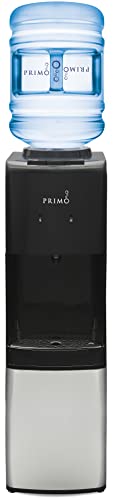
Primo Top Loading Hot Cold Room Temperature Water Dispenser
Primo has long been tied to bottle swaps at grocery stores, and its top loading dispenser mirrors that habit with a layout that most people understand at a glance. It adds a room temperature tap, so you can fill a pet bowl, a pot or a baby bottle without using the hot or cold side. Model codes differ by retailer, so confirm the exact code on the page.
Basic does not mean careless. The hot side normally has a push or lock arrangement that the maker describes in the manual, and that is the part to learn properly before you give anyone access to the machine. The listing is the place to check whether the temperature is adjustable, because that varies between versions.
Compared with bottom loading designs, the top loader has fewer moving parts and a simpler way to change the bottle, but you pay for that with a heavier lift. It is a sensible choice if you have strong help on bottle day.
It suits households that like a no fuss routine. Avoid it if you cannot comfortably raise a jug above waist height.
Brio Top Loading Water Cooler Dispenser CLTL520
Brio markets this top loading cooler for homes and small workplaces. It keeps the feature list tight: a cold tap, a hot tap and straightforward controls on the back panel. Confirm the model code on the listing, since Brio uses similar codes across several variants.
The value of a unit like this is that there is very little to go wrong. Many offices end up with complicated machines that no one wants to maintain. A simple cooler is easy to explain to a new employee, and a hot side lock is easy to point out. Keep the manual somewhere handy so anyone can look up the lock and the hot water switch.
The weaker side is that simple means fewer extras. Do not expect a built in filter, a night light or a self cleaning mode unless the listing says so. If you want those, look at more advanced lines.
It fits a break room, a garage workshop or a home study. Skip it if you want extra functions and a very modern look.
Brio Top Loading Water Cooler Dispenser CLTL520
Avalon A1 Bottom Loading Water Cooler A1BLWATERCOOLER
This Avalon is included here for a different reason than the top loaders. It keeps the same basic hot and cold arrangement, but the jug slides into a cabinet at the base. If your main frustration is lifting, a design like this keeps the plain feature list and removes the heavy part of the chore.
The maker lists hot and cold dispensing and a safety lock on the hot tap. Read how the lock is released, because some people will want it engaged all the time and others will find it inconvenient. The listing also shows the available colours.
The cost is a larger body and a little more internal machinery. The pump that raises water from the jug is another part that could need attention one day. You also need to leave enough clearance for the cabinet door.
It suits older adults, people with back concerns and busy families. Skip it if you want a short unit that fits under a cabinet.
Avalon A1 Bottom Loading Water Cooler Dispenser A1BLWATERCOOLER
Aquaverve Hot and Cold Countertop Water Dispenser
For a small kitchen where floor space is scarce, a countertop dispenser keeps the basics and removes the tall body. Aquaverve offers a hot and cold unit sized for a worktop. Read the listing for bottle compatibility, since the way you load it is an important part of daily life.
The advantage is size. It tucks beside a kettle, takes up very little room and suits one or two users. The drawback is that you lift a bottle higher than you would on a floor model, and a smaller reservoir may not keep up with a crowd.
Treat the hot tap with the same respect you would give a kettle. A unit on a worktop sits at a convenient height for small hands, so use the lock if the model has one and place it away from the edge of the counter.
Choose it for apartments and desks. Skip it if you need large capacity.
Aquaverve Hot and Cold Countertop Water Dispenser
Best Basic Pick for Kitchens
The Frigidaire EFWC498 is the one to consider if you want a cooler that looks like an appliance and keeps things simple.
Best for Offices
The Brio CLTL520 suits places where many people will use the machine and no one wants a complicated device to manage.
Best for Avoiding Lifting
The Avalon A1 keeps the basics while letting you slide the bottle in at the bottom of the cabinet.
Best for Tight Spaces
The Aquaverve countertop dispenser takes the smallest footprint of the five.
Hot Tap Locks and Hot Water Adjustment
Most hot and cold coolers include a lock on the hot tap, which usually requires a push or a press to release. This is a listed feature, not a promise of safety, and it does not replace supervision. Learn how it works before the cooler goes into daily use.
Some models also let you switch the heating off or adjust the hot water setting. Whether that is possible depends on the maker and the version, so check the manual. A switch on the back is the most common form, and turning it off when the machine is not needed can help reduce energy use. Locks that are stiff or worn should be reported to the seller rather than forced.
How to Choose
Begin with the way you load the bottle. Top loading units are simple but need a lift. Bottom loading units are easier on the back and take more space. Countertop units are compact but require you to place a heavy bottle higher up than normal.
Next, compare the tap arrangement. A basic cooler usually has red and blue taps, with the hot side protected. Look at the position of the taps and the height of the drip tray, since tall bottles and travel mugs do not always fit. Photos on the listing can help.
Consider the lock design. Some locks are a button, some are a pull, and some are a sliding catch. Read the description and the questions on the listing to learn how it feels to use. A lock you have to fight with will be left disengaged, which defeats the purpose.
Think about your own household. Homes with young children, pets or older relatives need careful placement and clear rules for the hot tap. A cooler on a busy hallway may be bumped, while one in a quiet corner is less exposed.
Finally, check the power. Cooling and heating both draw power, and a cooler should be plugged into a proper wall outlet. Avoid extension cords unless the manual allows them. Common errors include crowding the back vent, forgetting about the bottle brand and ignoring the lock until something spills.
Installation, Safety and Legal Notes
Read the manual first. Rinse and sanitise parts as directed, allow the unit to stand upright before powering it on if the maker asks for that, and keep it away from heat and splashes. Never operate it with a damaged cord.
Hot water can burn, so follow the maker’s instructions for the hot tap and the lock. A licensed electrician should handle any wiring issue. Rental homes, schools and offices may have their own rules about heating appliances, so check before you plug in.
Care and Troubleshooting
| Problem | Try this |
|---|---|
| Hot tap stiff | Check how the lock releases and wipe away residue |
| Cold water weak | Confirm the switch and clear the back vent |
| Water drips from tap | Close it fully and inspect the seal |
| Hot side does not heat | Check the switch and the outlet, then read the manual |
Wipe the outside and the drip tray often. Unplug the unit before cleaning the inside and follow the sanitising steps in the manual.
A Checklist Before You Buy a Water Cooler
A hot and cold dispenser sits in the open and works every day, so it pays to check the details before you commit. Go through the points below, and keep a note of the measurements and answers.
- Measure the floor or counter space, including the clearance the maker recommends behind and beside the unit.
- Decide whether you want a top-loading or bottom-loading design, and think about who will change the bottle.
- Check the type and size of bottle the dispenser accepts, and whether it is easy to buy refills where you live.
- Look at the safety features for the hot water tap, such as a lock, and how the lock operates.
- Find out where the nearest outlet is and whether the cord reaches without stretching.
- Check whether a drip tray, a cup holder or storage cabinet is included.
- Read the maker’s cleaning instructions, and make sure you can reach the parts that need regular attention.
Where there are children in the home, the safety features are worth extra thought, and the maker’s instructions should guide how you set the unit up.
Mistakes People Make With Water Dispensers
One common mistake is placing the unit where heat or direct sunlight can reach it. Follow the maker’s guidance on placement, and keep the back and sides clear so air can move around. Another is neglecting regular cleaning. Reservoirs, taps and drip trays can collect residue over time, so follow the maker’s schedule and use the products the manual recommends.
People also forget about the water source. Check the label on bottled water and store bottles as the supplier recommends. If you use filtered water, follow the maker’s instructions for the unit. Another slip is ignoring the hot tap. Hot water can scald, so use the safety lock as the maker describes, keep the unit away from where small children play, and teach everyone in the household how the lock works.
Finally, avoid leaving the unit on constantly if the maker suggests an energy saving or off mode when you are away. Always unplug the dispenser before cleaning, and let it cool first.
Comparing Top-Loading and Bottom-Loading Designs
| Feature | Top-loading | Bottom-loading |
|---|---|---|
| Bottle change | Lift and flip the bottle onto the top | Slide the bottle into a cabinet at the base |
| Appearance | Bottle is visible on top | Bottle is hidden for a tidier look |
| Effort | Needs lifting overhead | Lower lift, easier on the back |
| Cabinet space | Less internal storage | Cabinet space is used for the bottle |
If lifting is a concern for anyone who will use the cooler, a bottom-loading design may be appealing. If you simply want a straightforward unit, a top-loading model may be fine.
A Short Glossary of Dispenser Terms
| Term | Meaning |
|---|---|
| Reservoir | The internal tank that holds hot or cold water. |
| Child safety lock | A control that must be released before hot water can flow. |
| Drip tray | A removable tray that catches spills below the taps. |
| Compressor cooling | A cooling method that uses a refrigeration cycle. |
| Thermoelectric cooling | A different method that cools using an electrical effect, often in smaller units. |
| Standby mode | A setting that lowers power use when the unit is idle. |
For the specific meaning on a given model, consult the maker’s manual.
A Decision Guide by Setting
Home kitchens
Choose a model that fits your layout and keeps the bottle easy to change. A discreet appearance may matter if the unit sits in a visible spot.
Small offices
Think about the number of users and how often bottles will be changed. A cabinet or a clear schedule for refills can help.
Homes with young children
Prioritize safety locks and stable placement. Keep the cord out of reach, and follow the maker’s guidance on supervision.
Rental apartments
Check that the unit fits your space and can be moved easily when you leave.
Cleaning and Care Routine
Unplug the dispenser and empty the reservoirs as described in the manual. Clean the taps, the drip tray and the bottle area with products that the maker recommends. Rinse thoroughly and let parts dry before reassembly. Replace any filters on the maker’s schedule. If you notice leaks, unusual noises, odd smells or tripping circuit protection, stop using the unit and contact the maker or a qualified technician.
Placement, Power and Noise Questions
A dispenser quietly hums all day, so consider its sound and its location. Place it on a firm, level surface away from heat sources and out of direct sunlight, and keep the recommended gap around it. Check the outlet and avoid overloaded power strips, following the instructions in the manual. If the unit will stand in a quiet room, look at the maker’s information about cooling methods and noise, since compressor models and thermoelectric designs can differ in sound.
Think about the floor, too. A leak or spill can damage wood or carpet, so a small tray or mat under the unit can help. Keep the cord tidy and out of walkways.
Reading a Dispenser Listing Without Missing Details
Look past the headline features. Check the capacity of the hot and cold reservoirs, the bottle size supported, the type of controls and the way the safety lock works. See what the maker says about cleaning access and filter options, and what accessories are included. Find out about warranty length and coverage on the maker’s page, and check how easy it is to get parts such as drip trays and caps. If a detail is unclear, ask the seller before you order.
A Day With a Basic Cooler: What Ownership Actually Feels Like
Specification lists describe a cooler as a set of temperatures and tank sizes, but ownership is a rhythm of small moments: the first glass of cold water in the morning, the mug filled for tea without waiting for a kettle, the bottle swap that always seems to fall due on the busiest evening. Judging the models in this guide by that rhythm, rather than by their feature lists alone, gives a fairer picture of which one suits a given home.
- Morning: a cooler that has stood overnight delivers its coldest, freshest water first thing. Households that drink most of their water early will barely notice recovery time; households of grazers notice it all day.
- Mealtimes: filling several glasses in a row is the real test of a small cooler. A brief dip in coldness by the fourth glass is normal for basic models and matters only if it happens at every meal.
- Hot drinks through the day: the hot side earns its place in homes that make tea, coffee or instant meals repeatedly. In homes that boil a kettle once a day, the hot tank is mostly an energy cost and a safety consideration.
- Evenings: a cooler near living space should be quiet when the house is quiet. Compressor sounds that vanish into daytime noise can become the loudest thing in a still room.
- Bottle swap day: top loaders ask for a lift and a confident inversion; bottom loaders ask for cupboard space and a few minutes of crouching. Which chore you prefer is a legitimate deciding factor.
Reading reviews with this day in mind, rather than scanning for superlatives, is the quickest way to recognise the cooler that matches your household’s actual habits.
Hot Water Habits, Safety Locks and Peace of Mind
The hot tap is the feature that most distinguishes these coolers from a simple cold dispenser, and it is also the feature that deserves the most deliberate thought, particularly in homes with children, elderly relatives or forgetful moments. The safety lock fitted to the models in this guide is not decoration; it exists because the water behind it is hot enough to scald, delivered instantly, at a height small hands can reach.
Make the lock a habit rather than a hurdle. Adults should use the two-step action every time, without developing a workaround grip that a watching child can copy in one motion. When relatives or babysitters use the kitchen, show them the action once rather than leaving them to experiment, since a lock that confuses a guest tends to be forced, propped or complained about until someone looks for a way around it.
Placement helps as much as hardware. A cooler positioned where children pass constantly, at exactly hand height, invites fiddling; one placed a little away from the main traffic line, with the hot side understood and respected, causes no trouble at all. If the household genuinely never uses hot water, switching the hot function off where the model allows it, following the manual, removes the question entirely while saving a little energy.
For homes that do use it, the hot tank repays the respect: instant water for drinks, noodles, hot water bottles and a dozen small kitchen tasks, without a kettle’s wait or its clutter on the counter. The lock is simply the price of that convenience, and it is a fair one.
Taste, Freshness and the Simple Science of Stored Water
When cooler water tastes off, owners usually blame the machine, but the machine is often innocent. Water sits in two places, the bottle and the cooler’s internal tanks, and its taste reflects everything it has met: the source, the storage, the cleanliness of the taps and the age of what is sitting in the reservoir.
- Bottle storage sets the ceiling: a spare bottle kept in sunlight or beside strong-smelling products delivers water no cooler can improve. Shade, a cap and a clean store place come first.
- Stagnation dulls flavour: a cooler in a rarely used room, or a hot tank kept on for a household that never drinks hot water, holds water that sits. Regular use is itself a freshness strategy.
- Taps and drip trays tell the truth: a film around the taps or a neglected drip tray flavours every glass and signals that the cleaning routine has slipped. These are the parts to wash first when taste is questioned.
- New-bottle rinse: a fresh bottle benefits from the same rinse routine described in the care section, and the first glass from a newly cleaned cooler should be drawn and discarded as a matter of habit.
- Temperature changes perception: water that tastes flat is sometimes simply not cold. Check that the cold side is switched on and has had time to recover before investigating further.
The encouraging point is that taste problems are almost always curable with cleaning and rotation rather than replacement. A cooler that tastes stale is asking for an hour of attention, not for a successor.
Placement, Ventilation and the Coolers Quiet Needs
Basic coolers are forgiving appliances, but they have three quiet needs that placement decides: air around them, a level floor beneath them and a power socket sensibly reached. Meeting all three at the moment of installation prevents the slow problems, warmth, noise and nuisance, that owners otherwise chase for months.
Coolers with compressors shed heat and need space for air to move around their sides and back. A unit pushed tight into a corner or boxed in by stored items works harder, runs longer and may never reach its best cold. The manual for each model states its clearances; treating those as requirements rather than suggestions is the difference between a cooler that hums briefly and one that labours audibly all afternoon.
Level ground matters for quieter reasons. A cooler standing on an uneven floor or a flexing board can vibrate sympathetically, and a bottle seated on a slightly tilted cooler may seal imperfectly. A firm, level spot, away from the direct heat of an oven or a radiator, gives the machine its best chance of being forgotten about, which is the highest praise a basic appliance can earn.
Finally, think about the socket and the cable before the bottle goes on. The cable should reach without stretching across a walkway, and the switch should be reachable for the times you deliberately turn the hot side off. A cooler that is easy to switch, clean and refill is a cooler whose routine actually gets done.
Troubleshooting the Common Complaints
Most calls about basic coolers concern a small set of complaints, and most of those have a short list of causes worth checking before assuming a fault. Working through them calmly, in order, resolves the majority without tools or parts.
- Water not cold enough: confirm the cold switch is on, allow recovery time after a bottle change or heavy use, and check the ventilation space around the back and sides before suspecting the cooling system.
- Water not hot: the hot side often has its own switch, sometimes at the back where it is switched off during moving and forgotten. Check the switch and the lock action before anything else.
- Slow flow from a tap: look for a partly closed bottle seal, a blocked tap outlet or a bottle that has not seated fully. Flow problems are usually at the ends of the path, not the middle.
- A leak that appears and disappears: often a bottle with a hairline crack that leaks only as it empties and air enters, or condensation mistaken for a leak. Dry everything, then watch with the next bottle before condemning the cooler.
- Unusual noise: distinguish the normal compressor cycle from new rattles. Bottles or items touching the cabinet, and a cooler standing off level, explain most new sounds.
- A tripped household breaker: a cooler sharing a circuit with a kettle or microwave may simply be part of an overloaded moment. Note what else was running before blaming the appliance.
Anything involving burning smells, visible damage or repeated electrical tripping is different in kind: switch off, unplug, and have the unit looked at properly. Ordinary complaints reward patience; electrical ones reward caution.
Sharing a Cooler Well: Families, Housemates and Small Offices
A basic cooler in a shared space succeeds or fails on small agreements. Whoever refills, cleans and notices the empty bottle is usually whoever cares most, and shared coolers stay pleasant when those jobs are named rather than assumed.
In families, the routine is simple: the person who takes the last full glass says so, and the spare bottle lives in an agreed place. In housemates’ kitchens, adding the bottle to the shared shopping rhythm prevents the standoff of an empty cooler that everyone uses and nobody owns. In a small office, one named person with a deputy, a standing arrangement for bottles and a drip tray emptied on a rota will keep the cooler an asset rather than a grievance.
Shared hot water deserves one extra agreement: the lock stays in use, and nobody wedges or tapes it for convenience. Offices that would not dream of disabling a safety feature on any other appliance sometimes treat a cooler’s lock casually, and a basic model with a proper lock, used properly, is the right answer to that temptation. With those small agreements in place, the unglamorous cooler becomes what it should be: the most quietly appreciated appliance in the building.
Hot Tap Water in the Kitchen: Uses and Honest Limits
Owners of hot and cold coolers quickly build a small repertoire around the hot tap: drinks, instant noodles and soups, warming a mug before coffee, loosening a jar lid under a brief stream, starting a pan faster than a cold tap would. Used this way the hot side is a genuine convenience, woven through the day in seconds-long tasks that a kettle would serve more slowly and with more clutter.
Its limits deserve equal clarity. Cooler hot water is hot tap water, not a kettle’s rolling boil, and tasks that specifically call for freshly boiled water should still meet a kettle. That distinction matters most for anything where guidance specifies boiled water, such as preparing feeds for infants, where parents should follow the current official guidance and their health professionals’ advice rather than treating any appliance’s hot tank as a substitute. It also matters for cooks who care about the difference in a delicate tea or a recipe that assumes boiling water at the moment of pouring.
Understood that way, the hot tap neither disappoints nor overpromises. It is instant, very hot water for the hundred small jobs that do not require a boil, delivered through a lock that keeps it safe, and the households that use it most are simply the ones whose days contain many of those small jobs.
Filters, Bottles and the Question of What Is in the Water
Basic coolers are sometimes criticised for lacking the filtration of fancier machines, and sometimes praised for exactly the same simplicity. The honest position is that a bottled cooler delivers the water that was put into the bottle, no more and no less, so the filtration question is really a question about your source rather than about the dispenser.
Households happy with their bottled supply need nothing further; the cooler is a temperature and dispensing device and performs that role without interference. Households whose water comes from a source they filter, or who refill bottles from a filtered tap, have already made their filtration decision upstream. What a basic cooler does not do is rescue a supply the household distrusts, and a buyer whose main concern is filtration should be shopping for a filter or a plumbed, filtered dispenser rather than expecting a basic bottled model to be something it is not.
The maintenance angle cuts the other way in the basic models’ favour. There are no filter cartridges to remember, date and replace, and no risk of an exhausted filter quietly ceasing to do the job it is trusted for. Simplicity is a feature with real value, provided it is chosen knowingly, which is the purpose of raising the question here at all.
Serving Guests, Elderly Relatives and Anyone New to the Cooler
A cooler is a household appliance that guests are expected to use without instruction, and mostly they can, but two features regularly defeat newcomers: the hot tap lock and the bottom loader’s hidden bottle. A host who explains each in one sentence saves the guest the embarrassment of tugging at a locked tap or reporting the cooler broken when its bottle is simply out of sight and empty.
For elderly relatives and anyone with limited grip or strength, the taps themselves are the question. Lever-style taps that can be pressed with the side of a hand or the weight of a glass are kinder than small buttons or squeeze mechanisms, and a glass placed on the tray beneath the tap should be stable without being held throughout the fill. If a particular relative visits often and struggles, that observation belongs in the choosing process for the next cooler, alongside temperatures and tank sizes.
Children as guests combine both points: they are new to the machine and they are exactly whom the hot lock exists for. Show them the cold tap, settle the hot tap as adults-only equipment, and the cooler becomes a small pleasure of the visit, the novelty of helping themselves to cold water, rather than a worry at the edge of the kitchen.
Seasons: Summer Peaks and Winter Habits
A basic cooler’s workload follows the year. Summer brings the obvious peak: more cold water, more often, with bottles emptying faster and recovery times showing at family meals and garden days. Planning follows naturally: keep the spare bottle filled and stored in shade before the hot week arrives, and accept the fourth glass at a barbecue being a little less cold as the physics of a small machine rather than a fault.
Winter reverses the balance. Hot drinks multiply, the hot tank becomes the busier side, and cold water may sit longer in a household drinking less of it, which is a freshness argument for the cleaning and rotation routine rather than for leaving water to age. Dry indoor air from heating also makes hydration easier to forget; a visible cooler in the kitchen is a quiet prompt that many households genuinely value in the dark months.
Holidays compress both patterns into a few days of guests, cooking and constant small demands. The cooler that has been cleaned, stocked and checked before the guests arrive will simply cope, and that small preparation belongs on the same list as the spare towels and the extra chairs.
Renting, Borrowing and Second-Hand Coolers
Not every basic cooler is bought new, and the alternatives deserve a word. Rented and subscription arrangements bundle the machine with bottle supply and servicing, which suits households that value the absence of errands over the arithmetic of ownership; the models in this guide indicate the class of machine such services typically provide, and the choosing criteria apply unchanged. What matters is reading the arrangement itself: what happens when the machine faults, who cleans it, and how the bottles are supplied.
A second-hand cooler can be a sensible purchase, with conditions. It should be cleaned thoroughly before its first use in your home, following the maker’s guidance, with particular attention to the reservoir, taps and drip tray, since its history is unknown. Check the hot lock works, the taps do not drip, the cable is sound and the bottle seating is undamaged. A machine that passes those checks and chills and heats as it should has years to give; one that fails any of them is not a bargain at any price, because water, heat and electricity in one cabinet deserve equipment in honest condition.
Whichever route brings the cooler home, the destination is the same: a simple machine, understood, cleaned and placed well, quietly providing the two temperatures a household asks for most. That is the whole promise of the basic category, and the models above were chosen because they keep it.
One Year On: the Costs and Chores Nobody Mentions
Choosing a cooler is usually argued on features, but ownership is argued on the year’s accumulation of small costs and chores, and a fair preview of them helps a buyer choose with open eyes. None of them is large; together they are the actual texture of living with the machine.
The consumable is the water itself, arriving by whichever route the household chooses: collected, delivered or exchanged. Each route has its own rhythm of effort, and the honest comparison between models in this guide should include the route the household will actually use, since a bottom loader’s convenience is worth most to a household that swaps bottles weekly and least to one visited by a delivery service that does the lifting. Electricity is the quiet second cost, modest for the cold side and more noticeable for a hot tank kept ready around the clock; households that switch the hot side off when it will not be used for days, as their manual allows, will see the difference without ever missing the feature.
The chores are the cleaning routine, the drip tray, the bottle store and the occasional inspection underneath for the first signs of a leak. Budget them honestly at a few minutes a week and a longer session a few times a year, and compare that with the chores of the alternatives: descaling a kettle, washing a fridge jug, or queuing for a shared kitchen’s tap. Most owners conclude that the cooler asks no more than its rivals and returns more, which is why the category endures.
Finally, the year’s end is the moment to ask the only question that matters about any basic appliance: knowing what you now know, would you place the same machine in the same spot and use it the same way? For a cooler chosen by the criteria in this guide, placed with ventilation and level ground, cleaned on its simple schedule and understood by everyone in the house, the answer is almost always yes, and the machine settles into the background of the home’s life, which is where the best basic appliances have always lived.
What to Do in the First Week With a New Cooler
A new cooler settles into a household best when its first week is treated as a short trial rather than as an installation followed by forgetting. The maker will direct an initial cleaning and flushing before the first drink, and that direction should be followed exactly, since a new reservoir and new pipework carry the tastes of their manufacture. Expect the first bottle to taste faintly of the machine’s newness even after flushing, and expect that taste to be gone entirely by the second.
Use the week to learn the machine’s actual behaviour in your home rather than its behaviour on a specification sheet. Notice how long the cold side takes to recover after the morning rush, whether the hot tank’s rhythm suits the household’s drinks, and where the sound of the cooling cycle lands in the quiet of the evening. Adjust the small things while they are still new habits: the cooler’s exact position for ventilation and reach, the place where the spare bottle lives, the person whose job the drip tray is. Check underneath twice in that first week, not from anxiety but from method, since a connection that is going to weep usually announces itself early, when it is a trivial adjustment rather than a damaged floor.
By the second week, a basic cooler should have achieved the condition this guide keeps describing as success: it should have stopped being a subject of conversation. Temperatures are trusted, the lock is a reflex, the bottle routine is known, and the machine has joined the kettle and the fridge in the category of things a household simply uses. Everything in the choosing sections exists to buy that unremarkable outcome, and the first week’s small attentions are how it is collected.
Frequently Asked Questions
What is a hot tap lock?
It is a button or catch that must be pressed before hot water flows. It is a listed feature on many models.
Can I adjust the hot water temperature?
Some models allow it and some only switch the heater on and off. Check the listing and manual.
Do basic coolers need a filter?
No. These models are bottle fed. If you want filtration, look at a different type of product.
Which layout is easiest to live with?
It depends on your strength and space. Bottom loading is gentler on the back, countertop saves room.
Can I switch off the cold side only?
Many units have separate switches for hot and cold, but confirm that on the page.
Is it safe to leave the cooler on all day?
Makers usually allow it, though turning heating off while away is common. Follow the manual.
Bottom Line
A basic hot and cold cooler should be easy to understand and easy to maintain. The Frigidaire looks like a kitchen appliance, the Primo adds a room temperature tap, the Brio keeps things plain, the Avalon removes lifting and the Aquaverve saves space. Check each listing, learn the hot tap lock properly and follow the maker’s instructions for use.