Disclosure: topratedkitchenware.com is reader-supported. When you buy through links on our site, we may earn an affiliate commission from Amazon and other retailers, at no extra cost to you.
Where to buy
Every pick in this guide to the best blenders under 20 is listed on Amazon, where you can check the latest price on Amazon and confirm the exact variant before ordering. One rule matters more at this tier than any other: treat $20 as the band this guide shops in, and verify the current figure on the listing itself, because prices and variants at the very bottom of the market move fast. The short list:
- Hamilton Beach Portable Blender 14 oz, Raspberry — Best Corded Reliability. Check on Amazon
- Ganiza Smoothie Blender Set — Most Complete Kit.
- Cberhrik Personal Travel Blender — Best for Travel Bags.
- Turelar Smoothie Blender — Best Two-Cup Routine.
- Sleetop Portable Blender, Black — Best Rechargeable Features.
- Sleetop Portable Blender, White — Best Second Unit / Color Pick.
Read the full guide ↓ for the honest version of what the lowest tier does well, what it cannot do, and how to pick the one whose limits you will never meet.
Let us set the frame for the best blenders under 20 before a single pick is named, because this tier is shopped badly more often than any other. At the bottom of the market, a blender is a single-serving tool: a personal cup, a small motor, one drink at a time. Every verified pick in this guide lives in that format — corded personal blenders from Hamilton Beach and Ganiza, and compact rechargeable portables from Sleetop and Cberhrik. Judged as what they are, several are genuinely good purchases. Judged as miniature versions of full-size machines, all of them will disappoint you, and the disappointment will be the expectation’s fault, not the blender’s.
So this guide does two jobs. It matches six verified machines to the routines they actually serve — the home smoothie, the household queue, the gym bag, the dorm shelf — and it draws the tier’s boundary lines in ink: no hot liquids, no family batches, no freezer-hard loads without liquid help, and at this end of the market, a standing instruction to confirm the exact variant and current figure on the listing before money moves. Readers who find the boundary lines too tight are not wrong; they are shopping the wrong tier, and the guide’s closing sections point at the step-up logic honestly, including the wider context at Best Blenders Under $30 and Best Blenders Under $40.
Key Takeaways
- This tier is personal-format only: one serving, small motor, cup-based blending. Buy it for that job and it delivers.
- The corded Hamilton Beach is the reliability pick — no battery, no charging, no fading power.
- The rechargeable Sleetop pair trades force for freedom: gym, office, and travel blending with USB-C charging and an LED display.
- The Ganiza set is the household outlier: three cups, two sizes, and the strongest power class in the guide.
- Two picks are one Sleetop model in black and white — disclosed openly; choose on finish, not imagined performance.
- At this tier, verify the exact variant and current price on the listing before ordering. Figures here move too fast for any guide to print honestly.
In this guide
Quick Picks
| Pick | Badge | Headline spec |
|---|---|---|
| Hamilton Beach Portable Blender 14 oz, Raspberry | Best Corded Reliability | Capacity: 14 oz travel jar (blends and travels in the same jar) |
| Ganiza Smoothie Blender Set | Most Complete Kit | Power: 900 watts peak power |
| Cberhrik Personal Travel Blender | Best for Travel Bags | Capacity: 380 ml BPA-free cup |
| Turelar Smoothie Blender | Best Two-Cup Routine | Cups: two 16.9 oz to-go cups |
| Sleetop Portable Blender, Black | Best Rechargeable Features | Capacity: 17 oz |
| Sleetop Portable Blender, White | Best Second Unit / Color Pick | Capacity: 17 oz |
How These Picks Were Chosen
This is a research-led guide built for the lowest tier’s realities. We shortlisted personal and portable blenders whose verified listings fit the band’s format, then verified every product through the Amazon Creators API: capacities, blade counts, charging systems, cup counts, and included parts in each review come from the verified listing data, and only API-confirmed products carry Amazon links and images in this guide. Where a listing publishes thin data — the Cberhrik entry is the clearest case — the review says so and keeps its claims to what the listing supports.
Three tier-specific standards shaped the final six. First, format honesty: no pick is presented as anything but a single-serving machine. Second, variant honesty: the two Sleetop listings are one model in two finishes, and the guide labels them as siblings rather than manufacturing a fake distinction — the same standard we apply whenever a pool contains color variants. Third, price honesty: this guide prints no static product prices at all. The band in the keyword is a shopping frame, listings at this level change figures and configurations frequently, and the only durable advice is to confirm the current figure for the exact variant on Amazon before ordering. Any guide that prints a confident price for the bottom tier is printing a number with a short life.
We weighted routine fit over specification drama throughout, because at this tier the difference between a blender that gets used daily and one that gets returned is almost never a spec — it is whether the machine’s limits sit outside the owner’s actual routine. The questions readers ask at adjacent tiers, visible in searches like Best Blenders Under $30 Usd, are the same ones we pressed here: what does it blend, how big is the serving, and what breaks first?
The 6 Best Blenders Under $20 for Single-Serving Routines

Hamilton Beach Portable Blender with 14 oz Travel Jar (Raspberry)
Badge: Best Corded Reliability
Strengths
- Corded power: no battery to charge, fade, or replace — it works at full strength every single time
- An established brand’s long-running design, with the blend-in-the-jar routine reduced to its simplest form
- The jar is the cup: blend, swap the blade base for the travel lid, drink — one vessel to wash
Trade-offs
- 14 oz is one modest serving, and there is no second cup in the routine
- 300 watts peak is a soft-load figure: frozen fruit needs liquid leadership and modest portions
- Corded means kitchen-bound — this is not a gym-bag blender
Key specs (from the verified listing)
- Capacity: 14 oz travel jar (blends and travels in the same jar)
- Power: 300 watts peak power, corded
- Blades: durable stainless steel
- Jar and lid: BPA free
- Model: 51131G, Raspberry finish
At the lowest tier of the blender market, the most valuable feature is not power or capacity — it is the absence of failure modes. This Hamilton Beach design has exactly one job and very few ways to fail at it: a corded 300-watt peak base, stainless steel blades, and a 14 oz BPA-free jar that you blend in and then drink from after swapping the blade base for the travel lid. No battery to forget, no charge to fade mid-blend, no app, no modes. For readers shopping the best blenders under 20, that simplicity is not a stripped-down compromise. It is the tier’s most rational design.
Performance is honest personal-blender performance. Fresh fruit, banana, berries, yogurt, and protein powder blend into a smooth drink; lightly frozen ingredients work when liquid leads and portions respect the jar. A dense, freezer-hard load will stall it, and the correct response is ratio — more liquid, smaller frozen pieces — not force. Readers who understand that bargain get a machine that does its one job dependably for a long time.
Choose this pick if your blending happens at a kitchen counter, your serving is one, and your priority is a blender that simply works every morning. Choose a rechargeable pick below if the blending happens anywhere else.
Best for: one daily smoothie or shake at home, with zero charging and minimal washing / Not suited for: travel blending, big servings, or heavy frozen loads

Ganiza Smoothie Blender 14-Piece Personal Set
Badge: Most Complete Kit
Strengths
- Three cups in two sizes is the most complete serving setup in this guide — a household can blend in sequence without washing between drinks
- The 900-watt peak figure is the strongest power class here, and frozen fruit meets the least resistance
- The 24 oz cup fits a genuine meal-size smoothie that the smaller vessels in this guide cannot
Trade-offs
- At this tier, kit listings and variants shift — confirm the exact configuration and the current figure on the listing before ordering
- Fourteen pieces means fourteen pieces to store and wash; small kitchens feel it
- Peak power is a class indicator, not a cross-brand laboratory measurement
Key specs (from the verified listing)
- Power: 900 watts peak power
- Cups: three portable cups — one 24 oz and two 17 oz
- Set: 14 pieces including cups and accessories (per listing)
- Materials: BPA-free cups
- Extras: recipe included (per listing)
The Ganiza set is the maximalist outlier of this tier: a 900-watt peak-power base with a 14-piece kit and three BPA-free cups — one 24 oz and two 17 oz. Where the other picks in this guide strip blending to a single vessel, Ganiza bets on the opposite insight: in multi-person households, the bottleneck is never the motor, it is the single dirty cup standing between servings. Three cups end that queue, and the large cup covers meal-size builds the 14–17 oz vessels here cannot attempt.
Two honesty notes, because this tier demands them. First, peak-power figures are class indicators; read 900 watts peak as “the strongest class in this guide,” which matches how the machine handles frozen fruit in practice, not as a precision measurement. Second, at the lowest end of the market, listings, bundles, and variants change quickly — the verified listing behind this review is the 14-piece, three-cup configuration described above, and you should confirm the configuration on the listing matches it before ordering, along with the current price, since this guide prints no static figures.
As one of the best blenders under 20 for a household rather than an individual, the Ganiza earns its place on cups and capability. Solo minimalists should take the Hamilton Beach or a rechargeable pick and enjoy the empty counter instead.
Best for: households blending several different drinks, and meal-size servings / Not suited for: minimalists, tiny kitchens, or buyers who will not verify the listing configuration

Cberhrik Personal Travel Portable Blender, 380 ml
Badge: Best for Travel Bags
Strengths
- The smallest blender in this guide — it fits the bag, locker, and shelf spaces the others cannot
- 380 ml is honestly sized for a light smoothie, a juice-style drink, or a protein shake
- Travel-first simplicity: very little to pack, assemble, or wash
Trade-offs
- The verified listing is the least detailed in this guide, so buy it for its size, not for specifications it does not publish
- 380 ml cannot hold a meal-size smoothie
- Mini format means mini loads — frozen ingredients belong in small, liquid-led amounts
Key specs (from the verified listing)
- Capacity: 380 ml BPA-free cup
- Format: mini personal travel blender for shakes and smoothies
- Use: sports, travel, and home (per listing)
- Design: compact, high-speed mixing (per listing)
This guide’s credibility rule applies here in full: the verified listing for this Cberhrik mini blender publishes the least detail of any pick in the pool — a 380 ml BPA-free cup, a compact travel format for shakes and smoothies across sports, travel, and home use, and general high-speed mixing language without a fuller spec sheet. We include it for the one attribute that needs no spec sheet to verify: it is the smallest blender in this guide, and for some readers size is the entire decision.
The use case writes itself. A protein shake in a gym locker room, a light smoothie in a dorm, a juice-style drink in a hotel room or a camper — contexts where the alternative is not a bigger blender but no blender. The 380 ml cup is a true small serving, and loads should match the format: fresh and soft ingredients, modest frozen content, liquid leading. Ask it to behave like a countertop machine and it will decline; ask it to be the blender that fits, and it does its job.
Among the best blenders under 20, this is the portability extreme of the tier. If your counter has room and your servings are full-size, the corded Hamilton Beach or the two-cup Turelar will serve you better every day of the week.
Best for: travelers, students, gym bags, and the tightest spaces / Not suited for: meal-size servings, frozen-heavy recipes, or spec-driven buyers

Turelar Smoothie Blender with Two 16.9 oz To-Go Cups
Badge: Best Two-Cup Routine
Strengths
- Two matched 16.9 oz cups remove the wash-between-servings bottleneck for twice-a-day or two-person routines
- 16.9 oz is a full, satisfying serving — the most generous standard cup size among the single-base picks here besides the Ganiza large cup
- Positioned for shakes, frozen drinks, and light food prep, with recipe material included
Trade-offs
- The listing is lighter on motor detail than the branded listings here, so frozen-load expectations should stay moderate
- Two cups is still a two-serving ceiling before washing joins the routine
- Personal-format rules apply throughout: no hot liquids, no crowd batches
Key specs (from the verified listing)
- Cups: two 16.9 oz to-go cups
- Format: single-serve personal smoothie maker
- Use: shakes, frozen drinks, and food prep (per listing)
- Materials: BPA-free
- Extras: recipe included (per listing)
The Turelar’s design insight is about rhythm rather than force. Two matched 16.9 oz BPA-free to-go cups mean a morning smoothie and an afternoon shake — or two people’s different drinks — never queue behind a wash cycle. At the lowest tier, that second cup is worth more than marginal motor differences, because the thing that actually ends blending habits is friction, and a dirty single cup is friction in its purest form. The listing positions the machine for shakes, frozen drinks, and light food prep, and includes recipe material to calibrate ratios from day one.
The honest caveat is specification depth: the verified listing publishes less motor detail than the Hamilton Beach or Ganiza listings, so we recommend buying this pick for its routine design and treating it as a shakes-and-standard-smoothies machine — fresh fruit, protein drinks, moderate frozen content with proper liquid — rather than the frozen-load specialist of the guide. Buyers whose smoothies always start with a heaped cup of freezer-hard fruit should choose the Ganiza’s power class instead.
For the large middle of readers — two servings a day, standard recipes, a small budget — this is one of the best blenders under 20 on pure routine fit, and the calmest purchase in the guide.
Best for: twice-a-day drinkers and two-person households on a minimal budget / Not suited for: frozen-heavy smoothies or buyers who want fully published motor specs
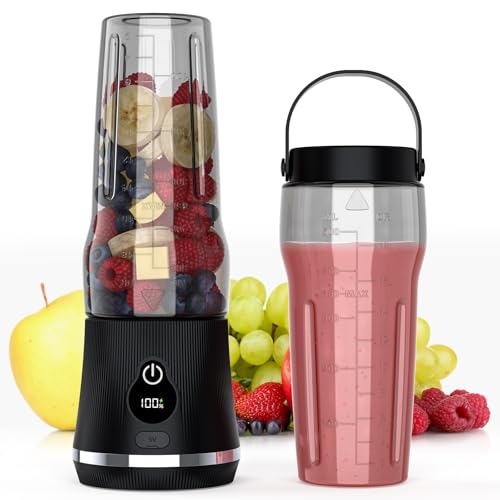
Sleetop Portable Blender, 17 oz, USB-C Rechargeable (Black)
Badge: Best Rechargeable Features
Strengths
- USB-C rechargeable and cordless: blends at the gym, the office, or on the road with no outlet
- Six stainless blades and an LED display are genuinely fuller features than this tier usually offers
- An extra lid in the box covers the lose-a-lid failure that strands portable blenders
Trade-offs
- Battery power is for shakes and soft smoothies — hard frozen loads are outside the format
- Cordless ownership means charge discipline; an uncharged blender blends nothing
- 17 oz is one serving, and the motor base makes it heavier than a plain bottle
Key specs (from the verified listing)
- Capacity: 17 oz
- Blades: 6 stainless steel blades
- Power: USB-C rechargeable
- Display: LED display
- Extras: extra lid included (per listing)
- Use: gym, office, and on-the-go (per listing)
- Color: Black
The Sleetop is what the lowest tier looks like when it aims at features instead of stripping them away: a 17 oz personal blender with six stainless steel blades, USB-C recharging, an LED display, and an extra lid in the box, built for the gym, the office, and everywhere on-the-go. The display is a small thing that matters — knowing the charge state before you leave removes the portable blender’s classic failure, the dead battery discovered at the worst moment — and the spare lid quietly solves the second classic failure, the lost lid.
Keep the physics in view. A rechargeable motor in this class blends shakes, protein drinks, and soft smoothies well; it is not a frozen-fruit machine, and this guide will not dress it up as one. Banana, berries, powder, and liquid are its home ingredients. Within that lane, the cordless freedom is real: the smoothie is made where it is drunk, fresh, in about the time a kettle takes to be missed.
As one of the best blenders under 20 for mobile routines, the black Sleetop is the feature pick of the rechargeable pair in this guide — and yes, pair: the next pick is its sibling in white, disclosed openly rather than disguised as a different machine.
Best for: gym, office, and travel blending with modern charging and a charge display / Not suited for: frozen-fruit smoothies or anyone who will not maintain a charging habit

Sleetop Portable Blender, 17 oz, USB-C Rechargeable (White)
Badge: Best Second Unit / Color Pick
Strengths
- Identical verified specification to the black model — choose purely on finish, availability, or as a second unit
- A white unit is visibly distinct in shared households and shared gym bags: no mix-ups, no borrowed-by-mistake
- Same USB-C charging, LED display, six-blade setup, and extra lid as its sibling
Trade-offs
- It is a color variant, not an upgrade — performance expectations should be identical to the black model
- White finishes show smoothie stains more readily and reward prompt rinsing
- All cordless trade-offs apply equally: soft loads, charge discipline, one serving
Key specs (from the verified listing)
- Capacity: 17 oz
- Blades: 6 stainless steel blades
- Power: USB-C rechargeable
- Display: LED display
- Extras: extra lid included (per listing)
- Use: gym, office, and on-the-go (per listing)
- Color: White
This guide lists the white Sleetop separately for the same reason it would list any sibling variant openly: it is a separate verified listing with an identical specification — 17 oz capacity, six stainless steel blades, USB-C recharging, LED display, extra lid included — in a different finish. Anything else would be padding disguised as research, and this site does not publish that. What differs is real but modest: appearance, visibility in a shared bag or household, and the practical option of owning one of each color so two people’s blenders never get confused.
Everything in the black model’s review applies here without alteration: shakes and soft smoothies are the lane, the display supports the charging habit, the spare lid covers the classic loss, and frozen-heavy recipes belong to a corded machine. The one finish-specific note is cosmetic honesty — white shows berry and turmeric stains more than black does, so the rinse-immediately habit matters slightly more, and in exchange the unit is easier to spot in a dark gym bag.
Choose between the two Sleetops on finish and listing availability alone. Choose a Sleetop at all when your blending life is mobile; choose the corded picks above when it is not.
Best for: buyers who prefer the white finish, or a color-coded second unit for a partner / Not suited for: anyone expecting different performance from the black model — it is a sibling, not a step up
Comparison Table
| Pick | Badge | Key specs | Amazon |
|---|---|---|---|
| Hamilton Beach Portable Blender 14 oz, Raspberry | Best Corded Reliability | 14 oz travel jar (blends and travels in the same jar); 300 watts peak power, corded; durable stainless steel | Check on Amazon |
| Ganiza Smoothie Blender Set | Most Complete Kit | 900 watts peak power; three portable cups — one 24 oz and two 17 oz; 14 pieces including cups and accessories (per listing) | Check on Amazon |
| Cberhrik Personal Travel Blender | Best for Travel Bags | 380 ml BPA-free cup; mini personal travel blender for shakes and smoothies; sports, travel, and home (per listing) | Check on Amazon |
| Turelar Smoothie Blender | Best Two-Cup Routine | two 16.9 oz to-go cups; single-serve personal smoothie maker; shakes, frozen drinks, and food prep (per listing) | Check on Amazon |
| Sleetop Portable Blender, Black | Best Rechargeable Features | 17 oz; 6 stainless steel blades; USB-C rechargeable | Check on Amazon |
| Sleetop Portable Blender, White | Best Second Unit / Color Pick | 17 oz; 6 stainless steel blades; USB-C rechargeable | Check on Amazon |
How to Choose at the Lowest Tier: Fit Before Features
The first decision is power source, and it is really a decision about where blending happens. Corded picks — the Hamilton Beach and the Ganiza — blend at a counter, at full strength, forever, with no battery in the story. Rechargeable picks — both Sleetops and the travel-first Cberhrik — blend wherever you are, at battery strength, for as long as your charging habit holds. Neither is better; they are answers to different geographies. The most common regret at this tier is buying a cordless blender for a kitchen routine (and resenting the charging) or a corded blender for a gym routine (and never using it). Name your geography first.
The second decision is servings per session. One drink, one person: the Hamilton Beach jar, a Sleetop, or the Cberhrik mini all fit, and the choice returns to geography. Two drinks or two people: the Turelar’s twin cups or the Ganiza trio prevent the wash-between-servings stall. A meal-size smoothie points at exactly one vessel in this guide, the Ganiza’s large cup. Trying to stretch a 14 oz jar into a two-person routine is the classic false economy of this tier — the savings are real and so is the daily annoyance, and the annoyance wins.
The third decision is load honesty. Soft ingredients and shakes succeed everywhere here. Moderate frozen content succeeds with liquid-led loading in the corded picks and the stronger personal bases. Dense frozen builds succeed nowhere in this tier without compromise, and readers whose daily smoothie is a cup of freezer-hard fruit should read that sentence twice before ordering anything on this page — their tier is a step up, and guides like Best Blenders Under $50 Dollars describe where personal blending starts to gain real frozen authority, while Best Blenders Under $200 Dollars marks where full-size formats enter the conversation.
Finally, apply the tier’s standing check: before ordering, open the listing, confirm the variant and configuration match what the review described, and confirm the current figure sits where your budget expects. Listings at the bottom of the market are living documents — bundles change, colors rotate, figures drift — and thirty seconds of verification is the difference between the machine this guide reviewed and a stranger with a similar name.
How to Get a Good Blend From a Small Blender: Technique and Care
Small blenders reward technique that big machines forgive, and three habits decide most outcomes. First, loading order: liquid first, then soft ingredients, then anything frozen last and on top. Liquid at the blades creates the vortex that pulls the load down; frozen weight on top feeds the load into that vortex as blending starts. Second, portion discipline: fill to the vessel’s line and no further, because a sealed, overfilled cup cannot circulate — most “weak blender” verdicts at this tier are overfilled-cup verdicts. Third, pulsing: short bursts let a thick load settle and re-form its vortex, clear stalls faster than one long run, and spare small motors the heat of straining against a stuck blend.
Ratios are the other half of the craft. A dependable starting point is roughly one part liquid to one part solids for a drinkable smoothie, with frozen shares kept modest in the rechargeable picks. When a blend stalls, the fix is a splash of liquid and a pulse, not a longer run. For green smoothies in small cups, blend the leaves with the liquid alone for a few seconds before adding the rest; the greens liquefy first and the finished drink is smooth rather than speckled.
Care is quick and worth ritualizing. Rinse the blade base and cup immediately after use — dried smoothie in a gasket is the source of nearly every lingering smell in personal blenders, and at this tier the gasket is the part you most want to protect. Wipe motor bases with a damp cloth rather than rinsing them, let cups dry with lids off, and inspect seals and threads weekly. A small blender treated this way outlasts its price class by years; one left unrinsed in a gym bag will smell like it within a month.
Troubleshooting
Problem: the motor runs but nothing at the top of the cup moves → the load is too thick or the cup is overfilled. Add a splash of liquid, reduce the fill, and pulse until a vortex forms.
Problem: a rechargeable pick dies mid-blend or weakens across the week → the charging habit, not the motor, is the usual story. Recharge after use rather than before need, and use the LED display on the Sleetop models to check state before leaving.
Problem: leaks at the seal → wipe the rim before closing, seat the gasket flat, and check the fill line; a smear of smoothie on the threads breaks more seals than any manufacturing flaw.
Corded vs Rechargeable at This Tier: The Honest Split
Because three of this guide’s six picks plug in and three run on batteries, the split deserves its own plain accounting. Corded power is constant: the Hamilton Beach blends its hundredth smoothie with the same strength as its first, and the Ganiza’s stronger class is available on every single use. There is no battery to age, and a corded personal blender’s lifespan is mostly a story of gaskets and cups. The price of that constancy is geography — the blender’s world is the length of its cord, and for kitchen routines that price is zero.
Rechargeable power is freedom with a meter running. The Sleetops and the Cberhrik mini blend in locker rooms, offices, parks, and passenger seats, and that freedom is the entire reason their owners blend more often than they would with a home machine. The meter is twofold: per-charge capacity, managed by a simple recharge-after-use habit, and long-term battery aging, which no rechargeable appliance escapes. Buyers who understand they are purchasing a few years of location freedom, rather than a decade of counter service, are consistently the happy ones. The unhappy ones bought a battery blender for a counter routine, or a counter blender for a travel life — the geography error again, wearing two different costumes.
When to Step Up a Tier Instead
An honest lowest-tier guide should name its own exits. Step up if your smoothie is a meal and a 14–17 oz serving leaves you hungry — vessel size, not willpower, is the constraint, and larger personal formats live one tier up. Step up if frozen fruit is the foundation of every blend rather than an ingredient in it; the stronger personal bases in guides like Best Blenders Under $300 territory and the mid-band personal machines handle freezer-hard loads as a routine rather than a negotiation. Step up, without hesitation, if hot blending, family batches, or nut butters appear in your week at all — no tier of personal blender claims those jobs, and pretending otherwise wastes the one purchase this guide is trying to get right.
Staying is equally respectable. A huge number of households blend one soft smoothie or shake a day, in one place, for one person — and for them the machines in this guide are not a compromise awaiting an upgrade. They are the correct tool, bought at the correct scale, and the money not spent is not a gap in the kitchen. It is just money not spent.
Durability Realism: What Longevity Looks Like at the Bottom of the Market
Buyers at this tier often ask the wrong durability question — “will it last forever?” — when the useful question is “what will its life look like, and what ends it?” A budget personal blender used within its format is not a disposable object. Corded bases in particular have very little to wear out: a motor, a switch, a blade assembly. Used with sensible loads and rinsed gaskets, the Hamilton Beach pattern of machine serves for years, and its most likely end is a cracked cup or a perished seal, both of which are wear items rather than verdicts on the machine.
Rechargeable models carry one additional clock: the battery. Every rechargeable appliance’s battery loses capacity across charge cycles, gradually shortening the blends-per-charge figure until the routine outgrows it. That is not a defect or a scandal; it is the chemistry every cordless product shares, from phones upward. The practical translation is to buy a rechargeable pick for a defined chapter of life — a degree, a gym phase, a travel-heavy job — and to treat anything beyond that chapter as a bonus. Buyers who frame it that way are satisfied; buyers who frame a battery blender as a lifetime purchase are scheduling their own disappointment.
Across both power types, longevity is mostly behavior. Motors die from straining against dry, overloaded cups far more often than from honest use; seals die from dried smoothie and overfilled threads; cups die from drops and dishwasher heat they were not rated for. The care section above is therefore not garnish — at this tier it is the difference between a blender that serves for years and one that serves for a season, and it costs about twenty seconds a day.
Who Each Pick Serves: A Quick Matching Guide
Compressed to one pass, the matching logic of this guide runs as follows. The home traditionalist — one smoothie, one counter, no interest in charging anything — is the Hamilton Beach’s person, and the shorter this decision takes them, the happier they will be. The household quartermaster, blending for several people with several preferences, is the Ganiza’s person: cups for everyone, the strongest motor class here, and a big vessel for the biggest appetite. The commuter and the gym regular are the Sleetop’s people, in black or white by taste, blending where the workout or the workday happens. The student, the traveler, and the truly space-starved are the Cberhrik mini’s people, for whom fitting at all is the feature that outranks every other. And the twice-a-day regular — smoothie at dawn, shake at dusk — is the Turelar’s person, whose twin cups keep the rhythm unbroken.
If you read that paragraph and recognized nobody, the likeliest explanation is that your routine contains one of the format’s hard limits — size, heat, or frozen mass — and the step-up section above is your paragraph instead. Recognizing that before ordering is the single most valuable thing this guide can do for you, worth more than any individual pick it contains.
Common Buying Mistakes
The first mistake is expectation inflation: ordering the cheapest tier while picturing a flagship’s resume. Every limit in this guide — single servings, soft loads, no hot liquids — is a property of the format, and no individual product at this level repeals them. The second mistake is the geography error described above: cordless for the kitchen, corded for the gym bag. Both machines will be blamed for a decision made before they arrived.
Third, ignoring the variant check. At this tier, listings bundle and unbundle cups, lids, and finishes constantly; ordering without confirming the configuration is how a buyer ends up with one cup where the review described two. Fourth, treating sibling finishes as different machines — our two Sleetops are one model in two colors, and any guide or listing that implies a performance difference between them is selling you a story. Fifth, overfilling and under-liquiding, then concluding the motor is weak. Sixth, neglecting the rinse: at this tier, hygiene habits, not hardware, determine whether a blender is pleasant in month three.
Final Recommendation
For the most common reader of this guide — one person, one daily smoothie or shake, blended at home — the Hamilton Beach Portable Blender 14 oz, Raspberry is our first recommendation: corded dependability, the simplest routine in the guide, and no battery anywhere in the story. If your blending happens at the gym, the office, or on the road, take the Sleetop Portable Blender, Black in whichever finish you prefer, and build the recharge-after-use habit from day one.
Households should take the Ganiza set for its cups and power class, twice-a-day drinkers the Turelar for its twin-cup rhythm, and travelers the Cberhrik mini for the spaces nothing else fits. Whichever you choose, run the tier’s standing check before ordering — variant, configuration, current figure — and the lowest tier will treat you as well as it has treated the many daily drinkers who quietly rely on it.
Frequently Asked Questions
Can a blender at this tier really make a good smoothie?
Yes, within the format’s honest limits: fresh fruit, yogurt, protein powder, and modest frozen content with enough liquid blend into a genuinely smooth drink in the corded picks and a good shake-style smoothie in the rechargeables. What the tier cannot do is dense, freezer-hard, low-liquid builds — that is a load problem no machine at this level solves, and technique (liquid first, frozen last, pulsing) closes much of the remaining gap.
Is corded or rechargeable better at this price level?
Neither — they serve different geographies. Corded models blend at full strength indefinitely and suit kitchen routines; rechargeable models blend anywhere and suit gym, office, and travel routines, at the cost of charge management and battery aging. Choose by where your blending happens, and the better option selects itself.
Are the black and white Sleetop blenders different machines?
No. They are the same model — same 17 oz capacity, six stainless blades, USB-C charging, LED display, and extra lid — sold as separate listings in two finishes. We review them as siblings and say so openly. Choose on finish, availability, or as a color-coded second unit for another person; expect identical performance.
Why does this guide not print the price of each pick?
Because at the bottom of the market, printed prices rot fastest: figures shift with sales, variants, and bundles, and a confident number in a guide becomes a wrong number quietly. The keyword’s band is the shopping frame; the listing is the only honest place for the current figure. Check it, along with the exact variant, before ordering — that thirty-second habit prevents most disappointments at this tier.
What breaks first on a budget personal blender?
Usually the wear parts, not the motor: gaskets that lose their seal, cups that crack at the threads, lids that get lost. The defenses are mundane — rinse promptly, do not overfill, keep the gasket seated, and favor picks with spare lids or extra cups in the box, like the Sleetop’s extra lid and the multi-cup sets in this guide.
Can I make baby food or purees in these?
Small, soft batches are within the format: steamed vegetables or fruit, cooled first and blended with enough liquid, puree perfectly well in the corded picks, and the cup size suits the small quantities baby portions involve. Two rules apply — never blend hot food in a sealed cup, and let steamed ingredients cool before sealing — and for large batch-and-freeze sessions, a bigger machine remains the practical tool.
Is a cheap personal blender a good gift?
It can be an excellent one, because it is a complete routine in a box rather than an accessory to someone else’s system. Match the type to the recipient’s geography — a rechargeable model for the gym-goer or student, a corded model for the home smoothie beginner — and prefer picks with spare cups or an extra lid, which make the gift feel considered and keep it useful longer. Include the loading-order tip in the card; it genuinely improves their first week with it.
When should I skip this tier entirely?
When your routine includes any of the format’s hard limits as a regular event: meal-size servings as the norm, freezer-hard smoothies daily, hot blending, family batches, or nut butters. Those are not flaws in these machines; they are descriptions of different machines, one or two tiers up, and buying the right tier first is cheaper than buying this one twice.


