A commercial coffee brewer is built to make batch after batch of drip coffee without slowing down.
The six brewers below mix pourover foodservice units with premium drip machines that suit offices, small cafes and large households. We have not used these products ourselves, so please confirm sizes, materials and what is included on the current listing before buying.
As an Amazon Associate we earn from qualifying purchases. Links below are affiliate links, and they do not change the product information we give.
What to Look For
| Feature | Why it matters |
|---|---|
| Water supply | Pourover units are filled by hand; plumbed models connect to a water line |
| Heating | A hot water tank means faster back-to-back pots |
| Carafe type | Glass, thermal and airpot carafes keep coffee hot in different ways |
| Capacity | Match the pot size to how many cups you serve at peak times |
In this guide
Specs at a Glance
| Product | Type | Best for | Notes |
|---|---|---|---|
| Bunn VPR | Pourover commercial | Cafes and offices | Hot water tank; hand-filled |
| Bonavita BV1900TS | Home drip brewer | Small offices | Thermal carafe; simple controls |
| Moccamaster KBGV Select | Home drip brewer | Large households | Copper heating element; hand-built |
| Cuisinart DCC-3200P1 | Home drip brewer | Budget-friendly batches | Programmable; glass carafe |
| Bunn Speed Brew Elite | Home and light office | Fast pots | Hot water reservoir; glass carafe |
| OXO Brew 9 Cup | Home drip brewer | Smaller groups | Thermal carafe; rainmaker head |
The 6 Best Commercial Coffee Brewers
Top pickBest for cafes and small offices
1. Bunn VPR Pourover Commercial Coffee Brewer
A long-running pourover brewer from a name that dominates foodservice. You fill it with water by hand, drop in a paper filter and grounds, and it brews into a glass decanter on a warming plate. Check the current listing for the exact size and what is included before you order.
Suits: cafes and small offices. Strengths: foodservice build and a hot water tank. Weaknesses: it needs hand filling and has no thermal carafe. Skip it if you want a plumbed or automatic unit.
View Bunn VPR Pourover Commercial Coffee Brewer on Amazon
Best for small offices
2. Bonavita Connoisseur 8-Cup Coffee Maker (BV1900TS)
A compact drip brewer with a thermal carafe, known for a simple one-touch layout and a showerhead that wets the grounds evenly. It makes a modest pot, so it suits a small team rather than a crowd. Check the current listing for the exact size and what is included before you order.
Suits: small offices. Strengths: a thermal carafe with no hot plate. Weaknesses: a limited pot size for big groups. Skip it if you serve dozens of cups at once.
View Bonavita Connoisseur BV1900TS on Amazon

Best for large households and break rooms
3. Technivorm Moccamaster KBGV Select Coffee Brewer
A hand-built Dutch drip brewer with a copper heating element and a glass carafe on a warming plate. It has a long reputation for consistent brewing and is easy to service. Check the current listing for the exact size and what is included before you order.
Suits: large households and break rooms. Strengths: a sturdy build and steady results. Weaknesses: a higher price tier than most home brewers. Skip it if you want a budget machine.

Best for budget-friendly large pots
4. Cuisinart DCC-3200P1 14-Cup Programmable Coffee Maker
A widely sold 14-cup drip machine with a glass carafe, a programmable timer and a brew-strength control. It is a consumer model, but its large pot works for family gatherings. Check the current listing for the exact size and what is included before you order.
Suits: budget-friendly large pots. Strengths: a big carafe and easy programming. Weaknesses: a glass carafe sits on a hot plate. Skip it if you need all-day foodservice duty.
View Cuisinart DCC-3200P1 14-Cup Coffee Maker on Amazon
Best for busy kitchens and light office use
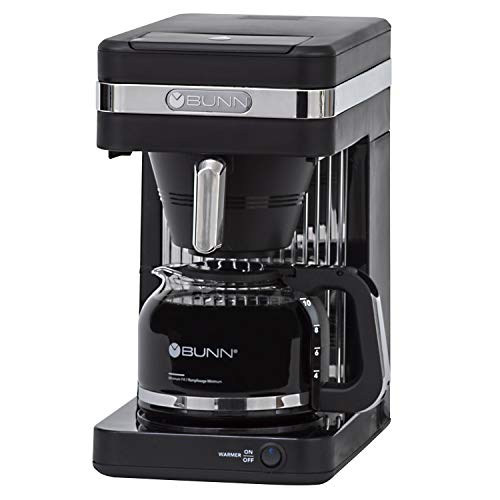
5. Bunn Speed Brew Elite Coffee Maker
A fast drip machine that keeps water warm in an internal reservoir so a pot finishes quickly. It comes from the same brand that supplies many restaurants. Check the current listing for the exact size and what is included before you order.
Suits: busy kitchens and light office use. Strengths: quick brewing from a hot water reservoir. Weaknesses: a glass carafe on a warming plate. Skip it if you want a thermal carafe.
View Bunn Speed Brew Elite on Amazon
Best for small groups
6. OXO Brew 9 Cup Coffee Maker
A stainless steel and thermal carafe machine with a rainmaker shower head and a clear water reservoir. It is a good match for a small shared kitchen. Check the current listing for the exact size and what is included before you order.
Suits: small groups. Strengths: clear controls and a thermal carafe. Weaknesses: less capacity than 12 or 14 cup models. Skip it if you brew for a crowd.
View OXO Brew 9 Cup Coffee Maker on Amazon
Care and Setup
- Descale every few months, more often with hard water.
- Rinse carafes after each use so oils do not build up.
- Run a clean water cycle before the first pot.
- Use paper filters that match the basket size.
Mistakes to Avoid
- Buying a home brewer for all-day foodservice use.
- Skipping descaling.
- Leaving coffee on a hot plate for hours.
- Ignoring how much counter and outlet space you have.
Estimating Your Peak Demand
The best way to size a brewer is to think about your busiest hour, not your average day. A small office may use most of its coffee in a short morning window, and a cafe may have a rush before work and another at lunch. If the brewer cannot keep up during those windows, people queue or the pot runs dry, even if the machine is fine for the rest of the day.
Start by estimating how many cups you serve during the busiest hour. Then check how much one brew cycle produces, how long a cycle takes and how many carafes or pots are available. Multiply the output of one cycle by the number of cycles you can realistically run in that hour. If the result falls short, you need a larger capacity, a faster brewer or an additional unit.
- Check the brew time in the manual or listing for a full batch.
- Check how quickly the machine can start a second batch.
- Count carafes or warming positions, not just the brewer.
- Allow some margin for events, meetings and busy days.
Cup sizes differ. A listing may count a cup as a small serving, which is smaller than the mugs most people use. Divide the stated volume by the size you actually serve to avoid overestimating capacity. When in doubt, choose a little more capacity than your estimate, because running short is a bigger problem than having spare room.
Power, Electrical and Space Checks
Commercial-style brewers can draw significant power, so check your electrical setup before buying. Look at the voltage, amperage and plug type listed in the product details. A brewer that needs a dedicated circuit will trip breakers if plugged into a shared one with other appliances. If you are unsure, ask a qualified electrician or the building manager, and follow the maker’s installation instructions.
Also check the physical space. Measure the width, depth and height of the brewer, and remember to include clearance above for filling, removing the brew basket and lifting the lid. Steam and heat also need somewhere to go. Placing a brewer in a tight cabinet or under a low shelf can cause problems and may be unsafe.
- Confirm the plug type matches the outlet you plan to use.
- Keep the cord clear of wet areas and walkways.
- Leave space around the unit for air circulation.
- Check the weight of a full unit and whether the counter can support it.
Think about where the carafes will be stored, where the filters and supplies will be kept and where the used grounds go. A good layout makes service faster and keeps the area cleaner, and it affects staff more than any specification on the box.
Carafes, Warmers and Holding Quality
Brewed coffee loses quality as it sits. How you hold it matters nearly as much as how you brew it. The main options are glass carafes on warming plates, insulated thermal carafes and airpot-style dispensers. Each approach suits a different style of service.
- Glass carafe on a warming plate: easy to see the level and quick to pour. The heat keeps coffee hot, but it can make it taste stewed after a while.
- Thermal carafe: keeps coffee hot without direct heat, which many people prefer for flavor over longer periods. It is easy to carry to a meeting room.
- Airpot dispenser: convenient for self-service, with a pump top. It suits events and offices with steady demand.
Whichever you pick, plan how long coffee will sit. A good habit is to brew in smaller batches more often, rather than a very large batch that sits for hours. Check whether the brewer works with the carafe type you want, because some units are designed for one style only. Spare carafes are worth having, since glass breaks and lids go missing.
Follow the maker’s guidance on warmer settings and never leave an empty carafe on a hot plate. Clean carafes thoroughly, because oils build up and affect flavor over time.
Water Quality and Descaling Routine
Coffee is mostly water, so the water you use shapes the result and affects the machine. Hard water leaves mineral deposits, called scale, on heating elements and inside tubes. Scale slows heating, reduces flow and can eventually damage the brewer. Very soft or heavily treated water can also affect flavor and sometimes cause its own issues.
If your tap water is hard, consider a filter suited to coffee equipment, and follow the maker’s advice on what water is appropriate. Filters need replacement on a schedule, otherwise they stop doing their job. If you are unsure about your water, a basic test kit or a local water report can tell you about hardness.
- Descale on a regular schedule, and more often if you notice slower brewing or a change in taste.
- Use a descaler recommended by the maker, and follow the dilution and rinse instructions.
- Run several plain water cycles afterward to clear any residue.
- Keep a log of the date so the task is not forgotten.
Daily care matters too. Empty and rinse the brew basket, wipe the spray head and clean the area around the unit. A brewer that is kept clean tends to taste better and last longer, and you will spot problems sooner.
Running Costs, Supplies and Staff Habits
The brewer price is only part of the cost of serving coffee. Filters, cleaning products, descaler, water filters, replacement carafes and electricity all add up. When comparing models, think about what each one needs to keep running, and whether those supplies are easy to find.
Filter size is a common trap. Brew baskets use specific paper filter sizes, and a mismatch causes overflow and mess. Check the filter size in the listing and buy a supply that matches. Check also whether the brewer uses a standard basket or a proprietary one, since replacement parts may be harder to find for unusual designs.
Staff habits make a difference too. Write a short routine and display it near the machine:
- Check the water and filter before each batch.
- Measure the coffee rather than guessing, using the ratio recommended for your beans and brewer.
- Label each batch with the time it was made, and discard old coffee.
- Clean spills straight away and wipe the plate before it bakes on.
Consistent measuring is one of the cheapest ways to improve the cup. Coffee that is too weak or too strong usually reflects the dose, not the machine. If problems continue, check the grind, the water temperature and the age of the beans before blaming the brewer.
Choosing Between the Picks in This Guide, One by One
Six options is a lot to hold in your head at once, so it helps to work through the shortlist for this commercial coffee brewer guide pick by pick, using only what the reviews above already establish. Each pick below is framed the same way: who it suits, what it does best, and the limitation to accept with open eyes. Read the six in order and mark the one whose weakness bothers you least — that simple test resolves most shortlists faster than chasing an abstract idea of the single best option.
Consider the Bunn VPR Pourover Commercial Coffee Brewer if its particular balance of trade-offs matches how you actually work. The guide above notes that it suits cafes and small offices, and that its appeal rests on foodservice build and a hot water tank. Set against the other picks, that makes it the natural shortlist entry when those qualities matter more to you than all-round convenience. Its honest limitation is worth weighing just as carefully: it needs hand filling and has no thermal carafe. Skip it if you want a plumbed or automatic unit. If that limitation touches something you do every day, another pick in this guide will serve you better; if it touches something you rarely do, it is a fair price in kind for the strengths you gain. The mistake to avoid is choosing it for a use case it was never aimed at, then blaming the product for a mismatch that was visible from the start.
The Bonavita Connoisseur 8-Cup Coffee Maker (BV1900TS) earns its place for a narrower reason than the headline suggests. It suits small offices, with a thermal carafe with no hot plate as the qualities that separate it from the rest of this list. Read it as a specialist rather than a default: when your routine lines up with what it does well, it can outperform a more general pick, and when your routine does not, its drawback — a limited pot size for big groups. Skip it if you serve dozens of cups at once — will be the thing you notice daily. A useful test is to picture your most ordinary session, not your most ambitious one, and ask whether this is the pick you would reach for then. Ordinary sessions are where satisfaction is actually decided.
With the Technivorm Moccamaster KBGV Select Coffee Brewer, the decision comes down to priorities. It is aimed at large households and break rooms, and it stands out for a sturdy build and steady results. Those are real advantages, but they sit alongside a clear compromise: a higher price tier than most home brewers. Skip it if you want a budget machine. Compared with the neighbouring picks in this guide, it asks you to accept that compromise in exchange for doing its main job in its own way. If you have read the other reviews and found yourself nodding at this one’s strengths while shrugging at its weakness, that reaction is usually the right signal. If the weakness made you hesitate, trust the hesitation and look at the pick whose strengths match the task you found yourself defending.
Consider the Cuisinart DCC-3200P1 14-Cup Programmable Coffee Maker if its particular balance of trade-offs matches how you actually work. The guide above notes that it suits budget-friendly large pots, and that its appeal rests on a big carafe and easy programming. Set against the other picks, that makes it the natural shortlist entry when those qualities matter more to you than all-round convenience. Its honest limitation is worth weighing just as carefully: a glass carafe sits on a hot plate. Skip it if you need all-day foodservice duty. If that limitation touches something you do every day, another pick in this guide will serve you better; if it touches something you rarely do, it is a fair price in kind for the strengths you gain. The mistake to avoid is choosing it for a use case it was never aimed at, then blaming the product for a mismatch that was visible from the start.
The Bunn Speed Brew Elite Coffee Maker earns its place for a narrower reason than the headline suggests. It suits busy kitchens and light office use, with quick brewing from a hot water reservoir as the qualities that separate it from the rest of this list. Read it as a specialist rather than a default: when your routine lines up with what it does well, it can outperform a more general pick, and when your routine does not, its drawback — a glass carafe on a warming plate. Skip it if you want a thermal carafe — will be the thing you notice daily. A useful test is to picture your most ordinary session, not your most ambitious one, and ask whether this is the pick you would reach for then. Ordinary sessions are where satisfaction is actually decided.
With the OXO Brew 9 Cup Coffee Maker, the decision comes down to priorities. It is aimed at small groups, and it stands out for clear controls and a thermal carafe. Those are real advantages, but they sit alongside a clear compromise: less capacity than 12 or 14 cup models. Skip it if you brew for a crowd. Compared with the neighbouring picks in this guide, it asks you to accept that compromise in exchange for doing its main job in its own way. If you have read the other reviews and found yourself nodding at this one’s strengths while shrugging at its weakness, that reaction is usually the right signal. If the weakness made you hesitate, trust the hesitation and look at the pick whose strengths match the task you found yourself defending.
Volume Planning: Pots, Peaks and the Cost of Waiting
Commercial brewing is a logistics problem wearing an appliance’s clothes. Start with the demand curve: how many cups in the busiest hour, how they cluster — a meeting break drinks differently from a café’s steady stream — and how long brewed coffee can wait before its quality window closes. That curve, not the showroom, decides capacity. Too small and the queue drinks yesterday’s patience; too large and coffee sits ageing while the machine’s size mocks the actual need. The brewers in this guide span office to café scale; match them to the curve you measured, not the one you imagine on your best day.
Holding is the second half of volume. Coffee brewed perfectly and held badly is bad coffee by the time it is poured. Thermal holding protects flavour far better than prolonged heat, which cooks a pot steadily downward. If your setting serves across hours — an office kitchen, a waiting room — the holding method may matter more than the brew method, and the reviews above flag which designs hold how. Brew in smaller, more frequent batches where you can; freshness loves frequency.
Water, Scale and the Maintenance Contract You Sign by Buying
Commercial brewers process far more water than home machines, and water fights back with scale at a commercial pace. Hard water areas can scale a busy brewer with startling speed, narrowing pipes, slowing flow and flattening flavour long before anything visibly breaks. A filter matched to your water, changed on schedule, plus descaling on the maker’s commercial rhythm, is not optional care — it is the operating cost of the category. Price it into the purchase decision, because a brewer whose upkeep your setting will not perform is the wrong brewer however well it brews in week one.
Assign the care to a named person or a service arrangement. Shared equipment with unowned maintenance follows a universal law: everyone assumes someone else descaled it. A simple log by the machine — dates, initials, filter changes — converts hope into a system. Settings that keep the log find their brewers lasting years longer than identical machines in settings that rely on memory and good intentions.
The Serving Station Around the Brewer
A brewer succeeds inside a station: cups, lids, milk, sweeteners, stirrers, a bin, and space to pour without reaching across a queue. Design the station by watching one busy service and noting every step a server takes away from it — each step is a design flaw with a fix. Keep consumables at the point of use, refilled on a rhythm tied to the brew schedule, and put the brewer where its water supply, drainage needs and steam all behave. The best brewer in this guide installed in a chaotic station will underperform a modest one in a station that flows.
For self-service settings, clarity replaces staff skill: label what is what, keep the fresh pot identifiable, and make the bin obvious so the station tidies itself socially. People treat a clear, clean station with respect and a confusing one as a free-for-all; the difference is design, not manners. Review the station monthly with fresh eyes — drift accumulates invisibly to the people who work around it daily.
A Slower Decision Routine Before You Order
Most disappointment with a commercial coffee brewer is not caused by a bad product; it is caused by a quick decision made on the wrong criterion. The criteria table near the top of this guide is short for a reason — those are the checks that actually predict whether you will be happy. Work through them in the order below, in writing if necessary, before you commit to any of the six picks.
Start with water supply. The guide’s table puts it plainly: pourover units are filled by hand; plumbed models connect to a water line. Do not treat that as a box to tick and move on. Picture it in your own space and routine — where this commercial coffee brewer will live, who else will use it, and how often. A criterion that looks minor on a product page becomes major when it is part of a daily habit, and minor daily friction is what quietly pushes a purchase into a cupboard. If a pick is weak on the criterion that matters most in your routine, that weakness outweighs several strengths elsewhere.
Start with heating. The guide’s table puts it plainly: a hot water tank means faster back-to-back pots. Do not treat that as a box to tick and move on. Picture it in your own space and routine — where this commercial coffee brewer will live, who else will use it, and how often. A criterion that looks minor on a product page becomes major when it is part of a daily habit, and minor daily friction is what quietly pushes a purchase into a cupboard. If a pick is weak on the criterion that matters most in your routine, that weakness outweighs several strengths elsewhere.
Start with carafe type. The guide’s table puts it plainly: glass, thermal and airpot carafes keep coffee hot in different ways. Do not treat that as a box to tick and move on. Picture it in your own space and routine — where this commercial coffee brewer will live, who else will use it, and how often. A criterion that looks minor on a product page becomes major when it is part of a daily habit, and minor daily friction is what quietly pushes a purchase into a cupboard. If a pick is weak on the criterion that matters most in your routine, that weakness outweighs several strengths elsewhere.
Start with capacity. The guide’s table puts it plainly: match the pot size to how many cups you serve at peak times. Do not treat that as a box to tick and move on. Picture it in your own space and routine — where this commercial coffee brewer will live, who else will use it, and how often. A criterion that looks minor on a product page becomes major when it is part of a daily habit, and minor daily friction is what quietly pushes a purchase into a cupboard. If a pick is weak on the criterion that matters most in your routine, that weakness outweighs several strengths elsewhere.
Finish the routine by re-reading the review of your leading pick one more time, looking only for reasons not to buy it. If the reasons you find are things you can genuinely live with, you have made a sound choice. If they are things you are merely hoping will not matter, keep looking — the other five picks exist precisely because no single commercial coffee brewer suits everyone.
Three Mistakes That Lead to the Wrong Choice
Buying capacity for the best day of the year
A brewer sized for the annual event sits oversized for the other fifty weeks, holding ageing coffee and eating counter. Size for the busy ordinary week and handle the exceptional day with a second batch or a borrowed urn. Equipment should fit the pattern, not the anecdote.
Skipping water treatment to save money
Untreated hard water converts savings into scale, service calls and dull coffee with interest. Filtration and descaling are the brewer’s fuel, not its accessories. Any budget that cannot carry them cannot carry a commercial brewer, whatever the purchase price suggests.
Letting coffee sit on heat for hours
A pot held on a burner through a long afternoon becomes the taste people associate with your setting — and they do associate it. Brew smaller batches more often, prefer thermal holding, and discard on a schedule you would defend to a guest. Freshness is a policy before it is a flavour.
Living With It: The First Month and Beyond
In the first month, keep the brew log religiously: batches, times, what ran out, what was discarded. Four weeks of log reveals the true demand curve, and most settings adjust batch size or timing once, decisively, on that evidence. After the adjustment, waste falls and freshness rises together — the signature of a system that finally matches its setting.
Train every user on the same simple standard: how much coffee, how much water, what to do when the pot is low, what never to do — and write it at the machine. Commercial brewers are simple; the variability is all human. Settings with a one-page standard at the point of use get café-consistent results from non-specialist staff, which is the entire promise of the category.
Over a year, judge the brewer by complaints you no longer hear and coffee no longer wasted. Keep the service contact and the manual with the log, note filter and descale dates where the next person cannot miss them, and the machine becomes infrastructure — invisible, reliable, and quietly shaping how your setting tastes to everyone who visits it.
More Questions About Choosing and Using One
How is a commercial brewer different from a large home machine?
Duty cycle and serviceability: commercial units are built to brew repeatedly all day, to be cleaned fast, and to be repaired with available parts. A home machine used commercially may brew well initially and then fail early under a load it was never designed for — the categories differ in endurance, not just size.
Do I need a plumbed water line?
Only if your volume makes filling a reservoir a genuine burden and your setting allows the installation. Many excellent settings run pour-over commercial brewers happily. Decide from your busiest hour’s arithmetic: if one person would spend it refilling, plumbing earns its cost; otherwise it is a convenience to add later.
How often should a commercial brewer be descaled?
On the maker’s schedule adjusted for your water hardness and volume — busy, hard-water settings may need it far more often than intuition suggests. Watch flow speed and taste as early warnings. The log by the machine, with dates, is what turns ‘we should descale soon’ into a date that actually happens.
What grind and coffee suit a commercial brewer?
Fresh coffee from a roaster you trust, ground for drip, in quantities your setting uses while fresh — the same principles as home brewing, at volume. Consistency of supply matters commercially: a coffee your supplier can deliver identically all year beats a brilliant one that changes monthly, because your regulars are drinking for the familiar cup.
Three Readers, Three Different Right Answers
Abstract rankings matter less than fit, so consider three typical readers of this commercial coffee brewer guide and notice how the same shortlist resolves differently for each. Their situations are composites, but the reasoning is the reasoning you should apply to your own circumstances, using the reviews above as the evidence base.
The first-time buyer has never owned one and wants the fewest possible surprises. For this reader, the Bunn VPR Pourover Commercial Coffee Brewer is the natural landing place: it suits cafes and small offices, and its case rests on foodservice build and a hot water tank. Crucially, its known limitation — it needs hand filling and has no thermal carafe. Skip it if you want a plumbed or automatic unit — is one this reader is well placed to accept, because it does not collide with the use they actually have in mind. The lesson generalises: the right pick is rarely the one with the fewest weaknesses, but the one whose weaknesses fall where you will never step. Read your own situation into these three sketches, decide which reader you most resemble, and let that resemblance — not the numbering in the list — order your shortlist.
The upgrader already owns a basic version and is replacing it because one specific frustration finally outweighed the rest. For this reader, the Technivorm Moccamaster KBGV Select Coffee Brewer is the natural landing place: it suits large households and break rooms, and its case rests on a sturdy build and steady results. Crucially, its known limitation — a higher price tier than most home brewers. Skip it if you want a budget machine — is one this reader is well placed to accept, because it does not collide with the use they actually have in mind. The lesson generalises: the right pick is rarely the one with the fewest weaknesses, but the one whose weaknesses fall where you will never step. Read your own situation into these three sketches, decide which reader you most resemble, and let that resemblance — not the numbering in the list — order your shortlist.
The host or gift buyer is choosing for other people’s use, or for a household where several people will share it. For this reader, the Bunn Speed Brew Elite Coffee Maker is the natural landing place: it suits busy kitchens and light office use, and its case rests on quick brewing from a hot water reservoir. Crucially, its known limitation — a glass carafe on a warming plate. Skip it if you want a thermal carafe — is one this reader is well placed to accept, because it does not collide with the use they actually have in mind. The lesson generalises: the right pick is rarely the one with the fewest weaknesses, but the one whose weaknesses fall where you will never step. Read your own situation into these three sketches, decide which reader you most resemble, and let that resemblance — not the numbering in the list — order your shortlist.
Commercial Coffee Brewer FAQ
Is a commercial brewer worth it for home?
Only if you brew large pots often. A premium home brewer is simpler for most kitchens.
What is a pourover commercial brewer?
It is a brewer you fill with water by hand instead of connecting to a water line.
Do any of these need a water line?
The ones listed here are all hand-filled. Check the listing before ordering anything plumbed.
How do I work out what size brewer I need?
Estimate how many cups you serve in your busiest hour, then compare that with the output and brew time of each model. Add some margin for busy days.
Can I plug a commercial brewer into a normal outlet?
It depends on the model. Check the voltage, amperage and plug type in the listing and the manual, and ask a qualified electrician if you are unsure.
Is a thermal carafe better than a hot plate?
A thermal carafe keeps coffee hot without direct heat, which many people prefer for taste over time. A hot plate is simple and lets you see the level. Choose based on how long coffee sits.
How often should I descale?
It depends on your water and how much you brew. Follow the maker's schedule, and descale sooner if brewing slows or the taste changes.
What filter size does a commercial brewer use?
It varies by model, so check the listing or manual for the basket size. Buying the wrong size can cause overflow and a weak brew.
How long can brewed coffee sit?
Quality drops over time, especially on a hot plate. Many operators brew in smaller batches and discard coffee after a set time. Follow your own standard and the maker's guidance.
Should I use filtered water?
Filtered water can reduce scale and improve flavor, but follow the maker's advice on water type. Replace filters on schedule, since old ones stop working well.
Matching a Brewer to Your Setting
A brewer that is perfect for a busy cafe can be wasteful in a five-person office, and a premium home machine can fall short at an event. Thinking in terms of setting makes the decision simpler.
Small office or shared workspace
Offices need steady, low-maintenance coffee with minimal supervision. Thermal carafe models such as the Bonavita and OXO listed here suit this because they hold temperature without a hot plate, which reduces the burnt taste of coffee left sitting. The drawback is capacity: a single carafe may not last through a morning rush, so consider whether a second brewer or a larger unit would help.
Cafe counter or bakery
A pourover foodservice unit like the Bunn VPR is designed for repeated pots. Without a water line, you fill it by hand, which keeps installation simple. Staff need a routine for swapping filters and carafes, and it helps to have more than one carafe so a fresh pot can go in while another is served.
Large household or entertaining
If you host often, a high-capacity drip brewer such as the Moccamaster is a reasonable fit. People choose it for its brewing approach and long-lived construction, though you should check the listed capacity and carafe type, because the number of cups per pot is stated in small measures, not mug-sized ones.
Pop-up, church or event use
Occasional events care about portability, setup time and the ability to serve many people quickly. A fast brewer with a hot water reservoir, like the Bunn Speed Brew Elite, makes back-to-back pots easier, but you still need to plan a supply of filters, cups and a safe place to plug in.
Reading Cup Sizes and Capacity Claims
Brewer capacity is easy to misread. A so-called 10-cup coffee maker usually counts a cup as about five or six ounces, which is much smaller than the mug most people pour. That means a 10-cup brewer may serve only four to five full mugs. Always convert the listed capacity into ounces and compare it to your real servings.
Brew time is the other number to watch. A brewer that makes a pot in a few minutes can keep up with a line, while a slower one leaves people waiting. Look for the stated brew time per batch and for whether a second batch can start immediately or needs the tank to reheat.
Finally, think about batch size versus quality. Many drip brewers make the best coffee when filled close to their stated capacity. Brewing a quarter-pot in a large machine can produce uneven extraction, so choose a size that matches your typical batch.
Maintenance, Spare Parts and Warranty
Commercial-style brewers are built for heavy use, so it is worth checking how they are meant to be maintained. Ask whether spray heads, tank gaskets and carafe lids are easy to replace, and whether the maker or retailers sell those parts. A brewer with a replaceable carafe is more forgiving than one where a broken pot means replacing the whole set.
Read the warranty on the current listing, and note whether it distinguishes between home and commercial use. Some home brewers carry shorter or conditional coverage if used in a business setting. For an office or cafe, that detail can decide which model you buy, because a warranty that excludes commercial use may leave you without coverage for a heavily used machine.
Home Drip Brewers Versus Foodservice Units
This guide mixes both types on purpose. Foodservice pourover units tend to be simple, sturdy and fast, with fewer features to fail. Home drip brewers often add programmable timers, thermal carafes and a more refined brew head, and some are made to meet specific brewing standards. If you value programmability and appearance, a home brewer may serve better; if you value speed, durability and repeated use, a foodservice unit is a strong candidate.
Whichever way you lean, test your assumptions against the real numbers: how many people drink coffee at the busiest hour, how long they are willing to wait, and how much counter space the machine and its spare carafes will occupy. Writing those three figures down makes the comparison between the six brewers far more concrete than a feature list.
Setting Up a Brewing Station That Runs Smoothly
Where you put the brewer affects how well it works day to day. Leave room above the machine for the lid or filter basket to open, and keep it near a sink or water source so refilling and rinsing are easy. Put a small tray or mat under it to catch drips, and keep spare filters, cleaning supplies and a descaling product within reach so routine care does not get skipped.
If several people use the brewer, post short instructions nearby: how much coffee per pot, which filters to use and what to do when the carafe is empty. Clear habits keep coffee consistent and spare the machine from avoidable misuse, such as an empty tank running or a carafe left on a hot plate for hours.
Related guides
- 6 Best Commercial Coffee Machines for Offices and Cafes
- 6 Best Commercial Coffee Makers for Cafes and Offices
- 6 Best Commercial Coffee Urns for Events and Offices
Frequently Asked Questions
How many cups of coffee does a commercial brewer make per hour?
It depends on the model, its heating system and how quickly you swap carafes. Manufacturers often state a gallons-per-hour figure on the listing. Use that number together with your peak demand to judge whether one brewer is enough or a second unit would reduce waiting.
Do commercial coffee makers need a dedicated circuit?
Some do, especially high-output units with large heating elements. Check the listing for wattage and voltage, and compare it with the circuit you plan to use. If anything else runs on the same line, ask an electrician rather than guessing.
Can I make tea or hot water with a pourover brewer?
Many pourover brewers have a separate hot water faucet or tap for tea and other uses, but not all models include one. Confirm the feature on the listing. Use clean water only, and avoid brewing other drinks through the coffee path.
How long should a coffee brewer last in daily use?
There is no single answer, because lifespan depends on build quality, water hardness and cleaning. Regular descaling and replacing worn gaskets extend useful life. Foodservice units are generally built for heavy use, but read the maker’s warranty for an idea of expected durability.
The Short Version
For a true commercial pourover, the Bunn VPR. For a small office pot, the Bonavita BV1900TS. For a premium drip brewer, the Moccamaster KBGV Select. For a budget-friendly large pot, the Cuisinart DCC-3200P1. For fast pots at home or work, the Bunn Speed Brew Elite. For a tidy countertop pot, the OXO Brew 9 Cup.


