Disclosure: topratedkitchenware.com is reader-supported. When you buy through links on our site, we may earn an affiliate commission from Amazon and other retailers, at no extra cost to you.
Where to buy
The six machines below are the verified picks in this guide to the best commercial coffee makers for home use, for homes that want commercial habits without commercial hardware. Each name links to its Amazon listing, where you can check the latest price on Amazon, confirm the current configuration, and read the newest owner feedback before you decide.
- Keurig K-Express (Mint)
- Hamilton Beach FlexBrew Advanced 4-in-1
- Ninja Single Serve Coffee Maker PB051
- Keurig K-Elite
- Keurig K-Express (Black)
- Keurig K-Express (Warm Stone)
Read the full guide ↓ for the reasoning behind the order, the honest limitations of every pick, and the checks that matter more than any headline claim.
The search for the best commercial coffee makers for home use is really a search for standards. The home in question brews a lot of coffee — for a big family, a home office, constant guests, perhaps a small business run from the kitchen — and it wants the things commercial settings take for granted: coffee that is always ready, capacity that survives the rush, consistency from cup to cup, and a machine that does not wilt under daily volume. What it does not want is the plumbing, the batch waste and the industrial presence of actual commercial hardware. This guide ranks six verified home machines by how much of the commercial standard they honestly import.
The honest framing first: every pick here is a home machine, and none carries a commercial duty rating. The commercial traits that matter at home are a subset — reservoir capacity, brewing pace, format discipline and the readiness ritual — and on those traits the pool separates clearly. The Ninja PB051 and Hamilton Beach FlexBrew import the most, with the largest reservoirs and the broadest formats. The Keurig K-Express models import the readiness and simplicity. The K-Elite imports the presentation. Each review states what its machine takes from the commercial world and what it leaves behind, because that leaving-behind is usually the point.
Read the guide as a translation exercise: commercial practice, translated into domestic scale. Readers whose setting is an actual workplace should step up to the Best Commercial Coffee Makers For Office guide, while readers still deciding which commercial traits they truly need will find the benchmark discussion in the Best Commercial High Performance Coffee Makers conversation useful.
Key Takeaways
- The commercial traits worth importing home are capacity, pace, consistency and readiness — not plumbing or batch volume.
- The Ninja PB051 imports the most: a 56 oz reservoir, 24 oz cups, both formats and four brew styles.
- The Hamilton Beach FlexBrew adds fast brewing and iced capability behind a 45 oz reservoir.
- Keurig K-Express models deliver the commercial virtues of simplicity and readiness in three finishes.
- Every pick is a home machine; the guide borrows commercial standards, not commercial labels.
In this guide
Quick Picks
The six verified picks below are ordered by how completely each brings commercial habits into a home. Badges stay consistent across the Quick Picks, the detailed reviews and the comparison table.
| Pick | Badge | Best for | Link |
|---|---|---|---|
| Keurig K-Express (Mint) | Best Light Finish | Busy homes wanting commercial readiness in a bright, friendly machine | Check on Amazon |
| Hamilton Beach FlexBrew Advanced 4-in-1 | Best for Households | Large families and home offices needing pace, variety and iced drinks | Check on Amazon |
| Ninja Single Serve Coffee Maker PB051 | Best Overall | Heavy home users who want the maximum commercial character available here | Check on Amazon |
| Keurig K-Elite | Best Premium Pod Pick | Homes where the coffee station is part of entertaining presentation | Check on Amazon |
| Keurig K-Express (Black) | Best Pod All-Rounder | Homes wanting the commercial basics — readiness, capacity, simplicity — in pod form | Check on Amazon |
| Keurig K-Express (Warm Stone) | Best for Style-Led Kitchens | K-Express buyers whose hard-working station sits in a design-led room | Check on Amazon |
How These Picks Were Chosen
Selection for this brief used a translation method: the demands of commercial service were listed first — ready water, throughput, consistency, operability by anyone, resilience under volume — and each was converted into its domestic equivalent before the verified pool was scored. A commercial reservoir became a home reservoir measured against a family morning; commercial pace became fast brewing across a round of individual cups; commercial operability became a routine a guest can perform unaided. Only confirmed specifications were scored, and the ranking reflects the translated standard rather than any machine’s marketing altitude.
The guide is research-led and label-honest. No pick is called commercial, because none is; each is called what it is, a home machine with a stated measure of commercial character. Where a listing confirms little — the K-Elite again — the review argues only from what is confirmed. That discipline matters most in this category, where the word commercial is most often used as perfume. Readers should finish the guide able to name the exact traits they are buying, which is the only protection against perfume that works.
The 6 Best Commercial Coffee Makers for Home Use, Translated

Keurig K-Express (Mint)
Badge: Best Light Finish
The Mint K-Express brings the standard K-Express formula — 42 oz removable reservoir, three brew sizes, Strong Brew button, travel mug friendly, works with all K-Cup pods — in a pale mint finish that suits retro-leaning and pastel kitchens. Functionally nothing separates it from its black, Warm Stone and Evergreen siblings, so the honest advice is to choose it for the colour and enjoy the same routine: several cups per reservoir fill, a bolder option when a pod tastes weak, and clearance for the travel mug on workday mornings. The pale finish does ask for a little more wiping, because coffee drips and grounds dust show against mint more readily than against black or green. In exchange, the machine brightens a counter corner instead of darkening it. For a renter, a student house or anyone furnishing a small kitchen with some personality, Mint is the K-Express that does not take itself too seriously.
Mint’s commercial import is readiness with a smile: the K-Express pattern of a filled 42 oz reservoir and a one-button routine means the home’s coffee is always one press from existing, which is the domestic form of the diner’s promise. In a home that hosts often, that readiness is felt by guests as hospitality — nobody waits, nobody watches a process, coffee simply arrives. The mint finish keeps the hard-working machine looking like a chosen part of a bright kitchen rather than a piece of office equipment on loan, and its splash-showing honesty keeps it wiped. For the home whose commercial need is really a hospitality need, Mint is the most charming answer in the pool.
Strengths
- Full K-Express feature set in a light, retro-leaning mint finish
- 42 oz removable reservoir is easy to carry to the tap
- Three brew sizes plus Strong Brew cover most single-cup needs
Trade-offs
- Pale finish shows coffee splashes and needs wiping more often
- Pods only in normal use, with pod cost per cup to budget for
- No dedicated iced or cold-brew programme
Key specifications
- Format: Single-serve K-Cup pod coffee maker
- Brew sizes: 3 brew sizes
- Reservoir: 42 oz, removable
- Feature: Strong Brew button
- Mug fit: Travel mug friendly
- Finish: Mint
Best for: Busy homes wanting commercial readiness in a bright, friendly machine / Not suited for: Homes needing the largest capacity in the pool

Hamilton Beach FlexBrew Advanced 4-in-1
Badge: Best for Households
The Hamilton Beach FlexBrew Advanced 4-in-1 is the pool member that tries to end arguments. It brews hot and iced coffee, it accepts both pod packs and ground coffee, and it carries a removable 45 oz reservoir — the largest water capacity in this guide alongside genuinely fast brewing. That combination means a household split between pod loyalists and grounds drinkers can share one machine, and a drinker who wants iced coffee in summer and hot coffee in winter is not maintaining two appliances. The reservoir changes the morning maths: several cups can be brewed back to back before anyone visits the tap, which is exactly when single-serve machines usually show their limits. It remains a single-serve design, so there is no carafe for a brunch table, and its broader brief takes more counter space than the minis. As a one-machine answer to mixed household tastes, though, it is the most complete package here.
The FlexBrew imports the commercial trait home machines most often lack: pace under variety. A commercial station serves different drinks quickly in succession, and the FlexBrew’s combination — fast brewing, pods and grounds, hot and iced, a 45 oz reservoir — is the closest domestic analogue, built for the household where the morning round includes a strong grounds coffee, two pods and an iced drink for the road. It behaves like a small station rather than a personal appliance, which is exactly the shift this keyword asks for. Its limit is the same as every pick here: it is a home machine, and a home that becomes a venue should promote it to second machine and buy up a class.
Strengths
- Largest reservoir here paired with hot and iced modes
- Takes both pod packs and grounds, so no format lock-in
- Fast brewing suits back-to-back morning cups
Trade-offs
- Bigger brief than the minis, so it needs real counter space
- Still a single-serve machine: no carafe for a table of guests
- More modes means more settings for a household to learn
Key specifications
- Format: 4-in-1 single-serve coffee maker
- Modes: Hot and iced coffee
- Reservoir: 45 oz, removable
- Inputs: Pod packs and ground coffee
- Brewing: Fast brewing
- Finish: Black
Best for: Large families and home offices needing pace, variety and iced drinks / Not suited for: Small households wanting the simplest routine

Ninja Single Serve Coffee Maker PB051
Badge: Best Overall
The Ninja PB051 is the heavyweight of this pool: a single-serve combo machine that takes both K-Cup pods and ground coffee, offers four styles of brewing, brews cup sizes up to 24 oz and carries a 56 oz removable reservoir — the largest water capacity and the largest single cup in this guide. Those numbers translate into a specific kind of freedom. The reservoir covers a full morning of household cups, the 24 oz ceiling means the biggest travel mug is filled in one brew rather than two, and the pod-plus-grounds format means a new bag of beans and a box of pods can coexist without a second machine. Four brew styles let the same coffee land differently in the cup, from an everyday mug to a more concentrated style for milk drinks or iced coffee. The costs are counter space and a modest learning curve. For households that brew often and in quantity, the PB051 is built exactly for that life.
The Ninja imports the deepest set of commercial habits in the pool. Capacity: 56 oz of ready water and 24 oz cups, so the round is served in few passes. Consistency: four brew styles that let the house standardise its drinks — this style for the morning mug, that one for iced — the way a café standardises a menu. Format discipline: pods for the household’s speed, grounds for its standards, in one station. Run with the readiness ritual from the how-to section, it gives a heavy home the felt experience of a small commercial station while remaining, honestly, a home machine with a home warranty. For the household this keyword describes, it is the complete answer.
Strengths
- Biggest reservoir in the pool at 56 oz, removable
- Pods and grounds in one machine, with four brew styles
- Brews up to 24 oz, covering large travel mugs in one pass
Trade-offs
- The largest brief here, so small counters should measure first
- Four styles add a learning curve for guests and family
- Still single-serve: big cups, but no carafe
Key specifications
- Format: Single-serve combo machine for K-Cup pods and grounds
- Brew styles: 4 styles of brewing
- Cup sizes: Up to 24 oz
- Reservoir: 56 oz, removable
- Model: PB051
- Finish: Black
Best for: Heavy home users who want the maximum commercial character available here / Not suited for: Compact kitchens and occasional drinkers

Keurig K-Elite
Badge: Best Premium Pod Pick
The Keurig K-Elite in brushed silver is the premium-leaning pod machine in this pool: a single-serve K-Cup brewer whose metal-toned finish is designed to be seen rather than hidden. Where the K-Express models compete on reservoir size and brew-size lists, the K-Elite competes on presence — it is the machine for a counter that is part of the room, in an open-plan kitchen or a smart office kitchenette where a plastic-looking appliance would jar. The coffee routine is the familiar Keurig one: a pod, a button, a cup, with the entire K-Cup range available to choose from. Buyers should note honestly that the verified listing for this model confirms fewer headline specifications than its K-Express siblings, so the decision here rests on finish, format and brand tier rather than on a longer feature list. If those are your criteria, the K-Elite is the pool member aimed at you.
The K-Elite imports commercial presentation rather than commercial throughput. In better cafés and hotel lounges, equipment is part of the room’s promise, and the brushed silver Keurig plays that role domestically: a machine that looks intentional on the counter of a home that entertains, serving the pod routine every guest already knows. Its commercial character is therefore real but narrow — readiness and presentation for small numbers — and the guide will not inflate it into capacity it does not claim. Homes whose rush is two couples after dinner will find it perfectly cast; homes whose rush is a brunch for twelve should choose the Ninja and let presentation follow function.
Strengths
- Brushed silver finish suits visible, design-led counters
- Single-serve K-Cup format gives access to the full pod range
- A step-up Keurig nameplate for buyers who want the premium tier of pod machines
Trade-offs
- Listing confirms fewer headline specs than the K-Express models
- Pods only, so grounds drinkers are not served
- Premium positioning without a carafe or second format
Key specifications
- Format: Single-serve K-Cup pod coffee maker
- Finish: Brushed Silver
Best for: Homes where the coffee station is part of entertaining presentation / Not suited for: Homes buying primarily for volume

Keurig K-Express (Black)
Badge: Best Pod All-Rounder
The Keurig K-Express in black is the straightforward centre of the K-Cup world: a single-serve pod machine with a 42 oz removable reservoir, three brew sizes and a Strong Brew button for a bolder extraction from the same pod. The reservoir is the detail that shapes daily life with it, because it turns brewing into a rhythm of several cups between refills instead of a fill for every single mug. It is travel mug friendly, so a commuter cup slides under the spout without decanting from a smaller mug first. Because it works with all K-Cup pods, the coffee choice is as wide as the pod aisle itself, from dark roasts to flavoured blends to tea and cocoa pods. Operation is deliberately plain: insert a pod, choose a size, press brew. There is no carafe, no grinder and no milk system, and that simplicity is the point. For a household that wants predictable pod coffee with the fewest possible steps, this is the reference design the rest of this guide is measured against.
The black K-Express is the commercial basics done domestically: a 42 oz reservoir that keeps the home perpetually ready, three sizes that standardise the household’s cups, a Strong Brew setting that acts as the house adjustment for weak pods, and an operation simple enough that any guest, grandparent or teenager can run it without instruction. Commercial settings prize exactly that untrained-user reliability, and it is rarer in home machines than it should be. Black is the finish of the working station — practical, unshowy, splash-forgiving in the ways that matter. For a home that wants the diner’s promise without the diner’s machine, this is the honest baseline recommendation.
Strengths
- 42 oz removable reservoir means several cups between refills
- Strong Brew button gives a bolder cup from the same pod
- Three brew sizes cover a small cup through a travel mug
Trade-offs
- Pods only in normal use, so grounds need a separate routine
- No dedicated iced or cold-brew programme
- Black finish shows dust and scale marks readily
Key specifications
- Format: Single-serve K-Cup pod coffee maker
- Brew sizes: 3 brew sizes
- Reservoir: 42 oz, removable
- Feature: Strong Brew button
- Mug fit: Travel mug friendly
- Finish: Black
Best for: Homes wanting the commercial basics — readiness, capacity, simplicity — in pod form / Not suited for: Grounds drinkers and true venues
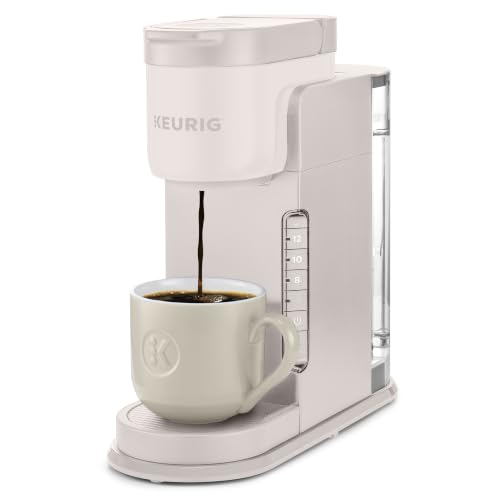
Keurig K-Express (Warm Stone)
Badge: Best for Style-Led Kitchens
The Warm Stone K-Express is the same machine as the black K-Express — 42 oz removable reservoir, three brew sizes, Strong Brew button, travel mug friendly, compatible with all K-Cup pods — wearing a softer, stone-toned finish. That makes the choice between them a kitchen-design decision rather than a coffee decision, and there is no shame in that: a machine that lives on the counter every day should look like it belongs there. The warm neutral tone sits comfortably beside pale wood, stone worktops and stainless appliances, and it is more forgiving of the light dusting of coffee grounds and water spots that accumulate around any brewer. Everything said about the K-Express routine applies here unchanged: pod in, size chosen, cup brewed, with several cups available before the reservoir needs attention. If your household has already decided the K-Express feature set is right, Warm Stone is simply the version for kitchens where black reads too stark.
Warm Stone performs the identical commercial-basics role as the black K-Express, and in a hard-working home its finish is a practical feature: high-use stations accumulate evidence, and the warm neutral tone hides the daily dusting of grounds and water marks that a busy reservoir machine gathers. A station that looks clean gets treated as clean, and standards in a shared home machine are self-reinforcing in both directions. Choose Warm Stone when the K-Express capability is settled and the room is pale, warm and watched. The coffee operation — readiness, rounds, strong adjustments — is the family standard described above, unchanged by the colour it wears.
Strengths
- Same 42 oz reservoir and three brew sizes as the black version
- Warm Stone finish hides everyday marks better than gloss black
- Strong Brew button for a more intense cup when wanted
Trade-offs
- Functionally identical to the other K-Express colours
- Pods only in normal use, with no grounds basket in the box story
- No dedicated iced or cold-brew programme
Key specifications
- Format: Single-serve K-Cup pod coffee maker
- Brew sizes: 3 brew sizes
- Reservoir: 42 oz, removable
- Feature: Strong Brew button
- Mug fit: Travel mug friendly
- Finish: Warm Stone
Best for: K-Express buyers whose hard-working station sits in a design-led room / Not suited for: Anyone expecting more capacity than the black K-Express
The ranking above follows the translation method strictly: the machines that import the most commercial character, in the traits homes actually feel, lead the list. That is why a pod machine with a premium finish sits below dual-format machines with larger reservoirs — presentation is a real commercial trait, but capacity and consistency are felt more often. The table that follows isolates the borrowed traits so the trade can be judged without the reviews’ prose around it.
Comparison Table
Compare the commercial imports directly: water capacity for the round, format discipline, and the trait each machine takes from the professional world. The home virtues — size, simplicity, looks — are in the reviews; this table is about the borrowed standards.
| Pick | Format | Water capacity | Standout trait | Link |
|---|---|---|---|---|
| Keurig K-Express (Mint) | K-Cup pods | 42 oz reservoir | Mint finish, full K-Express feature set | Check on Amazon |
| Hamilton Beach FlexBrew Advanced 4-in-1 | Pod packs and grounds | 45 oz reservoir | Hot and iced modes with fast brewing | Check on Amazon |
| Ninja Single Serve Coffee Maker PB051 | K-Cup pods and grounds | 56 oz reservoir | Four brew styles, cups up to 24 oz | Check on Amazon |
| Keurig K-Elite | K-Cup pods | Reservoir format, size not confirmed in listing | Brushed silver premium finish | Check on Amazon |
| Keurig K-Express (Black) | K-Cup pods | 42 oz reservoir | Strong Brew button for concentrated cups | Check on Amazon |
| Keurig K-Express (Warm Stone) | K-Cup pods | 42 oz reservoir | Warm Stone finish, full K-Express feature set | Check on Amazon |
How to Choose Which Commercial Traits Your Home Actually Needs
List your home’s commercial moments before shopping. The school-morning round, the home-office deadline day, the Sunday hosting, the holiday crowd — each moment names a trait. Rounds name capacity; deadline days name readiness and pace; hosting names operability and presentation. A home whose list is mostly hosting should weight the K-Elite and K-Express pattern; a home whose list is mostly volume should weight the Ninja and FlexBrew. Buying the trait list rather than the word commercial is the entire method of this guide, applied one final time.
Be honest about the operator population. Commercial operability matters in homes where the machine serves grandparents, guests, teenagers and the occasional babysitter — people who will not learn a system. Pod machines are the professional answer to that population for a reason. Homes with a single enthusiast operator can indulge format complexity, but even they should ask whether the complexity survives the enthusiast’s holiday. The machine that works when its owner is away is the machine with commercial character, whatever its size.
Finally, respect the boundary at the top. A home that regularly serves queues — a business in domestic clothing — should stop translating and start buying: the office and commercial guides in this cluster, including the Best Commerical Coffee Makers overview, take over from there. The homes below that boundary will find everything they need in this pool, at domestic prices of money, space and attention.
How to Run a Home Coffee Station to Commercial Standards
Adopt the readiness ritual. At night: reservoir filled with fresh water, the next morning’s format stocked, mugs in place, drip tray emptied. In the morning the station simply works, which is the entire felt difference between a home machine and a commercial-style station — not speed of brewing, but absence of preamble. Commercial operators call this mise en place; homes can call it tomorrow’s gift. Assign it to whoever closes the kitchen, and rotate the honour if the household is large enough to argue about it.
Standardise the house drinks. Commercial consistency comes from recipes, and a home can borrow the trick with a small card by the machine: the house mug is this size, the strong drinker uses this setting, the iced recipe is this pod at this size over a full glass. Guests and family stop improvising, quality stops wandering, and the machine’s four styles or strong button become a menu instead of a mystery. This is the cheapest quality upgrade available to any pick in this guide.
Problem: quality varies by who brews → the house recipe is missing or ignored; write it down and put it where the brewing happens. Problem: the station is always mid-chaos during hosting → the readiness ritual lapsed; reinstate the night-before reset and add a mid-event water check. Problem: the machine is ageing faster than expected → volume is telling the truth about duty; descale on schedule, keep the format paths clean, and if the volume keeps growing, accept the promotion path to a heavier class of machine.
Maintain like a professional, in miniature: a weekly wipe of the splash zone and format parts, a descale calendar matched to your water, and a note of anything that changes — a slower brew, a new noise, a flavour drift. Commercial reliability is mostly this notebook habit wearing overalls. A home that keeps it will get commercial years out of a domestic machine.
Consistency: The Commercial Trait Homes Notice Most
Ask café regulars why they return and the answer is rarely excellence; it is sameness. The cup tastes like yesterday’s cup, and yesterday’s was good. Homes notice the same trait in reverse — the machine is blamed when Monday’s coffee differs from Sunday’s, even when the variable was the water, the dose or the brewer’s mood. Commercial-style home machines attack inconsistency mechanically: pods dose identically, reservoirs keep water ready at the same conditions, brew styles repeat a chosen profile at a button press.
The household completes the system with its recipe card and its readiness ritual, and the result is a home whose coffee can be relied on — by guests forming an impression, by workers fuelling a deadline, by the family itself on the mornings when nothing else goes to plan. Of all the traits this guide translates, consistency is the one whose absence is felt daily and whose presence is never remarked. That is the definition of infrastructure, and it is what the word commercial really buys.
What to Leave Behind: Plumbing, Batches and Industrial Scale
Translation means leaving things behind, and three commercial traits should stay in the café. Plumbing: a fixed water line serves continuous volume a home does not have, at an installation cost and a flood risk no household needs. Batch brewing: pots brewed ahead and held are a solution to queues, and they tax freshness in homes whose drinkers arrive one at a time. Industrial scale: oversized bodies, warm-up rituals and service contracts answer problems of uptime economics that a home simply does not face.
Naming what to leave behind protects the buyer from the category’s favourite upsell, in which commercial is treated as a synonym for better. It is a synonym for fitted — fitted to volume, queues and untrained users. The fitted home machine is the one whose borrowed traits match the home’s list and whose left-behind traits stay left. Every pick in this guide can be that machine for the right list, which is a more useful truth than any ranking.
The Home Office: Where This Category Earns Its Keep
The purest case for commercial-style home coffee is the working home: the office in the spare room, the studio in the garage, the practice run from the kitchen table. Working homes brew working volumes, host clients occasionally, and run on deadlines that make coffee a tool rather than a treat. For them the readiness ritual is productivity, the reservoir is a small infrastructure, and a client served a good cup quickly is part of the business’s texture. The Ninja and FlexBrew were ranked at the top of this guide with the working home explicitly in mind.
Working homes should also borrow the office’s supply discipline: stock that is visible, a reorder point that is known, and a backup plan — a kettle and a simple grounds option — for the day the machine falters mid-deadline. Readers whose working home grows into a working office will find the next step mapped in the Best Compact Coffee Makers guide’s treatment of small professional spaces.
The Guest Test: Commercial Character Measured in Hospitality
There is a simple instrument for measuring a home’s coffee standard, and it is the guest. Watch a visitor make or receive coffee in your home and every trait in this guide becomes visible at once. Can they operate the machine without asking? Does the coffee arrive quickly, at the strength they would have chosen, without the host performing a process? Is the second cup as easy as the first? Commercial settings are engineered to pass that test for strangers; a home that passes it for friends has imported the standard successfully, whatever its machine cost or claims.
The test also exposes the traits that do not matter. No guest has ever praised a home for its plumbing, its batch capacity or its duty rating; they praise readiness, choice and the feeling that coffee in this house is simply handled. That is why this guide’s translation discards the industrial traits without regret and ranks the domestic ones — reservoir, pace, recipe consistency, operability — as the substance of the category. The word commercial, properly translated, turns out to mean nothing more exotic than a home where the coffee is handled.
The working home deserves one more paragraph, because it is where this category stops being about hospitality and becomes about livelihood. A deadline practice, a clinic, a studio with clients — these homes measure coffee failures in professional embarrassment, not domestic disappointment. For them the readiness ritual and the recipe card are business processes, the reservoir is infrastructure, and the backup plan is a professional obligation. The picks at the top of this guide were ranked with that seriousness in mind, and a working home should choose between them with the same seriousness it would apply to any other tool of the trade.
The Five-Year View: Living With a Hard-Working Home Machine
Home coffee machines are rarely replaced on schedule; they are replaced on failure, usually at the least convenient moment, which makes the five-year view the honest frame for this purchase. Five years of family service is thousands of brews, hundreds of reservoir fills and dozens of descale cycles, and the machines that survive it gracefully are the ones whose daily routine was simple enough to be done properly every time. Complexity is the long-term enemy: every additional format path, mode and moving part is a place for scale, residue and wear to accumulate, and a household choosing between the picks here should weigh the cleaning reality of year four alongside the feature list of day one.
The five-year view also reframes value. A machine used four times a day for five years has made several thousand drinks; the difference between the adequate pick and the right pick, multiplied across those drinks, is the difference between a station the household trusts and one it tolerates. That is why this guide spent its length on fit — reservoir against the round, format against the operators, ritual against the household’s discipline — rather than on novelty. Novelty is spent in a month. Fit pays out for the whole five years, in the currency of mornings that simply work.
Finally, the five-year view argues for the notebook and the ritual one last time. The households whose machines reach year five still tasting right are not lucky; they are the ones who descaled on a calendar, refreshed water on a rhythm and noticed small changes early. Commercial operators call that preventive maintenance and build businesses on it. A home can borrow it for the price of a pencil and a habit, and in doing so import the last and most valuable commercial trait of all: the machine is looked after before it asks to be.
There is also a generational angle that commercial thinking clarifies. A home station built to a standard — ready, consistent, operable by anyone — teaches the household’s younger members what handled looks like, the same way a well-run café teaches its regulars. Teenagers who learn coffee on a station with a recipe card and a restock rhythm absorb a small, transferable discipline along with the caffeine, and grandparents visiting the same station are served by it rather than defeated by it. Infrastructure is never only about the drinks. It is about whether a home’s shared systems welcome everyone who touches them, and the coffee station, used more than almost any other system in the house, is where that welcome is proven daily.
Common Buying Mistakes
The headline mistake is buying the word instead of the traits: paying for commercial language on a machine whose reservoir, pace and operability were never checked against the home’s actual list. The translation method in this guide exists to make that mistake difficult.
The second mistake is importing the batch habit. Homes that brew ahead and hold coffee — in a jug on a warmer, in a pot from a borrowed routine — sacrifice the freshness that is the home machine’s native advantage. Brew on demand; the machines here are fast enough that demand is never the problem.
Third, do not let the station’s standards depend on one person. A commercial-style setup that collapses when its owner travels was a hobby, not a station. Write the recipe, share the ritual, and let the machine be the household’s.
Finally, avoid under-maintaining a hard-working home machine. Volume is volume whether it happens in a café or a kitchen, and a descale schedule ignored at home produces the same slow, cool, tired brews it produces commercially. The notebook habit is the difference.
Final Recommendation
The most complete translation of the commercial standard in this pool is the Ninja Single Serve Coffee Maker PB051: capacity, consistency tools, both formats and a presence that suits a serious home station. Households whose commercial need is pace and variety should choose the Hamilton Beach FlexBrew Advanced 4-in-1, whose fast, flexible brewing serves a family round like a small café.
Homes whose need is readiness and hospitality in pod form are well served by the Keurig K-Express (Black) and its finish siblings. Translate honestly, borrow the traits your list names, and leave the plumbing to the cafés — your home will run to a standard your guests notice and your mornings quietly depend on.
Related guides
Frequently Asked Questions
What makes a coffee maker commercial-style for a home?
Borrowed traits rather than a label: a reservoir that keeps the station ready, enough capacity for the household’s round, repeatable brew settings for consistency, and operation simple enough for any member of the household or a guest. All six picks here have some of those traits; the Ninja and FlexBrew have the most.
Do I need a plumbed machine for a busy home?
Almost certainly not. Plumbing serves continuous commercial volume. A busy home’s peaks are rounds of individual cups, which a 45 to 56 oz reservoir absorbs comfortably. Refilling a removable reservoir at the tap is a small price for avoiding installation entirely.
Which pick is best for a home office?
The Ninja PB051, for its capacity, its 24 oz cups that fill a desk mug or travel cup in one brew, and its pod-plus-grounds flexibility for the worker and the visiting client alike. The FlexBrew is the choice if iced drinks are part of the working day.
How do I keep quality consistent across the household?
Write the house recipe down — sizes, settings, doses — and keep it by the machine, refresh the reservoir water on a rhythm, and descale on schedule. Consistency is a system of small habits, and the machine’s repeatable settings do the rest.
Is a K-Express enough for a large family?
For many large families, yes: the 42 oz reservoir and simple pod routine serve a family round gracefully, and every member can operate it. Families that also want grounds, iced drinks or larger cups should step up to the FlexBrew or Ninja.
When has a home outgrown this category?
When coffee is served to a queue regularly — a business operating from the home, or hosting at near-commercial frequency. At that point the duty, service and uptime questions become commercial questions, and the office and commercial guides in this cluster are the right next read.
Is a commercial-style setup worth it for a small household?
Only the parts of it that match your list. A couple that hosts monthly gains from readiness and operability, and nothing from maximum capacity. Take the traits in the order your household feels them, and let the rest of the standard stay in the cafés where it belongs.


