Disclosure: topratedkitchenware.com is reader-supported. When you buy through links on our site, we may earn an affiliate commission from Amazon and other retailers, at no extra cost to you.
Where to buy
The six machines below are the verified picks for this guide to the best commercial high performance coffee makers. One honesty note before the list: true commercial machines are plumbed, certified workhorses built for cafes, and none of these countertop models is that. What they are is the high-performance end of countertop drip brewing — fast, high-capacity, thermal machines that handle office, small-team, and heavy home demand honestly well. Each name links to its Amazon listing so you can check the latest price on Amazon and confirm the current configuration.
- BUNN Speed Brew Platinum Thermal Coffee Maker
- Hamilton Beach FlexBrew Advanced 5-in-1 Coffee Maker
- KRUPS 12-Cup Programmable Thermal Carafe Coffee Maker
- Cuisinart 10-Cup Thermal Classic Coffeemaker
- SECPOEDR Grind and Brew Coffee Maker with Built-In Grinder
- Gevi 10-Cup Grind & Brew Coffee Maker
Start with our top pick: Check on Amazon for the current listing. Read the full guide ↓ for the reasoning, the honest limitations, and the checks that matter.
Searching for the best commercial high performance coffee makers usually means one of two things: a small business, office, or venue that has outgrown a basic home machine, or a household that brews like one. Either way, the real requirements are the same — throughput, consistency across back-to-back pots, and coffee that still tastes right in the last cup. This guide is built around those requirements, and it starts with a disclosure we would rather make than hide: the verified pool for this guide is countertop equipment, not plumbed cafe machinery. If you need a certified commercial brewer for a high-volume cafe, that is a different purchase through a different channel, and no article should pretend otherwise.
What countertop high performance does mean is worth defining. It means a full pot brewed fast enough that a queue does not form. It means extraction hot and even enough that pot three tastes like pot one. It means a thermal carafe that protects a pot across a meeting instead of cooking it on a plate. And it means controls a rotating cast of people can operate without a manual. The six machines below were chosen and ranked against exactly those tests. Readers comparing neighbouring categories will also find our guide to Best Commercial Pour Over Coffee Makers useful, because the overlap between high-output drip and pour-over style brewing is where many small venues land.
We have also included the ownership side that commercial-leaning buyers care about: descaling rhythm under heavy use, carafe discipline, and the mistakes that kill countertop machines in shared spaces. A machine that serves a team lives or dies on maintenance habits, not on its first-week performance.
Key Takeaways
- Be honest about the category: these are high-performance countertop machines for offices, small venues, and heavy homes — not plumbed cafe equipment.
- Throughput is the commercial test: brew speed and back-to-back consistency matter more than feature lists.
- Thermal carafes protect a pot across a meeting; warming plates cook it.
- The BUNN Speed Brew Platinum is the closest pick to commercial priorities: speed and simplicity first.
- In shared spaces, descaling rhythm and carafe discipline decide how long any machine lasts.
In this guide
Quick Picks
| Pick | Badge | Why it is here | Listing |
|---|---|---|---|
| BUNN Speed Brew Platinum | Best Overall | Fast brewing and thermal holding, the closest to commercial priorities | Check on Amazon |
| Hamilton Beach FlexBrew Advanced | Most Versatile | Pot plus single-serve flexibility for mixed-demand teams | Check on Amazon |
| KRUPS 12-Cup Thermal | Best for Scheduled Service | Scheduled 12-cup pots with three strength settings | Check on Amazon |
| Cuisinart Thermal Classic 10-Cup | Best for Small Teams | Compact programmable 10-cup for smaller teams | Check on Amazon |
| SECPOEDR Grind and Brew | Best for Fresh-Ground Pots | Fresh-ground pots on a timer for bean-buying offices | Check on Amazon |
| Gevi 10-Cup Grind & Brew | Best Modern Controls | Grind-and-brew with touch controls and a reusable filter | Check on Amazon |
How These Picks Were Chosen
This guide is research-led. We compared the verified listings available for this guide, read the manufacturer specifications published in those listings, and weighed the features that change daily results for this product type: capacity, carafe format, brewing temperature and saturation design, strength control, programming, and how much cleaning the machine asks for. Every linked pick below comes from that verified pool, with its Amazon listing checked on 2026-11-20, and only those verified products carry links and images in this article.
We want to be plain about the limits of that method. This is not a hands-on laboratory test, and we do not claim it is. We did not brew side-by-side pots under instrumented conditions for this guide. What research can do well is compare verified specifications, spot which features are real and which are decoration, and match machines to the households they actually fit. Where a specification was not present in the verified listing data, we left it out rather than guessing, and where a pick has a genuine weakness we say so in its review.
The badges were assigned after the comparison, not before. Best Overall goes to the machine we would point the widest range of readers to. The other badges name the specific job each machine does best, because in a mature category like drip coffee the second-best machine for everyone is often the best machine for someone. Price played no part in the ranking as a printed number, because prices move; we considered each machine’s tier qualitatively, and every pick’s listing invites you to check the latest price on Amazon before deciding.
The 6 Best Commercial High Performance Coffee Makers for Small Teams and Serious Homes

BUNN Speed Brew Platinum Thermal Coffee Maker
Badge: Best Overall
Strengths
- Built around fast brewing, so a full pot arrives quickly when several people are waiting
- Thermal carafe holds heat without a warming plate cooking the coffee
- Simple, work-focused controls with very little menu digging
Trade-offs
- No built-in grinder, so beans need a separate grinder or pre-ground coffee
- No strength-selection menu comparable to the programmable picks here
- Thermal carafe should be pre-warmed for the longest heat retention
Key specs: Capacity: 10 cups; Carafe: Thermal, stainless steel; Finish: Stainless steel and black; Model: 55200 CSB3T Speed Brew Platinum.
BUNN built its name on machines that get coffee brewed and served with minimal fuss, and this home-format Speed Brew Platinum carries that same priority: speed and simplicity over menus. The 10-cup thermal carafe suits households and small teams that drink a pot across a morning rather than in one sitting, because coffee held in an insulated carafe does not sit on a hot plate stewing. Operation is deliberately plain, which is a genuine advantage at 6 a.m. and in shared kitchens where nobody wants to learn a control panel. The honest limitation is flexibility: there is no grinder on board and no layered strength programming, so the customisation here comes from your coffee, your grind, and your ratio rather than from the machine. Buyers who want one button between them and a fast, hot pot will understand the appeal immediately; buyers who want to schedule, dial in, and experiment should look at the programmable picks.
For a team setting, the BUNN’s value is measured in minutes: a fast full pot, minimal controls for a rotating cast of users, and thermal holding that survives a long meeting. It is the pick that behaves most like the commercial machines its brand is known for, scaled to a countertop.
Best for: busy small teams and offices that need a fast full pot with zero training / Not suited for: a cafe needing certified plumbed commercial equipment, or anyone wanting a built-in grinder
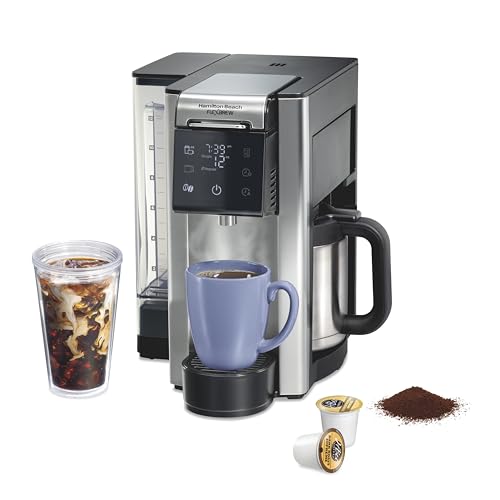
Hamilton Beach FlexBrew Advanced 5-in-1 Coffee Maker
Badge: Most Versatile
Strengths
- Drip pot and single-serve brewing in one footprint, so households with mixed habits need one machine
- Accepts both pods and ground coffee on the single-serve side
- Removable 60 oz. reservoir is easy to fill and clean at the sink
Trade-offs
- Two brewing systems mean more parts to rinse and keep track of
- Single-serve and pot brewing rarely peak at the same moment, so busy mornings still need a queue
- Thermal carafe performance depends on pre-warming like every insulated carafe
Key specs: Capacity: 12-cup drip side plus single serve; Reservoir: Removable 60 oz.; Formats: Pods and ground coffee; Carafe: Thermal, programmable drip side; Modes: Hot and iced coffee.
The FlexBrew Advanced is the diplomat of this group: it settles the argument between the person who wants a full pot and the person who wants one pod, one cup, right now. The drip side brews a 12-cup thermal pot on a programmable schedule, while the single-serve side handles pods or grounds for hot and iced drinks. The removable 60 oz. reservoir is a practical touch, because filling at the sink beats pouring over a counter with a carafe. The honest limitation is complexity: two systems share one counter footprint, and both need rinsing, descaling, and occasional attention. Households that genuinely use both formats weekly will love it; a household that only ever brews pots is paying for a second machine it will rarely touch.
Mixed-demand spaces are where the FlexBrew earns its footprint: the morning pot for the team, single cups for the late arrivals and the iced-coffee drinker, from one machine. In a small office that replaces both a pot brewer and a pod machine, the counter savings are real.
Best for: offices and break rooms with mixed pot and single-cup demand / Not suited for: high-volume service where both sides would be queued at once

KRUPS 12-Cup Programmable Thermal Carafe Coffee Maker
Badge: Best for Scheduled Service
Strengths
- Three brew strengths make it easy to adjust for different coffees and drinkers
- 24-hour programming covers the set-it-the-night-before routine
- Double-wall thermal carafe is listed as keeping coffee hot for 4 hours without a warming plate
Trade-offs
- No built-in grinder
- No warming plate means the carafe alone carries heat retention, so pre-warming matters
- Buyers who like a visible glass pot will not get one here
Key specs: Capacity: 12 cups; Programming: 24-hour programmable; Strengths: 3 brew strengths; Carafe: Double-wall thermal, keeps coffee hot 4 hours; Warming plate: None (thermal carafe design).
This KRUPS is built for the scheduled household: set it the night before, choose one of three strengths, and wake to a full thermal pot. The double-wall carafe is the centre of the design, listed as keeping coffee hot for four hours, and because there is no warming plate the last cup avoids the scorched, stewed flavour a hot plate creates over a long morning. Strength selection is the feature drinkers actually use day to day, since a bolder setting can rescue a lighter roast and a gentler setting can calm a dark one. The honest limitation is that everything rides on the carafe: if your household stretches a pot across an entire day, even a good thermal carafe will eventually give back lukewarm coffee, and there is no plate to rescue it.
A workplace runs on schedules, and the KRUPS is the schedule specialist: a 12-cup pot brewed before the first meeting, at a strength chosen for the group, held in a thermal carafe that the listing credits with four hours of heat. Set it Friday for Monday and the routine carries itself.
Best for: teams that brew one or two scheduled pots a day / Not suited for: venues needing continuous all-day holding beyond a thermal carafe’s window

Cuisinart 10-Cup Thermal Classic Coffeemaker
Badge: Best for Small Teams
Strengths
- Straightforward programmable brewing in a manageable 10-cup size
- Thermal carafe avoids hot-plate flavour changes
- Black finish and classic format suit most kitchens without visual fuss
Trade-offs
- Smaller capacity than the 12-cup picks, so big households brew twice
- No built-in grinder
- Fewer headline extras than the PerfecTemp models in this guide
Key specs: Capacity: 10 cups; Carafe: Thermal; Programming: Programmable; Finish: Black; Model: DCC-1170BKNAS.
The Thermal Classic is Cuisinart in its most straightforward form: a programmable 10-cup machine with a thermal carafe and no attempt to be five appliances at once. That restraint is its strength. Ten cups is the right size for a couple or a small family that finishes a pot by mid-morning, and the thermal carafe keeps the coffee tasting like coffee rather than like a warming plate. Programming covers the wake-up routine, and the black finish disappears into most kitchens. The honest limitation is headroom: households that regularly serve six or more drinkers will feel the 10-cup ceiling, and there is no grinder or elaborate strength system to play with. It is the pick for buyers who want a known format done competently.
Not every workplace needs twelve cups. For a small office or a studio team, the Thermal Classic’s 10-cup programmable format covers the morning without the waste of a half-drunk oversized pot, and its plain operation suits spaces where the machine has many casual users.
Best for: small teams of two to five coffee drinkers / Not suited for: larger offices that empty a 12-cup pot before nine

SECPOEDR Grind and Brew Coffee Maker with Built-In Grinder
Badge: Best for Fresh-Ground Pots
Strengths
- Built-in grinder means whole beans go in and fresh-ground coffee comes out
- Programmable brewing pairs with the grinder for a true night-before setup
- 2-hour keep warm function suits households that drink across the morning
Trade-offs
- Grinder adds noise to early-morning brewing
- More parts to clean than a grounds-only machine
- Keep-warm holding will change flavour over the full two hours, as with any held coffee
Key specs: Capacity: 10 cups; Grinder: Built-in; Programming: Programmable; Keep warm: 2-hour keep warm function; Finish: Stainless steel.
Grind-and-brew machines exist for one reason: coffee tastes better when the beans are ground moments before water hits them, and most people will not run a separate grinder at dawn. This SECPOEDR builds the grinder into a programmable 10-cup machine, so the night-before routine is beans in, timer set, and fresh-ground coffee in the morning without extra counter equipment. The 2-hour keep warm function suits slower mornings. The honest limitations come with the format: grinding is loud, the grinder chamber needs regular cleaning to stop old grounds flavouring new pots, and coffee held warm for the full window will not taste like the first cup. For freshness-first households, those are fair trades.
Offices that buy whole beans get the grind-and-brew advantage at pot scale: beans ground moments before brewing, on a timer, so the first pot of the day is fresh-ground without anyone arriving early to grind. Budget a minute of grinder noise into the morning soundscape.
Best for: bean-buying teams that want fresh-ground pots on a schedule / Not suited for: open-plan offices where dawn grinder noise would disturb early workers

Gevi 10-Cup Grind & Brew Coffee Maker
Badge: Best Modern Controls
Strengths
- Built-in grinder plus touch-screen programmable controls in one all-in-one unit
- Reusable filter cuts paper-filter restocking
- Glass carafe makes the remaining level visible at a glance
Trade-offs
- Glass carafe on a warm plate changes flavour faster than a thermal carafe over long holds
- Grinder adds noise and cleaning steps
- Touch controls are less glove- and wet-hand-friendly than physical dials
Key specs: Capacity: 10 cups; Grinder: Built-in; Controls: Touch screen, programmable brew; Carafe: Glass; Warm plate: 90-minute warm plate; Tank: 1.5L; Filter: Reusable filter included.
The Gevi takes the grind-and-brew idea and gives it a modern control surface: a touch screen, programmable brewing, a built-in grinder, and a 1.5L tank feeding a 10-cup glass carafe. The reusable filter is a small but real running-cost and waste advantage, and the glass carafe lets you see exactly how much is left, which thermal carafes never do. The 90-minute warm plate keeps coffee hot for the standard morning window. The honest limitation is that a warm plate is a flavour compromise over time, and a touch panel is not everyone’s preference with wet hands at dawn. Buyers who want the all-in-one format with contemporary controls will find this the most complete expression of it here.
The Gevi suits the workspace that prefers a screen to a dial: touch controls, programmable grind-and-brew, and a reusable filter that removes one recurring supply purchase from the office manager’s list. The glass carafe also lets anyone see at a glance whether a fresh pot is needed.
Best for: modern offices that like touch controls and visible coffee levels / Not suited for: teams wanting thermal holding across long meetings
Comparison Table
| Pick | Capacity | Carafe / Format | Standout feature | Listing |
|---|---|---|---|---|
| BUNN Speed Brew Platinum | 10 cups | Thermal, stainless steel | Fast brewing and thermal holding, the closest to commercial priorities | Check on Amazon |
| Hamilton Beach FlexBrew Advanced | 12-cup drip side plus single serve | Thermal, programmable drip side | Pot plus single-serve flexibility for mixed-demand teams | Check on Amazon |
| KRUPS 12-Cup Thermal | 12 cups | Double-wall thermal, keeps coffee hot 4 hours | Scheduled 12-cup pots with three strength settings | Check on Amazon |
| Cuisinart Thermal Classic 10-Cup | 10 cups | Thermal | Compact programmable 10-cup for smaller teams | Check on Amazon |
| SECPOEDR Grind and Brew | 10 cups | Drip coffeemaker | Fresh-ground pots on a timer for bean-buying offices | Check on Amazon |
| Gevi 10-Cup Grind & Brew | 10 cups | Glass | Grind-and-brew with touch controls and a reusable filter | Check on Amazon |
How to Choose the Right Drip Coffee Maker
Start with honest capacity math. A coffee maker’s cup is a small unit, roughly five ounces, not the mug in your hand. A 10-cup machine makes about 50 ounces, which is four generous mugs; a 12-cup machine makes about 60 ounces, or five mugs. Count the mugs your household actually drinks before noon, add one for the guest or the second round, and buy that size. Oversized machines brew small pots badly unless they carry a dedicated small-batch setting, and undersized machines make you brew twice, which nobody does happily at dawn.
Choose the carafe before the features. Thermal carafes hold coffee with insulation, so the last cup tastes close to the first, but you cannot see how much is left and they reward a hot-water pre-warm. Glass carafes show the level at a glance and sit on warming plates that keep coffee hot at the cost of slowly cooking it. If your household finishes a pot within the hour, glass is fine and cheaper to replace. If a pot stretches across a morning, thermal is the flavour-preserving choice, and it is why thermal models dominate this guide.
Temperature and saturation decide the taste more than the badge count. Coffee extracts best in hot water, and it extracts evenly only when the water is spread across the whole bed of grounds. Machines that advertise hotter brewing or engineered showerheads are addressing the two variables that most often make home drip taste sour or hollow. Strength controls are the third useful lever: they let you adjust a pot to the coffee you bought instead of re-measuring ratios every time a new bag arrives.
Decide how you feel about grinding. A built-in grinder delivers the single biggest freshness upgrade available to a drip drinker, because ground coffee stales in hours while whole beans hold for weeks. The cost is noise, a chamber to clean, and one more mechanism in the machine. Households that buy pre-ground coffee for convenience should skip grind-and-brew entirely and put the money toward a better brewer; households that buy whole beans anyway should seriously consider it.
Programming is worth having if your mornings are predictable. A 24-hour programmable start sounds like a small thing until the first week of waking to a finished pot. It matters less for households where someone is always awake first and happy to press a button. Small-batch settings, brew pause, and removable reservoirs are the other practical features: each removes a specific daily friction rather than adding a line to a feature list.
Finally, think about the sink, not the counter. Every machine here needs descaling, carafe washing, and basket rinsing. Removable reservoirs, dishwasher-friendly carafes where the listing allows, and reusable filters all change the weekly effort. The machine you will keep clean is the machine that will keep making good coffee in year three.
How to Brew, Clean, and Look After a Drip Coffee Maker
Setting up for the first pot. Wash the carafe, lid, and filter basket in warm soapy water before first use, then run one full cycle of plain water through the machine to rinse the internal path. Place the machine so the reservoir is easy to fill and the steam from brewing is not trapped under a cabinet. If your model has a clock and programmable start, set them now, while the manual is open, rather than at midnight before the first workday.
The daily brew, step by step. Fill the reservoir with fresh cold water to the line for the number of cups you actually want. Add the filter and coffee: a reliable starting ratio is one to two tablespoons of ground coffee per six ounces of water, adjusted to taste over the first week. For a thermal carafe, swirl hot water through it for a minute first and empty it; a pre-warmed carafe can be the difference between a hot last cup and a lukewarm one. Start the brew, and resist lifting the carafe mid-cycle unless your machine has a brew-pause feature, because early cups are disproportionately strong and the pot’s balance depends on the full cycle finishing.
Grind and storage basics. Medium grind is the drip standard; too fine over-extracts into bitterness and can overflow the basket, too coarse under-extracts into sourness. Store beans or grounds in an airtight container away from heat and light, and buy in quantities your household finishes while the coffee is still lively. If your machine grinds, empty and brush the grinder chamber regularly, because old grounds clinging to the chamber will flavour every new pot.
Cleaning rhythm. Rinse the carafe and basket daily; coffee oils go rancid and will season the machine in the worst way. Wash removable parts weekly. Descale on the schedule your water hardness demands: mineral scale insulates the heating element, brewing temperature falls, and the coffee quietly turns sour weeks before the machine complains. Use the descaling method the manufacturer specifies, run rinse cycles afterwards, and treat a slowdown in brew time as the early warning it is.
Troubleshooting
Problem: the coffee tastes sour and weak → check the grind first (too coarse), then the ratio (too little coffee), then descale, because a scaled machine brews too cool and under-extracts exactly this way.
Problem: the basket overflows or grounds reach the carafe → the grind is likely too fine, the basket was overfilled, or a collapsed paper filter blocked drainage; reduce the dose slightly and make sure the filter sits flat before brewing.
Problem: the last cups from a thermal carafe are lukewarm → pre-warm the carafe with hot water before brewing, keep the lid fully closed between pours, and brew the size of pot your household finishes within the carafe’s strong window.
What “Commercial Performance” Actually Requires From a Countertop Machine
Commercial buyers think in pots per hour and cups per person, and it is worth translating that thinking to countertop scale before choosing. A 12-cup machine makes roughly 60 ounces, about five generous mugs. A team of eight drinking two mugs each before lunch needs three to four pots by midday, which means the machine’s real job is back-to-back consistency: pot four must extract like pot one, the reservoir must be quick to refill, and the carafe must pour cleanly when people are in a hurry. This is why brew speed and thermal design dominate this guide’s ranking, and why we weighted them ahead of novelty features.
Consistency under repetition is also a maintenance story. Scale builds faster in a machine that heats water all day, and a scaled heating element brews cooler, which reads in the cup as sour, thin coffee that staff blame on the beans. In a shared space, assign descaling to a named person on a calendar rhythm; machines in offices die of nobody’s-job maintenance far more often than of defects. Our companion guide to Best Commerical Coffee Makers covers the wider commercial-leaning category if your shortlist is still forming.
Finally, plan the serving side. A thermal carafe on a side counter with cups, lids, and a rinse routine will outperform a fancier machine wedged beside the sink. Where the coffee is served is part of the system, and it is the part entirely in your control.
Countertop High Performance vs True Commercial Equipment: An Honest Line
It is worth stating plainly what separates these machines from true commercial equipment, so the purchase is made with open eyes. Commercial cafe brewers are typically plumbed to a water line, built for continuous duty across hundreds of cycles, certified for commercial food service, and supported by service contracts. The machines in this guide are countertop, reservoir-fed, and built for homes and light-duty shared use. For a small office, a studio, a salon waiting area, a church hall, or a heavy-drinking household, that is not a compromise — it is the appropriate class of equipment, at a fraction of the commitment.
The line to respect is volume and duty. If your setting serves coffee continuously to paying customers all day, buy commercial equipment through a commercial channel. If your setting brews a handful of pots a day for a team or family, the picks above will do that job well, and the strongest of them — the fast, simple BUNN — will do it with the least friction. Buyers weighing smaller footprints for tight counters should also see Best Compact Coffee Makers, and those interested in basket geometry can compare Best Cone Coffee Makers.
Setting Up a Small-Team Coffee Station That Actually Works
A commercial-leaning coffee setup succeeds or fails on layout more than on machinery. Put the machine where water is easy to reach and spent grounds are easy to discard, because every refill and every basket dump is a small negotiation with the space. Keep the coffee, filters, and a waste bin within one step of the machine. Put cups and lids at the serving point, not at the brewing point, so the person pouring does not block the person brewing. In genuinely busy small venues, a second carafe is the cheapest throughput upgrade that exists: one pot serving while the next brews removes the queue that makes a good machine feel slow.
Assign the invisible jobs. Someone owns descaling on a calendar. Someone owns the Monday check that beans, grounds, and filters are stocked. Someone owns the rule that the basket never sits full of wet grounds overnight, because that single habit is responsible for more bad Monday pots than any mechanical fault. Write the brew ratio on a card taped inside a cupboard door, so a new starter brews the house pot correctly on day one. These are unglamorous systems, and they are exactly the difference between a workplace that loves its coffee setup and one that is shopping for a replacement by spring.
Think about water as a supply line, not an afterthought. Machines in shared spaces are refilled from whatever jug or tap is nearest, and a reservoir that is easy to remove and carry — the FlexBrew’s removable reservoir is the example in this pool — gets filled properly instead of topped up with a mug. If your water is hard, the descaling interval is not a suggestion from the manual; it is the maintenance schedule the machine’s temperature, and therefore its flavour, depends on.
The Real Cost of a Pot: Thinking Like an Operator
Operators think in cost per pot and cost per cup, qualitatively even when they never print the numbers. The machine is the smallest part of that arithmetic over its life. Coffee is the largest: a pot brewed with a heavy hand on the scoop costs noticeably more across a year than the same pot brewed at a measured ratio, and tastes stronger in a way drinkers often mistake for better. Filters, descaler, and a replacement carafe across the machine’s life are the middle items. The hidden item is waste: pots brewed too large for the team and poured away at noon are pure loss, which is why right-sizing — the 10-cup Cuisinart for a small team, the 12-cup machines for larger ones — is an operator’s decision, not just a shopper’s.
The other operator habit worth copying is the quality loop. Once a month, someone tastes the first cup of the day critically: sour means check the descale date and the ratio; bitter means check the dose and how long the pot has been held; flat means check the coffee’s age. Five minutes of attention monthly prevents the slow drift that ends with staff buying coffee elsewhere and the machine gathering dust. High performance, in a shared space, is mostly this: a decent machine, a measured ratio, a calendar, and a person who tastes.
Choosing Between the Six: A Decision Walk-Through
Walk the decision in the order an operator would. First, headcount at peak: if the morning rush is three people, the 10-cup Cuisinart Thermal Classic is honestly sized and the money saved belongs in better coffee; if it is eight, start at the 12-cup machines and do not look back. Second, demand shape: a single morning wave suits the KRUPS, programmed and held in its thermal carafe; rolling arrivals across hours suit the BUNN, whose speed turns brewing into an on-demand act rather than a scheduled one; a split between pot drinkers and single-cup drinkers is the FlexBrew’s entire reason to exist. Third, the bean question: a team that buys whole beans and values freshness should let the grind-and-brew pair — SECPOEDR for the keep-warm window, Gevi for the touch controls and reusable filter — argue it out, because both remove the stale-grounds variable that quietly caps every other machine’s quality.
Fourth, the serving window. Coffee served within the hour forgives almost any carafe; coffee served across a three-hour meeting does not, and that is why thermal picks dominate this ranking while the Gevi’s glass carafe is recommended only where pots turn over fast and visibility matters. Fifth, the human factor: in a shared space the best machine is the one the least technical user can run at 7 a.m. without a note on the fridge. Simplicity is a performance specification in commercial-leaning settings, and it is scored that way here.
Run those five questions honestly and most readers will find the decision has quietly made itself, with the runner-up equally clear. That is what a good shortlist is for: not to crown a universal winner, but to make the trade-offs visible enough that the right machine for your counter is obvious. The wrong way to choose — by feature count, by finish, by whichever listing a colleague forwarded — is how workplaces end up with a beautiful machine nobody uses and a kettle doing the real work.
The First Month With a Team Machine: A Short Playbook
Week one is for the ratio card and the routine: brew the house pot at the standard ratio, post the card, and let people simply get used to where things live. Week two is for the first honest tasting — one person, first cup, notes on the card — and one adjustment only. Week three is for the serving check: is the carafe station where people actually gather, or where the plan said it should be? Move it if reality disagrees. Week four is for the calendar: descale date set, supply check assigned, and the second-carafe question answered with a month of real queue data instead of a guess. A team machine onboarded this way becomes infrastructure. One that is simply unboxed becomes an appliance people route around — and routing around is the true failure mode of shared equipment, long before anything breaks.
Common Buying Mistakes
Buying capacity by the headline number. Shoppers compare 10-cup and 12-cup labels as if they were mug counts. They are not, and the mismatch is why big households end up brewing twice and small households end up with weak small pots. Do the mug math before you shop, and look for a small-batch setting if your household swings between two cups on weekdays and a crowd on weekends.
Paying for a grinder you will not clean. Grind-and-brew machines are wonderful for exactly as long as the grinder chamber stays clean. If you know your household will not brush out a chamber weekly, a grounds-only machine and a bag of good pre-ground coffee will honestly taste better by month two.
Ignoring the carafe question. Buyers compare features and forget the vessel the coffee lives in. A glass carafe on a plate punishes slow drinkers; a thermal carafe frustrates people who want to see the level. This one decision shapes every single morning with the machine, so make it deliberately.
Chasing feature counts instead of extraction basics. Hot water, even saturation, and a sensible ratio make coffee taste good. A long feature list built on a cool, uneven brew makes expensive bad coffee. Weight the basics first, then let features break ties.
Skipping descaling until the machine slows down. By the time a scaled machine brews noticeably slowly, it has been brewing too cool for weeks. Put descaling on a calendar rhythm matched to your water, not on a when-it-breaks rhythm.
Final Recommendation
For most readers who arrived with a commercial brief and a countertop reality, the BUNN Speed Brew Platinum is the first choice: it is the fastest route to a full thermal pot, the simplest for many hands to use, and the closest in spirit to the commercial priorities of speed and consistency. Choose the Hamilton Beach FlexBrew Advanced instead if your space genuinely splits demand between pots and single cups. Pick the KRUPS 12-Cup Thermal for scheduled team pots, the SECPOEDR or Gevi grind-and-brew models if your team buys whole beans, and the Cuisinart Thermal Classic if your team is small enough that ten cups is a full morning. And if your volume is truly cafe-scale, take the honest path and shop commercial equipment through a commercial supplier.
Ready to decide? Start with the top pick and Check on Amazon to confirm the current configuration before you buy.
Still torn between the top two? Compare the runner-up directly and Check on Amazon for its current listing details.
Frequently Asked Questions
Are these machines really commercial grade?
No, and this guide does not claim they are. They are high-performance countertop drip machines suited to offices, small venues, and heavy home use. True commercial brewers are plumbed, certified for food service, and built for continuous all-day duty; if that is your setting, buy through a commercial equipment channel.
Which pick is fastest for a team that queues for coffee?
The BUNN Speed Brew Platinum is built around fast brewing and is the pick we would put in front of a queue. Its simple controls also matter in shared spaces, because a rotating cast of users needs no training to run it.
How many pots a day can a countertop machine handle?
A handful of pots a day for a team or household is the natural duty of this class. The practical limit is less the machine than the maintenance: heavy daily use builds scale faster, so descale on a shorter calendar rhythm than a home user would.
Is a thermal carafe or a glass carafe better for an office?
Thermal, for most offices. Meetings stretch, and a thermal carafe holds coffee in good condition across them, while a warming plate slowly cooks a pot. Glass only wins where the pot is finished quickly and seeing the level matters more.
Can one machine serve both pot drinkers and single-cup drinkers?
Yes — that is exactly the Hamilton Beach FlexBrew Advanced’s design, with a 12-cup programmable drip side and a single-serve side that takes pods or grounds. It suits mixed-demand spaces better than buying two machines.
What maintenance matters most in a shared space?
Descaling on a named person’s calendar, daily carafe and basket rinsing, and a rule that grounds never sit in the basket overnight. Shared machines fail from neglected basics far more often than from defects.


