A compact espresso machine gives you real espresso in a footprint that fits a studio kitchen. Slim pump machines, pod systems and manual presses are the main routes.
The six options below range from a slim pump machine with a steam wand to a manual press that needs no outlet. Exact dimensions vary, so measure your space and check the size on the listing. Small machines trade some tank size and drip tray room for a slimmer body, so expect to refill and empty them a little more often. Warm-up time, steam power and whether you must buy a separate grinder are worth weighing alongside size. If you mostly drink milk drinks, put steam performance near the top of your list. We have not used these products ourselves, so please confirm sizes, materials and what is included on the current listing before buying.
As an Amazon Associate we earn from qualifying purchases. Links below are affiliate links, and they do not change the product information we give.
What to Look For
| Feature | Why it matters |
|---|---|
| Footprint | Measure width, depth and height under your cabinets |
| Pump or pod | Pump machines give control; pods give speed |
| Steam wand | Needed if you want to steam milk by hand |
| Water tank | A small tank means more refills |
| Warranty and support | Check the maker’s warranty terms and how to reach support if a part fails |
In this guide
Specs at a Glance
| Product | Type | Best for | Notes |
|---|---|---|---|
| Breville Bambino Plus | Pump machine | Daily milk drinks | Automatic milk texturing |
| De’Longhi Dedica EC685 | Slim pump machine | Narrow counters | Slim body |
| De’Longhi Stilosa | Pump machine | Budget-friendly | Manual steam wand |
| Nespresso Vertuo Pop | Pod machine | Quick cups | Compact pod brewer |
| Wacaco Picopresso | Manual espresso maker | Travel and tiny spaces | No outlet needed |
| Flair Neo | Manual lever | Hands-on brewers | Compact manual |
The 6 Best Compact Espresso Machines

Top pickBest for daily milk drinks
1. Breville Bambino Plus Espresso Machine
A compact pump machine with a fast heat-up and an automatic steam wand that textures milk for you. Check the current listing for the exact size and what is included before you order.
Suits: daily milk drinks. Strengths: a small footprint and automatic milk. Weaknesses: limited tank size. Skip it if you want manual control of steam.

Best for narrow counters
2. De’Longhi Dedica EC685 Espresso Machine
A slim pump machine in a narrow body, often chosen for tight counters. It has a manual steam wand. Check the current listing for the exact size and what is included before you order.
Suits: narrow counters. Strengths: a very slim body. Weaknesses: small drip tray. Skip it if you want a big tank.
View De’Longhi Dedica EC685 on Amazon
Best for budget-friendly espresso
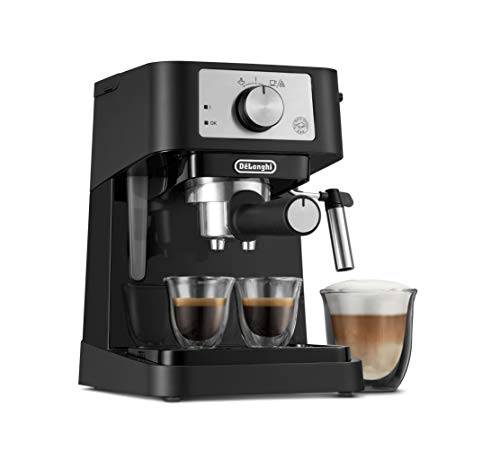
3. De’Longhi Stilosa Espresso Machine
A budget-friendly pump machine with a manual steam wand and a compact build. Check the current listing for the exact size and what is included before you order.
Suits: budget-friendly espresso. Strengths: a low entry point. Weaknesses: plastic body. Skip it if you want advanced features.

Best for quick cups
4. Nespresso Vertuo Pop Coffee and Espresso Machine
A small pod machine that brews coffee and espresso-style cups with a single button. Check the current listing for the exact size and what is included before you order.
Suits: quick cups. Strengths: a tiny footprint and speed. Weaknesses: locked into Nespresso pods. Skip it if you want to grind your own beans.

Best for tiny spaces and travel
5. Wacaco Picopresso Portable Espresso Maker
A manual espresso maker that uses hand pressure and ground coffee, so it needs no outlet and stores in a drawer. Check the current listing for the exact size and what is included before you order.
Suits: tiny spaces and travel. Strengths: a very small size. Weaknesses: requires practice. Skip it if you want a push-button machine.
View Wacaco Picopresso on Amazon
Best for hands-on brewers
6. Flair Neo Espresso Maker
A compact manual lever espresso maker that brews with hand pressure and hot water from a kettle. Check the current listing for the exact size and what is included before you order.
Suits: hands-on brewers. Strengths: an affordable manual route. Weaknesses: requires a separate kettle. Skip it if you want automatic steaming.
Care and Setup
- Descale on the maker’s schedule.
- Purge the steam wand after use.
- Empty the drip tray often.
- Use fresh water in the tank.
Mistakes to Avoid
- Ignoring counter height.
- Using pre-ground coffee that is too coarse.
- Skipping descaling.
- Expecting cafe results without a grinder.
Measuring Your Space the Right Way
Width and depth are only part of the story with a compact machine. Start by measuring the counter spot, then check the height from the counter to the underside of any cabinet or shelf. Many machines need room above them to lift the lid and refill the water tank, and some have tanks that slide out from the back or side. A machine that fits when closed may be awkward to use if you cannot reach the tank.
Next, think about the space around it. You need room in front for the portafilter handle or the cup, a spot for the cup to sit under the spout, and space for a milk pitcher if you steam milk. Check the listing for the cup clearance, since a tall mug or travel cup may not fit under the spout. Many machines come with a removable drip tray that can be lowered or flipped for taller cups.
Also plan where the cord reaches, whether the outlet is behind the machine, and how you will pull the machine forward to refill. Finally, look at where the rest of the gear will live: a grinder, a scale, a knock box and beans all need a home. In a small kitchen, a cart, shelf or drawer for accessories can matter as much as the machine itself.
Pump, Pod or Manual: Which Route Suits You
Compact machines come in three broad families, and each asks something different of you.
- Slim pump machines use a portafilter and ground coffee, give you control over dose and grind, and usually include a steam wand. They reward practice and make the closest thing to cafe espresso in a small footprint, but need a grinder and a few minutes of setup per drink.
- Pod and capsule machines are quick and need little cleanup. They make espresso-style drinks and are limited to the pods the machine accepts, so check which format the listing says it uses.
- Manual presses and levers need no counter outlet in some designs and take almost no space, but you supply the effort and usually heat the water separately. They suit hobbyists who enjoy the process and want a tiny footprint.
Be honest about your mornings. If you want a drink within a minute and have no appetite for tinkering, a pod machine fits. If you enjoy learning and want better control over taste, a pump machine or manual device offers more room to grow. A manual device also suits travel or an office desk, where plugging in a full machine is awkward.
Tank, Drip Tray and Warm-Up Trade-Offs
Small bodies mean small reservoirs. A compact tank is fine for one or two drinks a day but becomes a chore if several people use the machine. Check the listing for tank size and whether it is removable, since a removable tank is easier to fill at the sink and to clean.
The drip tray works the same way: a slim tray fills quickly if you rinse the group head or run a pre-heat shot. Empty it often, and check whether it has a float or indicator that tells you when it is full. Cup-warming areas may be limited, so pre-warming with hot water is a good habit.
Warm-up time varies. Some machines are ready within a short time, while others need longer for the group head and portafilter to reach working temperature. Stable temperature helps shot quality, so give the machine its time even if a ready light appears early. A machine that heats quickly suits busy mornings, but check how it handles steam: some switch modes slowly, which delays milk drinks.
If you drink mostly milk drinks, steam performance deserves attention. A weak wand takes longer to build foam, and a very small boiler may struggle to make several drinks back to back.
Grinders, Beans and Milk in a Tiny Kitchen
A pump machine or manual maker needs freshly ground coffee, and in a small kitchen the grinder becomes the second piece of equipment to place. Hand grinders take little space, store in a drawer and work without power, but take effort for each dose. Electric burr grinders are faster and more consistent for daily use, though they occupy counter space.
Whatever you choose, use a burr grinder with fine adjustment. Pre-ground coffee is convenient but often too coarse for a pump machine, and it goes stale quickly. Buy beans in amounts you will use within a few weeks of roasting, and keep them in a sealed container away from heat and light.
Milk needs a little planning too. If you steam by hand, use a small jug sized to one drink, and wipe and purge the wand after each use. Automatic milk systems save time but add parts to clean. Keep a cold spot in the fridge for milk, and use fresh milk each time. If you avoid dairy, check the manual for guidance on plant milks, since results vary.
Small-Machine Care and Longevity
Compact machines work in tight spaces, so care is a matter of regular small habits.
- Wipe the group head or spout and steam wand after each drink, before milk dries on it.
- Empty the drip tray and rinse the portafilter and basket daily.
- Use fresh, filtered water if your tap water is hard, and descale on the maker’s schedule.
- Check seals and the tank fit occasionally for leaks.
- Let a pod machine’s used-capsule bin empty before it overflows.
Keep the area around the machine dry. Moisture under a machine in a cramped corner can cause stains or damage to the counter, so wipe splashes promptly and allow airflow around the body.
Signs it may be time to repair or replace include weak pressure or flow, a steam wand that no longer builds foam, water leaking from the base, strange noises from the pump, a heater that no longer reaches temperature, or a portafilter that will not lock. Before replacing, check the manual for descaling and cleaning steps, since scale causes many faults. If you outgrow a compact machine, because you now host guests or want more control, consider what annoyed you most and let that guide the next purchase.
Compact Espresso Machine FAQ
Do compact machines make real espresso?
Pump and manual machines do. Pod machines make espresso-style drinks.
Do I need a grinder?
For pump and manual machines, yes. A burr grinder helps most.
Which is best for milk drinks?
The Bambino Plus has automatic milk texturing.
Can I use pods with the others?
Only the Nespresso machine uses pods.
How do I check whether a cup will fit under the spout?
Look for the cup clearance on the listing, then measure your tallest mug. Many machines have a removable or adjustable drip tray to make room for larger cups.
Is a hand grinder good enough for a compact setup?
Many people use one successfully, especially for one or two drinks a day. It saves space but takes effort. Choose one with fine adjustment so you can match the grind to your machine.
Do compact machines get as hot as larger ones?
Heat performance depends on the model rather than size alone. Check the listing for warm-up details, and pre-warm the cup and portafilter for better results.
What should I do if the drip tray fills quickly?
Empty it regularly, and avoid unnecessary flushing. Some machines have a full indicator. Check the manual for how the tray is removed and cleaned.
Can I use a manual espresso maker without electricity?
Some manual devices need only hot water and your effort, though you still need a way to heat the water. Check the listing for what is required, and whether a grinder is also needed.
How often should I descale a small machine?
Follow the schedule in the manual, and do it sooner in hard-water areas. Skipping descaling is a common cause of weak flow and faults.
Where should I store beans in a small kitchen?
Keep them in a sealed container in a cool, dark cupboard. Avoid storing them next to the stove or in direct sun. Buy amounts you can use within a few weeks.
Compact Espresso for Dorms, Offices, Campers and Studios
A small machine often goes into a small, unusual space, and each setting brings its own limits. Thinking about where the machine will live narrows the choices faster than comparing specs.
- Dorm rooms: rules on appliances vary by school, and some prohibit certain heating elements. Check your housing policy before you buy. A pod machine or a manual maker avoids a lot of mess, and a slim pump machine can work if the rules allow it.
- Shared offices: a machine that heats quickly and cleans in a minute gets used. Consider where you will fill the tank, since a break-room sink may be far from the desk. Manual makers also need a kettle, which may not be available.
- Camper vans, boats and cabins: power may be limited. A manual espresso maker needs no outlet, only hot water, which makes it the practical option off-grid. Check the voltage and wattage of any electric machine against your power source.
- Studio apartments: counter space is the issue. A slim machine that tucks into a corner, or a manual maker stored in a drawer, keeps the kitchen from feeling crowded.
- Travel: the lightest manual makers pack into a bag, but you will also need a way to grind coffee and heat water.
Be honest about how much effort you will give. The most compact option is often the one that asks the most from you, because manual makers trade size for work. If you will not do the work on a busy morning, a slightly larger pump or pod machine may serve you better than the smallest possible choice.
Power, Outlets and Circuit Limits
Espresso machines with a heating element draw significant power while they heat, and in older buildings or shared circuits this can matter. If a kettle, microwave and toaster share the same outlet, adding an espresso machine can trip a breaker. Check the wattage on the listing, and avoid plugging the machine into a power strip or a thin extension cord, which can overheat. Use a wall outlet, preferably one that is not shared with other high-draw appliances running at the same time.
Cord length affects placement. A short cord may force the machine to sit right by the outlet, which might not be the best spot for the tank or the steam wand. If you travel with a machine, remember that voltage differs between countries, and a plug adapter alone does not make a device safe on a different voltage. Check the label and the manual before plugging in abroad.
Building a Small Coffee Station
The machine is only one piece. A tidy station makes a compact setup pleasant to use, and a messy one makes it frustrating. You need a place for beans, a grinder if you use one, a milk pitcher, a knock box or small bin for used grounds, a cleaning cloth and a tamper where the machine needs it. All of that has to fit in a small area.
- Use vertical space with a wall shelf or hooks for mugs and tools.
- Put a small tray under the machine to catch drips and stray grounds.
- Choose an airtight canister that fits your cabinet depth, and store beans away from heat.
- Keep a dedicated cloth for the steam wand in plain sight, so you actually wipe it.
- Group items by task, so everything for making a drink sits within one arm’s reach.
If you must store the machine away between uses, check whether it can be moved easily. Heavy machines tend to stay put, which is fine if they live on the counter, but a problem if they need to be lifted into a cabinet every day. Also leave the tank open to dry after use, since stored damp parts can smell.
Planning for an Upgrade Later
Many people start small and move up. Thinking about this in advance saves money. A good burr grinder is the part most likely to carry over to a bigger machine, so if you are choosing between a better grinder and a fancier machine, the grinder may hold its value across upgrades. A milk pitcher, a scale and a tamper also move with you. Pods, on the other hand, tie you to one system, and a pod machine will not use any of your other equipment.
Think about what would make you want to upgrade. If it is steam power, a more capable steam wand will matter. If it is workflow, you may eventually want a machine with a built-in grinder. If it is capacity, a larger tank and drip tray are the fixes. Knowing your likely reason helps you avoid paying now for features you will replace later.
Before you order, write down three numbers: the width and depth of your spot, the clearance under the cabinet, and the height of your tallest mug. Check each against the listing, and leave a little margin for the tank, the drip tray and the cord. That five-minute check prevents most returns.
Related guides
- 6 Best Water Purifiers and Filters for Espresso Machines
- 6 Best Water Softening Options for Espresso Machines
- 6 Best Espresso Machines for Home Kitchens
- 6 Best Espresso Machines for Latte Art
Frequently Asked Questions
Can I use a compact espresso machine in a dorm room?
Possibly, but many schools restrict appliances with heating elements. Check your housing rules first. A manual espresso maker needs only hot water, though you would still need a kettle or access to hot water, and a way to grind coffee.
Will a compact machine trip my circuit breaker?
It can if the outlet is shared with other high-wattage appliances like a kettle or microwave. Check the machine’s wattage, plug it directly into a wall outlet and avoid running other heavy appliances on the same circuit at the same time.
What should I buy first: a better grinder or a better machine?
For machines that use ground coffee, the grinder has a large effect on the taste and carries over if you upgrade later. If you use pods, a grinder is not needed. Consider your budget and whether you plan to move up to a bigger machine.
How do I store a compact espresso machine when not in use?
Empty the water tank, drip tray and any leftover grounds, wipe it down and let the parts dry before storing. Leave lids and tanks slightly open to avoid odors. If the machine is heavy, it may be easier to leave it on the counter.
Matching a Compact espresso machine to the Way You Actually Work
Plenty of guides stop at listing features, but choosing a compact espresso machine well means matching it to the rhythm of your small kitchen. The picks above were selected for different kinds of users, and the differences between them matter most once the equipment is part of a daily routine rather than a novelty. This section walks through the situations these products actually live in, so you can place your own needs alongside them and see which end of the list deserves your closest attention.
Picture a small apartment kitchen, where every centimetre of counter is contested and the machine must justify its footprint daily. It also helps to picture the unglamorous moments: refilling, wiping down, emptying, and explaining the process to someone new. A choice that makes those small tasks quick and obvious will be used properly far more often than one that depends on everyone remembering a long list of exceptions. When you read the reviews above with that picture in mind, the right shortlist usually becomes obvious: look for the pick whose strengths line up with the busiest, least forgiving version of your routine, not the quietest one.
Picture a home office corner or studio, where one person makes a few drinks a day and values speed and tidiness over ceremony. Space shapes behaviour as much as features do. If people have to move things out of the way before they can start, they will start skipping steps, and the results will drift. Leave clear room for the supplies that belong with the task and for the finished result to land without blocking the next person. When you read the reviews above with that picture in mind, the right shortlist usually becomes obvious: look for the pick whose strengths line up with the busiest, least forgiving version of your routine, not the quietest one.
Picture a shared flat or family kitchen, where the machine is used by people with very different levels of interest and patience. When demand arrives in a rush rather than a trickle, the gap between a well-matched choice and a merely adequate one becomes obvious, because there is no spare minute to work around an awkward routine. Think about who is standing in front of the equipment at that moment, how much guidance they have had, and what happens to the line of people waiting behind them. When you read the reviews above with that picture in mind, the right shortlist usually becomes obvious: look for the pick whose strengths line up with the busiest, least forgiving version of your routine, not the quietest one.
How the Picks Compare in Day-to-Day Use
Specifications only tell half the story with compact espresso machines. The other half is emphasis: each pick in this guide leans in a different direction, and the reviews above describe those leanings in terms of who each one suits. The comparisons below draw only on those stated strengths, and they are meant to help you choose between neighbouring picks on the list rather than to crown an overall winner.
Set the Breville Bambino Plus beside the De’Longhi Dedica EC685 and the trade-off is one of emphasis. The guide above puts the Breville Bambino Plus forward for milk drinks, while the De’Longhi Dedica EC685 is the one it highlights for narrow counters. If your routine matches the first description, the Breville Bambino Plus will feel like the natural fit from the first week; if the second sounds more like your small kitchen, start with the De’Longhi Dedica EC685 instead. Also weigh what happens on the second and third use of the day, not just the first. Heat, residue, and simple fatigue all change the picture, and the option that stays consistent across repeated use is usually the one people end up recommending to each other. Read the two full reviews above back to back with your own routine in mind, and note which review’s cautions sound like problems you would actually meet.
Set the De’Longhi Stilosa beside the Nespresso Vertuo Pop and the trade-off is one of emphasis. The guide above puts the De’Longhi Stilosa forward for budget-friendly, while the Nespresso Vertuo Pop is the one it highlights for speed. If your routine matches the first description, the De’Longhi Stilosa will feel like the natural fit from the first week; if the second sounds more like your small kitchen, start with the Nespresso Vertuo Pop instead. Neither direction is wrong in the abstract. The right answer depends on whether your priority is speed, control, simplicity, or the lowest possible burden on whoever tidies up afterwards, and it is worth naming that priority honestly before you decide. Read the two full reviews above back to back with your own routine in mind, and note which review’s cautions sound like problems you would actually meet.
Set the Wacaco Picopresso beside the Flair Neo and the trade-off is one of emphasis. The guide above puts the Wacaco Picopresso forward for a drawer-sized maker, while the Flair Neo is the one it highlights for manual espresso. If your routine matches the first description, the Wacaco Picopresso will feel like the natural fit from the first week; if the second sounds more like your small kitchen, start with the Flair Neo instead. In practice, the deciding factor is rarely a single headline feature. It is the accumulation of small things: how intuitive the controls feel to a first-time user, how forgiving the process is when supplies vary, and how much attention the cleanup demands at the end of a long day. Read the two full reviews above back to back with your own routine in mind, and note which review’s cautions sound like problems you would actually meet.
One final filter applies across the whole list: support and consumables. Whichever compact espresso machine you choose, you will live with its supplies, its cleaning routine and its maker’s support for years. A pick that is slightly less exciting but easy to feed, clean and get help with will usually make its owner happier than a more dramatic choice that fights the routine at every step.
Setup and a Routine That Gets Consistent Results
Good results with a compact espresso machine are mostly a matter of routine. The steps below describe a sensible order of work that applies whichever pick from this guide you end up with; adapt the details to your manual, but keep the order, because each step sets up the next.
Step: Keep the machine’s small routine in one spot: beans, cups and cloth within reach. If more than one person will be doing this, agree on one shared way of handling this step and write it down where the work happens. Consistency between operators matters more than any individual’s personal twist on the technique. Done consistently, this step stops being something you think about and becomes simply how the job is done in your small kitchen, which is exactly where reliable results come from.
Step: Warm the machine and rinse as the manual directs before the first drink. Notice what a good result looks like at this stage and use it as your reference next time. Building that mental picture is how beginners become reliable, and it is the fastest way to spot when something has changed and needs attention. Done consistently, this step stops being something you think about and becomes simply how the job is done in your small kitchen, which is exactly where reliable results come from.
Step: Weigh or measure the dose the same way each time, even on busy mornings. Take a moment at this stage rather than rushing, because small shortcuts early on tend to surface later as inconsistent results that are hard to diagnose. If something looks or feels off, it is far easier to correct it now than after the process is fully under way. Done consistently, this step stops being something you think about and becomes simply how the job is done in your small kitchen, which is exactly where reliable results come from.
Step: Make the drink fully, then wipe and purge the steam wand immediately. This is also the point where a simple habit pays off: keep the supplies for this step in one place, in the order you use them. Fumbling around mid-task is how mistakes creep in and how a routine that should feel easy starts to feel like a chore. Done consistently, this step stops being something you think about and becomes simply how the job is done in your small kitchen, which is exactly where reliable results come from.
Step: Empty the drip tray and used grounds little and often, because small machines fill both quickly. If more than one person will be doing this, agree on one shared way of handling this step and write it down where the work happens. Consistency between operators matters more than any individual’s personal twist on the technique. Done consistently, this step stops being something you think about and becomes simply how the job is done in your small kitchen, which is exactly where reliable results come from.
Cleaning, Care and Making It Last
Care is where the lifespan of a compact espresso machine is decided. None of the tasks below is difficult, but all of them are easy to postpone, and postponement is what turns a good purchase into a disappointing one.
Descale on schedule, since small water paths are affected by scale quickly. Build the routine into the end of the session rather than treating it as a separate job. When wiping down, emptying, and checking for wear become the natural final steps, they actually happen; when they rely on someone remembering later, they quietly stop happening.
Wash the drip tray, tank and removable parts regularly rather than only rinsing them. Keep a small stock of the consumables the routine depends on, stored with the equipment itself. Running out of the right cleaning supply is the most common reason a good routine collapses, and it usually collapses at the busiest possible moment.
Wipe the exterior and the counter beneath, where a compact machine’s drips are easy to miss. Cleaning little and often beats the occasional heroic deep clean, both for hygiene and for the life of the equipment. Residue that is removed while it is fresh comes away easily; left for days, it hardens, flavours linger where they are not wanted, and parts begin to wear or stick.
As for the supplies that support all of this, keep them together and keep them stocked: beans or pods matched to the machine you chose, a milk jug and a cloth dedicated to the steam wand, a knock box or a tidy way to deal with used grounds, cleaning tablets or solution suited to the machine, cups that fit under the spouts with room to spare. Having the right supplies within reach is what turns good intentions about care and consistency into a routine that survives busy weeks.
Troubleshooting Common Problems
Most problems with compact espresso machines announce themselves gradually and have ordinary causes. Work through the relevant entry below before concluding that anything is broken.
Coffee tastes weak or watery
Weak results usually come from an under-dosed basket, stale beans, or a grind that is too coarse for the machine. Measure consistently, store beans sealed and away from heat, and adjust the grind in small steps, tasting as you go. Start with the simplest explanations before assuming a fault. Check that everything is seated, filled, emptied, and connected as it should be, and run the standard cleaning or reset routine the manual describes, because a large share of everyday problems trace back to a skipped basic rather than a broken part.
The machine seems to need constant emptying
Compact machines have compact trays and tanks; that is the trade you made for the footprint. Build emptying and refilling into the daily routine rather than waiting for warning lights mid-drink, and keep a cloth under the machine if drips are a habit. If the problem appeared suddenly, think about what changed: new supplies, a different operator, a moved machine, or a cleaning step that was rushed. Reversing the most recent change is often the quickest diagnostic you have, and it costs nothing to try.
Milk drinks disappoint
Check the basics: cold fresh milk, a clean wand, and enough practice with the jug position. Small machines often have less steam power, so texture a smaller amount of milk at a time rather than filling the jug and hoping. When a problem keeps returning after the basics are covered, stop forcing the equipment and contact the maker or a qualified service provider. Continuing to run something that is struggling tends to turn a small, fixable issue into a larger and more expensive one.
Planning Mistakes Worth Avoiding
Finally, a few patterns account for most of the disappointment people report with compact espresso machines. They are all avoidable, and none of them requires spending more money.
Choosing on the headline feature alone. The feature that dominates a product listing is not always the one that decides daily satisfaction. Decide which two or three jobs the equipment must do well every single day, and judge every candidate against those jobs first. Features outside that list are bonuses, not reasons to buy.
Skipping the unglamorous setup checks. Many disappointments blamed on a product actually begin before it is ever switched on or used: the space was never measured, the supporting supplies were never bought, or the surface, power, or water it depends on was never checked. Ten minutes of checking beforehand prevents weeks of working around a poor fit.
Letting the cleaning routine slide. Almost every piece of equipment in this guide performs well when it is clean and drifts when it is not. If the honest truth is that nobody will maintain a complicated routine, choose the option whose upkeep is simplest, because a modest choice that is cared for will outlast and outperform a premium one that is neglected.
Buying for the biggest imaginable day. Sizing for the single busiest event of the year leaves you with equipment that is oversized, awkward, or underused the rest of the time. Size for the busy end of normal, and have a simple plan — a second smaller unit, a borrowed backup, or a adjusted menu or routine — for the rare exceptional day.
Never writing the routine down. In any setting with more than one user, unwritten routines drift within weeks. A short, plain list of the agreed steps, kept where the work happens, keeps results consistent, makes training new people painless, and makes troubleshooting far easier because everyone is working from the same baseline.
More Questions About Owning One
The main FAQ above covers the most common questions about this category. The answers below go a step further into ownership: the decisions and habits that matter once your compact espresso machine is actually in use.
How long should it last with regular care?
There is no single honest answer, because lifespan depends far more on use and upkeep than on the badge on the front. Equipment that is cleaned on schedule, used within the workload it was designed for, and stored sensibly will generally serve for years, while the same equipment run hard and cleaned rarely will show wear quickly. Treat the care routine in the manual as part of the purchase: if you follow it, you are giving the equipment its best chance, and if a part does wear, check whether it can be replaced before replacing the whole unit.
What should I double-check before ordering?
Confirm the physical size against the space you actually have, including room to open, fill, empty, and clean it, and confirm exactly what is included in the box, because accessories shown in photos are not always supplied. Check any compatibility requirements that apply to your situation, such as the supplies it uses or the fittings it expects, and read the current listing rather than relying on an older description. Finally, confirm the returns position in case the fit is wrong, since size and workflow mismatches are the most common reason equipment like this goes back.
Is bigger always better?
Rarely. A larger option brings capacity you may use only occasionally, and it usually costs you counter or storage space every day, takes longer to clean, and can be less efficient with small loads or batches. The better question is what your typical session looks like, not your biggest one. Choose the size that handles an ordinary busy day comfortably, and keep a simple workaround for the exceptional day, rather than paying a daily penalty for capacity you seldom need.
Which extras are worth having from the start?
The worthwhile extras are the ones that support the routine itself rather than decorate it: the supplies the process consumes, the tools that make cleaning quick, and somewhere sensible to store both. Buy those alongside the equipment so the routine works properly from the first day. Decorative or highly specialised extras can wait until you have lived with the equipment for a while and know, from experience rather than guesswork, which gap is actually worth filling.
When is it time to replace rather than persist?
Consider replacing when the same fault keeps returning after proper cleaning and basic checks, when worn parts are no longer available, or when the equipment no longer fits the way your household or business actually works. A change in your routine — more people, a different menu or workload, a new space — is a legitimate reason on its own. Before replacing, note what specifically frustrates you about the current setup, because that list is the most reliable buying brief you will ever write.
Habits That Make Ownership Easier
Training Everyone Who Uses It
In any shared setting, the compact espresso machine is only as good as its least-trained user. A short, friendly walkthrough for each new person — what to do, what to avoid, and how to leave things ready for the next user — prevents most of the damage and inconsistency that people later blame on the product. Pair the walkthrough with the written routine mentioned earlier, and revisit both after the first few weeks, when real habits have formed and the gaps in your instructions have become visible. Small corrections made early become the culture around the compact espresso machine; left alone, workarounds become the culture instead, and they are much harder to shift.
The Short Version
For milk drinks, the Breville Bambino Plus. For narrow counters, the De’Longhi Dedica EC685. For budget-friendly, the De’Longhi Stilosa. For speed, the Nespresso Vertuo Pop. For a drawer-sized maker, the Wacaco Picopresso. For manual espresso, the Flair Neo. Whichever you choose, confirm the details on the current listing and match the size and type to how you will really use it.


