Disclosure: topratedkitchenware.com is reader-supported. When you buy through links on our site, we may earn an affiliate commission from Amazon and other retailers, at no extra cost to you.
Where to buy
The six picks below are the verified shortlist for this guide to best descaling for coffee makers. Each name links to its Amazon listing, where you can check the latest price on Amazon, confirm the current configuration, and read the newest owner feedback before you decide.
- Durgol Swiss Espresso Descaler 4 Pack
- Keurig Descaling Solution
- Tillbrook Espresso Machine Compatible Descaler
- Urnex Dezcal Descaler 900g
- De’Longhi EcoDecalk Universal Descaler
- Caffe Assaggio Breville Descaler 10 Uses
Read the full guide ↓ for the detailed reviews, the honest limitations of every pick, and the buying checks that matter more than any headline claim.
Good descaling for coffee makers is a routine, not an event. The mineral film building inside your machine today is invisible, inexpensive to remove, and quietly deciding how your coffee will taste next season. Most owners meet descaling as an emergency, a flashing alert, a slowing pump, a lukewarm cup, when it should have been a calendar entry months earlier. This guide is written from the routine side of that story: which products make the habit easy to keep, and how the habit itself should run.
The six products below overlap heavily with the shelf any descaler search surfaces, universal liquids, maker-made solutions, a concentrate, an espresso specialist, and a cafe powder, and that overlap is honest. There is a small group of products that genuinely do this job. What differs here is the ordering logic: this guide ranks by how well each product supports a repeatable schedule for a particular machine, because a descaler that fits your routine gets used, and one that fights it gets left in the cupboard while scale wins. The product-first view lives in Best Descaler For Coffee Makers for readers who want the comparison the other way round.
Everything here assumes one authority above the guide itself: your machine’s manual. Descaling programmes, approved products, and alert resets are machine-specific, and the routine below is built to sit inside those instructions rather than replace them.
Key Takeaways
- Descaling works as a scheduled habit; emergency descaling is the expensive version of the same job.
- Rank products by the routine they support: pre-measured for simplicity, concentrate for economy, powder for volume.
- Early signs, cooler cups and slower flow, are the schedule speaking before the alert light does.
- A second gentle cycle beats a stronger dose when buildup is heavy.
- Rinsing is half the treatment; a neutral-tasting water cup is the finish line.
In this guide
Quick Picks
| Pick | Badge | Key details | Check |
|---|---|---|---|
| Durgol Swiss Espresso Descaler 4 Pack | Best for Espresso Machines | Format: liquid, pack of 4 · Size: 4.2 fluid ounces per bottle | Check on Amazon |
| Keurig Descaling Solution | Best for Keurig Machines | Format: liquid descaling solution · Compatibility stated: Keurig 2.0 and 1.0 K-Cup pod coffee makers | Check on Amazon |
| Tillbrook Espresso Machine Compatible Descaler | Best Concentrated Value | Format: concentrated liquid, 16 oz · Uses: 4 uses, framed as 1 year supply | Check on Amazon |
| Urnex Dezcal Descaler 900g | Best Powder for Heavy Use | Format: powder, 900g bottle · Action: activated scale remover | Check on Amazon |
| De’Longhi EcoDecalk Universal Descaler | Best Maker-Made Universal | Format: liquid universal descaler · Size: 16.90 oz | Check on Amazon |
| Caffe Assaggio Breville Descaler 10 Uses | Best Long Supply | Format: descaling kit · Uses: 10 uses, framed as 2.5 year supply | Check on Amazon |
The table is the shortcut; the reviews below are the reasoning. Badges are used consistently across the Quick Picks, the detailed reviews, and the comparison table, so a pick you spot here is easy to find again further down the page.
How These Picks Were Chosen
Selection drew on verified listings and one organising question: what routine does this product make easy, and for which machine? Only confirmed coffee and espresso descaling products were eligible, and the set was arranged so that pod owners, espresso owners, and mixed counters each have a first choice whose stated compatibility matches their machine without special pleading. The sibling comparison in Best Descaling Solution For Coffee Makers covers the same shelf from the product-format angle.
Ranking here rewards schedule-keeping. The Durgol leads because a pre-measured bottle turns descaling into a task with no decisions left in it, and decisions are where routines die. Maker-made products follow closely for owners who want compatibility settled by the badge on the bottle. Concentrates and powders serve the committed, who descale often enough that supply economics matter. This is research-led guidance from listings and maker documentation, not laboratory testing, and the reviews flag every place where a product’s fit is narrower than its headline.
One expectation deserves setting plainly: descaling restores a machine that scale has slowed; it does not renovate a machine with a failing pump or a split seal. If two honest cycles change nothing, the diagnosis has moved beyond minerals.
The 6 Best Options for Best Descaling for Coffee Makers
Six picks follow, in ranked order for best descaling for coffee makers. Each review follows the same honest pattern: what the product is, where it is strong, where it trades something away, the verified specifications, and a plain verdict about who should buy it and who should walk past it.

Durgol Swiss Espresso Descaler 4 Pack
Badge: Best for Espresso Machines
Strengths
- Formulated and positioned specifically around espresso machine care
- Single-serve bottles remove measuring and dilution guesswork
- Four pack keeps several maintenance cycles on hand
Trade-offs
- Espresso-first positioning is narrower than a universal cleaner
- Pre-measured bottles give you less flexibility on partial cycles
- Four small bottles create more packaging per descale
Key specs
- Format: liquid, pack of 4
- Size: 4.2 fluid ounces per bottle
- Positioning: espresso descaler for all coffee machine brands
- Origin framing: Swiss
Durgol has built its name on espresso descaling, and the pre-measured bottle format is the reason many owners stick with it: pour, run the cycle, rinse, done, with no dilution arithmetic at the sink. For a prosumer espresso setup where the boiler is the expensive heart of the machine, that repeatability is worth more than a bulk discount.
The same pre-measured convenience is the limitation: if your machine maker specifies a different dose, a fixed bottle gives you less room to adjust than a concentrate or powder.
As a routine tool, the Durgol Swiss Espresso Descaler 4 Pack should be judged by the habit it builds. Its badge, Best for Espresso Machines, points at the machine and schedule it serves best, and its defining detail, Format: liquid, pack of 4, decides how much thought each cycle asks of you. A routine survives on low thought: the fewer decisions between noticing the alert and starting the cycle, the more reliably the cycle happens. That is the lens this guide applies to every pick, and it is why formats that look similar on a shelf separate clearly once you imagine using them on a tired Sunday morning.
There is a record-keeping habit that pairs naturally with this pick: write the cycle date on the packaging, and note anything unusual the cycle revealed, a slower rinse, a second pass, a change in the pump’s note. Size: 4.2 fluid ounces per bottle tells you how many of those dated entries the pack will hold. Across a year those small notes become the machine’s service history, and they turn the next buying decision, repair, replace, or simply continue, into an informed one instead of a guess made over a machine that stopped mid-brew.
Best for: buyers who want a pre-measured espresso descale with no measuring / Not suited for: buyers whose priorities run against the trade-offs listed for this pick above
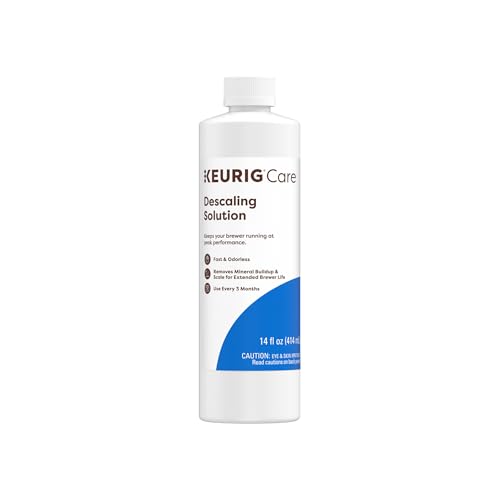
Keurig Descaling Solution
Badge: Best for Keurig Machines
Strengths
- Made by the machine maker, so compatibility questions disappear
- Formulated for both 2.0 and 1.0 K-Cup pod machines
- The safe choice where warranty language points to approved products
Trade-offs
- Brand specific: it is not the economical answer for other machines
- Pod machine focus means espresso owners should look elsewhere
- Single brand supply ties you to one maker range
Key specs
- Format: liquid descaling solution
- Compatibility stated: Keurig 2.0 and 1.0 K-Cup pod coffee makers
- Maker: Keurig
For a Keurig owner, the shortest path to a correct descale is the solution sold by the company that built the brewer. There is no compatibility research to do and no manual cross-checking, which matters because pod machines hide their scale problem until the pump is already straining. If the machine is under warranty, the maker own product is also the least arguable choice.
It only solves the Keurig problem: a household that also runs an espresso machine will still need a second product for that side of the counter.
As a routine tool, the Keurig Descaling Solution should be judged by the habit it builds. Its badge, Best for Keurig Machines, points at the machine and schedule it serves best, and its defining detail, Format: liquid descaling solution, decides how much thought each cycle asks of you. A routine survives on low thought: the fewer decisions between noticing the alert and starting the cycle, the more reliably the cycle happens. That is the lens this guide applies to every pick, and it is why formats that look similar on a shelf separate clearly once you imagine using them on a tired Sunday morning.
There is a record-keeping habit that pairs naturally with this pick: write the cycle date on the packaging, and note anything unusual the cycle revealed, a slower rinse, a second pass, a change in the pump’s note. Compatibility stated: Keurig 2.0 and 1.0 K-Cup pod coffee makers tells you how many of those dated entries the pack will hold. Across a year those small notes become the machine’s service history, and they turn the next buying decision, repair, replace, or simply continue, into an informed one instead of a guess made over a machine that stopped mid-brew.
Best for: buyers who want the maker-made solution for a Keurig brewer / Not suited for: buyers whose priorities run against the trade-offs listed for this pick above

Tillbrook Espresso Machine Compatible Descaler
Badge: Best Concentrated Value
Strengths
- Concentrated format stretches a single bottle across four uses
- Positioned across Breville, Keurig, Nespresso, and DeLonghi machines
- A year supply framing suits a steady quarterly rhythm
Trade-offs
- Concentrate means measuring carefully rather than pouring a ready dose
- Compatibility is stated as compatible-with, not made-by, each brand
- Sixteen ounces still needs safe, upright storage
Key specs
- Format: concentrated liquid, 16 oz
- Uses: 4 uses, framed as 1 year supply
- Compatibility stated: Breville, Keurig, Nespresso, DeLonghi and espresso machines
- Origin: made in USA
A concentrate is the format for the owner who descaled once, saw what came out, and decided to stay ahead of the problem. Four uses from one bottle keeps the per-cycle commitment low and the cupboard small, and the cross-brand positioning covers the mixed counter that is now normal in many kitchens.
Concentration shifts work to you: measure sloppily and you either waste product or run a weak cycle that leaves scale behind in the boiler.
As a routine tool, the Tillbrook Espresso Machine Compatible Descaler should be judged by the habit it builds. Its badge, Best Concentrated Value, points at the machine and schedule it serves best, and its defining detail, Format: concentrated liquid, 16 oz, decides how much thought each cycle asks of you. A routine survives on low thought: the fewer decisions between noticing the alert and starting the cycle, the more reliably the cycle happens. That is the lens this guide applies to every pick, and it is why formats that look similar on a shelf separate clearly once you imagine using them on a tired Sunday morning.
There is a record-keeping habit that pairs naturally with this pick: write the cycle date on the packaging, and note anything unusual the cycle revealed, a slower rinse, a second pass, a change in the pump’s note. Uses: 4 uses, framed as 1 year supply tells you how many of those dated entries the pack will hold. Across a year those small notes become the machine’s service history, and they turn the next buying decision, repair, replace, or simply continue, into an informed one instead of a guess made over a machine that stopped mid-brew.
Best for: buyers who want a concentrate that covers a year of cycles from one bottle / Not suited for: buyers whose priorities run against the trade-offs listed for this pick above
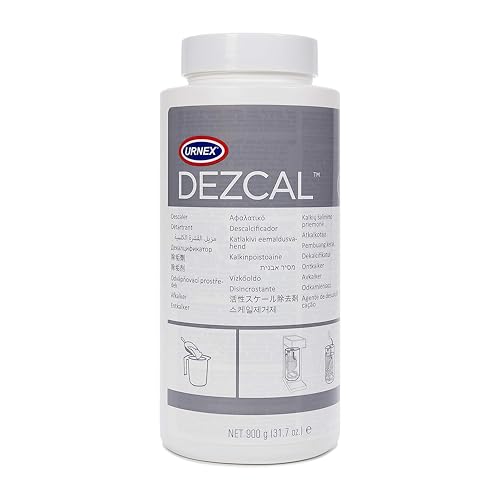
Urnex Dezcal Descaler 900g
Badge: Best Powder for Heavy Use
Strengths
- Large powder bottle suits frequent descaling and multiple machines
- Activated scale remover aimed at boilers and heating elements
- Also positioned for faucets, spray heads, and milk systems
Trade-offs
- Powder must be fully dissolved before the cycle starts
- Nine hundred grams is a lot of product for a single small machine
- Commercial breadth means home users should read dosing guidance carefully
Key specs
- Format: powder, 900g bottle
- Action: activated scale remover
- Targets: boilers, heating elements, faucets, spray heads, milk systems
- Maker: Urnex
Urnex comes from the cafe world, and Dezcal reads like it: a big powder bottle meant for machines that work hard and descale often. Home users with a prosumer espresso machine, or several machines under one roof, get a format that does not run out mid-season and a product line that also speaks to milk systems and spray heads.
Powder is the least forgiving format for a rushed user: undissolved granules should never enter a machine, so the dissolve step is part of the job, not an optional extra.
As a routine tool, the Urnex Dezcal Descaler 900g should be judged by the habit it builds. Its badge, Best Powder for Heavy Use, points at the machine and schedule it serves best, and its defining detail, Format: powder, 900g bottle, decides how much thought each cycle asks of you. A routine survives on low thought: the fewer decisions between noticing the alert and starting the cycle, the more reliably the cycle happens. That is the lens this guide applies to every pick, and it is why formats that look similar on a shelf separate clearly once you imagine using them on a tired Sunday morning.
There is a record-keeping habit that pairs naturally with this pick: write the cycle date on the packaging, and note anything unusual the cycle revealed, a slower rinse, a second pass, a change in the pump’s note. Action: activated scale remover tells you how many of those dated entries the pack will hold. Across a year those small notes become the machine’s service history, and they turn the next buying decision, repair, replace, or simply continue, into an informed one instead of a guess made over a machine that stopped mid-brew.
Best for: buyers who want a high-volume powder for frequent descaling / Not suited for: buyers whose priorities run against the trade-offs listed for this pick above

De’Longhi EcoDecalk Universal Descaler
Badge: Best Maker-Made Universal
Strengths
- Made by DeLonghi, with universal compatibility stated beyond the brand
- Generous bottle framed as a long supply for routine cycles
- Easy to use positioning suits owners who descale reluctantly
Trade-offs
- DeLonghi owners get the strongest fit; other brands should still check manuals
- Larger bottle is a storage commitment for a small kitchen
- Universal claims never replace a super-automatic maker specific programme
Key specs
- Format: liquid universal descaler
- Size: 16.90 oz
- Supply framing: 15 month supply
- Maker: DeLonghi
- Formula framing: safe formula, universally compatible
EcoDecalk is the middle path between a single-brand product and a fully generic one: it carries a major maker’s name, which settles nerves, while stating compatibility well beyond that maker’s own machines. For a DeLonghi household it is the obvious shelf choice, and for mixed counters it remains a credible, easy routine.
A maker’s own universal product still sits behind your specific machine manual: if your super-automatic has a proprietary descale programme with a named product, follow the programme.
As a routine tool, the De’Longhi EcoDecalk Universal Descaler should be judged by the habit it builds. Its badge, Best Maker-Made Universal, points at the machine and schedule it serves best, and its defining detail, Format: liquid universal descaler, decides how much thought each cycle asks of you. A routine survives on low thought: the fewer decisions between noticing the alert and starting the cycle, the more reliably the cycle happens. That is the lens this guide applies to every pick, and it is why formats that look similar on a shelf separate clearly once you imagine using them on a tired Sunday morning.
There is a record-keeping habit that pairs naturally with this pick: write the cycle date on the packaging, and note anything unusual the cycle revealed, a slower rinse, a second pass, a change in the pump’s note. Size: 16.90 oz tells you how many of those dated entries the pack will hold. Across a year those small notes become the machine’s service history, and they turn the next buying decision, repair, replace, or simply continue, into an informed one instead of a guess made over a machine that stopped mid-brew.
Best for: buyers who want a major maker’s own universal descaler / Not suited for: buyers whose priorities run against the trade-offs listed for this pick above

Caffe Assaggio Breville Descaler 10 Uses
Badge: Best Long Supply
Strengths
- Ten uses per kit is the longest supply framing in this guide
- Formulated specifically around Breville espresso machines
- Carbon friendly framing will matter to some buyers
Trade-offs
- Breville focus narrows its usefulness on a mixed counter
- A long supply only pays if you actually keep the rhythm
- Specialist positioning means reading the dose guidance closely
Key specs
- Format: descaling kit
- Uses: 10 uses, framed as 2.5 year supply
- Target: Breville espresso machines
- Framing: carbon friendly
If you own a Breville espresso machine and you are honest that descaling slips your mind, a ten-use kit changes the maths: the product is simply there, cycle after cycle, for years of routine. The Breville-specific formulation also removes the universal-product hesitation that espresso owners often feel about boilers and seals.
Ten uses of a Breville-focused product is a commitment to one brand; if you replace the machine with another maker, the remaining supply may not follow it.
As a routine tool, the Caffe Assaggio Breville Descaler 10 Uses should be judged by the habit it builds. Its badge, Best Long Supply, points at the machine and schedule it serves best, and its defining detail, Format: descaling kit, decides how much thought each cycle asks of you. A routine survives on low thought: the fewer decisions between noticing the alert and starting the cycle, the more reliably the cycle happens. That is the lens this guide applies to every pick, and it is why formats that look similar on a shelf separate clearly once you imagine using them on a tired Sunday morning.
There is a record-keeping habit that pairs naturally with this pick: write the cycle date on the packaging, and note anything unusual the cycle revealed, a slower rinse, a second pass, a change in the pump’s note. Uses: 10 uses, framed as 2.5 year supply tells you how many of those dated entries the pack will hold. Across a year those small notes become the machine’s service history, and they turn the next buying decision, repair, replace, or simply continue, into an informed one instead of a guess made over a machine that stopped mid-brew.
Best for: buyers who want a long supply matched to one brand of espresso machine / Not suited for: buyers whose priorities run against the trade-offs listed for this pick above
Comparison Table
| Pick | Badge | Key attribute | Second attribute | Check |
|---|---|---|---|---|
| Durgol Swiss Espresso Descaler 4 Pack | Best for Espresso Machines | Format: liquid, pack of 4 | Size: 4.2 fluid ounces per bottle | Check on Amazon |
| Keurig Descaling Solution | Best for Keurig Machines | Format: liquid descaling solution | Compatibility stated: Keurig 2.0 and 1.0 K-Cup pod coffee makers | Check on Amazon |
| Tillbrook Espresso Machine Compatible Descaler | Best Concentrated Value | Format: concentrated liquid, 16 oz | Uses: 4 uses, framed as 1 year supply | Check on Amazon |
| Urnex Dezcal Descaler 900g | Best Powder for Heavy Use | Format: powder, 900g bottle | Action: activated scale remover | Check on Amazon |
| De’Longhi EcoDecalk Universal Descaler | Best Maker-Made Universal | Format: liquid universal descaler | Size: 16.90 oz | Check on Amazon |
| Caffe Assaggio Breville Descaler 10 Uses | Best Long Supply | Format: descaling kit | Uses: 10 uses, framed as 2.5 year supply | Check on Amazon |
Read the table by columns, not by rows: find the attribute that matches your situation, then follow that column to the pick that carries it. The detailed reviews above explain what each attribute costs in trade-offs, which is the half of the story a table cannot tell.
How to Choose for Best descaling for coffee makers
Build the interval from your water, not from a slogan
Supply framings such as a year of descaling assume a moderate rhythm on moderate water. Your real interval comes from three local facts: your water hardness, your daily volume, and your machine’s own alerts. Hard water and a busy machine can halve the textbook interval; soft water can stretch it. Write the date of each descale on the calendar or the cupboard door, and let the gap between the first two cycles teach you the third. The routine matters more than the exact week, and any steady rhythm beats an heroic annual rescue. Shoppers comparing machine formats can see how water paths differ in Best Drip And Pod Coffee Makers.
Choose the format your future self will actually use
Every format in this guide is a bet about your behaviour. Pre-measured bottles bet that simplicity keeps you on schedule. Concentrates bet that you will measure carefully in exchange for a small cupboard footprint and a low cost per cycle. Powders bet that you descale often, own more than one machine, and will dissolve the dose properly every time. Ready liquids bet that you want no arithmetic at all. Be honest about which person you are on a tired Sunday, because that person does the descaling.
Pod machines and espresso machines keep different calendars
A pod machine’s narrow water path shows scale as slow, weak cups surprisingly early, and its maker-made solution exists to make the fix thoughtless. An espresso boiler accumulates scale against the element, where the cost of neglect is temperature instability and eventually a service visit. Super-automatics with built-in programmes want the product their programme names. The calendar is therefore machine-shaped: the same kitchen can honestly run a monthly pod descale beside a quarterly espresso descale, and both are correct.
Keep descaling and cleaning on separate tracks
Mineral scale and coffee oil are the twin declines of every brewer, and they respond to different chemistry on different schedules. A descale that leaves oils behind still improves temperature and flow; a clean that leaves scale behind still improves flavour. Track both dates. Owners who keep the two habits separate rarely meet the third problem, the machine that seems simply worn out at an age when it is only dirty in two different ways. The brewing formats that make this easiest to see are compared in Best Drip Brew Coffee Makers.
How to Run a Descaling Routine That Sticks
A routine is a cycle plus a trigger plus a record. Build all three and descaling stops depending on memory or on a flashing light.
- Pick your trigger. Use the machine alert, a calendar interval from your water hardness, or the early signs of slower, cooler cups, whichever arrives first.
- Stage the product. Keep the descaler where the machine lives, not in a distant cupboard; friction is the enemy of maintenance.
- Run the full cycle. Follow the manual’s programme with the product dose it approves, including the soak time the chemistry needs.
- Rinse to neutral. Run fresh-water cycles until a plain cup of water tastes like water and nothing else.
- Record the date. Note it on the calendar and, if your machine counts cycles, reset the reminder properly.
- Check the result. Time the next brew and taste it; restored speed and temperature confirm the cycle worked.
- Set the next date now. Schedule the following descale before you put the bottle away, adjusted for what this cycle found.
The first descale on a neglected machine may need a repeat cycle with fresh solution; that is the backlog clearing, not the product failing. From the second cycle onward, a kept schedule should hold the machine at its best with single cycles. Households redesigning their coffee corner can also browse Best Designed Coffee Makers for machines whose maintenance access is part of the design.
Troubleshooting
Problem: cups are still cooler than they should be after descaling → run one more cycle with fresh solution; heavy scale insulates in layers and the first pass may only clear the surface.
Problem: the machine tastes fine but the alert stays lit → the alert is a counter, not a sensor; clear it with the reset sequence in the manual.
Problem: flow improved for a week, then slowed again → your interval is too long for your water; shorten the cycle gap and consider whether a filter or softer water source should join the routine.
What Scale Is Actually Doing Inside the Machine
Every litre of heated water leaves a trace of its minerals behind, preferentially on the hottest surfaces. On a heating element that trace becomes insulation, so the element runs hotter to deliver cooler water, aging itself while underperforming. In narrow tubes and valves the same deposit narrows the path, so the pump works harder for a slower flow. On temperature probes it blurs the reading, so the machine’s own brain starts making decisions from false data. Descaling reverses each of those quietly compounding problems with mild chemistry and time, which is why the soak stage of a cycle matters as much as the product choice. Nothing in that story is dramatic, and that is the point: scale is a slow tax, and routine descaling is simply refusing to keep paying it.
The flavour chapter follows the mechanical one. A scaled, rough interior holds stale residue and sheds it into fresh coffee, so the cup dulls before the machine slows. Owners often chase that dullness with new beans and new settings, spending on everything except the ten-minute maintenance that caused it.
The Two-Product Cupboard: Descaler and Cleaner
A well-kept coffee corner holds two maintenance products, not one, and this guide’s shelf is only half of that cupboard. The descaler handles the mineral story told above. A separate cleaner handles the oil story: the rancid film that builds on brew groups, carafes, and portafilters and flavours coffee from the surface inward. Confusing the two is the most common maintenance error after neglect itself, because each product’s success hides the other’s problem for a while. Date both bottles, schedule both jobs, and the machine’s decline becomes two slow, reversible processes instead of one mysterious failure. Readers building the full routine from scratch will find the format context in Best Drip Brewing Coffee Makers useful alongside this guide.
Building the Habit: Descaling as a Household System
Every household that maintains a coffee machine well has, usually without naming it, a small system: a trigger, a place, and a record. The trigger is the event that starts the job, an alert, a calendar date, or the first lukewarm cup noticed at breakfast. The place is where the product lives, close enough to the machine that starting costs no extra steps. The record is the date, written somewhere the next decision-maker will see it. Systems like this survive busy months and house moves; good intentions do not. If your descaling has historically depended on remembering, the most valuable purchase in this guide is not any single bottle but the decision to give the job a trigger, a place, and a record from this cycle onward.
The system also scales gracefully across machines. A pod brewer on a monthly rhythm and an espresso machine on a quarterly one can share a cupboard and a calendar while using different products, and the record makes the difference between the two schedules feel organised rather than complicated. That is the quiet end-state this guide is aiming at: descaling as unremarkable as taking out the recycling, done on its day, with the right product, leaving the machine to do the one job anyone actually bought it for.
Common Buying Mistakes
- Treating the descale alert as a suggestion and resetting it without running the cycle.
- Doubling the dose for a neglected machine instead of running a second standard cycle with fresh solution.
- Keeping the descaler somewhere inconvenient, so the routine depends on a special trip and quietly stops happening.
- Judging the interval by a supply label’s year framing rather than by your own water and the machine’s early signs.
- Assuming a successful descale also cleaned the coffee oils, then chasing the remaining stale flavour through new beans.
Every mistake on that list has the same shape: a decision made on the wrong axis, size instead of fit, headline instead of specification, or hope instead of a routine. The sections above exist to put the decision back on the axis that decides how the product will actually live in your kitchen.
When to Stop Descaling and Start Diagnosing
A kept routine has one more virtue that deserves its own section: it teaches you what normal looks like, and that knowledge is what tells you when a problem is no longer about scale. A machine on a schedule that suddenly slows between cycles is saying something different from a neglected machine that slows across a year. A temperature fault that survives two honest descalings is not a mineral fault. A leak that appears at a seal is not dissolved away by any product in this guide. The routine’s gift is contrast: because the mineral variable is controlled, the remaining symptoms point where they should, at parts, seals, and service.
That is also the answer to the owner who asks whether descaling is worth the effort for a modest machine. The product cost of a cycle is small, the time cost is smaller, and what is bought with them is not only temperature and flow but information. A maintained machine that fails has told you a clean story about why. An unmaintained machine that fails has told you nothing, and the repair conversation starts from fog. Service technicians, like doctors, work better with a history.
So run the routine for the machine’s sake, and keep the tiny record for your own. Between the two, descaling stops being a chore that interrupts coffee and becomes part of how the household simply runs, which is where every good maintenance habit eventually belongs.
It is worth closing the routine discussion with the new-machine case, because habits are cheapest to build at the beginning. A machine descaled on schedule from its first season never develops the layered deposits that make later rescue cycles slow and uncertain, and its owner never has to guess whether a dull cup is beans, settings, or scale, because scale has been controlled from the start. If you have just unboxed a brewer, the most valuable page in its manual is the maintenance page, and the most valuable habit in this guide is the first dated entry in the record. Everything after that is repetition.
For the older machine, the one that arrived at this guide through a flashing alert and a disappointing cup, the message is nearly as kind. Scale that built up over seasons usually leaves over a cycle or two, temperature and flow return in a way you can measure, and the routine that follows costs minutes a few times a year. Few repairs in a kitchen offer that exchange rate. Start the routine with the product matched to your machine, write the date down, and let the next alert, when it eventually comes, find a household that was already expecting it.
There is a small ritual that ties the whole routine together, and it costs nothing: brew the first coffee after a descale a little more attentively than usual. Notice the restored sound of the pump, the honest temperature of the cup, the flavour of a familiar bean coming back into focus. That moment is the routine paying you, visibly, for ten unglamorous minutes, and noticing it is what turns maintenance from a chore you endure into a system you believe in. Believed-in systems are the ones still running in year five, long after the alert light has stopped being news.
Share the system, too, if the machine is shared. A routine that lives in one person’s head fails the first time that person travels, while a date on the cupboard door and a product on the right shelf can be acted on by anyone in the house. Maintenance that survives its owner’s absence is maintenance that has truly become a system, and a shared coffee machine deserves exactly that resilience.
Final Recommendation
If routine is your goal, the Durgol four pack is the easiest habit to keep: no measuring, no decisions, just a cycle that happens. Keurig owners should default to the Keurig solution, De’Longhi owners to EcoDecalk, and anyone who wants compatibility questions closed by the badge on the bottle should stay maker-made. The Essential Values and Tillbrook options serve the mixed counter and the value-minded respectively, while the Urnex powder belongs to heavy use and multiple machines. Choose the product that fits the routine you will honestly keep, write the date down, and descaling becomes what it should be: unremarkable.
Shortlist again, for the reader who scrolled: start with Durgol Swiss Espresso Descaler 4 Pack as the default, consider Keurig Descaling Solution for its particular strength, and look at Tillbrook Espresso Machine Compatible Descaler if your situation matches its speciality. Each listing is the place to check the latest price on Amazon before you commit.
Frequently Asked Questions
What is the actual point of descaling?
Descaling dissolves the mineral deposits that heated water leaves on elements, in boilers, and along water paths. Removing them restores temperature, flow, and pump ease, and prevents the deposits from aging the machine. It is preventative maintenance with a flavour benefit, not a cosmetic ritual.
How do I know my machine needs descaling before the alert?
Watch for the early signs: cups running cooler, flow slowing, the pump sounding strained, and familiar coffee tasting dull. Those signals usually arrive before any alert, and answering them early keeps the job to a single gentle cycle.
Can descaling damage my machine?
Used as directed, the products here are made for these machines. Damage stories almost always involve the wrong product, the wrong dose, or a skipped rinse. Follow the manual’s programme and the product’s dose, and prefer a maker-made option whenever warranty wording makes you hesitate.
My machine has a descale programme. Do I still choose the product?
Yes. The programme controls the machine’s side of the cycle, timing, temperature, and flow; the product is the chemistry inside it. Some programmes name an approved product, and that naming outranks any general recommendation, including the ones in this guide.
Is one strong descale better than two gentle ones?
No. Scale dissolves at the surface the solution touches, so a fresh second cycle reaches new surface as the first layer clears. Doubling a dose mostly wastes product and can leave more residue to rinse. Two standard cycles are the correct answer to heavy buildup.
Do drip coffee makers need descaling too?
Yes, on the same mineral logic, usually on a gentler schedule than espresso boilers. Their open design makes the signs easy to see: slower dripping and a carafe that stops tasting clean. The drip formats are compared in Best Discount Coffee Makers searches less often than they should be, but the maintenance applies to every tier.


