Disclosure: topratedkitchenware.com is reader-supported. When you buy through links on our site, we may earn an affiliate commission from Amazon and other retailers, at no extra cost to you.
Where to buy
The six picks below are the verified shortlist for this guide to best descaling solution for coffee makers. Each name links to its Amazon listing, where you can check the latest price on Amazon, confirm the current configuration, and read the newest owner feedback before you decide.
- Tillbrook Espresso Machine Compatible Descaler
- Urnex Dezcal Descaler 900g
- De’Longhi EcoDecalk Universal Descaler
- Caffe Assaggio Breville Descaler 10 Uses
- Essential Values Coffee Machine Descaler 2 Pack
- Essential Values Universal Descaling Solution 2 Uses
Read the full guide ↓ for the detailed reviews, the honest limitations of every pick, and the buying checks that matter more than any headline claim.
Choosing a descaling solution for coffee makers comes down to chemistry in a format you can live with. Every product in this guide exists to do one thing, dissolve the calcium and mineral deposits that heated water leaves inside a brewer, but the solutions differ in ways that decide whether the job gets done well: liquid or powder, ready-dosed or concentrated, universal or formulated for one maker’s machines. This guide compares those differences directly, because the best solution on paper is worthless if its format annoys you out of using it.
The six picks below are the same small, honest shelf this category always produces, ordered here by format logic. A concentrate leads for owners who descale on a rhythm and want one bottle to cover it. A cafe powder serves heavy use. Maker-made and brand-focused options close the compatibility question for De’Longhi and Breville owners. Universal liquids cover the mixed counter. If you arrived here from the product-first comparison in Best Descaler For Coffee Makers, this guide is the format-first companion to it.
As everywhere in this category, the machine manual is the final word on approved chemistry. These solutions are made for coffee machines, and several are made by the machine makers themselves, but a warranty line naming a specific product always outranks a general recommendation.
Key Takeaways
- Format is the real choice: ready liquid, concentrate, pre-measured, and powder each suit a different owner.
- Concentrates give the lowest cost per cycle and the smallest storage footprint, at the price of careful measuring.
- Powder must be fully dissolved before it enters any machine, every time, without exception.
- Brand-focused solutions close the compatibility question for Breville and De’Longhi owners.
- Universal solutions earn their place on counters running more than one maker’s machines.
In this guide
Quick Picks
| Pick | Badge | Key details | Check |
|---|---|---|---|
| Tillbrook Espresso Machine Compatible Descaler | Best Concentrated Value | Format: concentrated liquid, 16 oz · Uses: 4 uses, framed as 1 year supply | Check on Amazon |
| Urnex Dezcal Descaler 900g | Best Powder for Heavy Use | Format: powder, 900g bottle · Action: activated scale remover | Check on Amazon |
| De’Longhi EcoDecalk Universal Descaler | Best Maker-Made Universal | Format: liquid universal descaler · Size: 16.90 oz | Check on Amazon |
| Caffe Assaggio Breville Descaler 10 Uses | Best Long Supply | Format: descaling kit · Uses: 10 uses, framed as 2.5 year supply | Check on Amazon |
| Essential Values Coffee Machine Descaler 2 Pack | Best Overall | Format: liquid descaling solution, pack of 2 · Supply framing: 1 year supply | Check on Amazon |
| Essential Values Universal Descaling Solution 2 Uses | Best Simple Routine | Format: liquid universal descaling solution · Uses per pack: 2 | Check on Amazon |
The table is the shortcut; the reviews below are the reasoning. Badges are used consistently across the Quick Picks, the detailed reviews, and the comparison table, so a pick you spot here is easy to find again further down the page.
How These Picks Were Chosen
Picks were selected from verified listings by comparing format, stated uses per pack, and stated compatibility, with only confirmed coffee and espresso descaling solutions eligible. The set was built to represent each format honestly rather than to crown one chemistry: a reader should be able to choose by how they live with the product, dose, storage, and reorder rhythm included. The routine-first treatment of the same shelf appears in Best Descaling For Coffee Makers, and readers comparing the two will find the overlap deliberate.
Ranking here follows format logic for a typical home espresso or pod setup: concentrates first for rhythm-keepers, powder for volume, maker-made for certainty, universal liquids for mixed counters. This is research-led guidance from listings and maker documentation. No laboratory dissolved a standard scale block for this guide, and where a product’s compatibility is a compatible-with statement rather than a maker’s own badge, the review keeps that distinction visible.
A final framing note: descaling solution is a consumable with a job description, not an heirloom. Buy the supply size that matches the interval your water imposes, because a half-used giant bottle that expires in a cupboard is no bargain, and a tiny pack in a hard-water home is no saving either.
The 6 Best Options for Best Descaling Solution for Coffee Makers
Six picks follow, in ranked order for best descaling solution for coffee makers. Each review follows the same honest pattern: what the product is, where it is strong, where it trades something away, the verified specifications, and a plain verdict about who should buy it and who should walk past it.

Tillbrook Espresso Machine Compatible Descaler
Badge: Best Concentrated Value
Strengths
- Concentrated format stretches a single bottle across four uses
- Positioned across Breville, Keurig, Nespresso, and DeLonghi machines
- A year supply framing suits a steady quarterly rhythm
Trade-offs
- Concentrate means measuring carefully rather than pouring a ready dose
- Compatibility is stated as compatible-with, not made-by, each brand
- Sixteen ounces still needs safe, upright storage
Key specs
- Format: concentrated liquid, 16 oz
- Uses: 4 uses, framed as 1 year supply
- Compatibility stated: Breville, Keurig, Nespresso, DeLonghi and espresso machines
- Origin: made in USA
A concentrate is the format for the owner who descaled once, saw what came out, and decided to stay ahead of the problem. Four uses from one bottle keeps the per-cycle commitment low and the cupboard small, and the cross-brand positioning covers the mixed counter that is now normal in many kitchens.
Concentration shifts work to you: measure sloppily and you either waste product or run a weak cycle that leaves scale behind in the boiler.
Format is destiny for the Tillbrook Espresso Machine Compatible Descaler. Its badge, Best Concentrated Value, follows directly from its defining detail, Format: concentrated liquid, 16 oz, because in this category the format decides the dose accuracy, the storage footprint, and the friction of every cycle you will ever run with it. Owners should choose this pick with their own behaviour in view: the measuring it asks for, the dissolving it may require, the space it will occupy beside the machine. A solution that fits its owner’s habits gets used at full strength and on schedule; one that fights them gets diluted, postponed, and quietly blamed.
The second-cycle view matters too. Uses: 4 uses, framed as 1 year supply frames how this product behaves across a year of ownership, and a descaling solution is one of the few kitchen consumables where the year view is the honest one. Judge the reorder point, the storage it needs while it waits, and whether its compatibility still matches your counter if a machine is replaced. The Tillbrook Espresso Machine Compatible Descaler holds its place in this guide because those year-long answers stay sensible long after the first, easiest cycle is done.
Best for: buyers who want a concentrate that covers a year of cycles from one bottle / Not suited for: buyers whose priorities run against the trade-offs listed for this pick above
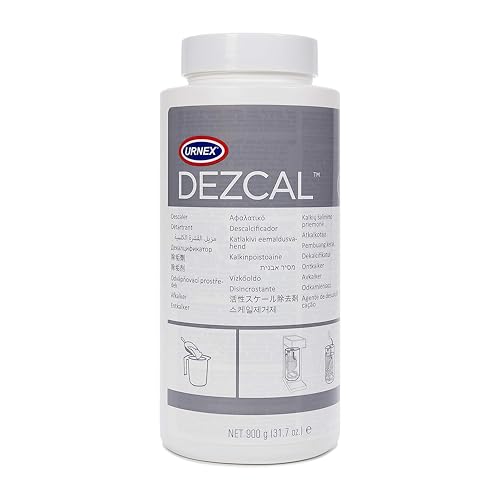
Urnex Dezcal Descaler 900g
Badge: Best Powder for Heavy Use
Strengths
- Large powder bottle suits frequent descaling and multiple machines
- Activated scale remover aimed at boilers and heating elements
- Also positioned for faucets, spray heads, and milk systems
Trade-offs
- Powder must be fully dissolved before the cycle starts
- Nine hundred grams is a lot of product for a single small machine
- Commercial breadth means home users should read dosing guidance carefully
Key specs
- Format: powder, 900g bottle
- Action: activated scale remover
- Targets: boilers, heating elements, faucets, spray heads, milk systems
- Maker: Urnex
Urnex comes from the cafe world, and Dezcal reads like it: a big powder bottle meant for machines that work hard and descale often. Home users with a prosumer espresso machine, or several machines under one roof, get a format that does not run out mid-season and a product line that also speaks to milk systems and spray heads.
Powder is the least forgiving format for a rushed user: undissolved granules should never enter a machine, so the dissolve step is part of the job, not an optional extra.
Format is destiny for the Urnex Dezcal Descaler 900g. Its badge, Best Powder for Heavy Use, follows directly from its defining detail, Format: powder, 900g bottle, because in this category the format decides the dose accuracy, the storage footprint, and the friction of every cycle you will ever run with it. Owners should choose this pick with their own behaviour in view: the measuring it asks for, the dissolving it may require, the space it will occupy beside the machine. A solution that fits its owner’s habits gets used at full strength and on schedule; one that fights them gets diluted, postponed, and quietly blamed.
The second-cycle view matters too. Action: activated scale remover frames how this product behaves across a year of ownership, and a descaling solution is one of the few kitchen consumables where the year view is the honest one. Judge the reorder point, the storage it needs while it waits, and whether its compatibility still matches your counter if a machine is replaced. The Urnex Dezcal Descaler 900g holds its place in this guide because those year-long answers stay sensible long after the first, easiest cycle is done.
Best for: buyers who want a high-volume powder for frequent descaling / Not suited for: buyers whose priorities run against the trade-offs listed for this pick above

De’Longhi EcoDecalk Universal Descaler
Badge: Best Maker-Made Universal
Strengths
- Made by DeLonghi, with universal compatibility stated beyond the brand
- Generous bottle framed as a long supply for routine cycles
- Easy to use positioning suits owners who descale reluctantly
Trade-offs
- DeLonghi owners get the strongest fit; other brands should still check manuals
- Larger bottle is a storage commitment for a small kitchen
- Universal claims never replace a super-automatic maker specific programme
Key specs
- Format: liquid universal descaler
- Size: 16.90 oz
- Supply framing: 15 month supply
- Maker: DeLonghi
- Formula framing: safe formula, universally compatible
EcoDecalk is the middle path between a single-brand product and a fully generic one: it carries a major maker’s name, which settles nerves, while stating compatibility well beyond that maker’s own machines. For a DeLonghi household it is the obvious shelf choice, and for mixed counters it remains a credible, easy routine.
A maker’s own universal product still sits behind your specific machine manual: if your super-automatic has a proprietary descale programme with a named product, follow the programme.
Format is destiny for the De’Longhi EcoDecalk Universal Descaler. Its badge, Best Maker-Made Universal, follows directly from its defining detail, Format: liquid universal descaler, because in this category the format decides the dose accuracy, the storage footprint, and the friction of every cycle you will ever run with it. Owners should choose this pick with their own behaviour in view: the measuring it asks for, the dissolving it may require, the space it will occupy beside the machine. A solution that fits its owner’s habits gets used at full strength and on schedule; one that fights them gets diluted, postponed, and quietly blamed.
The second-cycle view matters too. Size: 16.90 oz frames how this product behaves across a year of ownership, and a descaling solution is one of the few kitchen consumables where the year view is the honest one. Judge the reorder point, the storage it needs while it waits, and whether its compatibility still matches your counter if a machine is replaced. The De’Longhi EcoDecalk Universal Descaler holds its place in this guide because those year-long answers stay sensible long after the first, easiest cycle is done.
Best for: buyers who want a major maker’s own universal descaler / Not suited for: buyers whose priorities run against the trade-offs listed for this pick above

Caffe Assaggio Breville Descaler 10 Uses
Badge: Best Long Supply
Strengths
- Ten uses per kit is the longest supply framing in this guide
- Formulated specifically around Breville espresso machines
- Carbon friendly framing will matter to some buyers
Trade-offs
- Breville focus narrows its usefulness on a mixed counter
- A long supply only pays if you actually keep the rhythm
- Specialist positioning means reading the dose guidance closely
Key specs
- Format: descaling kit
- Uses: 10 uses, framed as 2.5 year supply
- Target: Breville espresso machines
- Framing: carbon friendly
If you own a Breville espresso machine and you are honest that descaling slips your mind, a ten-use kit changes the maths: the product is simply there, cycle after cycle, for years of routine. The Breville-specific formulation also removes the universal-product hesitation that espresso owners often feel about boilers and seals.
Ten uses of a Breville-focused product is a commitment to one brand; if you replace the machine with another maker, the remaining supply may not follow it.
Format is destiny for the Caffe Assaggio Breville Descaler 10 Uses. Its badge, Best Long Supply, follows directly from its defining detail, Format: descaling kit, because in this category the format decides the dose accuracy, the storage footprint, and the friction of every cycle you will ever run with it. Owners should choose this pick with their own behaviour in view: the measuring it asks for, the dissolving it may require, the space it will occupy beside the machine. A solution that fits its owner’s habits gets used at full strength and on schedule; one that fights them gets diluted, postponed, and quietly blamed.
The second-cycle view matters too. Uses: 10 uses, framed as 2.5 year supply frames how this product behaves across a year of ownership, and a descaling solution is one of the few kitchen consumables where the year view is the honest one. Judge the reorder point, the storage it needs while it waits, and whether its compatibility still matches your counter if a machine is replaced. The Caffe Assaggio Breville Descaler 10 Uses holds its place in this guide because those year-long answers stay sensible long after the first, easiest cycle is done.
Best for: buyers who want a long supply matched to one brand of espresso machine / Not suited for: buyers whose priorities run against the trade-offs listed for this pick above

Essential Values Coffee Machine Descaler 2 Pack
Badge: Best Overall
Strengths
- Universal positioning covers the major automatic machine brands in one routine
- Two pack framed as a year supply, so the next descale is already in the cupboard
- Made in the USA, stated plainly on the listing
Trade-offs
- Universal formulas ask you to follow your machine maker dilution guidance
- A year supply only matches households that descale on a steady rhythm
- Liquid format needs careful storage away from other kitchen chemicals
Key specs
- Format: liquid descaling solution, pack of 2
- Supply framing: 1 year supply
- Compatibility stated: DeLonghi, Keurig, Breville, Nespresso and other automatic espresso and coffee makers
- Origin: made in the USA
This is the straightforward household choice: a universal liquid descaler, sold as a two pack, intended to keep a mixed-brand kitchen covered without a shelf of single-brand bottles. If your home runs a pod machine beside an espresso machine, one shared descaler that both makers accept in principle is the simplest system to actually maintain.
Universal is a promise you still have to check: a few machines tie warranty language to approved products, so read your manual line on descaling before the first use.
Format is destiny for the Essential Values Coffee Machine Descaler 2 Pack. Its badge, Best Overall, follows directly from its defining detail, Format: liquid descaling solution, pack of 2, because in this category the format decides the dose accuracy, the storage footprint, and the friction of every cycle you will ever run with it. Owners should choose this pick with their own behaviour in view: the measuring it asks for, the dissolving it may require, the space it will occupy beside the machine. A solution that fits its owner’s habits gets used at full strength and on schedule; one that fights them gets diluted, postponed, and quietly blamed.
The second-cycle view matters too. Supply framing: 1 year supply frames how this product behaves across a year of ownership, and a descaling solution is one of the few kitchen consumables where the year view is the honest one. Judge the reorder point, the storage it needs while it waits, and whether its compatibility still matches your counter if a machine is replaced. The Essential Values Coffee Machine Descaler 2 Pack holds its place in this guide because those year-long answers stay sensible long after the first, easiest cycle is done.
Best for: buyers who want an all-round first choice that balances the strengths in this category / Not suited for: buyers whose priorities run against the trade-offs listed for this pick above

Essential Values Universal Descaling Solution 2 Uses
Badge: Best Simple Routine
Strengths
- Two uses per pack keeps the commitment small and the routine clear
- Universal formula aimed at automatic coffee and espresso machines
- Made in the USA with the major brands named on the listing
Trade-offs
- Two uses disappear quickly in hard water areas
- Same universal caveat: confirm your maker guidance first
- No powder option for brewers who prefer dry storage
Key specs
- Format: liquid universal descaling solution
- Uses per pack: 2
- Compatibility stated: DeLonghi, Keurig, Breville, Nespresso
- Use case: all automatic coffee makers and espresso machines
Some households do not want a stockpile, they want the next two descalings handled. This pack is exactly that size, and its universal positioning suits the common two-machine kitchen. It is a good fit for a first descale on a machine you have owned a while, where the goal is to start the habit rather than optimise a supply cupboard.
In very hard water, two uses can be a single season rather than a year, so heavy-scale households will reorder sooner than the framing suggests.
Format is destiny for the Essential Values Universal Descaling Solution 2 Uses. Its badge, Best Simple Routine, follows directly from its defining detail, Format: liquid universal descaling solution, because in this category the format decides the dose accuracy, the storage footprint, and the friction of every cycle you will ever run with it. Owners should choose this pick with their own behaviour in view: the measuring it asks for, the dissolving it may require, the space it will occupy beside the machine. A solution that fits its owner’s habits gets used at full strength and on schedule; one that fights them gets diluted, postponed, and quietly blamed.
The second-cycle view matters too. Uses per pack: 2 frames how this product behaves across a year of ownership, and a descaling solution is one of the few kitchen consumables where the year view is the honest one. Judge the reorder point, the storage it needs while it waits, and whether its compatibility still matches your counter if a machine is replaced. The Essential Values Universal Descaling Solution 2 Uses holds its place in this guide because those year-long answers stay sensible long after the first, easiest cycle is done.
Best for: buyers who want the next two descalings handled with no stockpile / Not suited for: buyers whose priorities run against the trade-offs listed for this pick above
Comparison Table
| Pick | Badge | Key attribute | Second attribute | Check |
|---|---|---|---|---|
| Tillbrook Espresso Machine Compatible Descaler | Best Concentrated Value | Format: concentrated liquid, 16 oz | Uses: 4 uses, framed as 1 year supply | Check on Amazon |
| Urnex Dezcal Descaler 900g | Best Powder for Heavy Use | Format: powder, 900g bottle | Action: activated scale remover | Check on Amazon |
| De’Longhi EcoDecalk Universal Descaler | Best Maker-Made Universal | Format: liquid universal descaler | Size: 16.90 oz | Check on Amazon |
| Caffe Assaggio Breville Descaler 10 Uses | Best Long Supply | Format: descaling kit | Uses: 10 uses, framed as 2.5 year supply | Check on Amazon |
| Essential Values Coffee Machine Descaler 2 Pack | Best Overall | Format: liquid descaling solution, pack of 2 | Supply framing: 1 year supply | Check on Amazon |
| Essential Values Universal Descaling Solution 2 Uses | Best Simple Routine | Format: liquid universal descaling solution | Uses per pack: 2 | Check on Amazon |
Read the table by columns, not by rows: find the attribute that matches your situation, then follow that column to the pick that carries it. The detailed reviews above explain what each attribute costs in trade-offs, which is the half of the story a table cannot tell.
How to Choose for Best descaling solution for coffee makers
Liquid versus powder: the honest trade
Liquids arrive ready to work and forgive a distracted owner; the dose is the dose, and the only skill is pouring it into the tank. Powders ask for one extra behaviour, complete dissolution in water before the cycle, and repay it with shelf life, supply size, and a cost per cycle that liquids rarely match. The failure mode of powder is impatience: granules that enter a machine undissolved can lodge where they were meant to clean. If your descaling happens in a rush, buy the liquid and accept the trade with a clear conscience. The machine formats that stress this choice most are compared in Best Drip And Pod Coffee Makers.
Concentrate economics and the measuring habit
A concentrate converts one bottle into several cycles, which shrinks storage and stretches the interval between reorders. The skill it demands is measurement: too weak a mix wastes a cycle, too strong a mix wastes product and lengthens rinsing. Owners who already weigh coffee and time shots will find the habit trivial; owners who descale reluctantly should choose a ready dose instead. Judge by your own temperament, because the solution only works in the cycles that actually happen.
Universal versus maker-made: what the badge buys
A maker-made solution buys certainty: the company that built the boiler sells the chemistry for it, and compatibility arguments end. A universal solution buys coverage: one bottle serves the pod machine, the espresso machine, and the drip brewer a guest bedroom hides. Brand-focused third-party options sit between, formulated around one maker’s machines without being sold by that maker, and they are often the long-supply bargains of the category. None of these positions is naive; the right one depends on your counter and your warranty paperwork.
Supply size: match the bottle to your water
Uses-per-pack framings in this guide run from two to ten, and the correct size is a water question disguised as a shopping question. Hard water shortens intervals and eats supply; soft water stretches both. A ten-use kit is a bargain for a Breville owner on hard water and a slow-moving commitment for the same owner on soft water. Estimate your honest annual cycles first, then buy the pack that covers them with a little to spare. Shoppers still choosing equipment can see how formats differ in Best Drip Brew Coffee Makers.
How to Use Descaling Solution Correctly
The solution does the chemistry; your job is dose, contact time, and rinsing. These steps are the shape every machine’s own programme follows.
- Read both labels. The product dose and the machine manual’s programme are the two authorities; where they differ on dose, the manual wins.
- Prepare the tank. Empty it, and if your format is powder, dissolve the dose fully in the tank water until no granules remain visible.
- Run the descale programme. Let the machine move the solution through its paths at the pace its programme sets.
- Respect the soak. Where the programme pauses, the solution is dissolving scale; do not shortcut the pause to save minutes.
- Discard and rinse the tank. Solution that has done its work should never be reused for a second pass.
- Rinse the system. Run fresh-water cycles until a plain cup tastes neutral; espresso machines may need the rinse through both the group and the hot water path.
- Note the date and the dose. Recording what you used makes the next cycle a repetition instead of a research project.
Store solutions upright, sealed, and away from food preparation surfaces, and keep powders dry; a powder that has absorbed cupboard humidity clumps and dissolves unevenly. The same store-it-properly logic applies across the coffee counter, as the grinder-and-brewer combinations in Best Drip Coffee And Grinder Makers remind anyone who has found stale beans beside a neglected machine.
Troubleshooting
Problem: the solution cycle finished but scale signs remain → the buildup was layered; run a second cycle with fresh solution at the standard dose rather than strengthening the mix.
Problem: a bitter or sharp note lingers in the first brews → rinsing was incomplete; continue fresh-water cycles and taste plain water between them until it runs neutral.
Problem: powder will not fully dissolve → use warmer water and more stirring time, and never start the cycle while granules remain; patience at the tank is cheaper than a blocked valve.
Why So Many Solutions Claim the Same Machines
A reader comparing these listings will notice the same brand names recurring across rival bottles, and it is fair to ask what actually differs. The active job, dissolving mineral scale with a food-safe acid solution, is shared across the category. What genuinely differs is concentration, dose format, added agents for particular systems such as milk paths, and the maker’s own testing against its seals and boilers. That is why this guide ranks by format and fit rather than by miracle claims: in a category where the chemistry converges, the product you will use correctly and on schedule is the product that works. The honest differences are convenience, supply, and certainty, and they are difference enough to choose on.
It also explains the tiers without any mystique. You pay for pre-measured convenience, for a maker’s badge and its warranty comfort, or you save by accepting measuring and dissolving as your share of the work. Each tier is a legitimate exchange, and the reviews above price that exchange in effort rather than in currency.
Descaling Solution and the Rest of the Maintenance Shelf
No solution in this guide removes coffee oil, cleans a milk system end to end, or replaces a water filter, and a complete maintenance shelf respects those boundaries. Think of the shelf as four small jobs: descaling for minerals, cleaning for oils, milk system care where a machine steams, and filtration to slow the mineral problem at its source. Owners who adopt that map stop asking one bottle to perform miracles and start getting the quiet, compounding benefit of each product doing its single job on time. The brewing side of the same counter is covered for drip drinkers in Best Drip Brewing Coffee Makers, where the oil half of the story matters just as much.
Filtration deserves its final sentence here. A filter or a softer water source does not eliminate descaling, but it stretches the interval honestly, which is the closest thing this category has to a free lunch.
Dose, Dilution, and the Discipline of the Standard Cycle
If one idea separates owners whose machines last from owners whose machines fade, it is respect for the standard cycle. The standard dose, fully dissolved where the format requires it, given its full contact time, and rinsed to neutral, will clear the scale that a kept schedule produces, every time. The temptations to improvise, a stronger mix for a neglected machine, a shorter soak on a busy day, a second machine run on spent solution, all trade a small saving now against residue, waste, or a half-finished job. Descaling chemistry is patient, surface-by-surface work, and it rewards the owner who lets a fresh standard cycle follow the first rather than asking one heroic cycle to do the work of two.
That discipline also makes results interpretable. When every cycle is run the same way, a change in the outcome means something: the interval needs shortening, the water has changed, or the machine has a problem that is no longer mineral. Improvised cycles destroy that signal, because nothing is comparable to anything else. The solutions in this guide were chosen to make the standard cycle easy to repeat, in dose, in format, and in supply, so that the discipline costs as little willpower as possible. Repeatability, in the end, is the active ingredient no label can list.
Common Buying Mistakes
- Strengthening the dose for a neglected machine instead of running a second standard cycle with fresh solution.
- Starting a cycle with powder that has not fully dissolved, and sending granules into the valves the cycle was meant to protect.
- Reusing spent solution for a second machine, when its working capacity was consumed by the first.
- Buying the largest supply on a soft-water interval, then storing an aging bottle for years past its best use.
- Expecting descaling solution to remove coffee oils as well, and declaring it ineffective when the oily stale note remains.
Every mistake on that list has the same shape: a decision made on the wrong axis, size instead of fit, headline instead of specification, or hope instead of a routine. The sections above exist to put the decision back on the axis that decides how the product will actually live in your kitchen.
Water: The Ingredient That Decides How Hard Your Solution Works
Every descaling story begins upstream, in the water itself. Municipal supplies vary by city and season; well water varies by geology; and the same machine can live an easy life in one postcode and a scaled one in another. Owners who want to understand their interval should start with the simplest evidence available: the kettle. A kettle that furs quickly is reporting hard water in plain sight, and a coffee machine fed the same water is scaling on the same schedule, invisibly. A kettle that stays clean for months is reporting the opposite, and the descaling calendar can relax accordingly.
Filtration enters the story as a modifier, not a replacement. A filter jug or an in-machine filter reduces the mineral load the water carries in, stretching the honest interval between cycles and letting each standard cycle work on a thinner deposit. What filtration cannot do is remove scale that has already formed, which is why filtered-water households still need the solution, only less often. The two tools are partners: one slows the problem, the other reverses it, and the owners who use both on schedule are the ones whose machines reach old age still tasting like themselves.
All of which returns to the shelf in this guide with a clearer eye. Choose the solution whose format fits your habits, size the pack to the interval your water imposes, and let the kettle be your early-warning system. The chemistry will do the rest, quietly, on the dates you give it.
Storage deserves a final, practical word, because a solution’s working life is partly decided by the cupboard it waits in. Liquids should stand upright, sealed, and away from the heat of the machine they serve; the top of a warm espresso boiler is the worst shelf in the kitchen for the bottle meant to clean it. Powders should stay dry above all, since a clumped powder dissolves unevenly and tempts exactly the undissolved-granule mistake this guide has warned against twice. None of this is fussy. It is the same respect for a consumable’s conditions that coffee drinkers already give their beans, applied to the other bottle on the shelf.
And when the bottle finally empties, let the reorder decision be made by the record rather than by the emergency. The dates you wrote down say how many cycles your water actually demanded, which pack size that argues for, and whether the format you chose still fits the counter you own now. Buying the next solution from evidence instead of from a flashing alert is the last step in turning descaling from a recurring surprise into a settled household system, and it is the step this guide has been building toward from its first page.
Keep one more small discipline in view as you close the cupboard: never let the descaling shelf become a museum. A bottle kept for a machine you no longer own, a powder bought for an interval your water never imposed, a concentrate opened so long ago that its dose is a rumour, none of these serve the routine this guide has built. Pass the surplus on, recycle the empties, and let the shelf hold only what the current counter will actually use. A lean shelf is a working shelf, and a working shelf is what keeps the next cycle effortless.
The same evidence-first habit settles the last recurring argument in this category, whether a solution is still good after long storage. Rather than guessing, run the standard cycle and read the result the way this guide has taught throughout: flow, temperature, and a neutral rinse. The machine itself is the test instrument, and its verdict outranks any date arithmetic performed at the cupboard door.
Final Recommendation
Choose by format and the rest follows. The Tillbrook concentrate is the rhythm-keeper’s default, the Urnex powder serves heavy and multi-machine use, EcoDecalk and the Caffe Assaggio kit close the compatibility question for De’Longhi and Breville owners respectively, and the Essential Values liquids cover mixed counters with the least possible fuss. Whichever solution you shelve, the method is the same: correct dose, full contact time, rinse to neutral, and a date written down. That is the whole secret of machines that keep tasting like themselves.
Shortlist again, for the reader who scrolled: start with Tillbrook Espresso Machine Compatible Descaler as the default, consider Urnex Dezcal Descaler 900g for its particular strength, and look at De’Longhi EcoDecalk Universal Descaler if your situation matches its speciality. Each listing is the place to check the latest price on Amazon before you commit.
Frequently Asked Questions
What is descaling solution made to do?
It is formulated to dissolve the mineral deposits, mainly calcium scale, that heated water leaves inside coffee and espresso machines. Dissolving those deposits restores flow and temperature and protects pumps and boilers. It is a maintenance consumable, used in cycles, not a one-time cure.
Which format is best for a first-time descaler?
A ready liquid or a pre-measured product removes the dose decisions that make a first cycle stressful. Concentrates and powders reward experience with economy and supply size. Choose the format that makes your first cycle easy; you can trade up in efficiency once the habit exists.
How many uses should I buy at once?
Match the pack to your honest annual cycles, which your water hardness largely decides. The picks here range from two uses to ten. Hard-water espresso owners will use a large kit steadily; soft-water pod owners may find a small pack covers the year with room to spare.
Can one solution serve both my pod machine and my espresso machine?
Often, yes: the universal and concentrate picks here state compatibility across both families. The exception is a machine whose manual names a specific approved product, especially under warranty. In that case the named product wins for that machine, whatever the universal bottle promises.
Why does the same brand appear on several rival solutions?
Because compatibility is a claim about the machine, not a partnership. Third-party makers formulate for popular machines and say so; the machine maker also sells its own. The distinction the reviews keep visible is made-by versus compatible-with, and your warranty paperwork decides how much that distinction matters.
Does descaling solution lose strength in storage?
Sealed and stored upright away from heat, solutions keep their working life well; powders additionally need dry storage to dissolve properly later. A bottle that has sat open for years is a false economy. Buy the size your interval will actually consume.


