Disclosure: topratedkitchenware.com is reader-supported. When you buy through links on our site, we may earn an affiliate commission from Amazon and other retailers, at no extra cost to you.
Where to buy
The six machines below are the verified picks for this guide to the best drip coffee makers sca-minded buyers ask about. Each name links to its Amazon listing, where you can check the latest price on Amazon and confirm the exact configuration before you decide.
- Cuisinart 12-Cup Programmable PerfecTemp Thermal Carafe Coffee Maker
- Cuisinart PerfecTemp 12-Cup Thermal Drip Coffee Maker
- BLACK+DECKER 12 Cup Thermal Programmable Coffee Maker CM2046S
- BLACK+DECKER CaféCraft 12-Cup Thermal Coffee Maker
- SECPOEDR Grind and Brew Coffee Maker with Built-In Grinder
- Gevi 10-Cup Grind and Brew Coffee Maker
Read the full guide ↓ for an honest explanation of what the SCA framework does and does not certify, how each pick measures against its brewing parameters, and where the limits of this list sit.
Anyone searching for the best drip coffee makers sca standards apply to is really asking a precise question: which home brewers respect the brewing parameters that the Specialty Coffee Association’s Golden Cup framework treats as the difference between balanced coffee and a disappointing pot — water hot enough to extract properly, contact time in a sensible range, even saturation of the grounds, and a recipe ratio that gives the coffee a fair chance. This guide answers that question honestly, and honesty requires a disclosure up front: none of the six verified machines in this guide carries an SCA certification claim in its verified listing data, and this article does not invent one for them. What it does instead is more useful for most buyers. It evaluates six real, purchasable drip machines against the SCA parameters one by one, explains which design traits move a brewer toward or away from those parameters, and tells you plainly that if a formal certification logo is a hard requirement, you should shop from the association’s own certified brewer list rather than from this page.
That framing matters because the SCA lens is genuinely valuable even without a logo. The framework’s core insight is that most bad drip coffee is a measurement problem, not a bean problem: water that arrives too cool under-extracts and tastes sour, water distributed unevenly extracts the bed in patches, and coffee held badly after brewing loses what the brew got right. The picks below were ordered by how seriously their designs take those three problems. Hotter-brewing designs and showerhead distribution rank high; thermal carafes protect the result; grind-and-brew machines appear with their freshness advantage and their consistency caveat both stated. Readers who want to go deeper on one parameter in particular will find Best Drip Coffee Makers That Brew Hotenough a natural companion, since temperature is the variable the SCA framework weights most heavily in practice.
Key Takeaways
- SCA is a standards framework, not a synonym for expensive: its Golden Cup parameters concern water temperature, contact time, even extraction, and ratio.
- None of the six verified picks here claims SCA certification in its listing data; this guide evaluates them against the parameters instead of inventing a credential, and says so openly.
- Hotter, controlled brewing is the most SCA-aligned trait in this list, which is why the two PerfecTemp designs lead it.
- Even saturation matters as much as heat: a showerhead design that wets the whole grounds bed supports the uniform extraction the framework wants.
- Thermal carafes protect a well-brewed pot after extraction, which the framework’s spirit favours over holding coffee on a hot plate.
- If formal certification is non-negotiable, buy from the association’s certified list; if SCA-style brewing at home is the goal, the picks and checks here are the practical route.
In this guide
Quick Picks
| Pick | Badge | Why it made the list | Listing |
|---|---|---|---|
| Cuisinart 12-Cup PerfecTemp Thermal | Best Overall | PerfecTemp hotter brewing, brew strength control, a 1-4 cup setting, and brew pause in a thermal carafe design. | Check on Amazon |
| Cuisinart PerfecTemp DCC-3400NAS | Best for Hotter Brewing | The original PerfecTemp thermal design with strength control in double-wall stainless steel. | Check on Amazon |
| BLACK+DECKER CM2046S | Best for Even Saturation | VORTEX showerhead distribution with brew strength selection in a 12-cup thermal format. | Check on Amazon |
| BLACK+DECKER CaféCraft Thermal | Most Versatile | A 12-cup thermal programmable machine that also brews iced coffee, widening the routine beyond one style. | Check on Amazon |
| SECPOEDR Grind and Brew | Best Grind-and-Brew | Fresh grinding before brewing, the variable SCA-minded buyers control most at home, in a programmable ten-cup machine. | Check on Amazon |
| Gevi 10-Cup Grind and Brew | Best Modern Controls | Touch screen grind-and-brew with a reusable filter and programmable timing for a repeatable routine. | Check on Amazon |
The badges in this guide describe alignment with the framework’s priorities, not certification. Best Overall goes to the machine whose combined traits — hotter brewing, strength control, small-batch setting, thermal holding — track the parameters most completely. The grind-and-brew badges mark a different contribution: freshness and repeatability of the coffee itself, which the framework assumes as its starting point. Read every badge in that spirit and the ranking will make sense. It is also worth deciding, before you read the reviews, which single parameter your current coffee fails most visibly, because that decision converts the ranking from a general order into your order: temperature failures point to the top two picks, distribution failures to the third, freshness failures to the grind-and-brew pair, and holding failures to any of the thermal designs over the one glass carafe in the list.
How These Picks Were Chosen
The method here had to solve a specific honesty problem: how to write an SCA-lens guide from a verified pool that contains no certified machines. The solution was to separate the credential from the criteria. Only machines confirmed in the verified pool received links and images, as always. Each was then assessed against the publicly understood SCA brewing parameters — sufficiently hot and stable brew water, even saturation, sensible contact time, and post-brew holding that does not degrade the cup — using only design traits present in the verified data, such as PerfecTemp hotter brewing, showerhead distribution, strength control, small-batch settings, and carafe type. No machine was credited with a temperature figure, a certification, or a test result that the verified data does not contain.
This is a research-led guide, not a laboratory evaluation, and it does not claim to have measured slurry temperatures or extraction yields. What it offers instead is a defensible ordering and, more importantly, a method you can apply yourself: the how-to section explains how a home buyer can sanity-check brew temperature and distribution with ordinary kitchen tools, which is closer to the SCA spirit than any badge printed on a box. Readers comparing this standards-first approach with the broader market can also scan Best Drip Coffee Makers Under $100 for how the mainstream tier frames the same machines, but the deciding layer here remains the parameters, not the positioning.
Two consequences of the method are worth stating. First, feature novelty scored nothing: a touch screen earned its pick no SCA credit, only a usability note. Second, holding method scored real points, because a framework concerned with the quality of the served cup cannot be indifferent to a hot plate steadily degrading it. That is why five of the six picks are thermal designs, and why the single glass-carafe machine carries its holding limitation openly in its review. A third consequence deserves equal emphasis: price played no role in the ordering at all, because the framework’s parameters do not correlate neatly with cost, and some of the most parameter-respecting design traits in this pool — a showerhead, a small-batch setting, an insulated carafe — appear on mainstream machines rather than flagships.
The 6 Best Drip Coffee Makers for SCA-Style Brewing at Home

Cuisinart 12-Cup Programmable PerfecTemp Thermal Carafe Coffee Maker
Badge: Best Overall
Strengths
- PerfecTemp hotter brewing targets the temperature parameter the SCA framework treats as foundational.
- Brew Strength control and a 1-4 cup setting let you hold the recipe ratio closer across different batch sizes.
- Thermal carafe holding protects the brewed coffee instead of cooking it on a plate.
Trade-offs
- It is not an SCA-certified brewer, and this guide does not present it as one; it is the closest parameter match in the verified pool.
- Brew Pause is convenient but pulling the carafe mid-brew unbalances the remaining extraction if overused.
- White and stainless styling shows coffee splashes more than black finishes.
Key specs: 12-cup capacity; PerfecTemp thermal carafe; 1-4 cup setting; Brew Strength control; Brew Pause; programmable; stainless steel and white.
This Cuisinart leads the list because it addresses the framework’s variables in combination rather than one at a time. PerfecTemp hotter brewing speaks to temperature. The strength control speaks to extraction management. The 1-4 cup setting speaks to a variable home brewers routinely get wrong: small batches, where a full-size machine’s standard cycle can rush water through a shallow bed of grounds and under-extract it. A dedicated small-batch mode is exactly the kind of unglamorous design decision a standards-minded buyer should reward. Add thermal holding and you have the most complete parameter profile in the pool.
In the cup, that profile suits the buyer this keyword describes: someone who weighs or at least measures their coffee, notices when a pot tastes thin, and wants the machine to stop being the limiting factor. The honest caveats are the ones printed above. Brew Pause is a serving convenience, not a brewing feature, and the machine’s alignment with SCA parameters is a matter of design traits, not a certificate. Buy it as the strongest SCA-style mainstream brewer in this guide, with that distinction understood, and it will not disappoint you.
Best for: standards-minded buyers wanting the closest parameter match in a mainstream machine / Not suited for: buyers who require a formal SCA certification logo

Cuisinart PerfecTemp 12-Cup Thermal Drip Coffee Maker DCC-3400NAS
Badge: Best for Hotter Brewing
Strengths
- PerfecTemp hotter brewing is the design centre, aimed squarely at the under-extraction problem.
- Brew Strength control gives a second lever when a bean brews thin or harsh.
- Double-wall stainless steel thermal carafe holds the result without a degrading hot plate.
Trade-offs
- Like its sibling above, it is parameter-aligned rather than certified, and the guide keeps that distinction explicit.
- No dedicated small-batch setting is listed in its verified data, so small pots need more care from the user.
- Two similar Cuisinarts in one guide demand model-number attention at purchase.
Key specs: 12-cup capacity; double-wall stainless steel thermal carafe; PerfecTemp hotter brewing; Brew Strength control; silver finish; model DCC-3400NAS.
If the framework’s temperature parameter is your primary concern — and for most buyers behind this keyword it should be — this is the most direct expression of it in the pool. The DCC-3400NAS built the PerfecTemp reputation: hotter brewing as the headline engineering claim, strength control as the adjustment layer, and a proper double-wall thermal carafe to hold the result. It reads like a checklist written from the SCA parameter list, which is precisely why it ranks second here rather than lower.
Why second and not first? Its sibling above adds the 1-4 cup setting and brew pause, widening the range of batch sizes it handles gracefully, and batch-size handling is a real extraction variable. For households that always brew full or near-full pots, that difference shrinks to nothing and this machine’s simpler focus may even appeal more. Either way, check the model number when you buy; the two machines are close relatives, and the distinction between them is exactly the kind that listings blur. What neither machine offers is a certificate, and a buyer for whom that is essential should treat both as stepping stones to the certified list, not substitutes for it.
Best for: full-pot households whose main complaint is under-extracted, sour coffee / Not suited for: small-batch specialists or certification-required buyers
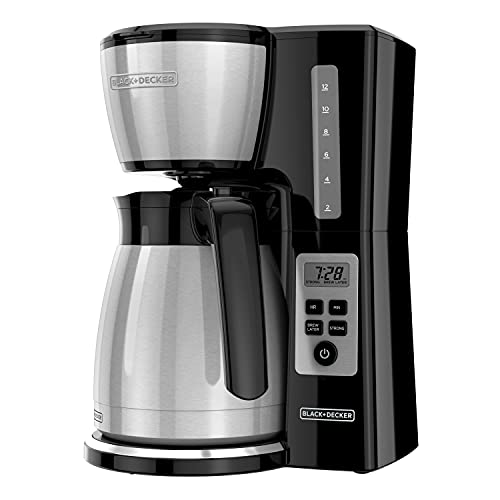
BLACK+DECKER 12 Cup Thermal Programmable Coffee Maker CM2046S
Badge: Best for Even Saturation
Strengths
- VORTEX showerhead design targets even saturation, the distribution parameter behind uniform extraction.
- Brew strength selection adds extraction control in a mainstream thermal machine.
- Twelve-cup thermal format holds a properly brewed pot the framework-approved way, by insulation.
Trade-offs
- No hotter-brewing design claim in its verified data, so its temperature story is less explicit than the Cuisinarts’.
- Not SCA-certified; its case rests on distribution design, not credentials.
- Thermal carafe level is invisible, the standard trade of the format.
Key specs: 12-cup capacity; thermal carafe; programmable; brew strength selection; VORTEX Technology; black/steel; model CM2046S.
Temperature gets the attention in standards discussions, but distribution is its equal partner: water that enters the basket in one stream drills a channel, over-extracting a narrow path while the rest of the bed barely brews, and the cup ends up sour and bitter simultaneously — a combination no bean can fix. The CM2046S is in this guide because its VORTEX showerhead is a direct engineering answer to that failure mode, spreading water across the bed so extraction can be uniform. Paired with strength selection and a thermal carafe, it covers two of the framework’s concerns credibly in a widely available machine.
Its position below the Cuisinarts reflects the temperature column of the ledger, where its verified data makes no hotter-brewing claim, not any doubt about the showerhead’s value. For a buyer whose current machine produces that tell-tale mixed cup — sharp and harsh in the same sip — this pick may actually be the most relevant one in the list, because it treats the diagnosed cause. As with every pick here, the certification distinction stands: this is a parameter argument, honestly made, not a logo.
Best for: buyers whose coffee tastes sour and bitter in the same cup / Not suited for: buyers prioritising an explicit hotter-brewing design

BLACK+DECKER CaféCraft 12-Cup Thermal Coffee Maker
Badge: Most Versatile
Strengths
- Twelve-cup thermal programmable brewing covers the framework-friendly daily pot.
- Hot and iced capability widens the machine’s usefulness without changing its core drip identity.
- Thermal holding keeps the standard pot off a hot plate, consistent with the framework’s spirit.
Trade-offs
- Its verified data carries no hotter-brewing or showerhead headline, so its parameter case is the generalist one.
- Iced brewing is a different preparation with its own ratios; it does not inherit the hot pot’s extraction profile.
- Not SCA-certified, like every pick in this pool.
Key specs: 12-cup capacity; thermal carafe; programmable; hot and iced brewing.
The CaféCraft is the generalist of the list: a twelve-cup thermal programmable machine that also turns to iced coffee when the season demands it. Under the SCA lens its virtues are structural rather than specialised — a thermal carafe that holds coffee properly, programmability that supports a consistent daily routine, and a full-size pot format that suits the standard recipe ratio the framework assumes. Consistency deserves emphasis here, because a standards framework is ultimately about repeatability: the machine that brews the same way every morning gives the user a stable platform for adjusting dose and grind, which is where real improvement happens.
Its limitation is the mirror image of its strength. With no hotter-brewing claim and no named distribution system in its verified data, it cannot argue the temperature or saturation parameters as directly as the three picks above it, and its iced mode sits outside the hot-extraction conversation entirely. Choose it if your household wants one thermal machine that covers hot pots and summer iced coffee with a consistent routine; choose above it if your goal is to push extraction quality as far as this pool allows.
Best for: households wanting one consistent thermal machine for hot and iced routines / Not suited for: extraction specialists chasing temperature and distribution features

SECPOEDR Grind and Brew Coffee Maker with Built-In Grinder
Badge: Best Grind-and-Brew
Strengths
- Grinding immediately before brewing protects the aroma and flavour compounds the framework’s recipe assumes.
- Programmable timing makes the fresh-ground routine repeatable, and repeatability is the framework’s core demand.
- Ten-cup format with a two-hour keep warm window covers the standard morning pot.
Trade-offs
- An integrated grinder’s consistency is harder to control than a dedicated grinder’s, which cuts against extraction precision.
- Grinder-path cleaning is mandatory upkeep; neglected residue undermines every parameter at once.
- No hotter-brewing or distribution design claim in its verified data.
Key specs: 10-cup capacity; built-in grinder; programmable; 2-hour keep warm function; stainless steel.
The SCA framework begins its thinking with the coffee itself, and that is where this machine makes its contribution: beans ground moments before water arrives simply present more of what extraction is supposed to capture. For a buyer whose current routine uses pre-ground coffee, the step to grind-and-brew can improve the cup more than any heating refinement in this list, which earns the SECPOEDR its place despite its caveats.
Those caveats are real and they are stated here rather than buried. Integrated grinders trade some grind consistency for convenience, and grind consistency is an extraction variable in its own right, so the precision-minded buyer may eventually pair a plainer brewer with a dedicated grinder instead. The cleaning obligation is the second cost: a grinder path carrying old oils will flavour a pot no parameter discipline can rescue. Buy this machine as a freshness upgrade with a maintenance contract attached, and it serves the SCA-minded goal well; buy it expecting laboratory precision from the grinder and it will eventually frustrate you.
Best for: pre-ground users ready to step up to fresh grinding / Not suited for: precision brewers who want a dedicated, adjustable grinder

Gevi 10-Cup Grind and Brew Coffee Maker
Badge: Best Modern Controls
Strengths
- Touch screen controls make a two-stage grind-and-brew routine easier to set identically every day.
- Built-in grinder with programmable timing supports the fresh, repeatable recipe the framework favours.
- Reusable filter removes a consumable variable and a recurring purchase from the routine.
Trade-offs
- Glass carafe on a 90-minute warm plate is the holding method least aligned with the framework’s quality concerns.
- Same integrated-grinder consistency and cleaning caveats as the other grind-and-brew pick.
- Interface polish earns no extraction credit; its case is routine-building, not parameters.
Key specs: 10-cup capacity; built-in grinder; touch screen; glass carafe; 90-minute warm plate; reusable filter; 1.5L tank.
The Gevi closes the list as the routine-builder’s grind-and-brew option. Its touch screen does not extract coffee any better, and this guide awards it no such credit; what it does is lower the friction of setting the same grind-and-brew programme every evening, and in a standards framework built on repeatability, a routine that actually happens beats a theoretically superior one that does not. The reusable filter supports the same point by removing a small recurring variable from the process.
Its holding arrangement is its honest weakness under this lens. A glass carafe kept on a warm plate for up to ninety minutes steadily degrades the cup the brew worked to produce, which is why this pick ranks last in an SCA-framed guide while remaining perfectly serviceable for households that empty a pot quickly. If your household drinks promptly and values the interface, it is a reasonable final choice; if your pot lingers, every thermal pick above it respects the framework’s intent better.
Best for: prompt-drinking households that value an easy, repeatable grind-and-brew routine / Not suited for: slow households or buyers focused on holding quality
Comparison Table
| Model | Capacity | Carafe / holding | Parameter it addresses best | Listing |
|---|---|---|---|---|
| Cuisinart PerfecTemp Thermal (12-Cup) | 12-cup | Thermal carafe | Temperature plus small-batch ratio | Check on Amazon |
| Cuisinart PerfecTemp DCC-3400NAS | 12-cup | Double-wall stainless thermal | Temperature | Check on Amazon |
| BLACK+DECKER CM2046S | 12-cup | Thermal carafe | Even saturation | Check on Amazon |
| BLACK+DECKER CaféCraft | 12-cup | Thermal carafe | Routine consistency, hot and iced | Check on Amazon |
| SECPOEDR Grind and Brew | 10-cup | 2-hour keep warm | Freshness of grounds | Check on Amazon |
| Gevi Grind and Brew | 10-cup | Glass carafe, 90-minute warm plate | Repeatable routine | Check on Amazon |
How to Choose a Drip Coffee Maker the SCA Way
Choosing the SCA way means ranking variables in the framework’s order rather than the box’s order. Temperature comes first: extraction chemistry needs water hot enough to dissolve the desirable compounds in the time available, and the practical symptom of failure is sour, thin coffee from good beans. That is why the two PerfecTemp designs lead this guide and why readers should treat Best Drip Coffee Makers That Blooming as a related refinement, since the bloom stage — the initial wetting that lets fresh coffee release gas before the main pour — only helps when the water arriving is already at a proper temperature.
Distribution comes second. Ask how the machine delivers water to the basket: a showerhead or an equivalent spreading design supports the even extraction the framework wants, while a single stream invites channelling. Ratio comes third, and it is the variable most fully in your control: weigh or measure coffee and water consistently, use any small-batch setting when brewing partial pots, and change one thing at a time when a cup disappoints. Holding comes fourth, and the rule is simple — insulation preserves, plates degrade — which is why Best Drip Coffee Makers With Carafe research so often ends at thermal designs for slow-drinking households.
Notice what is absent from that ranking: screens, programme counts, and finish options. They may decide between two otherwise equal machines, and there is no shame in enjoying them, but they do not move a single SCA parameter. A buyer who internalises the ranking above can evaluate any future machine in minutes, including ones not yet released, which is worth more than any individual recommendation in this guide.
How to Brew, Check, and Troubleshoot Like a Standards-Minded Owner
Start with a consistent recipe and write it down: the same dose, the same water level, the same setting, for at least three pots before changing anything. Writing it down is not pedantry; memory quietly edits itself after a good cup and blames the machine after a bad one, while a short note on the fridge keeps the experiment honest across the week. For the bloom-minded, fresh coffee benefits from the grounds being fully wetted early in the cycle; machines handle this stage differently, so observe your first brews and note whether the bed looks evenly wet or dry in patches. When you adjust, move in the framework’s order — dose, then grind, then strength setting — and taste the result against the previous pot rather than against an idealised memory.
You can sanity-check the headline parameter with ordinary tools. A basic kitchen thermometer held in the stream or the freshly brewed slurry gives a rough picture of whether your machine brews genuinely hot or merely warm; treat the reading as indicative rather than laboratory-grade, and compare it against the widely published Golden Cup brewing range rather than against perfection. If the reading is far low and the coffee tastes sour, the machine, not the beans, is your limiting factor. Descaling also belongs in this routine, because scale insulates heating elements and quietly drags temperature down over months — a machine that once brewed hot can drift out of its own best performance without any visible fault.
Problem: coffee tastes sour and thin → work the extraction ladder: confirm the dose is sufficient, confirm the machine is descaled, then use a strength setting or a hotter-brewing design rather than darker beans to mask the fault. Problem: coffee tastes bitter and hollow at once → suspect uneven saturation or a stale grinder path; check that the bed wets evenly, clean the basket and grinder route, and confirm the filter is not folding and bypassing. Problem: a small pot tastes far worse than a full one → use the machine’s small-batch setting if it has one, as the leading pick here does, or brew full pots and hold the extra in the thermal carafe instead of brewing tiny batches badly.
What SCA Certification Actually Is, and What It Is Not
The Specialty Coffee Association maintains brewing standards, best known through its Golden Cup framework, and it operates a certified home brewer programme under which specific models are tested against those standards and permitted to carry the certification. That programme is a genuine quality signal, and this guide respects it enough not to blur it. Certification attaches to exact tested models, not to brands, product lines, or machines that merely resemble a certified design, and it says nothing automatic about the model a store happens to stock this season.
It is equally important to say what certification is not. It is not a guarantee that a given household will love the coffee, because the framework standardises the machine’s side of the equation while the beans, water, dose, and holding remain the owner’s. Nor is the absence of certification proof of a bad machine: plenty of capable brewers are simply never submitted for testing. That is the space this guide occupies — machines assessed on parameter-aligned design traits, openly uncertified, chosen for buyers whose goal is SCA-style brewing rather than the logo itself. Buyers who need the logo have a clear path, the association’s own list, and this guide would rather send them there than dress a mainstream machine in borrowed credentials.
The Ratio Variable: The One Parameter Entirely in Your Hands
Of all the framework’s variables, ratio — the proportion of coffee to water — is the only one no machine can fully manage for you, and it is where home results are won or lost after the purchase. Too little coffee for the water and no heating design can save the cup, because there is simply not enough material to extract into balance; too much and the brew turns heavy and harsh even with perfect temperature. The standards-minded habit is boring and decisive: measure both sides of the ratio the same way every time, whether that means a small scale or a consistent scoop-and-level routine, and record what you used. Three identical pots teach you more than three experimental ones, because they establish the baseline every later adjustment is measured against.
Batch size complicates ratio in a way the framework predicts and casual brewing ignores. A half pot is not a small version of a full pot: the grounds bed is shallower, water passes through it differently, and contact time shifts, so the same ratio can extract differently at different volumes. This is the practical reason the leading pick’s 1-4 cup setting earned it the top position in this guide — it is a design admission that small batches are a distinct brewing problem. Households that mostly brew small should weight that feature heavily, while households that always brew full pots can safely ignore it and judge on temperature and distribution alone. Either way, the error to avoid is brewing a small, badly extracted pot daily and concluding that drip coffee itself is mediocre.
Water itself is the quiet partner in the ratio. Very hard water scales heating elements and drags temperature down over time; very soft or heavily filtered water can leave a cup tasting flat regardless of the machine. The framework assumes reasonable water as its background condition, which is one more reason descaling appears throughout this guide: it is not housekeeping, it is parameter maintenance, the routine that keeps a good machine inside the performance it had when you chose it.
Bloom, Contact Time, and the Edge Cases the Framework Illuminates
Fresh coffee releases gas when hot water first hits it, and the initial swelling of the grounds bed — the bloom — is the visible sign of that release. A brew that wets the bed evenly and allows that gas to escape extracts more uniformly afterwards, which is why the blooming stage attracts so much attention from careful brewers and why this guide’s readers often continue to Best Drip Coffee Makers Under $50 and its neighbouring discussions to compare how machines at every level handle the early moments of the cycle. Home drip machines manage this stage automatically and unevenly: some pause or pulse early water delivery, others simply pour. You cannot retrofit a bloom programme onto a machine that lacks one, but you can support the same goal by using fresh coffee, an even grounds bed, and a machine whose distribution design wets the whole surface rather than one spot.
Contact time is the bloom’s quieter sibling. Extraction needs the water and grounds together long enough to dissolve the desirable compounds, and not so long that the harsher ones dominate. In a drip machine, contact time is set by the machine’s flow design interacting with your grind: finer grounds slow the water and extend contact, coarser grounds let it rush through. This is why the standards-minded owner adjusts grind before dose when a cup disappoints — grind is the contact-time lever, and small changes there have predictable effects that random setting changes do not. The grind-and-brew picks in this guide automate that variable, gaining convenience while surrendering some of the fine control a separate grinder offers, a trade their reviews state openly.
The final edge case is altitude and environment, which no certification tests on your behalf. Water boils at lower temperatures higher up, ambient kitchen cold affects carafes, and seasonal water supply changes can shift taste in ways owners misread as machine failure. The framework’s value in these cases is diagnostic: it gives you the short list of variables to check — temperature, distribution, ratio, contact time, holding — before concluding anything is broken. A buyer who thinks in parameters troubleshoots in minutes; a buyer who thinks in features replaces machines. That difference, more than any single pick, is what the SCA lens is for.
A Worked Example: Diagnosing One Disappointing Pot, Parameter by Parameter
Abstract parameters become useful when they are applied to a real complaint, so consider the most common one behind this keyword: a household buys decent beans, uses a mainstream machine, and produces a pot that tastes sour at the first sip and oddly bitter at the back of the tongue. The feature-led response is to shop for a new machine immediately. The parameter-led response is a sequence. First, holding: was the pot tasted fresh, or after an hour somewhere warm? If it sat, brew again and taste immediately, because a degraded pot can mimic an extraction fault. Second, ratio: was the dose measured, or scooped casually? Repeat the brew with a deliberately consistent, slightly fuller dose and taste again. Third, distribution: open the basket after brewing and look at the bed — a crater in the middle with dry edges is channelling made visible, and it points at the showerhead question that the CM2046S in this guide addresses. Fourth, temperature and scale: if the machine is months old on hard water and has never been descaled, descale it before judging anything, because scale silently lowers brew temperature. Fifth, contact time: if the grounds were very coarse, the water may have rushed through; a finer grind extends contact and often resolves the sourness on its own.
Notice what that sequence costs: a few pots of coffee and some attention, against the price of a replacement machine bought to fix a problem that may live in the dose or the descaler rather than the brewer. Notice also what it teaches: by the end, the owner knows which parameter their kitchen actually struggles with, and that knowledge converts this guide’s ranking into a personal one. If your diagnosis ends at distribution, the showerhead pick outranks the list order for you. If it ends at temperature, the PerfecTemp picks confirm their lead. If it ends at freshness, the grind-and-brew machines become the relevant shortlist. The framework does not replace judgement; it organises it, and an organised buyer is almost impossible to sell the wrong machine to.
Common Buying Mistakes
- Assuming a brand or a premium finish implies SCA certification, when certification attaches only to specific tested models.
- Chasing temperature while ignoring distribution, then wondering why the cup is sour and bitter at the same time.
- Brewing small pots on a full-pot cycle and blaming the machine for under-extraction the batch size caused.
- Letting scale build until brew temperature quietly drifts, then replacing beans and machines instead of descaling.
- Holding an excellent brew on a hot plate for hours and judging the machine by the degraded last cup.
- Changing dose, grind, and strength settings simultaneously, so no improvement can be traced to its cause.
Final Recommendation
For the buyer behind this keyword, the first choice is the Cuisinart 12-Cup Programmable PerfecTemp Thermal Carafe Coffee Maker: it covers temperature, strength control, small-batch handling, and thermal holding in one mainstream machine, the most complete parameter profile in the pool. If you brew full pots only and want the purest temperature focus, take the PerfecTemp DCC-3400NAS; if your cup’s flaw is uneven extraction, take the BLACK+DECKER CM2046S and its showerhead. And keep the guide’s opening honesty in view: if formal SCA certification is a requirement rather than a lens, none of these is the purchase — buy from the certified list instead, and use the parameter checks here to run whichever certified machine you choose.
Frequently Asked Questions
Are any of the machines in this guide SCA certified?
No, and the guide says so deliberately. None of the six verified picks carries an SCA certification claim in its verified listing data, so each is evaluated on how its design traits align with the SCA brewing parameters — temperature, saturation, ratio handling, and holding — rather than presented with a credential it does not hold.
What does the SCA Golden Cup framework actually measure?
In practical terms it concerns whether coffee is brewed with water hot enough for proper extraction, with even contact between water and grounds, over a sensible brew time, at a balanced coffee-to-water ratio, so the served cup lands in a balanced extraction range. The details are published by the association; the home takeaway is that temperature, distribution, and ratio decide the cup together.
Why do the PerfecTemp models rank at the top?
Because temperature is the parameter home machines fail most often and the one their design addresses by name. Hotter, controlled brewing plus strength adjustment gives the user the two levers that fix under-extraction, and the thermal carafes then protect the result. In a framework-led ranking, that combination outranks novelty features.
Does a showerhead really matter, or is it marketing?
It matters mechanically. Even wetting prevents channelling, where water drills one path through the grounds and leaves the rest under-brewed. The symptom of channelling — a cup that is somehow sour and bitter together — is one of the most recognisable faults in home drip coffee, and distribution design is its direct remedy.
Can I check my machine’s brew temperature at home?
Roughly, yes. A kitchen thermometer in the brew stream or fresh slurry gives an indicative reading; compare it with the widely published Golden Cup range and treat it as a guide rather than a lab result. If the reading is far low, the coffee tastes sour, and descaling does not help, the machine is your limiting factor.
If certification matters to me, what should I do?
Buy from the Specialty Coffee Association’s own certified home brewer list, verify the exact model, and then apply this guide’s routine checks — consistent ratio, descaling, sensible holding — to whichever certified machine you choose. Certification standardises the machine; the owner still supplies the other half of the cup.
Does an SCA-style approach make coffee more complicated?
Only briefly. The framework asks you to hold a handful of variables steady — a consistent ratio, a descaled machine, attention to distribution and holding — and in exchange it removes the guesswork that makes home coffee feel mysterious. Most owners find the routine becomes automatic within a couple of weeks, after which the approach is not more work but less: fewer disappointing pots, fewer random adjustments, and a clear order to follow on the rare morning when a cup still misses. That is the practical promise behind the standards, and it is available with the mainstream machines in this guide even in the absence of a certificate.


