Where to buy
Check the latest price, availability and delivery on Amazon. Orders are placed on Amazon. We may earn a commission from qualifying purchases.
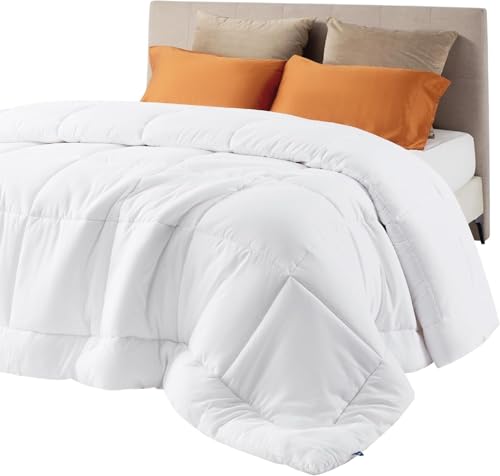
- Best overall: Serta Goose Feather Down Fiber Comforter Duvet Insert, Full/Queen — Check on Amazon
- puredown Lightweight Down Blanket, Queen — Check on Amazon
- Bedsure Comforter Duvet Insert, GentleSoft, Queen — Check on Amazon
- EASELAND Down Alternative Comforter Duvet Insert, Queen — Check on Amazon
See 2 more Amazon options
- Linenspa All-Season Down Alternative Comforter and Duvet Insert, Queen — Check on Amazon
- Utopia Bedding Comforter Duvet Insert, Queen — Check on Amazon
Read the full guide ↓
Disclosure: As an Amazon Associate, topratedkitchenware.com earns from qualifying purchases. Links to Amazon on this page are affiliate links; they cost you nothing extra. Listing details such as price and availability change often, so check the current Amazon listing before you buy.
An apartment changes what a good duvet insert is. In a house, you buy warmth and loft and the rest takes care of itself. In a rental, the insert also has to survive a shared laundry room with machines somebody else overloads, disappear into a closet that is already negotiating with a vacuum cleaner for floor space, fit a bed that might be a twin in this lease and a full in the next, and — when the lease ends — compress into a bag and move without a fight. Seventy-five dollars is the first budget where that harder job gets interesting, because it is the first budget where real animal fill enters the picture. Not premium down — let us be precise about that from the first paragraph. What $75 buys is feather and down fiber (the processed, resilient fill hotels use), better down-alternative fills with published weights, cotton shells instead of polyester on several picks, and — only when a deal is running — one genuinely down-filled lightweight blanket that also happens to be the most packable thing in this guide.
Every pick below was judged at the queen or full/queen size, because that is the size we verified, and bedding choices are meaningless without the size attached. If your rental bed is a twin or a full, the same inserts exist in smaller sizes — check the live listing for that size and check the current price on Amazon rather than assuming the smaller size is positioned the same way. For most renters we would begin with the Serta feather and down fiber insert if the lease is a long one, because it is an accessible way here to sleep under real goose fill inside a real cotton shell. If you move often or sleep hot in a unit where the thermostat is a landlord’s decision, the puredown blanket is the renter’s pick — with a catch about its position near the top of this budget that we flag in its headline, its review and the FAQ, because the catch matters. Below you will find a quick picks table, detailed notes on each of the six products, a comparison table, a buying checklist written for renters, the mistakes apartment shoppers make most at this budget, and answers to the questions that come up again and again.
In this guide
Quick Picks
Short on time, or comparing several options at once? Each row below names a renter type and the product that suits it, with a link to the listing.
| Buyer type | Pick | Why it stands out | Link |
|---|---|---|---|
| Best overall | Serta Goose Feather Down Fiber Comforter Duvet Insert, Full/Queen 90×90 | Real goose feather/down fiber in a 100% cotton shell | Check on Amazon |
| Best for movers and hot rentals (on deal) | puredown Lightweight Down Blanket, Queen 90×90 | Minimum 75% white down fill — packs down smaller than anything here | Check on Amazon |
| Best for shared laundry rooms | Bedsure Comforter Duvet Insert, GentleSoft, Queen 88×88 | Fully machine washable, with 8 corner tabs | Check on Amazon |
| Best published specs for the money | EASELAND Down Alternative Comforter Duvet Insert, Queen 88×88 | Stated 300 GSM whole-piece fill and corner tabs, in the lower part of this budget — check price on Amazon | Check on Amazon |
| Best warranty for a first apartment | Linenspa All-Season Down Alternative Comforter and Duvet Insert, Queen | 8 duvet loops and a 3-year warranty that outlasts most leases | Check on Amazon |
| Lowest price that still works | Utopia Bedding Comforter Duvet Insert, Queen 88×88 | The proven budget insert, at the lowest end of this guide’s range — check price on Amazon | Check on Amazon |
How These Picks Were Chosen
The first filter was the budget itself, applied honestly and at the queen size. Every product below is a real Amazon listing positioned at or regularly near the $75 budget in the queen or full/queen size in the United States — check the current price on Amazon for each one before you buy, because positions within the budget move. One pick — the puredown — only qualifies while its deal is running, and rather than quietly rounding it in, we flag that in its headline, its review and the FAQ. Anything that could not be verified at or under the cap was left out of the linked picks, however good it might be; several strong feather inserts whose exact queen ASINs could not be verified (a DOWNCOOL feather insert, a Cosybay feather insert, a Hotel Grand insert and a Bare Home insert, each positioned in the same part of this budget as the linked natural-fill pick) are named in the ceiling section below instead of being linked on a guess.
The second filter was the apartment itself, and it re-ordered the list. We asked four renter questions of every candidate. Can it be washed in a shared laundry room, or does it need care a renter cannot easily get? How small does it pack — both for a closet that has no spare shelf and for the box it will travel in on moving day? Does it work as one half of a single insert-and-cover system, since most renters own exactly one of each? And does its value survive a change of bed size, given that the next apartment’s bedroom may fit a smaller bed than this one’s? A beautiful insert that fails all four questions can still be a fine product; it is just not a fine apartment product, and this guide marks it down accordingly.
We did not use these products ourselves. We read the maker listings and specification pages, compared fill types and fill splits, shell fabrics, dimensions, attachment hardware and care instructions, and favored products that publish real numbers over products that publish adjectives. Because this guide is about inserts rather than standalone comforters, we judged the insert-specific hardware hard: corner tabs or loops that tie to a cover, box stitching that keeps fill in its own square, and shells quiet and plain enough to disappear under a cover. One thing we looked at closely was fill language, because at $75 it is doing heavy marketing work. “Down fiber” and “feather fiber” are real fills — cleaned, processed feather material that lofts and breathes — but they are not down clusters, and they do not insulate like clusters at the same weight. Where a maker publishes a fill split (the Serta’s 90/10, the puredown line’s minimum 75% down), we print it. Where a maker publishes no fill weight at all — the Utopia, notably — we say so in the review rather than guess. Warmth, loft and fill-power figures throughout are maker claims, and “hypoallergenic” appears only as the attributed maker label it is.
The 6 Best Duvet Inserts for Apartments Under $75
Serta Goose Feather Down Fiber Comforter Duvet Insert, Full/Queen 90×90 (Medium Warmth)
Who it suits: Renters on a longer lease who want the feel of a hotel bed — real goose fill, a cotton shell, a little reassuring weight — inside their own duvet cover, and who are staying put long enough to enjoy it.
This is the pick that changes what the budget means. The listing’s own specification (model SE003025, made by Blue Ridge Home Fashions) puts the fill at 90% white goose feather fiber and 10% white goose down fiber inside a 100% cotton shell, at a full 90 by 90 inches, and Amazon sells it under a title that literally includes the words “Duvet Insert,” so there is no ambiguity about the job it is hired for. It sits comfortably inside this guide’s cap — check the current price on Amazon. Roundups report a queen weight around 7 lb, which is the drape-and-hug feel people associate with hotel bedding: present, not oppressive. In an apartment with thin walls and a radiator you do not control, that weight is a feature in winter — this is the insert that makes a drafty rental bedroom feel finished.
Read the fill split honestly and the Serta still earns its place. Feather fiber is not down — it is the feather’s resilient structure, processed — so this insert warms more by loft and coverage than by cluster insulation, and it will feel different from a true down duvet: flatter in the hand, springier, with a faint rustle the cotton shell mostly tames. What you get for that trade is durability and an accessible position in this budget. Feather fiber shrugs off the compression of a storage bag better than a cheap synthetic, the cotton shell breathes in a way no polyester shell in this guide can match, and the whole thing behaves inside a cover exactly as an insert should. The renter’s caveat is care, and it is in the limitation below: this is a settle-in pick, not a wash-and-go one.
- Real goose feather/down fiber fill — the entry rung of natural fill, honestly labeled.
- 100% cotton shell at a full 90×90 inches, the joint-largest footprint in this guide.
- Real fill inside this budget, with room in the overall system budget for a cover — check price on Amazon.
Honest limitation: It is a fiber fill, not down clusters, and it is not a weekly machine-wash product; the maker family’s guidance points to a duvet cover doing the dirty work and professional cleaning when the insert itself needs it — a real errand and cost in a rental without a car, and the reason short-lease renters should look below.
Choose it if your lease is a year or more and you want natural fill and a cotton shell under $75. Skip it if you need to machine-wash the insert itself regularly, you move every year, or any feather content is a problem in your household.
puredown Lightweight Down Blanket, Queen 90×90 — Real Down, Only on Deal
Who it suits: Renters who move often, sleep hot in units where the heating is the landlord’s decision, or store their bedding in a closet with no room to spare — and who can wait for the deal.
Here is the only pick in this guide filled with actual down. The puredown lightweight line’s specification is a minimum of 75% white down fill in a 100% cotton cover with satin trim and box stitching, at 90 by 90 inches in queen. That fill line matters: everywhere else in this guide, “down” arrives as fiber or as a synthetic alternative, and the difference is real — clusters trap air with almost no weight, which is why this blanket feels like a held breath rather than a layer. For an apartment, though, the down’s second property is the headline: it compresses. A queen down blanket rolls into a fraction of the space of any synthetic pick here, which is closet gold in a small unit and moving-day gold when everything you own has to fit in one car or one van trip. As an insert it is a summer-weight one: slipped inside a cover it gives a warm sleeper a genuine-down feel without a winter duvet’s commitment — exactly right for top-floor units and buildings whose radiators run on their own schedule.
Now the catch, printed as plainly as we can print it. This pick sits near the top of this budget and only belongs in this guide while its deal is running; when no deal is running it can sit above the cap. Check the current price on Amazon, and if the deal is gone, either wait for it to return (this line deals often) or take the Serta above and accept fiber instead of clusters. We would rather lose the pick than fudge the budget, and the FAQ repeats the warning.
- Minimum 75% white down fill per the line’s specification — the real thing, not fiber.
- Compresses smaller than any other pick — the storage and moving-day winner.
- 100% cotton cover with satin trim and box stitching, at a full 90×90.
Honest limitation: Two of them. Its position in this budget is deal-dependent, so check the current price on Amazon before counting on it, and puredown sells this as a lightweight down blanket, not a tabbed insert — the listing does not promise corner tabs, so use duvet clips or a cover with ties if you run it inside a cover.
Choose it if the deal is live, you sleep warm, or you move often enough that pack size matters. Skip it if the current price on Amazon puts it over this budget, or if you need a winter-weight insert — this is a light blanket by design.
Bedsure Comforter Duvet Insert, GentleSoft, Queen 88×88 (Cream)
Who it suits: Renters whose laundry plan is a shared laundry room — anyone who needs the insert itself to go through a normal machine wash and come back fine.
Bedsure’s GentleSoft insert is the down-alternative pick we would hand to a renter first, because it answers the apartment’s hardest question — washing — without conditions. The fill is polyester, worked soft — the brand’s whole pitch is a brushed, gentle hand — held in box stitching so it stays in its own squares, with 8 corner tabs to tie into a cover. The linked listing is the Cream queen at 88 by 88 inches, and it sits in the lower-middle part of this budget — check the current price on Amazon, because its position within the budget can move.
As an insert, the details are right, and for apartment life the washability is the detail that outranks the rest. Eight tabs is the count that actually stops the 2 a.m. migration (four corners alone let the middle wander), the box stitch keeps the fill from pooling in the bottom third of the cover, and when the cover is in the wash and something spills on the insert itself, this is the pick you can carry down to the laundry room and machine-wash the same afternoon. What you give up against the Serta is the cotton shell and the natural fill’s breathability — this is a polyester product, shell and fill, and a hot sleeper in a warm unit will notice the difference by August. Set against the Serta’s higher position in this budget, most bedrooms will not care.
- 8 corner tabs — the attachment count that genuinely stops bunching.
- Fully machine washable — the shared-laundry pick of this guide.
- Positioned in the lower-middle part of this budget — check price on Amazon.
Honest limitation: Polyester shell and fill: it sleeps warmer and feels less breathable than the cotton-shelled Serta, and its position within this budget can move, so check the current price on Amazon.
Choose it if washability and softness top your list, as they should for most renters. Skip it if you run hot and can stretch to the cotton shell above.
EASELAND Down Alternative Comforter Duvet Insert, Queen 88×88 (White)
Who it suits: Spec-sheet shoppers in small spaces who want published numbers — a stated fill weight, a stated cover weight — and an insert that packs flat on a closet shelf between seasons.
EASELAND publishes what most budget brands will not. Feature extraction from its listing records a 105 g/m² brushed polyester cover over a 300 GSM whole-piece polyester fill, in an 88 by 88 inch queen with corner tabs. The “whole-piece” construction is the detail worth knowing, and it matters twice in an apartment: instead of chopped fill that can migrate and clump, the fill is a continuous batt, which is why this insert keeps an even hand-feel wash after wash in hard-working shared machines — and why it folds and rolls evenly instead of lumping, so it stores flatter on the one closet shelf a renter can spare it. It sits in the lower part of this budget — check the current price on Amazon before you buy.
That positioning cuts in the reader’s favor. Even if its current price has drifted upward within this budget, this remains one of the best-documented inserts under the cap; if it has drifted higher than that, the Bedsure above is the documented alternative, also positioned in the lower-middle part of the budget. Either way, what you are buying is the synthetic insert done properly: even fill, tabs that hold a cover, and a cover fabric with a stated weight.
- Stated 300 GSM whole-piece fill — no chopped fill to clump, migrate or store lumpy.
- Stated 105 g/m² brushed cover and corner tabs, per the listing’s own data.
- Documented specs at a lower-budget position — check price on Amazon.
Honest limitation: Its position in this budget can move — check the current price on Amazon, and know the article’s advice already assumes it may sit higher within the budget than its lowest sale positioning.
Choose it if you want documented specs, an even washable fill and flat storage. Skip it if the current price on Amazon has climbed past the Bedsure’s, which gives you 8 tabs and the same washable approach.
Linenspa All-Season Down Alternative Comforter and Duvet Insert, Queen (White)
Who it suits: Anyone furnishing a first apartment who wants the safest, most warrantied purchase in the guide — the insert you buy once and stop thinking about for the length of the lease.
Linenspa’s all-season insert is the elder statesman here: a down-alternative comforter and insert that has sold in this form for years, with a maker-rated 300 GSM fill, box stitching, and — the insert-specific detail — 8 duvet loops for tying into a cover. It sits near the low end of this budget — check the current price on Amazon — and the line carries a 3-year warranty, a term none of the other synthetic picks in this guide match. For a renter, that warranty has a specific value: it is longer than most leases, so the one bedding purchase you cannot afford to have fail mid-tenancy is the one with a brand standing behind it. In a category where most products are anonymous and interchangeable, that backing is a genuine feature, and at its position in this budget it is a particularly strong one.
Nothing about the Linenspa is exciting, and that is the recommendation. The fill is polyester, the shell is microfiber, the warmth is honestly all-season — adequate for most bedrooms most of the year, neither a summer whisper nor a winter wall. Inside a cover it does the insert job without a single surprise: it ties in at eight points, it machine-washes in the building’s machines, it comes back the same shape. First apartments, studio beds and sofa-adjacent sleep setups run on exactly this kind of boring reliability, and so do plenty of main beds whose owners would rather spend the savings on the cover everyone actually sees.
- 8 duvet loops and box stitching — proper insert hardware at a budget position.
- 3-year warranty — longer than a typical lease, the strongest backing in this guide.
- Maker-rated 300 GSM fill, near the low end of this budget — check price on Amazon.
Honest limitation: Microfiber shell and polyester fill sleep warmer than cotton, and “all-season” means exactly the middle of the road — cold sleepers in cold, drafty units will want a throw over it in January.
Choose it if you want the lowest-risk purchase in the guide for a first apartment. Skip it if you sleep hot enough to need the cotton shell and natural fill of the Serta.
Utopia Bedding Comforter Duvet Insert, Queen 88×88 (White)
Who it suits: Renters who want a proven insert for as little as possible — a futon or sofa bed, a roommate-era second bed, a sublet you are furnishing for one season.
Utopia’s insert is the budget benchmark the rest of the category is measured against: an 88 by 88 inch queen in a box-stitched polyester/microfiber build with corner tabs, sold in enormous numbers for years. It sits at the lowest end of this guide’s range — check the current price on Amazon — and sits so far under this guide’s cap that the only sensible advice is to check its current price and not agonize over small movements within that low position. At this end of the budget, an insert becomes nearly disposable in the renter’s sense: if a move, a spill or a bed-size change ends its tour of duty, replacing it is an inconvenience, not a major loss.
One gap deserves print, because it decides comparisons: Utopia publishes no fill weight for this insert. Roundups of duvet inserts have noted the same omission. You therefore cannot compare its warmth on paper against the EASELAND’s or Linenspa’s stated 300 GSM — you can only go on its long record of being warm enough for the all-season job it claims. Inside a cover, that record is what matters: the tabs hold, the boxes keep the fill distributed, the whole thing machine-washes without ceremony, and the insert vanishes into the cover’s look and feel, which is the whole job. At this end of the budget, “vanishes and works” is a complete recommendation.
- The proven budget insert: years of sales, box stitch, corner tabs.
- At the lowest end of this guide’s range in queen — check price on Amazon.
- Machine washable and forgiving — ideal for futons, sublets and second beds.
Honest limitation: No published fill weight, so its warmth cannot be verified on paper — and the polyester build sleeps warmer than the cotton-shelled picks.
Choose it if price is the first criterion and the bed is temporary or a second one. Skip it if you want documented fill specs (EASELAND) or natural fill (Serta).
Comparison Table
| Product | Fill (maker-stated) | Best apartment use | Link |
|---|---|---|---|
| Serta Goose Feather Down Fiber Insert, Full/Queen 90×90 | 90% goose feather fiber / 10% goose down fiber, cotton shell | Long leases, hotel drape, drafty rooms | Check on Amazon |
| puredown Lightweight Down Blanket, Queen 90×90 | Minimum 75% white down, cotton cover | Frequent movers, hot rentals, tiny closets — on deal | Check on Amazon |
| Bedsure GentleSoft Insert, Queen 88×88 | Polyester, 8 corner tabs | Shared laundry rooms, softest washable pick | Check on Amazon |
| EASELAND Down Alternative Insert, Queen 88×88 | 300 GSM whole-piece polyester (maker figure) | Published specs, flat shelf storage | Check on Amazon |
| Linenspa All-Season Insert, Queen | 300 GSM down alternative (maker figure), 8 loops | First apartments, warranty-backed reliability | Check on Amazon |
| Utopia Bedding Insert, Queen 88×88 | Polyester, fill weight unpublished | Futons, sublets, lowest workable price | Check on Amazon |
How to Choose a Duvet Insert for an Apartment Under $75
- Start with your laundry reality, not your warmth preference. If the insert itself must survive a shared laundry room, buy synthetic (Bedsure, EASELAND, Linenspa, Utopia). Natural fill (Serta, puredown) asks the cover to do the washing work and professional cleaning for the insert itself.
- Count your storage before you count threads. A queen synthetic insert off-season needs roughly a closet shelf; the puredown compresses to a fraction of that. In a studio, pack size is a feature on par with warmth.
- Match the insert to the bed you have, then check that size on the listing. Every pick in this guide was judged at the verified queen or full/queen size. Rentals run twin and full as often as queen — the same listings sell those sizes, but each size is positioned on its own; confirm the size and check the current price on Amazon rather than assuming.
- Buy one insert and one good cover, not two cheap inserts. The renter’s system is a single insert that stays on the bed year-round plus a cover that carries the look and the washing. A second insert is a storage problem wearing a bargain’s clothes.
- Count the attachment points. Eight tabs or loops hold an insert where four corners let the middle sag. If your cover has only corner ties, side loops on the insert are wasted; if it has eight ties, buy an insert that can use them. The puredown has no promised tabs at all — plan for duvet clips if you choose it.
- Match insert size to cover size, not bed size. An 88×88 insert in a 90×90 cover drifts; a 90×90 insert in an 88×88 cover bunches. Measure the cover you own before ordering either footprint in this guide.
- Read the shell fabric like it matters — in a rental, it does. Cotton shells (Serta, puredown) breathe, which counts double in a unit whose heating and cooling you do not control; microfiber shells are quieter, warmer and cheaper.
- Treat warmth words as maker claims. “All-season,” “medium warmth” and GSM figures are the maker’s own labels, not a tested standard. Cross-check with fill weight where published, and with your own bedroom — top-floor and radiator-blasted units need less insert than the adjective suggests.
- Check the current price on Amazon on deal-driven picks. Two picks in this guide (puredown, EASELAND) depend on deal positioning within this budget. The live listing is the only price that counts; if it has moved over the cap, the honest move is the documented alternative, not a shrug.
- Think about the exit. Whatever you buy will be carried down stairs, through a lobby and into a vehicle on moving day. If you move yearly, weight and pack size (puredown, Utopia) beat drape (Serta) — and an insert at the low end of the budget that you can replace beats a precious one you must protect.
One Insert, One Cover: The Renter’s Bedding System
Homeowners collect bedding; renters run a system. The system that works in an apartment is one insert, chosen for the warmest and coldest nights the unit actually delivers, and one cover — two, if laundry day is weekly and you want a rotation — that carries the room’s look and takes the weekly wash. The insert stays on the bed in every season because swapping inserts means storing one, and storage is the resource an apartment does not have. That is why this guide favors all-season and medium-warmth picks for rental life, and why the one genuinely seasonal product here, the puredown lightweight blanket, earns its place on a different virtue: it is the only pick that can be stored in the space a spare towel takes when summer makes even an all-season insert too much.
The cover is the half of the system that does the visible and hygienic work, and it changes how you should judge the insert under it. Because the cover is what guests see and what the laundry actually washes, the insert’s own shell matters less for looks and more for behavior — smooth enough to slide into the cover during the wrestling match of changing it, quiet enough not to announce every turn through a thin wall to a roommate, and tied in at enough points that making the bed stays a one-minute job. Spend the system’s money in that order: insert first for warmth and washability, cover second for looks, and nothing at all on a second insert until the closet proves it can hold one.
There is a budget consequence worth stating. A natural-fill insert that needs a cover you do not own costs more than the insert alone, once the cover is counted; a synthetic insert you already have a cover for costs only the insert itself. Renters comparing the Serta, positioned higher in this budget, against the Bedsure, positioned lower, should price the whole system — insert, cover, and the first professional cleaning the natural fill will eventually want — rather than the two listings alone. The gap narrows on that fuller accounting, and for a one-year lease it can close entirely.
Laundry Day: Washing an Insert in a Shared Laundry Room
Shared laundry imposes rules that a home laundry room forgives. The machines are commercial-sized but shared, the hot water is whatever the building gives you, and an insert that needs special handling competes with every other tenant’s Sunday. Four of this guide’s six picks — the Bedsure, EASELAND, Linenspa and Utopia — are built for that reality: synthetic fills that machine-wash and tumble without ceremony, box stitching that keeps the fill in its squares through an industrial spin cycle, and no care label that uses the words “professional” or “specialist.” Of those, the EASELAND’s whole-piece fill is the construction least likely to clump under that treatment, and the Bedsure’s eight tabs mean it comes out of the machine in the same shape it went in, ready to tie straight back into its cover.
The natural-fill picks play by different rules, and a renter should choose them with eyes open. The Serta’s maker family points to the duvet cover as the washable layer and professional cleaning for the insert itself — in practice, that means the insert gets cleaned rarely, at a cost and an errand, while the cover does the weekly work. The puredown’s down fill likewise wants gentle handling rather than a hot shared-machine cycle. Neither is a defect; both are the known trade-off of natural fill, and in a long lease with a good cover the arrangement works well. But if your building’s laundry is your only laundry and your cover rotation is one, the synthetic picks are not the cheap compromise — they are the correct engineering for your situation.
One habit protects any insert in a shared facility: wash the cover weekly and the insert rarely, air the insert over a shower rail or balcony door when you change the cover, and never store an insert that went into the bag even slightly damp — a sealed storage bag in a warm closet is where apartment bedding goes to smell like it. Let every insert expand for 24 to 48 hours out of its packaging before judging its loft, and give a stored insert the same day of air when it comes back out.
Small Beds, Small Closets, Moving Day: The Size and Storage Problem
Rental beds are smaller than the bedding industry’s default imagination. Studios and second bedrooms run twin and full beds, futons and sofa beds, and the queen-size judgments verified in this guide are a benchmark, not a promise about what your size costs — each listing positions its own sizes, and the honest move is to open the listing, select your size, and check the current price on Amazon there. What does transfer across sizes is the judgment: the same fills, shells and attachment hardware rank the same way on a full bed as on a queen, and an insert bought for a full bed in this lease can serve as a throw-weight layer on a bigger bed in the next one, while the reverse is not true. When a size change is likely, buying for the bed you have — not the bed you hope for — is the cheaper mistake.
Storage is the second size problem. Off-season, a queen synthetic insert wants roughly a shelf of closet; the Serta’s feather fiber compresses respectably but is the heaviest object in this guide at a reported 7 lb in queen; the puredown compresses to the smallest bundle here by a wide margin, which is the quiet reason frequent movers and studio dwellers should weight it beyond its warmth. A storage bag with the air pressed out — not a vacuum bag held at full compression for months, which tires any fill — keeps an insert clean in a closet that shares space with everything else you own. Label it, keep it dry, and it will outlast several leases.
Moving day is where the apartment lens stops being a metaphor. Every object in this guide will be carried down stairs and fitted into a vehicle, and the ranking there is blunt: the puredown rolls smallest and lightest, the synthetics compress adequately and forgive rough handling, and the Serta is the one pick you will notice carrying — the trade-off of its drape, paid once a move. None of that should override warmth and washability for a long lease. For a renter who already knows the lease is the last one in this city, it reasonably can.
What $75 Does Not Buy: The Ceiling Above This Guide
Honesty about a budget means naming what sits above it. Premium down starts well past this cap: a 750-fill-power queen insert sits in a higher tier well above this budget, and a 93% goose down, 800-fill-power duvet sits far above it — those are the fill ladder’s upper rungs, and no deal makes them $75 products. One near-miss deserves a name: a lightweight goose feather comforter from APSMILE sits just above this guide’s cap, and it is excluded on principle — a budget that bends a little bends by a lot. If your ceiling is genuinely flexible by that much, it is the first product to look at; inside a strict $75, it is not in this guide.
The other names above the line are here because they belong in the same budget conversation but their queen listings could not be tied to a confirmed ASIN, and we do not link guesses: a DOWNCOOL feather and down fiber insert in a cotton cover, queen 90×90 with 8 corner tabs; a Cosybay feather and down fiber insert, queen 90×90; a Hotel Grand feather down fiber insert with 8 corner loops; and a Bare Home down-alternative insert. Each is positioned in the same part of this budget as the linked natural-fill pick. If any of them is available when you shop, they belong in the same conversation as the Serta — verify the size and check the current price on the listing page, and they are legitimate alternatives rather than omissions.
Common Buying Mistakes
- Reading “down fiber” as “down,” then feeling cheated by a fill that was honestly labeled all along.
- Comparing a different size against a queen budget — every judgment here is queen, and if your rental bed is smaller, check that size on the listing instead of assuming.
- Buying the puredown when its current price is over this budget because a guide listed it under $75, without checking whether the deal is live.
- Buying two inserts for two seasons in an apartment with one closet — the second insert will live on the bed, on a chair, or in your way, in that order.
- Pairing an 88×88 insert with a 90×90 cover (or the reverse) and blaming the tabs for the drifting that the size mismatch caused.
- Washing a natural-fill insert like a towel in the shared machines — hot water, high heat, weekly — and shortening its life to a season.
- Storing an insert in a vacuum bag at full compression for a whole lease, then wondering why the fill never lofts again.
- Judging loft in the first hour out of the packaging, before the fill has had its 24 to 48 hours to expand.
- Assuming “hypoallergenic” is a certification you can rely on; on these listings it is a maker label, printed here only as one.
- Forgetting the cover in the budget: a natural-fill insert that needs a cover you do not own costs more than its listing alone.
Final Recommendation
- Most renters: Bedsure Comforter Duvet Insert, GentleSoft, Queen — the washable, eight-tab insert a shared laundry room cannot hurt.
- Long leases and natural fill: Serta Goose Feather Down Fiber Comforter Duvet Insert, Full/Queen.
- Frequent movers and hot units: puredown Lightweight Down Blanket, Queen — at its deal positioning, and only at its deal positioning.
- Documented specs and flat storage: EASELAND Down Alternative Comforter Duvet Insert, Queen.
- First apartments and safe bets: Linenspa All-Season Down Alternative Insert, Queen.
- Futons, sublets and lowest workable price: Utopia Bedding Comforter Duvet Insert, Queen.
Our top two for apartment life are the Serta for anyone staying put who wants real goose fill in a cotton shell, and the Bedsure for everyone else — which, in rental reality, is most people: it machine-washes in the building’s machines, ties in at eight points, and sits low enough in this budget that a move or a spill is an inconvenience rather than a loss. If you move every year or your unit runs hot, take the puredown at its deal positioning and enjoy the smallest bundle on moving day. Between the Serta and the puredown sits exactly what $75 means in this category: the entry rung of natural fill, bought honestly, with fiber and cluster each labeled as what it is. Check the current price on Amazon and your bed’s size on every listing before you order, and let the insert expand for a full day before you decide what you bought.
Related guides
Frequently Asked Questions
Can you really buy a down duvet insert for under $75?
Yes — with the words defined honestly. Under $75 buys feather and down fiber inserts (the Serta is the guide’s example) at full all-season weight, and it buys genuine down clusters only in one lightweight blanket, and only while its deal positioning holds. A full-weight, high-fill-power cluster duvet starts well above this budget and runs far higher.
What size were the picks in this guide judged at?
Queen, or the maker’s combined full/queen size, for every pick — that is the size we verified. Rental beds are often twin or full, and the same listings sell those sizes, but each size is positioned on its own: select your size on the live listing and check the current price on Amazon there rather than assuming it follows the queen positioning.
Which insert is best if my apartment has a shared laundry room?
One of the four synthetic picks. The Bedsure, EASELAND, Linenspa and Utopia all machine-wash at home or in a building laundry and need no professional care. The natural-fill picks (Serta, puredown) rely on the duvet cover as the washable layer, with professional cleaning for the insert itself — workable in a long lease, awkward in a short one.
Why does the puredown pick depend on a deal?
Because its position straddles the cap: on deal it sits inside this budget, and without a deal it can sit above it. At its deal positioning it qualifies; above the cap it does not. The guide keeps it, flags it in three places, and names the Serta as the alternative — that is the honest way to handle a straddle, rather than rounding a higher position down to $75. Check the current price on Amazon before you count on it.
How do I store an insert in a small apartment?
Clean, fully dry, loosely compressed in a breathable storage bag on the highest closet shelf you have. The puredown compresses smallest; the synthetics fold adequately; the Serta’s feather fiber tolerates a storage bag well but is the heaviest to lift up there. Avoid holding any fill at full vacuum compression for months — it tires the fill — and never bag an insert that is even slightly damp.
How do I stop my insert bunching inside its cover?
Tie every attachment point, not just the corners: eight-point inserts (the Bedsure and Linenspa here) exist precisely because four corners let the middle migrate. Match the insert’s dimensions to the cover’s — an 88×88 insert in a 90×90 cover will drift no matter how well it is tied — and if you choose the puredown, which promises no corner tabs, use duvet clips or a cover with ties to do the job.
What does “hypoallergenic” mean on these listings?
On these listings it is a maker label, and this guide prints it only as one. It is not a medical claim and not a guarantee: reactions to bedding come from fill, dust, detergents and more, and no insert in this guide treats allergies, night sweats or any other condition. If a health concern is driving the purchase, a clinician’s advice comes before a listing’s label.
What if a pick has moved over $75 when I shop?
Then for your cart, it is not an under-$75 pick, whatever any guide says — prices move, and two picks here (the puredown and the EASELAND) are explicitly deal-dependent in their positioning. Use the documented alternatives: the Serta anchors the natural-fill end well under the cap, and the Bedsure, Linenspa and Utopia sit so far under it that normal price movement will not evict them. Check the current price on Amazon for whichever you choose.