Where to buy
Check the latest price, availability and delivery on Amazon. Orders are placed on Amazon. We may earn a commission from qualifying purchases.
- Best overall: Buffy Cloud Comforter, Full/Queen — Check on Amazon
- Egyptian Bedding Siberian Goose Down Comforter, Queen — Check on Amazon
- REST Evercool Cooling Comforter, Full/Queen — Check on Amazon
- APSMILE All Season Down Comforter, Queen — Check on Amazon
See 2 more Amazon options
- Pacific Coast Goose Feather Down Fiber Comforter, Queen — Check on Amazon
- Serta Goose Feather Down Fiber Comforter Duvet Insert, Queen — Check on Amazon
Read the full guide ↓
Disclosure: As an Amazon Associate, topratedkitchenware.com earns from qualifying purchases. Links to Amazon on this page are affiliate links; they cost you nothing extra. Listing details such as price and availability change often, so check the current Amazon listing before you buy.
A guest room changes the arithmetic of buying a duvet insert. Your own bed uses an insert night after night, all year; a guest bed might see only a handful of stays, and the insert spends the other eleven months folded in a closet doing nothing at all. So this guide judges the same under-$200 field a different way: value per guest-night instead of value per night, warmth chosen for sleepers you cannot interview instead of for yourself, care judged by what happens between guests rather than in your own laundry routine, and storage treated as a first-order feature, because for a guest insert, storage is most of its life.
The good news is that $200 is a generous guest-room budget. It reaches the best down-alternative insert on Amazon, a genuine goose down insert in the 750 fill-power class, and a specialist cooling comforter when it is discounted into this budget — with the value pick in this guide sitting at the low end of the budget and leaving most of it for the cover, which is the layer your guests will actually see and touch. What $200 does not buy, for a guest room or any other room, is the shelf above: 800-plus fill power and the luxury labels live higher, and this guide names them rather than pretending otherwise.
One translation warning before the picks, because these listings need it: “down fiber” and “feather fiber” are shredded, processed fill — real goose material, but not the clusters that give down its loft — and this guide never calls a fiber product a down comforter. Where a pick is fiber, it says fiber. Where a pick is genuine cluster down, it says that too, and says whose figure the fill power is. Every positioning below is for the queen or full/queen size, stated with the size it belongs to, because on these listings the king often sits above this budget.
In this guide
Quick Picks
Short on time, or comparing several options at once? Each row below names a hosting situation and the product that suits it, with a link to the listing.
| Buyer type | Pick | Why it stands out | Link |
|---|---|---|---|
| Best overall for guests | Buffy Cloud Comforter, Full/Queen | Machine washable, corner loops, medium warmth that suits almost any sleeper | Check on Amazon |
| Best genuine down | Egyptian Bedding Siberian Goose Down Comforter, Queen | Real cluster down, eight tabs — the hotel-bed gesture for a guest who matters | Check on Amazon |
| Best for a hot guest room (when discounted) | REST Evercool Cooling Comforter, Full/Queen | Cool-to-touch face for summer guests; only qualifies when discounted into this budget | Check on Amazon |
| Best mid-price natural fill | APSMILE All Season Down Comforter, Queen | 46 oz of down/feather fiber in an organic cotton shell, with corner tabs | Check on Amazon |
| Best for a cold guest room | Pacific Coast Goose Feather Down Fiber Comforter, Queen | Heavyweight build and eight loops — the most warmth and anchoring here | Check on Amazon |
| Best value for a rarely used room | Serta Goose Feather Down Fiber Comforter Duvet Insert, Queen | Genuine goose fiber and eight loops, positioned at the low end of this budget | Check on Amazon |
How These Picks Were Chosen
The first filter was the budget, applied to the queen size specifically. Every product below is a real Amazon listing whose queen or full/queen size is positioned at or under this budget — in one clearly flagged case, only when it is discounted into this budget, which the guide tells you to wait for. Check the current price on Amazon for each pick before you buy. Anything that could not be tied to a specific listing was left unlinked and named in the notes, however good it looked. Where a pick’s availability is less certain than we would like, the review says so in plain language rather than rounding the uncertainty away.
The second filter was the guest test, and it reorders priorities that a main-bed guide takes for granted. Warmth had to be a default, not a preference: every pick here is a medium, all-season weight or offers one, because you cannot ask a guest in advance whether they sleep hot, and the fixable problem is layering, not the insert. Care was judged between guests: the cover takes the wash after every stay, so what matters is whether the insert itself can be washed occasionally, protected reliably, or — in one case — kept honest behind a cover because it is dry-clean-only. Storage counted as heavily as loft: an insert that spends eleven months in a closet has to survive the closet, and down and synthetic fills survive it differently. And attachment hardware mattered more, not less, than in a main bedroom — a guest will politely say nothing about an insert that bunched into a corner by 3 a.m., and you will never know.
The third filter was fill honesty. Within this budget the listings divide into three families that marketing tries hard to blur: genuine cluster down, feather and down fiber, and down-alternative. This guide keeps them separate in every review, in the comparison table and in the sections below. Fill power figures are maker claims and are attributed as such; fill power is only ever quoted for real down, because the number means nothing for shredded fiber or polyester.
A note on overlap: duvet inserts and comforters are largely the same products under two names on Amazon, and most of these listings carry both words in their titles. Several picks here also appear in our main duvet insert guide at this budget. That reuse is deliberate — each product below is genuinely sold for, and built for, use as a duvet insert (the Serta’s Amazon title literally includes the words “Duvet Insert”) — and each is re-judged here on guest criteria: cost per guest-night, unknown-sleeper warmth, between-guests care and storage. If you already read the main guide, the new information here is the hosting grading, not a repeated sales pitch. One more product deserves naming here rather than linking: the Royoliving Premium Feathers Down queen — certified feather and down fill, organic cotton cover, eight corner tabs — could not be linked because its standard-queen ASIN could not be verified (only its king-size siblings’ listings surfaced). It is the first swap-in if that ASIN verifies, and it is named here, unlinked, rather than linked on a guess.
We did not use these products ourselves. We read the maker listings and specification pages and reviewer measurements, and favored products whose claims could be checked against something other than the brand’s own copy.
The 6 Best Duvet Inserts for Guest Rooms Under $200
Buffy Cloud Comforter, Full/Queen
Who it suits: Most hosts — anyone whose guest room sees a normal rotation of friends, family and the occasional week-long stay, and who wants one insert that asks nothing of anybody.
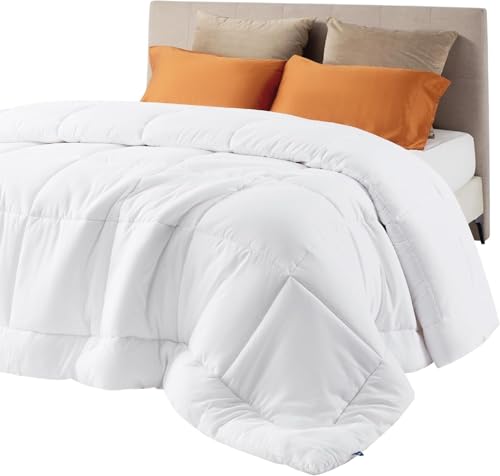
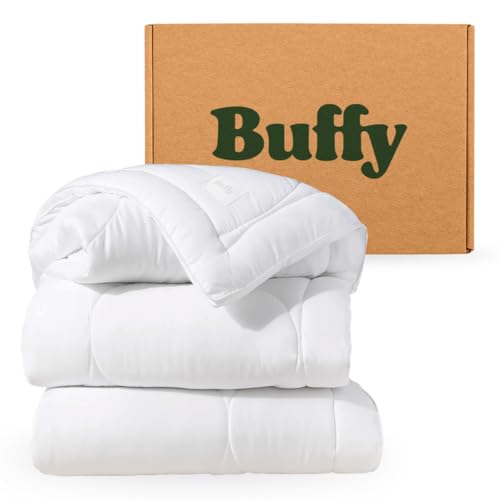
The Cloud is the rare down-alternative that behaves like a premium product instead of a placeholder. The shell is eucalyptus lyocell (the listing describes it as rayon from eucalyptus), smooth and cool-feeling, and the fill is layers of 100% recycled fiber — the maker puts it at roughly 50 recycled bottles per comforter, which is a maker figure, printed here as one. It measures a true 90 by 90 inches in full/queen, and it has corner loops for duvet ties, a feature independent reviewers specifically note as making it work “more akin to a traditional duvet insert” than most comforters in this tier. For the full/queen size it sits toward the upper end of this budget — check the current price on Amazon before you buy.
For a guest room, its decisive virtue is the washing machine. Guests are strangers to your laundry routine: someone will spill tea, a child will be sick, a dog will be allowed up “just this once.” The Buffy is the only premium pick here whose insert itself can simply go in the machine, shell and all, and come back reset — no dry cleaner, no spot-treating around a fill you are afraid to wet. Its medium warmth is the other guest virtue: layered recycled fiber at an all-season weight is the closest thing to a warmth default this category offers, neither the commitment of a heavyweight winter insert nor the apology of a summer blanket. The value logic is honest too: in a guest room that hosts regularly, its upper-end positioning is spread across many guest-nights over years of use — real money, but the price of never thinking about the guest bed again.
- Machine washable, shell and all — the easiest between-guests reset in this guide.
- Corner loops for duvet ties — genuinely insert-ready, unlike most comforters.
- Lyocell shell stays smooth inside a cover and presents well when the cover is off.
- Positioned toward the upper end of this budget in full/queen — check price on Amazon.
Honest limitation: It is recycled polyester fill, however well made — it will not match the loft-per-ounce or the decade-long lifespan of the genuine down pick below, and the king size sits above this budget, so the size selector is a real trap.
Choose it if your guest room hosts regularly and you want the insert itself washable. Skip it if the room hosts only a few nights a year — the Serta below does that job at a much lower position in this budget.
Egyptian Bedding Siberian Goose Down Comforter, Queen
Who it suits: The host making a point — most often to a visiting parent or in-law — that the guest bed in this house is not the leftover bed.
This is the genuine article: Siberian goose down in a 600 thread count 100% Egyptian cotton cover, with a maker-stated 750 fill power and a generous 60 ounces of fill in the queen — figures that come from the maker’s specifications as measured and reported by reviewers, and printed here as maker claims, not laboratory results. The construction is what separates it from the fiber crowd: true baffle boxes, which give the down three-dimensional room to loft instead of sewing it flat, double-needle stitching, and eight tabs stitched around the corners and edges to anchor it inside a duvet cover, a detail confirmed in hands-on review coverage. Reviewers who have handled it describe it as one of the loftiest comforters in its class, and that loft is exactly what 750 fill power with 60 ounces behind it should feel like. On a made guest bed, it is the one pick here that reads as a hotel gesture: the duvet sits high, the cover drapes instead of lying flat, and the message to a parent who once gave up their own bed for you is delivered without a word being said.
The hosting caveats are real, and they are about care and storage rather than sleep. Down does not go through your home machine casually; between guests, the cover does the washing and the insert gets aired, shaken and spot-treated, with a professional clean as an occasional event rather than a routine. Stored, it wants to live loose in a breathable bag — eleven months vacuum-sealed flat is how down loses the loft you paid for. And its positioning needs honest handling: reviewer coverage places the queen in the middle-to-upper part of this budget, comfortably within it, but you should check the current price on Amazon on the live listing before you rely on it, because that is the only way to confirm where it sits today.
- Genuine goose down clusters — the only true down pick in this guide.
- Maker-stated 750 fill power with 60 oz of fill: real loft, not marketing loft.
- Baffle-box construction and eight duvet tabs, confirmed by reviewers.
- 600 thread count Egyptian cotton shell — the best shell fabric here.
Honest limitation: Its live position in this budget should be confirmed on the listing — check price on Amazon before you buy. Down also asks for loose storage and gentler care than any synthetic pick — a real cost in a room that sits idle.
Choose it if the guest room is a statement and you will store it properly. Skip it if you need to machine wash the insert itself between guests, or the closet plan is a vacuum bag.
REST Evercool Cooling Comforter, Full/Queen
Who it suits: Hosts of summer guests, and anyone whose guest room is the hot room — the one over the garage, under the roof, or facing west — where a normal insert would be pushed off by midnight.
The Evercool is the specialist: a cool-to-touch nylon and spandex face fabric over a Tencel and Sorona-blend fill, engineered to feel cold on contact rather than merely breathable. It is thin — reviewers consistently note the low, quilt-like profile — machine washable, quick-drying, and decorated with a Good Housekeeping award that the listing claims and we repeat only as a listing claim. REST publishes cool-touch lab figures for its fabric; those are maker-reported measurements of first contact, not all-night temperature control, and no comforter in this guide — this one included — treats night sweats or any medical condition. What it genuinely does is start cold and wick well, which in a stuffy spare room in August is the difference between a guest who sleeps and a guest who lies there radiating, too polite to mention it at breakfast.
Two disciplines govern this pick, and both are printed rather than buried. First, the positioning: the full/queen lists above this budget, and discounting is what puts it in this guide. Check the current price on Amazon, and only buy it when it is discounted into this budget; do not buy it at list. Second, the hardware: it has no corner loops or tabs. REST designs it to be used on its own — its own FAQ says a cover is unnecessary — so inside a duvet cover it can drift, and you will need duvet clips to anchor it. For a guest room that is arguably a feature in disguise: used bare, it is the one pick whose sleeping surface is itself washable, so the between-guests reset is a single laundry load with no cover to re-tie. Just know that is the arrangement you are buying.
- The strongest cool-to-touch face fabric in this guide — the hot-room fix.
- Machine washable and quick-drying; used bare, the whole sleeping surface washes.
- Regularly discounted into this budget — check the current price on Amazon.
- Thin profile suits summer guests who dislike lofty, puffy inserts.
Honest limitation: It has no corner loops or tabs, so inside a cover it drifts unless you add duvet clips — and it is only in this guide when discounted into this budget; at list it is over budget, full stop.
Choose it if your guest room runs hot, it is currently discounted into this budget, and you will use it bare or with clips. Skip it if your guests come at Christmas, or you want a traditional lofty insert that anchors to a cover out of the box.
APSMILE All Season Down Comforter, Queen
Who it suits: Hosts who want natural fill and a cotton shell in the guest room at a mid-budget position, and who understand precisely which kind of “down” they are getting.
Precision first, because this listing’s name will not give it to you: the APSMILE is filled with 46 ounces of down and feather fibers — processed, shredded material — not down clusters. It is not a down comforter in the way the Egyptian Bedding pick is, and this guide will not call it one. What it is, judged on its own terms, is a well-specified fiber insert: the fill sits in a 100% organic cotton cover, the queen is a full 90 by 90 inches, the line claims OEKO-TEX certification on its listings, and it has corner tabs for duvet-cover use — the hardware that qualifies it for this guide. Fiber fills have real virtues in a guest room specifically: they are consistent from corner to corner with no cold spots for a guest to discover, they do not poke quills through the shell, and an all-season fiber weight is a safe warmth default for a sleeper whose preferences you do not know.
It sits in the middle of this budget for the all-season queen — check price on Amazon. That middle positioning is the honest tension in this pick: it is a good insert, but a guest room has to host often before it out-earns the Serta below, which sits much lower in the budget. One caution is attached: during research, direct fetches of this ASIN were blocked, so confirm on the live listing that the ASIN resolves to the all-season queen, 90 by 90, 46-ounce version before relying on it. The brand also sells other warmth levels under similar names, and the differences are exactly the kind that get mis-ordered.
- 46 oz of down/feather fiber in a 100% organic cotton shell.
- Corner tabs included — properly equipped for cover use.
- Middle-of-budget positioning for the all-season queen — check price on Amazon.
- Fiber fill is even and quill-free — no cold corners for a guest to find.
Honest limitation: The fill is fiber, not clusters — loft and lifespan sit a class below genuine down, and any “fill power” language attached to this product line should be ignored, because fill power does not describe fiber. Its listing details also need a live check — check the current price on Amazon and confirm the version before you buy.
Choose it if the guest room hosts monthly and you want natural fill with tabs at a mid-budget position. Skip it if you are specifically shopping for cluster down — that is the Egyptian Bedding pick — or the room hosts rarely, which is the Serta’s brief.
Pacific Coast Goose Feather Down Fiber Comforter, Queen
Who it suits: Hosts whose guest room is the cold room — the basement room, the north-facing room, the one in the house that is not quite on the heating circuit — and anyone whose current guest insert migrates inside its cover all night.
Pacific Coast Feather Company supplies hotels, and this comforter reads like it: a 90 by 90 queen filled with goose feather and down fiber, offered in all-season and heavyweight builds, and fitted with eight loops — at the corners and at the centers of the sides. Both of those details earn their place in a guest guide. The heavyweight build is the warmest option here, the right answer for the room where guests otherwise sleep in socks; and the center loops solve the failure guests never report — corner-only attachment lets a wide insert sag and bunch along its long edges, and eight anchor points keep the whole perimeter registered to the cover, so the bed you made on Friday is still the bed your guest sleeps in on Saturday. Feather fiber is also the heaviest, most substantial fill family here: this is the pick for guests who like a comforter with presence rather than a cloud.
Now the discipline, because this pick carries a caution. Both the heavyweight queen and the all-season extra-fluffy queen sit near the top of this budget, not comfortably in its middle, and this pick carries the highest cost position in this guide — check price on Amazon. Worse, an Amazon crawl of this listing during research showed “No featured offers available.” Listings flicker — but before you rely on this pick, confirm on the live listing that a featured offer exists and that the queen fits within this budget. If it does not, the documented swap is the Egyptian Bedding 48-ounce baffle-box queen from the same research trail, which has also flickered — verify whichever one you use.
- Eight corner and center loops — the best attachment hardware in this guide.
- Heavyweight build available — the warmest pick, for cold guest rooms.
- Hotel-supplier brand with a long track record in feather bedding.
- Substantial, weighty fill for guests who dislike floaty inserts.
Honest limitation: Its positioning sits near the top of this budget, the fill is feather/down fiber (not clusters), and a research crawl found no featured offer on the listing — live availability must be confirmed before this pick can be used.
Choose it if your guest room runs cold, anchoring is your priority, and the live offer checks out within this budget. Skip it if the listing has no live featured offer, or the room hosts too rarely to justify the highest cost position here.
Serta Goose Feather Down Fiber Comforter Duvet Insert, Queen
Who it suits: The honest majority of hosts — anyone whose guest room hosts a handful of weekends a year, and who would rather spend the budget where guests can see it: on the cover.
Start with the name, because the name is the lesson of this whole guide: this is feather fiber and down fiber — the listing’s own specification reads 90% white goose feather fiber and 10% white goose down fiber — in a 100% cotton cover. It is the entry rung of real goose fill, not a down comforter, and positioned like it: it sits at the low end of this budget, frequently among the most affordable genuine feather/down queens on Amazon — check price on Amazon. The maker’s “hypoallergenic” label appears on this product; we print it only as the maker’s label, because fiber processing claims are the brand’s to make, not ours to endorse — and no label on any insert settles what a particular guest can sleep under, which is a question to ask the guest, not the listing.
As a guest insert it is better equipped than its low-end positioning suggests, and its value logic is the best in the guide. The Amazon title includes “Duvet Insert” outright, the queen is a full 90 by 90 inches, and roundup spec reads credit it with eight corner loops for cover attachment — hardware that budget-tier inserts in this series would envy. Roundups put the queen at roughly seven pounds, a medium, hotel-style presence that suits the median guest. Because it sits so low in this budget, its cost spread across guest-nights over years of use stays modest even in a quiet room that hosts only occasionally. The one real discipline is care: retailer listings put this pick as dry-clean-only, the least convenient care here — which is precisely why the guest-room arrangement suits it. The washable cover takes every between-guests wash, the insert underneath is aired and shaken rather than laundered, and the dry-cleaning question arises perhaps once a year instead of once a month. Buy the Serta, spend a meaningful share of the remaining budget on a genuinely good cotton or linen cover, and the combination out-presents most premium inserts hiding inside a basic cover.
- Frequently among the most affordable genuine goose-fill queens on Amazon — check price on Amazon.
- Eight corner loops and a title that says “Duvet Insert” — built for covers.
- 100% cotton shell; medium warmth that suits most guests and most rooms.
- Made under license by Blue Ridge Home Fashions, a specialist feather-bedding maker.
Honest limitation: Care is dry-clean-only per retailer listings — workable in a guest room only because the cover takes the washing; do not buy it for a bed where the insert itself will need frequent laundering. The fill is fiber, with the loft ceiling that implies, and its low-end positioning can vary, so check the current price on Amazon.
Choose it if your guest room hosts occasionally and you want real goose fill, proper loops and budget left for the cover. Skip it if the room hosts weekly — the Buffy’s washability earns its premium at that tempo.
Comparison Table
| Product | Fill (honest label) | Attachment | Queen price positioning | Link |
|---|---|---|---|---|
| Buffy Cloud, Full/Queen | Recycled fiber (down-alternative), lyocell shell | Corner loops | Upper end of this budget — check price on Amazon | Check on Amazon |
| Egyptian Bedding Siberian, Queen | Goose down clusters, maker-stated 750 FP, 60 oz | 8 tabs, baffle box | Middle-to-upper part of this budget — check price on Amazon | Check on Amazon |
| REST Evercool, Full/Queen | Tencel/Sorona blend, cool-touch nylon face | None — clips needed | Only when discounted into this budget — check price on Amazon | Check on Amazon |
| APSMILE All Season, Queen | Down/feather fiber, 46 oz, organic cotton shell | Corner tabs | Middle of this budget — check price on Amazon | Check on Amazon |
| Pacific Coast, Queen | Goose feather/down fiber | 8 corner & center loops | Near the top of this budget — check price on Amazon | Check on Amazon |
| Serta, Queen | Goose feather/down fiber, 90/10 | 8 corner loops | Low end of this budget — check price on Amazon | Check on Amazon |
How to Choose a Duvet Insert for a Guest Room Under $200
- Count your guest-nights before you count fill power. Frequent hosting justifies the Buffy or the down pick; occasional hosting makes the Serta the rational buy and everything above it a donation to the closet. Judge every pick against your real hosting count, not an assumed one.
- Default to medium warmth, then layer. You cannot interview your guests. An all-season insert plus a folded throw or light blanket at the foot of the bed lets a cold sleeper add warmth and a hot sleeper shed the insert entirely — the layering does the adjusting the insert cannot.
- Judge care as a system, not a label. The cover washes after every guest; the insert washes occasionally or, for the dry-clean-only pick, almost never. What matters is that the layer touching the guest is freshly laundered — which is the cover’s job — and that a protector sits between cover and insert if spills are likely.
- Count the attachment points. Four corner tabs are the minimum for a queen; eight tabs, or loops at corners and side centers, keep a wide insert registered to its cover. Guests will not report bunching. They will just sleep worse and say the bed was “fine.”
- Read the fill line, not the headline. Cluster down, feather/down fiber, and down-alternative are three different products at three different loft and lifespan levels. The listing title will blur them; the specification block will not.
- Match the insert size to your cover, not to your bed. Most queens here are 90 by 90 inches, but covers vary by several inches in both directions. An insert more than about two inches smaller than the cover will swim; one larger will bunch. Measure the cover you own.
- Plan the storage before you buy the fill. Down wants a large breathable bag and its loft back on arrival day; synthetics tolerate a compression bag and a small closet. If your storage is a vacuum bag under the bed, that fact alone ranks the picks — see the storage section below.
- Spend the split deliberately. Guests see and touch the cover; they feel the insert only as warmth and loft. A sensible guest-room split gives the larger share to the insert and a meaningful share to the cover — which is exactly the balance the Serta makes possible and the flagship picks consume entirely.
- Respect the sale calendar at this tier. Some picks only belong in this guide when discounted into this budget. If the listing in front of you is at full list and over this budget, the correct move is to wait or choose another pick — not to stretch.
- Check the size selector before you compare. Several listings headline a smaller size or default to a king that breaks the budget. Every positioning in this guide is for the queen; confirm you are looking at the queen before you compare.
The Guest-Room Equation: Cost Per Guest-Night, and Warmth for a Sleeper You Cannot Ask
Think of value in this guide the same honest way: a guest room that hosts regularly spreads an insert’s cost across many guest-nights over years of use, while a quiet room that hosts only occasionally spreads it across very few. On that logic the picks separate clearly by position — the Buffy sits toward the upper end of this budget, the Egyptian Bedding in its middle-to-upper part, the APSMILE in the middle, the Pacific Coast near the top, and the Serta at the low end. The less a room hosts, the more that positioning matters, while the Serta’s low-end position stays easy to justify at almost any hosting rate. That is the whole argument of this guide in one paragraph: at guest-room usage rates, differences in positioning that look modest in a main bedroom become stark, and the question stops being “which insert is best” and becomes “which insert is best per night anyone actually sleeps under it.” A flagship from the tier above — the puredown 800 fill-power queen — sits well above this budget, which is why this guide’s ceiling honesty matters more here than anywhere: the shelf above this budget is not merely a higher tier for a guest room, it is a higher tier in the exact unit a guest room spends.
The other half of the equation is warmth, and the guest room’s version of the problem is that the sleeper is a variable you do not control. Your own bed can be tuned to your thermostat habits over months; a guest bed gets one setting for a rotating cast — the friend who sleeps with the window open in February, the parent who is cold in August, the couple in which one of each shares the same duvet. The workable answer is a medium, all-season insert as the base layer — every pick here qualifies or offers the option — and adjustability moved to the layers around it: a folded throw at the foot for the cold sleeper to pull up, a top sheet under the duvet for the hot sleeper to sleep under alone, and a room they can ventilate. What does not work is specializing the insert itself: a heavyweight winter insert is a complaint waiting for a warm guest, and a summer-weight insert is the same complaint in the other direction. The Pacific Coast’s heavyweight build is the exception that proves the rule — it is in this guide for rooms that are measurably cold, where the room, not the guest, sets the requirement.
Between Guests: Washing, Airing and Storing an Insert That Sleeps Thirty Nights a Year
The between-guests routine is where guest inserts are actually won and lost, because the insert’s enemies are not wear — thirty nights a year wears nothing out — but time, damp and compression. The routine itself is simple. The cover comes off and is washed after every stay; that is non-negotiable and it is also sufficient, because the cover is the layer that touched the guest. The insert gets shaken out, aired for a few hours — over a line or a chair, ideally in moving air — and checked for the spills and stains that got through. A washable protector between cover and insert turns even that into a rare event, and for the dry-clean-only Serta it is close to mandatory equipment. The insert itself is washed occasionally: the Buffy and the REST go through a home machine without ceremony, the fiber picks want a large machine and patience, and genuine down wants the gentlest handling of all, dried thoroughly and completely before it goes back in a cover or a bag, because a down insert stored even slightly damp will let you know about it months later.
Storage is the longer discipline. Down and feather fills store best loose, in a large breathable cotton bag, in a dry place — loft is their working asset, and months of hard vacuum compression is how clusters and fibers alike come back diminished. If a vacuum bag is the only storage you have, that is a genuine argument for the synthetic picks, which tolerate compression with far less complaint, and against buying the Egyptian Bedding for a room whose closet cannot house it properly. Whatever the fill, the arrival-day ritual matters more than any of this: get the insert out the day before your guest, not the hour before. Shake it, let it stand on the bed and recover its loft for as many hours as you can give it — down especially arrives at its height slowly after months compressed — make the bed, and then leave the room alone. An insert given a day to breathe reads as a plump, deliberate guest bed; the same insert made up straight from the bag reads as exactly what it is.
The Cover Is What Your Guests Actually See
Here is the guest room’s open secret: nobody has ever complimented an insert. Your guest sees a cover — its fabric, its drape, whether it looks crisp or tired — and feels the combination of cover, insert and sheets as a single impression they will describe as “we slept really well” or not at all. The insert’s contribution is real but invisible: loft that makes the cover drape instead of lying flat, warmth that lands in the middle of the range, and fill that stays distributed so no corner of the bed feels empty. Everything else — the hand of the fabric against skin, the look of the made bed from the doorway, the freshness of the laundering — is the cover and the sheets. This is why the Serta-plus-good-cover combination recurs in this guide: it is not a compromise, it is the correct allocation of a guest-room budget, spending on the layer that is seen and touched while buying entirely adequate warmth and loft underneath it.
The cover also has a mechanical job, and it is the half hosts forget. The insert’s tabs and loops only work if the cover has internal ties to meet them — count both sides before you buy either. Match sizes within about two inches: the picks here are 90 by 90 inch queens, and a cover cut meaningfully smaller will make even a good insert bunch, while one cut larger lets it wander. And treat the cover as the diplomatic layer too. The visiting parent who would never mention a thin blanket will notice, and remember, a guest bed that was clearly made with care — fresh cover, plump duvet, a folded throw for the cold hours. None of that requires the most expensive insert in this guide. It requires the insert to be adequate, the cover to be good, and the whole bed to look intended. Buy accordingly.
Common Buying Mistakes
- Spending the whole budget on the insert and very little on the cover — guests see and touch the cover, and judge the bed by it.
- Choosing the warmth you like rather than the median guest’s: a heavyweight insert for a room that hosts in July is a complaint you will never hear about.
- Storing a down insert vacuum-sealed for eleven months, then wondering where the loft went.
- Washing the insert after every single-night guest. The cover and protector take the washing; the insert takes airing, and over-washing shortens its life.
- Buying the REST at list price. Its place in this guide is only when discounted into this budget; at list it belongs to a different budget’s guide.
- Ignoring the size selector: the king of two picks in this guide breaks this budget, and several listings headline a smaller size.
- Assuming a “hypoallergenic” maker label settles a guest’s sensitivity. It is a label, not a finding — ask the guest, and default to the washable down-alternative if you cannot.
- Making the bed straight from the storage bag an hour before arrival, so the guest gets the insert at its flattest and stalest.
- Buying an insert with no tabs or loops for a cover with ties — or the reverse — and letting the guest discover the bunching you never will.
- Judging a down insert in its first hour out of storage. It needs a day of airing and shaking to reach the loft you paid for.
Final Recommendation
- Most hosts: Buffy Cloud Comforter, Full/Queen.
- The guest who matters most: Egyptian Bedding Siberian Goose Down Comforter, Queen.
- Hot guest rooms (when discounted into this budget): REST Evercool Cooling Comforter, Full/Queen.
- Mid-price natural fill: APSMILE All Season Down Comforter, Queen.
- Cold guest rooms: Pacific Coast Goose Feather Down Fiber Comforter, Queen.
- Rarely used rooms: Serta Goose Feather Down Fiber Comforter Duvet Insert, Queen.
Our top two are the Buffy Cloud for most hosts and the Serta for most rooms — and the distance between those two sentences is the guest-room question in miniature. The Buffy earns the lead where the room earns its keep: hosted monthly or better, its machine washability makes the between-guests reset trivial, its medium warmth suits the widest range of unknown sleepers, and its cost is spread across enough guest-nights to stay easy to justify. The Serta is the pick when the honest count is a few weekends a year: genuine goose fiber, eight loops, a cotton shell, and enough budget left over to buy the cover your guests will actually judge. The Egyptian Bedding is the deliberate exception — bought not on value logic but on message, for the guest whose comfort is the point of the room — and it earns that place provided its live listing fits within this budget and its storage is done properly. Decide your guest-nights first, and the right pick in this guide usually decides itself.
Frequently Asked Questions
How much should I spend on a duvet insert for a guest room?
Let your guest-nights decide. A room that hosts regularly can justify any pick in this guide — even the Buffy, toward the upper end of this budget, spreads its cost across many guest-nights over years of use at that tempo; check price on Amazon. A room that hosts only occasionally makes every upper-end pick harder to justify, and at that point the Serta, at the low end of this budget, with the rest of the budget spent on the cover, is the rational allocation. The mistake is not overspending exactly; it is spending flagship money on nights nobody sleeps.
What warmth level should I choose for guests I cannot ask?
Medium, all-season — the default every pick in this guide offers — and move the adjustability into the layers. A folded throw or light blanket at the foot of the bed serves the cold sleeper; a top sheet under the duvet serves the hot one. Specializing the insert itself, heavyweight or summer-weight, bets the whole bed on one kind of guest. The exception is a room that is itself extreme: a genuinely cold room earns the Pacific Coast’s heavyweight build, and a genuinely hot one earns the REST.
How often should a guest-room insert be washed?
The cover, after every guest — that is the layer that touched them. The insert, far less often: air and shake it between stays, spot-treat anything that got through, and wash it occasionally or when it needs it, following its own care label. The Buffy and REST inserts machine wash easily; the Serta is dry-clean-only per retailer listings, which is workable precisely because a washed cover and a protector mean the insert itself rarely needs cleaning. Over-washing any insert shortens its life faster than guests do.
Can I store a down insert in a vacuum bag between visits?
You can, but for down it is the worst of the common options. Months of hard compression diminish the loft that is down’s whole value, and the recovery gets slower each season. Store down and feather fills loose in a large breathable bag in a dry place if you possibly can. If a vacuum bag is genuinely your only storage, treat that as a product decision: the synthetic picks in this guide tolerate compression far better, and they are the honest choice for that closet.
Is down or down-alternative better for a guest with sensitivities?
This guide cannot adjudicate anyone’s allergies, and no listing label can either — “hypoallergenic” on a product is a maker’s label, not a medical finding, and no insert here treats any condition. The practical host’s answer is to ask the guest what they usually sleep under, and, if you cannot ask, to default to the washable down-alternative: the Buffy can be laundered whole before the stay, which is the one freshness guarantee a host can actually deliver. A guest with a diagnosed allergy should follow their clinician’s advice over any bedding guide, including this one.
What if one guest runs hot and the other runs cold?
It is the most common guest-bed problem there is, and the insert cannot solve it alone — which is why this guide steers you to the medium insert plus layers. Give the bed the all-season insert, a top sheet, and a folded throw on the cold sleeper’s side; the hot sleeper sleeps under the sheet, the cold sleeper takes sheet, duvet and throw. Couples solve this nightly at home with exactly that arrangement, and a guest bed that offers the same options reads as thoughtful rather than compromised.
Does a guest-room insert really need tabs or loops?
Yes — arguably more than your own insert does. You would notice and fix a bunched insert in your own bed within a night; a guest will endure it silently for a week and describe the bed as “fine.” Attachment hardware is the difference between the bed you made and the bed they got. Four corner points are the minimum, eight are better, and if your cover has no internal ties, add duvet clips — the REST pick, which has no loops at all, needs them if it is used inside a cover.
What size insert fits a queen guest bed?
Measure your cover’s inside dimensions and match them. Most queen covers are built around a 90 by 90 inch insert, which is the size of every pick in this guide, but covers vary by brand in both directions. If your guest bed is a twin or a full, the same listings sell other sizes — every positioning in this guide is for the queen, so check the size selector and check the current price on Amazon for the size you actually need.