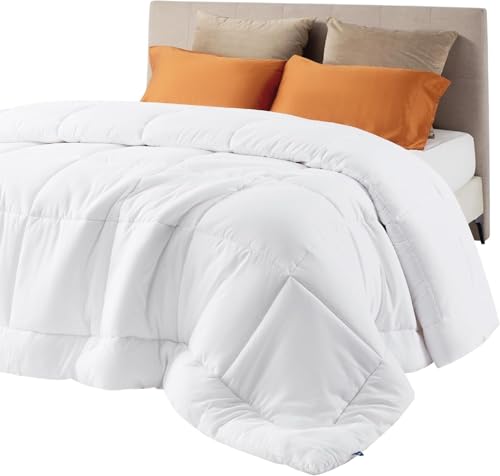
Where to buy
Check the latest price, availability and delivery on Amazon. Orders are placed on Amazon. We may earn a commission from qualifying purchases. This guide focuses on the queen size for every pick. Small bedrooms often hold twin or full beds, and these listings sell those sizes too — select your size on the listing and check the current price on Amazon, rather than trusting the headline figure.
- Best overall: Bedsure Comforter Duvet Insert, White, Queen 88 x 88 Inches — Check on Amazon
- Utopia Bedding Comforter Duvet Insert, White, Queen 88 x 88 Inches — Check on Amazon
- Linenspa All-Season Down Alternative Comforter and Duvet Insert, White, Queen 88 x 92 Inches — Check on Amazon
- Modern Threads Comforter Duvet Insert, Reversible, Sage Green / Cream, Queen — Check on Amazon
See 2 more Amazon options
- Utopia Bedding Comforter Duvet Insert, Box Stitched, Beige, Queen 88 x 88 Inches — Check on Amazon
- Utopia Bedding Queen Comforter Duvet Insert, Grey, 88 x 88 Inches — Check on Amazon
Read the full guide ↓
Disclosure: As an Amazon Associate, topratedkitchenware.com earns from qualifying purchases. Links to Amazon on this page are affiliate links; they cost you nothing extra. Listing details such as price and availability change often, so check the current Amazon listing before you buy.
A small bedroom changes what a duvet insert has to do. The bed is not one piece of furniture among many — it is most of the room, the surface you sit on, fold laundry on and look at all day. The room itself has so little air in it that it warms up fast from a sleeping body and cools just as fast when the heating clicks off, so the insert works through wider temperature swings than the same insert in a big, steady room. And there is nowhere to put anything: no linen closet for a spare insert, no spare corner for the bulky one you are not using, often no washer you can count on. A good small-bedroom insert is therefore sized honestly to the bed, warm in the all-season middle, anchored so it survives being sat on and slept on in the same day, and flat-storing enough that owning it costs you no storage you do not have.
One honesty note before the picks: there is no real down under $30. Genuine feather-and-down queen comforters sit well above this tier, and feather-and-down-fiber inserts sit in a higher tier as well. What $30 buys is a polyester-fill insert in a microfiber shell — which, in a small room, is less of a compromise than it sounds. Polyester fill compresses into a vacuum bag for storage and recovers, washes in a shared or laundromat machine without special detergents, and dries fast in a room where the only drying space is a door. For most people we would start with the Bedsure insert — the fullest fill in this guide and eight tabs to hold it in place through a bed’s double life as seating. If you want the category’s default white insert, the Utopia Bedding white insert is the reference buy — check the current price on Amazon.
In this guide
Quick Picks
Short on time, or comparing several options at once? Each row below names a buyer type and the product that suits it, with a link to the listing. Prices change with deals, coupons and colorways, so check the current price on Amazon for the queen size and confirm your size and colorway on the listing.
| Buyer type | Pick | Why it stands out | Link |
|---|---|---|---|
| Best overall | Bedsure Comforter Duvet Insert, White, Queen 88 x 88 | 300 GSM-class fill, box stitching and 8 tabs — the most complete insert here | Check on Amazon |
| Best classic insert | Utopia Bedding Comforter Duvet Insert, White, Queen 88 x 88 | The category’s default white insert, box stitched — check price on Amazon | Check on Amazon |
| Best brand and warranty | Linenspa All-Season Comforter and Duvet Insert, White, Queen 88 x 92 | A known bedding brand, 8 loops and a 3-year warranty — check price on Amazon | Check on Amazon |
| Best for a bed that is also the room | Modern Threads Comforter Duvet Insert, Sage Green / Cream, Queen | Reversible faces for coverless use in a room where the bed is always on show — check price on Amazon | Check on Amazon |
| Best budget insert | Utopia Bedding Comforter Duvet Insert, Beige, Queen 88 x 88 | The same insert job at the budget end of this tier — check price on Amazon; a practical laundry-day spare | Check on Amazon |
| Best grey colorway | Utopia Bedding Queen Comforter Duvet Insert, Grey, 88 x 88 | A grey insert for grey and dark covers — check price on Amazon | Check on Amazon |
How These Picks Were Chosen
The first filter was the budget, applied to the queen size specifically. Insert listings are priced by their smallest size, so the headline figure usually belongs to a twin; every pick here had to sit in this under-$30 budget tier for the queen, with an ASIN we could verify against the actual listing. The second filter is the one that makes this an insert guide rather than a second comforter guide: every pick is sold as a duvet insert — the words are in the listing title — with the anchoring hardware an insert needs. Comforter sets with shams were left to the comforter guide; a set’s job is to be seen, and an insert’s job is to stay put.
The third filter is this guide’s own: the small-room test. A pick had to store flat or compress without a fight, because a spare insert in a small bedroom competes for the same few cubic feet as everything else you own. It had to be machine washable without ceremony, because small bedrooms cluster in apartments and shared houses where laundry is a trip. And it had to be sized the way small rooms need sizing: matched to the bed and cover, not an oversized drape that pools on the floor and makes a small room look smaller.
We did not sleep under these inserts ourselves. We read maker listings and specification pages, compared tab counts, dimensions, stitch patterns and fill figures, and cross-checked listing details against deal coverage. Where a maker prints a fill figure, the article says it is a maker figure — GSM numbers in this aisle come from the brand’s own page, not from any standard test. Where a maker publishes no fill figure at all, we say that too, rather than borrowing a number from a sibling listing.
One thing this guide weighs more heavily than a standard insert guide is anchoring: a small room’s bed is sat on, perched on and piled with laundry all day, and every use shoves an untied insert toward the foot of its cover. An insert tied at eight points stays a rectangle through all of it; one tied at four corners can still fold a corner under itself. The reviews below grade tab counts and cover fit ahead of fill weight for exactly that reason. And a word on brand concentration: Utopia Bedding holds three of the six slots, in three separate listings — the shape of the verified market, not laziness. At under $30, the listings whose queen versions we could tie to a specific ASIN concentrate in a few high-volume brands, and Utopia’s colorways are separate listings. We picked the three that do different jobs — white classic, beige value pick, grey colorway — rather than pad the guide with listings we could not verify.
The 6 Best Duvet Inserts for Small Bedrooms Under $30
Bedsure Comforter Duvet Insert, White, Queen 88 x 88 Inches
Who it suits: Most small-bedroom duvet-cover owners — anyone whose insert bunches, drifts or feels thin, and whose bed has to survive being sat on all day and slept in all night.
This is the most complete insert in the guide, and the specification sheet is why. The fill is Bedsure’s GentleSoft down-alternative polyester at the 300 GSM class — the listing’s model line is literally built around that figure — held in box stitching so each square of fill stays in its own cell instead of drifting to the corners. Eight corner and side tabs anchor it inside a duvet cover, double the count of most rivals here, and those tabs are the reason it leads a small-bedroom guide: a small room’s bed is also its sofa, its desk chair and its laundry table, and every one of those uses works an insert loose inside its cover. Corners alone stop the insert sliding; corners plus side tabs stop it folding. The shell is plain white microfiber — exactly what an insert shell should be, since the cover provides the look — the whole thing is machine washable, and the listing carries an OEKO-TEX Standard 100 certification. Check price on Amazon for the white queen.
The storage case matters in a small room, and this pick makes it well. At roughly six pounds in the queen size, it has the loft its rivals photograph but do not all deliver — and polyester fill of this class compresses into a vacuum bag and comes back, so the one insert you own can shrink to a shelf’s worth of space in summer. The box stitching keeps that loft distributed after washing and compressing: the failure mode of cheap inserts is not thin fill on day one, it is fill migrated into lumps by month six, visible through your cover as a lumpy silhouette — a flaw a small room cannot hide.
- 300 GSM-class down-alternative fill — the fullest specification in this guide.
- Box stitching plus 8 tabs: fill stays distributed, insert stays anchored through a bed’s double life.
- White queen in this budget tier — check the current price on Amazon.
Honest limitation: The 88 x 88 inch cut is square, and a queen mattress is 60 x 80 — so the drop is a modest 14 inches per side, and the insert sits a touch small inside a 90 x 90 duvet cover, where it can shift despite the tabs. In a small room that modest drop is mostly a virtue — nothing pools on the floor — but match it to an 88-inch-class cover for the fit its tabs are designed for. Prices for this listing move with promotions, so check the current price on Amazon before you buy.
Choose it if you want the best-specified insert under $30 and your duvet cover is an 88-inch-class queen. Skip it if your cover is an oversized 90 x 90 or larger and you hate re-centering an insert — size up within Bedsure’s own line instead, accepting that the bigger cuts leave this budget behind.
Utopia Bedding Comforter Duvet Insert, White, Queen 88 x 88 Inches
Who it suits: Buyers who want the default answer — the plain white insert, from the brand that sells more of them than anyone — check price on Amazon.
If the Bedsure is the best-specified insert here, this is the most ordinary one, and ordinary is a genuine virtue in a product that lives hidden inside a cover. Utopia’s white queen insert (model UB0063) is box stitched, so its down-alternative fill is locked into cells; it has corner tabs for tying into a duvet cover; it measures the standard 88 x 88 inches; and it is machine washable. Check the current price on Amazon for the white queen. Utopia Bedding is one of the highest-volume bedding brands on Amazon, and in this tier that is worth something: the failure modes are known, mundane and well understood.
Judge it as the reference insert — and in a small bedroom, the reference insert has a second job: it is the affordable spare. Storage math rules small rooms, and a flat-folding insert in this budget tier is the rare spare that earns its shelf: one on the bed, one compressed away, and laundry day stops dictating your bedding. What you give up against the hero is anchoring depth and published detail: corner tabs rather than eight tabs, and a maker that does not headline a fill GSM for this model, so its warmth is judged by its class — a medium all-season weight — rather than by a number.
- Box-stitched down-alternative fill with corner tabs — the standard insert specification, done cleanly.
- White queen in this budget tier — check the current price on Amazon.
- A long-running listing from a high-volume brand: known quantities, no surprises.
Honest limitation: Corner tabs only — inside a duvet cover it can shift more than the eight-tab hero, especially in an oversized cover or on a bed that doubles as daytime seating. The maker does not publish a headline fill weight for this model, so treat its warmth as the all-season class average rather than a verified figure.
Choose it if you want the category’s default insert in this budget tier — check price on Amazon. Skip it if your current insert already migrates inside its cover and anchoring is your whole problem — the eight-tab Bedsure is the direct answer to that complaint.
Linenspa All-Season Down Alternative Comforter and Duvet Insert, White, Queen 88 x 92 Inches
Who it suits: Buyers who want a known bedding brand with a real warranty behind a $30 purchase — and taller sleepers, because this is the longest insert in the guide.
The third pick is the establishment choice, and its listing says “duvet insert” in its own title. Linenspa’s all-season insert carries a 300 GSM down-alternative fill in box stitching, eight built-in corner and side loops — matching the hero’s hardware count — and dimensions of 88 x 92 inches, four inches longer than the square 88-inch queens that dominate this tier. Inside a cover, that extra length is coverage at the foot of the bed that square inserts cannot give, and for anyone over about six feet tall it is the difference between an insert that reaches and one that quits at the ankles. It is machine washable, and it is backed by a 3-year warranty, the only warranty in this guide long enough to be a genuine buying argument. Check price on Amazon for the white queen — its position in this tier can vary with promotions, which is also the honest catch, covered below.
The small-room case for the Linenspa is the warranty, read correctly: in a room with no storage for a spare, the insert you own has to be the insert that lasts, and a named brand with a published 3-year warranty gives you somewhere to go when a seam opens in year one. The length cuts both ways, though: four extra inches are a gift inside a long cover and a nuisance inside a square one, where the surplus bunches at the foot — exactly the pooled, unmade look a small room is trying to avoid. Buy this one because your cover is cut long or your household is tall, not by default.
- 88 x 92 inches — the longest queen here; better foot coverage for tall sleepers.
- 300 GSM fill, box stitching and 8 loops, matching the hero’s specification class.
- A 3-year warranty from an established bedding brand — unique in this guide.
Honest limitation: Its position relative to this guide’s ceiling can shift with promotions, and it can sit in a higher tier for parts of the year. Check the current price on Amazon first; if it sits above this budget when you shop, the hero above is the same specification class without the wait.
Choose it if check price on Amazon shows it within this budget, you are tall, or the warranty matters to you. Skip it if it sits above this budget when you shop and the budget is firm — do not stretch for a logo; stretch for specification, and the hero matches it.
Modern Threads Comforter Duvet Insert, Reversible, Sage Green / Cream, Queen
Who it suits: Small-room sleepers whose insert will often work bare — because in a small bedroom the bed is the room’s largest visible surface, and a plain white insert used coverless reads as unfinished.
The fourth pick is the guide’s one genuine design idea, and a small bedroom is where it earns its keep. Modern Threads builds its insert reversible: sage green on one face, cream on the other, so the same insert presents two ways when it is used without a cover, and disappears as quietly as any other under one. In a small room that flexibility is worth more than it sounds — the bed fills your eyeline from every angle, there is no budget or closet space for a rotation of covers, and one insert that flips between a calm green and a soft cream is a decor change that costs nothing and stores nowhere. The construction underneath the color is the standard this guide requires — box stitching, corner tabs. Check price on Amazon for the sage green / cream queen — it is positioned at the lower end of this budget tier. The same listing carries the disclosure this pick owes you, below.
Judge it as the flexible insert. Inside a cover, it is a competent box-stitched insert with corner tabs, no better and no worse than the Utopia picks. Outside a cover — the studio bed made up in a hurry, the small room where the duvet cover is in the wash and the bed still has to look intentional — the reversible faces make it the only pick here that looks deliberate rather than undressed. The maker does not headline a fill GSM for this model, so its warmth is judged by class: an all-season weight in the same band as the rest of this guide.
- Reversible sage green / cream faces — the only pick designed to be seen as well as hidden.
- Box stitching and corner tabs: the full insert specification underneath the color.
- Sage green / cream queen at the lower end of this budget tier — check the current price on Amazon.
Honest limitation: The price discipline is real: this colorway can sit above this guide’s ceiling at times, so this is a buy-when-it-sits-within-budget pick, not an always-under-$30 one. Colorways on this listing are positioned very differently, so check the current price on Amazon for sage green / cream specifically. Corner tabs only, like the Utopia picks.
Choose it if check price on Amazon shows it within this budget and your insert will ever work without a cover. Skip it if it sits above this budget when you shop — the hero’s eight tabs and published fill figure are the better spend in this tier.
Utopia Bedding Comforter Duvet Insert, Box Stitched, Beige, Queen 88 x 88 Inches
Who it suits: The strictest budgets — small rooms, first apartments, guest corners — and anyone buying two inserts where the money for one was planned.
The fifth pick does the white Utopia’s job at the budget end of this tier, and the trade is written plainly in its specification. The fill is siliconized fiberfill — hollow polyester fibers treated for loft and softness — held in box stitching, in a brushed microfiber shell, machine washable, with four corner tabs for duvet-cover use. Check the current price on Amazon for the beige queen; other colorways of the same insert are positioned differently, so confirm the colorway you are buying on the listing.
At this end of the tier the small-room argument writes itself: a second insert is a practical rotation option, and in a room where laundry is a laundromat trip, a second insert is not a luxury — it is how the bed stays made while the first one dries over a door. Beige earns its place twice over. On the beds this pick is bought for, the insert is often the top layer, and beige hides the minor marks that make a white insert look tired within a year — marks a small room puts on display, because there is no angle from which the bed is not visible. What you give up against the hero is anchoring and published detail: four tabs instead of eight, and no headline fill GSM for this model either.
- Box-stitched siliconized fiberfill for the queen, positioned at the budget end of this tier — check price on Amazon.
- Beige colorway hides wear better than white and warms up pale covers from underneath.
- Machine washable, with 4 corner tabs for use inside a duvet cover.
Honest limitation: Four corner tabs only — inside a duvet cover it can shift more than the eight-tab hero, especially in an oversized cover or on a bed used as seating. The maker does not publish a headline fill weight for this model, so treat its warmth as the all-season class average rather than a verified figure. Colorways on this listing are positioned differently; check the current price on Amazon for beige specifically.
Choose it if the budget is hard and the job is simply “a decent queen insert” — or two. Skip it if you toss and turn inside a big duvet cover — the eight-tab Bedsure will stay put better — or if you need a verified heavy fill for a cold room.
Utopia Bedding Queen Comforter Duvet Insert, Grey, 88 x 88 Inches
Who it suits: Owners of grey, charcoal and dark duvet covers — and anyone furnishing a grey-toned small room where the insert will sometimes serve as the visible layer.
The last pick exists because of a mistake the other five cannot fix: a white insert inside a dark cover is fine, but a white insert under a lightweight grey cover, or used bare on a grey bed, reads as a mismatch every single day — and in a small bedroom, that means from every seat, doorway and mirror in the room. Utopia sells this grey colorway of its queen insert (model UB1145) at the same 88 x 88 inches as its white and beige listings — check price on Amazon for the grey queen, which sits in this guide’s budget tier, with the positioning note stated openly in the limitation below.
Judge it as the colorway pick, because that is its entire argument. Grey works in both directions: dark enough not to glare through a thin mid-grey cover, neutral enough to serve bare in a grey or charcoal room without the institutional look of white, and far more forgiving than white of the slow greying that laundered inserts acquire anyway — a grey insert starts where white inserts end up. The listing publishes fewer specification details than the hero’s, and this guide will not borrow numbers across listings: no headline fill figure is printed for this colorway, so its warmth is judged by its class, like the other Utopia picks. What is verified is the listing, the size and the colorway — which, for a pick whose job is to be the right color within this budget tier, is the specification that matters.
- The grey colorway: no show-through mismatch under grey covers, no stark white when used bare.
- Grey queen in this budget tier — check the current price on Amazon.
- Same 88 x 88 queen cut as the guide’s other Utopia inserts — matches standard queen covers.
Honest limitation: Confirm the current price on Amazon before counting on it; this listing’s colorways have historically moved within and around this budget tier. Grey also cuts the other way under a thin white cover, where it can shadow through and dull the white — pair it with mid-tone and dark covers, not your brightest white set. And the maker publishes no headline fill GSM for this colorway.
Choose it if your covers run grey or dark and check price on Amazon shows it under the line. Skip it if your main cover is thin white linen-look fabric — take the white Utopia or the hero instead.
Comparison Table
| Product | Form | Best use | Link |
|---|---|---|---|
| Bedsure Comforter Duvet Insert, White, Queen | Insert, 300 GSM class, 8 tabs | The fullest, best-anchored insert under $30 | Check on Amazon |
| Utopia Bedding Comforter Duvet Insert, White, Queen | Insert, box stitched, corner tabs | The classic white insert — check price on Amazon | Check on Amazon |
| Linenspa All-Season Comforter and Duvet Insert, White, Queen | Insert, 300 GSM, 88 x 92 in, 8 loops | Brand, warranty and extra length | Check on Amazon |
| Modern Threads Comforter Duvet Insert, Sage Green / Cream, Queen | Reversible insert, box stitched, corner tabs | Two faces for coverless use — check price on Amazon | Check on Amazon |
| Utopia Bedding Comforter Duvet Insert, Beige, Queen | Insert, box stitched, 4 tabs | The same job at the budget end of this tier — check price on Amazon | Check on Amazon |
| Utopia Bedding Queen Comforter Duvet Insert, Grey | Insert, 88 x 88 in, grey colorway | The right color under grey and dark covers | Check on Amazon |
How to Choose a Duvet Insert for a Small Bedroom Under $30
- Size the insert to the bed you actually have. Small bedrooms hold twin and full beds as often as queens. An insert far larger than the bed drapes to the floor, gathers dust and shrinks the room visually; an insert matched to the bed and cover looks made. This guide focuses on the queen versions — the same listings sell smaller sizes, so select your size on the listing and check the current price on Amazon.
- Then match the insert to the cover, not the mattress. An insert lives inside a cover, so the cover’s internal dimensions are the ones that matter. An 88-inch insert in a 90-inch cover will wander no matter how many tabs it has; an insert the same size as its cover, or an inch or two larger for a plump look, stays put.
- Count the tabs and loops — double in a small room. Eight tabs or loops anchor an insert at corners and sides; four corners alone let an insert bunch toward the foot, and a small room’s bed gets sat on, leaned on and folded on all day, which works inserts loose faster than sleeping alone does. Check that your cover actually has internal ties to meet them.
- Budget storage as part of the purchase. Ask where the insert lives when it is not on the bed. Polyester fill compresses into a vacuum bag and recovers; a spare insert you cannot store is clutter, not a spare. If you have no storage at all, buy one good insert and put the budget toward a second cover instead — covers store flat.
- Plan for shared or laundromat laundry. Every pick here is machine washable, which is the point: an insert that needs a large home machine you do not have will be washed rarely. A queen insert still needs a large-capacity drum — use the laundromat’s big machine, gentle cycle, low-heat dry, and let the cover take the weekly washes in between.
- Read GSM as a class, not a measurement. Where makers publish fill weights in this guide, they sit in the all-season band, and every figure is a maker figure with no standard test behind it. Several honest listings publish no figure at all. Use the numbers to rank inserts against each other, never as a promise of warmth in degrees — and in a small room, all-season is the right class anyway, as the section below explains.
- Prefer box stitching. Boxes lock fill into cells; sewn-through quilting lets it migrate to the edges over a season of washing. Inside a cover, migrated fill reads as lumps through the fabric — and in a small room the lumpy bed is the room’s centerpiece, so stitch pattern predicts both lifespan and looks.
- Choose the shell color for your cover and your room. White under a thin white cover is invisible; white under a thin grey cover can glare at the edges; grey under a thin white cover shadows through. In a small room the bed is always visible, so the insert’s color is a lighting and decor decision — hence the white, beige, grey and reversible options above.
- Respect the deal cycle. This tier prices by promotion, and a pick’s position relative to this budget can shift. If check price on Amazon shows a pick over $30 when you shop, the correct move is usually to wait, not to stretch — or to take the pick that is under the line today.
- Treat “hypoallergenic” as a label, not a promise. Down-alternative fill is polyester, and makers label it hypoallergenic because it is not down. That is a materials statement. Buy these inserts for warmth, weight, anchoring and washability — not as a health intervention.
Why Small Bedrooms Swing Hot and Cold
A small bedroom has very little air in it, and air is the buffer that keeps a big room’s temperature steady. In a small room, one sleeping body, a laptop, a radiator or an afternoon of sun can push the temperature up noticeably — and when the heat source stops, there is so little warm air stored in the room that it gives the temperature back just as fast. Anyone who sleeps in a small room knows the pattern: too warm at midnight with the door closed, oddly chilly at 5 a.m. when the heating cycle is off.
That pattern is exactly what an all-season insert is built for, and it is why this guide does not apologize for every pick sitting in the same warmth class. In a large, climate-steady bedroom, a specialist winter or summer insert can be the right buy. In a small room, the swing happens nightly, in both directions, and the practical answer is a middle-weight insert — every pick here — plus layering you can adjust without storage: a throw at the foot for the cold end of the night that lives there permanently, and a breathable cotton cover for the warm end.
Two small-room habits complete the system. First, the door: a closed door traps the sleeper’s own heat in a small room, and cracking it or running a small fan changes the room more than any insert upgrade will. Second, the cover: in a warm small room the cover fabric against your skin does more thermal work than the fill behind it, so a breathable cover over a mid-weight insert beats a heavy insert under a sealed microfiber cover every time. Buy the insert for the middle of your room’s range and dress it for the ends.
No Closet, No Problem: Storing an Insert in a Small Room
Every insert purchase is secretly two purchases: the insert on the bed, and the space it occupies when it is not on the bed. In a small bedroom the second purchase is the expensive one — there may be no linen closet at all, and under the bed may already be spoken for. This is the hidden reason the under-$30 tier suits small rooms better than its reputation suggests: polyester-fill inserts compress. Rolled or vacuum-bagged, a queen insert of this class shrinks to a fraction of its lofted size and — unlike down, which asks for loose, breathable storage to protect its clusters — polyester fill tolerates compression and comes back with a shake and a few hours of air.
The discipline that follows: own at most two inserts, and only if the second genuinely rotates — one on the bed, one as the laundry-day spare, like the two-beige-Utopia rotation the budget pick above makes practical. A third insert is not preparedness; it is a storage bill. Covers store flat and change the bed’s look and wash cycle completely, so the smarter second purchase is almost always a second cover. And whatever you store, store it clean and fully dry: a small room’s storage spots are low-airflow places, and a damp-stored insert is a mildew risk that a small room will announce to you daily.
Drying is the storage problem in reverse. A washed queen insert in a small room dries draped over a door or a shower rail, occupying the room’s only vertical space for the better part of a day. That argues for the insert setup itself: the cover takes the weekly wash and dries in hours, the insert takes the occasional wash and the occasional lost day, and the rotation spare exists precisely so that day does not have to be negotiated. Plan the wash for a morning you are out, and the room forgives you by evening.
Twin, Full and the Discipline of Sizing Down
Small bedrooms break the queen-first habit this site usually recommends, because small bedrooms are where the other sizes live. A twin bed is 38 inches wide, a full is 54, a queen is 60 — and an insert cut for a queen, draped over a full, carries roughly six inches of surplus width plus its length surplus, which in practice means fabric pooling at the sides and foot, sliding off, gathering floor dust, and making a small bed — and therefore a small room — look permanently unmade. The correct insert for a small bed is a small insert: matched to the mattress and, as everywhere in this guide, matched to the cover it will live inside.
Why, then, does this guide focus on queen versions throughout? Because queen is the size we verified against each listing, with an ASIN tied to that size. The twin and full versions of these same listings exist, and smaller sizes in this aisle are generally positioned the same or lower in the tier — but this guide does not assume a position it did not verify. The practical instruction is simple: open the listing, select your size first, and check the current price on Amazon.
Sizing down has one more small-room dividend: wash and storage shrink with the insert. A twin or full insert fits more home machines than a queen does, dries faster over a door, and compresses smaller. The only place to resist sizing down is the shared bed: a full bed sleeping two wants the queen’s width in practice, because drape that looks surplus on an empty bed is coverage at 3 a.m. with a blanket-stealing partner. Size to the sleepers first, the mattress second, and the room’s looks third — in that order.
Common Buying Mistakes
- Shopping the headline figure, which belongs to the smallest size, without selecting your size first — select the queen, twin or full on the listing and check the current price on Amazon.
- Putting a queen insert on a twin or full bed and living with pooled, dusty drape that makes the small room look smaller.
- Buying an insert by mattress size instead of cover size — the insert must fit the cover it lives in, and covers vary by inches behind the same size label.
- Expecting down, feather or a cotton shell under $30 — the tier is polyester fill in microfiber, and listings that imply otherwise are describing the photograph.
- Tying only the corner tabs, or none, then blaming the insert for bunching — on a small room’s bed, which doubles as seating all day, untied inserts migrate faster than anywhere else.
- Buying a spare insert with nowhere to store it, then living with a vacuum bag as furniture.
- Judging warmth by the listing photo’s loft, which is a freshly fluffed insert at its best angle.
- Paying above this budget for a deal-cycle listing without checking first — check the current price on Amazon, because positions in this tier shift with promotions.
- Forcing a queen insert into a compact home washer and tearing the seams you were relying on to hold the fill — small rooms usually mean small machines, so plan the laundromat’s big drum instead.
- Reading “hypoallergenic” as a medical claim rather than a maker’s label for synthetic fill.
Final Recommendation
- Most buyers: Bedsure Comforter Duvet Insert — the fullest fill and the best anchoring under $30.
- The classic insert: Utopia Bedding Comforter Duvet Insert, White.
- Brand and warranty: Linenspa All-Season Comforter and Duvet Insert, bought when check price on Amazon shows it within this budget.
- A bed that is also the room: Modern Threads Reversible Duvet Insert, bought when check price on Amazon shows it within this budget.
- Hardest budget, or a storable spare: Utopia Bedding Comforter Duvet Insert, Beige.
- Grey and dark covers: Utopia Bedding Queen Comforter Duvet Insert, Grey.
Our top two are the Bedsure insert and the Utopia Bedding white insert, because between them they cover the tier’s honest range: the most complete specification we could verify under the line — 300 GSM-class fill, box stitching, eight tabs — and the category’s default insert, box stitched and corner-tabbed — check price on Amazon for each. Together they make a primary insert and a laundry-day spare that stores flat — the exact combination a small bedroom’s storage and laundry realities call for. Add the pick that matches your room: the Linenspa if your cover is long or you are tall, the Modern Threads if the bed is the room’s centerpiece, the grey Utopia if your covers run dark. None of these inserts is down, and none pretends to be. They are the honest $30 layer: measure your cover, count the tabs, check the price for your size on the listing, and let the deal cycle do the rest.
Related guides
Frequently Asked Questions
Can you really buy a down duvet insert for under $30?
No. Genuine down and feather fill starts well above this budget in a queen size, and feather-and-down-fiber inserts sit in a higher tier as well. Everything under $30 is down-alternative: polyester fill in a microfiber shell. For a small room that class is a good one — washable, compressible for storage, genuinely warm — as long as you buy it knowing what it is.
What size insert does a small bedroom need?
The size of the bed and the cover, not the size of this guide. Small bedrooms often hold twin or full beds, and an insert should match its mattress and its cover’s internal dimensions — oversized inserts pool on the floor and make a small room look unmade. This guide focuses on queen versions; the same listings sell twin and full, so select your size on the listing and check the current price on Amazon. One exception: two sleepers sharing a full bed usually sleep better under a queen insert’s extra width.
Why does my small bedroom feel too hot at night and too cold by morning?
Air volume. A small room has so little air that a sleeping body, electronics and a radiator heat it quickly — and it loses that heat just as quickly when the source stops, so the temperature swings more across the night than in a larger room. The insert answer is a middle-weight, all-season fill like every pick in this guide, layered with a throw for the cold end of the night and paired with a breathable cover for the warm end. Cracking the door or running a small fan changes the room more than any insert upgrade.
What is the difference between a duvet insert and a comforter?
In this tier, mostly the assignment. The same down-alternative product is sold under both names; an insert is the one destined for the inside of a duvet cover, so it is graded on anchoring hardware, plain shell and dimensional fit, while a comforter is graded on how it looks as the top layer. Several picks here are judged in our comforter coverage too — there as comforters, here as inserts. If a product has corner tabs and a plain shell, it is built to be an insert whatever its title says first.
How do I stop my insert bunching inside its cover?
Tie every tab. Use all the insert’s tabs or loops against the cover’s internal ties — corners and sides, not corners alone — and check the fit: an insert the same size as its cover, or an inch or two larger, has nowhere to travel, while an undersized insert in an oversized cover will bunch no matter how it is tied. Small-room beds need this more than most, because the bed doubles as seating and every sit-down shoves an untied insert toward the foot. If your cover has no internal ties, duvet clips are the standard fix.
Where do I store a spare insert in a small bedroom?
Compressed. Polyester-fill inserts of this class tolerate vacuum bags and flat storage and recover their loft with a shake and a few hours of air — under the bed, flat on a wardrobe’s top shelf, or in the gap behind hanging clothes. Store it clean and completely dry, because small-room storage spots have little airflow. And keep the count honest: one spare is a system, two spares are clutter. A second cover stores flatter than any insert and changes the bed more.
How warm is a 300 GSM insert, really?
GSM is a maker figure with no standard test behind it, so treat it as a class marker: the 300 GSM-class inserts here are full all-season weight — right for most sleepers in a heated room most of the year, and the right class for a small room’s nightly temperature swing. Several picks publish no GSM at all and sit in the same all-season class. Warmth also lives in loft and in your room’s temperature, so layer a throw for the coldest weeks rather than chasing a bigger number.
Are these inserts really machine washable?
Yes — every pick in this guide is sold as machine washable, and polyester fill tolerates washing far better than down does. The conditions are capacity and space: a queen insert needs a large-capacity machine — often the laundromat’s big drum for small-room households — a gentle cycle and a low-heat dry, plus somewhere to drape it while it finishes air-drying. In an insert setup the cover takes most washes anyway; that division of labor is the main reason to own one.
What does “hypoallergenic” mean on these listings?
It is the maker’s label for the fill being synthetic rather than down or feather — a materials description printed on the listing. We report it as a label only. Nothing in this guide treats an insert as a treatment for allergies or any other condition; buy on warmth, weight, anchoring, fit and washability.
What if a pick has moved over $30 when I shop?
Check the deal cycle before you stretch. Several of this guide’s picks can sit on both sides of the line as promotions change — the Linenspa and the Modern Threads colorway are the examples here where position shifts most. If your pick is over the line today, take the one that is under it, or wait for the next cycle; at this tier the premium for impatience is the only genuinely bad deal.
- Best Duvet Insert Under $75
- Best Comforter Under $30
- Best Duvet Cover Set Under $30
- Best Bed Sheet Set For Small Bedrooms Under $30
- Best Cooling Pillow Under $30
- Best Duvet Insert For Apartments Under $30